ABSTRACT:Introduction: Leishmaniasis represents an important burden of diseases in tropical countries, with signiicant levels of morbidity and mortality where they occur, including in Brazil. In this context, popular participation in prophylactic actions can be decisive for the success of the control strategies. Objective: For this reason, this study aimed at investigating the population’s knowledge concerning leishmaniasis and the occurrence of peridomiciliary risk factors associated with the population of Formiga, Minas Gerais. Methods: A household questionnaire with a sample of 427 individuals was conducted between May and July 2011. Results: Only 7.5% of the residents presented knowledge regarding leishmaniasis, most of them being women (OR = 3.15; 95%CI 1.30 – 7.65). The prevalence of peridomiciliary risks was 95%. A statistically signiicant association was found between higher education levels and less peridomiciliary risk factors (OR = 0.45; 95%CI 0.28 – 0.72) and between the place of residence and a higher number of risk factors (OR = 0.84; 95%CI 1.19 – 2.85).
Conclusion: The results demonstrate that the population has low levels of knowledge about leishmaniasis. Moreover, the majority of respondents are subject to some peridomiciliary risk factor, which may contribute to the maintenance of the disease cycle in the city.
Keywords: Leishmaniasis. Knowledge. Population at risk. Risk factors. Disease prevention. Health promotion.
Peridomiciliary risk factors and knowledge
concerning visceral leishmaniasis in the
population of formiga, Minas Gerais, Brazil
Fatores de risco peridomiciliares e conhecimento sobre
leishmaniose visceral da população de Formiga, Minas Gerais
Júlia Alves MenezesI, Tatiana Chama Borges LuzI, Fabrizio Furtado de SousaII,
Rafael Negreiros VerneII, Fernanda Pinheiro LimaIII, Carina MargonariI,II ORIGINAL ARTICLE / ARTIGO ORIGINAL
ICentro de Pesquisas René Rachou – Belo Horizonte (MG), Brazil.
IIDivinópolis Educational Foundation, Universidade do Estado de Minas Gerais – Divinópolis (MG), Brazil. IIICentro Universitário de Formiga – Formiga (MG), Brazil.
Corresponding author: Carina Margonari. Centro de Pesquisas René Rachou. Laboratório de Educação em Saúde e Ambiente.
Avenida Augusto de Lima, 1.715, Barro Preto, CEP: 30190002, Belo Horizonte, MG, Brazil. E-mail: [email protected]
INTRODUCTION
Leishmaniasis is a complex of diseases caused by the protozoa belonging to the
genus Leishmania Ross, 1903 and it is transmitted by phlebotomus (Diptera, Psychodidae:
Phlebotominae). They are spectrum diseases that can manifest as ulcers, which is the case of Tegumentary Leishmaniasis (TL), or systemically and highly lethally, like in the Visceral Leishmaniasis (VL). In its zoonotic transmission pattern, they have various types of wild hosts (foxes, possums, rodents) and domestic hosts (dogs, cats), in addition to humans1.
The complexity for diagnosis, treatment, and control, along with the fact that the illness is asso-ciated with poverty, makes leishmaniasis a group of neglected diseases that are in second place for mortality and in fourth for morbidity among the tropical diseases2,3. Worldwide, it is estimated that between 200 and 400 thousand of visceral cases and between 700 thousand and 1.2 million of cutaneous cases occur annually4. In Brazil, it is estimated that 30 thousand new cases of TL are reported annually, with an incidence rate of 18.5 cases for every 100 thousand habitants5, while for VL, between 2001 and 2010, 33,473 new cases were registered, with an average fatality rate of 6.5%68.
In Brazil, leishmaniasis have been modifying their transmission patterns and acquiring an urban, peri-urban, and reemerging pattern in recent years. The new epidemiologic transmis-sion patterns combine numerous factors (coexistence of diferent vector species, reservatories, and etiological agents, in addition to environmentally modifying human actions), which make the planning of efective action to control the disease a challenge to the public health policies in the country9,10. Because of this, especially in the case of VL, in addition to ighting the vector, treating human cases, and eliminating the household reservatory, the control policies also incor-porated strategies focused on environmental management and in raising public awareness11.
RESUMO:Introdução: As leishmanioses representam uma importante carga de doença nos países tropicais, apresentando índices signiicativos de morbimortalidade nos locais onde ocorrem, incluindo o Brasil. Nesse contexto, a participação popular nas ações proiláticas pode ser determinante para o êxito das estratégias de controle. Objetivo: Por isso, o presente estudo teve o objetivo de investigar o conhecimento da população sobre as leishmanioses e a ocorrência de fatores de risco peridomiciliares associados à população no município de Formiga, Minas Gerais. Métodos: Foi realizado um inquérito domiciliar com uma amostra de 427 indivíduos entre maio e julho de 2011. Resultados: Apenas 7,5% dos moradores mostraram conhecimento sobre as leishmanioses, sendo principalmente as mulheres (OR = 3,15; IC95% 1,30 – 7,65). A prevalência de riscos peridomiciliares foi de 95%. Associação estatisticamente signiicativa foi encontrada entre maior escolaridade e menos fatores de risco peridomiciliares (OR = 0,45; IC95% 0,28 – 0,72) e entre o local de residência e maior número desses fatores de risco (OR = 1,84; IC95% 1,19 – 2,85). Conclusão: Os resultados demonstram que há baixo nível de conhecimento sobre as leishmanioses por parte da população. Além disso, a maioria dos respondentes está sujeita a algum fator de risco peridomiciliar, fato que pode contribuir para a manutenção do ciclo da doença no município.
This last aspect, when developed within the control strategies, can contribute to a suc-cessful control program in which there is room for public acceptance and participation in the prophylactic actions proposed12-14. Studies show that raising public awareness regard-ing the morbidity problem can possibly turn into the efective participation in the sanitary actions applied in a community15. Therefore, in the case of the leishmaniasis, understanding the knowledge, attitudes, and practices of a population regarding the disease can contribute to the creation of preventative/corrective actions, which are truly eicient and long-lasting16. However, studies concerning the population’s knowledge regarding leishmaniasis are rare in scientiic literature14,17-23.Some papers show that populations afected by leishmaniasis are unaware of important concepts about the disease, in terms of transmission, treatment, and even prevention17-21. Futhermore, health education does not yet receive the necessary incentive to mobilize preventative actions in Brazil, whether individual or collective24. Given the importance of this factor for the success of control programs, it is necessary to become aware of the knowledge of the community that has been afected by leishmaniasis, a fact that can contribute to an improvement in the quality of life and health of the population.
For the city of Formiga, Minas Gerais, due to the absence of an oicial prevention and control program of VL, popular knowledge has become a key to the formulation of a proper planning to the local reality of the county. Until now, there were no actions target to VL, with such practices being restricted to oicial informational newsletters from the Ministry of Health, available at some basic health services. The city presents few cases of VL — 2 in 2011 and 1 in 2012, but with high fatality rate — 50% in 2011. However, the mechanisms for the transmission of the disease in the area are still unknown, as is the knowledge regard-ing the population afected by leishmaniasis. Because of this, the present study had the objec-tive of investigating VL and the occurrence of peridomiciliary risk factors associated with the population of the municipality of Formiga, Minas Gerais, Brazil.
SUBJECTS AND METHODS
STUDY DESIGN AND POPULATION
A household questionnaire was conducted between May and July of 2011 with propor-tionate stratiication probability sampling according to sex and age in the municipality of Formiga, Minas Gerais. The information utilized to estimate the size of each stratum was the 2010 Demographic Census (Censo Demográico 2010), from the Brazilian Institute of Geography and Statistics (Instituto Brasileiro de Geograia e Estatística – IBGE).
canine cases of leishmaniasis; the last two, the lowest number of cases for the disease, accord-ing to information from the City Health Department. The minimum sample was calculated
so as the maximum error of the estimate would be ± 5%, with a conidence of 95%,
gener-ating a sample of 398 people. To deal with potential losses, 10% was added to this number. The questionnaires were conducted in the households by trained interviewers. The instru-ment utilized was formulated and validated by Margonari et al. in 201221. The inclusion cri-teria for the study were being over 15 years old and living in the districts cited above. These criteria were based on the fact that the knowledge, the actions, and the living habits of the family context are under cyclical and multivetorial inluence, interfering in the health status of each member25. The family, as a unit of care, is inluenced by the cultural environment and the socioeconomic conditionsin which it is included. Thus, the respondent , even if young (15 years old) at the moment of the interview, is capable of functioning as a proxy for the conditions and perceptions of the nuclear family, as well as inluencing behavioral changes.
KNOWLEDGE REGARDING LEISHMANIASIS
Leishmaniasis presents a complex epidemiologic cycle in which various factors combine to determine the disease’s transmission. Therefore, the assessment of the knowledge that an individual holds regarding this illness should be multidimensional26. Thus, an indicator was constructed for “Knowledge regarding leishmaniasis,” obtained through the combina-tion of four quescombina-tions from the quescombina-tionnaire. The quescombina-tion “Do you know how it is trans-mitted?” had the following possible answers: a) Phlebotomus, b) A sick dog, c) I don’t know, and d) Others, with only the irst answer being considered appropriate. The question “Do you know which animal can have leishmaniasis?” presented the following options: a) Dog, b) Cat, c) Rat, d) Chicken, e) I don’t know, and f ) Others, with answers a, b, and/or c being considered correct. The question “Do you know how to prevent the disease?” had the fol-lowing options: a) Cleaning the site/yard, b) Sacriicing the sick dogs, c) Using mosquito repellent, d) Avoiding stagnant waters, e) Avoiding anyone sick with leishmaniasis, f ) I don’t know, and g) Others, wherein the answers a, b, and/or c were considered correct. Finally, the question “What would you do regarding a human under the suspicion of having leish-maniasis?” had the following options: a) Take this person to a hospital, b) To look for a health agent from city hall, c) Nothing, d) I don’t know, and e) Others, with answers a and b being considered correct. The individuals were classiied into two groups, considering that only those who answered all of the questions correctly had knowledge concerning leishmaniasis.
PERIDOMICILIARY RISK FACTORS
of the disease: the presence and type of vegetation, altitude, plantations and monocultures (cofee, bananas), watercourses , and the presence of domestic dogs, among others27-31.
In this study, the following peridomiciliary risk factors were considered: having a pet, the presence of hematophagous insects, the presence of rodents, the presence of an vacant lot, watercourses and green areas near the residence, regular waste collection, presence of a yard with a plantation, and regular cleaning of the house area. The response options were yes or no type. Later, a dichotomous indicator was constructed titled “Peridomiciliary Risk Factor,” based on the average and median values for risk factor (3). Thus, the households were classiied into “0” (≤ 3 factors) and “1” (over 4 factors).
The independent variables correspond to the socioeconomic and demographic character-istics of the population obtained in the questionnaire. The covariables utilized were sex, age (15 to 39 years old and ≥ 40 years old), education level ( none up to primary education, second-ary education, tertisecond-ary education), family income in minimum wage salaries (< 1, between 1 and 2.99, between 3 and 4.99, > 5), the number of residents per household (≤ 4 residents and ≥ 5 residents), and the district (Novo Horizonte/Centro and Nossa Senhora de Lourdes/Lajinha).
DATA ANALYSIS
The data were analyzed through descriptive analysis with estimates of averages, frequencies, and percentages. First, the population was described according to its socioeconomic and demo-graphic characteristics and regarding its knowledge of some aspects relative to the epidemiologic cycle of leishmaniasis. Next, the individuals were compared so as to verify diferences regarding their knowledge on leishmaniasis and the presence of peridomiciliary risk factors, according to their socioeconomic and demographic characteristics. In the crude analysis, the odds ratios (ORs) and their respective values at a conidence interval of 95% (95%CI) were calculated for each independent variable. Then, the model was adjusted for all of these variables. Statistical analysis was performed using the Statistical Package for Social Sciences (SPSS 13.0 for Windows – IBM Corporation). .
ETHICAL ASPECTS
Participation in the study was voluntary and the application of the questionnaire occurred following the signing of the Consent Term. The study was approved by the Ethics Committee of the Divinópolis Educational Foundation nº 10/2011.
RESULTS
female (54.6%), young people between the age of 15 and 39 years old (50.1%) and with up to a primary education level (46.4%). The average income was between 1 and 3 minimum wage sala-ries (65.5%) and the number of inhabitants in the household was up to 4 (75.1%) for the majority of those who were interviewed. The number of respondents per district was 122 for Centro, 108 for Lajinha, 101 for Nossa Senhora de Lourdes, and 106 for Novo Horizonte (Table 1).
Socioeconomic characteristics of the population of Formiga n (%)
Gender
Male 194 (45.4)
Female 233 (54.6)
Age (years)
15 to 39 213 (50.1)
≥ 40 212 (49.9)
Education level (completed years)
None to primary 194 (46.4)
Secondary education 151 (35.4)
Tertiary education 74 (17.3)
Income (in minimum wage salaries)
< 1.0 15 (3.5)
1.0 – 2.99 275 (65.5)
3.0 – 4.99 88 (21.0)
≥ 5 42 (10.0)
Number of residents in the household
≤ 4 314 (75.1)
≥ 5 104 (24.9)
Residing district
Centro 112 (26.2)
Novo Horizonte 106 (24.8)
Lajinha 108 (25.3)
Nossa Senhora de Lourdes 101 (23.7)
Table 1. Socioeconomic characteristics of the study population from the municipality of Formiga,
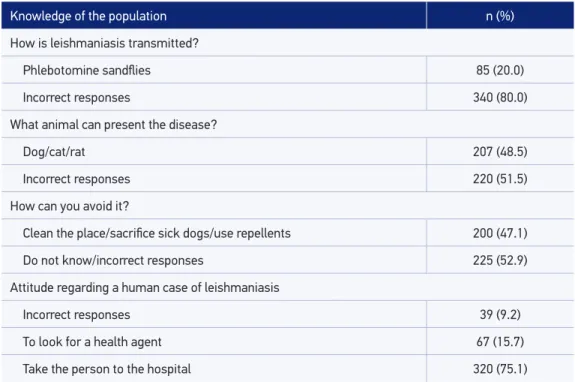
It was observed that merely 32 people (7.5%) adequately replied to the questions con-cerning transmission, prevention, and attitude toward a human case. The responses regard-ing these questions are shown in detail in Table 2.
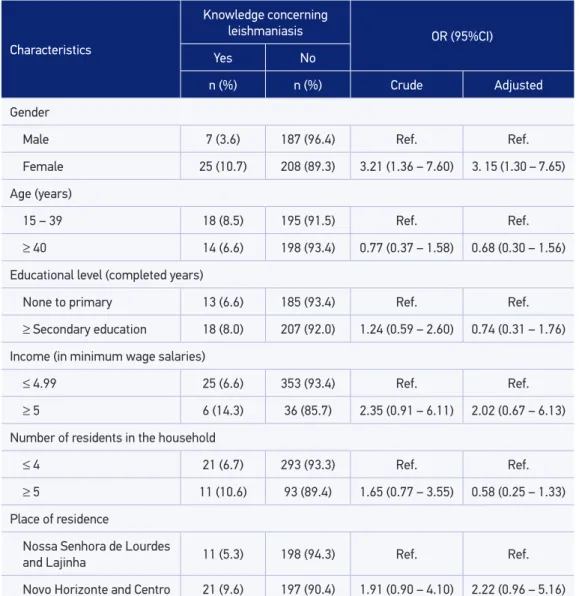
Table 3 shows the result of the crude and adjusted analysis of the association between knowledge regarding leishmaniasis and the population’s characteristics. The result of the comparison between the knowledge regarding the disease and the district surveyed was not signiicant. The only variable that signiicantly inluenced the population’s knowl-edge concerning leishmaniasis was sex; in the municipality of Formiga, the women pre-sented a 3.1 times higher chance of being aware of the disease in comparison with men. Regarding the peridomiciliary risk factors, it was observed that 94.8% of the respon-dents reported the presence of a risk factor. Only 5.2% of the responrespon-dents did not report the presence of peridomiciliary risk factors. When analyzed according to the dichotomous indicator “peridomiciliary risk factors,” 258 (60.4%) presented up to three risk factors and 169 (39.6%) presented over four factors.
Table 4 shows the result of the crude and adjusted analysis of the association between the perid-omiciliary risk factors and the population’s characteristics. Individuals with a higher education level presented a lower chance of residing in dwellings with more peridomiciliary risk factors (OR = 0.45;
Table 2. Response of the interviewees for the questions most relevant to the epidemiologic cycle of the leishmaniasis present in the questionnaire applied to the population of the municipality of
Formiga, Minas Gerais.
Knowledge of the population n (%)
How is leishmaniasis transmitted?
Phlebotomine sandlies 85 (20.0)
Incorrect responses 340 (80.0)
What animal can present the disease?
Dog/cat/rat 207 (48.5)
Incorrect responses 220 (51.5)
How can you avoid it?
Clean the place/sacriice sick dogs/use repellents 200 (47.1)
Do not know/incorrect responses 225 (52.9)
Attitude regarding a human case of leishmaniasis
Incorrect responses 39 (9.2)
To look for a health agent 67 (15.7)
95%CI 0.28 – 0.72). Regarding the place of residence, the respondents from the districts with cases of the disease — Novo Horizonte and Centro — had an 80% higher chance of residing in a house-hold with over four peridomiciliary risk factors (OR = 1.84; 95%CI 1.19 – 2.85). The remaining char-acteristics did not seem to inluence the level of exposure to the risk factors investigated.
In addition, the association between the knowledge concerning leishmaniasis and the presence of peridomiciliary risk factors was analyzed, with no association being found (p = 0.837), data not shown in table.
Table 3. Crude and adjusted analysis between the knowledge concerning leishmaniasis and the characteristics of the study population of the municipality of Formiga, Minas Gerais.
Characteristics
Knowledge concerning
leishmaniasis OR (95%CI)
Yes No
n (%) n (%) Crude Adjusted
Gender
Male 7 (3.6) 187 (96.4) Ref. Ref.
Female 25 (10.7) 208 (89.3) 3.21 (1.36 – 7.60) 3. 15 (1.30 – 7.65)
Age (years)
15 – 39 18 (8.5) 195 (91.5) Ref. Ref.
≥ 40 14 (6.6) 198 (93.4) 0.77 (0.37 – 1.58) 0.68 (0.30 – 1.56)
Educational level (completed years)
None to primary 13 (6.6) 185 (93.4) Ref. Ref.
≥ Secondary education 18 (8.0) 207 (92.0) 1.24 (0.59 – 2.60) 0.74 (0.31 – 1.76)
Income (in minimum wage salaries)
≤ 4.99 25 (6.6) 353 (93.4) Ref. Ref.
≥ 5 6 (14.3) 36 (85.7) 2.35 (0.91 – 6.11) 2.02 (0.67 – 6.13)
Number of residents in the household
≤ 4 21 (6.7) 293 (93.3) Ref. Ref.
≥ 5 11 (10.6) 93 (89.4) 1.65 (0.77 – 3.55) 0.58 (0.25 – 1.33)
Place of residence
Nossa Senhora de Lourdes
and Lajinha 11 (5.3) 198 (94.3) Ref. Ref.
Novo Horizonte and Centro 21 (9.6) 197 (90.4) 1.91 (0.90 – 4.10) 2.22 (0.96 – 5.16)
DISCUSSION
In Brazil, the leishmaniasis control program includes the role of the population in dis-ease control actions. However, the knowledge and perception of the community is almost always ignored during these preventative and control actions in the country. In the case of the study area, this aspect becomes evident, as merely 7.5% of those who were interviewed had some knowledge concerning leishmaniasis. If on one hand studies show that having
Characteristics
Peridomiciliary risk factors OR (CI95%)
0 a 3 ≥ 4
Crude Adjusted
n (%) n (%)
Gender
Male 113 (58.2) 81 (41.8) Ref. Ref.
Female 145 (62.2) 88 (37.8) 0.85 (0.57–1.25) 0.87 (0.57 – 1.30)
Age (years)
15 – 39 130 (61.0) 83 (39.0) Ref. Ref.
≥ 40 127 (59.9) 85 (40.1) 1.01 (0.71 – 1.55) 0.78 (0.50 – 1.23)
Educational level (completed years)
None to primary 105 (53.0) 93 (47.0) Ref. Ref.
≥ Secondary education 151 (67.1) 74 (32.9) 0.55 (0.37 – 0.82) 0.45 (0.28 – 0.72)
Income (in minimum wage salaries)
≥ 4.99 166 (57.2) 124 (42.8) Ref. Ref.
≥ 5 88 (67.7) 42 (32.3) 0.84 (0.43 – 1.62) 1.07 (0.52 – 2.18)
Number of residents in the household
≥ 4 188 (59.9) 126 (40.1) Ref. Ref.
≥ 5 63 (60.6) 41 (39.4) 0.97 (0.62 – 1.53) 0.92 (0.56 – 1.49)
Place of residence
Nossa Senhora de Lourdes
and Lajinha 74 (354) 135 (64.6) Ref. Ref.
Novo Horizonte and Centro 95 (43.6) 123 (56.4) 1.41 (0.95–2.08) 1.84 (1.19 – 2.85)
Table 4. Crudeand adjusted analysis between the peridomiciliary risk factor and the characteristics
of the study population of Formiga. Minas Gerais.
some knowledge about the disease can minimize the risk of its occurrence12,19, on the other, this type of knowledge is often fragmented and does not allow the population to understand and acknowledge all of the components of the epidemiological chain of transmission20-22.
In fact, what is observed in many educational health practices is that the established knowledge ends up not resulting in change of behavior,, once such information does not generate social representation capable of permeating the daily lives of these individuals32,33. The understanding that the change in behavior is associated with the cultural context of the population can produce, in a more satisfactory manner, a process of empowerment and articulation of the necessary knowledge to the construction of a new and long-lasting health practice. Hence, the community’s perception should be known and worked with in order to revert it into better awareness concerning the disease and attitude toward prevention23.
Among the characteristics of the population, the female sex was shown to have an asso-ciation with knowledge concerning the illness in question. An explanation for this inding can be the fact that women are known to pay more attention to health issues, manifesting their attentiveness within the family, in various situations with their children, partners, par-ents, and grandparents34. This care is often based on accumulated experience (health service appointments) or in learning this experience from other women in the family so this knowl-edge is put into practice to prevent the disease and guarantee the family’s health34.
However, other factors can also inluence the health knowledge and practices, for exam-ple, social class and education level. According to Boltanski35, these factors are capable of limiting the spread of medical knowledge, inluencing the frequency and quality of the phy-sician–patient dialogue. The results of the present study point to an association between higher education level (secondary school) and the presence of a lower number of peridom-iciliary risk factors. It is possible that the educational level relects in better socioeconomic conditions and, consequently, in better habitational conditions, reducing exposure to per-idomiciliary risk factors.
It should be noted the fact that 94.8% of the population studied lived in locations with the presence of at least one risk factor and that 39.6% reported the presence of over four of these factors; it was observed a signiicant association between place of residence and the presence of a higher number of risk factors. This association would have been expected, as the districts that registered the highest number of cases would probably present higher vulnerability to the occurrence of the disease. The inluence of these peridomiciliary char-acteristics and how they are related to the risk of leishmaniasis occurrence are well demon-strated — the presence of a pet, henhouse , fruit trees, and remaining forests, among oth-ers2731.These factors can attract the vector and favor its reproduction in the areas surrounding the residence due to the possible accumulation of organic matter. It is therefore of great importance that both the residence as its annexes (backyard, kennel, henhouse) are kept clean in order to prevent the proliferation of phlebotomine sandlies.
disease also depends on reducing the risk factors in the peridomiciliary environment. This fact becomes even more evident when it is observed that 94.8% of the residents have at least one peridomiciliary risk factor in their homes. The absence of an association between the knowledge and the presence of these factors in the peridomiciliary area indicates, further-more, that the inhabitants are unaware of the risks to which they are subject to. It is possi-ble that, despite presenting some level of knowledge concerning the disease, this awareness is so incipient that it does not result in any behavior changes in the population.
Education can be of help in reverting this scenario. However, so that the appropriate knowledge can relect in appropriate and efective prevention practices, the knowledge — correct reproduction of content, the attitude — opinion of an individual concerning the content, and the practice — action carried out, should go hand in hand with the population’s reality36. Thus, health education should be conceptualized as a concrete sanitary measure that can lead to the failure or success of a control program and, consequently, can inluence the risk of exposure of the population18.
In this context, capacity building for health and education professionals should be con-sidered. The irst group is responsible for disseminating scientiic knowledge and making it more accessible to the public, requiring, thefore, a permanent education, so that they are capable of following the evolution of endemic diseases26. Conceptual laws or discrepancies by health professionals concerning leishmaniasis, as observed by other authors regarding transmission17 and the common name for leishmaniasis26, can relect on the quality of infor-mation that reaches the population. On the other hand, the primary education teachers, as they maintain a close contact with children and adolescents, can collaborate in trans-forming students into disseminators of the information received in the classroom. Study conducted in Divinópolis, Minas Gerais, regarding teacher’s perception of leishmaniasis demonstrated that these professionals are not knowledgeable about this disease37, however, they are willing to raise awareness among their students, highlighting school as a favorable space to spread this knowledge37.
These processes should be continuous and periodically advertised as they often represent the only source of popular information38. With the active participation of the community, it is possible to reduce the conditions that facilitate the transmission of leishmaniasis in the region. In addition, the disease issue can be explored in a health promotion perspective, in which the public policies favor the personal and collective skills focused on the improve-ment of life and health quality of the population.
FINAL CONSIDERATIONS
the control and prevention of the disease in the region, where cases of human leishmania-sis have frequently been registered. In the same sense, the discovery of peridomiciliary risk factors in the majority of houses surveyed, as well as the association between the place of residence and the higher number of these factors, points to the possibility of the cycle of the disease remain active in the municipality, a fact that should be followed up on by the local epidemiological surveillance.
ACKNOWLEDGEMENTS
We thank Juliana Castro and “Padre” for the support in executing the project, the com-munity health agents, the population of Formiga for the reception and the participation, and the Minas Gerais Research Support Foundation (Fundação de Amparo à Pesquisa de Minas Gerais — FAPEMIG – APQ-01657-11) for inancing this study.
1. Quinnell RJ, Courtenay O. Transmission, reservoir hosts and control of zoonotic visceral leishmaniasis. Parasitology 2009; 136(4): 191534.
2. Alvar J, Yactayo S, Bern C. Leishmaniasis and poverty. Trends Parasitol 2006; 22: 5527.
3. Mathers CD, Ezzati M, Lopez AD. Measuring the burden of neglected tropical diseases: the global burden of disease framework. PLoS Negl Trop Dis 2007; 1(2): e114.
4. Alvar J, Vélez ID, Bern C, Herrero M, Desjeux P, Cano J, et al. Leishmaniasis worldwide and global estimates of its incidence. PloS One 2012; 7(5): e35671. 5. Ministério da Saúde, Secretaria de Vigilância em Saúde,
Departamento de Vigilância Epidemiológica. Manual de Vigilância da Leishmaniose Tegumentar Americana. 2ª ed. Brasília: Editora do Ministério da Saúde; 2007. 6. Ministério da Saúde. Casos conf ir mados de
Leishmaniose Visceral, Brasil, Grandes Regiões e Unidades Federadas, 1990 a 2010. Disponível em: http://dtr2004.saude.gov.br/sinanweb/tabnet/dh? sinannet/leishvi/bases/leishvbrnet.def. (Acessado em 24 de abril de 2014).
7. Ministério da Saúde. Letalidade de Leishmaniose Visceral. Brasil, Grandes Regiões e Unidades Federadas, 2000 a 2010. Disponível em: http://dtr2004.saude. gov.br/sinanweb/tabnet/dh?sinannet/leishvi/bases/ leishvbrnet.def. (Acessado em 24 de abril de 2014).
8. Braga ASC, Toledo Junior ACC, Rabello A. Factors of poor prognosis of visceral leishmaniasis among children under 12 years of age. A retrospective monocentric study in Belo Horizonte, State of Minas Gerais, Brazil, 20012005. Rev Soc Bras Med Trop 2013; 46(1): 559.
9. Costa JML. Epidemiologia das leishmanioses no Brasil. Gaz Med Bahia 2005; 75(1): 317.
10. Marzochi MCA. A leishmaniose tegumentar no Brasil. In: Grandes Endemias Brasileiras. Brasília: Universidade de Brasília; 1989.
11. Gontijo CMF, Melo MN. Leishmaniose visceral no Brasil: quadro atual, desaios e perspectivas. Rev Bras Epidemiol 2004; 7(3): 33849.
12. Dias JCP. Problemas e possibilidades de participação comunitária no controle das grandes endemias do Brasil. Cad Saúde Pública 1998; 14(Supl. 2): 1937. 13. Santos JB, Lauand L, Souza GS, Macêdo VO. Fatores
sócioeconômicos e atitudes em relação à prevenção domiciliar da leishmaniose tegumentar americana, em uma área endêmica do sul da Bahia, Brasil. Cad Saúde Pública 2000; 16(3): 7018.
14. Alemu A, Alemu A, Esmael N, Dessie Y, Hamdu K, Mathewos B, et al. Knowledge, attitude and practices related to visceral leishmaniasis among residents in Addis Zemen town, South Gondar, Northwest Ethiopia. BMC Public Health 2013; 13: 382.
15. Costa JML, Vale KC, França F, Costa MAF, Silva JO, Lago EL, et al. A Leishmaniose Tegumentar Americana em uma região endêmica como fator de mobilização comunitária. Rev Soc Bras Med Trop 1994; 27: 2557. 16. Borges BKA, Silva JA, Haddad JPA, Moreira EC,
Magalhães DF, Ribeiro LML, et al. Presença de animais associada ao risco de transmissão da leishmaniose visceral em humanos em Belo Horizonte, Minas Gerais. Arq Bras Med Vet Zootec 2009; 61: 103543. 17. Weigel MM, Armijos RX, Racines RJ, Zurita C, Izurieta R,
Herrera E, et al. Cutaneous leishmaniasis in subtropical Ecuador: popular perceptions, knowledge, and treatment. Bull Pan Am Health Organ 1994; 28(2): 14255. 18. Gama MEA, Barbosa JS, Pires B, Cunha AKB, Freitas AR,
Ribeiro IR, et al. Avaliação do nível de conhecimento que populações residentes em áreas endêmicas têm sobre leishmaniose visceral, estado do Maranhão, Brasil. Cad Saúde Pública 1998; 14: 38190.
19. Borges BKA, Silva JA, Haddad JPA, Moreira EC, Magalhães DF, Ribeiro LML et al. Avaliação do nível de conhecimento e de atitudes preventivas da população sobre a leishmaniose visceral em Belo Horizonte, Minas Gerais, Brasil. Cad Saúde Pública 2008; 24(4): 77784. 20. Amin TT,Kaliyadan F, AlAjyan MI, AlArfaj AK,
Almujhim MA, AlHarbi SJ, et al. Public awareness and attitudes towards cutaneous leishmaniasis in an endemic region in Saudi Arabia. J Eur Acad Dermatol Venereol 2012; 26(12): 154451.
21. Margonari C, Menezes JA, Rocha MN, Maia KN, Oliveira ME, Fonseca AL, et al. Public knowledge about and detection of canine visceral leishmaniasis in urban Divinópolis, Brazil. J Trop Med 2012; 2012: 18. 22. Ruoti M, Oddone R, Lampert N, Orué E, Miles MA,
Alexander N, et al. Mucocutaneous leishmaniasis: knowledge, attitudes, and practices among paraguayan communities, patients, and health professionals. J Trop Med 2013; 2013: 538629.
23. LópezPerea N, Sordo L, Gadisa E, Cruz I, Hailu T, Moreno J, et al. Knowledge, Attitudes and Practices Related to Visceral Leishmaniasis in Rural Communities of Amhara State: A Longitudinal Study in Northwest Ethiopia. PLoS Negl Trop Dis 2014; 8(4): e2799. 24. Schall VT. An interactive perspective of health education
for the tropical disease control: the schistosomiasis case. Mem Inst Oswaldo Cruz 1998; 93(Supl. I): 518. 25. Zanetti ML, Biagg MV, Santos MA, Péres DS, Teixeira CRS. O cuidado à pessoa diabética e as repercussões na família. Rev Bras Enferm 2008; 61(2): 18692. 26. Luz ZMP, Schall V, Rabello A. Evaluation of a pamphlet
on visceral leishmaniasis as a tool for providing disease information to healthcare professionals and laypersons. Cad Saúde Pública 2005; 21(2): 60821.
27. Aparicio C, Bitencourt MD. Modelagem espacial de zonas de risco da leishmaniose tegumentar americana. Rev Saúde Pública 2004; 38(4): 5116.
28. Forattini OP, Rabello EX, Galati EAB. Novos encontros de lebotomíneos no estado de São Paulo, Brasil, com especial referência a Lutzomyia longipalpis. Rev Saúde Púb 1976; 10: 1258.
29. Marzochi MCA, Marzochi KBF. Leishmanioses em áreas urbanas. Rev Soc Bras Med Trop 1997; 30: 1624. 30. Elnaiem DE, Schorscher J, Bendall A, Obsomer V,
Osman ME, Mekkawi AM, et al. Risk mapping of visceral leishmaniasis: the role of local variation in rainfall and altitude on the presence and incidence of kalaazar in Eastern Sudan. Am J Trop Med Hyg 2003; 68(1): 107.
31. Ocampo CB, Ferro MC, Cadena H, Gongora R, Pérez M, ValderramaArdila CH, et al. Environmental factors associated with American cutaneous leishmaniasis in a new Andean focus in Colombia. Trop Med Int Health 2012; 17 (10): 130917.
32. Gazzielli MF, Gazzielli A, Reis DC, Penna CMM. Educação em saúde: conhecimentos, representações sociais e experiências da doença. Cad Saúde Pública 2005; 21(1): 2006.
33. Câmara AMCS, Melo VLC, Gomes MGP, Pena BC, Silva AP, Oliveira KM, et al. Percepção do processo saúdedoença: signiicados e valores da educação em saúde. Rev Bras Educ Med 2012; 36 1(suppl 1): 4050. 34. Scavone L. O trabalho das mulheres pela saúde: cuidar, curar, agir. In: Vilella W, Monteiro S, org. Gênero e Saúde: Programa Saúde da Família em questão. São Paulo: Associação Brasileira de Saúde Coletiva; Fundo de População das Nações Unidas; 2005. p. 10111. 35. Boltanski L. A relação médicopaciente. As classes
sociais e o corpo. Rio de Janeiro: Graal; 1979. 36. Reis CB, Andrade SMO, Cunha RV. Responsabilização
do outro: discursos de enfermeiros da Estratégia Saúde da Família sobre ocorrência de dengue. Rev Bras Enferm 2013; 66 (1): 748.
37. França VH, Margonari C, Schall VT. Percepção de professores do ensino básico em relação as suas práticas educativas sobre leishmanioses: um estudo em área endêmica de Minas Gerais. Rev Ensaio 2013; 15(3): 3551.
38. Lobo KS, Bezerra JMT, Brito LMO, Silva JS, Pinheiro VCS. Conhecimentos de estudantes sobre Leishmaniose Visceral em escolas públicas de Caxias, Maranhão, Brasil. Ciênc Saúde Coletiva 2013; 18(8): 2295300. Received on: 05/07/2014