Introduction
Soccer is the most popular sport in the world, played in almost every country, both as a leisure activity and competitively. The most important soccer tournament worldwide is the FIFA World Cup (WC), in which the best players from 32 national teams represent their countries every four years. The irst tournament was held in Montevideo, Uruguay in 1930. Since then, eight different national teams have won the FIFA WC: Brazil (5
times), Italy and Germany (4 times), Argentina and Uruguay (twice) and England, France and Spain (once).
Performance in soccer is highly complex. Depending on the interaction of multiple factors, such as technical aspects, tactical strategies, nutritional and psychological factors, itness abilities (power, speed, anaerobic and aerobic demands) and individual soccer skills (Ali, 2011; Arnason, Sigurdsson, Gudmundsson, Holme, Engebretsen & Bahr, 2004; Barnes, Archer, Hogg, Bush, & Bradley, 2014; Castagna, Impellizzeri, Chamari, Carlomagno & Original article (short paper)
Previous participation in FIFA World-Cup:
the key to success?
Ronaldo Kobal
Núcleo de alto rendimento esportivo de São Paulo, SP, Brasil
Renato Barroso
Universidade Estadual de Campinas, Campinas, SP, Brasil
Cesar Cavinato Cal Abad Kátia Kitamura
Núcleo de alto rendimento esportivo de São Paulo, SP, Brasil
Everton Crivoi do Carmo
Centro Universitário Senac, São Paulo, SP, Brasil
Lucas Pereira
Núcleo de alto rendimento esportivo de São Paulo, SP, Brasil
Fábio Yuzo Nakamura
Núcleo de alto rendimento esportivo de São Paulo, SP, Brasil Universidade Estadual de Londrina, Londrina, PR, Brasil
Irineu Loturco
Núcleo de alto rendimento esportivo de São Paulo, SP, Brasil
Abstract––This qualitative-descriptive investigation examining the inluence exerted by experienced soccer-players
on the ranking obtained from the four best-ranked by their teams in the last four FIFA World Cups (WC). They were divided into experienced-players (at least one WC participation [+1WC]) or non-experienced players (no previous participation [1WC]). Thereafter, they were classiied according to their contribution in each of the playoff matches in a given WC: STARTER (started all matches); START/SUBST (started at least one match); SUBST/BENCH (did not start any matches, but replaced a player in at least one match); and BENCH (did not participate in matches). The sample was composed of 33.7% experienced and 66.3% non-experienced players. The number of players +1WC in inalist teams was signiicantly higher than in the non-inalist teams (p<0.05). In addition, when compared with the non-inalist teams, the inalists presented signiicantly higher number of players STARTER with +1WC (p<0.05). Possibly, the selection of experienced players to participate in WC may be an effective strategy to achieve better competitive performance.
Rampinini, 2006; Kobal et al., 2014; Stolen, Chamari, Castagna, & Wisloff, 2005; Wisloff, Castagna, Helgerud, Jones, & Hoff, 2004). Although these physiological/technical aspects have been extensively investigated by sport scientists, there is a lack of data regarding other parameters which could be related to successful team performance trajectories during important tournaments.
There are some methodological dificulties in investigat -ing teams participat-ing in the FIFA WC due to the restricted access to information and the short-period of preparation and competition. Therefore, using observational and qualitative data available on specialized soccer websites (i.e. www.ifa.com) might contribute to the development of new studies investigating the particular/crucial characteristics presented by successful national teams during the WC. Certainly, the match outcome is the primary (and most important) criterion for evaluating speciic performances in team sports. Thus, establishing the data capable of deining the “closeness of the game” (i.e., winning and losing margin) may provide substantial information about the success obtained during the competitions (Liu, Gomez, Lago-Penas & Sampaio, 2015). These additional data would allow head coaches and technical staff to identify team skills/ qualities more associated with the winning teams.
Some studies have already shown that athletes with compet-itive experience perform speciic motor tasks more eficiently than novice athletes (Gabbett, Jenkins & Abernethy, 2011; Garcia-Gonzalez, Moreno, Moreno, Iglesias, & del Villar, 2012; Gil, Moreno, Moreno, Garcia-Gonzalez, Claver & Del Villar, 2013; Lex, Essig, Knoblauch, & Schack, 2015; Vanttinen, Blomqvist, Luhtanen, & Hakkinen, 2010; Vaz, Leite, Joao, Goncalves, & Sampaio, 2012). For instance, Gabbett et al. (2011) demonstrated that rugby players selected to play in the irst National Rugby League were older, more experienced, fast -er, had superior power and aerobic capacities, and skill qualities than non-selected players. Moreover, Lex et al. (2015) showed that more experienced soccer players, in contrast to less experi-enced soccer players, possess a functionally organized cognitive representation of team-speciic tactics in soccer and reacted faster in tactical decisions. That is experienced players have a perceptual advantage in tactical decision-making in soccer.
These studies reported that experienced athletes possess more extensive, organized, structured and complete under-standing of the game in comparison to novice players. This information allows coaches to produce/create more eficient
athletes for identifying relevant technical/tactical aspects of the game and, as a consequence, make more appropriate decisions to execute the speciic soccer tasks (Del Villar, Garcia Gonzalez, Iglesias, Perla Moreno, & Cervello, 2007; Garcia-Gonzalez et al., 2012), thereby affecting their match performance. Based on these previous statements, it is highly likely that top-level soccer players with previous experience in world tournaments may present better performance in the WC and thus impact on the competitive performance presented by their teams. If conirmed, this hypothesis would allow soccer managers and head coaches to plan more eficient/successful long-term strategies for their national teams in order to attain better results during the WC.
In addition to the role of the athletes’ experience in the competition results, understanding the inluence of the experienced starters (i.e., players starting the match who have previously participated in the WC) and experienced non-starters (i.e., bench-players with previous experience of WC participation) on the rate of success reached by their na-tional teams during the WC could assist the technical staff to select the better/more suited players to compose their squads for competing in this tournament. Moreover, this information could help the head coaches to choose the best formation to start the games even during the course of the WC. Therefore, the primary purpose of this study was to investigate, in the 4 most highly ranked teams from the last 4 FIFA WCs (i.e., 2002, 2006, 2010 and 2014), the inluence exerted by the total number of experienced players in the inal classiication reached by their teams during the FIFA WCs. Secondly, the role played by experienced starters (experienced soccer play-ers who started the games) in determining the success rate of their teams was examined.
Methods
Sample
Three hundred and sixty-eight top level soccer players from the four best-ranked teams of the last four FIFA World Cups (23 players from each team) were analysed in this qualitative and descriptive investigation. The teams which represent the population of this study are described in Table 1.
Table 1. Ranking of the last four FIFA World Cups.
Champion 2nd place 3rd place 4th place
2002 Brazil Germany Turkey Republic of Korea
2006 Italy France Germany Portugal
2010 Spain Netherlands Germany Uruguay
2014 Germany Argentina Netherlands Brazil
Procedures
The data used in this study were obtained through the oficial FIFA website (www.ifa.com/worldcup). All selected players
to their contribution in each playoff match (round of 16; quar-ter-inals; semi-inals, and inal or third place) in a given WC. Contribution categories were: STARTER (started all playoff matches); START/SUBST (started at least one playoff match); SUBST/BENCH (did not start any playoff matches, but replaced a player in at least one playoff match); and BENCH (did not participate in the playoff matches). The group’s matches were excluded because most of the previous classiied teams used the START/SUBST, SUBST/BENCH, and/or BENCH players as starters in the last match of this stage.
Statistical Analyses
To test for differences between experienced (+1WC) and non-experienced (1WC) players by ranking (champion, second, third, and fourth places) the Kruskal-Wallis test was used. Since this statistical analysis does not reveal the direction the differ-ences, inalists (champion and second place) and non-inalists (third and fourth places) were grouped. Sequentially, the Chi-square (x2) test was applied to check for differences between +1WC and 1WC by subgroup (inalists and non-inalists). Subsequently, the Kruskal-Wallis test was used to search for differences between +1WC and 1WC (players by ranking in each speciic contribution as STARTER, START/SUBST, SUBST/ BENCH, and/or BENCH). Afterward, the Chi-square test was used to compare +1WC and 1WC (contributions of players in inalists and non-inalists). Finally, a Spearman rank-order correlation was used to analyze the relationships between rank-ing places (champion, second, third, and fourth place) and the respective number of players classiied STARTER with +1WC. Data of the soccer players age are presented as mean ± stan-dard deviation (SD). An independent t-test was used to test the
difference between ages of the two groups (+1WC) and (1WC). The level of signiicance was set at p ≤ 0.05 in all analysis.
Results
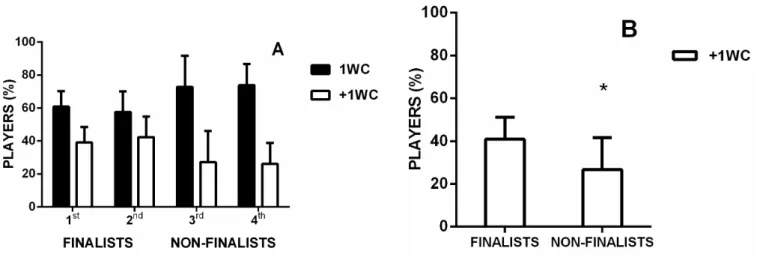
Of the 368 soccer players, 66.3% had never participated in a previous WC (1WC, n=244) and 33.7% had participat-ed in at least one WC (+1WC, n=124). +1WC players were signiicantly older than 1WC players (29.8 ± 3.2yrs; 26.4 ± 3.5yrs, p<0.05). On average the champion teams had 60.9 ±
9.4% of 1WC and 39.1± 9.4% of +1WC players. The second place teams contained 57.6 ± 12.5% of 1WC and 42.4 ± 12.5% of +1WC, the third place teams had 72.8 ± 18.9% of 1WC and 27.2 ± 18.9% of +1WC and the fourth place teams 73.9 ± 12.8% of 1WC and 26.1 ± 12.8% of +1WC (Figure 1A). In addition, the inalist teams demonstrated signiicantly higher percentage of +1WC than non-inalist teams (Figure 1B) (x2 = 8.222; p ≤ 0.05). Figure 2 (A, B, C, and D) presents the
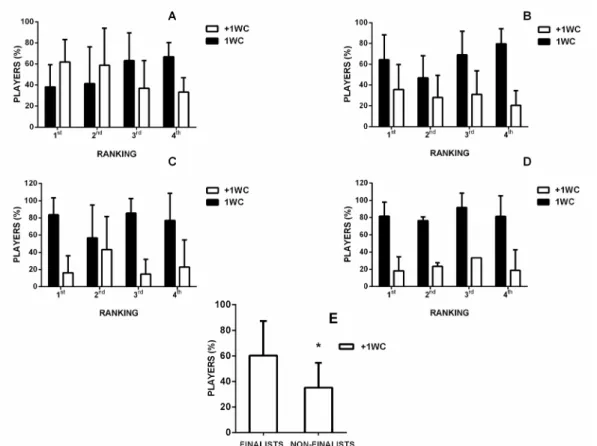
STARTER, START/SUBST, SUBST/BENCH, and BENCH players classiied as 1WC and +1WC among the inal rank -ing. No signiicant differences were found between players +1WC by contribution in inalists and non-inalists, except by STARTERs (x2 = 9.655; p ≤ 0.05) (Figure 2E). Figure 3 presents the eleven starting players in the most important matches of the WCs (inal and 3rd place) according to their classiication
in 1WC and +1WC. Figure 4 presents the numbers of started players with +1WC distributed by each stage of the playoff matches. Signiicant and large correlations between ranking places and STARTERs with +1WC were found (r = 0.70; p ≤
0.05). From the all STARTER players (n=117), 58 were +1WC and of these, 50 (86.2%) had started at least one match in a previous WC.
Figure 1. Panel A - Classiication of all players in experienced (+1WC) and non-experienced (1WC) (mean and SD) among irst, second, third, and fourth places of the last four WCs. Panel B –Experienced players (+1WC) between inalists (irst and second place) and non-inalists (third
Figure 2. Distribution of players experienced (+1WC) and non-experienced (1WC) (mean and SD): Panel -A- STARTER, Panel -B- START/
SUBST, Panel -C- SUBST/BENCH, Panel –D- BENCH, among irst, second, third, and fourth places of the last four WCs. Panel –E- STARTER experienced players (+1WC) between inalists (irst and second place) and non-inalists (third and fourth place). * p≤0.05 lower than inalists.
Figure 3. Classiication of the eleven starting players in experienced (+1WC) and non-experienced (1WC) in inal and 3rd place matches.
Discussion
The purpose of this study was to verify the inluence exerted by experienced soccer players on the inal ranking obtained by their teams in the last four FIFA World Cups. In addition, we verify the respective contributions of these experienced soccer players according to their participation in the playoff match-es (i.e., STARTER, START/SUBST, SUBST/BENCH, and BENCH). The main indings reported herein were: 1) overall, among all soccer players in the 4 analyzed WCs, the number of 1WC players was greater than the number of +1WC players; 2) the percentage of +1WC players was signiicantly higher in the inalists (compared to non-inalists); 3) importantly, the inalists demonstrated signiicantly higher number of STARTER players with +1WC when compared to the non-inalists; 4) there was a large correlation (r = 0.70) (Hopkins, 2002) between ranking places and the numbers of STARTER players with +1WC 5) ≈ 55% of the twenty-two started players in the inalist teams were +1WC.
At least for the four FIFA WCs examined in this study, our indings demonstrated that the experience of players played a crucial role in the inal classiication reached by a national team in the WC. This can be conirmed by analyzing the higher number of +1WC among the inalist teams (≈ 40% of +1WC) when compared to the third and fourth place teams (≈ 26% of +1WC) (Figure 1B). For reasons to be further explored it seems that these players have a great inluence on the match outcomes; especially in the semi-inals, when teams with higher numbers of +1WC played against teams with lower numbers of +1WC (Figure 4). Indeed, Sedeaud, Marc, Schipman, Taflet, Hager & Toussaint (2012) demonstrated similar relevance of previous participation in the Rugby World Cup from 1987 to 2007. For these Rugby WCs, the winning teams contained a signiicantly higher number of experienced players (i.e., players who par-ticipate in WC before) than all the other teams. Additionally, the percentage of experienced players increased from the quar-ter-inalists (33.4%) to the winning teams (39.6%). According to the authors, it is likely that the “time playing together” exerted a substantial inluence on the results achieved by a given team during a speciic tournament (i.e., the longer the time, the better the team performance).
Another advantage for the experienced players was inves-tigated by Thelwell, Weston, Lane, and Greenlees (2006), who demonstrated that more experienced soccer players, presented a more positive general mood proile than less experienced players. Particularly during away matches, that represent an uncomfortable and stressful situation, the less experienced players reported signiicantly more tension than the more expe -rienced ones. When playing in the FIFA WC playoffs, players are probably submitted to similar or worse situations. Thus, it is conceivable that experienced athletes would also present less tension than non-experienced athletes, which may positively inluence the team performance.
In this sense, we found that ≈20% of the players did not participate (BENCH) in any playoff matches. Accordingly, 16.3% of the players participated as SUBST/BENCH in (at least one) playoff matches (Figure 2C and 2D). Consequently, of the
23 players selected by each speciic national team, about eight players had little or no participation in the playoffs. Importantly, the majority of these players were debuting in the WC in all ranked places. This highlights the importance of the athletes’ experience during the crucial phases of the WC.
The selection of soccer players with previous participation in the WC seems to be crucial to achieve higher levels of competitive performance. However, it appears that the number of experienced players do not differ between irst and second place teams. Curiously, there is a particularity in the FIFA WC inalist teams: a higher number of +1WC players participating as STARTER in the inalist teams (Figure 2 E). It is important to emphasize that, among all STARTER players with +1WC, 86.2% had started at least one match in a previous WC. It seems reasonable to suggest that not only “being in a WC” is important for the athletes to become more experienced, but rather, it is important to have participated as a starter in at least one match in a previous WC. Of note, a comparison between the champions and the runner-up reveals only a small difference in the number of players STARTER with + 1WC playing in these teams (irst place ≈ 62% vs second place ≈ 59%). This similarity between the number of STARTER players +1WC playing in the inalist teams was also observed in the closely matched inal games, as demonstrated by the need for extra-time in the last three FIFA WCs (2006, 2010 and 2014).
Indeed, it is likely that selecting more experienced players as starters in a team throughout the training process and com-petition could be an advantage in the technical and/or tactical factor, especially in short-tournaments. For instance, Vaz et al. (2012) compared physical exertion and game performance indi-cators of experienced (more than ive years in regular national or international competitions) and novice (one or less years of rugby playing experience) players in Rugby Union, when play-ing small-sided games. In spite of the absence of differences in the physical exertion, the results from the game performance indicators (i.e., passes, tries and tackles made) demonstrated signiicant differences between the two groups, with a clear advantage in favor of the more experienced players. Probably, in team sports, the “athlete’s experience” plays a central role in determining the level of performance in speciic technical/ tactical game actions.
the number of crucial game actions (i.e., assistances and shots on target). This is surely a characteristic of teams formed by highly experienced players who have been playing together (under the same formation) for a long time.
In summary, this study may assist the technical staff to choose the best players for participating in FIFA WCs. Using the information presented here, the national head coaches can discriminate their national players into speciic sub-groups (STARTER, START/SUBST, SUBST/BENCH and BENCH) and, consequently, adopt the best strategy to form their teams. Since the more experienced players have a central role in de-termining the rate of success of the national teams during the FIFA WCs, it is highly suggested that the coaches increase the participation of these athletes during the competitions. Secondly, the inclusion of novice players in the national teams and their participation in at least one match during the FIFA WCs seems to have a great inluence on the experience accumulated by this player, which consequently inluences the results, obtained in future WCs.
Conclusion
To conclude, our indings suggest that experienced soccer players who participate in playoffs can signiicantly contribute to inluencing the performance obtained by their national teams during FIFA WCs. It could be highlighted when observing the large level of correlation between the number of experienced STARTER and the ranking places reached by their respective teams. Increasing the experience level of the novice soccer players by including these athletes during partial times of the matches might also be an important strategy to form winning teams.
References
Ali, A. (2011). Measuring soccer skill performance: a review. Scandinavian Journal of Medicine and Science in Sports, 21(2), 170-183. doi:10.1111/j.1600-0838.2010.01256.x.
Arnason, A., Sigurdsson, S.B., Gudmundsson, A., Holme, I.,
Engebretsen, L., & Bahr, R. (2004). Physical itness, injuries, and
team performance in soccer. Medicine Science in Sports Exercise, 36(2), 278-285. doi:10.1249/01.MSS.0000113478.92945.CA. Barnes, C., Archer, D.T., Hogg, B., Bush, M., & Bradley, P.S. (2014).
The Evolution of Physical and Technical Performance Parameters in the English Premier League. International Journal of Sports Medicine. doi:10.1055/s-0034-1375695.
Castagna, C., Impellizzeri, F.M., Chamari, K., Carlomagno, D., &
Rampinini, E. (2006). Aerobic itness and yo-yo continuous and
intermittent tests performances in soccer players: a correlation study. Journal of Strength Conditioning Research, 20(2), 320-325. doi:10.1519/R-18065.1.
Castellano, J., Casamichana, D., & Lago, C. (2012). The Use of Match Statistics that Discriminate Between Successful and Unsuccessful Soccer Teams. Journal of Human Kinetics, 31, 139-147. doi:10.2478/v10078-012-0015-7.
Del Villar, F., Garcia Gonzalez, L., Iglesias, D., Perla Moreno, M., & Cervello, E.M. (2007). Expert-novice differences in cognitive and execution skills during tennis competition. Perceptual and Motor Skills, 104(2), 355-365. doi:10.2466/pms.104.2.355-365. Gabbett, T.J., Jenkins, D.G., & Abernethy, B. (2011). Relative
importance of physiological, anthropometric, and skill quali-ties to team selection in professional rugby league. Journal of Sports Science, 29(13), 1453-1461. doi:10.1080/02640414.20 11.603348.
Garcia-Gonzalez, L., Moreno, A., Moreno, M.P., Iglesias, D., & del Villar, F. (2012). Tactical knowledge in tennis: a comparison of two groups with different levels of expertise. Perceptual and Motor Skills, 115(2), 567-580. doi:10.2466/30.10.25. PMS.115.5.567-580.
Gil, A., Moreno, M.P., Moreno, A., Garcia-Gonzalez, L., Claver, F., & Del Villar, F. (2013). Analysis of the relationship between the amount of training and cognitive expertise. A study of young vol-leyball players. Journal of Strength Conditioning Research, 27(3), 698-702. doi:10.1519/JSC.0b013e31825d99c9.
Hopkins, W.G. (2002). A scale of magnitudes for effect statistics. Avaliable at: http://www.sportsci.org/resource/stats/effectmag. html.
Kobal, R., Loturco, I., Gil, S., Cavinato Cal Abad, C., Cuniyochi, R., Barroso, R., & Tricoli, V. (2014). Comparison of physical perfor-mance among brazilian elite soccer players of different age-cat-egories. The Journal of Sports Medicine and Physical Fitness. Lex, H., Essig, K., Knoblauch, A., & Schack, T. (2015). Cognitive
representations and cognitive processing of team-speciic tactics
in soccer. PLoS One, 10(2), e0118219. doi:10.1371/journal. pone.0118219.
Liu, H., Gomez, M.A., Lago-Penas, C., & Sampaio, J. (2015). Match statistics related to winning in the group stage of 2014 Brazil FIFA World Cup. Journal of Sports Science, 1-9. doi:10.1080/026404 14.2015.1022578.
Sedeaud, A., Marc, A., Schipman, J., Taflet, M., Hager, J.P., &
Toussaint, J.F. (2012). How they won Rugby World Cup through height, mass and collective experience. British Journal of Sports Medicine, 46(8), 580-584. doi:10.1136/bjsports-2011-090506. Stolen, T., Chamari, K., Castagna, C., & Wisloff, U. (2005). Physiology
of soccer: an update. Sports Medicine, 35(6), 501-536.
Thelwell, R.C., Weston, N.J., Lane, A.M., & Greenlees, I.A. (2006). Relation of game location and experience on mood states. Perceptual and Motor Skills, 102(1), 157-162. doi:10.2466/ pms.102.1.157-162.
Vanttinen, T., Blomqvist, M., Luhtanen, P., & Hakkinen, K. (2010). Effects of age and soccer expertise on general tests of percep-tual and motor performance among adolescent soccer players. Perceptual and Motor Skills, 110(3 Pt 1), 675-692. doi:10.2466/ PMS.110.3.675-692.
Vaz, L., Leite, N., Joao, P.V., Goncalves, B., & Sampaio, J. (2012). Differences between experienced and novice Rugby Union players during small-sided games. Perceptual and Motor Skills, 115(2), 594-604. doi:10.2466/30.10.25.PMS.115.5.594-604.
Authors’ note
Ronaldo Kobal, Cesar Cavinato Cal Abad, Kátia Kitamura, Lucas Pereira and Irineu Loturco are afiliated with the NAR - Nucleus of High Performance in Sport, São Paulo, SP, Brazil.
Renato Barroso is afiliated with the Faculty of Physical Education, State Univer -sity of Campinas, SP, Brazil.
Everton Crivoi do Carmo is afiliated with the Department of Physical Education, University Center – Senac, SP, Brazil.
Fábio Yuzo Nakamura is afiliated with the Department of Physical Education, State University of Londrina, PR, Brazil and NAR - Nucleus of High Performance in Sport, São Paulo, SP, Brazil.
Corresponding author
Ronaldo Kobal
Nucleus of High Performance in Sport, São Paulo Av. Padre José Maria, 555 São Paulo, SP, Brazil. Email: [email protected]
Manuscript received on November 11, 2015 Manuscript accepted on February 04, 2016