EVALUATION OF DIFFERENT METHODS FOR DETECTING METHICILLIN RESISTANCE IN
STAPHYLOCOCCUS AUREUS ISOLATES IN A UNIVERSITY HOSPITAL LOCATED IN THE NORTHEAST OF BRAZIL
Francisco Canindé de Sousa Júnior1, Gildelane da Silva Néri1, Ana Karine Silva1, Bibiana Priscila Rodrigues Câmara de Araújo1, Myrian Júlia de Paiva Dourado Guerra1, Maria José de Britto Costa Fernandes1, Eveline Pipolo Milan2, Maria
Celeste Nunes de Melo1*
1
Departamento de Microbiologia e Parasitologia, Centro de Biociências, Universidade Federal do Rio Grande do Norte, Natal,
RN, Brasil; 2Departamento de Infectologia, Centro de Ciências da Saúde, Universidade Federal do Rio Grande do Norte, Natal, RN, Brasil.
Submitted: May 22, 2009; Returned to authors for corrections: August 13, 2009; Approved: October 06, 2009.
ABSTRACT
Many methods have been described for the detection of methicillin-resistant Staphylococcus aureus
(MRSA), but the heterogeneous expression of methicillin resistance affects the reliability of these methods.
The aim of the present study was to evaluate some methods for detecting methicillin resistance in
Staphylococcus aureus isolates in a university hospital located in the Northeast of Brazil. Among the
isolates, 15 were methicillin-susceptible and 45 were methicillin-resistant, including low-level
heterogeneous resistance strains. Both the 30 g-cefoxitin disk and PBP2a test had 100%
sensibility/specificity and appear to be good options for the detection of MRSA in the clinical laboratory.
Key words: MRSA, methicillinresistance, heterogeneous resistance,cefoxitin, PBP2a.
INTRODUCTION
Methicillin-resistant Staphylococcus aureus (MRSA) has
become the leading nosocomial pathogen worldwide and seems
to have spread into the community (10). Methicillin resistance
in staphylococci is caused by the expression of PBP2a encoded
by the mecA gene that is located on a genetic element called
the staphylococcal cassette chromosome mec- SCCmec (9).
There are several methods available to laboratories for
detecting methicillin resistance. These include oxacillin disk
test, automated susceptibility testing systems, and oxacillin
agar screen plate. In addition, the cefoxitin disk test was
recently recommended by the Clinical and Laboratory
Standards Institute for prediction of mecA–mediated resistance
(5). Finally, there are also mecA-specific tests such as mecA
polymerase chain reaction and PBP2a latex agglutination test
(21). However, detection of methicillin resistance in routine
clinical laboratories has been problematic ever since the
emergence of MRSA during the 1960s (19). The difficulties are
associated mainly with heterogeneous expression of methicillin
resistance in most MRSA strains currently prevalent (11, 24).
Errors in the detection of methicillin resistance can have
serious adverse clinical consequences. False-susceptibility
results may result in treatment failure and the spread of MRSA
if appropriate infection control measures are not applied.
Conversely, false-resistance results may increase healthcare
costs following unnecessary isolation precautions and may lead
to overuse of glycopeptides (3, 23). Thus, as some controversy
still exists over the inaccuracy of the recommended methods
for identification of MRSA, we evaluated some of these
methods for detecting methicillin resistance in Staphylococcus
aureus isolates in a university hospital located in the Northeast
of Brazil.
MATERIAL AND METHODS
Bacterial strains
A total of 60 strains of S. aureus isolated from clinical
samples in a university hospital in Natal city, RN, located in
the Northeast of Brazil were used in the study. The isolates
were identified as S. aureus using routine tests (Gram’s stain,
catalase and free coagulase tests) and stored at -70 ºC in TSB
containing 10% (w/v) glycerol. The study was approved by the
Research Ethics Committee of the Universidade Federal do Rio
Grande do Norte (UFRN), according to protocol no. 109/2006.
The methicillin-susceptible strain of S. aureus ATCC 25923
and the MRSA isolate BMB9393 were used to control.
Detection of the mecA gene
We considered the presence of the mecA gene as the
reference or “gold standard” method for establishing the
sensitivity and specificity of each of the techniques studied.
The DNA extraction was performed as described by Pacheco et
al. (13) and the mecA gene was detected with the polymerase
chain reaction (PCR) technique based on the procedure
described by Oliveira and de Lencastre (12), with the following
primers: mecA-F AAA ACT AGG TGT TGG TGA AGA TAT
ACC and mecA-R GAA AGG ATC TGT ACT GGG TTA
ATC AG, which amplify an internal region of 585bp of this
gene. Amplicons were visualized following electrophoresis on
agarose gels stained with ethidium bromide.
Susceptibility tests
The 1 g-oxacillin and 30 µg-cefoxitin disk tests (DME,
Araçatuba, SP, Brazil) and 6 g/mL oxacillin screen test (OST)
were performed by observing the recommendation of the
Clinical and Laboratory Standards Institute (5). The 25 g/mL
methicillin test (25-Met) was carried using trypticase soy agar
plates and heavy bacterial inoculums (109-1010 c.f.u.), as described previously (14).
Detection of penicillin-binding protein 2a (PBP2a test)
The Slidex® MRSA Detection (Biomérieux, Paris, France), which is based on the agglutination of latex particles
sensitized with monoclonal antibodies against PBP2a, was
carried out and interpreted according to the manufacturer’s
instructions.
Population analysis profiling (PAP)
The expression of methicillin resistance was analyzed by
PAP for strains that yielded isolated colonies on 25-Met.
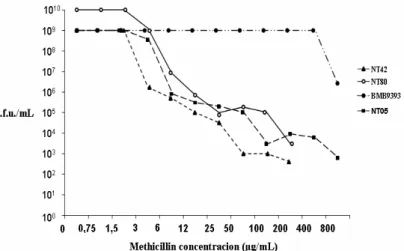
Overnight cultures grown in TSB at 35ºC, containing 109–1010 c.f.u./mL, were plated at four dilutions (100, 10-1, 10-3 and 10-5) on to agar plates containing serial (two-fold) dilutions of
methicillin at concentrations of 0 and 0.75 to 800 mg/mL.
Colonies were counted after 48 h incubation at 35ºC. A graphic
representation was constructed by plotting colony forming
units per millilitre against the concentration of methicillin (22).
RESULTS
Among the 60 S. aureus isolates, 45 were MRSA (mecA
positive) and 15 were MSSA (mecA negative; Fig. 1). Of the
45 MRSA isolates, 73% (33/45) belonged to the Brazilian
Epidemic Clone (ST239- SCCmecIIIA), 7% (3/45) to the
pediatric clone (ST5- SCCmecIV), and 20% (9/45) to the
sporadic clones (20).
Of all the mecA-positive isolates, one (NT42) displayed
inhibition zone diameters of 13mm by a 1µg-oxacillin disk test
(resistance breakpoint 10mm) and two (NT05 and NT80)
showed small individual colonies or light growth within the
inhibition zone >10mm and could have been erroneously
classified as methicillin-susceptible isolates (sensibility 93.3%,
specificity 100%). The NT42 strain yielded a very hazy growth
on the surface of OST (sensibility 97.8%, specificity 100%). In
colonies on 25-Met and were classified as low-level
heterogeneous resistance to methicillin by PAP (Fig. 2). The 30
µg-cefoxitin disk test and PBP2a test showed 100% de
sensibility e specificity. The sensibility and specificity of the
phenotypic tests as compared with mecA detection are
presented in Table 1.
Figure 1. Gel image of representative PCR mecA gene
products (585bp), Lane 1: molecular size marker (123bp);
Lanes 2-10: isolates BMB9393 (a positive control), NT05,
NT11, NT42, NT76, NT80, NT99, NT21 and ATCC 25923 (a
negative control).
Figure 2. Population analysis profile of three low-level
heterogeneous isolates (NT42, NT80 and NT05) and one
homogeneous isolate (BMB9393).
Table 1. Sensibility and specificity of the phenotypic tests as
compared with mecA detection
Test method Detected as
MRSA
Sensibili
ty (%)
Specificity
(%)
1 µg-oxacillin disk test 42 93.3 100
30 µg-cefoxitin disk test 45 100 100
6µg/mL oxacillin screen test 44 97.8 100
PBP2a test 45 100 100
DISCUSSION
Rapid and accurate identification of MRSA is required to
help clinicians select appropriate antibiotic treatment and to
avoid the spread of these strains (16, 18). However, there is no
optimal phenotypic method for detecting methicillin resistance
in S. aureus (2, 3). Furthermore, genotypic tests involving
mecA gene detection by PCR, which are considered to be the
reference (1, 21), are not practical for routine use in clinical
laboratories.
In the paper presented here, we evaluated some
methods for detecting methicillin resistance in Staphylococcus
aureus isolates and observed that the 1 µg-oxacillin disk test
and oxacillin screen test may occasionally result in
misidentification, especially by a microbiology technician with
no previous practice with MRSA detection (17). Similar results
were found by other authors (2, 6, 11, 24). Then, special
attention should be given to these strains because these, as well
as community-acquired MRSA (CA-MRSA) strains, have been
described in Brazil and throughout the world (15, 17, 24).
In this study the 30 µg-cefoxitin disk test was found to
be as sensitive as the mecA gene detection by PCR. The greater
reliability of the test with the cefoxitin disk confirmed earlier
studies which showed that the cefoxitin disk test, without
modification to conditions to improve expression of resistance,
is more reliable than the oxacillin disk test for the detection of
methicillin resistance in S. aureus (7, 16, 18). According to
Caulwelier et al. (4), because the cefoxitin would be a better
why heterogeneous MRSA populations that variably express
the mecA gene are better detected by disk diffusion with
cefoxitin than with oxacillin, which is a weak inductor of
PBP2a production.
The PBP2a test was 100% sensitive and did not
misclassify any MRSA with low-level resistance as MSSA.
Our findings are consistent with many other studies (4,6,8). In
addition to being easy to interpret and showing 100%
correlation with mecA detection, the PBP2a test has the
advantage that suspected colonies could be tested from the
primary cultures before the accomplishment of the bacterial
identification (17). However, this test is rather expensive for
routine application.
Although the number of isolates tested in our study was
low, our results support the evidence that the cefoxitin disk test
and the PBP2a test are good options for MRSA detection in the
clinical laboratories, as both showed 100% correlation with
mecA detection, including low-level resistance to methicillin
strains.
ACKNOWLEDGEMENTS
This work was supported by Fundação de Apoio à
Pesquisa do Estado do Rio Grande do Norte- FAPERN
(protocol MS/CNPq/FAPERN-03/2004) and Pró-Reitoria de
Pesquisa- PROPESQ/UFRN.
REFERENCES
1. Anand, K.B.; Agrawal, P.; Kumar, S.; Kapila, K. (2009). Comparison of cefoxitin disc diffusion test, oxacillin screen agar, and PCR for mecA gene for detection of MRSA. Indian J. Med. Microbiol. 27 (1), 27-29. 2. Baddour, M.M.; AbuElKheir, M.M.; Fatani, A.J. (2007). Comparison of
mecA polymerase chain reaction with phenotypic methods for the detection of methicillin-resistant Staphylococcus aureus. Curr. Microbiol. 55 (6), 473-479.
3. Boutiba-Ben Boubaker, I.; Ben Abbes, R.; Ben Abdallah, H.; Mamlouk, K.; Mahjoubi, F.; Kammoun, A.; Hammami, A.; Ben Redjeb, S. (2004). Evaluation of a cefoxitin disk diffusion test for the routine detection of methicillin-resistant Staphylococcus aureus. Clin. Microbiol. Infect. 10 (8), 762-765.
4. Cauwelier, B.; Gordts, B.; Descheemaecker, P.; Van Landuyt, H. (2004). Evaluation of a disk diffusion method with cefoxitin (30 microg) for detection of methicillin-resistant Staphylococcus aureus. Eur. J. Clin. Microbiol. Infect. Dis. 23 (5), 389-392.
5. CLSI (Clinical and Laboratory Standards Institute). (2007). Performance standards for antimicrobial disk susceptibility tests, 9th edn. Approved Standard M2-A9.Wayne, PA: document M100-S17.
6. Felten, A.; Grandry, B.; Lagrange, P.H.; Casin, I. (2002). Evaluation of three techniques for detection of low-level methicillin-resistant
Staphylococcus aureus (MRSA): a disk diffusion method with cefoxitin and moxalactam, the vitek 2 system, and the MRSA-screen latex agglutination test. J. Clin. Microbiol. 40 (8), 2766-2771.
7. Fernandes, C.J.; Fernandes, L.A.; Collignon, P. (2005). Cefoxitin resistance as a surrogate marker for the detection of methicillin-resistant
Staphylococcus aureus. J. Antimicrob. Chemother. 55 (4), 506–510. 8. Hamdad, F.; Donda, F.; Lefebvre, J.F.; Laurans, G.; Biendo, M.;
Thomas, D.; Canarelli, B.; Rousseau, F.; Eb, F. (2006). Detection of methicillin/oxacillin resistance and typing in aminoglycoside-susceptible methicillin-resistant and kanamycin-tobramycin-resistant methicilin-susceptible Staphylococcus aureus. Microb. Drug Resist. 12 (3), 177-185. 9. Hanssen, A.M.; Ericson Sollid, J.U. (2006). SCCmec in staphylococci:
genes on the move. FEMS Immunol Med Microbiol. 46(1), 8-20. 10. Kluytmans, J.; Struelens, M. (2009). Meticillin resistant Staphylococcus
aureus in the hospital. BMJ. 12 (1), 338-364.
11. Melo, M.C.N.; Silva-Carvalho, M.C.; Ferreira, R.L.; Coelho, L.R.; Souza, R.R.; Gobbi, C.N.; Rozenbaum, R.; Solari, C.A.; Ferreira-Carvalho, B.T.; Figueiredo, A.M.S. (2004). Detection and molecular characterization of a gentamicin-susceptible, methicillin-resistant
Staphylococcus aureus (MRSA) clone in Rio de Janeiro that resembles the NewYork/Japanese clone. J. Hosp. Infec. 58 (4), 276-285.
12. Oliveira, D.C.; de Lencastre, H. (2002). Multiplex PCR strategy for rapid identification of structural types and variants of the mec element in methicillin-resistant Staphylococcus aureus. Antimicrob. Agents Chemother. 46 (7), 2155-2161.
13. Pacheco, A.B.; Guth, B.E.; Soares, K.C.; Nishimura, L.; Almeida, D.F.; Ferreira, L.C. (1997). Random amplification of polymorphic DNA reveals serotype-specific clonal clusters among enterotoxigenic
Escherichia coli strains isolated from humans. J. Clin. Microbiol. 35 (6), 1521-1525.
14. Rezende, C.A.; Figueiredo, A.M.S. (1997). Discrimination of methicillin-resistant Staphylococcus aureus from borderline-resistant and susceptible isolates by different methods. J. Med. Microbiol. 46 (2), 145-149. 15. Ribeiro, A.; Coronado, A.Z.; Silva-Carvalho, M.C.; Ferreira-Carvalho,
16. Sharp, S.E.; Warren, J.A.; Thomson, R.B. Jr. (2005). Cefoxitin disk diffusion screen for confirmation of oxacillin-resistant Staphylococcus aureus isolates and utility in the clinical laboratory. Diagn. Microbiol. Infect. Dis. 51 (1), 69-71.
17. Silva-Carvalho, M.C.; Teixeira, L.A.; Ferreira, F.A.; Ribeiro, A.; Ferreira-Carvalho, B.T.; Figueiredo, A.M. (2009). Comparison of different methods for detecting methicillin resistance in MRSA isolates belonging to international lineages commonly isolated in the American continent. Microbiol. Immunol. 53 (2), 117-122.
18. Skov, R.; Smyth, R.; Clausen, M.; Larsen, A.R.; Frimodt-Muller, N.; Olsson-Liljequist, B.; Kahlmeter, G. (2003). Evaluation of a cefoxitin 30 g disc on Iso-Sensitest agar for detection of methicillin-resistant
Staphylococcus aureus. J. Antimicrob. Chemother. 52 (2), 204–207. 19. Skov, R.; Smyth, R.; Larsen, A.R.; Bolmstrôm, A.; Karlsson, A.; Mills,
K.; Frimodt-Moller, N.; Kahlmeter, G. (2006). Phenotypic detection of methicillin resistance in Staphylococcus aureus by disk diffusion testing and Etest on Mueller-Hinton agar. J. Clin. Microbiol. 44 (12), 4395-4399.
20. Sousa-Junior, F.C.; Silva-Carvalho, M.C.; Fernandes, M.J.B.C.; Vieira,
M.F.P.; Pellegrino, F.L.P.C.; Figueiredo A.M.S.; Melo, M.C.N.; Milan, E.P. (2009). Genotyping of methicillin-resistant Staphylococcus aureus
isolates obtained in the Northeast region of Brazil. Braz. J. Med. Biol. Res. 42 (10): 877-881.
21. Swenson, J.M.; Lonsway, D.; McAllister, S.; Thompson, A.; Jevitt, L.; Zhu, W.; Patel, J.B. (2007). Detection of mecA-mediated resistance using reference and commercial testing methods in a collection of
Staphylococcus aureus expressing borderline oxacillin MICs. Diagn. Microbiol. Infect. Dis. 58 (1), 33-39.
22. Tomasz, A.; Nachman, S.; Laef, H. (1991). Stable classes of phenotypic expression in methicilin-resistant clinical isolates of staphylococci.
Antimicrob. Agents Chemother. 35 (1), 124-129.
23. Velasco, D.; Tomas, M.M.; Cartelle, M.; Beceiro, A.; Perez, A.; Molina, F.; Moure, R.; Villanueva, R.; Bou, G. (2005). Evaluation of different methods for detecting methicillin (oxacillin) resistance in Staphylococcus aureus. J. Antimicrob. Chemother. 55 (3), 379-382.