Occurrence of culturable soil fungi in a tropical moist deciduous forest Similipal
Biosphere Reserve, Odisha, India
Santanu K. Jena, Kumanand Tayung, Chandi C. Rath
*, Debraj Parida
Department of Botany, North Orissa University, Odisha, India.Submitted: December 30, 2013; Approved: June 6, 2014.
Abstract
Similipal Biosphere Reserve (SBR) is a tropical moist deciduous forest dominated by the species
Shorea robusta. To the best of our knowledge their rich biodiversity has not been explored in term of its microbial wealth. In the present investigation, soil samples were collected from ten selected sites inside SBR and studied for their physicochemical parameters and culturable soil fungal diversity. The soil samples were found to be acidic in nature with a pH ranging from of 5.1-6.0. Highest per-centage of organic carbon and moisture content were observed in the samples collected from the sites, Chahala-1 and Chahala-2. The plate count revealed that fungal population ranged from 3.6 x
104-2.1 x 10⁵and 5.1 x 10⁴-4.7 x 10⁵cfu/gm of soil in summer and winter seasons respectively. The
soil fungus, Aspergillus nigerwas found to be the most dominant species and Species Important
Values Index (SIVI) was 43.4 and 28.6 in summer and winter seasons respectively. Among the sites studied, highest fungal diversity indices were observed during summer in the sites, Natto-2 and Natto-1. The Shannon-Wiener and Simpson indices in these two sites were found to be 3.12 and 3.022 and 0.9425 and 0.9373 respectively. However, the highest Fisher’s alpha was observed during winter in the sites Joranda, Natto-2, Chahala-1 and Natto-1 and the values were 3.780, 3.683, 3.575 and 3.418 respectively. Our investigation revealed that, fungal population was dependent on mois-ture and organic carbon (%) of the soil but its diversity was found to be regulated by sporulating
spe-cies likeAspergillusandPenicillium.
Key words:diversity indices, fungal population, SIVI.
Introduction
In the forest ecosystems, the growth and diversity of microorganisms are regulated by different physical and chemical properties like pH, organic carbon, P and K
con-tents of the soil (Wardleet al., 2004; Ogramet al., 2006).
Rhizosphere, which is a complex environment of forest ecosystems, is an intense site of microbial activity that har-bours a great diversity of microorganisms affecting plant
growth and health (Khanet al., 2007). Among various
mi-croorganisms, rhizospheric fungi play an important role for decomposition of different macromolecules like celluloses, hemicelluloses and peptides in forest ecosystem (Berg and
McClaugherty, 2003; Hansonet al., 2008; McGuireet al.,
2010). The population size and distribution of these organ-isms is often influenced by the abundance and nature of the
organic content of the soil, climatic conditions, surface
vegetation and soil texture (Marschneret al., 2003).
Recent studies suggested that there may be around 1.5 to 5.1 million extant fungal species and about 1200 new
species are being described in each year (Hibbettet al.,
2011). Further, O’Brienet al.(2005) were of the opinion
that less that 2-6% of the fungal species are currently de-scribed. This indicated that there are many more fungal spe-cies to be explored, named and identified. Therefore, studying fungi in tropical forests, unexplored habitats and lost or hidden species could contribute sustainable to global fungal diversity (Hawksworth and Rossman, 1997). The estimation of fungal species diversity at any given site of any ecosystem may be a difficult task for mycologist be-cause of the fact that fungal communities are highly di-DOI: http://dx.doi.org/10.1590/S1517-838246120131367
Send correspondence to C.C. Rath. Biotechnology, Science and Technology Department, Government of Odisha, India. E-mail: [email protected].
*
verse, cryptic and ephemeral in nature. Besides, probability of encountering and recording all species present during
any sampling effort is low (Tranet al., 2006; Aime and
Brearley, 2012).
Similipal hills located in the midst of Mayurbhanj district of Odisha state, India and located in between 21°28’ to 22°08’N latitude and 86°04’ to 86°37’ E longitude and
covering 5,578 km2of forest land. The Similipal Biosphere
Reserve has been divided into three zones,i.e.Core zone
(845 km2), Buffer zone (2174 km2) and transitional zone
(2559 km2). The climates of Similipal is tropical with warm
and humid, summer temperature around 40 °C during peak of the season. The rainy season starts from mid of June to October with a rainfall of about 125 mm in the monsoon. Winter creeps in gradually from mid October and becomes severe in December lowering temperature up to 5 °C in many parts of the hill. This uneven geophysical condition influences the diversity of floral and faunal distribution.
Except few sporadic reports (Bahutiet al., 2006; Beheraet
al., 2009) scientific studies of SBR in terms of microbial
wealth is not available in literature. This prompted us to carry out the present investigation to study the fungal diver-sity of this unique ecosystem in different seasons with re-spect to their physicochemical factors, in order to explore the importance of fungal population in maintenance of soil quality and to exploit their biotechnological potentials in near future.
Materials and Methods
Collection of soil samples
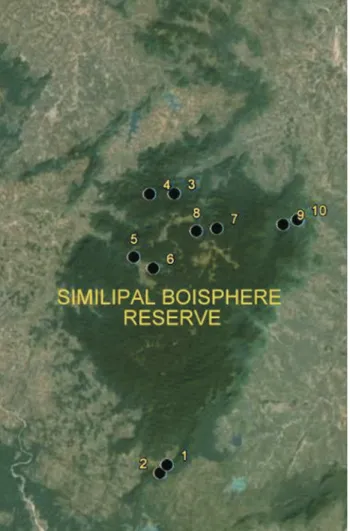
Hundred soil samples were collected from ten differ-ent sites (Chahala-1&2, Bareipani, Natto1-&2, Gurgudia-1&2, Pithabata-1&2 and Joranda) particularly from rhizo-sphere during a time span of 2 years (2010-2012) represent-ing both summer and winter seasons (Figure 1). All ten sites differ from each other on the basis of physical and chemical nature of soil. The Chahal-1&2 are within core re-gion and covered by dense forest. Natto-1 &2 are character-ized by dense vegetation with slope position of 20-30°. Bareipani is located at high elevation of 776 m above sea level. The vegetation of Joranda is characterized by numer-ous streams and water fall with dense forest cover, Pitha-bota- 1 &2 are located in between buffer and core areas. The Gurgudia-1&2 are located in the buffer area of the Bio-sphere reserve. Random sampling was carried out in each plot following the method of Baruah and Barthakur (1998). Each soil sample represents composite of well mixed five sampling units collected from each plot of 20 x 20 m. Soil pH, temperature, humidity, P, K and percentages of organic carbon was determined by following standard soil analysis methods (Alexander, 1972; Baruah and Barthakur, 1998).
Isolation and enumeration of fungi
Fungi were isolated and enumerated following stan-dard microbiological culture technique on Potato Dextrose
Agar (PDA) by total plate count method (Cruickshanket
al., 1973). The fungal isolates were identified based on
their colony morphology, growth pattern on medium and reproductive characters using the standard identification manuals (Gilman, 1971; Barnett and Hunter, 1996).
Quantification of the species (Species Important Value Index, SIVI)
The relative abundance, relative frequency and rela-tive density of species were determined using the following formulae (Dash, 2001).
Relative Abundance (RA) = Abundance of a species per sampling sites divided by total number of abundance value based on number.
Relative Frequency (RF) = Number of sampling sites containing a species divided by sum of frequency of all spe-cies.
Relative density (RD) = Number of individuals of a species in all sampling sites divided by number of individu-als of all species in all sampling sites.
Species Importance Values Index (SIVI) was calcu-lated by the sum of three parameters (RA+RF+RD).
Diversity analyses
Fisher’s a, Shannon’s diversity index (H’),
Shimpson’s diversity index (l), Margalef’s richness index
(RI), Menhinick’s richness index (R2), and Evenness
indi-ces (E1, E2, E3, E4 and E5) diversity indiindi-ces were calcu-lated using software of Paleontological Statistics (PAST
ver. 2.0; Ryanet al., 1995).
Community ordination techniques
The variations of population size among the sampling area in two seasons were summarized and the relations be-tween sites were determined by Principal Components Analysis (PCA). The logarithmic values of population of each site were arranged in relation to multi condition axes (axis 1, 2 and 3) on PCA. These data were used to calculate the Eigen value based on which co-ordinate axes were rep-resented so as to produce information on the similarity of the habitat types. To test for linearity of population struc-ture among the sites, the data was further evaluated to Detrended correspondence analysis. Thus, genera were cal-culated to be highest SIVI was considered for determina-tion of inter species reladetermina-tion distribudetermina-tion in two different seasons by measuring Euclidean distance, using PAST.
Results
Physico chemical parameters of the soil
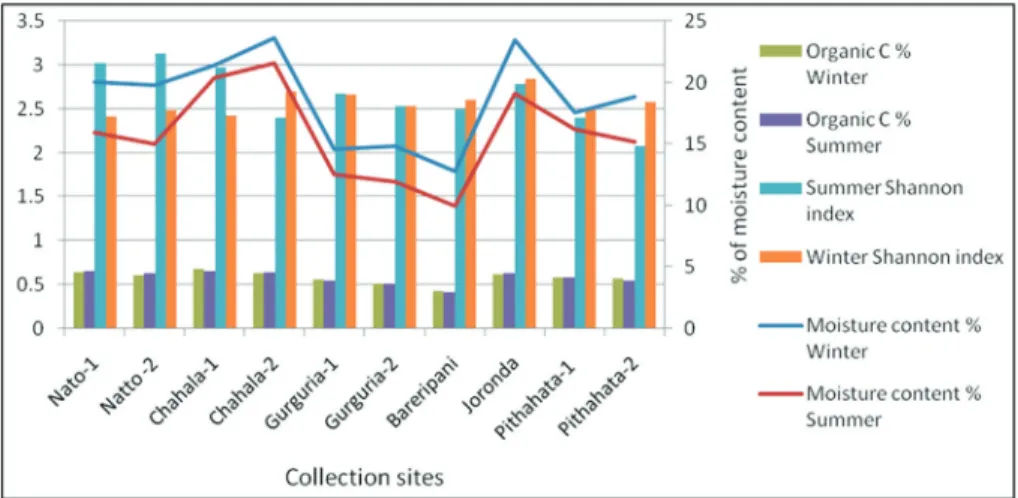
A total of 260 fungal isolates were obtained from 100 soil samples collected from 10 different sites of Similipal Biosphere Reserve in two seasons. The physico-chemical parameters of the soil samples and its associated plant spe-cies were studied (Table 1). All the soil samples were found to be acidic in nature, and highest acidity, moisture and or-ganic carbon percentage were observed in the soil sample collected from Chahala-1. Whereas, low moisture content and organic carbon percentage were recorded from Bare-ripani site. The salinity of the soil samples were found to be even (0.5) except increasing trend was observed in the soil samples collected from Gurgudia. The dominant plant
spe-cies occurring in the collected sites wasShorea robusta.
Fungal population
Occurrence of fungal propagules in the soil samples were enumerated by standard plate count methods (pour
and spread plate methods) and expressed in cfu gm-1of soil.
Soil fungal population was observed to vary among differ- Table
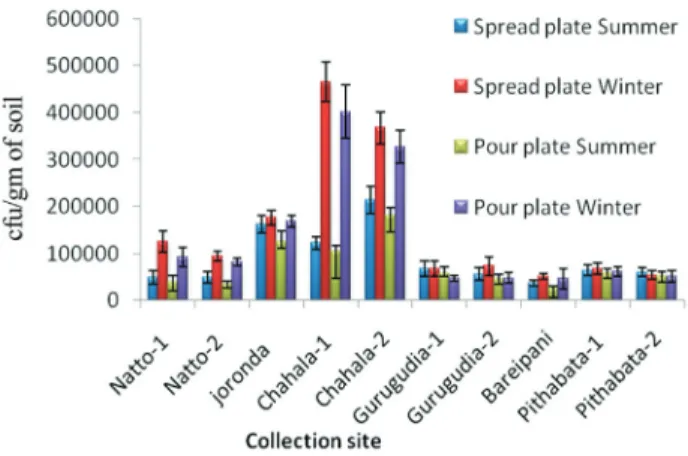
ent sites. The fungal population ranged from 3.6 x 10⁴to
2.1 x 10⁵in summer and 5.1 x 10⁴to 4.7 x 10⁵during winter.
In comparison, spread plate method showed higher number of fungal propagules than pour plate technique. Among the sites, highest fungal population was observed in the soil sample collected from Chahala-2 in both the seasons whereas, lowest fungal population was observed in the sample collected from Bareipani (Figure 2).
Species important values index (SIVI)
Species important values index is used to determine the overall importance of identified species in the commu-nity structure (Table 2). It gives an idea of the sociological structure of a species in its totality in the community. The
result indicated that Aspergillus niger and Aspergillus
awamorishowed highest SIVI values.Aspergillusspecies were found to be the most dominant species among the community in all sampling sites. The dominant species of
Aspergillus were identified as A. alliceus, A. flavus,
A. fornscecous, A. humicola, A. luchuensis, A. niger,
A. awamori,A. tamarine,A. terrus,A. wentii,A. ustus and A. panamensis.
Species diversity and richness
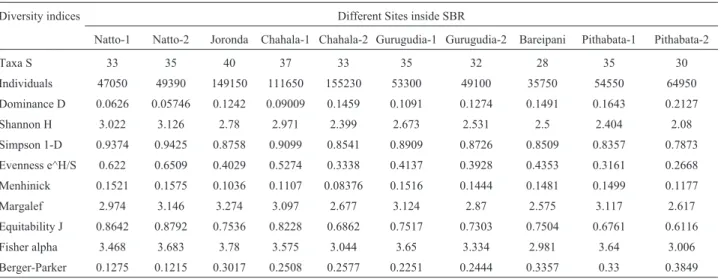
The species diversity and richness of soil fungi were studied by different diversity indices in different sites and seasons (Tables 3, 4). Shannon diversity index (H) was cal-culated as it represents the number of individuals as well as number of taxa in each collected site. Maximum value of H was observed at Natto-2 (3.12) and Joranda (2.84) in sum-mer and winter seasons respectively (Figure 3). Simpson diversity index (1-D) was also studied as it measures the dominant species. Highest 1-D was observed at Natto-2 (0.942) during summer while during winter was observed in Chahala-2 (0.903). The Dominance (D) indicates domi-nancy of a particular species. The value was highest at Pithabata-2 (0.2127) during summer. But in Natto-2, the D value was higher in winter (0.1557) and lower in summer
(0.05746). However, lowest D value was observed at Chahala-2 (0.09694) in winter. Besides, Fisher alpha diver-sity indicated highest value in the soil sample of Joranda in both seasons.
Sometimes one sample may contain a larger number of taxa, while the other has a larger diversity index. There-fore, a number of diversity indices may be compared to make sure that the diversity ordering is robust. A formal way of doing this is to define a family of diversity indices, dependent upon a single continuous parameter. So the di-versity profile was carried out among the samples in differ-ent sites. The diversity profile of the sites, Natto-1 and Natto-2, Chahala-1, Chahala-2, Bareipani and Gurgudia did not intercept with each other, indicating the distinctness of their diversity indices (Figure 4). Further, species rich-ness was studied by Menhinick- Margalef diversity indices (Smax). The result indicated that maximum species rich-ness was reported in the sampling site of Joranda but less in Bareipani. Besides, Berger Parker dominance index was calculated which expresses the proportion of the total share that is due to the dominant species. In comparison to the species components in sampling sites with respect to their population size, Berger-Parker dominance index expressed total higher number of species sharing the communities in the sites Pithabata-2, followed by Bareipani, Pithabata-1, Joranda, Chahala-1, Chahala-2, Gurguria-2, Guruguria-1, Natto-1 and Natto-2 during summer season. While, it was found to be highest in Bareipani followed by Pithabata-1, Natto-2 and Chahala-1 during winter.
Species evenness
Species evenness is also an important component of diversity index as it calculates the distribution pattern of species among the sites. Simpson index (1-Shannon index) measures evenness of the community from zero to one. The calculated values indicated approximately towards zero, which means, less evenness species distribution. At Natto-1 and Natto-2 during summer season, the distribution of species was found to be even in nature whereas, in Pitha-bat-2 species distribution was less even. But during winter, species evenness was more in Pithabata-2 followed by Bareipani and Chahala-2. Little variation of equitability values were observed among the sites.
Component ordination
PCA is used for the reduction of information on a large number of variables into a small set while losing only a small amount of information. It also helps in breaking down or partitioning a resemblance matrix into a set of per-pendicular axes or components.
The presences of variables (population of sampling units) in different axis were provided maximum informa-tion about the ecological similarities among sites. Each PCA axis or components correspond to an Eigen value is the variance accounted for, by the axes. The Eigen values
Table 2- SIVI value of different fungal species of two seasons (summer and winter).
Fungal species Relative density Relative abundance Relative frequency SIVI
summer winter summer winter summer winter summer winter
Absidiasp. 3.4 5.4 2.9 1.9 3.1 3.0 9.4 10.2
Alternariasp. 1.9 1.4 1.9 0.8 2.7 2.3 6.4 4.6
Aspergillus alliceus 1.9 1.8 1.9 1.5 2.7 2.6 6.4 5.9
Aspergillus flavus 1.7 0.9 1.5 3.0 3.1 3.0 6.2 6.8
Aspergillus fonscecous 2.2 1.6 1.9 1.3 3.0 2.9 7.1 5.8
Aspergillus humicola 2.2 3.2 1.9 17.5 3.0 2.9 7.1 23.6
Aspergillus luchuensis 1.9 1.3 1.8 3.3 3.0 2.7 6.7 7.3
Aspergillus niger 21.9 20.3 18.3 5.2 3.2 3.1 43.4 28.6
Aspergillus panamensis 0.2 0.3 0.3 0.2 1.7 1.5 2.3 2.1
Aspergillus awamori 4.9 3.8 4.5 1.6 3.0 3.1 12.4 8.4
Aspergillussp. 2.8 5.4 2.6 1.2 2.9 2.8 8.2 9.4
Aspergillus tamarine 0.6 1.4 0.7 0.6 2.3 2.3 3.6 4.3
Aspergillus terrus 0.7 1.3 0.9 0.2 2.1 3.0 3.7 4.5
Aspergillus untii 0.7 0.5 0.9 0.5 1.9 2.3 3.5 3.3
Aspergillus ustus 0.3 0.2 0.3 0.3 2.8 2.6 3.4 3.1
Curvulariasp. 0.1 0.2 0.3 0.1 1.3 2.1 1.7 2.4
Emencellopsissp. 0.3 0.2 0.3 1.3 2.9 2.8 3.5 4.3
Epicoccum nigrosum 0.1 0.1 0.2 0.4 1.2 1.4 1.6 1.8
Epicoccumsp. 1.9 1.5 1.6 0.5 3.2 3.1 6.7 5.1
Fusarium oxysporium 0.5 0.4 0.4 0.1 2.8 2.7 3.7 3.2
Fusariumsp. 0.7 0.5 1.7 0.2 2.7 2.6 5.0 3.2
Gliocladium catenulatum 0.2 0.1 0.2 0.1 2.6 2.5 2.9 2.7
Gliocladiumspp. 0.2 0.2 0.2 0.1 2.7 2.6 3.2 2.9
Homicola brevis 0.1 0.1 0.2 5.6 2.4 2.3 2.7 8.1
Mucor circinelloides 0.2 0.1 0.2 0.3 2.8 2.6 3.1 3.0
Mucorsp. 6.1 6.5 5.1 1.2 3.2 3.1 14.4 10.8
Penicillium coryphilum 0.4 0.2 0.5 0.5 2.1 1.8 2.9 2.6
Penicillium cumminie 1.1 0.8 1.6 1.1 1.7 1.7 4.4 3.5
Penicillium granulatum 0.3 0.2 1.2 4.2 0.8 1.2 2.3 5.7
Penicillium implicatum 1.0 0.7 2.4 3.5 1.2 1.7 4.5 5.9
Penicillium regulosum 1.1 2.7 2.7 1.3 1.1 1.7 4.9 5.6
Penicilliumsp. 18.0 18.0 16.1 10.8 3.2 3.1 37.4 31.9
Penicillium stectii 0.6 2.3 1.1 0.6 1.4 1.7 3.0 4.6
Penicillium tardum 1.0 0.7 1.8 15.5 1.5 1.4 4.2 17.6
Penicillium rubrum 0.6 0.4 0.9 1.3 1.7 1.7 3.2 3.3
Rhizoctoniasp. 2.1 1.5 1.7 1.8 3.2 3.1 7.0 6.4
Rhizopussp. 4.8 5.6 4.0 2.0 3.2 3.1 12.0 10.6
Scopulariopsis brevicaulis 1.7 1.3 2.3 0.5 2.0 1.8 6.0 3.6
Talaromycessp. 2.6 1.7 2.9 3.5 2.4 2.3 7.9 7.5
Trichoderm aliguorum 0.6 0.4 0.9 1.3 2.1 2.0 3.6 3.7
Trichodermasp. 6.1 4.1 5.1 2.6 3.2 3.1 14.5 9.8
Table 3- Diversity indices of fungi at different sites of Similipal Biosphere Reserve, during summer season.
Diversity indices Different Sites inside SBR
Natto-1 Natto-2 Joronda Chahala-1 Chahala-2 Gurugudia-1 Gurugudia-2 Bareipani Pithabata-1 Pithabata-2
Taxa S 33 35 40 37 33 35 32 28 35 30
Individuals 47050 49390 149150 111650 155230 53300 49100 35750 54550 64950
Dominance D 0.0626 0.05746 0.1242 0.09009 0.1459 0.1091 0.1274 0.1491 0.1643 0.2127
Shannon H 3.022 3.126 2.78 2.971 2.399 2.673 2.531 2.5 2.404 2.08
Simpson 1-D 0.9374 0.9425 0.8758 0.9099 0.8541 0.8909 0.8726 0.8509 0.8357 0.7873
Evenness e^H/S 0.622 0.6509 0.4029 0.5274 0.3338 0.4137 0.3928 0.4353 0.3161 0.2668
Menhinick 0.1521 0.1575 0.1036 0.1107 0.08376 0.1516 0.1444 0.1481 0.1499 0.1177
Margalef 2.974 3.146 3.274 3.097 2.677 3.124 2.87 2.575 3.117 2.617
Equitability J 0.8642 0.8792 0.7536 0.8228 0.6862 0.7517 0.7303 0.7504 0.6761 0.6116
Fisher alpha 3.468 3.683 3.78 3.575 3.044 3.65 3.334 2.981 3.64 3.006
Berger-Parker 0.1275 0.1215 0.3017 0.2508 0.2577 0.2251 0.2444 0.3357 0.33 0.3849
Table 4- Diversity indices of fungi at different sites of Similipal Biosphere Reserve, during winter season.
Diversity indices Different sites inside SBR
Natto-1 Natto-2 Joronda Chahala-1 Chahala-2 Gurugudia-1 Gurugudia-2 Bareipani Pithabata-1 Pithabata-2
Taxa S 34 35 41 34 35 35 32 28 36 30
Individuals 107650 88890 146150 242850 215050 60900 49100 35750 57650 66900
Dominance D 0.146 0.1557 0.1126 0.1498 0.09694 0.1073 0.1274 0.1491 0.1495 0.1058
Shannon H 2.416 2.481 2.84 2.427 2.696 2.666 2.531 2.6 2.493 2.575
Simpson 1-D 0.854 0.8443 0.8874 0.8502 0.9031 0.8927 0.8726 0.8509 0.8505 0.8942
Evenness e^H/S 0.3293 0.3414 0.4175 0.3332 0.4236 0.4109 0.3928 0.4353 0.3362 0.4377
Menhinick 0.1036 0.1174 0.1072 0.06899 0.07547 0.1418 0.1444 0.1481 0.1499 0.116
Margalef 2.848 2.984 3.363 2.661 2.769 3.086 2.87 2.575 3.193 2.61
Equitability J 0.685 0.6977 0.7648 0.6883 0.7584 0.7499 0.7303 0.7504 0.6958 0.7571
Fisher alpha 3.268 3.446 3.892 3.009 3.144 3.594 3.334 2.981 3.732 2.996
Berger-Parker 0.2787 0.2925 0.2737 0.2882 0.186 0.2299 0.2444 0.3357 0.3122 0.1794
are extracted in the descending order of magnitude. Such that the corresponding PCA components represented grea-ter to lesser amount variation in the matrix (Muthukrishna
et al., 2012). The values of PCA as co- relation among the sites were represented (Figure 5). The PCA ordination
plot-ting of Component 1vs. Component 2 indicates that the
data of the fungal population sites showed highest +ve val-ues for Chahala-1 and Chahala-2 around 0.9 to be static and more significantly modulated the fungal population in this ecosystem. On the other hand Pithabat-2 and Bareipani were positioned towards the -ve sides of the axis and values were less to be -0.40289 and -0.64711 respectively. Whereas, variation in the fungal population was observed in both while studying in spread and pour plates. Plotting
Component-1vs. Component-3 also showed relatively
same effect as that of spread plate and pour plate methods for encountering the fungal population. But, the summer population and winter population fall on alternate sides
when Component-1vs.Component-3 and Component-2vs.
Component-3 were plotted. Moreover, the populations of fungi in Chahala-2 and Joranda-1 sites were depicted on same sides of plotting represented less variation between the sites.
Detrended correspondence analysis
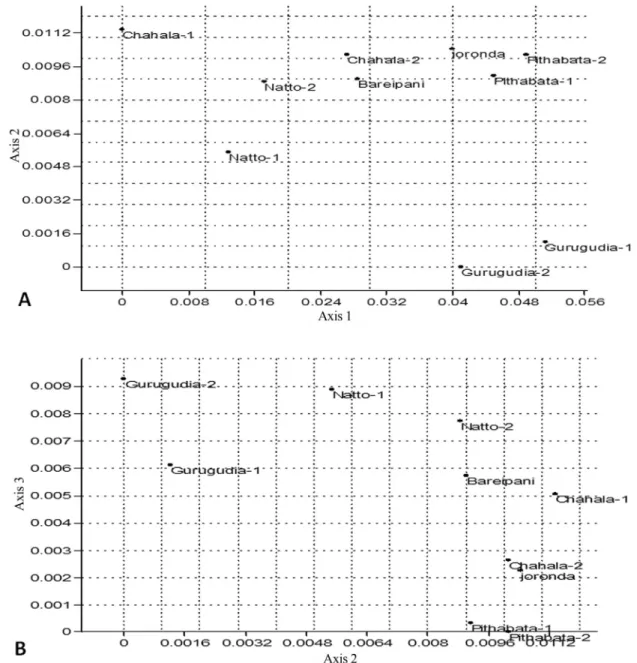
We have made an attempt to find out the linearity dis-tribution of fungal population among the sampling sites. Detrended correspondence analysis plotting axis 1 and axis 2 and axis 2 and axis 3 indicated non linear arrangement of the samples. The values of the first three axis obtained by computing the detrended correspondence analysis is proved. In pictorial representation (Figure 6) of all the sites were plotted on sheet, to be observed scattered any where suggested that non linearity distribution of taxa among sampling sites.
Community ordination ofAspergillusspecies
The relationships betweenAspergillusspecies in the
community in different sites and seasons were analysed by community ordination to understand the natural system of grouping of species.
Overall 12Aspergillusspp. reflected the community
structure and population size. Dendrogram of the clustering of the species using Euclidean distance during summer is
provided (Figure 7). The result indicated thatAspergillus
nigerformed a separate group in the community. Further,
A. awamorialso differed from other group indicating its distinctness. While other species clustered together within the community. Correspondingly, the dendrogram using Euclidean distance during winter also indicated similar re-sults (Figure 8).
Discussion
In terrestrial ecosystem, fungi are important compo-nents of microbial communities and play vital role in main-taining soil health and productivity. Studies suggest that soil fungal diversity and composition is governed by wide
range of biotic and abiotic factors (Lauber et al., 2008;
Barcenas-Morenoet al., 2009; Hawkeset al., 2011). Das
and Dkhar (2011) were of the opinion that microbial flora in moist deciduous forest is dependent on moisture content, pH, temperature, Nitrogen, Carbon sources. Several studies surveyed fungal diversity in different forest ecosystems, suggested a strong correlation between fungal and plant
di-versity, due to fungal host specificity (Peayet al., 2013; Shi
et al., 2013). Similipal Biosphere Reserve rich in plant
di-versity and dominated byShorea robusta. The geography
of this Biosphere Reserve is uneven. The soil physico-chemical properties were found to be varied from site to site. Therefore, in this investigation, fungi occurring in soil samples of Similipal Biosphere Reserve were studied in re-spect to their diversity and physicochemical parameters of the soil. In the present investigation, we studied soil fungi
of 100 sampling units collected from Similipal Biosphere Reserve, which are categorized into 10 major sites (Ta-ble 1). In the other words, the disturbances on fungal com-munities and population have been poorly studied in tropi-cal regions, because these communities have been considered, likely wrongly, as both resistant and resilient to
disturbance (Allison and Martiny, 2008; Da Silva et al.,
2012). Fungal population and diversity also varied with
re-spect to the rhizopheric plants species(Hattoriet al., 2012).
Here, the sampling sites were accomplished to the
rhizopheric region ofShorea robusta as dominant flora.
Gilbert (2005) suggested that the high plant diversity of tropical systems results in a decrease in fungal specificity due to a lack of selective pressure for specialization, often resulting in low species diversity. The Similipal soil was fertilized continuously by deposition of biomass of the plants. Therefore, dominance of fungal species in the soil samples could be recognized by organic substances depos-ited by dominant plant species. Another factor that, geo-graphic distance monitoring the fungal diversity was
reported by Greenet al.(2004). According to him, fungal
community became less similar with increasing geographic distance. Therefore, in our investigation larger variation of population was recorded among the above 10 sites could be attributable to the geographic position of the sites. It was also found that the similar fungal flora were recorded where
soil samples were collected from closely located sitesi.e.
Chahala-1 &2, Natto-1 &2, Pithabata 1-&2, Gurgudia-1 &2. The varied population among the sites was also found due to the change in physicochemical parameters of the soil. Highest population was recorded in Chahala-1, fol-lowed by Chahala-2, Joranda and Natto-1 in winter season. Among the sites, the fungal population size was dependent on moisture content and organic carbon % of the soil (Table 1, Figure 2). Lowest fungal population was recorded in the
site Bareipanii.e., 5.16 x 10⁴and 3.62 x 10⁴in winter and
summer, seasons respectively.
In PCA analysis study it was summarized and calcu-lated that winter and summer populations to be far change in population size in same place. However, in summer, fun-gal population fell down to half of the winter population among the sites as recorded could be attributable to the dry-ing of soil. These finddry-ings are in corroboration with other workers (Gupta and Bhriguvanshi, 1997; Narsian and
Pa-tel, 2009). Yanet al.(2000) has drawn a relationship
be-tween organic carbon and functional diversity of fungal
population, as observed in this investigation. Sharmaet al.
(1997), stated a linear relationship between (Shannon’s di-versity index) H and microbial biomass. In this context, it was observed that Shannon index to be more in summer season than winter season because of the rise of dominance of single species. It was clearly understood that population size of ecosystem is directly dependent to organic carbon contents and moisture contents of the soil (Figures 2, 4). Both, Dominance and Simpson diversity index were found
to vary from site to site, as a result of difference in physico-chemical parameters and associated rhizopheric plants. Mycoflora differs in its composition from one ecological niche to the other have also been reported (Monoharachary, 2008). The dominant genera appeared abundantly in Indian soils regulate the relative frequency and relative density of other soil fungal genera (Bhagat and Pan, 2010) and had
important role in leaf litter decomposition (Panda et al.,
2009). This may be due to the faster growth rate of these fungi in addition to their better intrinsic prolific sporulating capacity to utilize the substrate. Therefore, sporulating fungi were better established and studied by culturable
methods. Pandaet al.(2010) also reported that fungal
suc-cession in plantation sites greatly differed from sites with-out plantation due to the presence of organic materials and
that promote the domination of single species. Therefore, eveness (Evenness e^H/S) of fungal species also varied from site to site as reported by our study due to uneven ge-ography, physico-chemical parameters of soil.
On the other hand, the exact evaluation of fungal
pop-ulation and diversity is very difficult (Smithet al., 2011;
Piepenbringet al., 2012). As, fungi are cryptic and hyper
diverse organisms that assemble in complex and dynamic
communities. Perroneet al. (2011) reported that species
that produce spore-bearing structures can be easier to dis-cover, although fruiting periods can be short and fructifi-cations are ephemeral. In this investigation, we have measured the fungal population rather than fungal diver-sity. The species which are more dominant colonized better on the plate (during standard plate count method) than other
Figure 7- Dendrogarm clustering the 12 abundant fungal (Aspergillus) species of the forest in summer litter using Euclidean distance.
species. On the other hand these species were better sporu-lating, therefore, soil fungal flora and population were maintained by these group of organisms. Total 17 genera were taken into account during this study, amongst all,
Aspergilluswas observed to be most dominant genera
fol-lowed byPenicillium. The SIVI value suggested the
flo-ristic status of the species (Table 2). TheAspergillus niger
showed SIVI 43.4 and 28.6 both in summer and winter sea-sons respectively, indicating the population size of the communities among the sampling sites being regulated by these two species, It is also called insurance hypothesis
(Yachi and Loreau, 1999). In winter theAspergillus niger
was isolated in more numbers than summer season but the SIVI value showed the alternate results due to the well es-tablishment of other species in winter rather than summer
season. The dendrogarm of the 12 abundant Aspergillus
species isolated from the Similipal Biosphere Reserve soil both in winter and summer season litter using Euclidean distance (Figures 7, 8) was drawn based on the SIVI values.
The figure showed thatAspergillus nigerform a separate
group in community and minimize the role of other mi-crobes in microbial ecosystem followed by cryptic species
(Perrone et al., 2011) like Aspergillus awamori.
Shimpson’s diversity index of the site Chahala-2(0.850) and Bareipani (0.854) was reported to be same but in Chahala-1 the fungal population recorded to be more by two folds, than that of population of Bareipani (Figure 2). It
clearly indicated thatAspergillus nigerhave not only better
sustainability but has capacity to regulate the microbial structure in moist deciduous forest soil, could be due to the competitively superior under such conditions when there
are favourable niches everywhere (Hallet al., 2000), called
resource heterogeneity hypothesis. Secondly, the specific association of fungal species in different sites is because of
their niche specialization. Senthilkumaret al. (1993)
re-ported that most of the fungal flora occurring in the later stages of decomposition was efficient degraders of cellu-lose and lignin. In the present study more fungal species were recorded from the sites with more moisture content and leaf litter deposition, indicating that these species could be efficient cellulose and lignin degraders.
A little change of diversity index and dominance in-dex were observed in communities with uniform distribu-tion of taxa among the sampling sites. But large variadistribu-tion of population of taxa among the sites were observed by study-ing the positionstudy-ing of sites on Detrended correspondence analysis plot of axis-1 vs axis-2 and axis-2 and 3 (Figure 6).
Conclusion
It is concluded from our findings and other investiga-tions, that the determination of complete structure of fungal flora is a difficult chapter. But, dominant and sporulating genera are the determinate of fungal diversity in the soil. The well evolved (sporulating) species are the dominant genera that contribute the maximum population to maintain
the floral structure in the soil ecosystem that is attributable due to well dissemination of their spores in the soil. How-ever, the moisture content and organic C percentage regu-late the viability of their spores as well as the vegetative hyphae, as evidenced in this investigation, maintaining the fungal diversity in the soil ecosystem to a large extent.
Acknowledgments
This study was financially supported by Department of Science and Technology, Govt. Odisha (no. ST-(Bio)-54/2009). We thank the help of Field Director (Dr. A.K. Nayak) Similipal Triger Reserve, Baripada, permitting to carry out the research investigation inside SBR.
References
Aime MC, Brearley FQ (2012) Tropical fungal diversity: closing the gap between species estimates and species discovery. Biodivers Conserv 21:2177-2180.
Alexander M (1972) Introduction to Soil Microbiology, 2nd edi-tion. Wiley and Sons, New York
Allison SD, Martiny JBH (2008) Resistance, resilience, and re-dundancy in microbial communities. Proc Natl Acad Sci 105:11512-11519.
Bahuti R, Rath CC, Mohapatra U (2006) Phsico- chemical and mycological studies of selected soil samples from Similipal Biosphere Reserve. Plant Sci 28:1-7.
Barcenas-Moreno G, Gomez-Brandon M, Rousk Jet al.(2009)
Adaptation of soil microbial communities to temperature: comparisonof fungi and bacteria in a laboratory experiment. Glob Chang Biol 15:2950-2957.
Barnett HL, Hunter BB (1996) Illustrated Genera of Imperfect Fungi. APS Press, St. Paul.
Baruah TC, Barthakur HP (1998) A Text Book Soil Analysis. Vikas publ, New Delhi.
Behera M, Dandapat J, Rath CC (2009) Isolation, characterization and screening of bacteria isolates from Similipal Biosphere Reserve forest soil for their metal tolerance capacity and extracellular enzymatic activities. Biorem Biodiv Bioavail 3:72-78.
Berg B, McClaugherty C (2003) Plant Litter: Decomposition, Hu-mus Formation, Carbon Sequestration. Spinger, Berlin. Bhagat S, Pan S (2010) Cultural and phenotypic characterization
ofTrichodermasp. From Andaman and Nicobar Islands. J Mycol Pl Pathol 40:145-157.
Cruickshank K, Duguid JP, Marmion BRet al.(1973) Medical
Microbiology, A Guide to the Laboratory Diagnosis & Con-trol of Infection, 12th edition. Edinburgh: ELBS and Chur-chill Livingstone, Great Britain.
da Silva DAC, Pereira CMR, de Souza RGet al.(2012) Diversity
of arbuscular mycorrhizal fungi in resting and dunes areas in Brazilian northeast. Biodiv Conserv 21:2361-2373. Das BB, Dkhar MS (2011) Rhizosphere microbial populations
and physico chemical properties as affected by organic and inorganic farming practices. Amer-Eur J Agr Environ Sci 10:140-150.
Dash MC (2001) Fundamental of Ecology. Tata McGrow-Hill Publ., New Delhi.
Interactions in the Tropics. Cambridge University Press, Cambridge, pp 141-164.
Gilman JC (1971) A Manual of Soil Fungi. Iowa State College Press, Ames, Lowa.
Green JL, Holmes AJ, Westoby Met al.(2004) Spatial scaling of
microbial eukaryote diversity. Nature 432:747-750. Gupta M, Bhriguvanshi SR (1997) Dissolution of phosphates as
influenced by soil moisture regimes and P solubilizing mi-croorganisms. J Ind Soc Soil Sci 45:613-614.
Hall SJ, Gray SA, Hammett ZL (2000) Biodiversity-productivity relations: an experimental evaluation of mechanisms. Oeco-logia 122:545-555.
Hanson CA, Allison SD, Bradford MAet al.(2008) Fungal taxa
target different carbon sources in forest soil. Ecosystems 11:1157-1167.
Hattori T, Yamashita S, Lee SS (2012) Diversity and conservation of wood-inhabiting polypores and other aphyllophoraceous fungi in Malaysia. Biodiv Conserv 21:2375-2396.
Hawkes CV, Kivlin SN, Rocca JDet al.(2011) Fungal
commu-nity responses to precipitation. Glob Chang Biol 17:1637-1645.
Hawksworth DL, Rossman AY (1997) Where are all the undes-cribed fungi? Phytopath 87:888-891.
Hibbett DS,Ohman A,Glotzer Det al. (2011) Progress in
molec-ular and morphological taxon discovery in Fungi and
op-tions for formal classification of environmental sequences.
Fungal Biol Rev 25:38-47.
Khan MS, Zaidi A, Wani PA (2007) Role of phosphate-solu-bilizing microorganisms in sustainable agriculture - A re-view Agronom for Sustain Develop 27:29-43.
Lauber CL, Strickland MS, Bradford MAet al.(2008) The
influ-ence of soil properties on the structure of bacterial and fun-gal communities across land-use types. Soil Biol Biochem 40:2407-2415.
Manoharchary C, Mohan KC, Kunwar IKet al.(2008) Phosphate
solubilizing fungi associated withCasuarina equisetifolia.J
Mycol Pl Pathol 38:507-513.
Marschner P, Kandeler E, Marschner B (2003) Structure and function of the soil microbial community in a long- term fer-tilizer experiment. Soil Biol Bioch 35:453-461.
McGuire KL, Bent E, Borneman Jet al.(2010) Functional
diver-sity in resource use by fungi. Ecol 9:2324-2332.
Muthukrishnan S, Sanjayan KP, Jahir HK (2012) Species compo-sition, seasonal changes and comm-unity ordination of alkalotolerant micro fungal diversity in a natural scrub jun-gle ecosystem of Tamil Nadu, India. Mycosphere 3:92-109. Narsian VT, Patel HH (2009) Relationship of physicochemical
properties of rhizosphere soils with native population of mineral phosphate solubilizing fungi. Indian J Microbiol 49:60-67.
O’Brien HE, Parrent JL, Jackson JAet al.(2005) Fungal
commu-nity analysis by largescale sequencing of environmental samples. Appl Environ Microbiol 71:5544-5550.
Ogram A, Bridgham S, Corstanje Ret al.(2006) Linkages
be-tween microbial community composition and
biogeoche-mical processes across scales. In: Verhoeven JTA, Beltman
B, Bobbink Ret al.(eds) Wetlands and Natural Resource
Management. Springer, Berlin, pp. 239-268.
Panda T, Pani PK, Mishra Net al.(2010) A Comparative Account
of the Diversity and Distribution of Fungi in Tropical Forest Soils and Sand Dunes of Orissa, India. J Biodiversity 1:27-41.
Panda T, Rout SD, Mishra N (2009) Decomposition ofCasuarina
leaf litter in coastal sand dunes of rissa. Int J Gen Mol Biol 1:137-143.
Peay KG, Baraloto C, Fine PV (2013) Strong coupling of plant and fungal community structure across western Amazonian rainforests. ISME J 7:1852-1886.
Perrone G, Stea G, Epifani Fet al.(2011)Aspergillus niger
con-tains the cryptic phylogenetic speciesA. awamori. Fungal
Biol 115:1138-1150.
Piepenbring M, Hofmann TA, Unterseher Met al.(2012) Species
richness of plants and fungi in western Panama: towards a fungal inventory in the tropics. Biodivers Conserv 21:2181-2193.
Ryan PD, Harper DAT, Whalley JS (1995) PALSTAT, Statistics for Palaeontologists. Chapman and Hall, Dordt.
Senthilkumar K, Udaiyan K, Manian S (1993) Succession pattern of mycolfora associated with litter degradation in a
Cymbopogoncaesius-dominated tropical grassland. Tropic Grasslands 27:121-127.
Sharma S, Piccolo A, Insam H (1997) Different carbon source uti-lization profiles from four tropical soils of Ethiopia. In: Insam H, Rangger A (eds) Microbial Communities. Sprin-ger, New York, pp 132-139.
Shi LL, Mortimer PE, Slik JWFet al.(2013) Variation in forest
soil fungal diversity along a latitudinal Gradient. Fungal Divers DOI 10.1007/s13225-013-0270-5.
Smith ME, Henkel TW, Aime MCet al.(2011) Ectomycorrhizal
fungal diversity and community structure on three co-occurring leguminous canopy tree species in a Neotropical rainforest. New Phytologist 192:699-712.
Tran HTM, Stephenson SL, Hyde KDet al.(2006) Distribution
and occurrence of myxomycetes in tropical forests of north-ern Thailand. Fungal Divers 22:227-242.
Wardle DA, Bardgett RD, Klironomos JNet al.(2004) Ecological
linkages between aboveground and belowground biota. Sci-ence 304:1629e1633.
Yachi S, Loreau M (999) Biodiversity and ecosystem productivity in a fluctuating environment: the insurance hypothesis. Pro-ceeding of National Academy of Science 96:1463-1468. Yan A, McBratney B, Copeland L (2000) Functional substrate
biodiversity of cultivated and uncultivated a horizons of vertisols in NW New South Wales. Geoderma 96:321-343.
Associate Editor: Fernando Dini Andreote