F
EATURE
292
D
ECANTING A PSYCHIATRIC HOSPITAL:
DEVELOPMENT OF A PATIENT
ASSESSMENT METHODOLOGY1
Morton M. Warner2
Introduction
In the past it was often felt that men- tal disorders were much less frequent in developing countries than in devel- oped ones. Consequently, in developing countries attention was given, and resources were allocated, to those suffering from physical illness. This belief, now challenged, is gradually being discarded. WHO, which has assisted this process, states that “Epidemiologic studies in several parts of the world have shown no fundamental difference, either in the range of mental disorders that occur or in the prevalence of seriously debilitating illness. These studies indicate that such seriously debilitating mental disorders are likely to affect at least 1% of any population at any one time and at least 10% at some time in their life” (1).
Two central questions then arise, these being (1) What is to be done for individuals presenting with mental disor-
ders? and (2) What alternative forms of care should be offered to those al- ready institutionalized, often for extended periods?
Historically, fear of mental illness led to the emergence of private madhouses and then the creation of public asy- lums. With the advent of mood-controlling drugs, community care, repre- senting what some say is the first big policy change in psychiatry since the early nineteenth century, has been instituted-often with poor results due to low levels of funding and poor preparation.
’ This piece will also be published in Spanish in the Bole& de Za Oficina Sanitaria Panameticma. Portions of this work have previously been presented in a 1986 PAHO report entitled “Psychiatric Services in Barbados: Prefeasibility Study” that cited work funded by the Government of Barbados and the Inter- American Development Bank (Project ATC/SF2521-BA).
In the United Kingdom, for example, the 1959 Mental Health Act resulted in the “decanting” of thousands of mental hospital patients without providing sufficient services to care for them (2); and in the United States the term “bag lady” is now common parlance, denoting an explicit social phenomenon. (The term describes tran- sient women, many discharged from mental hospitals, who are without homes or contact with relatives and who wander aimlessly, carrying their life’s possessions in a bag.)
PAHO’s member states, subscribing to the concept of “Health For All By The Year 2000" in 1982, agreed that “The integration of mental health, alcohol abuse, and drug abuse activities in Primary Health Care Services is considered a key activity for the develop- ment of a Plan of Action. Primary Health Care workers can be trained in simple techniques of crisis intervention, management of emergencies, detec- tion and follow-up of cases, and the formation of self-help groups, which will prepare them to handle a high proportion of affected persons and diminish the number of institutionalized cases” (3).
It is the last part of this statement (re- lating to diminution of hospital cases) that is of particular concern, especially when an explicit policy of mental hospital decanting is involved. In particu- lar, the assumption that all will be well if primary health care workers and programs are in place is clearly wrong. Among other things, many inpa- tients, especially in moderately developed countries, have found their hospi- tal experience to be long and debilitating. Hence, their ability to carry out the normal activities of daily living is questionable, and their need for alter- nate forms of szcpervised community and residential care is critical.
Assessments
Needed
When assessing psychiatric inpatients for possible discharge to alternate forms of care, it is especially important to assess the quality of their social and mental behavior-partly because their acceptance by family or friends often depends upon it. In addition, however, many inpatients have been hospital residents for some years, and so assess- ment of their ability to carry out activities of daily living (ADL) is essential.
Much of the literature to date has fo- cused on the development of “disability indices” for use in research dealing with chronic diseases and rehabilitation (4-8). These usually consist of inven- tories of the ADL. In recent years the construction of such indices has been the subject of some theoretical and methodologic debate, but this has mainly concerned the process of combining the component items ($11).
The emphasis of the work reported here is not directed at testing the validity of particular procedures but rather at constructing a tool that would help to measure the incidence of patient disability-physical, social, and mental-for planning purposes, thereby providing information on the czlrrent demand for different types of care.
It should be emphasized that the ap- proach used was developed for gro@ planning purposes alone, and that de- cisions regarding any individzcal would require a detailed clinical review.
The Patient Assessment
Form
Many countries possessing substantial institutionalized psychiatric populations confront a need to make planning decisions about the future of this patient group with scant information. In this regard, as of the start of the work described here, Barbados was no excep- tion. To deal with that situation, following extensive discussions at the hospi- tal level, an approach was adopted based upon two assumptions. These as- sumptions were (1) that the eligibility criteria for admission to alternate forms of care could be stated in behavioral terms; and (2) that a patient’s ability to carry out the tasks of daily living, in combination with his social behavior, could provide a useful planning indicator of requirements for par- ticular types of alternate care (as defined in Assumption 1).
Within &is context the team perform- ing the work listed six alternate, hypothetical types of care that were felt suit- able for Barbados in the future (clearly, other countries might develop a dif- ferent list). The types of care were as follows:
1 Institutional care (a mix of chronic and acute care including care for the mentally retarded).
2 Halfway housings (for those who have homes to go to).
3 Halfway housing (for those who have no homes to go to and who can be expected to subsequently require a workers’ group home, foster care, or rooms).
4 Group home care.* 5 Foster care.
6 Care at home.
3 A halfway house is defined as a care facility with no more than 10 residents that is therapeutic in character and enjoys psychiatric and social work support services. Residents needing reintegration into normal com- munity life function with some independence.
4 A group home is defined as a care facility with no more than 10 residents where the residents function with a high degree of independence without medical or resident nursing supervision. A resident supervi- sor normally administers the home.
The patient assessment form devel- oped by the study team-a form that proved easy to administer-is shown in Annex 1. Most of the medical questions on this form were included because many of the patients were elderly, the form was also used in a parallel geriat- ric services study, and certain data on morbidity among the institutionalized group were needed.
Nurses from each ward in the hospital who would be conducting patient assessments were given a half-day theoreti- cal and practical training session (in retrospect, the second part of this session could have been longer). Written instructions provided to these nurse-asses- sors to help them complete the patient assessment forms appear in Annex 2. Following this preparation, these nurses administered the forms to all 544 patients at a 57%bed institution over a two-week period. A further two weeks were required to complete the forms in cases where omissions had occurred.
Decision Algorithms
The study team set out combinations of behavioral criteria that patients would have to meet in order to be eligible for each of the six forms of care. This was done by indicating ratings for the individual elements of the patient assessment form in Annex 1. However, because of the complexity of these behavioral combinations and the large number of patients being assessed, an IBM PC XT microcomputer with a dBase III packages was employed to scan the data base using the following algorithms:
A GeneraZ instmctions i Ignore vision, hearing.”
ii Score “most impaired” through “not impaired” 05 through 01.
B InstitzctionaL care eZigiL&ty. Scan total data set and include patients who score:
i 5 on any item in Section D. ii 4 or 5 on Section C (iii).
iii “Poor” on Section E (comprehension), except when patient does not score in (i) above, and scores “no problem” or “some problem” in Section F.
iv “Poor” on Section E (memory).
v “Poor” on Section E (reality orientation), except when patient does not score in (i) above, and scores “no problem” or “some problem” in Section F, and/or
vi Any item “intolerable” in Section F.
vii Cut those eligible for institutional care away from the total group.
5 Acquired in March 1986 by the PAHOlWHO Office of Caribbean Program Coordination. A copy of the program developed is available on request but would only be of use if the same care alternatives were being considered.
C HaZfway house care edigibidity. Scan data set of remaining persons and in- clude patients who score across all items in the following combination:
i Section C (iii) Understanding-2,l ii Section D (i) Ambulation-4,3,2,1
” D (ii) Transfer- 1 ” D (iii) Bathing-l n D (iv) Dressing-2,l W D (v) Grooming-2,l I) D (vi) Eating-3,2,1 fl D (vii) Bladder-l fl D (viii) Bowel-l
iii Section G: “Yes,” works “with no supervision,” works “with some su- pervision.”
iv Section J (ii)-“ Very much” or “yes.”
v Section J (iv)-If “yes,” then cut away from group and allocate to half- way house (with home to go to). If “no,” then cut away from group and allocate to halfway house (later requir- ing a workers’ group home, foster care, or rooms). D Groz@ Borne eZig&iZity. Scan data set of remaining persons and include
patients who score across all items in the following combination: i Section D (v)-3,2,1
n D (vi)-3,2,1 U D (vii)-3,2,1 N D (viii)-3,2,1
ii Section E Comprehension-Fair/good N E Reality orientation-Fair/ good
iii Section F All items-“No problem,” except “Bizarre mannerisms/ speech”: “Some problem” or “No problem.”
E Home care, reZative care, or foster care eZigibiZi,ty. Scan data set of remain- ing persons and interrogate as follows:
i Section J (ii)-If “No” (does not want to leave hospital), then allocate to group home care.
Scan remaining persons:
ii Section J (iii)-“Own home” or “Family home”
iii Section J (iv)-If “Yes” (there is a home), then allocate to home/rela- tive care. If “No,” then allocate to foster care.
Given the all-encompassing nature of the algorithms, no patients will be left outside the predetermined groups.
Finally, many questions were raised as to why diagnoses were not noted. The study team had specifically precluded mentioning diagnoses for several reasons. First, it was felt that doing so would be apt to overtly influence completion of the assessment form by rein- forcing stereotypes of expected behavior, Also, with patients who had been hospitalized, many for long periods, present behavior was felt more impor- tant in anticipating future care requirements. Finally, if diagnoses were not cited, the nurse-assessors would not require sophisticated degrees of training to use the form.
Results
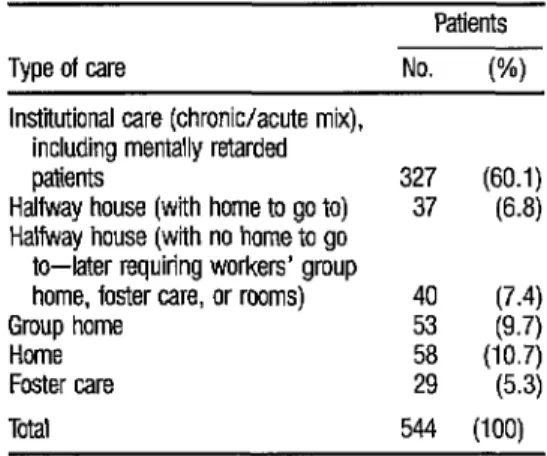
The results obtained by processing the assessment form data in the described manner are shown in Table 1. It should be noted that the “Institutional care” category included 75 mentally re- tarded patients, leaving 252 patients requiring a chronic/acute setting (prin- cipally the latter). The international standard for provision of acute psychiat- ric beds is one bed per thousand population; the findings reported here are in accord with that figure.
Concluding Remarks
The method presented here appears satisfactory, but only up to a point. Essentially, it deals with an existing popu- lation and assumes that if no changes in the mental health delivery system are made then the proportions of patients requiring certain types of care will not vary over time. It should be regarded, therefore, as a gross planning tool that gives preliminary indications of the size of the problem confronting pol- icymakers, resource allocators, and clinicians. It should not be viewed as pro- viding data that will remain valid after changes have been implemented.
TABLE 1. AUowtfon indiid by the algorithm of the 544 patients studied to the various types of care listed.
Patients Type of care No. (%) Institutional care (chronic/acute mix),
including mentally retarded patients
Halfway house (with home to go to) “: @O-‘) 63.8) Halfway house (with no home to go
to-later requiring workers’ group
home, foster care, or rooms) 40 (7.4) Group home 53 (9.7) Home
Foster care ;; w; Total 544 (100)
298
However, given the method’s ease and low cost of administration, as well as its beneficial side-effect of sensitizing nursing personnel to patients’ capaci- ties, it appears to provide a useful trigger for the planning process involved in preparing to decant a psychiatric hospital.
Acknowledgments
The psychiatric study team that devel- oped the patient assessment methodology described in this article consisted of the following people: Denis Lazure and Pat Bannister (psychiatrists of Montreal, Canada, and Barbados, respectively); Stephany Grasset and Clorine Brewster (nurses of Vancouver and Barbados); Sybil Patterson and David Clarke (social workers of Guyana and Barbados); Mark Wheeler (fi- nancial analyst of York, United Kingdom); and Morton Warner and Cortez Nurse (health planners of Cardiff, United Kingdom, and Barbados).
Jose Dekovic assisted in the manu- script review, as did Halmond Dyer, who in his role as Caribbean Program Coordinator also gave continuing advice and support to the study team.
References
1
2
3
4
5
G
7
8
9
10
11
World Health Organization. Organization of Mental Health Services in Developing Coun- tries: Sixteenth Report of the WHO Expert Conzmittee on Mental Health. WHO Technical Report Series, No. 564. Geneva, 1974.
Social Services Committee. Second Re art:
Adult Mental/y IL and Mental/y Han dp icapped People. HMSO, London, 1985. Community Care with Special Reference to
Pan American Health Organization. Health for Al by the Year 2000: PLan of Action for the Implementation of Regional Strategies. PAHO Off&I Document 179. Washington, D.C., 1982.
Garrad, J., and A. E. Bennett. A validated interview schedule for use in population sur- veys of chronic disease and disability. Br J Prev SOC Mea’ 12 ~97, 197 1.
Harris, A., E. Cox, and C. R. W. Smith. Handicapped and Impaired in Great Britain. HMSO, London, 1971.
Katz, S., A. B. Ford, R. W. Moscowitz, et al. Studies of illness in the aged: The index of independence in activities of daily living. JAMA l&5:914, 1965.
Wright, K. G. Alternative Measures of the Output of Social Programs: The Elderly. In: A. Culyer. Economic Policies and So&l Goals: Aspects of Public Choice. Bath, Martin, Ro- binson, 1974, pp. 239-272.
Wylie, C. M., and B. K. White. A measure of disabilities. Activities of EnvironmentaL Heabh 8:834, 1964.
Williams, R. G. A., M. Johnston, L. A. Willis, et al. Disability: A model and measure- ment technique. BrJ Prev SOG Med 30:71, 1976.
Wood, I? A. N. Taxonomic considerations in the approach to classification of chronic dis- eases and its consequences, In: Proceedingr of the Society of Social Medicine Symposium, 1Jth September 1976. Society of Social Medicine, 1976.
ANNEX 1. The patient assessment form devised by the study team that was administared to the patients at a 570-bed institution in Barbados.
RECORD NO. m
PATIENT ASSESSMENT STUDY
A. DEMOGRAPHIC
ASSESSOR’S NAME: 1. HOSPITAL CODE
m
2 AGE m 3. SEX: MALE/-JWARD OF PATIENT: FEMALE
NAME OF PATIENI: 4. MARITAL STATUS
[ ] SINGLE [ ] VISITING [ ] COMMON LAW [ ] MARRIED [ ] DIVORCED [ ] SEPARATED [ ] WIDOWED
5 YEAR OF FIRST ADMISSION 6. YEAR OF CURRENT ADMISSION 7. NUMBER OF PREVIOUS ADMISSIONS B. MEDICAL
(MARK IF CONDITION IS PRESENT)
[ ] LIMB AMPUTATION [ ] MILD DIABETES [ ] INSULIN DEPENDENT DIABETES [ ] EPILEPSY: CONTROLLED [ ] EPILEPSY: UNCONTROLLED [ ] DISABLING ARTHRITIS [ ] CHRONIC LEG ULCERS [ ] CHRONIC RESPIRATORY CONDITION [ ] ADVANCED MALIGNANT DISEASE [ ] HYPERTENSION: CONTROLLED [ ] HYPERTENSION: UNCONTROLLED [ ] SUICIDAL
[ ] PARALYSIS: UPPER LIMB-LEFT [ ] PARALYSIS, UPPER LIMB-RIGHT [ ) PARALYSIS: LOWER LIMB-LEFT [ ] PARALYSIS: LOWER LIMB-RIGHT C. COMMUNICATION [ ] WEARS GLASSES [ ] USES HEARING AID
(i) VISION [ ] UNIMPAIRED [ ] ADEQUATE FOR PERSONAL SAFM [ ] DISTINGUISHES ONLY LIGHT OR DARK [ ] BLIND-SAFE
IN FAMILIAR [ ] BLIND-REQUIRES ASSISTANCE LOCALE
(ii) HEARING [ ] UNIMPAIRED [ ] MILD IMPAIRMENT [ ] MODERATE [ ] IMPAIRED- [ ] TOTALLY DEAF IMPAIRMENT INADEQUATE FOR
BUT ADEQUATE SAFETY FOR SAFETY
(iii) UNDERSTANDING [ ] UNIMPAIRED [ ] UNDERSTANDS SIMPLE
PHRASES ONLY [ ] UNDERSTANDS KEY WORDS ONLY [ ] ;;J;Rf;NDING [ ] NOT RESPONSIVE
D. ACTIVITIES OF DAILY LIVING [ ] USES CANE [ ] USES WALKER [ ] USES CRUTCHES [ ] USES WHEELCHAIR [ ] ;JHE; PROSTHESIS
(i) AMBULATION [ ] INDEPENDENT IN
ENVIRONMENT [ ] INDEPENDENT IN EXISTING ENVIRONMENT ONLY [ ] REQUIRES SUPERVISION [ ] REQUIRES OR MINOR OCCASIONAL ASSISTANCE [ ] REQUIRES SIGNIFICANT
OR CONTINUED ASSISTANCE
(ii) TRANSFER [ ] INDEPENDENT [ ] fU;;;;lSION FOR: [ ] INTERMlllENT ASSIST. [ ] ;O;;;;UED ASSIST. [ ] COMPLETELY DEPENDENT
[ IBm FOR ALL MOVEMENT
[ ] CHAIR [ ] CHAIR [ ] CHAIR [ ITOILET [ ITOILET [ ]TOIL!ZT
ANNEX 1. (continued)
(iii) BATHING [ ] INDEPENDENT [ ] REQUIRES MINOR [ ] REQUIRES CONTINUED [ ] RESISTS rH;4T;ROR [ ] INDEPENDENT WITH MECHANICAL ASSISTANCE OR ASSISTANCE
AIDS SUPERVISION
(I) DRESSING [ ] INDEPENDENT [ ] SUPERVISION AND/ [ ] MUST BE DRESSED [ ] RESISTS OR CHOOSING OF [ ] PERIODIC DAILY PARTIAL OR
CLOTHING HELP
(v) GROOMING/HYGIENE [ ] INDEPENDENT [ ] REQUIRES REMINDER [ ] REQUIRES ASSIST
MOTIVATION AND/OR WITH SOME ITEMS [ ] REQUIRES ASSISTANCE TOTAL [ ] RESISTS DIRECTION
(vi) EATING [ ] INDEPENDENT [ ] INDEPENDENT WITH SPECIAL PROVISION FOR DISABILITY
[ ] REQUIRES INTERMITrENT HELP
[ ] MUST BE FED [ ] RESISTS (vii) BLADDER CONTROL [ ] TOTALLY [ ] ROUTINE TOILETING [ ] INCONTINENT [ ] INCONTINENT
CONTINENT OR REMINDER [ ] INCONTINENCE TO IDENTIFIABLE DUE LESS THAN ONCE MORE THAN FACTORS PER DAY ONCE PER DAY (viii) BOWELCONTROL [ ] TOTALLY
CONTINENT [ ] ROUTINE OR REMINDER TOILETING [ ] INCONTINENCE TO IDENTIFIABLE DUE [ ] INCONTINENT [ ] INCONTINENT LESS THAN ONCE MORE THAN ONCE FACTORS PER DAY PER DAY
E. MENTALHEALTH
COMPREHENSION MEMORY
[ ]GDDD [ ] FAIR [ ] POOR [ ]GOOD [ IFAIR [ ]POOR
REALITY ORIENTATION
[ ]GDOD [ IFAIR [ ]POOR
E SOCIAL BEHAVIOR
NOPROBLEM
(i) PHYSICALLY ASSAULTIVE
(peapIe and things) [I
(h) VERBALLY SCREAMING/THREATENING (iii) INAPPROPRIATE UNDRESSING/EXWSURE (ii) OVERACTIVITY (manic)
(v) UNDERACTIVI’IYISOCIAL WITHDRAWAL (vii) BIZARRE MANNERISMS/SPEECH
G. WORKPERFORMANCE
DOES THE PATIENT WORK? ANY? [ IYES
$
2 .
3
H. SOCIAL ACTIVITIES 2.$ (i) RECREATION/SPORTS
a (ii) CULTURAL G (iii) CHURCH
[ I [ I [ 1 [I [ 1
[ ] WITH NO SUPERVISION [ ] WITH SOME SUPERVISION [ ] TOTALLY SUPERVISED
NEVER
[ I [ 1 [ I
SOMEPROBLEM
[ 1 [ I [ 1 [ I [ I 1 1
[ INO
BECAUSE?
OCCASIONAL
[ I I I [ 1
INTOLERABLE
[ 1 I I [ 1 [ I [ 1 [ I
[ ] THEY CANNOT [ ] THEY WILL NOT [ ] NO WORK AVAILABLE
REGULAR
ANNEX 1. (continued)
J. MISCELLANEOUS
(i) DOES PATIENT HAVE REGULAR VISITORS? [ INo [ ] RELATIVES (at least weekly)
(ii) DOES PATIENT WANT TO LEAVE HDSPITAL? [ ] VERY MUCH [ IYEs (iii) LOCATION DESIRED? [ ] OWN HOME [ ] FAMILY HOME [ ] PRIVATE NURSING HOME (ii) IS THERE A DOMESTIC HOME TO WHICH THE PATIENT CAN GO? [ IYEs
[ ] FRIEND(S)
[ 1 ND (gotoJWl1
[ ] HOME FOR THE ELDERLY
[ INO
ASSESSOR’S RECOMMENDATION (ONE CHOICE ONLY) PATIENT IS ELIGIBLE FOR
[ ] RETURN TO OWN HOME [ ] RETURN TD HOME OF FAMILY [ ] NURSING HOME CARE [ ] HALFWAY HOUSE [ ] GROUP HOME CARE
ANNEX 2. Instructions provided to assessors for completing the form shown in Annex 1. INSTRUCTIONS TO ASSESSORS
RECORD NO.: Each form has been preceded. Do not change code.
ASSESSOR AND PATIENT DETAILS: Fill in accurately in order that if there are queries a check can be made.
A. DEMOGRAPHIC
lTEM 1: HOSPITAL CODE
Code appropriately as follows: 01 Psychiatric Hospital 07 Evalina Smith Ward 08 St. Andrew’s Hostel
ITEM 2: AGE
Right justify as follows:
e.g., for age 85 years Lols15)
ITEM 3: MARITAL STATUS
Be as accurate as possible. Whilst the inpatient population would not have responded to the census, think of the options presented in this way
ITEM 4: YEAR OF FIRST ADMISSION
lTEM 5: YEAR OF CURRENT ADMISSION
ITEM 6: NUMBER OF PREVIOUS ADMISSIONS
ANNEX 2. (continued) B. MEDICAL
Ascertain this information from the nurse-in-charge of the ward, and check, where necessary with the record.
C. COMMUNICATION
0. ACTIVITIES OF DAILY LIVING
E. MENTAL HEALTH
E SOCIAL BEHAVIOR
These will form the principal subjects of the training session put:
P/ease beware of automatically classifying patient function at its worst just because the individual is in a hospital. 0. WGRK PERFORMANCE
Note here the branch line of responses for “YES” and “NO.” A subsequent question is asked in each case.
H. SOCIAL ACTIVITIES
“Cultural” can be separated from “Recreation” by defining it as involving art, reading, etc. as opposed to dancing, bingo, etc.
“Church” is a lcose expression, but is meant to indicate the patient’s involvement in religious practices at any place.
I. MISCELLANEOUS
(i) Note, visitors must come at least weekly and either “no,” or “relatives,” or “friend(s),” or “relatives” and “friends” can be answered.
Ward staff should assist with this question.
(ii) (iii) Please ensure it is the patient, withouf influence, who answers these questions. (iv) Answer, in consultation with ward staff.
ASSESSOR’S RECOMMENDATION (ONE CHOICE ONLY)
This recommendation must assume the existence of a variety of options even though they do not occur in Barbados at the moment.
Consult with ward staff before making a final determination.