Bull Pan Am Health Organ 12(l), 1978.
INTEGRATED LEPROSY CONTROL IN GUYANA1
A. C. McDougall2 and P. Rose’
Guyana instituted a ‘ffind and treat” le@rosy program in 1971 that made use of existing out-patient facilities and stuff. The program, based on an integrated domiciliary approach to
diagnosis, treatment, and examination of contacts, has proved successful. This article describes development of the program and discusses the prospects for control and eventual eradication of leprosy in Guyana.
Introduction
Leprosy control in Guyana began with
the foundation of the Mahaica Lepro-
sarium in 1858, and until 1971 this facility handled the vast majority of all leprosy patients at some stage of their illness. Dr. F. G. Rose, M.D., M.R.C.P., father of the late
Governor-General of Guyana, was Medical
Superintendent from 1926 until his death in 1943. Since then there have been more than a dozen doctors in charge at various times, the most recent being Dr. Kim Do 11 from Korea. His detailed report, submitted to the Statistics Office of the Ministry of Health in 1974, concluded that because of rising costs and falling admissions, Mahaica’s existence as a leprosarium was no longer justified.
In 1971 a “find and treat” program was inaugurated. Operating as an integrated
part of Guyana’s health services, the
program’s object was to use a domiciliary approach from the outset in finding and
treating new cases and examining their
contacts, thus demonstrating the humani- tarian, medical, and economic advantages of out-patient control. The present article
‘Also appearing in Spanish in the BoEetCn de la
Oficina Sanitaria Panamericana, 1978.
2Leprosy Research and Clinical Investigation, The Slade Hospital, Headington, Oxford OX3 7JH, United Kingdom.
SMedical Officer of Health, Leprology, The Ministry of Health, Georgetown, Guyana.
describes the program’s development and
progress over five years in a community
where both the general public and the
victims of the disease had been accustomed to the concept of segregation for over a century.
Background Information on Guyana
The 1970 census estimated Guyana’s
population at 714,233. Between then and
1976 the total is estimated to have risen to about 785,000. Some 90 per cent of these inhabitants live in a strip of land 10 to 40 miles wide along the 270-mile coast. The country contains 83,000 square miles in all, and is divided by large rivers into three counties.
Essequibo, the largest county, borders on Venezuela and Brazil; it contains only 14
per cent of the population. Demerara
County, in the center, has 60 per cent of the people. Berbice County, to the east (border-
ing Surinam), contains the remaining 26
per cent. Forty-five per cent of the inhab- itants are under age 15, 41 per cent are between 15 and 44, and the remainder are over 44. The crude birth rate is 40 per 1,000, and the crude death rate is seven per 1,000.
The 1975 gross domestic product was
1,093 million Guyana dollars4 and the
4G$1.00 = US$O.39 = 22 new pence Sterling.
12 PAHO BULLETIN l vol. XII, no. 1, 1978
health budget was 29 million dollars. This latter figure appears small in comparison with those of several neighboring Carib- bean countries (see Annex): but the impres-
sion is misleading, because many non-
Government agencies-including city and
town councils, mining companies, and
sugar estates-have contributed significant- ly to running the health services.
Prevalence, Incidence, and Classification of Leprosy Cases
No information dating back before 1905 is available, but from that year on accurate registers were kept. A detailed analysis of them in 1971 revealed that 1,022 patients were “not under surveillance”; this cate-
gory included patients who were “not
accounted for” and “no longer in the area,” as well as those who had emigrated and those discharged from treatment.
Of 112 patients who were successfully traced but not contacted during 1971-1975, 41 had died and 71 had emigrated: 24 of the emigrants had gone to the United States, 20
had gone to the United Kingdom, and 16
had gone to Canada. Persistent inquiry and follow-up reduced the number of patients
“not under surveillance” from 1,022 in
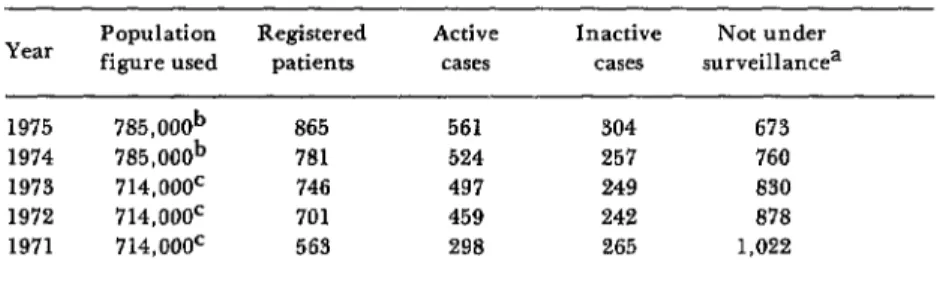
1971 to 673 in 1975 (Table 1).
The total number of leprosy patients registered in Guyana on 31 December 1975
was 865. Routine skin smears (often
augmented by biopsy of selected skin sites) and clinical examinations indicated that 561 of these patients had active disease and the remaining 304 had inactive disease. Of the inactive cases, 154 are merely kept under surveillance and receive no treat- ment. The other 150, many of which are
lepromatous cases, continue receiving
Dapsone.
Prevalence information is provided in
Table 1. Considering the difficult terrain and the problems involved in surveying or
even sampling a significant share of
Guyana’s population-and applying the
principles outlined by Leprosy Advisory
Teams for WHO (Bechelli and Martinez
Dominguez, 1966)-it seems reasonable to
estimate that there could be twice as many cases as are currently under surveillance.
The numbers of new cases registered each year since 1960 are shown in Table 2, along with the sex and racial origins of the patients. Classification of cases under treat-
ment for long periods before 1971 has
proved difficult, but the 250 cases registered in 1971-1975 have been classified as follows: lepromatous cases-70 (28 per cent); dimor- phous cases-154 (62 per cent); and tuber- culoid cases-26 (10 per cent). The propor- tions of tuberculoid and dimorphous cases have risen progressively; and this increase has been mirrored by an increasing percent-
age of diagnoses confirmed by biopsy,
Table 1. Yearly case prevalence and clinical status of leprosy patients in Guyana, 1971-1975.
Year Population figure used Registered Active Inactive Not under patients cases cases surveillancea
1975 785,000b 865 561 304 673
1974 785,000b 781 524 257 760
1973 714,oooc 746 497 249 830
1972 714,oooc 701 459 242 878
1971 714,oooc 563 298 265 1,022
aIncludes patients discharged before 1971 who were not reexamined. bEstimated.
McDougall and Rose 9 LEPROSY CONTROL IN GUYANA 13
Table 2. Leprosy patients registered in 1961-1975, listed by year of registration, sex, and racial origin.
Year
Sex Race
No. of
new patients M F African Indian Mixed Amerindian Othera
1975 54 24 30 34 15 4 0 1
1974 34 17 17 20 11 3 0 0
1973 38 17 21 18 13 6 1 0
1972 70 32 38 25 36 7 0 2
1971 54 32 22 29 22 2 0 1
1970 2 1 1 1 1 0 0 0
1969 14 7 7 2 7 3 0 2
1968 13 7 6 10 0 1 0 2
1967 17 11 6 5 10 2 0 0
1966 33 19 14 18 11 4 0 0
1965 38 20 18 18 16 3 0 1
1964 14 5 9 8 4 1 0 1
1963 26 9 17 11 11 3 0 1
1962 61 37 24 20 31 8 0 2
1961 39 23 16 20 13 3 0 3
aIncludes Orientals and Caucasians (mostly of Chinese, Brazilian, English, French, or Portuguese extraction).
together with a drop in the number and percentage of patients with positive smears. No pure neural cases have been encount- ered. Although a few cases have been classed as indeterminate during limited periods of clinical observation, this classification has ultimately been avoided by means of skin biopsies in all doubtful cases.
Development of Out-Patient Clinics since 1971
Working out of Georgetown Hospital’s
Public Health Clinic, a domiciliary pro- gram was started in 1971. This program’s aim was to find and treat patients and to examine their contacts on a strictly domi- ciliary basis.
Fourteen clinics now participate in this program along the coast, where the popula- tion is densest. These extend from Parika, 21 miles west of Georgetown, to Skeldon on the Corentyne River, only a few miles from the Surinam border. In addition, there is
one clinic situated inland at Linden
Hospital, 70 miles to the south in a bauxite mining area. All these clinics are visited regularly by the Government leprologist and a mobile staff consisting of a driver, a nurse, and a laboratory technician.
Emphasis is being given to integration of leprosy control activities into the normal working pattern of each clinic; they are run as “skin clinics,” and simple remedies are offered to all who come. Attendance rates for leprosy patients-over 85 per cent
during the program’s five years-are
remarkably high.
Diagnosis and registration of leprosy cases
are based on clinical examinations sup-
ported by data from skin scrapings. The latter (together with skin biopsies in selected cases) are taken on the spot and interpreted the next day at the clinic in Georgetown.
Leprosy is a notifiable disease in Guyana. Full details are recorded and are reported monthly to the Ministry of Health. Since
the start of the program in 1971, 920
14 PAHO BULLETIN . vol. XII, no. I. 1978
The estimated cost of running this out- patient “find and treat” service is approxi- mately $0.34 (34 Guyana cents) per patient per day, as compared to $9.16 per day for in- patient leprosarium care.
The Mahaica Leprosarium Today
At the end of 1975 there were 76 in- patients at Mahaica, almost all advanced in age or disabled. They had remained there largely for sociological reasons. Another 187 patients were living in the environs of
Mahaica and were receiving treatment or
supervision from the leprosarium, together with subsidizedemployment. Medical, para- medical, and administrative staff members
at Mahaica have to some extent been
“stranded” by the marked reduction of in- patients. Furthermore, the high running costs of this institution have led inevitably to the conclusion that it should be closed as a leprosarium and converted into a general hospital. Plans for doing so are now under discussion.
Discussion and Conclusions
The critical conversion of attitudes
required for the shift from a leprosarium
approach to an out-patient approach was
achieved only through persistent and clear
delineation of the benefits that would
accrue to the patients, their families, and the health services. Facilities have become more readily and willingly available during the five years of the program, and the whole
area covered now harbors virtually no
opposition to the presence of leprosy
patients in what are essentially general clinics. It appears that the practical demon- stration of leprosy diagnosis and treatment on an out-patient basis has made its mark.
In 1975, for the first time in the history of leprosy in Guyana, there were no admis- sions to the leprosarium. It is still to be regretted, however, that the “most powerful tool available for public health education
in leprosy” (Hasselblad, 1975), namely the definitive closure of the Mahaica Lepro- sarium or its conversion to a general hos- pital, has yet to be achieved. This institu- tion is expensive and outmoded: if its opera- tion were continued, this could be inter- preted as showing lingering reservations by the authorities about the policy of inte- grated out-patient leprosy control.
The number of leprosy patients in
Guyana is small compared to the 212,456 cases registered in the 33 countries and territories of the PAHO Region in 1974, and at first one is inclined to think that
Guyana could eradicate the disease or
reduce it to very low levels. Yet a nagging yearly incidence of new cases in purely Guyanese subjects from various parts of the country suggests that undiscovered foci of infection may exist. In this respect the situation is reminiscent of that prevailing in
Spain and various other European coun-
tries, where the yearly incidence shows little sign of dropping despite the provision of all necessary facilities for treatment.
An even closer parallel exists in French Guiana, where the number of new notifica- tions remains more or less constant from year to year, despite good coverage of the population and vaccination of all children with BCG since 1961 (SCrie, et al., 1973). The male-female ratio, the age distribution of new patients, and the proportions of the various types of leprosy have also remained
unchanged; the authors consider that
factors other than the mere presence of
leprosy bacilli may have an important
bearing on this situation.
McDougall and Rose l LEPROSY CONTROL IN GUYANA 15
stantially below the proportion (54 per cent)
in the Hemisphere as a whole (PAHO,
1974), it nevertheless represents a consider- able number of people who are now fully believed to be potent disseminators of bacilli from the nose before diagnosis and treat- ment .(Lancet, 1976). In view of leprosy’s long incubation period, it is more than likely that some of the new patients arriving in recent years have been infected by these lepromatous patients, or by other people with lepromatous cases who are now nasal excretors but whose cases are not clinically
recognizable. A few high-incidence foci
have been revealed and others are suspected, but (as in other parts of the world) a signifi- cant number of all patients interviewed give no history of any family or other close association with an index case.
In looking toward more effective control and the eventual eradication of leprosy in Guyana, it is our belief that “accumulated” prevalence figures have little more to con- tribute: incidence figures, on the other
hand, are likely to be highly significant (Kyaw Lwin and Zuiderhoek, 1975). If the incidence does not drop with continuing
regular treatment of lepromatous cases,
intensive health education, and examina- tion of schoolchildren and household con- tacts, there may be cause for a detailed epidemiologic study of all new patients diagnosed, certainly in recent years, and perhaps retrospectively to the beginning of the out-patient program in 1971. A study of this kind could be expected to reveal new cases, some of them possibly lepromatous
but with no obvious symptoms and few
clinical signs. Moreover, if such a study were undertaken by a research council or an international organization working with the existing staff, this might reveal valuable information contributing toward the eradi- cation of leprosy, not only in Guyana, but also in other countries where the disease smoulders inexplicably, despite the exis- tence of adequate facilities for diagnosis and treatment.
ACKNOWLEDGMENTS
The author’s work was supported by Guyana in April 1975 was sponsored by the
grants from the United Kingdom Medical Medical Branch of the Guyana National
Research Council and the British Leprosy Science Research Council. Relief Association (LEPRA). His visit to
SUMMARY
Guyana’s leprosy problem is small compared to that of some South American countries. On the other hand, there is a nagging incidence of new cases, despite adequate treatment and diag- nostic facilities, which is similar to the situation found in portions of the neighboring Caribbean and in some other parts of the world.
After more than a century of leprosarium- based treatment, a “find and treat” program using existing out-patient facilities was initiated in 1971. This has proved successful and has been well-accepted by patients, medical staff members, and the general public.
16 PAHO BULLETIN . vol. XII, no. 1, 1978
fact, there may be a case for conducting a only in Guyana, but also in other countries detailed epidemiologic study of all new cases with a small yearly incidence, where the disease diagnosed since 1971. Such a study might is potentially-but not actually-under control. contribute toward the eradication of leprosy not
REFERENCES
(1) Kim Do Il. Mahaicu Hosjn’tal Annual Re#ort. Health Statistics Office, Ministry of Health, Georgetown, Guyana, 1974.
(2) Bechelli, L. M., and V. Martinez Domin- guez. The leprosy problem in the world. Bull
WHO 34:811-826, 1966.
(3) Hasselblad, 0. W. Leprosy Survey: Surinam. PAHO consultant document, April 1975. Pan American Health Organization, Washington, D.C., 1975.
(4) Erie, Cl., G. Sabourin, G. Dujeu, and J. Mercier. Considerations sur l’end&mie hanse-
nienne en Guyane Francaise. Bull Sot Puthd Exot 66:371-380, 1973.
(5) Pan American Health Organization.
Annual Report of the Director 1974. PAHO Official Document No. 136, Washington, D.C., 1975.
(6) The nose and leprosy (editorial). Lanced
1:1062, 1976.
(7) Lwin Kyaw, and B. Zuiderhoek. Case detection rates for Central Burma. Znt J Lepr 43:125-128. 1975.
ANNEX
Caribbean government expenditures (total expenditues and health expendit-) in 1973. a
Country
Total government expenditures,
expressed in national currency (thousands of units)
Expenditures on health (thousands of units)
Health Per capita
expenditures expenditures as Y0 of total (in US expenditures dollars)
Barbados 128,009 19,945 15.6 40.7
Antigua 32,494 4,478 13.8 30.1
Trinidad 465,114 56,088 12.1 26.4
Jamaica 362,567 36,583 10.1 22.3
Guyana 173,629 13,618 7.8 8.3