www.bjorl.org
Brazilian
Journal
of
OTORHINOLARYNGOLOGY
ORIGINAL
ARTICLE
Rhinitis
as
an
associated
factor
for
anxiety
and
depression
amongst
adults
夽
Martín
Bedolla-Barajas
a,∗,
Jaime
Morales-Romero
b,
Norma
Angélica
Pulido-Guillén
c,
Martín
Robles-Figueroa
d,
Brenda
Renata
Plascencia-Domínguez
eaHospitalCivildeGuadalajara‘‘Dr.JuanI.Menchaca’’,Servic¸odeAlergiaeImunologiaClínica,ColoniaLaPerla,Guadalajara,
Jalisco,Mexico
bUniversidadVeracruzana,InstitutodeSaludPública,ColoniaIndustrialÁnimas,Xalapa,Veracruz,Mexico cUniversidadTecnológicadeGuadalajara,LicenciaturaenPsicología,Guadalajara,Jalisco,Mexico
dHospitalCivildeGuadalajara‘‘Dr.JuanI.Menchaca’’,EspecialidadenMedicinaInterna,ColoniaLaPerla,Guadalajara,Jalisco,
Mexico
eUniversidaddeGuadalajara,CentroUniversitariodeCienciasdelaSalud,ColoniaIndependenciaOriente,Guadalajara,Jalisco,
Mexico
Received23February2016;accepted16May2016 Availableonline16June2016
KEYWORDS Anxiety; Depression; Allergicrhinitis; Adults
Abstract
Introduction:Anxietyanddepressionarefrequentdisordersofchronicdiseases,yetthereis noconclusiveinformationtotheirassociationwithrhinitis.
Objective:The objectiveis to determine the frequency of anxiety and depressionand its possibleassociationtoallergicrhinitis(AR)andnon-allergicrhinitis(NAR).
Methods:This is across-sectional study in which procured subjects with AR(n=111), NAR (n=34)andacontrolgroup(n=96)fromtheuniversityhospital.Thepresenceofanxietyand depressionwasconsideredwhenitreachedascore>13basedonTheBeckAnxietyInventory TestandTheBeckDepressionInventoryIITest,respectively.TheassociationbetweenARand NARwithanxietyanddepressionwasadjustedwiththeMantel---HaenszelMethodandlogistic regression.
Results:ThefrequencyforanxietyinAR,NARandthecontrolgroupwas45.9%,52.9%,10.4%, respectively (p<0.001);depressionfrequency was38.7%, 47.1%,16.6% (p=0.0003), respec-tively. Both AR and NAR were associated to anxiety and depressionin women, but not to men.Afteradjusting thesex:ARwas associatedtoanxiety(OR=5.7,p<0.001)and depres-sion(OR=2.5,p=0.015),whileNARwas also associatedto anxiety(OR=7.8,p<0.001)and depression(OR=3.3,p<0.014).InmultivariateanalysisitwasidentifiedthatAR,NARandthe
夽 Pleasecitethisarticleas:Bedolla-BarajasM,Morales-RomeroJ,Pulido-GuillénNA,Robles-FigueroaM,Plascencia-DomínguezBR.Rhinitis
asanassociatedfactorforanxietyanddepressionamongstadults.BrazJOtorhinolaryngol.2017;83:432---8.
∗Correspondingauthor.
E-mail:[email protected](M.Bedolla-Barajas).
PeerReviewundertheresponsibilityofAssociac¸ãoBrasileiradeOtorrinolaringologiaeCirurgiaCervico-Facial. http://dx.doi.org/10.1016/j.bjorl.2016.05.008
individual’s sex(women) werefactorsassociatedtoanxietyanddepression.Resultsshowed thatagewasonlyassociatedtoanxiety.
Conclusion: ARandNARarediseasesassociatedtoanxietyanddepression,atleastinwomen. © 2016 Associac¸˜ao Brasileira de Otorrinolaringologia e Cirurgia C´ervico-Facial. Published by Elsevier Editora Ltda. This is an open access article under the CC BY license (http:// creativecommons.org/licenses/by/4.0/).
PALAVRAS-CHAVE Ansiedade;
Depressão; Rinitealérgica; Adultos
Rinitecomofatorassociadoparaansiedadeedepressãoentreadultos
Resumo
Introduc¸ão: Ansiedadeedepressãosãodistúrbiosfrequentesemdoenc¸ascrônicas,emboranão hajanenhumainformac¸ãoconclusivaàsuaassociac¸ãocomarinitealérgica.
Objetivo: Oobjetivo doestudo édeterminara frequênciade ansiedadee depressãoe sua possívelassociac¸ãoarinitealérgica(RA)erinitenãoalérgica(NRA).
Método: Estudotransversal,noqual indivíduoscomRA(n=111),NRA(n=34)e umgrupo controle(n=96)foramrecrutadosapartirdohospitaluniversitário.Apresenc¸adeansiedade e depressãofoi considerada quandoatingiuuma pontuac¸ão >13 noTeste doInventáriode Ansiedade de Becke noTeste II do Inventáriode Depressão de Beck, respectivamente. A associac¸ãoentreaRAeRNAcomansiedadeedepressãofoiajustadacomoMétodode Mantel-Haenszeleregressãologística.
Resultados: AfrequênciadeansiedadenaRA,RNAegrupocontrolefoide45,9%,52,9%,10,4%, respectivamente(p<0,001);afrequênciadedepressãofoide38,7%,47,1%,16,6%(p=0,0003), respectivamente.TantoaRAcomoaRNAforamassociadasaansiedadeedepressãoem mul-heres,masnãoparaoshomens.Depoisdeajustarosexo:RAfoiassociadaàansiedade(OR= 5,7,p<0,001)edepressão(OR=2,5,p=0,015),enquantoaRNAfoiassociadaaansiedade(OR =7,8,p<0,001)edepressão(OR=3,3,p<0,014).Naanálisemultivariadaidentificou-seque aRA,RNAeosexodoindivíduo(mulheres)foramfatoresassociadosaansiedadeedepressão. Osresultadosmostraramqueaidadesófoiassociadaàansiedade.
Conclusão:RAeRNAsãodoenc¸asassociadasaansiedadeedepressão,pelomenosemmulheres. © 2016 Associac¸˜ao Brasileira de Otorrinolaringologia e Cirurgia C´ervico-Facial. Publicado por Elsevier Editora Ltda. Este ´e um artigo Open Access sob uma licenc¸a CC BY (http:// creativecommons.org/licenses/by/4.0/).
Introduction
By definition, rhinitisis an inflammatory alterationof the nasal mucus;which is alsocharacterized by thepresence of twoor more of the following symptoms:nasal conges-tion,rhinorrhea,itchiness, sneezing,anddailyalterations ina patientssenseofsmellfor over anhour.1By classify-ingthepresenceorabsenceofallergicsensibilization,itis possibletodifferentiate betweenallergicrhinitis(AR)and non-allergicrhinitis(NAR).2
Amongst thelong evolution rhinitis, highlights the AR, disordercausing significantmorbidityanddisability,which affectsthequalityoflifein social,schoolandworkplace; causes a high economic impact aswell asan increase in the consumption of alcoholic beverages and sedatives.2---6 Additionally, this disrupts sleep patterns, along with cog-nitiveandproductivecapacities.3,5Upto43%ofARpatients wakeup feelingtired,thisis reflectedin matterssuchas theirmood andsexual appetite,furthermore,it hasbeen reportedasariskfactorfordepressionandanxiety.5,7,8
The mood disorder characterized by sadness, feelings of uselessness,self-depreciation, andsocial isolation, are knownasdepression;anxiety isthefeelingof restlessness orapprehensionthatactsasadefensemechanismandaids
inmanagingpotentialdanger,thisappearstohavean adap-tivefunctionasitproducesbodilyreactionsthatcanprepare anindividualforthe‘‘fightorflight’’response.9
Thedisordercharacterizedbyanxietyandmoodchanges arecommoninpatientswithchronicdiseases,10---13however, inthecaseofrhinitis,thesesideeffectshavenotyetbeen researchedthoroughly.Fora morein-depthunderstanding oftheseassociations,moreclinicalevidenceisneeded;thus far,moststudiesconcerninganxietyanddepressionas possi-bleconsequencesofrhinitishavebeenepidemiological.14---17 Theobjectivesinthisstudyconsistedofdeterminingthe levelsof anxietyand depression froma groupof patients withARandanothergroupwithNAR;thereafter, we com-paredourresultswithagroupofcontrolsubjects.Thiswas carriedoutinordertoobtainagreaterunderstandingofthe associationthatrhinitishastoanxietyanddepression.
Methods
Ethics
consent form in order to participate, additionally; every individualwasinformedthat ifheor shedeclined to par-ticipate, it would not affect the quality of his or her medical treatment. Immediately thereafter we obtained results fromthe tests thatidentified anxiety and depres-sion, all subjects were informed of their results, and whennecessary,theywereofferedspecializedpsychological attention.
Design
A cross-sectional study was carried out amongst patients with AR symptoms that sought external allergy consulta-tionsinauniversityhospital;thesewerelatercomparedto agroupofpatientswithNARandagroupofhealthypatients (controlgroup).
The recruitment processwas consecutiveand effected fromJuly 2012 toMarch2013. ARpatients wereselected with the following criteria: aged ≥18 and ≤50, they had to be first time allergy consulting patients with a rhinitis diagnosis, regardless of its severity. The second and third groups, respectively, constituted by subjects with NAR (rhinitis symptoms and negative skin prick tests to aeroallergens) and healthy subjects (consisting of blood donors that were consecutively denominated as the control group) whose ages and geographic prove-niencematchedsubjectsfromtheARgroup.Subjectsthat lived outside the city or patients with diabetes melli-tus, arterial hypertension, rheumatoid arthritis, asthma, urticaria,renalfailureorneoplasiaswerenotincludedinour study.
Definitions,instrumentsandscales
All AR diagnoses were clinically established and carried outby a singleallergy specialist. Each participanthad at leastone positive skin prick test toone of the aeroaller-gens tested, these included: grass pollens, weeds, trees, householddustmites,catanddog epitheliums,and atmo-sphericfungi.ARwasclassifiedaccordingtothefrequency ofthesymptoms,asintermittentorpersistent; andbased on the severity, mild or moderate to severe, as rec-ommended by ARIA (Allergic Rhinitis and its Impact on Asthma).2
Anxietyanddepressionsymptomswereevaluatedusing The Beck Anxiety Inventory and The Beck Depression Inventory-II,bothintheSpanishlanguageversionand val-idated in the Mexican population studies.18 These tests consistof21itemswhosesumofpointsobtainedineachof thequestions(63maximumpointspossible)allowthe cat-egorizationof anxiety and depression as: (a) mild (14---19 points),(b)moderate(20---28points)and(c)severe(29---63 points).
Bodymassindexwasdeterminedbyweighingand mea-suring each subject the day of the medical consultation, calculating:weight(kg)/height(m2).
Priortorecruitingourpatients,apilottestwascarried outonfiveindividuals withAR,theywerenotincluded in thefinalanalysis.Thepilottest allowedustocorrectthe selection criteria for subjects and to amend the written questionnaires.
Statisticalanalyses
The clinical and demographiccharacteristics of each sub-jectwereexpressedthroughmeans,standarddeviationsand proportions. The frequency of anxiety and depression, as wellastheirlevelsofseverity,wereexpressedas percent-ageswithineachcomparativegroup(AR,NAR,andcontrol). Generally, independent group proportionswere compared usingChiSquaredtestsor theFisher’sExactTest.Inorder tofindanassociationbetweenARorNARandtheirlinkwith anxiety or depression, theodds ratiowascalculatedwith confidenceintervalsat95%,adjustedbysexthrough strati-fiedanalysisusingtheMantelandHaenszelmethod.Lastly, we useda multivariate logistic regression model to eval-uate the association thatallergic andnon-allergic rhinitis (independentvariables) have withanxiety and depression (dependent variables), while also introducing co-variants (sexandage)intothemodel.Anyvalueofp≤0.05was con-sideredtobestatisticallysignificant.Fordataanalysis,we usedIBMSPSSStatistics(Armonk,NY,USA),version23.0.
Results
Thisstudyincluded241subjectsthatwereplacedintothree groups:allergicrhinitis(n=111),non-allergicrhinitis(n=34) andacontrolgroup(n=96).The meanageforeach study groupwasapproximately30;womenwerethemajority of thepatientswithanytypeofrhinitiswhile menwere pre-dominantinthecontrolgroup(Table1).Withinthecontrol group,almost15%oftheindividualssmokedtobacco,anda littleover50%consumedsomesort ofalcoholicbeverage. Overhalfoftheparticipantstookpartinsometypeof phys-ical activity at least once a week and had an average of 7h of dailysleep.PatientswithARhadpersistentclinical symptomswithmoderate toseverelevels,amongstthese, themost commonaeroallergenwherepollens,principally, thoseoriginatingfromtrees.
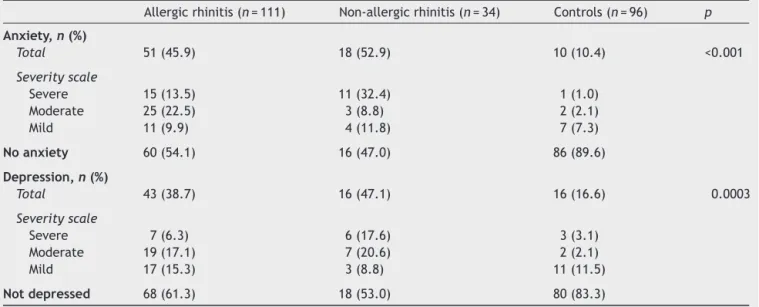
Theglobalanxiety frequencyamongstpatients withAR (51/111; 45.9%) andNAR (18/34; 52.9%) was significantly higher in comparison to subjects from the control group (p<0.001). Similarly, depression frequency amongst those withAR(43/111;38.7%)andinNAR(16/34;47.1%)was sig-nificantly highertothat ofthe controlgroup (p=0.0003). IntheARgroup,moderatelevelsofanxietyanddepression werepredominant;thus,withintheNARgroup,severeand moderatelevelswerepredominant,respectively(Table2).
The frequency of anxiety or depression did not differ accordingtotheintensity andfrequencyofARsymptoms, Table3.
Table1 Clinicalcharacteristicsoftestsubjects.
Allergicrhinitis(n=111) Non-allergicrhinitis(n=34) Controlgroup(n=96)
Meanageinyears±SD 32.9±10.4 36.5±10.4 32.1±9.7
Female,n(%) 82(73.9) 28(82.4) 37(38.5)
Maritalstatus,n(%)
Single 49(44.1) 13(38.2) 40(41.7)
Married 47(42.3) 16(47.1) 41(42.7)
Live-inpartner 8(7.2) 3(8.8) 7(7.3)
Divorced 4(3.6) 0(0) 5(5.2)
Widowed 3(2.7) 2(5.9) 3(3.1)
Currenttobaccointake,n(%) 9(8.1) 2(5.9) 14(14.6)
Currentalcoholintake,n(%) 27(24.3) 4(11.8) 49(51.0)
Symptomfrequency,n(%)
Intermittent, 28(25.2) ---
---Persistent 83(74.8) ---
---Symptomintensity,n(%)
Mild 22(19.8) ---
---Moderate-severe 89(80.2) ---
---Timeofevolution,years±SD 8.2±7.1 7.5±7.9
---BMI,kg/m2±SD 26.1±5.7 27.4±6.2 26.9±3.7
Sensibilization,n(%)
Trees 74(66.7) ---
---Grasses 57(51.4) ---
---Dustmites 53(47.7) ---
---Animalhair 53(47.7) ---
---Weeds 51(45.9) ---
---Cockroaches 41(36.9) ---
---Fungi 10(9.0) ---
---n,subjectswiththecharacteristicsofinterest;SD,standarddeviation;BMI,bodymassindex.
Table2 Frequencyofanxietyanddepressionsymptomsbasedonthetypeofrhinitis.
Allergicrhinitis(n=111) Non-allergicrhinitis(n=34) Controls(n=96) p
Anxiety,n(%)
Total 51(45.9) 18(52.9) 10(10.4) <0.001
Severityscale
Severe 15(13.5) 11(32.4) 1(1.0)
Moderate 25(22.5) 3(8.8) 2(2.1)
Mild 11(9.9) 4(11.8) 7(7.3)
Noanxiety 60(54.1) 16(47.0) 86(89.6)
Depression,n(%)
Total 43(38.7) 16(47.1) 16(16.6) 0.0003
Severityscale
Severe 7(6.3) 6(17.6) 3(3.1)
Moderate 19(17.1) 7(20.6) 2(2.1)
Mild 17(15.3) 3(8.8) 11(11.5)
Notdepressed 68(61.3) 18(53.0) 80(83.3)
n,subjectswithcharacteristicsofinterest.
Table3 Frequencyofanxietyanddepressionbasedontheclassificationofallergicrhinitissymptoms.
Classification Anxiety Depression
n % p n % p
Allergicrhinitis Symptomintensity
Mild,n=22 7 31.8 0.138 7 31.8 0.457
Moderate-severe,n=89 44 49.4 36 40.4
Symptomfrequency
Intermittent,n=28 13 46.4 0.953 9 32.1 0.407
Persistent,n=83 38 45.8 34 41.0
n,subjectswithcharacteristicsofinterest.
p-valuewasobtainedthroughtheChiSquaredtest.
Table4 Riskofanxietyanddepressioninsubjectswithrhinitisadjustedbysex.
Anxiety Depression
OR 95%CI p OR 95%CI p
Allergicrhinitisa
General 7.3 3.44---15.53 <0.001 2.9 1.54---5.62 0.0009
Men 3.4 0.98---12.0 0.06 2.1 0.72---6.23 0.17
Women 7.4 2.62---20.92 <0.001 2.7 1.10---6.62 0.03
Adjustedbysex 5.7 5.58---12.44 <0.001 2.5 1.24---4.90 0.015
Non-allergicrhinitisa
General 9.7 3.78---24.75 <0.001 4.1 1.76---9.70 0.0007
Men 5.4 0.78---37.16 0.12 1.11 0.12---10.66 0.99
Women 8.5 2.56---28.43 0.0002 4.2 1.42---12.30 0.008
Adjustedbysex 7.8 2.79---21.52 <0.001 3.3 1.28---8.25 0.014
OR,oddsratio;95%CI,confidenceintervalsat95%;ORadjustedbyMantelandHaenszel. p-valueobtainedbyusingChiSquaredorFisher’sExactTest.
aComparedvs.controlgroup.
Table5 Multivariatemodelofassociationforallergicandnon-allergicrhinitiswithanxietyanddepression.
Anxiety Depression
OR 95%CI p OR 95%CI p
Allergicrhinitisa 5.9 2.7---13.0 <0.001 2.5 1.3---5.0 0.009
Non-allergicrhinitisa 6.2 2.3---16.7 <0.001 3.3 1.4---8.2 0.009
Sex(female) 2.5 1.2---5.2 0.011 2.1 1.1---4.1 0.027
Age(years) 1.05 1.02---1.08 0.004 --- --- 0.073
ORobtainedthroughlogisticregressionwiththeForwardConditionalMethod. ORswerenotcalculatedforvariablesexcludedfromthemodel.
Allcovariateswerecategorical,exceptage(inyears),whichwasintroducedonacontinuousscale. aComparedvs.controlgroup.
notratifiedinmen,onlywomen.Finally,whenweweighed thesegroups,theassociationremainedstatistically signifi-cantafteradjustingitbysex(Table4).
Table 5 shows the risk of anxiety and depression in patientswithRAand RNAadjusted by multivariate analy-sis.Whencomparedtothecontrolgroup,bothARandNAR wereidentifiedasriskfactors foranxiety anddepression. Furthermore, women presented a higher risk for anxi-ety and depression, becauseage seemed to have a week
significantassociationtoanxiety,itwastakenoutfromthe model.
Discussion
suggeststhattheassociationthatrhinitishaswithanxiety anddepression is specific inwomen. Third,rhinitis itself, andnottheatopicstate,iswhatcausesalterationsof psy-chologicalrelevance.
Both anxiety and depression are mental health prob-lemsthatappearinahigherfrequencyamongstindividuals with diseases of prolonged evolution: chronic urticaria,10 rheumatoid arthritis,11 chronicrespiratory diseases,12 car-diovascular diseases,13 however, only on a few occasions, havethesebeenstudiedinchronicdiseasesofthenose.In ourstudy,overathirdofthetestedpatientswithsometype ofrhinitis denotedthepresence ofanxiety or depression. These findingsareconsistentwithprevious studies,which showthatsubjectswithARorvasomotor rhinitispresent a veryhighfrequencyofanxietythanthecontrolgroup.14,19 Ourstudy clearly illustrates a predominant occurrenceof anxietyanddepressioninwomenratherthanmen,withboth ARandNAR.Consistently,astudybasedonapopulationof adultsshowedthattheprobabilityofpresentingsymptoms fordepressionwasgreaterinwomenthathadahistoryof allergies14;however,itseemsthattheatopicstateisnotthe only linktoanxietyor depression, asthisassociation also occursinwomenaffectedbygastrointestinalillnesses,20,21 skin diseases22 or cardiovascular diseases,13 amongst oth-ers. The most important explanations could be found in family-life and difficult experiences during childhood, as well asaprevious historyof anxiety or depression,social circumstances, culturalnorms and vitaldifficulties.23 Itis necessarytocarryoutfurtherstudiestobetterunderstand the rolethat gender playsin thegenesis ofpsychological disorders.
There are previous studies that suggest there is a link between anxiety and depression to allergies. Buske-Kirschbaum et al.24 observed that patients with atopic dermatitisorallergicrhinitissharedsimilaritiesin person-alitytraits. More recently, in a population studyGoodwin etal.15highlightedthatsubjectswithallergicdiseaseshad a higher frequency of anxiety disorders and mood swings whencomparedtopatientswithoutallergies.Thissuggests thatatopyisassociatedtopsychologicalalterationsandnot to the chronic evolution of the disease. To better clarify this situation, we compared a group of patients with AR andanotherwithNAR, whosesymptoms are indistinguish-able.Surprisingly,weobservedthatinbothrhinitisgroups anxiety and depression were closely associated. Patients with a diminishing or a lost sense of smell, which tend to be followed by processes of chronic nasal inflamma-tion,havebeenassociatedtohighfrequenciesofanxietyor depression.25,26Anotherfactorthatoftenaccompaniesnose diseasesisinflammation;theproductsthatarereleased dur-ingthisprocesscouldexplaintheoriginsofdepressionand anxiety.27
Notwithstanding, we foundnoassociation between the severityofARtoanxietyordepression.Theinformationis inconsistent sinceonepopulationstudy onlyshowed asso-ciationwhenARwasmoderatetosevere andpersistent,28 anotherstudycarriedoutonadolescentswithallergic rhini-tisdidnot findany evidenceof association.29 It hasbeen proposedthattheindividual’sattitudetowardtheillnessis whatdetermines thelevelsof allergicseverity and symp-tomsforanxietyanddepression.30
Limitations
Wheninterpreting thefollowing results, itis necessary to considertheselimitations.First,thelackofconfirmationof thediagnosisofanxietyanddepressionbydirectinterview. Instead,weuseaninstrumentthathasbeenvalidatedinour populationandstronglycorrelateswithconceptsproposed byDSM-IV.AlsoworthnotingthatbothBeckinventories mea-surethe presenceof anxietyand depressionin theweeks beforeandnotduringthepast12monthsorinsomestage oflifeastheyhave done other studies.Second, the diffi-cultytogeneralizeourresultstootheragegroups,sincewe decidedtoevaluateonlyadults18---50yearsold.Third,the difficultyofassessingtheinfluenceofdrugsusedin control-lingthesymptomsofrhinitis,whereithasbeennotifiedthat someofthemarerelatedtoanxietydisordersand depres-sion.Four,wedidnotevaluatethepossibleassociationthat anxietyordepressionhaveindifferentlevelsofseverityfor NAR,aswe didnot have ascale toreference.Lastly,the presentstudyhasitsowncross-sectionalstudylimitations, sinceit isimpossibletodetermineifthe rhinitisprecedes theanxietyorthedepression.
Conclusion
We conclude that patients with AR and NAR, particularly women,haveahigherfrequencyofanxietyanddepression whencomparedhealthysubjects.Itislikelythatthecause ofthisassociationisthechronicnatureofthediseaseand nottheatopyitself.
Conflicts
of
interest
Theauthorsdeclarenoconflictsofinterest.
References
1.SacreHazouriJA.Non-allergicchronicrhinitis.RevAlergMex. 2010;57:85---95.
2.Cagnani CE, Solé D, Díaz SN, ZernottiME, Sisul JC, Borges MS,et al. Allergicrhinitis update and itsimpact on asthma (ARIA 2008). Latin American perspective. Rev Alergia Mex. 2009;56:56---63[inSpanish].
3.Camelo-Nu˜nesIC,SoléD.Allergicrhinitis:indicatorsofquality oflife.JBrasPneumol.2010;36:124---33.
4.DávilaI,MullolJ,FerrerM,BartraJ,delCuvilloA,MontoroJ, etal.Geneticaspectsofallergicrhinitis.JInvestigAllergolClin Immunol.2009;19Suppl.1:25---31.
5.LégerD,Annesi-MaesanoI,CaratF,RuginaM,ChanalI,PribilC, etal.Allergicrhinitisanditsconsequencesonqualityofsleep: anunexploredarea.ArchInternMed.2006;166:1744---8. 6.ManalaiP,HamiltonRG,LangenbergP,KosiskySE,LapidusM,
Sleemi A, et al. Pollen-specific immunoglobulin E positivity is associated withworsening of depression scores in bipolar disorder patients during high pollen season. Bipolar Disord. 2012;14:90---8.
7.GauciM,KingMG,SaxarraH,TullochBJ,HusbandAJ.A Min-nesotaMultiphasicPersonalityInventoryprofileofwomenwith allergicrhinitis.PsychosomMed.1993;55:533---40.
9.Sue D, Sue DW,Sue S. Trastornos delestado de animo. In: Psicopatología Comprendiendo laconducta anormal.9th ed. Latinoamérica:CENGAGELearning;2012.p.303---32.
10.StaubachP,DecheneM,MetzM,MagerlM,SiebenhaarF,Weller K,etal.Highprevalenceofmentaldisordersandemotional dis-tressinpatientswithchronicspontaneousurticaria.ActaDerm Venereol.2011;91:557---61.
11.AmiraO.Prevalenceofsymptomsofdepressionamongpatients with chronic kidney disease. Niger J Clin Pract. 2011;14: 460---3.
12.RyuYJ,ChunEM,LeeJH,ChangJH.Prevalenceofdepression and anxiety inoutpatients withchronic airway lungdisease. KoreanJInternMed.2010;25:51---7.
13.KilziehN,RastamS,MaziakW,WardKD.Comorbidityof depres-sionwithchronicdiseases:apopulation-basedstudyinAleppo, Syria.IntJPsychiatryMed.2008;38:169---84.
14.GoodwinRD,CastroM,KovacsM.Majordepressionandallergy: does neuroticism explain the relationship? Psychosom Med. 2006;68:94---8.
15.Goodwin RD, Galea S, Perzanowski M, Jacobi F. Impact of allergy treatment on the association between allergies and mood and anxiety in a population sample. ClinExp Allergy. 2012;42:1765---71.
16.Sanna L, Stuart AL, Pasco JA, Jacka FN, Berk M, Maes M, etal.Atopicdisordersanddepression: findingsfrom alarge, population-basedstudy.JAffectDisord.2014;155:261---5. 17.AnSY,ChoiHG,KimSW,ParkB,LeeJS,JangJH,etal.Analysis
ofvariousriskfactorspredisposingsubjectstoallergicrhinitis. AsianPacJAllergyImmunol.2015;33:143---51.
18.BeltránM,FreyreM,HernándezL.TheBeckDepression Inven-tory: its validity in adolescent population. Terapia Psicol. 2012;30:5---13.
19.AddoloratoG,AnconaC,CapristoE,GraziosettoR,DiRienzo L, Maurizi M, et al. State and trait anxiety in women affectedbyallergicandvasomotorrhinitis.JPsychosomRes. 1999;46:283---9.
20.Addolorato G, Mirijello A, D’Angelo C,Leggio L, Ferrulli A, Abenavoli L,et al.Stateand traitanxietyand depressionin patients affected by gastrointestinal diseases: psychometric
evaluationof1641patientsreferredtoan internalmedicine outpatientsetting.IntJClinPract.2008;62:1063---9.
21.Alosaimi FD, Al-Sultan OA, Alghamdi QA, Almohaimeed IK, Alqannas SI. Gender-specific differences in depression and anxiety symptoms and help-seeking behavior among gas-troenterologypatientsinRiyadh,SaudiArabia.Neurosciences (Riyadh).2014;19:203---9.
22.Annesi-Maesano I, Beyer A, Marmouz F, Mathelier-Fusade P, Vervloet D, Bauchau V.Do patients with skinallergies have higher levels of anxiety than patients withallergic respira-torydiseases?Resultsofalarge-scalecross-sectionalstudyina Frenchpopulation.BrJDermatol.2006;154:1128---36. 23.Piccinelli M, Wilkinson G. Gender differences in depression.
Criticalreview.BrJPsychiatry.2000;177:486---92.
24.Buske-KirschbaumA, EbrechtM,KernS,GierensA, Hellham-merDH.Personalitycharacteristicsinchronicandnon-chronic allergicconditions.BrainBehavImmun.2008;22:762---8. 25.DiRienzoBusinco L, DiRienzoBusinco A, Lauriello M,Coen
TirelliG.Stateandtraitanxietyinpatientsaffectedbynasal polyposisbeforeandaftermedicaltreatment.Acta Otorhino-laryngolItal.2004;24:326---9.
26.KatotomichelakisM,SimopoulosE,TzikosA,BalatsourasD, Trip-sianisG,DanielidesG,etal.Demographiccorrelatesofanxiety anddepressionsymptoms inchronicsinonasaldiseases.IntJ PsychiatryMed.2014;48:83---94.
27.Müller N, Ackenheil M. Psychoneuroimmunology and the cytokine action in the CNS: implications for psychiatric disorders. Prog Neuropsychopharmacol Biol Psychiatry. 1998;22:1---33.
28.KimDH,HanK,KimSH. Relationshipbetween allergic rhini-tisandmentalhealthinthegeneralKoreanadultpopulation. AllergyAsthmaImmunolRes.2016;8:49---52.
29.AdamiaN,JorjolianiL, Manjavidze N,Ubiria I,SaginadzeL. Psycho-emotionalcharacteristicsoftheadolescentswith aller-gicrhinitis.GeorgianMedNews.2015:38---42.