443
Letters to the Editor Rev Bras Cir Cardiovasc 2008; 23(3): 442-444
Heparin
Santos, July 14 2008
Esteemed Editor
I would like to congratulate Dr. Eduardo Melo and his co-workers by the important study “Heparin Quality Control in the Brazilian Market: Implications in the Cardiovascular surgery” (RBCCV/BJCVS.2008;23(2):169-174). Recently, we have presented in a Nationwide Congress, a theme in which we reported the low incidence of hemostasis reviews resulting from postoperative bleeding (X SCICVESP Congress-Nov/2007). However, due to the withdrawal of Roche’s heparin (Liquemin) and Bayer’s aprotinin, in the likeness of a number of worldwide and Brazilian Cardiac Surgery Services, we have started to observe an excessive increase in postoperative bleeding and a greater need of re-intervention due to this complication. Even with the replacement of a new heparin manufactured by another Laboratory did not mitigate these occurrences.
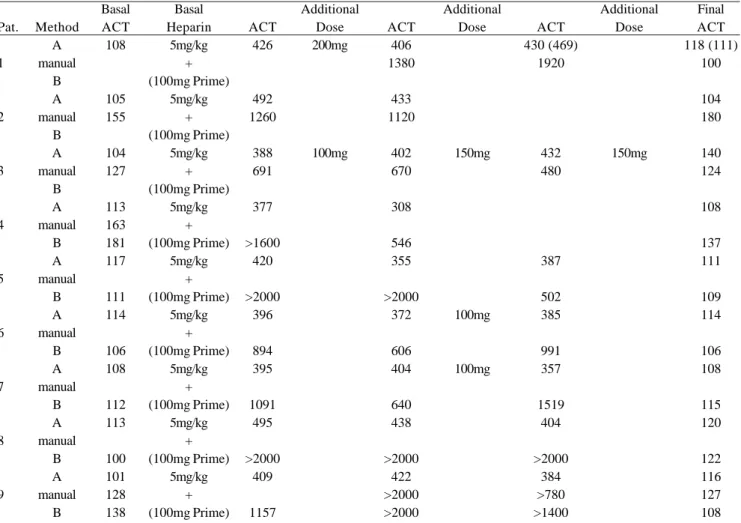
This communication aims at reporting an observation made by our perfusionits, Mr. Everaldo de Miranda and Mr. Denis Augusto de Miranda. In the last nine patients operated on under cardiopulmonary bypass (CPB), we use an initial dose of heparin, 5 mg/kg, besides 100 mg of the same infusion into the perfusate. In spite of it, in all patients the Activated Clotting Time (ACT) recorded by two self-operating automatic recording devices (from the same manufacturer) (A), did not surpass 500 seconds (despite the extra doses of heparin). According to the manufacturer, the warmed plate used to perform the exam contains silica, kaolin, and phospholipids. However, the result of ACT attained in the same samples by the old-fashioned manual method of assessment (which uses celite, 12 mg, as an activator), in which the tube test is moved by the perfusionist until the inner metal piece stands still; these values were, most of the time, more than twice the first dosages (performed by the method A). From the fourth patient on, we also started to perform the ACT with a different self-operating automatic recording device (which also uses celite in its tubes) – method B, whose results were similar to that of the manual method (see Table 1 below).
Table 1. Activated Clotting Time (ACT) and heparin dosages
444
Thus, the amount of heparin delivered during the perfusion was reduced, and we did not notice more inadequate bleedings than the expected ones. We have taken into consideration that this variation in ACT times for the same sample should be related to the different clotting activator agents. Add to this the possibility of earlier fibrin detection by the electronic method A, rather than by the manual method.
However, it attracted our attention the fact that, by the method A, even with the progressive increment of heparin, ACT hardly reached 400 seconds, never reaching 500 seconds. This led us to base our heparin replacement during CPB on the manual method, or on the electronic method B (in which our ACT minimum tolerance threshold for administration of extra anticoagulant is of 600 seconds).
Dr. Melo and co-workers observed, speaking with propriety, that the decreased anticoagulant activity of the new heparins can be hold responsible for the consumption coagulopathy during CPB, especially because its lower molecular weight fraction did not respond to the clotting test. Thus, this unfractionated heparin would not be counterbalanced by the protamine, remaining into the circulation, thus favoring per- and postoperative bleeding. We believe that, added to what has already been considered by the Authors, the underevaluation of ACT measurement (by device A), much inferior to that achieved by the manual method or by electronic devices with the same activator, leads to the administration of undesired new doses of heparin, which can also be contributing to a massive bleeding in these patients.
Cordially,
Luís Alberto O. Dallan, Fernando Platania, Adriano M. Milanez - Cardiac Surgery Service; Hospital Ana Costa – Santos/SP - Brazil
Transplantation
Mr. Editor of BJCVS:
This letter is a formal request for your Journal to publish a comment on my historical article, “Cardiopulmonary and Heart transplantation: 100 years of history and 40 years of existence” (RBCCV/BJCVS 23.1, Jan/Mar 2008), which was written as follows:
Regarding homologous heterotopic heart transplantation (intrathoracic) “in parallel” successfully performed for the first time in a human patient by C. Barnard in Cape Town in 1974 (cited in our Article) - it is important to also report the experimental study on this same subject, performed and published by PhD Professor Otoni Moreira Gomes.
In July 1970, in the Brazilian Journal of Medicine, Prof. Otoni M. Gomes published his study as a “Previous Note”. The study was performed in the Aloysio de Castro State Institute of Cardiology in Rio de Janeiro, and was titled “Homologous Heterotopic Heart Transplantation (Intrathoracic)”, experimentally performed in dogs.
PhD Professor Otoni M. Gomes’s study is also mentioned in the book “Techniques of Cardiovascular Surgery”, published by Editora Coração Ltda. of 2007.
Unfortunately, for reasons beyong my control, this innovative study performed in Brazil is not mentioned in my aforementioned article about cardiopulmonary and heart transplantation.
Thank you for your attention.
Yours sincerely.
Dr. Paulo Rodrigues da Silva, Rio de Janeiro/RJ -Brazil