Trajectories of cognitive decline over 10 years
in a Brazilian elderly population: the Bambuí
Cohort Study of Aging
Trajetória no longo prazo do declínio cognitivo
entre idosos brasileiros: Estudo de Coorte de
Idosos de Bambuí
1 Núcleo de Estudos em Saúde Pública e Envelhecimento, Fundação Oswaldo Cruz/Universidade Federal de Minas Gerais, Belo Horizonte, Brasil.
2 Institute of Psychiatry, King’s College, London, UK.
Correspondence E. Castro-Costa
Núcleo de Estudos em Saúde Pública e Envelhecimento, Fundação Oswaldo Cruz/ Universidade Federal de Minas Gerais.
Av. Augusto de Lima 1715, 6o andar, Belo Horizonte, MG 30130-002, Brasil. [email protected]
Erico Castro-Costa 1,2 Michael E. Dewey 2 Elizabeth Uchôa 1 Josélia O. A. Firmo 1
Maria Fernanda Lima-Costa 1 Robert Stewart 2
Abstract
Few population-based studies have examined long term cognitive trajectory, and these studies were conducted in high income countries. We in-vestigated the association of age, gender and edu-cation with 10-year cognitive trajectory in a well-defined population of elderly using data from the Bambuí Cohort Study of Aging, in Brazil. Cognition was measured using the Mini- Men-tal State Examination (MMSE). Cohort members underwent annual follow-ups. This analysis was based on 12,206 MMSE measurements from 1,461 (91%) baseline participants. We used mixed effects models to study MMSE as outcome. The key findings from this analysis are that women and people with a higher schooling level at base-line had high scores of MMSE, while older par-ticipants started off lower. Regarding cognitive decline, women, older people and those with a higher schooling level declined faster.
Cognition; Mental Health; Aged; Cohort Studies
Introduction
There is a normal process of age related cogni-tive decline across the life span characterized by increasing difficulties with memory, speed of information processing, language and other cognitive functions. More intense closing stages of decline in cognition tend to be defined as de-mentia but decline in the non-demented popu-lation has also been shown repeatedly with some cognitive functions more affected than others. Although cognitive decline is known to increase with age 1,2, low-education levels 1,3,4 and incon-sistently associated with gender 2,3,4,5,6, in cross-sectional studies, measurement of trajectories and production of these trajectories are much less certain.
Among studies that have focused on non-demented participants, one in the United States demonstrated that cognitive decline was faster in older cohorts, women, widowed, and never-mar-ried individuals but was slower in non-Hispanic black Americans 9. However, at first assessment, women had higher scores than men, and non-Hispanic black Americans had lower scores than non-Hispanic white Americans. Educational level was not associated with rate of decline in cognition scores. Another study carried out in the United Kingdom, demonstrated that educa-tion and social class were not related to decline and increased rate of change 10. In contrast, poor mobility was associated with lower cognitive performance, increased cognitive decline and increased rate of change of cognitive decline.
Although, some studies have examined the trajectory of cognitive decline, as mentioned above, to our knowledge there has been no re-search carried out in a developing country. De-veloping countries have on average lower educa-tion levels but also a much wider range of edu-cational levels and hence it might be possible to demonstrate a relationship between education and cognitive decline, which is attenuated in de-veloped countries by the restricted range.
In this study, we investigated the association of age, gender and education with trajectories of cognitive decline in a well-defined population of Brazilian elderly with low-education levels, us-ing data from a 10-year population-based cohort study.
Methods
Study area and population
This analysis was carried out using data from the Bambuí Cohort Study of Aging, which took place in Bambuí, a town of approximately 15,000 inhabitants, situated in Minas Gerais State in Southeastern Brazil. In the study area, the human development index (a composite statistic used as an index to rank countries by level of “human velopment”) was 0.70, which implies medium de-velopment, and the life expectancy was 70.2 years in 1991 11. The city had one general hospital and approximately one physician per 1,000 inhabit-ants. The main economic activities were agricul-ture (particularly farming) and commerce 11.
The Bambuí Cohort Study of Aging proce-dures have been described in detail elsewhere 11,12. Briefly, the baseline cohort population com-prised all residents aged 60 and over on January 1st, 1997 who were identified by means of a pri-vate census in the city. From a total of 1,742 older
residents identified in this census, 1,606 (92.2%) participated in the baseline survey. Baseline da-ta collection was carried out from February to May 1997, comprising standardized interviews and selected biological measures. Cohort mem-bers underwent annual follow-up, consisting of standardized interviews, and verification of death certificates.
Study variables
Cognition assessment •
The Bambuí cohort interview includes a standard Brazilian version of the MMSE 13. In the Brazilian validation study, some questions were modified according to their relevance to the target popu-lation 14. In the orientation section by Fostein et al. 8 questions about the season of the year, building, and floor were replaced by period of the day, room, and address 13. In the registration and recall section, the words used were cat, tree, and guitar (those words in Portuguese are gato, árvore and violão). In the attention and calcula-tion seccalcula-tion, serial fives replaced serial sevens, and “Maria”, which is more commonly used in Brazilian culture, replaced spelling “world” back-wards. The MMSE is a widely used instrument for assessing cognitive impairment 8. However, its application in research is much broader, in particular as a measure of cognitive function in clinical and epidemiological studies of persons without dementia.
Exploratory variables •
Age, gender and schooling were considered as exploratory variables in the present analysis.
Statistical analysis
(The R Foundation for Statistical Computing, Vi-enna, Austria; http://www.r-project.org).
Results
The total number of participants who answered the MMSE in the baseline of the Bambuí Co-hort Study of Aging was 1,558 (97%). However, participants with only one observation were ex-cluded from the main analysis, as they did not allow for estimation of time trends. Participants with missing education (two participants) were also excluded. This left 1,461 participants. The median age at entry was 69.1 years (standard de-viation – SD = 7.3) and 60.2% were female. The mean number of cognition assessment visits was 7.9, consisting of a total of 12,206 MMSE mea-surements.
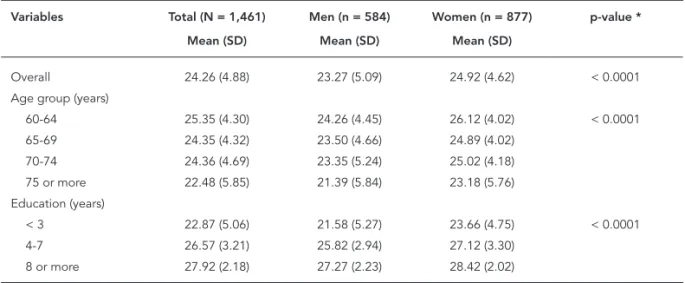
Overall mean score of MMSE at baseline was 24.2 (SD = 4.8) with higher values among wom-en in comparison with mwom-en [mean = 24.9 (SD = 4.6) and 23.3 (SD = 5.1)]. In general, the mean baseline MMSE score decreased with age, and increased with schooling level, and were higher among women in all groups (Table 1).
Table 2 shows the results of three separate mixed models to test primarily interactions be-tween gender, education, age and MMSE score trajectory. Each model is adjusted for the other two main effects. In model 1, the positive coef-ficient for the main effect of gender indicates a higher initial level of 0.4 MMSE points in women. However, the significant negative interaction with slope indicates a faster decline in MMSE in
women so that the performance of the two sexes is equivalent after about four years with women predicted to score lower from then on.
The model 2 investigated the effect of edu-cation on slope. Main effects indicated higher initial MMSE scores for those with higher educa-tion levels, and the significant interaceduca-tion along with the interaction term coefficients indicate a faster decline associated with higher education although these interaction term coefficients did not change in a monotonic fashion across the three education groups and slopes were similar for groups with 4-7 and > 8 years education.
Finally, the model 3 investigated the effect of age group on slope. Main effects for age do not indicate a monotonic association with initial MMSE score. However, the significant interac-tion indicates faster decline with increasing age, especially for the two oldest groups. The results for the dropout patterns and their interaction with time are not presented but in general show that participants who dropped out early had a steeper rate of decline than later dropouts.
Discussion
In this prospective population-based cohort study, carried out in a well-characterized large Brazilian elderly population, we modelled the ef-fects of age, gender and education on initial cog-nitive performance measured by the MMSE and rate of decline. The key findings from this analysis are that women and people with higher levels of education at baseline have high scores of MMSE,
Table 1
Baseline Mini-Mental State Examination score (MMSE), by gender. The Bambuí Cohort Study of Aging, 1997.
Variables Total (N = 1,461) Men (n = 584) Women (n = 877) p-value *
Mean (SD) Mean (SD) Mean (SD)
Overall 24.26 (4.88) 23.27 (5.09) 24.92 (4.62) < 0.0001
Age group (years)
60-64 25.35 (4.30) 24.26 (4.45) 26.12 (4.02) < 0.0001
65-69 24.35 (4.32) 23.50 (4.66) 24.89 (4.02)
70-74 24.36 (4.69) 23.35 (5.24) 25.02 (4.18)
75 or more 22.48 (5.85) 21.39 (5.84) 23.18 (5.76)
Education (years)
< 3 22.87 (5.06) 21.58 (5.27) 23.66 (4.75) < 0.0001
4-7 26.57 (3.21) 25.82 (2.94) 27.12 (3.30)
8 or more 27.92 (2.18) 27.27 (2.23) 28.42 (2.02)
SD: standard deviation.
Table 2
Mutually adjusted gender, age and education associations with trajectories of Mini-Mental State Examination score (MMSE). The Bambuí Cohort Study of Aging, 1997-2007.
Variables Model 1 Model 2 Model 3
β (95%CI) β (95%CI) β (95%CI)
Intercept 25.18 (24.76 to 25.60) 25.48 (25.08 to 25.89) Gender
Female vs. male 0.40 (0.03 to 0.78) Education (years)
4-7 vs. ≤ 3 3.05 (2.63 to 3.47)
≥ 8 vs. ≤ 3 4.23 (3.56 to 4.89)
Age (years)
65-69 vs. 60-64 -0.67 (-1.13 to -0.20)
70-74 vs. 60-64 -0.39 (-0.91 to 0.14)
≥ 75 vs. 60-64 -1.08 (-1.62 to -0.54)
Gender by time
Males by time 0.01 (-0.02 to 0.05) Females by time -0.10 (-0.13 to -0.08) Education by time
≤ 3 years by time -0.04 (-0.07 to -0.02)
4-7 years by time -0.10 (-0.14 to -0.07)
≥ 8 years by time -0.09 (-0.16 to -0.03)
Age by time
60-64 years by time -0.03 (-0.06 to 0.00)
65-69 years by time -0.04 (-0.08 to 0.00)
70-74 years by time -0.10 (-0.15 to -0.06)
75 or more years by time -0.21 (-0.26 to -0.15)
Likelihood-ratio test χ2: 35.9; df: 2 χ2: 8.6; df: 2 χ2: 38.3; df: 3
p-value < 0.0001 0.0136 < 0.0001
Model 1: adjusted by education and age; Model 2: adjusted by gender and age; Model 3: adjusted by gender and education.
while older participants started off lower. Regard-ing cognitive decline, women, those with higher education and older people declined faster.
The current study is, to our knowledge, the first investigation of cognitive trajectories to have been carried out in a low or middle-income country in a population with a low education level, adding to the relatively few longitudinal studies that have investigated this. Its strengths include the large population-based cohort fol-lowed over an extended period and the annual examination of cognitive performance over a long period of time using a widely applied brief assessment measure (the MMSE) administered in an identical format. It also provides support-ive evidence that the MMSE, although relatsupport-ively crude, is adequate to pick up variations between individuals and influences on decline over the period studied. The main limitations are the as-sumptions in the models of a linear decline and
further assumptions regarding dropout patterns being the same whether dropout is due to refusal or death.
assessment tool comparable to the MMSE 22) did not find a protective effect of education.
Findings from our study are mostly compara-ble with those from previous reports in which the same exposure measure (mental status measure) was administered to older adults in longitudi-nal population-base surveys 9,10,16,17,18,19,20,21,22. The previous findings at baseline of most stud-ies demonstrated that women had higher scores than men and older participants had lower scores than younger participants and are consistent with our findings 9,10,16,17,18,19,20,21,22.
Finally, our education findings (highly edu-cated groups decline faster) are not consistent with previous studies; those in which education has a protective effect 16,17,18,19,20,21,22 and those studies where education was not related to cog-nitive decline 9,10. The explanation for this differ-ence may be based on differdiffer-ences on the level of education across studies or a floor effect in poorly educated persons 23. While in all previous studies most participants have more than eight years of schooling, in Bambuí only 7.9% of participants have eight or more years of education, leading to differences in categorizing the variable. Possibly, we can explain the association of the highly
edu-cated group of current study (eight or more years of schooling) and cognitive decline, because the highly educated group of current study belongs to the low educated group categorization of those previous studies 9,10,16,17,18,19,20,21,22. Studies, such as Lyketsos et al. 18 (0-8, 9-11, 12,13-15 and 16 or more years of schooling), Farmer et al. 20 (0-9, 10-12 and more than 12 years of schooling), Kar-lamangla et al. 9 (0-7, 8-11, 12-14, more than 14 years of schooling) and Muniz-Terrera et al. 10 (0-14, 15 or more years of schooling), have fo-cused on subdividing the highly educated group rather than the low educated group, because of a high proportion of educated participants. Regarding the floor effect, the MMSE has been found to have it in different studies and popula-tions and it may have also happened in the cur-rent study because of the low education of this population.
In conclusion, in this large cohort of a Brazil-ian elderly population with low education lev-els, gender, age and education were associated with long-term rates of cognitive decline. Fur-ther analyses are needed to examine the effects of health conditions and other potential confound-ing variables on the MMSE trajectories.
Resumo
Poucos estudos de base populacional examinaram a trajetória no longo prazo do declínio cognitivo. Os estudos existentes foram conduzidos em países de al-ta renda. Nós investigamos as associações entre ida-de, sexo e escolaridade e o declínio cognitivo em uma população idosa bem definida, utilizando dados de 10 anos de seguimento da coorte de Bambuí, Minas Gerais, Brasil. A cognição foi aferida anualmente por meio do Mini-Exame do Estado Mental (MEEM). Es-sa análise foi baseada em 12.206 medidas do MEEM de 1.461 (90%) participantes da linha de base. Foram utilizados modelos de efeitos mistos, considerando-se o escore do MEEM como variável de desfecho. As mu-lheres e os indivíduos com maior escolaridade apre-sentaram resultados mais altos no MEEM na linha de base, enquanto que os idosos mais velhos apresenta-ram pontuações mais baixas. Com relação ao declínio cognitivo, participantes do sexo feminino, com maior escolaridade e mais velhos, apresentam reduções mais rápidas dos escores do MEEM.
Cognição; Saúde Mental; Idoso; Estudos de Coortes
Contributors
E. Castro-Costa, M. E. Dewey, M. F. Lima-Costa and R. Stewart contributed towards the conception and de-sign, data analysis, interpretation of data and writing of the manuscript. E. Uchôa and J. O. A. Firmo contributed to the data collection, interpretation of data and critical revision of the manuscript.
Acknowledgments
References
1. Crum RM, Anthony JC, Bassett SS, Folstein MF. Population-based norms for the Mini-Mental State Examination by age and education level. JAMA 1993; 269:2386-91.
2. Herrera Jr. E, Caramelli P, Silveira AS, Nitrini R. Epi-demiologic survey of dementia in a community-dwelling Brazilian population. Alzheimer Dis As-soc Disord 2002, 16:103-8.
3. Anderson TM, Brodaty H, Trollor JN, Andrews G. Effects of sociodemographic and health variables on Mini-Mental State Exam scores in older Austra-lians. Am J Geriatr Psychiatry 2007; 15:467-76. 4. Huppert FA, Cabelli ST, Matthews FE; MRC
Cog-nitive Function and Ageing Study. Brief cogCog-nitive assessment in a UK population sample – distri-butional properties and the relationship between the MMSE and an extended mental state examina-tions. BMC Geriatr 2005; 5:7.
5. Espino DV, Lichtenstein MJ, Palmer RF, Hazuda HP. Ethnic differences in mini-mental state examina-tion (MMSE) scores: where you live makes a differ-ence. J Am Geriatr Soc 2001; 49:538-48.
6. Valle EA, Castro-Costa E, Firmo JOA, Uchôa E, Lima-Costa MF. Estudo de base populacional dos fatores associados ao desempenho no Mini Exame do Estado Mental entre idosos: Projeto Bambuí. Cad Saúde Pública 2009; 25:918-26.
7. Wilkosz PA, Seltman HJ, Devlin B, Weamer EA, Lo-pez OL, DeKosky ST, et al. Trajectories of cognitive decline in Alzheimer’s disease. Int Psychogeriatr 2010; 22:281-90.
8. Folstein MF, Folstein SE, McHugh PR. “Mini-men-tal state”. A practical method for grading the cogni-tive state of patients for the clinician. J Psychiatr Res 1975; 12:189-98.
9. Karlamangla AS, Miller-Martinez D, Aneshensel CS, Seeman TE, Wight RG, Chodosh J. Trajecto-ries of cognitive function in late life in the United States: demographic and socioeconomic predic-tors. Am J Epidemiol 2009; 170:331-42.
10. Muniz-Terrera G, Matthews F, Dening T, Huppert FA, Brayne C; CC75C Group. Education and tra-jectories of cognitive decline over 9 years in very old people: methods and risk analysis. Age Ageing 2009; 38:277-82.
11. Lima-Costa MF, Firmo JOA, Uchôa E. Cohort pro-file: the Bambui (Brazil) Cohort Study of Aging. Int J Epidemiol 2010; [Epub ahead of print].
12. Lima-Costa MF, Firmo JOA, Uchôa E. The Bambuí Cohort Study of Aging: methodology and health profile of participants at baseline. Cad Saúde Pública 2011; 27 Suppl 3:S327-35.
13. Seabra MLV, Concílio GV, Villares JB, Carlini EA. Avaliação do teste “Mini-Mental State” em volun-tários e pacientes brasileiros. Rev ABP-APAL 1990; 12:1-7.
14. Castro-Costa E, Fuzikawa C, Ferri CP, Uchôa E, Firmo JOA, Lima-Costa MF, et al. Dimensions un-derlying the Mini-Mental State Examination in a sample with low-education levels: the Bambui Health and Aging Study. Am J Geriatr Psychiatry 2009; 17:863-72.
15. Anstey K, Christensen H. Education, activity, health, blood pressure and APOE as predictors of cognitive change in old age a review. Gerontology 2000; 46:163-77.
16. Evans DA, Beckett LA, Albert MS, Herbert LE, Scherr PA, Funkenstein HH, et al. Level of educa-tion and change in cognitive funceduca-tion in a com-munity population of older persons. Ann Epide-miol 1993; 3:71-7.
17. Jacqmin-Gadda H, Fabrigoule C, Commenges D, Dartigues JF. A 5-year longitudinal study of the Mini-Mental State Examination in normal aging. Am J Epidemiol 1997; 145:498-506.
18. Lyketsos CG, Chen LS, Anthony JC. Cognitive de-cline in adulthood: an 11.5-year follow-up of the Baltimore Epidemiologic Catchment Area study. Am J Psychiatry 1999; 156:58-65.
19. Colsher PL, Wallace RB. Longitudinal application of cognitive function measures in a defined popu-lation of community-dwelling elders. Ann Epide-miol 1991; 1:215-30.
20. Farmer ME, Kittner SJ, Rae DS, Bartko JJ, Regier DA. Education and change in cognitive function: the Epidemiologic Catchment Area study. Ann Epi-demiol 1995; 5:1-7.
21. Butler SM, Ashford JW, Snowdow DA. Age, educa-tion, and changes in the Mini-Mental State Exam scores of older women: findings from the Nun Study. J Am Geriatr Soc 1996; 44:675-81.
22. Christensen H, Korten AE, Jorm AF, Henderson AS, Jacomb PA, Rodgers B, et al. Education and decline in cognitive performance: compensatory but not protective. Int J Geriatr Psychiatry 1997; 12:323-30. 23. Tombaugh TN, McIntyre NJ. The Mini-mental
State Examination: a comprehensive review. J Am Geriatr Soc 1992; 40:922-35.
Submitted on 13/Dec/2010