© FECAP
RBGN
Received on December 12, 2013 Approved on March 12, 2015
1. Claudia Eugenia Toca Torres
Ph.D. in Political and Social Sciences (Public Administration) Universidad Nacional
Autónoma de México UNAM (Mexico)
2.Jesús Carrillo Rodríguez Ph.D. in Political and Social Sciences (Political Science) Universidad Nacional
Autónoma de México UNAM (Mexico)
Review of Business Management
DOI:10.7819/rbgn.v17i56.1837
Ecological Analysis of a
Tourism Business Network
1
Claudia Eugenia Toca Torres
Independent researcher and consultant, Bogotá, Colombia
Jesús Carrillo Rodríguez
Independent researcher and consultant, Bogotá, Colombia
Responsible editor: João Maurício Gama Boaventura, Dr. Evaluation process: Double Blind Review
ABSTRACT
Objective – Institutionalism as an adaptation theory has contributed to understanding of the changing characteristics in governance structures. At the same time, community ecology has enhanced the evaluation of change within organizational communities. his study aims to analyze the relations and interactions of a business network, using institutional ecology concepts.
Design/methodology/approach – We applied the methods of institutionalism, as an adaptation theory, and community ecology, as evolution theory, in a network comprised of 45 businesses. Data for the low of resources and institutional ecology were obtained using two separate instruments (designed by the researchers). Netdraw was used to graphically represent the various layers of the network and Ucinet 6 to generate the matrices.
Findings – While theory identiies information, services, decisions, solutions and money as resources, as far as the workers in the businesses researched are concerned, the irst four low naturally within the business network, but money is perceived as a resource that should always originate in the other nodes of the ecosystem.
Practical implications – Network stakeholders will make decisions that both strengthen relations among the members of the institutional arrangement and support the selection of institutional contexts more favorable to performing their activities.
Contributions – This is the first work that applies economic-evolutionary theories in order to analyze the relations and interactions within a business network.
1 INTRODUCTION
Organizational studies may be undertaken from two basic approaches: adaptation or evolution. In the adaptation approach, the two theories most commonly drawn upon are contingency theory and organizational learning theory, but this research has chosen to go with an alternative theory, institutionalism. In the evolution approach, community ecology is the one most commonly cited. Working from the premise that adaptation and evolution approaches are more complementary than contradictory, we decided to look to institutional ecology to support this study of higher life levels, be they ecosystems or communities. hus, the unit of analysis can be an organization, or some form of organization, meaning that appropriate analytical methods, namely, institutional analysis and ecological institutional analysis, can be applied. While the ield of business administration’s organizational studies of business networks cannot be ignored, it should be acknowledged that the immense possibilities institutional theories – adaptation as well as evolution – ofer for studying business networks have not been explored.
he object of this study was a business network comprised of 45 enterprises involved in various aspects of tourism (lodging, transportation, food and beverages, etc.) in ive municipalities belonging to single department of Colombia. he network is connected to four agents: the public, consisting of 10 municipal, departmental and national public agencies; the social, consisting of three not-for-proit organizations; the private, made up of six commercial collectives; and the international, represented by a multilateral foundation. he sum of all relations among the 45 enterprises was called “community” (inter-organizational arrangement), while all relations between the business network and the four agents (nodes) were called “ecosystem” (inter-institutional arrangement). An organizational ecosystem’s relations and interactions are analyzed using institutional ecology concepts. Drawing on these concepts, an instrument was designed
for use among the owners and workers of the 45 enterprises within the business network. The fundamental research hypotheses are: 1) workers, and the group of owners have difering perceptions with respect to network relations and interactions, and 2) owners believe the context’s economic impacts on network activity are more important than the environmental and social impacts resulting from business activity.
Section one of this paper presents the conceptual references of organizational studies. Section two addresses institutionalism, and institutional analysis theory and methodology, critical for understanding section three, which focuses entirely on institutional ecology and ecological analysis. Section four applies the methodology to carry out an institutional mapping of the tourism network, the object of study; the graphic representations (of institutionalism and community ecology) are rendered using Netdraw software. Interpretation of the various maps occupies section ive, the conclusions.
2 ORGANIZATIONAL STUDIES
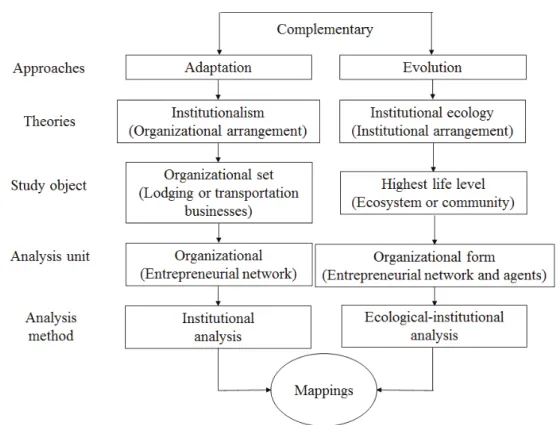
he conceptual references of this research are outlined in Figure 1 and are addressed in this section and the following two. At the center of this research are institutions. he study of organizations (and their relationship with the surrounding contextual environment) can be conducted from an adaptation or selection (evolution) perspective.
as cited in Carroll, 1984) was the irst to link the selection approach (from natural sciences, such as ecology) to organizational theory, giving rise to an Evolutionary Logic of Population Ecology.
Similarly, organizational demography and community ecology come together as the product of linking evolution approaches to organizational theory (Carroll, 1984).
FIGURE 1 – Conceptual references in organizational studies
From the perspective of an adaptation theory such as institutionalism, changes are often introduced into organizations’ formal structure in order to better align them with the changing institutional environment (Singh et al., 1986). Community ecology, an evolution theory, studies relations among a collection of interacting populations in a region (Carroll, 1984). If the enterprises comprising a business network do in fact make up a community, when the network has relationships, interactions and mediations with other private, social, public or international agents, its life level is raised to an ecosystem.
Presented in this way, the research could have gone in one of two diferent directions: either built on the previously mentioned Evolutionary Logic of Population Ecology idea, or moving
towards Institutional Ecology and its focus on institutional arrangements. his research chose the latter path; it is necessary, therefore, to irst address institutionalism and institutional analysis methodology, then institutional ecology and the ecological analysis of institutional arrangements.
3 I N S T I T U T I O N A L I S M A N D INSTITUTIONAL ANALYSIS
comparison of diferent theories and models of theories applied to particular problems” (Ostrom, 1999, p. 36). In business administration, for example, it is very common to confuse the term “institution” with “organization”, and more specifically, with “business”. Although many organizations are recognized as true institutions (family, church, police, parliament), the existence of enterprises that are truly institutions has yet to be demonstrated – at least in Colombia.
Institutions are unnecessary in a world where knowledge is perfect and information complete, but they are needed in other worlds. While economies develop and become more diverse and complex, uncertainty grows, and reliance on institutions to minimize behavioral uncertainty increases (Coase, 1960 as cited in Dinar & Saleth, 2004). Institutions provide the base on which rational decisions can be made, since they guarantee others’ behavior (North, 1990 as cited in Dinar & Saleth, 2004). Institutions as a whole are made up of component institutions that may, in turn, be connected as a system. From an atomic perspective, they are viewed as separate entities randomly joined together inside a whole. From a holistic point of view, connections between the global structure and its parts are seen as being closer, that is, parts are shaped by their place in the whole (Lane & Ersson, 1999).
Institution refers to a general model, to a categorization of activity or a speciic human arrangement that is either formally or informally constructed and organized (Keohane, 1988). Similarly, it is a set of rules that structure social interactions (Knight, 1992 as cited in Bartels, 2009). hese rules allow, require or prohibit people’s specific behavior in certain contexts (Ostrom, Gardner & Walker, 1994 as cited in Bartels, 2009). Speciically, these rules provide information about how people are excluded from behaving in given situations; they may be recognized by members of a relevant group as standards to be followed by others […] and they shape peoples’ strategic decisions, thereby
producing stable results (Knight, 1992 as cited in Bartels, 2009).
Although institutions work as a system, for analysis’ sake they may be grouped into two segments, i.e., institutional context and institutional arrangement, to better understand their functions. In fact, in social sciences, institutionalization (a process) is understood as a concept for studying relationships between organizational characteristics and organizational context (Keohane, 1969). Institutional context is deined as a set of fundamental legal and social policies that form the bases for production, exchange and distribution. Institutional arrangements, or governance structures, provide the structure in which the members of a society – individually or collectively – cooperate or compete with one another (Dinar & Saleth, 2004). Institutions are characterized by three basic traits: interlinkages, malleability and hierarchical nature (Dinar & Saleth, 2004). he governance structure includes the economic, political and social organizations belonging to the institutional arrangement (Williamson, 1992). he line separating context from arrangement is not ixed, but shifts, depending on the level and focus of analysis (Dinar & Saleth, 2004). When the institutional arrangements of a speciic region or subsector are the focus, their webs become part of the institutional context at the national and sectorial levels (Dinar & Saleth, 2004). As a result, laws and policies (rules) are considered part of the institutional context, and organizations (social units) considered part of an institutional arrangement. Moreover, institutional arrangements are made up of laws, regulations, operations practices and organizational structures, assembled into simple hierarchies. At the bottom level are the procedures agreed upon by people involved in order to make decision-making easier.
corporate hands; and reform or ratiication of local government political institutions. (Sharp, 1991, as cited in Feiock & Cable, 1992.) Mechanisms include citizen surveys, self-appointed community advisory committees, elected neighborhood commissions and public hearings (Feiock & Cable, 1992). Decisions can be made within government bureaucracy or through external organizations (businesses, chambers of commerce or quasi-governmental community development entities). Government reforms, in turn, similarly impact local policies (Feiock & Cable, 1992).
International institutional arrangements, especially concerning global organizations (health, trade, labor, tourism etc.), international agreements and codes (coffee, humanitarian, ethical, tourism, etc.), generally play an important role in the development of national systems. hese arrangements, which strive to standardize guidelines along which domestic regulations can then be established, are important drivers of change in national systems (Spriggs & Grant, 2001). Including the World Tourism Organization (UNWTO) and the Global Code of Ethics for Tourism (UNGCET) in a tourism business ecosystem’s institutional arrangement would undoubtedly be crucial to its functioning.
Global models define and legitimize agendas for local action, shaping the structures and policies of nations, and national and local stakeholders from all realms of social life: business, politics, education, science, even family life and religion (Meyer et al., 1997 as cited in Schneiberg & Clemens, 2006). he efects of global policy on nations can be measured using three strategies: the effects reveal an absence of associations between factors at a national level and national state policies; the efects of global events reveal associations between global developments and national policies; and the efects of global vs. national factors change over time (Schneiberg & Clemens, 2006).
Linkages occurring inside an institutional arrangement are called institutional linkages, while those established between an arrangement
and the performance of an environmental context are labeled institution-performance connections. Institutional links can be intra-, that is, they relate to matters taking place inside a given arrangement, or inter-, they occur across the components. here is also inluence from factors that are exogenous to institutional and contextual performance, which is why connections to the inside and those among institution, context and exogenous factors are viewed as dimensions, or layers, of the institution-performance process (Dinar & Saleth, 2004). It should be pointed out that a business network and its nodes, that is, an ecosystem, will be an independent, solid institution when within the framework of a department, a region or country, its linkages, interactions and mediations low smoothly, thereby imparting the network with dynamism.
The agency position (situational to the stakeholders) is a function of resources available to it (material and economic) and the political strategies they call for. his implies that stakeholders who have the resources to invest in their political causes have greater autonomy than those who do not; stakeholders who are capable of mobilizing sympathizers are less dependent than those who lack said capacity. Stakeholders’ positions in the structure relects the degree to which they are, structurally speaking, dependent on the decisions and practices of other stakeholders within the contextual environment to achieve collective goals (security, economic growth, etc.). Stakeholders have more autonomy if supporting them contributes to the general purpose. Possession of resources, choice of favorable strategies and structural position are determined and altered by, the established institutional arrangements. The institutional framework in which political struggles take place may also reveal how efective particular resources, strategies and positions are (Chorev, 2007).
Institutional analysis should also focus on how the stakeholders’ situational and structural positions are afected. It is helpful, analytically speaking, to distinguish among three types of relations afected by established institutional arrangements: those between competing stakeholders; those between non-state stakeholders and state agencies; and those between various state agencies. By allowing nodes diferent levels of access to decision-making, institutional arrangements may give disproportionate advantage to some stakeholders at a cost to others. Institutions determine the stakeholders’ relative political position via incentives, options and restrictions; they shape their strategies, alliances and prospective coalitions, inevitably impacting the inal result (Chorev, 2007).
Institutional analysis helps explain the rules and incentives set in place to govern the behavior of agents comprising the web and their inter-institutional relations. It is based on an understanding of rules – formal constructions or informal constructions deeply rooted in cultural
practice – mediating and deviating (Holland, 2007). It can be carried out at both micro and macro levels. Microanalysis views sophisticated institutions as exogenous factors of the highest, most abstract level. Macro-analysis deals with institutions at a highly aggregate level; it focuses on production of ad hoc descriptions and taxonomies. Macro-analyses lend themselves to institutional decomposition, indispensable to development of the analytical framework needed for mapping, characterizing and evaluating distinct institutional layers and performance linkages (Dinar & Saleth, 2004). Five alternative methodologies have been widely used in institutional analysis: contextual delineation, subjective institutional change theory, the pluralistic approach, the decomposition and institutional analysis framework, and the Institutional Analysis and Development Framework (IAD) developed by Ostrom (1991, 2011).
4 INSTITUTIONAL ECOLOGY AND ECOLOGICAL ANALYSIS
birth and death studies over time, more explicitly longitudinal than other empirical studies; and 5) passiveness in response to internal organizational dynamics, such as power struggles, leadership succession, and similar matters (Pfeffer & Salanick, 2003).
At the beginning, ecology was reserved exclusively for the study of natural settings and the establish interactions of their components. Over time, it came to include the study of human and institutional interactions (Mercier, 1994). Among the general principles of the ecology movement – especially the branch inclined toward institutional arrangements – is the diversity of human nature, to which is attributed the fact that humans are unable to artiicially standardize their creations. A second principle is the wisdom inherent to natural ecosystems; it rejects pure anthropocentrism. As a third principle, hierarchy has generated the most controversy. Does hierarchy exist in nature, or is the natural world based on equality? As institutional ecology interests diversiied, tensions and debates emerged incrementally, in part because it became problematic to use nature to explain or criticize various phenomena. Ecology, be it scientiic or institutional, is essentially an applied science, and its principles cannot be sustained linearly or abstractly within that domain without encountering, and clashing with another principle: paradox (Mercier, 1994).
Ecologists took on a set of problems that had their origins in evolution theory (adaptation and natural selection), geography (distribution and abundance) and physiology (the efects of physical factors, such as heat, light, soil and moisture on life history). At the same time, ecologists learned new quantitative and analytical methods and ways to use biological indicators. Ecology emerged as a sub-discipline, distinct from systems, morphology and genetics. Ecologists are interested in the bases for adaptation, in broadening physiology to take into account the dynamics of interacting groups of organisms, in quantifying the physical environment (physiography) and how these things afect the life history of organisms (Star & Griesemer, 1989).
The term institutional ecology is understood to mean that institutions are important for behavior, but in much more complex ways than those typically treated in economic models. Institutional ecology interacts with the state of technology, with cultural concepts of behavior, and with obligatory, emergent social practices which may be motivated, not only out of self-maximizing behavior, but a range of other psychological and social motivations too. In this complex ecology, institutions impact all of these other parameters and are, in turn, impacted by them. Institutions co-evolve with technology and social and market behavior. his co-evolution leads to periods of relative stability punctuated by periods of instability caused by external clashes or internally generated changes (Benkler, 2006).
Baum & Powell, 1995). Similarly, in order for institutional analysis to capture the dynamic aspects of institutionalization, it must be open to alternative visions of the diferential nature of interaction and ecological replication (Powell, 1991 as cited in Baum & Powell, 1995). And that is precisely what these writers suggest: to construct an institutional ecology of organizations – a more sophisticated theoretical understanding of the co-evolution nature of cultural interpretations, organizational forms, and limits on resources.
As viewed by ecologists, institutional arrangements go beyond exclusively economic concerns. he broader the institutional framework under analysis, the greater the number of factors, contradictions and paradoxes to be considered (Mercier, 1994). he intervention of the ecologists and a heated theoretical debate with the institutionalists prompted researchers to re-examine the relationships between ields and organizations. his was accomplished by addressing the consequences of adoption for organizations. hree actions deserve highlighting: inclusion of organizational survival as a dependent variable, challenges to the presumption that all extra-organizational factors are institutional factors; and reinements to the way legitimacy is measured. The results are evident in the study how of environmental context impacts an organization’s policies, and especially its survival. For example, research on businesses’ adoption of labor practices in response to changes in the legal and political environment. he commitment to population ecology has pushed institutionalists to more closely tie measurement strategies to theory, especially with regard to the key concept, legitimization (Schneiberg & Clemens, 2006).
Although ecological and institutional perspectives difer concerning topics of a general organizational nature, they share common ground where collective organizational contextual environments are concerned. Theoretical institutionalists emphasize the cultural and normative framework in which populations are immersed. he ecologists examine the more speciic efects of competition and legitimization
processes on population dynamics (Hannan & Carroll, 1992 and Scott, 1995 as cited in Baum & Oliver, 1996).
In organizational ecology, the potential for competition between organizations is seen as a function of their similarity with respect to demand for resources: the more similar the resources are, the greater the potential for competition. On the one hand, organizations that share the same organizational niche (i.e., organizations having the same demands for resources) are perfect competitors. On the other hand, organizations that have diferent demands quite simply do not compete. In general terms, the potential for competition between two organizations is proportional to the overlap of their organizational niches (Baum & Oliver, 1996).
Both institutional analysis and population ecology reject reductionism. According to the latter, however, critical contextual factors do not share scripts, norms or regulatory regimens; on the contrary, they are a function of organizational density. Emphasizing that institutionalized beliefs are embedded, some population ecologists maintain that legitimacy is, in essence, unobservable, that it is a state of mind that can be inferred from observing the efects of organizational density on crucial rates (Hannan et al., 1995 as cited in Schneiberg & Clemens, 2006). Density may be understood as the empowering of sociopolitical processes, such as approval, or the establishing of relations with regulatory agencies (Baum & Powell, 1995).
agents or collective groups (Young, 2002 as cited in Heikkila, Schlager, & Davis, 2011). Among the alternative methodologies that have been proposed to carry out institutional analysis is the ecosystems perspective, which may well support an ecological analysis of institutional arrangement (Dinar & Saleth, 2004).
An institutional structure may be viewed as an ecosystem that develops within a context, deined by social, political, cultural, political and economic conditions, for the purpose of performing. In this vein, institutional ecology principle looks at the diferent levels of institutional structures as a single, interconnected ecosystem that [co-]evolves along with an institutional context characterized by cultural, social economic and political factors. his principle facilitates clear conceptualization of the interconnections among institutions and the interaction of institutions with their contextual environments. From a theoretical point of view, the principle resolves the conlict between evolution and traditional approaches. From an analytical perspective, the principle provides the conceptual basis for institutional decomposition and the mapping of linkages. Furthermore, the principle makes it possible to treat the context and the institutional structure as a system, and to separate the system from its physical, social, economic and political frameworks (Dinar & Saleth, 2004).
Drawing on institutional ecology methodology, Dinar and Saleth (2004) ofer a unique analytical framework based on the detailed decomposition of select institutions, sector performance, and characterization of analytical and operative linkages among various components of a standard model. Another of the strategies used to evaluate heterogeneity in institutional arrangements focuses on organizational forms (community, species, population), and uses counts, over time, of organizations that have diverged from the dominant model and act as locations and carriers of models and alternative logics. his method has been used to track the entrance of socialist cooperativism in Israeli economy (Simons & Ingram, 2004) and the
ways US populists and progressivists fought to set up a decentralized, regional economy of farmers, independent producers, and markets in self-governing cities (Schneiberg, 2002 as cited in Schneiberg & Clemens, 2006).
Since ecologists adopted a set of problems with origins in evolution theory (adaptation and natural selection) and geography (distribution and abundance), an ecological institutional analysis could be conducted with a tool widely used by geographers and institutionalists alike: mapping (Holland, 2007). In simple terms, this tool helps prove hypotheses about the interests of social stakeholders and governing rules of any arrangement. Perhaps it is because mapping is such a basic geographical tool that scholars in the other social sciences limit its application to the tracing and production of maps. It is important to realize that a map is an intermediate mechanism for analysis, a bridge between collected data and conclusions. he map’s primary contribution is its capacity to reduce reality to a scale that allows understanding (Ullman, 1953). It is because of maps’ contributions to space and spatial interrelationships that sociology has relied on them for the execution of studies on social interactions.
5 APPLYING INSTITUTIONAL MAPPING
Drawing on the analytical considerations laid out above, this section will deal with the application of institutional ecology methods to a network comprised of 45 businesses. Said enterprises establish relations with four nodes – labeled agents in this research – namely: 1) a public agent, represented by ten government entities; 2) a private agent made up of six enterprises from outside the sector, in this case, tourism; 3) a social agent composed of three third sector entities; and 4) an international agent in the shape of a multilateral body. he tracing of institutional ecology and network relations, together with their various nodes, was carried out for two populations. Data on the low of resources and institutional ecology were obtained using two separate instruments (designed by the researchers); one was administered to the 45 business owners, the other was administered to 37 workers. he irst instrument is made up of 61 items designed to identify relations (interaction, cooperation, and interdependence) with the remaining members of the network, as well as other agents. he frequency of their relations traces actual (35 items) as well as ideal (11 items) lows of resources. he institutional mapping derives from the business leaders’ responses to 15 items. In complementary fashion, a second instrument was administered to 37 workers from diferent businesses. he reason the number of workers consulted does not match the number of businesses is transparent: members of the family work in some of the businesses but are not classiied as workers. he instrument administered to workers is made up of 25 items designed to identify relations (interaction, cooperation, and interdependence) with the remaining members of the network, as well as other agents. The frequency of their relations traces actual (18 items) as well as ideal (3 items) lows of resources. he institutional mapping is a product of the workers’ responses to four items. It should be explained that the instrument ofered to workers did not investigate business relations with each one of the agents’ stakeholders, but rather, focused on a single stakeholder for each of the agents.
Netdraw network visualization program software was used to graphically represent the various layers of the network. Ucinet 6 was used to generate the matrices. hus, three diferent graphs were obtained for each population: a static mapping, a process tracing, and an institutional mapping. The three were subsequently integrated into a single graph illustrating the three corresponding dimensions. he graphic representation of the networks incorporates both actual and ideal connections among network businesses (identiied in the graph as business nodes), as well as linkages between said node and the four agents. his graphic analysis is justiiable as it accounts for all the elements the network requires: its nodes (business, private, public, social and international), as well as linkages and lows of resources (money, information, services, decisions and solutions.)
in this regional context that community and society members are situated. It is also here that the environmental component (natural resources and species) resides.
5.1 Static mapping
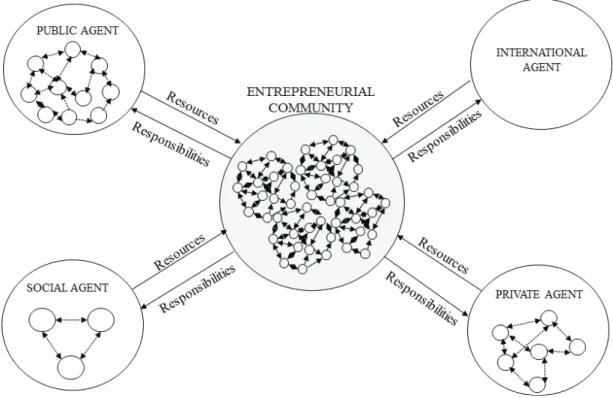
Static mapping gives a snapshot of a community’s contextual environment through illustration of the resources and responsibilities associated with the agencies and organizations with which the community interacts. The operative incentives and information available to stakeholders can be determined through case study analysis and interviews with key informants. his tool has been used to illustrate both the process and participants, and even to diagram the organizational low that maps out formal links among relevant stakeholders (Holland, 2007). Static mapping relates to ixed position, such as that indicated by latitude, longitude, climate or land use in a speciic area. It does not, of course, represent the dynamic reality of contemporary geography, nor does it adequately explain the underlying causes and consequences of relations portrayed on the maps (Rycroft & Cosgrove, 1995). his mapping is also viewed as a representation of the actual low of resources (always continuous lines) between enterprises in the business network and the various public, social, private and international agents. Its theory identiies money, information, services, decisions and solutions as primary resources.
Relations between the network and its various nodes are determined through static mapping, which in turn establishes a irst level for analysis and the level of institutional interaction or dynamics. Since this layer condenses the actual low of resources, mapping of the businesses’
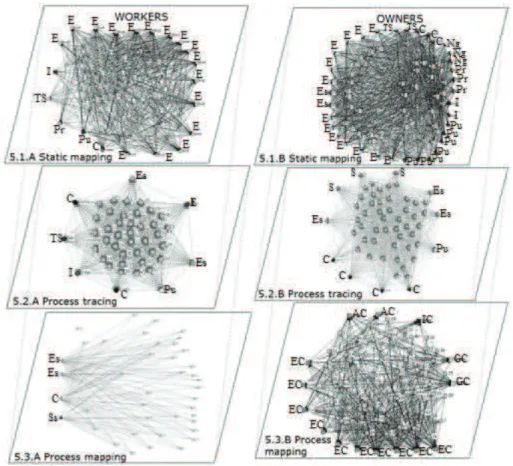
current relations was carried out using information provided by workers, and owners (Figure 2). Data gathered from the survey instrument regarding interaction, cooperation and interdependence served as the basis for the static mapping of the network.
Workers were interviewed about three levels of relations. he irst involved determination of the reciprocity of relations with other workers and owners; collective decision making processes; commitment to the needs of all members; trust in the information and other things businesses have to ofer; and transparency in the businesses’ behavior, and commitment to success and overall performance.
Relations with all the other businesses and the network’s executive administration were examined at the second level. And, at the third relational level (nodes), the instrument looked into interactions with oicials from local government agencies; a foundation representing the social agent; a business of the private agent, a multilateral body, the neighborhood and the environment.
Ecological Analysis of a Tourism Business Network
FIGURE 2 – Static mapping of the network.
he business owners in turn expressed their opinions on government investment; the favorableness of legislation for industry and the region; they made reference to ties with government entities, non-governmental organizations, members of society, the media and the political, social, economic, regional, cultural and global environment. hey spoke about representation and the ight for collective interests; involvement in public decisions (environmental, social and sectorial policy), identification with the business community, and responses and adaptations to changes in the various nodes. hey shared their thoughts on sectorial, social, community and environmental demands in planning; the luidity of relations with the executive administration of the network; interactions with local authorities, the social agent’s foundation, the multilateral body, other network enterprises and suppliers. hey talked about their trust in the other businesses and the information they share; their perceptions of other owners’ transparency, commitment and follow through.
It appears that the owners’ dynamic is quite distinct from the workers’ (Figure 5.1.B). he owners (net center) perceive more interaction and cooperation not only with the other members in the network (E), but with other nodes as well, including the public node (Pu), the community node (C), the private node (Pr), the non-governmental node (Ng), the international node (I) and the social node (TS). In both mappings, continuous lines indicate the low of a resource; the arrow indicates the direction relative to the agent. he conclusion can be drawn that the owners perceive more connections to the ecosystem’s exterior nodes (Es); for workers connections exist only within the interior of the business community. he irst research hypothesis is therefore accepted: workers’ and owners’ perceptions are diferent with respect to network relations and interactions.
5.2 Process tracing
tracked or followed; it identifies ideal paths and reveals risk or problem areas and potential solutions. Systems theory focuses on two types of resources: material and information. Material resources include personnel services and money. Information resources include participation in decision making, data and solutions. The purpose of process tracing is to test hypotheses about expected impacts on a community. When
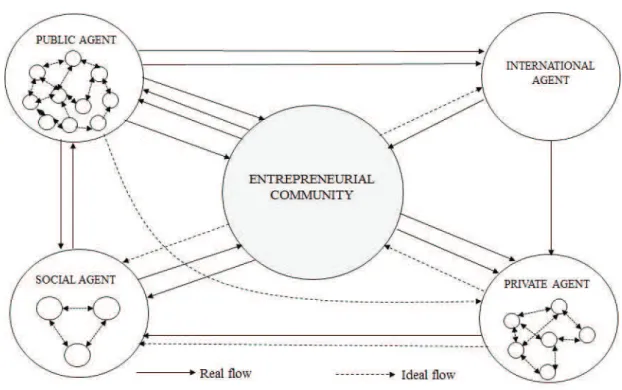
carefully applied it clearly illustrates, sometimes, complicated linkages and sequences (Holland, 2007). he tracing maps analysis of the origins and destinations of the flows of goods and personnel and establishment of connections between areas. Process tracing outlines the lows of resources deemed ideal (dotted lines) for the functioning of a business community (Figure 3).
FIGURE 3 – Process tracing of network.
he objective of process tracing here is to track the ideal lows of resources and visually represent risks, deficiencies, and potential solutions from the points of view of workers, and owners. Using current relations as a starting point, the ideal low of resources among the ecosystem’s nodes is traced. he process tracing in igure 5.2 diverges signiicantly from the static mapping in a fundamental way: reciprocity of relations (two-way arrows). It should be remembered that dotted lines represent ideal low, continuous line represent actual low.
(I); pro-environment actions and awareness of the ecological impact of present-day activities (Es), and neighborhood interactions (C).
The instrument explored the business owners’ positions (net center) on certain ideal matters, such as respect for public democratic values, commitment to and transparency with stakeholders, and investment in community improvements (igure 5.2.B). It also asked about who might be afected by the business’ activities and the business’ commitment to solving social problems (C). Similarly, owners were questioned about the timely payment of taxes into social spending and welfare funds, social well-being, eradication of activities that put society and nature at risk, and planning for the mitigation of injustices against society and nature (S). Finally, the instrument explored implementation of programs that promote protection of the environment (Es) and active participation in national and sub-national public political processes (Pu).
It is beneficial to strengthen relations between the business community and stakeholders from the public, private, and social agents. As the static mapping pointed out, workers are seldom familiar with even one stakeholder from each agent. Similarly, the business community should recognize that society and the environment are fundamental agents. Given these circumstances, the network should aim at achieving the ideal tracing (starting from the vision of both workers and business owners) and implement the strategies necessary to strengthen and consolidate relations, interaction and cooperation with the previously mentioned nodes in the ecosystem.
5.3 Institutional mapping
Institutional mapping is a tool that illustrates, in map form, the broad network of
lows of decisions, resources and information. It is a diagram created from process tracing’s many individual threads. It can be used to identify bottlenecks, constraints and opportunities to change processes to make them more eicient and efective (Holland, 2007). It identiies formal and informal rules and procedures, and relates resources to activities.
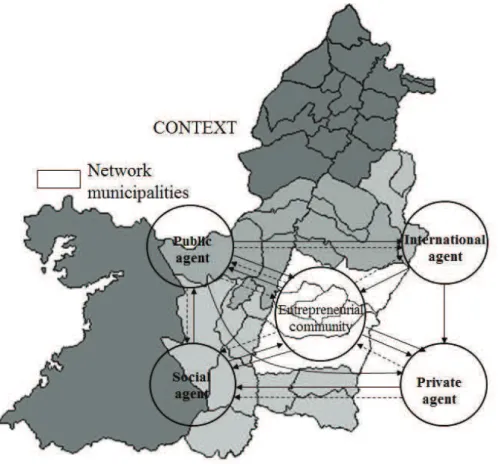
One last important objective of the mapping process is identiication of the means, incentives and mechanisms for mitigating obstacles and turning bottlenecks into opportunities for change (Holland, 2007). his mapping structures the environmental context, be it local regional or national. As the enterprises in the network researched are geographically situated in five municipalities of a single Colombian department, it seems most appropriate to map a regional context (igure 4).
Since a business community does not have a clear relationship with members of society, it is within a regional context where members are included in their two dimensions: community and societal. It is in this context as well that the environmental component (natural resources and species) resides.
FIGURE 4 – Institutional mapping.
Nestedness has involved action situations linking smaller scale groups, such as local users, with those of a larger scale (government entities). On the opposite side, polycentrism describes arrangements where multiple independent decision makers have overlapping authority, and
therefore participants have multiple opportunities to forge or dissolve linkages among diferent collective entities (Ostrom, Tiebout & Warren, 1961 and Mcginnis, 1999 as cited in Heikkila
FIGURE 5 – Institutional mapping.
he instrument administered to workers (numbers) assessed the importance given to sectorial, community, societal and environmental contexts. Figure 5.3. A maps such things as alignment between strategies and community demands (C); the efects of unanticipated sectorial situations and events (Ss); implementation of actions to protect the environment and awareness of the environmental impact of activities on a neighboring context (Es). Consistent with their station, the business leaders (numbers) assessed the impact of economic, union, as well as academic and international contexts (5.3.B).
Among the topics they identified as highly impacting business activities are rate of unemployment, business credit interest rates, regional economic expansion, overland transportation conditions, proximity of air and sea terminals, telecommunications system, departmental health system (EC). Also, the existence of regional training centers and public
and private universities (AC), operation of entities for the promotion of business and research (GC), and the presence of multilateral bodies promoting innovation (IC).
owners believe that the contextual environment’s economic impacts on network activities are more important than the environmental and social impacts resulting from business activity.
6 CONCLUSIONS
Data for this research was gathered through applying an instrument designed by the authors. hese data were then used to construct the maps in Figure 5. he moment has arrived to use these intermediate analytical tools to formulate conclusions. he business network being researched is an aggregate of organizations in the tourism industry; the network links the organizations to one another and allows them to establish relations with four types of agents: public, private, the third sector and international. he interdependence of the network and its nodes gives rise to a whole labeled an organizational ecosystem. Perhaps business administration has made progress in the organizational study of business networks with respect to adaptation points of view; however, institutional analysis of business networks from the perspective of selection has not.
his study demonstrated that a network can be analyzed as a business community (with 45 businesses comprising the network) and as an organizational ecosystem (45 networked enterprises, 10 public organizations, six private, three from the third sector and one international agent). Both the community and the ecosystem are collective entities which ecology identiies as organizational forms. From an institutional point of view, the network is made up of enterprises that are organizations in their own right; and the international node, for example, is represented
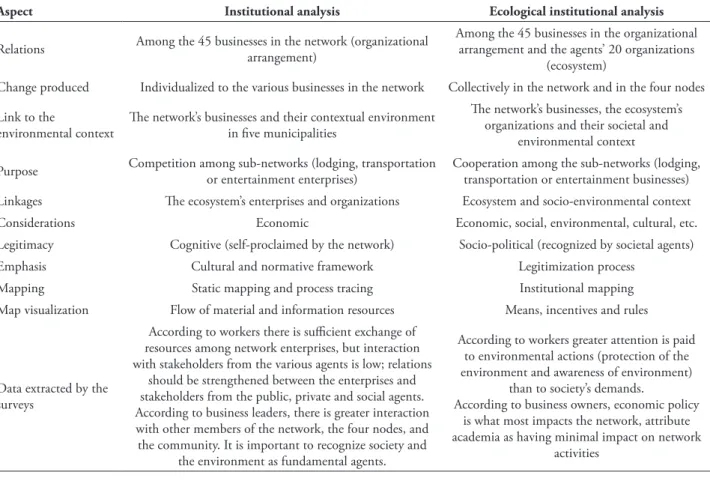
by an organization recognized as an institution. Altogether, the aggregate of 45 businesses and 20 organizations comprising the various public, private, third sector and international agents constitutes an institutional arrangement or governance structure. he chief conceptual contributions of this research are summarized in Table 1.
he linkages among the stakeholders of each agent (public, private and social) were always drawn using dotted lines, that is, as ideal lows, given that this project did not look at established relations inside each agent. he research focused on the business community’s (45 businesses) workers, and owners, but the possibility of conducting research from the standpoint of the perceptions of stakeholders in the various nodes remains open.
he research examined one institutional arrangement (its network and nodes) and its institutional context (community, society and region). A personal survey for workers and a second one for business leaders were the mechanisms used for data collection.
TABLE 1 – Conceptual contributions of the research
Aspect Institutional analysis Ecological institutional analysis
Relations Among the 45 businesses in the network (organizational
arrangement)
Among the 45 businesses in the organizational arrangement and the agents’ 20 organizations
(ecosystem)
Change produced Individualized to the various businesses in the network Collectively in the network and in the four nodes
Link to the
environmental context
he network’s businesses and their contextual environment in ive municipalities
he network’s businesses, the ecosystem’s organizations and their societal and
environmental context
Purpose Competition among sub-networks (lodging, transportation
or entertainment enterprises)
Cooperation among the sub-networks (lodging, transportation or entertainment businesses)
Linkages he ecosystem’s enterprises and organizations Ecosystem and socio-environmental context
Considerations Economic Economic, social, environmental, cultural, etc.
Legitimacy Cognitive (self-proclaimed by the network) Socio-political (recognized by societal agents)
Emphasis Cultural and normative framework Legitimization process
Mapping Static mapping and process tracing Institutional mapping
Map visualization Flow of material and information resources Means, incentives and rules
Data extracted by the surveys
According to workers there is suicient exchange of resources among network enterprises, but interaction with stakeholders from the various agents is low; relations
should be strengthened between the enterprises and stakeholders from the public, private and social agents. According to business leaders, there is greater interaction with other members of the network, the four nodes, and the community. It is important to recognize society and
the environment as fundamental agents.
According to workers greater attention is paid to environmental actions (protection of the environment and awareness of environment)
than to society’s demands.
According to business owners, economic policy is what most impacts the network, attribute academia as having minimal impact on network
activities
According to workers, the exchange of resources among the businesses in the network is suicient, however, interaction with stakeholders from the various agents is low. It is necessary, therefore, to build up the enterprises’ relations with additional stakeholders from the public, private and social agents. On a diferent note, workers felt the network paid more attention to environmental efforts (protection of the environment and awareness of environmental impact) than to the demands of society. Owners believe there is more interaction with other network members, with the four nodes and with the community, but feel it is important to recognize society and the environment as fundamental agents. In their eyes, it is economic policy that has the greatest impact on the network, and they demand greater support from academia (universities) for network activities.
As derived from the ecological institutional analysis performed, the principal suggestions
being set before the business network are: 1) Clearly deine the material (services, money) and information (participation in decision making, data, solutions) resources that can be exchanged among the various members of the community, the ecosystem, and users of the resources. 2) Deine the rules for appropriating and providing resources with respect to regional, not municipal, conditions. 3) Collectively formulate policies, rules, norms and standards in situations where all agents are represented. 4) Assign duties for auditing use of common resources to a group of business leaders. 5) Deine a system of sanctions for institutional violations of international arrangements, policies, rules, norms and decisions. 6) Establish mechanisms for resolution of conlicts in the community or ecosystem. 7) Call for the active participation of the political agent and its various stakeholders.
owners, and stakeholders’ representatives will make decisions that both strengthen relations among the members of the institutional arrangement and support selection of institutional contexts more favorable to performance of their activities (the goal of selection approaches). As international arrangements are important to the consolidation of national systems, it is essential that the network add more institutions, like a worldwide organization and a global code of ethics, to its international node. he network and its four nodes will be recognized as a unique, solid institution once its linkages, interactions and mediations low appropriately (static mapping), and especially after suggested international arrangements (trace mapping and institutional mapping) are addressed.
Finally, the idea that a business network could serve as a very useful model for public policy networks cannot be ignored; after all, businesses will always be stakeholders that can be brought in on participative processes. At the same time, it will always be more practical to deal with business networks than with individual businesses. Further, as discussed in section three, the public policy process allows for the possibility that organizations external to government, such as businesses and chambers of commerce, take part in decision making. he institutional ecosystem under study accommodates 45 businesses from the tourism sector, three chambers of commerce and three enterprises from outside of tourism. his research points toward an institutional aggregate that participates actively in the formulation of the Colombian department’s economic and industrial policy.
NOTE
1 This article was translated by Lynn Eddy-Zambrano. Master of Science, Management and Organization Development. Certiied Translator (Spanish-English), American Translators Association. leddyzambrano@ sbcglobal.net
REFERENCES
Bartels, B. (2009). Preventing cofee cooperation from grinding to a halt: An institutional analysis of the international coffee agreements and recommendations for achieving long-term cooperation in the international cofee trade.
Creighton Law Review, 42(3), 279-321.
Baum, J., & Oliver, C. (1996). Toward an institutional ecology of organizational founding.
The Academy of Management Journal, 39(5), 1378-1427.
Baum, J., & Powell, W. (1995). Cultivating an institutional ecology of organizations: Comment on Hannan, Carroll, Dundon, and Torres.
American Sociological Review, 60(4), 529-538. Benkler, Y. (2006). Wealth of networks: How social production transforms markets and freedom contract: freedom in the commons. New Haven: Yale University Press.
Carroll, G. (1984). Organizational ecology.
Annual Review of Sociology, 10, 71-93.
Chorev, N. (2007). Remaking U.S. Trade Policy: From protectionism to globalization. Ithaca, NY: Cornell University Press.
Dinar, A., & Saleth, R. M. (2004). Institutional economics of water: A cross-country analysis of institutions and performance. Washington, DC: World Bank Publications.
Feiock, R., & Cable, G. (1992). Need, institutional arrangements and economic Development.
Journal of Public Administration Research and heory, 2(4), 387-398.
Heikkila, T, Schlager, E., & Davis, M. W. (2011). he Role of cross-scale institutional linkages in common pool resource management: Assessing interstate river compacts. The Policy Studies Journal, 39(1), 121-145.
development practitioners. Herndon, VA: World Bank Publications.
Keohane, R. O. (1969). Institutionalization in the United Nations general assembly. International Organization, 23(4), 859-896.
Keohane, R. O. (1988). International institutions: Two approaches. International Studies Quarterly, 32(4), 379-396.
Lane, J., & Ersson, S. (1999). New institutional politics: Outcomes and consequences. London, GBR: Routledge.
Mercier, J. (1994). What level of government for ecologists? Public Administration Review, 54(4), 349-356.
Morçöl, G., & Wachhaus, A. (2009). Network and complexity theories: A comparison and prospects for a synthesis. Administrative heory & Praxis, 31(1), 44-58.
Ostrom, E. (1999). Institutional rational choice: An assessment of the institutional analysis and development framework. In P. Sabatier (Ed.),
heories of the Policy Process (pp. 35-69). Boulder, CO: Westview Press.
Ostrom, E. (2011). Background on the institutional analysis and development framework.
he Policy Studies Journal, 39(1), 7-27.
Pfefer, J., & Salancik, G. (2003). External control of organizations: A resource dependence perspective. Palo Alto, CA: Stanford University Press.
Rycroft, S., & Cosgrove, D. (1995). Mapping the modern nation: Dudley stamp and the land
utilization survey. History Workshop Journal, 40, 91-105.
Schneiberg, M., & Clemens, E. S. (2006). he typical tools for the job: Research strategies in institutional analysis. Sociological heory, 24(3), 195-227.
Simons, T, & Ingram, P. (2004). An ecology of ideology: Theory and evidence from four populations. Industrial and Corporate Change, 13(1), 33-59.
Singh, J. V, House, R., & Tucker, D. (1986). Organizational change and organizational mortality. Administrative Science Quarterly, 31(4), 587-611.
Spriggs, J., & Grant, I. (2001). Food safety and international competitiveness: The case of beef. Wallingford, GBR: CABI Publishing.
Star, S., & Griesemer, J. (1989). Institutional ecology, ‘translations’ and boundary objects: Amateurs and professionals in Berkeley’s Museum of vertebrate zoology, 1907-1939. Social Studies of Science, 19(3), 387-420.
Tan, S. Y. (1991). Institutional arrangements and the management of common-pool resources.
Public Administration Review, 51(1), 42-51. Ullman, E. L. (1953). Human geography and area research. Annals of the Association of American Geographers, 43(1), 54-66.