O R I G I N A L A R T I C L E
Macroalgal turfs in the Azores
Francisco M. Wallenstein1,2,3, Marlene R. Terra2, Joana Pombo2& Ana I. Neto2,3
1 School of Life Sciences, Heriot-Watt University, Edinburgh, UK
2 Departamento de Biologia da Universidade dos Ac¸ores, Secc¸a˜o de Biologia Marinha, Ponta Delgada, Portugal 3 CIIMAR (Centro Interdisciplinar de Investigac¸a˜o Marinha e Ambiental), Universidade do Porto, Porto, Portugal
Problem
A suite of studies undertaken during the past 15 years has investigated the intertidal and subtidal algal communities of the Azores (Neto 1992, 2000, 2001; Neto & Tittley 1995; Tittley et al. 1998; Tittley & Neto 2000). Algal turfs are generally described as complex assemblages of macro-algae with compact growth, 5 cm in height and well developed entangled prostrate axes (Price & Scott 1992). Turfs are conspicuous features of warm temperate inter-tidal communities, and have been widely studied (Chap-man 1955; Pryor 1967; Lawson & Norton 1971; Oliveira & Mayral 1976; Lawson & John 1977; Rogers & Salesky 1981; Stewart 1982; Neto & Tittley 1995; Morton et al. 1998). Some studies have classified communities system-atically as biotopes based on broad ecological ⁄ taxonomic categories, such as green algae, calcareous and non-calcar-eous turfs and crusts (e.g. Neto & Tittley 1995; Tittley et al. 1998, Tittley & Neto 2000; Wallenstein & Neto 2006; Wallenstein et al. 2008). Turfs classified as calcare-ous or coralline occur with increasing abundance towards
the low-shore and are usually not very conspicuous on less stable substrata such as cobbles, whereas turfs classi-fied as non-calcareous are more evenly distributed across the intertidal with higher abundances at mid-shore (Neto & Tittley 1995; Wallenstein & Neto 2006; Wallenstein et al. 2008). Classification of turfs into these two broad categories has been based on the abundance of erect cor-alline algae (recognizable by the naked eye) and can thus be subjective and artificial. To evaluate whether such a classification is artificial we have tested differences between species composition in samples of turf provision-ally identified in situ as calcareous (i.e. dominated by erect coralline algae) or non-calcareous turf.
Material and Methods
Data for analysis were gathered in the course of intertidal biotope surveys undertaken on three islands of the archi-pelago – Sa˜o Miguel, Santa Maria and Graciosa (Fig. 1) in the summer periods of 2004, 2005 and 2006, respec-tively. As macroalgae communities are not evenly
distrib-Keywords
Calcareous turf; intestidal; non-calcareous turf; rocky shores.
Correspondence
Francisco M. Wallenstein, School of Life Sciences, Heriot-Watt University, John Muir Building, Edinburgh EH14 4AS, UK. E-mail: [email protected] Conflicts of interest
The authors declare no conflicts of interest. doi:10.1111/j.1439-0485.2009.00311.x
Abstract
Studies on macroalgal communities of the Azores report algal turfs as one of the most conspicuous ecological entities occurring on the rocky shores of these islands. The present study investigates the influence of shore height and sub-stratum on turf composition. Data were analysed using the software PRIMER and results confirmed the previous distinction between calcareous, dominated by articulated coralline algae, and non-calcareous turfs, characterized mainly by small red algae. However, no differences in species composition were found in either type of turf occurring on different substrata or at different shore levels.
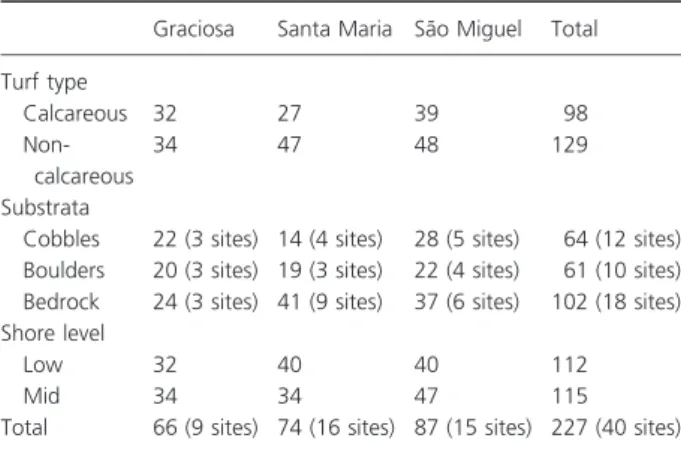
uted across the intertidal, both in terms of species com-position and substratum coverage, they pose a difficulty in sampling designs that require the collection of an equal number of samples at differing ‘substratum · shore level’ combinations. Although the original aim was to acquire quantitative data for macroalgal communities at high-, mid- and low-shore, on three substrata (cobbles, boulders and bedrock), high-shore samples had to be excluded from the pool of data because there were several sites where calcareous turf was absent. At mid- and low-shore, whenever possible two 10 · 10 cm areas (minimal inter-tidal scraping area defined by Neto 1997) of each type of turf (calcareous and non-calcareous) were cleared (scraped with a chisel into a nylon mesh bag) from the upper facing surfaces of three different substrata and brought to the laboratory for examination. Additionally, owing to an irregular distribution of substrata along the shores of the surveyed islands, an uneven sampling design had to be adopted (Table 1).
Turf constituents were identified with the help of a microscope and species abundances recorded using a semi-quantitative DAFOR scale (Dominant; Abundant; Frequent; Occasional; Rare). To test for differences between types of turfs (calcareous versus non-calcareous), substrata (cobbles versus boulders versus bedrock) and shore levels (low-shore versus mid-shore), PERMANOVA analyses were run on species richness (as pres-ence ⁄ abspres-ence data) and species relative abundance data with the software PRIMER (Anderson et al. 2008). PER-MANOVA combines the best of traditional test-statistics (ANOVA designs) and flexible multivariate nonparamet-ric methods, and can thus be based on symmetnonparamet-ric dissim-ilarity or distance measures (or their ranks) providing
probability values (P; significant if <0.05; not significant if ‡0.05) using appropriate permutation methods. The greater the number of possible permutations, the stronger the result of the tests. The island where samples were col-lected was set as a random factor, as there was no hypothesis regarding differences between islands. Further-more, SIMPER analysis on relative abundance data was used to identify the species responsible for the differences found between both types of turf.
Results
Species present
The turf samples contained 139 species of algae from 24 orders; the Ceramiales contained 60 species, the Gigarti-nales 11 species, and the CoralliGigarti-nales 9 species. These
Fig. 1. Schematic representation of the Azores archipelago with the sampled islands in dark.
Table 1. Number of samples collected according to the surveyed islands, turf types, substrata and shore level.
Graciosa Santa Maria Sa˜o Miguel Total Turf type Calcareous 32 27 39 98 Non-calcareous 34 47 48 129 Substrata
Cobbles 22 (3 sites) 14 (4 sites) 28 (5 sites) 64 (12 sites) Boulders 20 (3 sites) 19 (3 sites) 22 (4 sites) 61 (10 sites) Bedrock 24 (3 sites) 41 (9 sites) 37 (6 sites) 102 (18 sites) Shore level
Low 32 40 40 112
Mid 34 34 47 115
three orders are all in the red algae (Rhodophyta). Other orders present had fewer species.
Numerical analysis
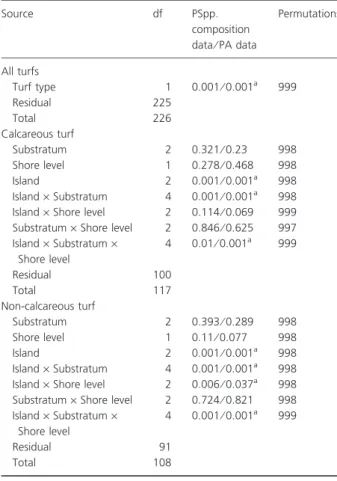
PERMANOVA tests on species composition and relative abundance upheld the basic separation into calcareous and non-calcareous turfs (Table 2).
When analysing data separately for each turf type there were no significant differences in turfs associated with substratum or shore level (Table 2).
Dissimilarity between calcareous and non-calcareous turfs is greater when comparing these using the relative abundance of its constituents (87.62) rather than using spe-cies richness (78.32). Differences between the two types of turf are mainly due to the co-dominant, erect calcareous species within one type of turf and Gelidium (dominant) and Ceramium spp. within the other (Table 3).
Discussion
The present study validates the empirical classification of two types of turf, calcareous, and non-calcareous, based on the presence of species of Corallina, Jania and Halipti-lon that occur in such abundance that they are visually recognizable (cf. Neto & Tittley 1995). Although differ-ences between the two types of turf are mainly due to the dominance of calcareous species within calcareous turfs, Corallina elongata can also be an important constituent of non-calcareous turfs; likewise, Laurencia spp. are a notice-able component of both communities. The few other major constituents of these two types of turf differ slightly, but there is a long list of minor constituents that are common to both (Table 3) and these are mainly fila-mentous red algae. The definition of both turfs in the present study is in accordance with the provisional bio-tope definition study of Tittley & Neto (2000). However, regarding non-calcareous turf in the present study we add Gelidium microdon to the species list defined as ‘soft algal turf’ by Tittley & Neto (2000). This is the main structur-ing species in our non-calcareous turf samples, which is certainly due to the fact that it occurs mainly in the mid-to-low eulittoral, which coincides with the distribution reported for the association of Gelidium microdon and Fucus spiralis by Tittley & Neto (2000). Approximately 30% of the total flora of the Azores was identified within the turfs sampled for the present study.
Highly mobile substrata tend to inhibit the attachment and growth of macroalgae and favour thin, turf-like growths that are resistant to abrasion, namely fast-grow-ing, opportunistic algae (mainly green algae and filamen-tous red and brown algae) that comprise non-calcareous turfs. Our finding of the absence of substratum specifici-ties in non-calcareous turfs with increasing substratum stability (cobbles to boulders to bedrock) was unexpected (Table 2). Increased stability was expected to allow the development of more mature communities, namely turfs with a greater number of species. However, unusual sta-bility conditions in cobble beaches as a result of reduced wave action in the summer might have allowed non-cal-careous turf communities on less stable substrata to develop towards those common on more stable substrata. Accordingly, sampling at other times of year might have detected changes in communities on different types of substrata.
Species composition of both types of turf does not vary significantly in the narrow mid- to low-shore range, prob-ably because of the limited shore extension in the Azores. Steep shores and small tidal ranges provide very little space for macroalgae to attach. A turf-like life form may present an advantage in the competition for space and help resist the strong wave action prevalent on most
Table 2. PERMANOVA analysis of differences in turfs according to substratum type (fixed factor with three levels: cobbles, boulders and bedrock) and to shore level (fixed factor with two levels: low-shore and mid-shore). Source df PSpp. composition data⁄ PA data Permutations All turfs Turf type 1 0.001⁄ 0.001a 999 Residual 225 Total 226 Calcareous turf Substratum 2 0.321⁄ 0.23 998 Shore level 1 0.278⁄ 0.468 998 Island 2 0.001⁄ 0.001a 998 Island· Substratum 4 0.001⁄ 0.001a 998
Island· Shore level 2 0.114⁄ 0.069 999
Substratum· Shore level 2 0.846⁄ 0.625 997 Island· Substratum · Shore level 4 0.01⁄ 0.001a 999 Residual 100 Total 117 Non-calcareous turf Substratum 2 0.393⁄ 0.289 998 Shore level 1 0.11⁄ 0.077 998 Island 2 0.001⁄ 0.001a 998 Island· Substratum 4 0.001⁄ 0.001a 998 Island· Shore level 2 0.006⁄ 0.037a 998
Substratum· Shore level 2 0.724⁄ 0.821 998 Island· Substratum ·
Shore level
4 0.001⁄ 0.001a 999
Residual 91
Total 108
aSignificant test; df = degrees of freedom; P = probability value
asso-ciated to the test; PA data = presence⁄ absence data; Permuta-tions = number of permutaPermuta-tions on which the test was based.
Table 3. Species that contribute to 90% of the differences between calcareous and non-calcareous turfs (SIMPER analysis) and their respective occurrence rate in all turf samples and abundance scores (DAFOR; in bold the most common category for each species).
Spp. Contribution% Occurrence DAFOR categories
Calcareous turf Corallina elongata 56.73 0.73 DA Haliptilon virgatum 9.63 0.32 DA Jania spp.a 10.83 0.46 DAFO Laurencia spp.b 7.37 0.51 AFO Chondria spp.c 2.17 0.29 AFO Gelidium spp.d 0.25 AFO Stypocaulon scoparium 0.27 FO Chondracanthus acicularis 0.25 FO Ceramium spp.e 4.08 0.51 FOR Chaetomorpha spp.f 0.26 OR
Other spp.(see below) <0.25 R
Total 90.81
Non-calcareous turf
Gelidium spp.d 32.44 0.43 DAF
Corallina elongata 13.15 0.46 AFO
Laurencia spp.b 7.71 0.35 AFO Ceramium spp.e 14.28 0.51 AFOR Jania spp.a 2.66 0.26 FO Ulva spp.g 2.48 0.28 OR Chaetomorpha spp.f 3.22 0.35 R Herposiphonia sp. 3.32 Polysiphonia spp.h 2.68 Gymnogongrus spp.i 2.52 Ahnfeltia plicata 1.77 Osmundea spp.j 1.57 Centroceras clavulatum 1.53 Caulacanthus ustulatus 1.4
Other spp. (see below) <0.25 R
Total 90.73
aJania capillacea, Jania longifurca, Jania pumila, Jania rubens. b
Laurencia viridis, Laurencia sp.
cChondria coerulescens, Chondria dasyphylla, Chondria capillaris. dGelidium microdon, Gelidium pusillum, Gelidium spinosum. e
Ceramium ciliatum, Ceramium circinatum, Ceramium diaphanum, Ceramium echionotum, Ceramium flaccidum, Ceramium virgatum.
fChaetomorpha linum, Chaetomorpha pachynema. gUlva compressa, Ulva intestinalis, Ulva clathrata, Ulva rigida.
hPolysiphonia brodiei, Polysiphonia denudata, Polysiphonia elongata, Polysiphonia furcellata. iGymnogongrus griffithsiae, Gymnogongrus crenulatus.
jOsmundea hibrida, Osmundea pinnatifida.
Other spp.: Acrosorium venulosum, Aglaothamnion sp., Aglaozonia parvula, Ahnfeltia sp., Ahnfeltiopsis intermedia, Amphiroa spp. (Amphiroa beauvoisii, Amphiroa sp.), Anotrichium spp. (Anotrichium furcellatum, Anotrichium tenue), Antithamnion sp., Asparagopsis armata, Bachelotia antillarum, Boergeseniella spp. (Boergeseniella fruticulosa, Boergeseniella sp.), Bonnemaisonia asparagoides, Bryopsis spp. (Bryopsis cupressina, Bryopsis hypnoides, Bryopsis plumosa), Callithamnion spp. (Callithamnion corymbosum, Callithamnion tetragonum, Callithamnion sp.), Catenella caespitosa, Caulacanthus ustulatus, Centroceras clavulatum, Chondracanthus acicularis, Chondrophycus sp., Cladophora spp. (Cladophora albida, Cladophora coelothrix, Cladophora prolifera, Cladophora sp.), Cladophoropsis membranacea, Cladostephus spongiosus, Codium adhaerens, Compsothamnion decompositum, Cryptopleura ramosa, Cystoseira spp. (Cystoseira abies-marina, Cystoseira humilis, Cystoseira sp.), Dasya spp. (Dasya corymbifera, Dasya hutchinsiae, Dasya sp.), Dictyota sp., Diplothamnion sp., Dipterosiphonia sp., Drachiella minuta, Endarachne binghamiae, Erythrocystis montagnei, Falkenbergia rufolanosa, Fucus spiralis, Gastroclonium spp. (Gastroclonium ovatum, Gastroclonium reflexum), Gelidiella sp., Gelidiopsis sp., Gigartina pistillata, Grateloupia spp. (Grateloupia filicina, Grateloupia dichotoma), Griffithsia corallinoides, Halopteris filicina, Herposiphonia sp., Heterosiphonia crispella, Hypnea spp. (Hypnea arbuscula, Hypnea musciformis), Lomentaria articulata, Lophosiphonia spp. (Lophosiphonia obscura, Lophosiphonia reptabunda), Nemoderma tingitanum, Platysiphonia sp., Pleonosporium sp., Plocami-um cartilaginePlocami-um, Porphyra sp., Pterocladiella capillacea, Pterosiphonia spp. (Pterosiphonia pennata, Pterosiphonia sp.), Rhodymenia holmesii, Sargassum spp. (Sargassum cymosum, Sargassum vulgare), Sphacelaria spp. (Sphacelaria cirrosa, Sphacelaria plumula), Sphondylothamnion multifidum, Stylonema alsidii, Stypocaulon scoparium, Symphyocladia marchantioides, Valonia spp. (Valonia macrophysa, Valonia utricularis).
shores of the Azores. Other advantages of the turf life form are the retention of water, the increased surface areas for attachment of admixed algae, increased resis-tance to herbivory, and increased ability in vegetative propagation (Price & Scott 1992).
No hypothesis was set regarding differences in turfs sampled on different islands. Sampling was done in dif-ferent years on each island and differences in species composition might reflect variations in population dynamics of the turf constituents.
The turf life form may be an ecological response to severe environmental conditions, notably wave action. Although this life form is resistant to the prevailing harsh conditions, more delicate ⁄ fragile algae, such as the fila-mentous species of Callithamnion and Dasya, are able to survive as minor constituents within the turf community. Turfs are an important feature of the warm temperate shore communities that dominate intertidal communities in the Azores. They thus deserve special attention, not as major features of an ecosystem, but as a local ecosystem in their own right.
Acknowledgements
The authors would like to thank Ian Tittley and the refer-ees for editing and comments, and all members of the Phycology Group of the Marine Biology Section of the University of the Azores and students that took part in the field surveys of Santa Maria, Sa˜o Miguel and Graciosa Islands. This work was partially supported by CIRN (Cen-tro de Investigac¸a˜o de Recursos Naturais; University of the Azores) and Governo Regional dos Ac¸ores ⁄ Secretaria Regional do Ambiente e do Mar. Francisco Wallenstein was supported by a PhD grant from Fundac¸a˜o para a Ci-eˆncia e Tecnologia (SFRH ⁄ BD ⁄ 27466 ⁄ 2006). The work carried out in the present study complies with the current laws of Portugal.
References
Anderson M.J., Gorley R.N., Clarke K.R. (2008) PERMANO-VA+ for PRIMER: Guide to Software and Statistical Methods. PRIMER-E, Plymouth, UK.
Chapman G. (1955) Aspects of the fauna and flora of the Azores VI. The density of animal life in the coralline algae zone. Annals and Magazine of Natural History, series 12, 398–400.
Lawson G.W., John D.M. (1977) The marine flora of Cap Blanc peninsula: its distribution and affinities. Botanical Journal of the Linnean Society, 75, 99–118.
Lawson G.W., Norton T.A. (1971) Some observations on lit-toral and sublitlit-toral zonation at Tenerife (Canary Isles). Botanica Marina, 14, 116–120.
Morton B., Britton J.C., Martins A.M.F. (1998) Coastal Ecology of the Azores. Sociedade Afonso Chaves, Ponta Delgada. Neto A.I. (1992) Contribution to the taxonomy and ecology of
the Azorean benthic marine algae. Biology Journal of the Lin-nean Society, 46, 163–176.
Neto A.I. (1997) Studies on Algal Communities of Sa˜o Miguel, Azores. Dissertac¸a˜o para a obtenc¸a˜o do Grau de Doutor em Biologia, especialidade de Biologia Marinha. Universidade dos Ac¸ores, Ponta Delgada, Portugal.
Neto A.I. (2000) Observations on the biology and ecology of selected macroalgae from the littoral of Sa˜o Miguel (Azores). Botanica Marina, 43, 483–498.
Neto A.I. (2001) Macroalgal species diversity and biomass of subtidal communities of Sa˜o Miguel (Azores). Helgoland Marine Research, 55, 101–111.
Neto A.I., Tittley I. (1995) Structure and zonation of algal turf communities on the Azores: a numerical approach. Boletim do Museu Municipal do FunchaI, (Suppl. 4), 487–504. de Oliveira Filho E.C., Mayral E.M. (1976) Seasonal
distribu-tion of intertidal organisms at Ubatuba, Sa˜o Paulo (Brazil). Revista Brasileira Biologia, 36, 305–316.
Price J.R., Scott F.J. (1992) . The Turf Algal Flora of the Great Barrier Reef. Part I. Rhodophyta. James Cook University, Townsville, Australia.
Pryor J. (1967) Intertidal Marine Algae of Sa˜o Jorge. Chelsea College Azores Expedition-Final Report, Chelsea College, London.
Rogers C.S., Salesky N.H. (1981) Productivity of Acropora palmata (Lamarck), macroscopic algae, and algal turf from Tague Bay reef, Saint Croix, U.S. Virgin Islands. Journal of Experimental Biology and Ecology, 49, 179–187.
Stewart J.G. (1982) Anchor species and epiphytes in intertidal algal turf. Pacific Science, 36, 45–59.
Tittley I., Neto A.I. (2000) A provisional classification of algal-characterised rocky shore biotopes in the Azores. Hydrobio-logia, 440, 19–25.
Tittley I., Neto A.I., Farnham F. (1998) Marine algae of the island of Flores, Azores: ecology and floristics. Boletim do Museu Municipal do Funchal, (Suppl. 5), 463–479. Wallenstein F.F.M.M., Neto A.I. (2006) Intertidal rocky shore
biotopes of the Azores: a quantitative approach. Helgoland Marine Research, 60, 196–206.
Wallenstein F.F.M.M., Neto A.I., A´lvaro N.V., Santos C.I. (2008) Algae based biotopes of the Azores (Portugal): spatial and seasonal variation. Aquatic Ecology, 42(4), 547–559.