ASSESSMENT OF THE FISH-WEIR FISHERY OFF THE
COAST OF PIAUÍ STATE, BRAZIL
Avaliação da pesca de curral na costa do Estado do
Piauí, Brasil
Ana Cecília Giacometti Mai1, Thiago Fernandes A. Silva2,3, Jefferson Francisco A. Legat3
1 Pós-Graduação em Oceanografia Biológica, Universidade Federal do Rio Grande. CP 474, Rio Grande, RS 96201-900. E-mail: [email protected]
2 Departamento de Ciências do Mar, Universidade Federal do Piauí, Parnaíba, PI, 64202-020. E-mail: [email protected] 3 EMPRAPA Meio-Norte. Núcleo de Pesquisa em Pesca e Aqüicultura, Parnaíba, PI, 64200-970. E-mail: [email protected]
ABSTRACT
Fish-weirs are stationary traps set up by ishermen in places with a considerable tidal height variation. This work followed the harvesting of three ish-weirs off the coast of Piauí State, Brazil. Sampling was conducted at daytime and nighttime shifts, during six days of each month of the period from December. 2008 through November, 2009. A total of 117 ish species was registered, belonging to 41 families. There was no signiicant difference in mean catch weight between the dry and wet seasons, the daytime and nighttime shifts, and full moon and new moon phases. The annual catch per ish-weir was estimated as 1.2 ton, of which 79.0% were made up of commercially-important ish species for Piauí State.
Keywords: ish-weir, artisanal ishing, species inventory, ishery statistics, Piauí State.
RESUMO
Currais-de-pesca são armadilhas utilizadas por pescadores em locais com variação de maré. Este trabalho monitorou três currais-de-pesca na costa do Piauí, Brasil. As amostragens foram conduzidas durante seis dias por mês, durante as despescas diurnas e noturnas, entre dezembro de 2008 a novembro de 2009. Um total de 117 espécies de peixes foram registrados, pertencentes a 41 famílias. Não houve diferença signiicativa para o peso médio das capturas entre as estações de chuva e seca, entre os períodos diurno e noturno, e entre as fases de lua cheia e lua nova. Estimou-se que cada curral-de-pesca gera uma produção anual de 1,2 t de peixe, da qual 79,0% são constituídos por espécies de importância comercial para o Estado do Piauí.
Palavras-chaves: curral-de-pesca, pesca artesanal, inventário de espécies, estatística pesqueira, Estado do Piauí.
Arq
u
ivo
s
d
e
C
iê
n
ci
a
s
d
o
Ma
INTRODUCTION
Fish-weirs are stationary traps for capturing
ish, usually designed with stakes vertically stuck in the ground, built following the direction of the tidal currents. This artisanal ishing gear is common in Northeast and North of Brazil where tidal variation is above 2 m high. Fishing weir technique was irst registered in Brazil in 1858 in the State of Ceará (Menezes 1974). Over a hundred years later, studies about this kind of ishing were developed in the States of Ceará, Maranhão and Pará (Paiva & Nomura, 1965; Paiva & Fonteles-Filho, 1968; Collyer & Aguiar, 1972; Almeida 1974; Tahim & Carvalho, 1990; Maneschy, 1993; Fonteles-Filho & Espínola, 2001; Ribeiro, 2004; Piorski et al., 2009).
In the State of Piauí, ishing is predominantly artisanal and the use of ishing weir traps is common in two out of the four municipalities of the coast, however, there is no published study about ishing weir for the state. Therefore, in order to cover this gap of information, we conducted the irst survey of ishes from shallow water zones collected in ish-weirs at the coast of Piauí State. We compared the
productivity relating diurnal versus nocturnal periods, wet versus dry seasons, and full moon versus new moon phases. In addition, we estimated the annual ish capture for each ishing weir.
MATERIAL AND METHODS
Study Area: sampling was conducted at the
municipality of Cajueiro da Praia, State of Piauí (Figure 1). This region is under the inluence of semi-diurnal tides up to 3.3 m of amplitude during spring tide. The climate is characterized by an average annual temperature of 27.8 degree Celsius and annual preci-pitation of 1,069 mm, heterogeneously distributed. Because it is located near the equator, seasons are governed by rainfall and are characterized by a dry period (July to December), and a wet period (January to June) (DIVA World Climate Data Base). For a more detailed description see Loebmann et al. (2010).
Description and operation of the ishing gear: ish-weirs at the State of Piauí are of the transverse type, composed by an entrance, two chambers, two small chambers and the ish trap, as it
is describe in (Piorski et al.,2009; Mai et al., 2012). The entrance is the biggest barrier, disposed perpendicularly towards tidal low, in a way that ish are intercepted and directed to the trapping compartments (Maneschy, 1993, Piorski et al,. 2009). Fish-weirs are harvested twice a day during low tide and two ishermen are needed for this activity, however, in small scale ish-weirs harvesting is possible to be carried out by only one man. Details about speciic gear, techniques for construction, and service life of ish-weirs are described by (Paiva & Nomura, 1965; Maneschy, 1993; Piorski et al,. 2009).
The ish-weirs were installed in shallow water zones, about 500 m from shoreline measured during neap tide, as the following:
Fish-weir 1: located at the village of Barra Grande, city of Cajueiro da Praia, 02°54’07”S - 41°24’18”W, 300 m distant from the lowest tidal shoreline. Its entrance measures 80 m. It is harvested by foot, by only one isherman.
Fish-weir 2: located in city of Cajueiro da Praia, 02°55’26”S - 41°20’21”W, 400 m distant from the lowest tidal shoreline. Its entrance measures 80 m. It is always harvested by two men in a canoe.
Fish-weir 3: located in city of Cajueiro da Praia, 02°55’26”S - 41°20’24”W, 400 m distant from the lowest tidal shoreline. Its entrance measures 80 m. It is always harvested by two men in a canoe.
Sampling: samples were collected between December, 2008 and November, 2009, at the three ish-weirs in operation in the littoral zone, all of them near the coast. Sampling was conducted during six days for each month, for diurnal and nocturnal harvestings.
During harvesting, collected specimens were identiied, the weight was recorded using a digital scale Rapala 25 kg RGSDS, and total length was measured by a ish measuring board with graph paper. Specimens that required a more thorough identiication and the ones that were the irst records for the region were taken to the Laboratory of Aquatic Resources of EMBRAPA Meio-Norte.
Specimens were ixed with 10% formalin and later preserved in 70% alcohol. Voucher specimens are deposited in the Ichthyologic Collection of Federal University of Rio Grande. Voucher codes are provided in the Appendix.
Data analysis: for each species we calculated
the frequency of occurrence (FO%), which is the number of times a given species was present in the samples, the numeric frequency (NF%), and the weight frequency (WF%) calculated based on the weight of a given species in relation to the total
weight obtained. In order to calculate the Index of Relative Importance (IRI) we used a formula proposed by Pinkas (1971), where IRI = FO% x (NF % + WF%). The IRI transformed in percentage is calculated considering the value for each species divided by the sum for all species.
In order to compare the weight obtained in the dry versus wet seasons, day versus night periods, and full moon versus new moon phases, we calculated the catch per unit effort (CPUE) since the sampling effort of those variables was not constant. In this case, the CPUE was calculated as the total weight of species divided by the number of samples, and each harvesting was considered a sample.
When comparing dry and wet seasons, all data were included. In the comparisons of harvestings conducted during day and night periods, only the months in which samples were obtained for both periods had their CPUEs compared. When comparing full moon versus new moon, only data from the month in which there were samples available for both moon phases had their CPUEs compared. We used Student’s t-test and a conidence interval of 0.95% for all analyses.
In order to gather more information on the capture of species of larger commercial interest for the region, we tabulated the data regarding catch numbers, and minimum medium and maximum length values throughout the year.
We estimated the total amount of annual capture in biomass for the ish-weirs of Piauí coast projecting the total biomass captured/ish-weir/ year, based on the total harvest effort of each ish-weir (see more details in Mai et al., 2012).
RESULTS
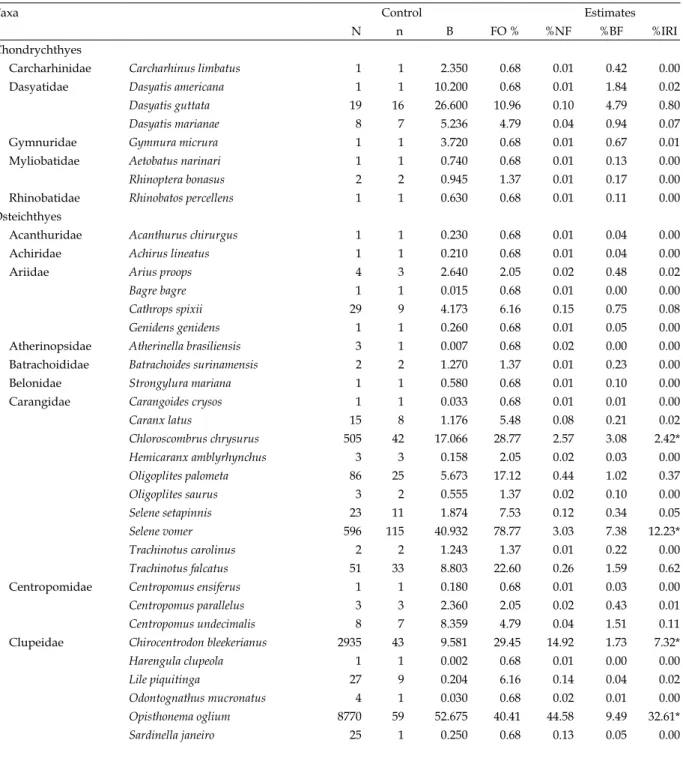
A total of 117 species belonging to 41 families were captured. The family with the higher number of representatives was Scianidae, with 17 species, and the second most diverse family was Engrauli
-dae, with 12 species (Tab. I). The most abundant spe -cies were Anchoa spinifer (spicule anchovy, manjuba
--vermelha), Anchoviella lepidentostole (broadband an
-chovy, manjuba-gordinha), Cetengraulis edentulus
(atlantic anchoveta, manjuba), Chirocentrodon bleeke
-rianus (dogtooth herring, sardinha), Opisthonema
oglinum (Atlantic thread herring, sardinha-bandeira), and Trichiurus lepturus, 1758 (largehead hairtail, es
-pada). Regarding the total biomass captured, species more representative were: Chaetodipterus faber (atlan
-tic spadeish, parum), Chloroscombrus chrysurus
(smallscale weakish, pescada-branca), Dasyatis guttata (longnose stingray, raia-da-pedra), Lobotes surinamensis (tripletail, chancarona), Megalops atlan -ticus (tarpon, camurupim), Opisthonema oglinum,
Selene vomer (lookdown, galo), and Trichiurus leptu -rus (Table I).
The ten species with higher IRI were: Anchoa spi
-nifer, Anchoviella lepidentostole, Cetengraulis edentulus,
Chaetodipterus faber, Chirocentrodon bleekerianus, Chloros -combrus chrysurus, Lycengraulis grossidens (Atlantic sa
-bretooth anchovy, manjuba, arenga), Opisthonema ogli -num, Selene vomer, and Trichiurus lepturus (Table I).
Taxa Control Estimates
N n B FO % %NF %BF %IRI Chondrychthyes
Carcharhinidae Carcharhinus limbatus 1 1 2.350 0.68 0.01 0.42 0.00 Dasyatidae Dasyatis americana 1 1 10.200 0.68 0.01 1.84 0.02
Dasyatis guttata 19 16 26.600 10.96 0.10 4.79 0.80
Dasyatis marianae 8 7 5.236 4.79 0.04 0.94 0.07
Gymnuridae Gymnura micrura 1 1 3.720 0.68 0.01 0.67 0.01
Myliobatidae Aetobatus narinari 1 1 0.740 0.68 0.01 0.13 0.00
Rhinoptera bonasus 2 2 0.945 1.37 0.01 0.17 0.00
Rhinobatidae Rhinobatos percellens 1 1 0.630 0.68 0.01 0.11 0.00 Osteichthyes
Acanthuridae Acanthurus chirurgus 1 1 0.230 0.68 0.01 0.04 0.00
Achiridae Achirus lineatus 1 1 0.210 0.68 0.01 0.04 0.00
Ariidae Arius proops 4 3 2.640 2.05 0.02 0.48 0.02
Bagre bagre 1 1 0.015 0.68 0.01 0.00 0.00
Cathrops spixii 29 9 4.173 6.16 0.15 0.75 0.08
Genidens genidens 1 1 0.260 0.68 0.01 0.05 0.00
Atherinopsidae Atherinella brasiliensis 3 1 0.007 0.68 0.02 0.00 0.00 Batrachoididae Batrachoides surinamensis 2 2 1.270 1.37 0.01 0.23 0.00
Belonidae Strongylura mariana 1 1 0.580 0.68 0.01 0.10 0.00
Carangidae Carangoides crysos 1 1 0.033 0.68 0.01 0.01 0.00
Caranx latus 15 8 1.176 5.48 0.08 0.21 0.02
Chloroscombrus chrysurus 505 42 17.066 28.77 2.57 3.08 2.42*
Hemicaranx amblyrhynchus 3 3 0.158 2.05 0.02 0.03 0.00
Oligoplites palometa 86 25 5.673 17.12 0.44 1.02 0.37
Oligoplites saurus 3 2 0.555 1.37 0.02 0.10 0.00
Selene setapinnis 23 11 1.874 7.53 0.12 0.34 0.05
Selene vomer 596 115 40.932 78.77 3.03 7.38 12.23*
Trachinotus carolinus 2 2 1.243 1.37 0.01 0.22 0.00
Trachinotus falcatus 51 33 8.803 22.60 0.26 1.59 0.62
Centropomidae Centropomus ensiferus 1 1 0.180 0.68 0.01 0.03 0.00
Centropomus parallelus 3 3 2.360 2.05 0.02 0.43 0.01
Centropomus undecimalis 8 7 8.359 4.79 0.04 1.51 0.11
Clupeidae Chirocentrodon bleekerianus 2935 43 9.581 29.45 14.92 1.73 7.32*
Harengula clupeola 1 1 0.002 0.68 0.01 0.00 0.00
Lile piquitinga 27 9 0.204 6.16 0.14 0.04 0.02
Odontognathus mucronatus 4 1 0.030 0.68 0.02 0.01 0.00
Opisthonema oglium 8770 59 52.675 40.41 44.58 9.49 32.61*
Sardinella janeiro 25 1 0.250 0.68 0.13 0.05 0.00
Sardinella sp. 1 1 0.010 0.68 0.01 0.00 0.00 Dactylopteridae Dactylopterus volitans 4 3 0.800 2.05 0.02 0.14 0.01 Diodontidae Cyclichthys spinosus 14 12 3.205 8.22 0.07 0.58 0.08 Echeneididae Echeneis naucrates 24 22 1.615 15.07 0.12 0.29 0.09
Engraulidae Anchoa cayorum 3 1 0.014 0.68 0.02 0.00 0.00
Anchoa ilifera 303 1 0.774 0.68 1.54 0.14 0.02
Anchoa januaria 18 7 0.047 4.79 0.09 0.01 0.01
Anchoa spinifer 866 36 9.040 24.66 4.40 1.63 2.22*
Anchoa tricolor 2 2 0.009 1.37 0.01 0.00 0.00
Anchovia clupeoides 99 6 0.814 4.11 0.50 0.15 0.04
Anchovia surinamensis 1 1 0.005 0.68 0.01 0.00 0.00
Anchoviella brevirostris 7 3 0.025 2.05 0.04 0.00 0.00
Anchoviella lepidentostole 943 40 8.662 27.40 4.79 1.56 2.60*
Cetengraulis edentulus 1254 26 7.347 17.81 6.37 1.32 2.05*
Engraulis eurystole 189 7 0.428 4.79 0.96 0.08 0.07
Lycengraulis grossidens 630 35 7.609 23.97 3.20 1.37 1.64*
Ephippiodae Chaetodipterus faber 436 72 104.321 49.32 2.22 18.80 15.47* Gerreidae Diapterus alisthostomus 1 1 0.031 0.68 0.01 0.01 0.00
Diapterus auratus 1 1 0.120 0.68 0.01 0.02 0.00
Diapterus rhombeus 127 46 10.253 31.51 0.65 1.85 1.17
Eucinostomus argenteus 23 8 0.130 5.48 0.12 0.02 0.01
Eucinostomus brasiliensis 5 1 0.004 0.68 0.03 0.00 0.00
Eucinostomus gula 5 2 0.018 1.37 0.03 0.00 0.00
Eucinostomus havana 2 1 0.006 0.68 0.01 0.00 0.00
Eucinostomus melanopterus 5 2 0.004 1.37 0.03 0.00 0.00
Eugeres brasiliensis 2 2 0.401 1.37 0.01 0.07 0.00
Gobiidae Ctenogobius boleosoma 1 1 0.007 0.68 0.01 0.00 0.00
Grammistidae Rypticus randalli 5 5 0.080 3.42 0.03 0.01 0.00
Haemulidae Anisostremus moricandi 1 1 0.001 0.68 0.01 0.00 0.00
Anisostremus virginicus 31 15 1.197 10.27 0.16 0.22 0.06
Conodon nobillis 1 1 0.240 0.68 0.01 0.04 0.00
Haemulon aurolineatum 1 1 0.060 0.68 0.01 0.01 0.00
Haemulon steindacneri 3 3 0.114 2.05 0.02 0.02 0.00
Genyatremus luteus 79 35 9.683 23.97 0.40 1.74 0.77
Orthopristis ruber 1 1 0.009 0.68 0.01 0.00 0.00
Pomadasys corviaeformes 164 17 0.927 11.64 0.83 0.17 0.17
Hemirhamphidae Hemirhamphus brasiliensis 1 1 0.019 0.68 0.01 0.00 0.00 Lobotidae Lobotes surinamensis 5 4 2.084 2.74 0.03 0.38 0.02
Lutjanidae Lutjanus analis 2 2 0.070 1.37 0.01 0.01 0.00
Lutjanus apodus 4 4 0.520 2.74 0.02 0.09 0.00
Megalopidae Megalops atlanticus 3 3 31.600 2.05 0.02 5.69 0.18
Mugilidae Mugil curema 4 3 1.960 2.05 0.02 0.35 0.01
Mugil liza 2 2 1.150 1.37 0.01 0.21 0.00
Ogcocephalidae Ogcocephalus vespertilio 4 4 0.540 2.74 0.02 0.10 0.00 Ostraciidae Acanthostracion polygonius 2 2 0.453 1.37 0.01 0.08 0.00
Lactophrys trigonus 3 3 0.395 2.05 0.02 0.07 0.00
Paralichthyidae Paralichthys brasilienses 2 1 2.180 0.68 0.01 0.39 0.00 Polynemidae Polydactylus oligodon 2 2 0.132 1.37 0.01 0.02 0.00
Polydactylus virginicus 8 3 1.200 2.05 0.04 0.22 0.01
Pomacentridae Abudefduf saxatilis 4 2 0.170 1.37 0.02 0.03 0.00 Pristigasteridae Pellona harroweri 129 34 2.289 23.29 0.66 0.41 0.37
Scianidae Bairdiella ronchus 7 5 0.266 3.42 0.04 0.05 0.00
Cynoscion leiarchus 2 2 0.425 1.37 0.01 0.08 0.00
Cynoscion microlepidotus 21 17 19.430 11.64 0.11 3.50 0.63
Cynoscion sp. 24 7 0.550 4.79 0.12 0.10 0.02
Cynoscion virescens 1 1 1.900 0.68 0.01 0.34 0.00
Isopisthus parvipinnis 4 4 0.067 2.74 0.02 0.01 0.00
Larimus breviceps 19 13 2.016 8.90 0.10 0.36 0.06
Macrodon ancylodon 2 2 0.315 1.37 0.01 0.06 0.00
Menticirrhus americanos 3 3 0.815 2.05 0.02 0.15 0.00
Menticirrhus littoralis 2 2 0.016 1.37 0.01 0.00 0.00
Micropogonias furnieri 2 2 0.346 1.37 0.01 0.06 0.00
Ophioscion punctatissimus 3 2 0.005 1.37 0.02 0.00 0.00
Parenques acuminatus 1 1 0.010 0.68 0.01 0.00 0.00
Stellifer brasilienses 4 3 0.019 2.05 0.02 0.00 0.00
Stellifer rastrifer 12 4 0.162 2.74 0.06 0.03 0.00
Stellifer stellifer 2 1 0.070 0.68 0.01 0.01 0.00
Steliffer sp. 5 1 0.180 0.68 0.03 0.03 0.00
Scombridae Scomberomorus brasiliensis 17 5 0.475 3.42 0.09 0.09 0.01
Scomberomorus cavalla 1 1 0.018 0.68 0.01 0.00 0.00
Sparidae Archosargus probatocephalus 2 2 0.140 1.37 0.01 0.03 0.00
Archosargus rhomboidalis 2 2 0.410 1.37 0.01 0.07 0.00
Stromateidae Peprilus paru 50 20 6.690 13.70 0.25 1.21 0.30
Tetraodontidae Colomesus psittacus 35 25 13.874 17.12 0.18 2.50 0.68
Lagocephalus laevigatus 4 3 2.670 2.05 0.02 0.48 0.02
Sphoeroides greeleyi 2 1 0.250 0.68 0.01 0.05 0.00
Sphoeroides testudineus 56 23 6.898 15.75 0.28 1.24 0.36
Sphoeroides tyleri 5 4 1.254 2.74 0.03 0.23 0.01
Trichiuridae Trichiurus lepturus 803 91 58.894 62.33 4.08 10.61 13.67*
Triglidae Prionotus punctatus 3 2 0.280 1.37 0.02 0.05 0.00
TOTAL 19672 146 555 100 100 100
* Ten species with the highest IRI.
There was no signiicant difference for the mean weight of captures between dry and the wet seasons (Student’s test, df = 9, p = 0.57; n.s.), between day and night periods (Student’s test, df = 16, p = 0.78; n.s.), and between full moon and new moon phases (Student’s test, df = 16, p = 0.75; n.s.) (Table III).
The species Anchoviella lepidentostole presented
seasonality, being captured between January and September, with a higher peak of captures from March to May; its total length varied from 5 to 13 cm.
Opisthonema oglinum also presented seasonality, being captured between December and July, with the highest peak of captures from March to July; its total length varied from 3 to 23 cm (Tab. II). Other species were captured throughout the year like
Table II - Number of sampled individuals (N), mean length in cm (L), and minimum and maximum length (min-max) of species of commercial interest captured in the ish-weirs off Piauí coast, during samplings conducted from December, 2008 to November, 2009.
Espécies December 2008 January 2009 February 2009 March 2009 April 2009 May 2009
N L (min-max) N L (min-max) N L (min-max) N L (min-max) N L (min-max) N L (min-max)
Anchoviella lepidentostole 7 8.7 (7-13) 6 9.88 (8-11) 393 8.75 (7-11) 126 9.74 (9-11) 272 9.11 (7-11)
Archosargus probatocephalus 1 21
Archosargus rhomboidalis 1 18 1 25
Batrachoides surinamensis 1 43
Cathorops spixii 2 33.5 (25-42) 1 21 3 46.23 (36-59) 5 18.08 (15-27)
Centropomus ensiferus
Centropomus parallelus 2 38.5 (38-39)
Centropomus undecimalis 1 52
Chaetodipterus faber 3 36.17 (34-39) 80 19.92 (4-35) 2 21.9 (12-32) 35 19.68 (10-34) 51 13.6 (5-34)
Cynoscion acoupa 3 42.37 (39-47) 4 39.5 (33-45)
Cynoscion leiarchus 1 36
Cynoscion microlepidotus 4 38.98 (32-46) 2 42.5 (42-43) 2 57.75 (55-61)
Dasyatis guttata* 1 32 1 50 1 45 3 28.03 (20-44) 1 40
Genyatremus luteus 1 23 1 16 1 19 51 15.13 (4-28)
Lobotes surinamensis 3 73.67 (73-75) 1 8
Megalops atlanticus 1 150 1 92 1 63
Mugil curema 1 40
Mugil liza 1 48 1 34
Opisthonema oglinum 2 7 (7-8) 10 4 2 9.95 (8-12) 2742 6.62 (5-9) 1210 9.78 (5-14) 2580 7.78 (3-17)
Peprilus paru 12 19.28 (17-22) 4 19.63 (19-20) 2 20.9 (20-22) 27 18.46 (16-22)
Sciades proops 1 47 1 53 2 44.8 (37-53)
Selene setapinnis 3 17.67 (16-19) 1 20
Selene vomer 25 17.98 (11-28) 39 15.39 (6-23) 29 19.5 (12-26) 53 18.2 (11-26) 20 16.95 (9-28) 135 14.65 (3-27) Trichiurus lepturus 21 65.63 (33-87) 12 61.5 (36-82) 42 62.13 (33-93) 152 35.5 (8-91) 417 36.82 (25-84) 40 39.1 (5-71)
Espécies June 2009 July 2009 August 2009 September 2009 November 2009
N L (min-max) N L (min-max) N L (min-max) N L (min-max) N L (min-max)
Anchoviella lepidentostole 21 10.12 (9-11) 94 7.44 (5-11) 24 11.68 (9-13)
Archosargus probatocephalus 1 38
Archosargus rhomboidalis
Batrachoides surinamensis 1 31
Cathorops spixii 1 24 17 15.23 (10-32)
Centropomus ensiferus 1 27
Centropomus parallelus 1 33
Centropomus undecimalis 2 42.75 (36-50) 5 46.7 (36-61)
Chaetodipterus faber 1 8 247 19.36 (6-37) 8 19.01 (14-22) 2 12.25 (11-14) 7 23.11 (12-30)
Cynoscion acoupa 1 53 3 52.7 (39-70) 3 42.57 (22-54) 1 70
Cynoscion leiarchus 1 68
Cynoscion microlepidotus 7 40 (35-52) 3 57.13 (56-59) 1 66 1 48 1 54
Dasyatis guttata* 2 26.15 (20-32) 4 28.55 (18-53) 6 38.33 (18-69)
Genyatremus luteus 10 19.97 (15-25) 11 19.81 (8-28) 2 19.1 (9-29) 1 14 1 16
Lobotes surinamensis 1 18
Megalops atlanticus
Mugil curema 1 37 2 36 (35-37)
Mugil liza
Opisthonema oglium 1021 11.82 (9-15) 1203 8.38 (4-23)
Peprilus paru 2 19.8 (19-21) 2 17.25 (16-19) 1 19
Sciades proops
Selene setapinnis 14 15.28 (13-22) 2 15.05 (14-16) 2 16 1 18
Selene vomer 49 15.66 (9-22) 229 15.71 (5-25) 6 15.38 (14-17) 9 17.2 (14-19) 2 19.2 (17-22)
Trichiurus lepturus 41 54.55 (32-92) 33 64.91 (53-80) 12 64.88 (39-76) 26 68.99 (34-82) 7 62.9 (43-79)
DISCUSSION
Because of the fact that the ish-weirs of Piauí are operating in shallow waters (up to 3 meters depth in the high tide), comparisons between our results with the captures taken by this ishing gear in the neighboring States of Maranhão and Ceará should be carefully interpreted. That is, due to distinct depths of operation in each State, it is expected that species composition changes and the total catch be higher with the increase of depth, even by comparison of samples with same effort. In fact, this pattern was previously observed by Paiva & Nomura (1965) which obtained higher capture indexes in ish-weirs installed far from the coast. On the other hand, although there is an expected tendency of higher catch in deeper zones, it is important to underscore that continuous studies of isheries are essential to monitoring if the ish stocks in the region are overexploited and catch has decreased as observed in several regions worldwide.
Another factor that is important to clarify is that estimates of total capture from the ish-weirs are considered an estimative of ish production only when all the scheduled harvests occur. During our study, we witnessed several periods in which harvesting did not occur. This absence of harvesting at irregular intervals was also observed by Maneschy (1993) and Piorski et al.(2009).
The comparison between species richness shows that Piauí ish-weirs present the higher values in relation to studies of other States in Brazil. Earlier researchers (Paiva & Nomura, 1965; Paiva & Fonteles-Filho, 1968; Collyer & Aguiar, 1972) have not provided a full list of captured species, listing only the eight most abundant species. Jacinto (1982) reported 78 species from Ceará ish-weirs between 1978 and 1981, and Piorski et al. (2009) presented a list of 42 species captured by ish-weirs in the State of Maranhão from April to September, 2004. The higher richness observed here may be related to the location of the ish-weirs in the State of Piauí, near the coast in shallow waters.
Data from 1962 to 1970 listed Megalops atlanticus, Trichiurus lepturus, Caranx sp.,
Chloroscombrus chrysurus, Opisthonema oglinum, and
Scomberomorus maculatus as the most abundant species captured in ish-weirs of Ceará State (Paiva & Nomura, 1965; Paiva & Fonteles-Filho, 1968; Collyer & Aguiar, 1972). Likewise, Almeida (1974) listed Euthynnus alleteratus and Elops saurus as the
major species for Ceará. Piorski et al. (2009) reported
C. edentulus, T. lepturus, C. crysos, O. saurus, M. ancylodon, Notarius grandicassis, P. harroweri, G. luteus,
C. chrysurus, S. vomer, C. psittacus, C. acoupa, B. bagre, and Aspistor quadriscutis as the most common species in the ish-weirs of Maranhão in 2004.
The major difference between data from the most important ishing species from the states of Ceará, Piauí and Maranhão, is the fact that some families with great commercial interest such as Carangidae and Scombridae end up not being accounted for the captures of Piauí State because of the location of the ish-weirs in shallow waters.
Historically, oficial data of ish landing from open sea in the State of Piauí indicate a ish annual capture lower than 3,000 ton, as it was recorded in 2009 when 2,959.7 tons of ish were registered (MPA 2010) and in 2010, when the value was 3.019,4 t (MPA, 2012). It is worth mentioning that the 1.2 ton annual catch accounts only for 0.05% of Piauí State’s total annual ish production.
Acknowledgments - We are thankful to ICMBio (Parnaíba) for the collaboration. We also would like to thank ishermen: Adécio, Antônio, Charles and Pedro, and helpers: Diniz, Davi and Davilson Soares, Obelix, Gabriel, Natelson, and Fernando.
REFERENCES
Almeida, H.T. Sobre a produção pesqueira de alguns currais-de-pesca do Ceará - dados de 1971-1973. Bol. Est. Biol. Mar. Univ. Fed. Ceará, Fortaleza, n.26, p.1-9, 1974.
Collyer, E.C. & Aguiar, D.A. Sobre a produção pesqueira de alguns currais-de-pesca do Ceará: 1968
Comparisons Mean 1 Mean 2 t value df P
Wet x dry seasons 59.875 44.904 0.59 9 0.57
Day x night shifts 4.599 5.115 -0.28 16 0.78
Full moon x new moon 4.288 3.821 0.32 16 0.75
a 1970. Bol Bol. Est. Biol. Mar. Univ. Fed. Ceará, Fortaleza, n.24, p.1-9, 1972.
Fonteles-Filho, A.A. & Espínola, M.F. Produção de pescado e relações interespecíicas na biocenose capturada por currais-de-pesca, CE. Bol. Téc. Cient. CEPNOR, Belém, v.1, p.111-124, 2001.
Jacinto, F.G. Análise da produção pesqueira de algumas espécies de peixes, capturadas por currais-de-pesca da praia de Almofala e Acaraú, Ceará, durante o período de 1978 a 1981. Monograia de Gaduação, Departamento de Engenharia de Pesca, Universidade Federal do Ceará, Fortaleza, 1982.
Loebmann, D.; Mai, A.C.G. & Lee, J.T. The invasion of ive alien species in the Delta do Parnaíba Environmental Protection Area, Northeastern Brazil.
Int. J. Trop. Biol., v.58, n.3, p.909-923, 2010.
Mai, A.C.G.; Silva, T.F.A.; Legat, J.F.A. & Loebmann, D. Capture of green sea turtles, Chelonia mydas, in ish-weirs off the Coast of Piauí, Northeastern Brazil.
Marine Turtle Newsletter, v.132, p.6-8, 2012.
Maneschy, M.C. Pescadores curralistas no litoral do Pará: evolução e continuidade de uma pesca tradicional. Rev. Soc. Brasil. Hist. Ciên., Campinas, v.10, p.53-74, 1993.
Menezes, R.S. Notas sobre história da pesca no Ceará.
Rev. Inst. Ceará, Fortaleza v.20, p.127-130, 1974.
MPA. Produção pesqueira e aquicola: estatística 2008 e 2009. Ministério da Pesca e Aquicultura, Brasília, 2010. MPA. Boletim estatístico da pesca e aquicultura: Brasil 2010. Ministério da Pesca e Aquicultura, Brasília, 2012. Paiva, M.P. & Fonteles-Filho, A.A. Sobre a produção pesqueira de alguns currais-de-pesca do Ceará - dados de 1965-1967. Bol. Est. Biol. Mar. Univ. Fed. Ceará, Fortaleza, n.16, p.1-5, 1968.
Paiva, M.P. & Nomura, H. Sobre a produção pesqueira de alguns currais-de-pesca do Ceará: Dados de 1962 a 1964. Arq. Est. Biol. Mar. Univ. Ceará, Fortaleza, v.5, p.175-214, 1965.
Piorski, N.M.; Serpa, S.S. & Nunes, J.L.S. Análise comparativa da pesca de curral na Ilha de São Luís, MA, Brasil. Arq. Ciên. Mar, Fortaleza, v.42, p.65-71, 2009.
Ribeiro, C.A. Caracterização da pesca artesanal em um curral-de-pesca na praia de Flecheiras, Trairi - CE.
Monograia de Gaduação, Departamento de Engenharia de Pesca, Universidade Federal do Ceará, Fortaleza, 2004.
Tahim, E.F. & Carvalho, R.C.A. Análise sócio-econômica da pesca de curral em Bitupitá, município de Barroquinha, Estado do Ceará. Monograia de Gaduação, Departamento de Engenharia de Pesca, Universidade Federal do Ceará, Fortaleza, 1990.
Appendix
Voucher list of specimens deposited in the Ichthyologic Collection of Federal University of Rio Grande:
Acanthostracion polygonius Poey, 1876 n°2634; Achirus lineatus (Linnaeus, 1758) n°2611; Anchoa cayorum (Fowler, 1906) n°2589;
Anchoa januaria (Steindachner, 1879) n°2602; Anchoa spinifer (Valenciennes, 1848) n°2628; Anchoa tricolor (Spix & Agassiz, 1829)n°2631;
Anchovia clupeoides (Swainson, 1839) n°2593; Anchovia surinamensis (Bleeker, 1865) n°2622; Anchoviella brevirostris (Günther, 1868) n°2607;
Anchoviella lepidentostole (Fowler, 1911) n°2626; Anisotremus virginicus (Linnaeus, 1758) n°2574; Atherinella brasiliensis (Quoy & Gaimard, 1825) n°2624; Bagre bagre (Linnaeus, 1766)n°2556; Bairdiella ronchus (Cuvier, 1830) n°2597 and 2620; Carangoides crysos (Mitchill, 1815) 2633;
Caranx latus Agassiz, 1831 n°2565; Cathorops spixii (Agassiz, 1829) n°2552; Cetengraulis edentulus (Cuvier, 1829) n°2598; Chaetodipterus faber
(Broussonet, 1782) n°2619; Chirocentrodon bleekerianus (Poey, 1867) n°2618; Chloroscombrus chrysurus (Linnaeus, 1766) n°2587; Conodon nobilis (Linnaeus, 1758) n°2563; Cynoscion leiarchus (Cuvier, 1830) n°2621; Cynoscion virescens (Cuvier, 1830) n°2569; Dactylopterus volitans
(Linnaeus, 1758) n°2561; Diapterus rhombeus (Cuvier, 1829) n°2627; Echeneis naucrates Linnaeus, 1758 n°2551; Engraulis eurystole (Swain & Meek, 1884) n°2572; Eucinostomus argenteus Baird & Girard, 1855n°2614; Eucinostomus gula (Quoy & Gaimard, 1824) n°2617; Eucinostomus havana (Nichols, 1912) n°2609; Eucinostomus melanopterus (Bleeker, 1863) n°2594; Genyatremus luteus (Bloch, 1790) 2550; Haemulon aurolineatum Cuvier, 1830n°2600; Haemulon steindachneri (Jordan & Gilbert, 1882) n°2608; Hemicaranx amblyrhynchus (Cuvier, 1833) n°2559;
Hemiramphus brasiliensis (Linnaeus, 1758) n°2568; Isopisthus parvipinnis (Cuvier, 1830) n°2554; Larimus breviceps Cuvier, 1830 n°2553; Lile piquitinga (Schreiner & Miranda Ribeiro, 1903) n°2629; Lutjanus apodus (Walbaum, 1792) n°2567; Lycengraulis grossidens (Agassiz, 1829) n°2573; Menticirrhus americanus (Linnaeus, 1758) n°2603; Micropogonias furnieri (Desmarest, 1823) n°2592; Odontognathus mucronatus
Lacepède, 1800 n°2562; Ogcocephalus vespertilio (Linnaeus, 1758)n°2635; Oligoplites palometa (Cuvier, 1832) n°2549; Oligoplites saurus (Bloch & Schneider, 1801) n°2571; Ophioscion punctatissimus (Fowler, 1917) n°2590; Opisthonema oglium (Lesueur, 1818) n°2555; Orthopristis ruber
(Cuvier, 1830) n°2596; Pellona harroweri (Fowler, 1917) n°2586; Polydactylus oligodon (Günther, 1860) n°2560; Polydactylus virginicus
(Linnaeus, 1758) n°2564; Pomadasys corvinaeformes (Steindachner, 1868) n°2612; Prionotus punctatus (Bloch, 1793) n°2605; Rypticus randalli
Courtenay, 1967 n°2625; Sardinella sp. n°2595; Scomberomorus brasiliensis Collette, Russo & Zavala-Camin, 1978 n°2623; Selene setapinnis
(Mitchill, 1815) n°2585; Selene vomer (Linnaeus, 1758) n°2570; Sphoeroides greeleyi Gilbert, 1900 n°2588; Sphoeroides tyleri Shipp, 1972 n°2606;