1 © The Author(s) 2018. Published by Oxford University Press on behalf of Entomological Society of America.
All rights reserved. For permissions, please e-mail: [email protected].
Ecotoxicology
Lethal and Sublethal Effects of Various Pesticides
on Trichogramma achaeae (Hymenoptera:
Trichogrammatidae)
João Fontes,
1Inés Sanchez Roja,
1João Tavares,
2and Luísa Oliveira
2,31Faculdade de Ciências e Tecnologias, Universidade dos Açores, Rua da Mãe de Deus, 9501-801 Ponta Delgada, S. Miguel, Açores, Portugal, 2Faculdade de Ciências e Tecnologias, Centro de Biotecnologia dos Açores, Universidade dos Açores, Rua da Mãe de Deus, 9501-801 Ponta Delgada, S. Miguel, Açores, Portugal, and 3Corresponding author, e-mail: [email protected]
Subject Editor: Eric Riddick
Received 16 October 2017; Editorial decision 24 February 2018
Abstract
Little information is available regarding the lethal and sublethal effects of pesticides on Trichogramma achaeae (Nagaraja and Nagarkatti; Hymenoptera: Tricogrammatidae) during integrated management of Tuta absoluta (Meyrick; Lepidoptera: Gelechiidae), an important pest for tomato production. Twenty-two pesticides sprayed on Ephestia kuehniella (Zeller; Lepidoptera: Pyralidae) eggs were evaluated on the mortality of adult parasitoids upon contact with the hosts 24 h after the treatments and their sublethal effects on the parasitoids were assessed in laboratory conditions. Tests were carried out with fresh solutions at the recommended concentration. According to the International Organisation for Biological and Integrated Control (IOBC) standards, chlorpyrifos is harmful to the parasitoid; merthiocarb, methomyl, spinosad lambda-cyhalothrin, and acrinatrin are moderately harmful; and chlorantraniliprole, lufenuron, hexythiazox, cyromazine and Bacillus thuringiensis have no effect on the parasitoid. Sulfur is slightly harmful, and azoxystrobin is harmless. Chlorpyrifos was the most lethal among these pesticides and killed all females in less than 24 h. All other pesticides affected the biological parameters of T. achaeae to varying degrees. Regarding the lethal and sublethal effects, merthiocarb and spinosad killed all female offspring in less than 24 h; lambda-cyhalothrin and sulfur reduced the number of parasitized eggs; and acrinatrin, deltamethrin and azoxystrobin affected the emergence rate. After that, we can recommend the use of chlorantraniliprole and B. thuringiensis to control Lepidoptera, cyromazine to control Diptera, pirimicarb to control Homoptera, hexythiazox to control mites and azoxystrobin can be used as fungicide in an integrated pest management program with mass released of T. achaeae.
Key words: pesticide, integrated pest management, egg parasitoid, toxicity, side effect
A combination of biological and chemical control approaches is very important for a successful integrated pest management (IPM) pro-grams (Musser et al. 2006, Ghorbani et al. 2016). IPM programs use a combination of strategies, such as chemical, biological, and mechanical control, to maintain pest populations below economic thresholds (Roubos et al. 2014, Khan et al. 2015). The use of pesti-cides that are effective against target pests but have little or no nega-tive effects on their natural enemies are desirable (Bastos et al. 2006,
Preetha et al. 2010). Although biological control is very important in pest control, chemical control is still needed when there is a pest outbreak that produces an economic loss.
The negative effects of pesticides on natural enemies induce the necessity to study their side effects to adjust chemical and bio-logical control programs and reduce the negative impacts of pesti-cides on non-target organisms (Souza et al. 2014, Ghorbani et al.
2016). Pesticides have lethal and sublethal effects on arthropods, as they can kill these organisms or negatively affect various biological parameters (Desneux et al. 2007, Garcia et al. 2009, Cordeiro et al. 2010, Castro et al. 2012).
Tomato (Solanum lycopersicum L.) is a major agricultural crop, with an estimated production of 170,751 MT year−1 (FAOSTAT 2014). Tomato crops are exposed to numerous pest organisms that cause economic losses, and the use of pesticides is necessary when they reach the economic threshold.
Tuta absoluta (Meyrick; Lepidoptera: Gelechiidae) is considered one of the most important pests for tomato production and results in serious damage in infested areas in different countries of the world (Desneux et al. 2011). The egg parasitoid Trichogramma achaeae (Nagaraja and Nagarkatti; Hymenoptera: Tricogrammatidae) was identified as an agent for the biological control of T. absoluta in the
Journal of Economic Entomology, XX(X), 2018, 1–8 doi: 10.1093/jee/toy064 Research article
Palaearctic region (Polaszek et al. 2012). Nevertheless, one method for the protection of these parasitoids is to use selective insecticides and fungicides, as well as other chemical and/or biological agents that are harmless to these organisms.
A combined use of parasitoid releases and safe pesticide products will maximize the impact of their use in pest control as tomato cul-tivation requires pesticides to be applied for protection against other pests and diseases, such as flies, whiteflies, spider mites and fungi (Momanyi et al. 2012).
Regardless of literature available on the effects of pesticides on Trichogramma spp. (Cônsoli et al. 2001, Garcia et al. 2009, Blibech et al. 2015), there is information on the adverse effects of the most commonly used pesticides regularly used in tomato crops on the eggs parasitoid T. achaeae, which are used in mass releases to control T. absoluta. Several studies have shown that Trichogramma spp. are very vulnerable to a large variety of pesticides (Hassan et al. 1998,
Vieira et al. 2001, Khan et al. 2015).
This study aimed to evaluate the negative effects of 22 com-monly used pesticides (20 insecticides or acaricides and 2 fungicides) in greenhouse tomato crops in Azores, on biological parameters of T. achaeae. We also analyzed the sublethal effects on the offspring.
Materials and Methods
InsectsTr. achaeae were originally collected from eggs of Thysanoplusia orichalcea (Fabricius) and Chrysodeixis calcites (Esper; Lepidoptera: Noctuidae) found at Chã da Macela, São Miguel Island, Azores (Portugal) (37° 75′ 87″ N, 25° 54′ 12″ O, at 253 m altitude) and maintained in laboratory conditions on Ephestia kuehniella (Zeller; Lepidoptera: Pyralidae) eggs for 5–7 generations. Parasitoids were reared on E. kuehniella, glued onto yellow cardboard (0.8 × 8.5 cm) with the aid of 30 % (w/v) gum Arabic, in glass tube (10.0 × 1.0 cm diameter) containing honey droplets as a source of food for emerged adult. The glass tubes were closed with cotton wool and maintained
at 21 ± 1°C of temperature, 70 ± 5% relative humidity (RH) and with a natural photoperiod (11.9 ± 3.6 h Light).
Pesticides
All tests were performed with fresh solutions of commercial pesticides prepared in water. Twenty insecticides and two fungicides were tested at the concentrations recommended by the manufacturer as indicated in Table 1. Pesticides were selected based on their use for the control of different pests in tomato greenhouses in the Azores archipelago. Toxicity of Dried Pesticide Residues to Tr. achaeae Adults
For analysis of the effect of the various pesticides on the mortality of females and on other biological parameters of T. achaeae, yellow cards (1.5 × 0.8 cm) were prepared, each with 500 UV-killed E. kue-hniella eggs glued to the card with a 30% solution of Arabic glue. The experiment design follows the guidelines of the International Organisation for Biological and Integrated Control (IOBC) for exposure of parasitoids to pesticides. The assay was performed in two different periods of time (group A and group B), with one control for each group. Every treatment was repeated four or five times, depending on the mortality of the females, and there were 15 replicates, corresponding to 15 host egg cards, sprayed with one of the 22 pesticides or with water (n = 60–75 per treatment). Each set of host egg cards was sprayed with 6 ml of an aqueous suspen-sion of one of the pesticides, using Potter tower equipment (Burkard, Rickmansworth, United Kingdom) at 2 bars. Controls were sprayed with distilled water. This resulted in homogeneous spray coverage of 9.52 ± 2.17 μl (mean ± SD) of fluid cm−2, corresponding to the con-centrations recommended by the manufacturer (1,000 l ha−1 = 10 µl cm−2). After treatment, egg cards were air-dried in an open plastic box for 24 h, and then they were offered to one isolated T. achaeae female, with less than 24 h of life, into the glass tube. The female was supplied with a honey solution (50%) and allowed to parasitize until her death. Females were observed daily until death to calculate
Table 1. Pesticides tested and their used and recommended field rates used in the experiment
Active ingredient (a.i.) Chemical group Trade name with formulation
Used Company Dose/cm2
Abamectin Avermectin Bermectine 1.8 EC Insecticide/acaricide SIPCAM Portugal 0.005 µl Acetamiprid Neonicotinoid Epik 20 SG Insecticide SIPCAM Portugal 0.005 mg Acrinatrin Pyrethroid Rufast Avance 75 EW Insecticide SELECTIS 0.006 µl Azoxystrobin Strobilurin Ortiva 23.1 SC Fungicide SYNGENTA 0.010 µl
Bacillus thuringiensis subsp.
Kurstaki
Microbiological Bactil X2 6.4 WP Insecticide SIPCAM Portugal 0.005 mg
Chlorantraniliprole Anthranilic diamide Altacor 35 WG Insecticide Bayer CropScience Portugal 0.001 mg Chlorpyrifos Organophosphate Destroyer 480 EC Insecticide Nufarm Portugal 0.020 µl Cyromazine Triazine Trigard 75 WP Insecticide SYNGENTA 0.003 mg Deltamethrin Pyrethroid Decis 25 EC Insecticide Bayer CropScience Portugal 0.005 µl Emamectin Benzoate Avermectin Affirm 0.85 SG Insecticide SYNGENTA 0.015 mg Hexythiazox Carboxamide Nisorum 10 WP Acaricide SIPCAM Portugal 0.005 mg Imidacloprid Neonicotinoid Confidor 200 SL Insecticide Bayer CropScience Portugal 0.005 µl Lambda-cyhalothrin Pyrethroid Atlas 9.5 SC Insecticide SELECTIS 0.003 µl Lufenuron Benzoylurea Match 0.50 EC Insecticide SYNGENTA 0.020 µl Merthiocarb Carbamate Mesurol 200 SC Insecticide Bayer CropScience Portugal 0.050 µl Methomyl Carbamate Lannate 25 WP Insecticide DU PONT-SAPEC 0.013 µl Neem oil Limonoid Neem EC Insecticide BIAGRO 1.000 µl Pirimicarb Carbamate Pirimor 50 WG Insecticide SYNGENTA 0.005 mg Spinosad Spinosyn Spintor 480 SC Insecticide Lusosem 0.003 µl Sulfur Inorganic Stullun 80 WG Fungicide SAPEC Agro Portugal 0.040 mg Thiamethoxam Neonicotinoid Actara 25 WG Insecticide SYNGENTA 0.003 mg Vegetable oils - Vegetable oil soap Insecticide Naturchemís 1.000 µl
the longevity of adults in contact with the treated eggs. For the two groups, after offspring emergence, development time (egg to adult), number of parasitized eggs (host eggs that turned black), emergence rate (number of host eggs with a hole made by Trichogramma/total number of parasitized eggs) and sex ratio of offspring (number of females/total number of adults) were quantified for each treatment.
All tests were performed under semi-controlled conditions, at 26 ± 1°C for group A and 23 ± 1°C for group B, in 70 ± 5% RH and with a natural photoperiod (13.3 ± 1.3 h Light).
Effects on the First Generation
After emergence, female offspring were isolated in a glass tube, and a yellow card with untreated E. kuehniella eggs and a small drop of honey solution was added. Parasitism was allowed for 7 d. Then, the female was removed, and the mortality rate was recorded. Once the progenitor was removed, the egg cards were kept until the end of development in the same conditions. The estimated parameters were progenitor mortality rate, development time, number of parasitized eggs, emergence rate, and sex ratio of the offspring.
Statistical Analysis
Differences between treatments and the water control in female longevity, parasitoid development times, and number of parasitized host eggs that turned black were determined by a T-test using √(x + 0.5)-transformed data. Adult emergence rates and sex ratio were analyzed by T-test using arcsine √ x-transformed data to normal-ize their distribution (Zar 1996). Female infertility rates and female
offspring mortality 7 d after emergence were analyzed by chi-square (χ2) tests for comparison of proportions (P < 0.05). All analyses were performed using the statistical software SPSS 23.0 (IBM SPSS 2015).
Furthermore, the reduction in T. achaeae parasitism as related to the control treatment was calculated by the following equation: E(%) = (1 – Vt/Vc) × 100, in which E(%) is the percent reduction in parasitism, Vt is the median parasitism for the treatment tested, and Vc is the average parasitism observed for the control treatment (Carmo et al. 2010). The chemicals were classified according to the IOBC standards as follows: class 1, harmless (E < 30%); class 2, slightly harmful (30% ≤ E ≤ 79%); class 3, moderately harmful (80% ≤ E ≤ 99%); and class 4, harmful (E > 99%) (Hassan 1992).
Results
Toxicity of Dried Pesticide Residues to Tr. achaeae Adults
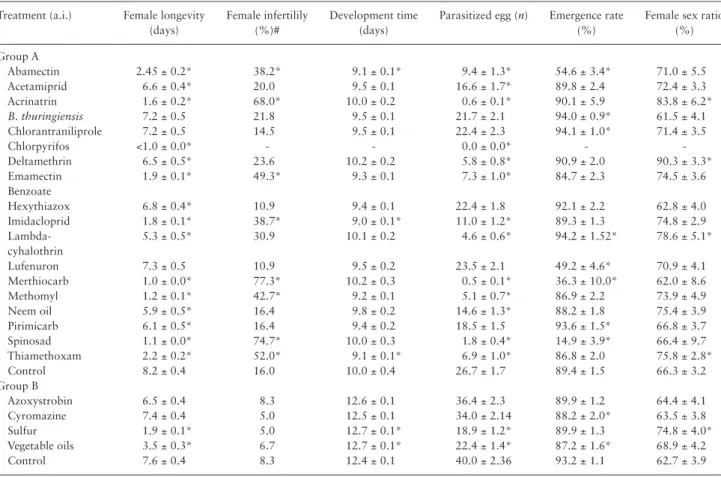
Among all the tested products, chlorpyrifos was the most poison-ous; it significantly reducing the female’s longevity and completely prevented the attainment of offspring (Table 2).
Most of the products tested affected the longevity of the females after contact with the eggs treated 24 h earlier, with the exception of chlorantraniliprole, lufenuron, B. thuringiensis, cyromazine and azoxystrobin, and eight of them reduced the longevity of females to less than 2 d (Table 2). The percentage of females that did not exhibit black host eggs (female infertility) was variable, and the most harm-ful products were chlorpyrifos, merthiocarb, spinosad, acrinatrin,
Table 2. Mean (± SE) female longevity, female infertility rate, development time (egg to adult), number of parasitized host eggs that turned
black, emergence rate and female sex ratio of offspring of T. achaeae, when parasitism occurred 24 h after the host eggs were treated with 23 pesticides
Treatment (a.i.) Female longevity (days)
Female infertilily (%)#
Development time (days)
Parasitized egg (n) Emergence rate (%)
Female sex ratio (%) Group A Abamectin 2.45 ± 0.2* 38.2* 9.1 ± 0.1* 9.4 ± 1.3* 54.6 ± 3.4* 71.0 ± 5.5 Acetamiprid 6.6 ± 0.4* 20.0 9.5 ± 0.1 16.6 ± 1.7* 89.8 ± 2.4 72.4 ± 3.3 Acrinatrin 1.6 ± 0.2* 68.0* 10.0 ± 0.2 0.6 ± 0.1* 90.1 ± 5.9 83.8 ± 6.2* B. thuringiensis 7.2 ± 0.5 21.8 9.5 ± 0.1 21.7 ± 2.1 94.0 ± 0.9* 61.5 ± 4.1 Chlorantraniliprole 7.2 ± 0.5 14.5 9.5 ± 0.1 22.4 ± 2.3 94.1 ± 1.0* 71.4 ± 3.5 Chlorpyrifos <1.0 ± 0.0* - - 0.0 ± 0.0* - Deltamethrin 6.5 ± 0.5* 23.6 10.2 ± 0.2 5.8 ± 0.8* 90.9 ± 2.0 90.3 ± 3.3* Emamectin Benzoate 1.9 ± 0.1* 49.3* 9.3 ± 0.1 7.3 ± 1.0* 84.7 ± 2.3 74.5 ± 3.6 Hexythiazox 6.8 ± 0.4* 10.9 9.4 ± 0.1 22.4 ± 1.8 92.1 ± 2.2 62.8 ± 4.0 Imidacloprid 1.8 ± 0.1* 38.7* 9.0 ± 0.1* 11.0 ± 1.2* 89.3 ± 1.3 74.8 ± 2.9 Lambda-cyhalothrin 5.3 ± 0.5* 30.9 10.1 ± 0.2 4.6 ± 0.6* 94.2 ± 1.52* 78.6 ± 5.1* Lufenuron 7.3 ± 0.5 10.9 9.5 ± 0.2 23.5 ± 2.1 49.2 ± 4.6* 70.9 ± 4.1 Merthiocarb 1.0 ± 0.0* 77.3* 10.2 ± 0.3 0.5 ± 0.1* 36.3 ± 10.0* 62.0 ± 8.6 Methomyl 1.2 ± 0.1* 42.7* 9.2 ± 0.1 5.1 ± 0.7* 86.9 ± 2.2 73.9 ± 4.9 Neem oil 5.9 ± 0.5* 16.4 9.8 ± 0.2 14.6 ± 1.3* 88.2 ± 1.8 75.4 ± 3.9 Pirimicarb 6.1 ± 0.5* 16.4 9.4 ± 0.2 18.5 ± 1.5 93.6 ± 1.5* 66.8 ± 3.7 Spinosad 1.1 ± 0.0* 74.7* 10.0 ± 0.3 1.8 ± 0.4* 14.9 ± 3.9* 66.4 ± 9.7 Thiamethoxam 2.2 ± 0.2* 52.0* 9.1 ± 0.1* 6.9 ± 1.0* 86.8 ± 2.0 75.8 ± 2.8* Control 8.2 ± 0.4 16.0 10.0 ± 0.4 26.7 ± 1.7 89.4 ± 1.5 66.3 ± 3.2 Group B Azoxystrobin 6.5 ± 0.4 8.3 12.6 ± 0.1 36.4 ± 2.3 89.9 ± 1.2 64.4 ± 4.1 Cyromazine 7.4 ± 0.4 5.0 12.5 ± 0.1 34.0 ± 2.14 88.2 ± 2.0* 63.5 ± 3.8 Sulfur 1.9 ± 0.1* 5.0 12.7 ± 0.1* 18.9 ± 1.2* 89.9 ± 1.3 74.8 ± 4.0* Vegetable oils 3.5 ± 0.3* 6.7 12.7 ± 0.1* 22.4 ± 1.4* 87.2 ± 1.6* 68.9 ± 4.2 Control 7.6 ± 0.4 8.3 12.4 ± 0.1 40.0 ± 2.36 93.2 ± 1.1 62.7 ± 3.9
and thiamethoxam, which induced an infertility percentage greater than 50% (Table 2).
The results showed that only three pesticides significantly reduced the development time (abamectin, thiamethoxam and imidacloprid) (Table 2). Several tested pesticides caused a significant reduction in the number of parasitized host eggs, with the exception of chlor-antraniliprole, lufenuron, pirimicarb, B. thuringiensis, hexythiazox, cyromazine and azoxystrobin, which resulted in rates of parasiti-sation equal or higher than the controls (Table 2). Merthiocarb, acrintrin, and spinosad resulted in less than two parasitized egg per female and chlorpyrifos none at all.
The emergence rate was significantly reduced by spinosad, fol-lowed by merthiocarb, lufenuron, and abamectin (Table 2). The three pyrethroids significantly affected the female sex ratio, with an increase in the number of females in the population (Table 2).
Consistent with these results, chlorpyrifos was the most toxic pesticide, reducing parasitism to zero, and was classified as harmful (class 4). Merthiocarb, methonil, lambda-cyhalothrinon, acrinatrin, and spinosad were moderately harmful (class 3). Only chlorant-raniliprole, lufenuron, B. thuringiensis, hexythiazox, and cyroma-zine had no significant effect on the number of parasitized eggs (class 1) (Table 3). Data from the fungicide results showed that sulfur was classified as slightly harmful (class 2) and azoxystrobin as harmless (class 1) to T. achaeae (Table 3).
Effects on the First Generation
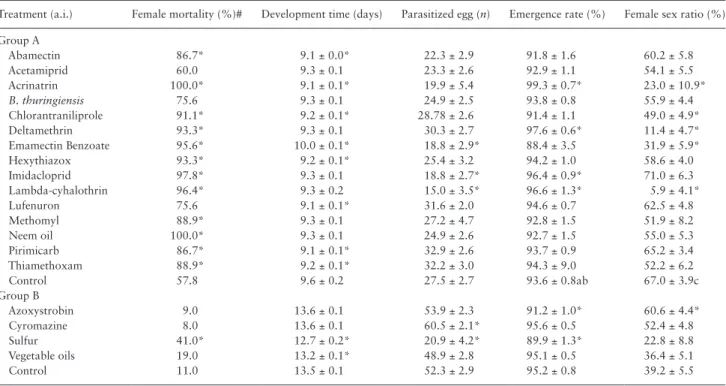
Analysis of the effects of merthiocarb, chlorpyrifos, and spinosad treatments was not performed, as the number of offspring females was very low, and they died in less than 24 h.
Regarding the mortality of the females, the most dangerous prod-ucts were emamectin benzoate, imidacloprid, lambda-cyhalothrin, acrinatrin, and neem oil, which caused more than 95% female mor-tality during the first 7 d. However, lufenuron, acetamiprid, B. thur-ingiensis, cyromazine, vegetable oils, and azoxystrobin did not affect this parameter (Table 4). The development time was significantly reduced by chlorantraniliprole, abamectin, lufenuron, pirimicarb, emamectin benzoate, acrinatrin, hexythiazox, vegetable oils, and sulfur, while the emamectin benzoate increased significantly this parameter (Table 4).
Only emamectin benzoate, imidacloprid, lambda-cyhalothrin, and sulfur significantly reduced the mean number of parasitized eggs. The emergence rate was significantly affected, with an increase induced by imidacloprid, lambda-cyhalothrin, acrinatrin, and del-tamethrin, not very relevant in biological terms, and a reduction by azoxystrobin (Table 4). The offspring female sex ratio was also sig-nificantly affected by some pesticides, with a reduction in the num-ber of females caused by chlorantraniliprole, emamectin benzoate, vegetable oils and by the three pyrethroids (lambda-cyhalothrin, acrinatrin and deltamethrin) and an increase caused by azoxystrobin (Table 4).
Discussion
Tr. achaeae is a suitable biological agent for use in pest management programs against T. absoluta, an introduced pest species that is dif-ficult to manage with insecticides alone in tomato greenhouses.
Most laboratory and field studies have shown that Trichogramma wasps are highly susceptible to broad-spectrum insecticides (Li et al. 1986). Consequently, use of insecticides and Trichogramma has his-torically been considered incompatible.
The pesticide concentrations tested were equivalent to those rec-ommended for field application. The toxic effects were assessed by measuring different biological parameters of T. achaeae exposed to residues on host eggs, 24 h after treatment.
A high degree of variation in the effects was found among classes of insecticides and among insecticides of the same class. Some classes of insecticides, such as the organophosphates, some carbamates, some pyrethroids and spinosad, showed little or no selectivity to the parasitoid species tested. Our study showed that different insecti-cides possessed significantly different risks to the T. achaeae adults, which may provide useful information for integration of biological control with pesticide control.
In the literature, organophosphate, carbamate, and synthetic pyrethroid insecticides are generally considered highly hazardous to biological control agents due to their broad-spectrum activity (Carmo et al. 2010, Cloyd 2012, Amaro et al. 2015).
Chlorpyrifos, an organophosphate, is one of the most widely used insecticides worldwide (Delpuech and Meyet 2003). Residual amounts of chlorpyrifos on the treated eggs are very toxic to T. achaeae as they caused high mortality in the wasps (100 %) in the 24 h after its application and reduced the parasitisation rate to zero. Therefore is classified as harmful (class 4). Amaro et al. (2015)
also found a high mortality and a negative effect on the behavior of T. pretiosum. These results were expected because organophosphate compounds have been described as highly harmful to parasitoids (Hassan et al. 1998, Moura et al. 2005, Moura et al. 2006), and its use in IPM should be avoided (Amaro et al. 2015).
Other neurotoxic insecticides, such as carbamates (pirimicarb, methiocarb and methomyl), may be directly and indirectly more harmful to natural enemies than non-nerve toxin-type pesticides (Cloyd 2012). The present study showed that merthiocarb and
Table 3. Placement of the pesticide into IOBC survival
side-effect classes based on the number of parasitized host eggs by
T. achaeae that turned black, when parasitism occurred 24 h after
the host eggs were treated with 22 compounds
Pesticide E (%) Class Classification Abamectin 65 2 Slightly harmful Acetamiprid 38 2 Slightly harmful Acrinatrin 98 3 Moderately harmful Azoxystrobin 9 1 Harmless
Bacillus thuringiensis 19 1 Harmless
Chlorantraniliprole 16 1 Harmless Chlorpyrifos 100 4 Harmful Cyromazine 15 1 Harmless Deltamethrin 78 2 Slightly harmful Emamectin Benzoate 73 2 Slightly harmful Hexythiazox 16 1 Harmless Imidacloprid 59 2 Slightly harmful Lambda-cyhalothrin 83 3 Moderately harmful Lufenuron 12 1 Harmless
Merthiocarb 98 3 Moderately harmful Methomyl 81 3 Moderately harmful Neem oil 45 2 Slightly harmful Pirimicarb 31 2 Slightly harmful Spinosad 93 3 Moderately harmful Sulfur 53 2 Slightly harmful Thiamethoxam 74 2 Slightly harmful Vegetable oils 44 2 Slightly harmful
E (%) = (1 – Vt/Vc) × 100, in which E is the effect of the pesticide on para-sitism viability reduction compared to the control, Vt is the parapara-sitism viabil-ity for the treatments and Vc is the parasitism viabilviabil-ity for the control. Class 1- harmless (E < 30%); 2- slightly harmful (30% < E < 79%); 3- moderately harmful (80% < E < 99%); and 4- harmful (E < 99%).
methomyl were moderately harmful, and pirimicarb was slightly harmful (class 2) based on their reduction of parasitisation. All of them severely affected the longevity of the females and the number of host eggs parasitized and significantly reduced the longevity of offspring populations. Merthiocarb and methomyl also increased female infertility rate. Different studies have reported that pirimicarb did not affect the biological parameters of T. pretiosum (Carvalho et al. 2001), however, other authors found that this product caused high mortality when adults of other parasitoids were exposed to dry residues or the direct spray method (Desneux et al. 2004, Moens et al. 2012). Bueno et al. (2008) demonstrated that methomyl signifi-cantly reduced parasitism viability when applied in the T. pretiosum immature stages.
Pyrethroids are the second most widely used family of insecti-cides (Delpuech and Delahaye 2013), however their application is not compatible with biological control methods, as shown in dif-ferent studies (Beserra and Parra 2005, Carmo et al. 2010, Ksentini et al. 2010). In our study, pyrethroids were moderately harmful (class 3) to T. achaeae and notably reduced the longevity of females after contact with treated host eggs and the number of parasitized eggs, and acrinatrin significantly increased the percentage of infer-tile females. We also observed lethal and sublethal effects in the offspring. Beserra and Parra (2005), observed that different formu-lations of lambda-cyhalothrin, when applied before contact of the females with the host eggs, were harmful to T. pretiosum and Wang et al. (2012) showed that pyrethroids (cyhalothrin, fenpropathrin and lambda-cyhaltrin) are highly toxic to T. ostriniae adults. Very little is known about the effect of acrinatrin on Trichogramma spe-cies; however, the same author reported that acrinatrin is harmful to different parasitoid species. Concerning the effect of deltamethrin residues on Trichogramma adults, Ksentini et al. (2010) found them to be very harmful towards all Trichogramma species tested, and the same was observed by Bastos et al. (2006), Blibech et al. (2015), and
Thubru et al. (2016).
Nowadays, neonicotinoids are the most widely used insecticidal class in the world (Jeschke and Nauen 2008, Simon-Delso et al. 2015), and are among the most effective insecticides for control of sucking and chewing herbivores (Tomizawa and Casida 2003). Some authors have suggested that some neonicotinoids may be used in combination with natural enemies in IPM programs (Millar and Denholm 2007, Pisa et al. 2017). However, in our study, we detected a significant reduction in the longevity of the females after contact with eggs treated with the assessed neonicotinoids and in the number of parasitized eggs, in treatments with thiamethoxam and imidaclo-prid. In this study, these neonicotinoids were classified as slightly harmful. Some authors have shown that thiamethoxam was harmful to other Trichogramma species, such as T. chilonis, T. platneri, and T. pretiosum (Brunner et al. 2001, Williams and Price 2004, Preetha et al. 2009). Imidacloprid has been found to be harmful to T. chilo-nis, T. cacoeciae, and T. nr. brassicae (Hewa-Kapuge et al. 2003,
Saber 2011). Conversely, other authors indicated that acetamiprid is safe for T. pretiosum (Moura et al. 2005) and could be recom-mended in association with this species in tomato pest management programs (Moura et al. 2006).
As we observed, the harmlessness of chlorantraniliprole was also reported for different Trichogramma species, such as T. pretiosum, T. dendrolimi, T. chilonis, and T. japonicum and other species of parasitoid eggs (Preetha et al. 2009, Brugger et al. 2010, Uma et al. 2014).
Additionally, avermectin produced a high mortality of the females, increased the infertility of the females, and reduced the number of parasitized host eggs, and abamectin reduced the emergence rate of T. achaeae. The lethal and sublethal effect on the offspring popula-tion was evident in the female mortality rate, and when emamectin benzoate was used, we observed a reduction in the number of females in the population. Araújo et al. (2013) observed a reduction in the number of parasitized host eggs and placed abamectin in Class 2 for T. pretiosum in eggs of Sitotroga cerealella (Oliver; Lepidoptera:
Table 4. Female mortality rate after 7 d of parasitism, mean (± SE) development time (egg to adult), number of parasitized host eggs that
turned black, emergence rate and female sex ratio of offspring of T. achaeae, obtained from eggs treated with 19 pesticides
Treatment (a.i.) Female mortality (%)# Development time (days) Parasitized egg (n) Emergence rate (%) Female sex ratio (%) Group A Abamectin 86.7* 9.1 ± 0.0* 22.3 ± 2.9 91.8 ± 1.6 60.2 ± 5.8 Acetamiprid 60.0 9.3 ± 0.1 23.3 ± 2.6 92.9 ± 1.1 54.1 ± 5.5 Acrinatrin 100.0* 9.1 ± 0.1* 19.9 ± 5.4 99.3 ± 0.7* 23.0 ± 10.9* B. thuringiensis 75.6 9.3 ± 0.1 24.9 ± 2.5 93.8 ± 0.8 55.9 ± 4.4 Chlorantraniliprole 91.1* 9.2 ± 0.1* 28.78 ± 2.6 91.4 ± 1.1 49.0 ± 4.9* Deltamethrin 93.3* 9.3 ± 0.1 30.3 ± 2.7 97.6 ± 0.6* 11.4 ± 4.7* Emamectin Benzoate 95.6* 10.0 ± 0.1* 18.8 ± 2.9* 88.4 ± 3.5 31.9 ± 5.9* Hexythiazox 93.3* 9.2 ± 0.1* 25.4 ± 3.2 94.2 ± 1.0 58.6 ± 4.0 Imidacloprid 97.8* 9.3 ± 0.1 18.8 ± 2.7* 96.4 ± 0.9* 71.0 ± 6.3 Lambda-cyhalothrin 96.4* 9.3 ± 0.2 15.0 ± 3.5* 96.6 ± 1.3* 5.9 ± 4.1* Lufenuron 75.6 9.1 ± 0.1* 31.6 ± 2.0 94.6 ± 0.7 62.5 ± 4.8 Methomyl 88.9* 9.3 ± 0.1 27.2 ± 4.7 92.8 ± 1.5 51.9 ± 8.2 Neem oil 100.0* 9.3 ± 0.1 24.9 ± 2.6 92.7 ± 1.5 55.0 ± 5.3 Pirimicarb 86.7* 9.1 ± 0.1* 32.9 ± 2.6 93.7 ± 0.9 65.2 ± 3.4 Thiamethoxam 88.9* 9.2 ± 0.1* 32.2 ± 3.0 94.3 ± 9.0 52.2 ± 6.2 Control 57.8 9.6 ± 0.2 27.5 ± 2.7 93.6 ± 0.8ab 67.0 ± 3.9c Group B Azoxystrobin 9.0 13.6 ± 0.1 53.9 ± 2.3 91.2 ± 1.0* 60.6 ± 4.4* Cyromazine 8.0 13.6 ± 0.1 60.5 ± 2.1* 95.6 ± 0.5 52.4 ± 4.8 Sulfur 41.0* 12.7 ± 0.2* 20.9 ± 4.2* 89.9 ± 1.3* 22.8 ± 8.8 Vegetable oils 19.0 13.2 ± 0.1* 48.9 ± 2.8 95.1 ± 0.5 36.4 ± 5.1 Control 11.0 13.5 ± 0.1 52.3 ± 2.9 95.2 ± 0.8 39.2 ± 5.5
Gelechiidae), and Khan et al. (2015) reported that it was highly toxic to the same species. Hussain et al. (2010) found that abamectin and emamectin benzoate were harmful to T. chilonis adults after 24 h of exposure.
Lufenuron is classified as harmless; however, it affects the emer-gence rate of T. achaeae. This is a benzoylphenylurea compound and acts by inhibiting the production of chitin, showing some selectivity across insect taxonomic orders (Carmo et al. 2010). It was reported to have only mild side effects on Trichogramma species, such as T. dendrolimi (Takada et al. 2001), and T. cacoeciae (Hassan and Haves 1998). However, the emergence rate of T. achaeae was sig-nificantly reduced, as observed by Carmo et al. (2010) in a study with the egg parasitoid Telenomus remus (Nixon; Hymenoptera: Scelionidae).
Concerning spinosad, the high mortality values and the negative effect on biological parameters of T. achaeaae could be explained by its mode of action, similar to the observed with the neonicotinoids pesticides, which excites the nervous system by activating the nico-tinic receptors of the acetylcholine, causing paralysis of the insects (Cônsoli et al. 2001). Similar results were observed by Ksentini et al. (2010) and Thubru et al. (2016), among others, in studies with dif-ferent species of Trichogramma.
Our results showed that hexythiazox and cyromazine could be considered harmless to this egg parasitoid, consistent with the obser-vations by Nadimi et al. (2008) in a study to evaluate the effect of hexythiazox (Nisorun, EC 10%) on Phytoseiulus persimilis (Evans; Acari: Phytoseiidae). Lira et al. (2015) reported a low acute tox-icity of hexythiazox on Tamarixia radiata (Waterston; Hemiptera: Eulophidae), an important ectoparasitoid of Diaphorina citri (Kuwayama; Hemiptera: Liviidae). Hassan (1994) also reported the harmless effect of cyromazine on T. cacoeciae.
Based on a lack of toxicity and no apparent lethal and sublethal effects, it seems acceptable to assume that B. thuringiensis prod-ucts, soap and oil could be successfully integrated into a biologi-cal control program unless these products are used in conjunction with small parasitoids (Brunner et al. 2001). Numerous studies have shown that B. thuringiensis is harmless to Trichogramma species (Vieira et al. 2001, Zhu et al. 2009, Thrubru et al. 2016). Among all 22 pesticides evaluated, neem oil reduced the longevity of the females and the number of parasitized host eggs by T. achaeae, and caused a very high mortality of their offspring. El-Wakeil et al. (2006) reported that neem products reduced the parasitism rate of T. pretiosum and had minor side effects on T. minutum, and Khattak and Mamoon-ur-Rashid (2006) observed that neem oil affected the parasitization of bollworm eggs by T. chilonis. Burnner et al. (2001)
observed mortality of T. platneri when exposed to sprays of soap and suggested that was due to physical properties of the formula-tions, and mortality was caused by the adhesion of wings, legs, and antennae to the body.
In our study, both fungicides tested were harmless or only slightly harmful to T. achaeae, as observed by other authors for the same genus (Pratissoli et al. 2010, Silva and Bueno 2015) or in other egg parasitoids. According to Pratissoli et al. (2010), the fungicide azox-ystrobin was selective to T. atopovirilia and can be used in integrated management of diseases in cucurbitaceous crops. Nevertheless, sulfur was slightly harmful to T. achaeae, with negative effects on female longevity and in the number on parasitized host eggs and lethal and sublethal effects on the offspring. Thomson et al. (2001)
considered sulfur harmful to adults and to immature stages of two Trichogramma species (T. carverae, T. funiculatum) and suggested that to reduce the impact on resident Trichogramma, other chemicals will need to be used.
According to our results, we suggest the used of chlorant-raniliprole and B. thuringiensis to control Lepidoptera as T. abso-luta and caterpillars, cyromazine to control Diptera as Liriomyza huidobrensis (Blanchard; Diptera: Agromyzidae) and other miners, pirimicarb to control Homoptera as aphids, hexythiazox to control mites and azoxystrobin to control fungus in an IPM program with mass released of T. achaeae. However, the insecticides usually used to control with flies, one of the major pests in tomato crops, showed to be toxic to T. achaeae.
Acknowledgments
We thank João Botelho and António Custódio for providing the pesticides used in this study.
References Cited
Amaro, J. T., A. F. Bueno, A. F. Pomari-Fernandes, and P. M. Neves. 2015.
Selectivity of organic products to Trichogramma pretiosum Riley (Hymenoptera: Trichogrammatidae). Neotrop. Entomol. 44: 489–497.
Araújo, E. S., D. P. Targão, P. L. Pastori, and L. B. Monteiro. 2013. Seletivity
of phytossanity products to Trichogramma pretiosum (Hymenoptera: Trichogrammatidae) collected in apple leafroller eggs, Bonagota salu-bricola (Meyrick, 1937) (Lepidoptera: Tortricidae) in Fraiburg, Brazil. Scientia Agraria, Curitiba, Brazil, 14: 35–39.
Bastos, C. C., R. P. Almeida, and F. A. Suinaga. 2006. Selectivity of pesticides
used on cotton (Gossypium hirsutum) to Trichogramma pretiosum reared on two laboratory-reared hosts. Pest Manag. Sci. 62: 91–98.
Beserra, E. B., and J. R. P. Parra. 2005. Selectivity of lambda-cyhalothrin to
Trichogramma pretiosum Riley, 1879 (Hymenoptera: Trichogrammatidae). Acta Sci. Agron. 27: 321–326.
Blibech, I., M. Ksantini, T. Jardak, and M. Bouaziz. 2015. Effect of insecticides
on Trichogramma Parasitoids used in biological control against Prays oleae insect pest. Adv. Chem. Engineer. Sci. 5: 362–372.
Brugger, K. E., P. G. Cole, I. C. Newman, N. Parker, B. Scholz, P. Suvagia, G. Walker, and T. G. Hammond. 2010. Selectivity of chlorantraniliprole
to parasitoid wasps. Pest Manag. Sci. 66: 1075–1081.
Brunner, J. F., J. E. Dunley, M. D. Doerr, and E. H. Beers. 2001. Effect of
pesticides on Colpoclypeus florus (Hymenoptera: Eulophidae) and Trichogramma platneri (Hymenoptera: Trichogrammatidae), parasitoids of leafrollers in Washington. J. Econ. Entomol. 94: 1075–1084.
Bueno, A., R. C. O. F. Bueno, J. R. P. Parra, and S. S. Vieira. 2008. Effects
of pesticides used in soybean crops to the egg parasitoid Trichogramma pretiosum. Ciênc. Rural. 38: 1495–1503.
Carmo, E. I., A. F. Bueno, and R. C. O. F. Bueno. 2010. Pesticide
select-ivity for the insect egg parasitoid Telenomus remus. BioControl. 55: 455–464.
Carvalho, G. A., J. R. P. Parra, and G. C. Baptista. 2001. Seletividade de alguns
produtos fitossanitários a duas linhagens de Trichogramma pretiosum Riley, 1879 (Hymenoptera: Trichogrammatidae). Cien. Agrotec. Lavras. 25: 583–591.
Castro, A. A., M. C. Lacerda, T. V. Zanuncio, F. de S Ramalho, R. A. Polanczyk, J. E. Serrão, and J. C. Zanuncio. 2012. Effect of the insect growth
regu-lator diflubenzuron on the predator Podisus nigrispinus (Heteroptera: Pentatomidae). Ecotoxicology. 21: 96–103.
Cloyd, R. A. 2012. Indirect effects of pesticides on natural enemies, pp. 127–
150. In R. P. Soundararajan (ed.), Pesticides: advances in chemical and botanical pesticides, InTech, Rijeka, Croatia.
Cônsoli, F. L., P. S. M. Botelho, and J. R. P. Parra. 2001. Selectivity of
insec-ticides to the egg parasitoid Trichogramma galloi Zucchi, 1988 (Hym., Trichogrammatidae). J. Appl. Entomol. 125: 37–43.
Cordeiro, E. M., A. S. Corrêa, M. Venzon, and R. N. Guedes. 2010. Insecticide
survival and behavioral avoidance in the lacewings Chrysoperla externa and Ceraeochrysa cubana. Chemosphere. 81: 1352–1357.
Delpuech, J. M., and M. Delahaye. 2013. The sublethal effects of deltamethrin
on Trichogramma behaviors during the exploitation of host patches. Sci. Total Environ. 447: 274–279.
Delpuech, J. M., and J. Meyet. 2003. Reduction in the sex ratio of the progeny
of a parasitoid wasp (Trichogramma brassicae) surviving the insecticide chlorpyrifos. Arch. Environ. Contam. Toxicol. 45: 203–208.
Desneux, N., H. Rafalimanana, and L. Kaiser. 2004. Dose-response
relation-ship in lethal and behavioural effects of different insecticides on the para-sitic wasp Aphidius ervi. Chemosphere. 54: 619–627.
Desneux, N., A. Decourtye, and J. M. Delpuech. 2007. The sublethal effects
of pesticides on beneficial arthropods. Annu. Rev. Entomol. 52: 81–106.
Desneux, N., M. G. Luna, T. Guillemaud, and A. Urbaneja. 2011. The invasive
South American tomato pinworm, Tuta absoluta, continues to spread in Afro-Eurasia and beyond: the new threat to tomato world production. J. Pest Sci. 84: 403–408.
El-Wakeil, N. E., N. Gaafar, and S. Vidal. 2006. Side effect of some neem
products on natural enemies of Helicoverpa (Trichogramma spp.) and Chrysoperla carnea. Arch. Phytopathology Plant Protect. 39: 445–455.
FAOSTAT. 2014. FAO statistical databases. Food and Agriculture
Organization of the United Nations, Rome, Italy. http://www.fao.org/ faostat/en/#data/QC.
Garcia, P. V., N. Pereira, and L. M. Oliveira. 2009. Side-effects of organic and
synthetic pesticides on cold-stored diapausing prepupae of Trichogramma cordubensis. BioControl. 54: 451–458.
Ghorbani, M., M. Saber, M. Bagheri, and N. Vaez. 2016. Effects of diazinon
and fipronil on different developmental stages of Trichogramma brassicae Bezdenko (Hym.; Trichogrammatidae). J. Agr. Sci. Tech. 18: 1267–1278.
Hassan, S. A. 1992. Guideline for the evaluation of side-effects of plant
protec-tion product on Trichogramma cacoeciae. IOBC/WPRS Bull. XV/3, 18–39.
Hassan, S. A. 1994. Comparison of three different laboratory methods and
one semi-field test method to assess the side effects of pesticides on Trichogramma cacoeciae Marchal (Hym., Trichogrammatidae). IOBC/ WPRS Bull. 17: 133–141.
Hassan, S. A., B. O. Haves, P. E. Degrande, and K. Herai. 1998. The side-effects
of pesticides on the egg parasitoid Trichogramma cacoeciae Marchal (Hym., Trichogrammatidae), acute dose–response and persistence tests. J. Appl. Entomol. 122: 569–573.
Hewa-Kapuge, S., S. McDougall, and A. A. Hoffmann. 2003. Effects of
meth-oxyfenozide, indoxacarb, and other insecticides on the beneficial egg para-sitoid Trichogramma nr. brassicae (Hymenoptera: Trichogrammatidae) under laboratory and field conditions. J. Econ. Entomol. 96: 1083–1090.
Hussain, D., M. Akram, Z. Iqbal, A. Ali, and M. Saleem. 2010. Effect of
some insecticides on Trichogramma chilonis (Ishii) (Trichogrammatidae: Hymenoptera) immature and adult survival. J. Agric. Res. 48: 531–537.
IBM. 2015. IBM SPSS statistics for Windows, Version 23.0. IBM Corp,
Armonk, NY.
Jeschke, P., and R. Nauen. 2008. Neonicotinoids-from zero to hero in
insecti-cide chemistry. Pest Manag. Sci. 64: 1084–1098.
Khan, M. A., H. Khan, A. Farid, and A. Ali. 2015. Evaluation of
tox-icity of some novel pesticides to parasitism by Trichogramma chilonis (Hymenoptera: Trichogrammatidae). J. Agric. Res. 53: 63–73.
Khattak, M. K., and M. Mamoon-ur-Rashid. 2006. Evaluation of neem
(Azadirachta indica A. Juss) oil, neem seed water extracts and baythroid TM against bollworms and egg parasitoid Trichogramma chilonis. Pak. Entomol. 28: 5–9.
Ksentini, I., T. Jardak, and N. Zeghal. 2010. Bacillus thuringiensis,
deltame-thrin and spinosad side-effects on three Trichogramma species. Bull. Insectology. 63: 31–37.
Li, K. H., X. Xu, Y. F. Li, Q. Z. Meng, and L. C. Zhou. 1986. Determination
of toxicity of 29 chemicals to Trichogramma japonicum at various devel-opmental stages. Nat. Enemies of Insects. 8: 187–194.
Lira, A. C., O. Z. Zanardi, V. H. Beloti, G. P. Bordini, P. T. Yamamoto, J. R. Parra, and G. A. Carvalho. 2015. Lethal and sublethal impacts of
acaricides on Tamarixia radiata (Hemiptera: Eulophidae), an import-ant ectoparasitoid of Diaphorina citri (Hemiptera: Liviidae). J. Econ. Entomol. 108: 2278–2288.
Millar, N. S., and I. Denholm. 2007. Nicotinic acetylcholine receptors: targets
for commercially important insecticides. Invert. Neurosci. 7: 53–66.
Moens, J., L. Tirry, and P. Clercq. 2012. Susceptibility of cocooned pupae
and adults of the parasitoid Microplitis mediator to selected insecticides. Phytoparasitica. 40: 5–9.
Momanyi, G., R. Maranga, S. Sithanantham, S. Agong, C. S. Matoka, and S. A. Hassan. 2012. Evaluation of persistence and relative toxicity of some
pest control products to adults of two native trichogrammatid species in Kenya. BioControl. 57: 591–601.
Moura, A. P., G. A. Carvalho, and R. L. O. Rigitano. 2005. Toxicidade de
inseticidas utilizados na cultura do tomateiro a Trichogramma pretiosum. Pesq. Agropec. Bras. 40: 203–210.
Moura, A. P., G. A. Carvalho, A. E. Pereira, and L. C. D. Rocha. 2006.
Selectivity evaluation of insecticides used to control tomato pests to Trichogramma pretiosum. BioControl. 51: 769–778.
Musser, F. R., J. P. Nyrop, and A. M. Shelton. 2006. Integrating biological and
chemical controls in decision making: European corn borer (Lepidoptera: Crambidae) control in sweet corn as an example. J. Econ. Entomol. 99: 1538–1549.
Nadimi, A., K. Kamali, M. Arbabi, and F. Abdoli. 2008. Side-effects of three
aca-ricides on the predatory mite, Phytoseiulus persimilis Athias-Henriot (Acari: Phytoseiidae) under laboratory conditions. Mun. Ent. Zool. 3: 556–567.
Pisa, L., D. Goulson, E. C. Yang, D. Gibbons, F. Sánchez-Bayo, E. Mitchell, A. Aebi, J. van der Sluijs, C. J. K. MacQuarrie, C. Giorio, et al. 2017. An
update of the Worldwide Integrated Assessment (WIA) on systemic insec-ticides. Part 2: impacts on organisms and ecosystems. Environ Sci Pollut Res. doi:10.1007/s11356-017-0341-3.
Polaszek, A., P. F. Rugman-Jones, R. Stouthamer, E. Hernández-Suárez, T. Cabello, and M. del Pino-Pérez. 2012. Molecular and morphological
diagnoses of five species of Trichogramma: biological control agents of Chrysodeixis chalcites (Lepidoptera: Noctuidae) and Tuta absoluta (Lepidoptera: Gelechiidae) in the Canary Islands. BioControl. 57: 21–35.
Pratissoli, D., A. M. Milanez, W. F. Barbosa, F. N. Celestino, G. S. Andrade, and R. A. Polanczyk. 2010. Side effects of fungicides used in Cucurbitaceous
crop on Trichogramma atopovirilia Oatman and Platner (Hymenoptera: Trichogrammatidae). Chil. J. Agric. Res. 70: 323–327.
Preetha, G., J. Stanley, S. Suresh, S. Kuttalam, and R. Samiyappan. 2009.
Toxicity of selected insecticides to Trichogramma chilonis: assessing their safety in the rice ecosystem. Phytoparasitica. 37: 209–215.
Preetha, G., J. Stanley, S. Suresh, and R. Samiyappan. 2010. Risk assessment
of insecticides used in rice on miridbug, Cyrtorhinus lividipennis Reuter, the important predator of brown planthopper, Nilaparvata lugens (Stal.). Chemosphere. 80: 498–503.
Roubos, C. R., C. Rodriguez-Saona, and R. Isaacs. 2014. Mitigating the effects
of insecticides on arthropod biological control at field and landscape scales. Biol. Control. 75: 28–38.
Saber, M. 2011. Acute and population level toxicity of imidacloprid and
fen-pyroximate on an important egg parasitoid, Trichogramma cacoeciae (Hymenoptera: Trichogrammatidae). Ecotoxicology. 20: 1476–1484.
Silva, D. M., and A. F. Bueno. 2015. Organic products selectivity for
Trichogramma pretiosum (Hymenoptera: Trichogrammatidae). Arq. Inst. Biol. 82: 1–8.
Simon-Delso, N., V. Amaral-Rogers, L. P. Belzunces, J. M. Bonmatin, M. Chagnon, C. Downs, L. Furlan, D. W. Gibbons, C. Giorio, V. Girolami, et al. 2015. Systemic insecticides (neonicotinoids and fipronil): trends, uses,
mode of action and metabolites. Environ. Sci. Pollut. Res. Int. 22: 5–34.
Souza, J. R., G. A. Carvalho, A. P. Moura, M. H. G. Couto, and J. B. Maia. 2014. Toxicity of some insecticides used in maize crop on Trichogramma
pretiosum (Hymenoptera, Trichogrammatidae) immature stages. Chil. J. Agric. Res. 74: 234–239.
Takada, Y., S. Kawamura, and T. Tanaka. 2001. Effects of various
insecti-cides on the development of the egg parasitoid Trichogramma dendrolimi (Hymenoptera: Trichogrammatidae). J. Econ. Entomol. 94: 1340–1343.
Thomson, L. J., D. C. Glenn, and A. Hoffmann. 2001. Effects of sulfur on
Trichogramma egg parasitoids in vineyards: measuring toxic effects and establishing release windows. Anim. Prod. Sc. 40: 1165–1171.
Thubru, D. P., D. M. Firake, and G. T. Behere. 2016. Assessing risks of
pesti-cides targeting lepidopteran pests in cruciferous ecosystems to eggs parasit-oid, Trichogramma brassicae (Bezdenko). Saudi J. Bio. Sci. doi:10.1016/j. sjbs.2016.04.007
Tomizawa, M., and J. E. Casida. 2003. Selective toxicity of neonicotinoids
attributable to specificity of insect and mammalian nicotinic receptors. Annu. Rev. Entomol. 48: 339–364.
Uma, S., S. Jacob, and K. R. Lyla. 2014. Acute contact toxicity of selected
conventional and novel insecticides to Trichogramma japonicum Ashmead (Hymenoptera: Trichogrammatidae). Jbiopest. 7: 133–136.
Vieira, A., L. Oliveira, and P. Garcia. 2001. Effects of conventional pesticides on the
preimaginal developmental stages and on adults of Trichogramma corduben-sis (Hymenoptera: Trichogrammatidae). Biocontrol Sci. Technol. 11: 527–534.
Wang, D. H. Y., X. Guo, and Y. Luo. 2012. Acute toxicities and sublethal
effects of some conventional insecticides on Trichogramma chilonis (Hymenoptera: Trichogrammatidae). J. Econ. Entomol. 105: 1104–1476.
Williams, L., and L. Price. 2004. A space-efficient contact toxicity bioassay for
minute Hymenoptera, used to test the effects of novel and conventional insecticides on the egg parasitoids Anaphes iole and Trichogramma pretio-sum. BioControl. 49: 163–185.
Zar, J. H. 1996. Biostatistical analysis. Prentice-Hall International Editions,
London, United Kingdom.
Zhu, J. S., M. L. Lian, J. Wang, and S. Qin. 2009. Toxicity and safety
evalu-ation of five insecticides on egg parasitoid, Trichogramma evanescens Westwood. Chin. J. Eco-Agric. 17: 715–720.