Abstract
Whenever we mention the place of childhood play, it is still clearly in our minds, and even after many years we can remember our favorite rides. Most of the children are permitted to play on the playground while waiting between classes or for their parents to pick them up. It’s the moment where we meet new friends and play games.
This project intends to present a study on children’s outdoor activities in the outdoor environment of Escola do Calvário, a Portuguese school. Research for problems in this school, find those problems and propose changes. The outdoor activity spaces for children are changing gradually with the passage of time. From its historical de-velopment, it is not hard to see that people are more and more concerned about children’s outdoor environment, because it can subtly influence children’s psycholo-gy, help children explore the world, better understand the world and enrich their life and childhood. The core idea of this project is that in the design of children’s outdoor activity space, the introduction of natural elements is of vital importance. As a part of education resources, campus playgrounds should provide opportunities for children to get hold of nature, encourage some meaningful risks, and increase the exposure of educators and children to the outdoors. Being close to nature can boost a children self-esteem, confidence and attention.
Children need us to study the outdoor activity spaces more carefully. They need to be protected, but they also need to carry out certain adventures and explorations, so they can develop wisdom, strength and be able to face difficulties and overcome them. However they often tend to be ignored by adults. The courage and strength of the dilemma; they need to cultivate the love, mutual assistance and cooperation in the free space for activities, as well as the correct attitude towards animals and plants and the understanding of nature and the macro world.
Sempre que mencionamos o lugar da brincadeira na infância, tal ainda está clara-mente presente nas nossas clara-mentes e, mesmo depois de muitos anos, podemos lem-brar-nos das nossas brincadeiras favoritas. A maioria das crianças tem permissão para brincar no recreio enquanto esperam no recreio, entre as diferentes aulas, ou pelos seus pais no fim do dia. É o momento em que conhecemos novos amigos e jogamos. Este projeto pretende apresentar um estudo sobre as atividades ao ar livre para cri-anças no ambiente exterior da Escola do Calvário. Primeiro pesquisamos e identifica-mos os principais problemas nesta escola, para em seguida propoidentifica-mos mudanças. Os espaços de atividade ao ar livre para crianças estão a mudar, gradualmente, com o decorrer dos tempos, não é difícil compreendermos que as pessoas estão cada vez mais preocupadas com as tipologias e caracteristicas do ambiente externo dedicado às crianças. Até porque estes podem influenciar subtilmente a psicologia das crianças, ajuda-las a explorar e entender melhor o mundo, enriquecendo a sua infância e até a vida no futuro. A idéia central deste projeto é a introdução de ele-mentos naturais, no espaço de atividades ao ar livre das crianças. Consideramos que estes são de vital importância. Como parte dos recursos educacionais, os recreios do “campus” devem oferecer oportunidades para as crianças conviverem com a na-tureza. Devem incentiva-las a serem assertivas, aumentando a sua exposição e a dos seus educadores à natureza e ao ar livre. Estar perto da natureza pode aumentar a autoestima, a confiança e até a capacidade de concentração das crianças.
As crianças precisam que todos estejam consientes da necessidade em estudar os es-paços de atividades ao ar livre mais cuidado e atenção. Pois as crianças necessitam de ser protegidas, mas também de realizar certas aventuras controladas, para que possam desenvolver sabedoria, experiência e força, sendo capazes de enfrentar e superar dificuldades futuras. No entanto, muitas vezes as reais necessidades delas ten-dem a ser ignoradas pelos adultos. As crianças precisam de ser estimuladas a cultivar amor, assistência mútua e cooperação no recreio, bem como a atitude correta em relação aos animais e às plantas, a compreensão da natureza e do mundo exterior.
Catalog
Introduction...1
I.Grow With Nature...3
1.1Playground Evolution...4
1.2Close to nature...6
1.3The playgrounds in School...8
1.4 Case Study...10
II.School Cavario...14
2.1Schoolyard Planning...14
2.2Problems...14
2.3Solution...16
III.Schoolyard design of Escola do Calvário...17
3.1Project ...17
3.2 Illustration and Material...22
Conclusion...24
Attachment...25
Bibliography...28
Imagine...29
Seconel Volume of Drawing
The school plays this important role in the childhood of children, and the primary school campus playground is the main active venue for students in schooldays. Unlike the univer-sity campus, the playgrounds of primary schools and kindergartens need to receive much more attention and consideration.We have been developing children’s outdoor activity space for more than 100 years. As early as 1848, authored by Henry Barnard (Brettet et al, 1993), Barnard’s playground is mainly for educating students, providing a place where teachers can lead children to the traditional games. There are just a few simple sticks in the playground, built with bushes. At the beginning of the 20th century, fitness equipment began to be included on the playground. This method has continued to this day and is very common nowadays. However spaces for children are gradually changing with the passage of time. It is not difficult to see its historical development. People are also more and more concerned about the outdoor environment provided for children. Because it’s proven that it can subtly influence children’s psychology. It can help children learn how to explore the world, understand it, and enrich their childhood.
The campus should be an educational resource, not a purely entertaining playground. Un-like the public game space for the general public, the campus playground should be more educational. For example, a variety of plants can teach children to observe the changes of the four seasons. Also the experimental planting field allows children to experience the end-less natural life. This project takes the role of natural elements in the outdoor environment of the campus as the central concept, and Escola do Calvário is the experimental objective of this project, with the re -planning of the main campus outdoor environment, playgrounds and outdoor public facilities.
Fig. 1 Escola do Calvário, Valongo, Portugal. Escola do Calvário.
This school is located in the urban area of Valongo, which is named after the surrounding mountains. There is just one school in the city. It is divided into 2 campuses, one for junior high school and the other for kindergarten and elementary school. The playground design is mainly for elementary school campuses, so the principal users vary from 3 up to 10 years old, also including a few teachers and staff members. The original playground of the cam-pus is composed of huge concrete floors, grassy and lacking natural elements. The facilities are rudimentary and unreasonable, making the playground too versatile and undefined.
Both the campus environment and the playground need to be re-designed to be perfect-ed. It is not merely entertainment facilities but all living facilities, eliminating safety hazards and building a healthy learning and entertaining environment. This project mainly summa-rizes the development history of children’s outdoor activity space. In the design, the intro-duction of natural elements is of great importance. As part of the educational resources, the campus playground should provide opportunities for children to make contact with nature. The adventure of meaning increases the contact between educators and children outdoors. Being on the brink of nature can enhance children’s self-esteem, self-confidence and attention levels.
I.Grow with Nature
Webster’s defines a playground as “a piece of ground and usually having special features for recreation, espe-cially from children” (Gove, 1961, p. 1737). Just like this definition, the development of the playground in the past 150 years is further con-tinued. Creating a real impact on how to meet the needs of children’s
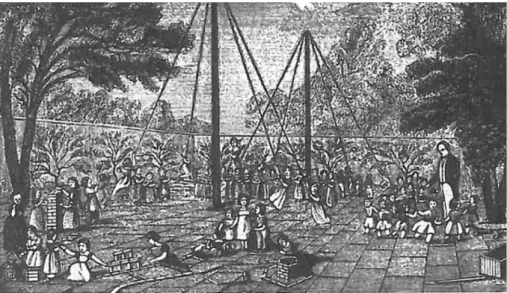
creativity. Fig. 2 19 century view of a playground for young children.(from H.Bar-nard,1848.courtesy of University) of Michigan,Making of America
In the early 20th century, new elements such as slides, swings, and seesaws began to ap-pear on playgrounds. Many countries used playgrounds as way to construct “outdoor gyms” for children (Frost, 1992). After the facilities appeared, the chance of children being injured also increased. However, the entertainment provided by such a variety of facilities cannot be resisted by children. Peo-ple began to deliberately plan the place-ment of playground facilities and pay atten-tion to the problem of paving around them to reduce the chance of children being ad-versely affected by remodeling
the lack of
design
Fig. 3 1940’s playground equipment.
Fig.4 Prisoners types playground, 1910–1915. Courtesy Library of Congress, Washington D.C. The playground with facilities has a long tradition. The first time this concept was proposed and emerged as in 1848. Authored by Henry Barnard (Brettet et al, 1993), Barnard’s playground is mainly pedagogical, and the teacher guides the children. We can play traditional games on the playground. There are just two simple wooden swings on the entire playground. But it is in-teresting that the wall of this humble playground is partitioned with some luxuriant fruit trees. And more natural than hard-cov-ered walls, that is now a commonplace. At the end of the 19th century, more and more of this playgrounds were developed in Germany in 1880s. The campuses in Boston, Chicago.
ground or hard paving. Finally, as people begin to study the playgrounds, the final form of the playground is not uniform, but incorporates more elements into the local history, culture, and art. Lady Allen of Hurtwood (1968) pointed out a series of exploration parks that existed successively in thefirst half of the 20th century: prisoners, hardware stores, cement pipes, mazes, and DIY. The names of these types of parks are all descriptions of the characteristics of outdoor space. They are also often the real material for the construction of these parks. But how many of these game parks really bring value to children? really bring value to chil-dren?
In the second half of the 20th century the majority of existing playgrounds are still the level asphalt type, with fixed equipment chosen from an ironmongers’ catalogue. Rarely is there any grass or trees or animals or any beauty. Children are increasingly condemned to live in a harsh, stark desert of hard surfacing. Playground facilities were heavy, fixed-position equipment, with asphalt floors, and occasionally a sand pit (Holme & Massie, 1997), and be-came standardized. Managed, unified space (Maxey, 1999). In recent years, playgrounds have been defined as a combination of game equipment. They are surrounded by fences and covered with carpets or rubber flooring, namely as: kit, fence, carpet or KFC play-grounds (Woolley, 2007). The value of game that such open space brings to children is not as great as they thought. The reason for adopting the kit, fence, carpet approach to build-ing outdoor recreation space is more often understood through practical experience than academic research. While these fences were originally used to prevent dogs from entering the play area, the fences are now more used to delimit children’s activities. As a result, chil-dren’s songs are confined to a specific space, and dogs can indeed wander in cities. The use of a rubber floor can absorb the impact of a collision, and children can minimize injuries when they inadvertently drop from high-level facilities. Initially these rubber bottoms were all black, sometimes in the form of paving tiles. Occasionally, it is laid on the spot, just like laying asphalt. A few years later, the playground rubber ground began to wear out, uneven, rich in color. There is no definite proof of whether rubber grounds can really prevent accidental injuries, but it is certain that children are rolling on such surfaces. When it falls, it will cause skin burns.
Architect Aldo van Eyck was a master of 20th-century structuralism, and between 1947 and 1978, van Eyck designed hundreds of amusement parks and built his first in Bertelmanplein, Amsterdam. The playground marks the childhood of a whole generation. While these play-grounds have largely disappeared, faded and forgotten, they are one of the most iconic architectural influences of the critical period: modernist functional architects transformed from top-down spatial organization to bottom-up architecture, designed to provide spatial imagination.
Aldo van Eyck was first part of the city design department, and in 1952 he began working for the city government, working for his office. In the first eight years, he designed more than 60, and then more, the last of which was almost in batches in new post-war areas. Out of a total of 700, only 90 survived into the 21st century with their original layout. Bertelmanplein’s first playground is a test case. Van Eyck designed a sand pit with a wide rim trim. He placed four round stones and a tumbling structure inside. The pit is at the north corner of the square, opposite to three rolling columns. Bordered by the square are trees and five benches. The playground was a success. Many designs followed.
I.Grow with Nature
For him, the playground is an opportunity to test his views on architecture, relativity and imagination. The theory of relativity in a sense says that the connections between elements are determined by their mutual relations, not by the central rank order principle. All ele-ments are equal: the playground Van Eyck designed is an exercise in non-hierarchical com-position. Van Eyck consciously designed the device in a minimalist way to spark the imagi-nation of users (kids), the idea that they could explain space through openness. Another is the playground’s modular character. Depending on the local environment, basic elements - sand bunkers, tumbling bars, stepping stones, slides and hemispheric jungle gyms - can be endlessly reassembled into different multi-center compositions. His children tested them. For him, the equipment was an integral part of the committee. The aim is to stimulate children’s minds. The hemispherical jungle gym is more than just a climbing thing. It’s a place to talk
Fig.5 The first Van Eyck play space on the Bertelmanplein, 1947
1.Grow with Nature
1.2. Close to nature
The problem with the kit, fence, carpet type of playground park is the limitation of the closeness to nature and the value of the game. Such play-grounds do not get lawns, trees and flowers, but are flooded with a large number of fixed amusement equipment. Children in this open space cannot obtain a natural experience and cannot access vegetation, sand, water, and mud, resulting in the so-called “nature deficit disorder” (Louv, 2006). In fact, studies generally agreed that it is not only ben-eficial to get close to natural elements, but also to be a human need (Kaplan, 1995), and this need is not only true for children, but also for adults. Being close to nature can improve children’s self-esteem, self-confidence, and attention, and help alleviate the symptoms of attention deficit disorder (Taylor et al, 2001). The potential impact is that this “kit-fence-carpet” playground cannot provide off.
The Natural Playscape in Jester Park, Polk Coun-ty, United States, is a good example of keeping children close to nature. Simple rocks and spoiled wood come from nearby forests.
Small water parks are cool and fresh. In the pool, children can dip in water, observe animals in the water, cockroaches, bullfrogs and turtles. In the in-genious sand pit, fossils created by artists are buried, and the children discover it. These simple materials as children’s play facilities make this playground seem to be broken, but it is striking that compared with the surrounding playgrounds, the use rate of natural playgrounds is 58% higher, and 82% of visi-tors believe that the region can stimulate children’s creativity and imagination. This area can stimulate children’s creativity and imagination. The surround-ing playground is only 42%, and 70% of the visitors feel that this provides a better experience than the traditional playground. The reason is that children can fully relax themselves on this scale-appropriate site, free from an assignment, play freely, and be safe. They dug ditches themselves, observe frogs and insects, and realize the power and beauty of nature. This crowd funded playground is like a min-iature jungle world.
They learn things about themselves that they don’t even know they’re learning and learn it in ways traditional schools aren’t teaching (Naturalist Lew Major). The natural-type amusement park creates a
freedom that stimulates children’s interest based on Fig. 6 Settings in Nature Playscape, Polk County, United States.
I.Grow with Nature
the Earth’s environment. This play space is built in a way that they can harvest many ex-periences that are only available in nature. At the same time, this environmental condition offers a certain degree of control and it is also safer for parents. Richard Louv cites a large amount of data in the final child of his academic work in Forest. Keeping in touch with the natural world is of great value. At the same time, he also pointed out that many of the prob-lems in today’s world that have plagued children’s growth can be found in this connection. In his research Louv quotes a large number of export documents to fully prove the important value of outdoor free activities.
1.3. The playgrounds in School
The playgrounds which are an important role in children’s childhood, are the main active venues for students on weekdays. Unlike the higher education schoolyard, the playgrounds of primary schools and kindergartens are required to receive much attention and consid-eration. The schoolyard environment and playgrounds need to be designed and planned. They shouldn’t be only entertainment facilities but also living facilities, including the elim-ination of safety hazards and the construction of a healthy learning and entertainment environment.
In fact, growing use of playground naturalization reflects a return to an earlier pedagogical approach. the playground and the school community experience is different for all people and needs to be more focused so it can be a resource for the curriculum. Leave the chil-dren’s social and physical development develop and the school playground becomes a venue with useful facilities. However it usually is relatively empty or with natural elements, which can provide as many possibilities as possible for children’s creativity. At the same time, environmental educationists believe that the rich natural environment of the play-ground can allow children in the city to have a richer understanding of nature through play. According to the 150 year evolution of the playground, we can also star from some decisive key properties of the playground:
·Safety;
· Encourage the success of education through a diverse and flexible environment; · Healthy social and physical development during play;
· Stay vibrant during school days.
A schoolyard should also be an important part of the educational resources. They are re-quired to satisfy four basic qualities. They can encourage some meaningful adventures and increase outdoor contact between educators and children. If the outdoor is designed to sever the needs of teachers, as well as those of children, they too will find the experience pleasurable and meaningful, this strategy can be effective (Moore & Wang. 1997). The ra-tional planning and refurbishment of the campus can be of benefit to the children. Here is a summary of the rational and healthy concepts of several design campuses:
1. The more possibility of playing for children who can not to play because of the design or for special people with limited mobility.
2. Reduce the pressure on the movement, especially the complex structures that are prone to tumble or falling.
3. Reasonable use of venue features, playground facilities to attract crowds into playing. 4. To increase the diversity of activities for children and different levels of the model, more complex planning to encourage some chase games, such as hide and seek, a combina-tion of school playground and nature can make the natural rate of the entire campus to improve, children play in this environment also reduce the risk of falling from the facility. 5. Providing an imaginative plan can enable children to use it according to their person-al needs, so children can develop their own personperson-ality and cooperative ability between friends.
6. Encourage outdoor teaching time and increase students’ physical activity under the sun and fresh air to improve their physical fitness.
7. Encourage students to play and invigorate nature, thus increasing their feelings and knowledge of the natural world and how to care for the natural environment.
8. The teacher can walk out of the classroom and have a rest time outdoors. At the same time, it provides teachers with an opportunity to establish relationships with their students, especially those who like to be free. They may have a difficult time connecting and have difficulties in a traditional class environment. A nature predominant playground can help to establish a connection.
I.Grow with Nature
So the school playground as a potential provider of a healthy environment requires a more advanced plan to meet these potentials. All relevant personnel should be committed to integrating education, including students, teachers, parents, and school administrators. The schoolyard occupies a wide range of social, economic, cultural, geographic and urban connection. They can make old, refurbished or new, while at the same time show various cultural diversity perspectives in cities, suburbs, or villages. Campus playgrounds can be large, small, or both, they may be flat, small slopes, or hidden in the forest. Nonetheless, design strategies based on landscape diversification and health promotion can respond to these opportunities in myriad ways to create environments that offer a sense of place and belonging for students, teachers and the community (Grant & Littlejohn, 2001).
Nature’s influence on children’s childhood is imperceptible. The children’s demand for nat-ural elements is invisible. They don’t open their mouths to ask me to give me a little green, so we hope that we can naturally participate in the children’s childhood, and It is not a companion to some equipment, but it can be a fun place for kids to enjoy. The difference between them as a campus facility and a playground for the general public is that they are not too irritating to the game and are therefore injured. The rate is greatly reduced and it is more educational than the traditional asphalt square. In the period of 3-10 years old, the biggest characteristic of the children is to grow up, they have grown to new ones without knowing it. Height, slowly moving towards maturity.
1.4. Case Study
Rakafot School’s Grounds / BO-Landscape Architects
Location Kiryat Bialik, Israel
Project Year 2015
Architects Knafo-Klimor Architects
Landscape architects Knafo-Klimor Architects
Photographs Amit Haas
The Raka School in Israel is a primary school. The planning of the campus was complet-ed in 2015. We can see many natural ele-ments in the campus after the designers’ planning. We have established a rich and changing ecosystem. The lines of the play-ground are mostly round, and the overall feeling is very fluid and lively. The design of the platform enables teachers and students to understand the environment in a way that they feel, observe and discover. A de-pression in the campus, after the first heavy rain that began in the school year, there was stagnant water, forming a “pond” flora and fauna that began to diversify. In addi-tion to playing the role of landscape, the
pond also gave students an experimental class. The teacher organized the students to take water and water the small trees on the campus. The “pond” is just an example of a comprehensive green building. It is a pilot project of the Israeli Ministry of Environ-ment, which is building more similar ecolog-ical schools for the future. The additional value added by these schools is multifac-eted, including environmental awareness, environmental protection, effective use of resources, best learning conditions, and en-vironmental education.
I.Grow with Nature
imagination. In the overall plan, they are consistent with the architectural style of the school. The diagonal lines, the circular pat-terns on the playground, and the correspon-dence fully express the lines of the school’s ar-chitectural features. The building is integrated with the surrounding landscape, making the environment more integrated and unique. The design of Raka School Grounds makes the playground no longer merely a playground. It is conceived as multi-layered field that complements the classroom space, which is also crucial for the school playground. The school playground must be a flexible area that can be used for games, sports, running, and jumping. This is a soft space for change and it should be as close as possible to na-ture. Although this open space can be con-sidered as a learning space, we first regard it as a place to flee the classroom. Here we can closely observe and study it. Fortunately, we can observe the process in which the little cub grows into a frog step by step.
Fig.8 The open space between the teaching buildings.
The vegetation in the school is not only a lawn, but also a soil and a variety of plants. The purpose is to enrich the diversity of spe-cies on campus, such as attracting the flow-ers of butterflies.
The main road on the campus makes eas-ier to everyone to reach the various areas. When the middle tree grows up, it will pass through the steel structure to provide a cool road.
The design of the green roof provides an in-teresting learning space. The roof provides excellent insulation while preventing the sun from refracting. The children take care of the plants every day and maintain the herbs and spices of the roof garden, which fully reflects the environmental value.
“Road of Adventure”, rumored around vari-ous buildings and courtyards, but it is narrow and more interesting than the vast middle deflector. Through the clumps of grass and vegetation, the boundaries of the school are blurred, and when it is passed through the game site, it is combined with various games to make the whole road itself a meaningful game environment and pro-mote the children’s sports enthusiasm and
II. Escola do Calvário
The entire campus is divided into two parts, one is the old-est teaching building, behind which is a two-part restaurant, and the other part is a barri-er-free ramp. The side of the teaching building is under con-struction by teachers for the students. The canopy allows children to play outdoors on rainy days. The second stairway is on the side of the canopy. Because it is relatively narrow, it is generally only used by faculty members and teachers.
2.1. Schoolyard Planning
Fig.9 Oldest teaching building, Escola do Calvário.
The other part of the campus consists of two teaching buildings, namely the elementary school and kindergarten. The back door of the restaurant has a canopy that is extended to the entrance of the kindergarten. The side door of the school is precisely opposite of the teaching building, and the area outside is a playground built of concrete. Also an empty area with vegetation.
Fig.10 All facilities around oldest teaching, Escola do Calvário.
The planning of the whole campus is reasonable. All the routes are very convenient. At the same time, the multi-faceted considerations, such as the setting of barrier-free passages and the canopy for children to play in the rainy days, are still handled rough.
2.2. Problems
Public Facility
•There are many problems with the remov-al of functionremov-al off-site service facilities. The worn-out seats on campus have a low us-age rate due to the solid material, and the good appearance has gradually disap-peared over time.
•There are virtually no entertainment fa-cilities available for children on campus. We found several dilapidated basketball stands in the middle of the playground in the kindergarten and elementary school building.
Campus Environment
As mentioned above, natural elements are es-sential for people. Whether for adults or chil-dren, natural elements are more educational for children in the outdoor environment of the school. The environment of the whole campus is slightly cold. The vegetation is poor or with weeds, looking clearly without too much at-tention. Although there are planned green ar-eas, the effect is minimal.
Fig.13 Plants in Escola do Calvário.
II. Escola do Calvário
Security risks
Fig.14. Abandoned storage wells, Escola do Calvário.
•The overall campus outdoor environment can increase the participation of natural elements, increase the green area, and increase the types of natural elements, so that the natural environment has educa-tional significance.
•Public facilities need to be designed to enhance utilization. Since the space is for children and a small number of adults, ma-terials with a slightly softer touch such as wood preservatives and grass are select-ed. At the same time, it combines shared facilities with the natural environment.
•The design of entertainment facilities should not consider overly complex and stimulating facilities. Considering the special environ-ment such as campus, if it is a low-security entertainment facility, faculty and staff will need more time to take care of the children, playground. For the school, it should be edu-cational and provide a fun place. The whole game area can’t be too abrupt in the whole campus environment, and it is different from the general geographical area.
•The safety hazard is ruled out, and the edge area of the school needs to be leveled and the abandoned storage wells removed to prevent the children from falling or bumping during the play time.
2.3. Solution
There’s not much security in the entire campus, and there are still unfilled slopes alongside abandoned storage wells on the playground, creating potential safety issues and limiting the range of games for children.
Through interviews with school directors, we can appreciate that the students in this school usually have a variety of recreational activities, mostly in open venues. Football is their fa-vorite sport, and the open space provides them with a free case. The open space provid-ed them with a space for free chasing, but it also limitprovid-ed the fun of their games.
III. Schoolyard design of Escola do Calvário
3.1Project
Children, like the plants on campus, will grow older and more prosperous over time, so we are committed to cre-ating a campus environment with rich natural elements that allows children to enjoy ev-eryday entertainment. It has a subtle educational signifi-cance, and at the same time allows public service facilities to blend with these natural landscapes. On the terrain we have many mini hills, just like this city surrounded by moun-tains, our concept is also in-spired by the unique terrain here.
From the original plan we can see that the outdoor plan-ning is very simple, large open space and rare greening, so in the re-planning of the cam-pus environment, our concept is spliced together by a variety of different natural elements. One of the biggest chang-es is that we have planned a route that runs through the campus and many of the secondary roads reach more locations. There are not too many recreational facilities in the teaching area, but differ-ent terrains formed by natural landscapes.
First of all, the first part, the earli-est teaching building on cam-pus, through field trips, because this entrance is close to the main road, so many children are wait-ing for the parents to pick up after school every day, so we opened a continent to the back here. In the dining room and other parts, the front and south sides of the school building have a landscape com-bined with a public seating design that allows children to wait for the parents on the lawn or in the seats.
III. Schoolyard design of Escola do Calvário
In front of the cafeteria, we planned this space from the teaching building to the middle of the cafeteria. We kept the original settings, stairs and wheelchair access, and only planned the landscape around it. The gravel road and the main road on the campus also There are small paths that can be reached in the lawn.
We can get to the second part by following the main campus road through the barrier-free access. In front of the primary school building, we set up a planting field, because it is very light-filled and suitable for plant growth. There has a shed for the placement tool next to the test field. This shed can also provide a rest bench that can be a resting place for children when planting.
III. Schoolyard design of Escola do Calvário
The concrete road through the planting fields leads directly to the square on the side of the children’s building and the primary school building. This is the origi-nal material-filled open space plaza. The reason is that the children’s original play-ing habits are related to the ground, such as hopscotch and Football so this venue drawn them the goal and line for football and some simple games as a demonstra-tion. In reality, they can draw the game they want to play on the ground. At the same time, as the largest open space on campus, it can also be provided to teach-ers for teaching activities.
In an abandoned
cor-ner next to the young
child’s building, We
added vegetation to
the land, and we built a
simple tree house in the
dense woods, which will
become a good place
to enjoy the cool in the
summer.
III. Schoolyard design of Escola do Calvário
In front of the children’s building, we have a rubber playground. This is because the
playground is mainly for 3-5 year old children. We don’t have very exciting
enter-tainment facilities, but we do it with high and low. A mini mountain terrain, with high
hills and hollow valleys, where children can enjoy the fun of the mountains.
The original part of the campus reservation is:
• Barrier-free access, due to the size of the site, in order not to affect the functionality of the barrier-free access, the location and size of the barrier-free passages have not changed, only the decorative features have been strengthened.
• Canopy, according to the interview of the director, we can know that this canopy is a rainy space for teachers to build for children, so we have reserved it.
• Some of the original playgrounds on the campus. On the original campus, children like to play games on the ground, so we have reserved a space for children to have space to continue their previous games.
GROW WITH NATURE
The Playground Design of Escola do Calvário
WANG ROUYI
Project created under orientation and co-orientation
Professor Ana Sofia Cardoso
Professor Maria Milano
ESAD/Escola Superior de Artes e Design
2018
This project is about the learning and design of a primary schoolyard planning. In nowadays technology, electronic products have become a necessity for children’s entertainment. But nature is indispensable in the child’s childhood, so we advocate that natural elements become the main elements of the design campus. The design of the campus is different from the design of other public places, especially for primary schools students and young children.
What features can we offer after the renovation of the schoolyard? First of all, the campus needs to provide an educational environment. In our design, it not only enriches the land-scape, but also joins the campus experimental field, providing a planting area for children to learn nature and take care of it. Secondly, there should be the following appropriate adventure areas on campus. We have made a hidden tree house behind the tree at the edge of the school. The more interesting the game is, the more beneficial it is to the children to concentrate on class. Finally, the social environment of the campus environment, the three independent teaching buildings are not connected to each other, but when playing together is the best social opportunity, can always find a public seat next to the entertain-ment facilities.
As an interior designer, we design the campus from an indoor perspective. The difference between campus and other public places is that the school ground is a place that service for indoor functions. Education and psychology research has found that children need Var-ious games to release a lot of energy. Especially in elementary school, if the campus can provide a place where children can play various games, it can improve the functionality of the classroom. In other words, the children can improve the efficiency of the study after the abundant games. At the same time, the playground has some conditions that cannot be met by indoor teaching. For example, our natural playground, nature is a powerful teacher. The significance of bringing education to children is incalculable. Through investigation, we can discover that children are always curious about nature. We enrich the campus landscape to provide a variety of possibilities, but compared to before the renovation, we reduced the area of concrete, and the area of greening increased to 60%. The simplistic handling of entertainment facilities, because children will always explore and invent their games, such facilities are highly engaged, and the staff will not tired for always keep eyes on the children. Due to the combination of different natural elements, the entire campus looks rich in color. To sum up, our goal is to made a good impact in the indoor environment by designing an outdoor environment.
The Playground design of Escola do Calvario
Interview
Because of language problems with children,it’s important to has a Interview with
the teacher which is help us to understand better the situation of the playground
use.the users suggestion is crucial to the process of the project. such as the
chil-dren’s age and grade, the teachers ‘and faculty’ s needs for the playground,etc.
Questions:
1.How old are the children studying here:
We has Primary and preschool classes,so the children ages around 3-10 years old.
2.What are the children’s favorite games?
They like to play football very much.
3.What do you think is the most needed function on the playground right now?
Maybe the we need more game facility
4.Will your staff enjoy leisure time outdoors?
No, they prefer to stay in an office where they can rest.
Questionnaire
As the most direct user of the campus, we still want to see the opinions of the
chil-dren. This questionnaire we organized 10 children, aged 4-10, to draw your dream
school playground (if you become The designer came to design the school
play-ground, how would you design?)
1.Robin Moore.(2006).playgrounds A 150-year-old model. Safe and Health School
Environments in Howard Frumkint.pp.86-103. Oxford University Press.
2 Woolley Helen.(2012,April.). What Value Outdoor Play Space?.Landscape
archi-tecture,Beijing:China forestry publishing.pp.26-35.
3.Play indoor and outdoor,Sandong publishing,2011
4.Mike BELL.(2012,April.).Natural Playscapes,Landscape
architecture(MA),Bei-jing:China forestry publishing.pp.56-63.
5.Susan Herrington.(2012,April.).An Informational Guide to Young Children’s
Out-door Play Spaces,Landscape architecture(MA).Beijing:China forestry publishing.
pp.42-55.
6.Sun Yu.(2016).The Rule for Deign Outdoor Active Apace of Chil
dren,Ming Ri Feng Shang. Nanjing.
7. Ana Mendez de Andés (red.) (2010) Urbanacción 07/09, La Casa Encendida,
Madrid, pp. 25-39.Aldo van Eyck and the City as Play ground.
8. Jansson Marit. (2012,April).Public outdoor playgrounds and thier qualities to
us-ers. Landscape architecture,Beijing:China forestry publishing.pp.36-41.
9. Withagen Rob.(2017,july).Aldo van Eyck’s Playgrounds: Aesthetics, Affordances,
and Creativity. https://doi.org/10.3389/fpsyg.2017.01130.
10.Kaitlin O’Shea.(2013,August.).How We Came to Play: The History of Playgrounds.
Imagines
Fig.1 shooting at November 2017.Escola do calvario,Valongo, Portugal.
Fig.2.(19 centry). playgrounds A 150-year-old model. Safe and Health School Environments in Howard Frumkint.pp.86-103. Oxford University Press.
Fig. 3 https://www.pinterest.com/pin/313915036497714540/?lp=true
Fig.4 https://savingplaces.org/stories/how-we-came-to-play-the-history-of-play-grounds/#.W_WjXvZ2tPY
Fig.5 The first Van Eyck play space on the Bertelmanplein, 1947 (Amsterdam Photo graph-ic Archives, 010009008748).
Fig.6 .Photographer: Kun Zhang.(2008). Nature Playscape , Jester park. United States. Fig.7-8 Photographer:Amit Haas.(2015). Rakafot School’s Grounds. Kiryat Bialik, Israel. Fig.9-14 shooting at November 2017.Escola do calvario,Valongo, Portugal.
Fig.15 (2018). Tecnichal drawing of Escola calvario playground design Project. Fig16-21(2018). The randers of EScola calvario playground design project.