Boson-boson effective nonrelativistic potential for higher-derivative electromagnetic theories in
D
dimensions
Antonio Accioly* and Marco Dias
Instituto de Fı´sica Teo´rica, Universidade Estadual Paulista, Rua Pamplona 145, 01405-000 Sa˜o Paulo, Sa˜o Paulo, Brazil (Received 1 July 2004; published 15 November 2004)
The problem of computing the effective nonrelativistic potentialUD for the interaction of charged-scalar bosons, within the context of D-dimensional electromagnetism with a cutoff, is reduced to quadratures. It is shown thatU3 cannot bind a pair of identical charged-scalar bosons; nevertheless,
numerical calculations indicate that boson-boson bound states do exist in the framework of three-dimensional higher-derivative electromagnetism augmented by a topological Chern-Simons term.
DOI: 10.1103/PhysRevD.70.107705 PACS numbers: 11.10.St, 11.10.Kk, 12.20.Ds
We consider in this Brief Report the problem of deter-mining the effective scalar-boson— charged-scalar-boson low energy potential UD arising from
D-dimensional electromagnetism with a cutoff a. The Lagrangian concerning this theory can be written as
L 1
4FF
a2
2 @F
@F
; (1)
whereF@A@A is the usual electromagnetic tensor field. Lagrangian (1) is gauge and Lorentz invari-ant; in addition, it leads to local field equations which are linear in the field quantities. At distances much larger than the cutoff, the fields described by Eq. (1) become essentially equivalent to the Maxwell fields.
We are motivated by two quite similar developments: In the first, we investigate whetherU3 can form ‘‘Cooper pairs.’’
Our second topic is related to three-dimensional Podolsky-Chern-Simons theory. Based on the interesting discussions from Jackiw [1] about the consistency of the nonrelativistic limit of certain relativistically invariant quantum field theories, it can be shown that the Chern-Simons term alone is unable to form boson-boson bound states [2]. Nonetheless, numerical calculations indicate that the Podolsky term provides a stabilizing mechanism allowing for the existence of Cooper pairs.
We use natural units throughout; our signature is ;;; ;.
Nonrelativistic quantum mechanics tells us that in the first Born approximation the cross section for the scatter-ing of two indistscatter-inguishable massive particles, in the center-of-mass frame (CoM), is given by dd jm
4
R
eip0rVreiprdD1rj2;wherep(p0) is the initial (final) momentum of one of the particles in the CoM. In terms of the transfer momentum,kp0p, it reads
d d
m
4
Z
VreikrdD1r 2
: (2)
On the other hand, from quantum field theory we know that the cross section, in the CoM, for the scattering of two identical massive scalar bosons by an electromag-netic field, can be written asdd j 1
16EMj2, whereEis
the initial energy of one of the bosons and M is the
Feynman amplitude for the process at hand, which in the nonrelativistic limit (NR) reduces to
d d
1
16mMNR
2
: (3) From Eqs. (2) and (3), we come to the conclusion that the expression that enables us to compute the D-dimensional effective nonrelativistic potential has the form
Vr 1
4m2
1
2D1 Z
dD1kM
NReikr; (4) which clearly shows how the potential from quantum mechanics and the Feynman amplitude obtained via quantum field theory are related to each other.
Now, in the Lorentz gauge Podolsky’s scalar QED is described by the Lagrangian
L 1
4FF
a2
2 @F
@F
1 2@A
2
DDm2; (5) where D @iQA. Therefore, the interaction Lagrangian to order Q for the processSS!SS, whereSdenotes a spinless boson of massmand chargeQ, is LintiqQA@
@. The Feynman rule
for the elementary vertex is shown in Fig. 1. Accordingly, the Feynman amplitude for the interaction of two charged spinless bosons of equal mass via a Podolskian photon exchange (see Fig. 2) is
M Vp; p0D
kVq; q0; (6)
where Dk designates the Podolskian photon propagator.
We propose now an algorithm for computing the propa-gator for electromagnetic theories with higher
deriva-*Electronic address: [email protected]
PHYSICAL REVIEW D, VOLUME 70, 107705
tives, based on the usual transverse and longitudinal vector projector operators, namely, @䊐@,
!@@
䊐 , which satisfy the relations , ! ! !, ! 0, where is the
Minkowski metric. The set of operators f; !g is a complete set of projector operators for rank-one ten-sors. Indeed, they are idempotent, mutually ortho-gonal, and satisfy the completeness relation !I.
Let L be the Lagrangian for electromagnetism with
higher derivatives. Since L is a gauge-invariant
Lagrangian, we add to it a gauge-fixing Lagrangian
Lgf, which implies that LL Lgf can be written
as L1
2AOA. Expanding O in the basis f; !g yields Ox1x2!. Accordingly, O1 y1y2!, whereO1is the propagator andy
1andy2are parameters to be determined. Now, taking into account thatOO1 I, we promptly obtain
O1 1 x1
1
x2!;
where we are supposing that both x1 and x2 are non-vanishing. Note that the procedure we have just outlined is quite straightforward: On the one hand, it reduces the work of calculating the propagator to a trivial algebraic exercise; on the other hand, it greatly simplifies calcula-tions involving the contraction of conserved currents @J0 with the propagator since in this case the
alluded contraction simply gives
O1
J
J x1
: (7)
From the above we find that the propagator for Podolsky’s electrodynamics in the Lorentz gauge as-sumes the form
Dk M 2
k2k2M2
k2!; (8) whereM21=a2.
From Eqs. (6) –(8), we get immediately M
M2Q22pk2qk
k2k2M2 , which implies
MNR 4m
2M2Q2
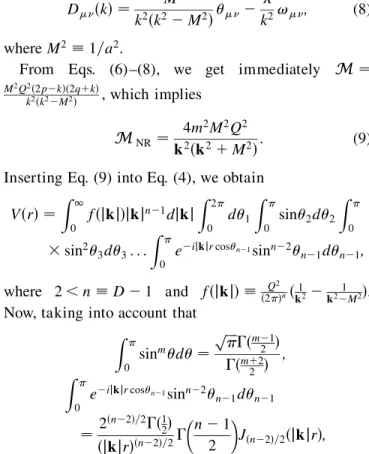
k2k2M2: (9) Inserting Eq. (9) into Eq. (4), we obtain
Vr Z1 0
fjkjjkjn1djkjZ2 0
d1 Z
0
sin2d2 Z
0
sin2 3d3. . .
Z
0
eijkjrcosn1sinn2
n1dn1; where 2< nD1 and fjkj 2Q2nk12
1
k2M2.
Now, taking into account that
Z
0
sinmd
p
m21 m2
2 ; Z
0
eijkjrcosn1sinn2
n1dn1 2
n2=2 1
2 jkjrn2=2
n 1
2
Jn2=2jkjr; where J denotes the Bessel function, we arrive at the following expression for the potential:
UDr Q
2D1=2rD3=2 Z1
0 1
k2
1
k2M2
jkjD1=2J
D3=2jkjrdjkj; (10)
whereUDr VQrandD >3.
On the other hand, it is trivial to show thatU3 can be evaluated from the expression
U3r Q
2
Z1
0 1
k2
1
k2M2
jkjJ0jkjrdjkj; which allows us to conclude that Eq. (10) can also be applied to the caseD3. Hence, the problem of comput-ing the effective nonrelativistic potential forD >2 was reduced to quadratures.
If Eq. (10) is correct, it must reproduce the Podolskian potential in31dimensions. Performing the computa-tion forD4, we get
U4r Q
4
1er=a
r ;
which is just the same result as that obtained in Podolsky’s electromagnetic theory.
FIG. 1. The relevant vertex for boson-boson interaction.
p´ q´
p q
k
FIG. 2. One-Podolskian photon-exchange contribution to the scattering of two identical massive charged bosons.
BRIEF REPORTS PHYSICAL REVIEW D70107705
ForD3, Eq. (10) yields U3r
Q
2
lnr
r0
K0Mr ; (11) where r0 is an infrared regulator andK is the modified Bessel function.
We discuss now the existence of boson-boson bound states in the context of planar quadratic electromagne-tism. The corresponding time-independent Schro¨dinger equation can be written as
HlRnl 1
m d2
dr2Rnl
1
r d drRnl
Veff
l Rnl
EnlRnl;
Veff
l
l2
mr2QU3r l
2
mr2 Q2
2
lnr
r0
K0Mr ;
where Rnl is thenth normalizable eigenfunction of the radial HamiltonianHlwhose corresponding eigenvalue
isEnland Veff
l is thelth partial wave effective potential.
On the other hand,
d drV
eff
l
2l2 m
1
r3 Q2
2
1
r Q2M
2 K1Mr;
which allows us to conclude thatdrdVeff
l <0in the interval
0< r <1, implying thatVeff
l is strictly decreasing in this
interval. Consequently, in the framework of planar qua-dratic electromagnetism, no bound state concerning the two charged-scalar bosons system exists.
Since boson-boson bound states do not show up in Podolsky planar electromagnetism, we investigate here whether the effective boson-boson low energy potential related to Podolsky-Chern-Simons (PCS) planar theory can bind a pair of identical charged-scalar bosons. The Lagrangian for PCS scalar QED, in the Lorentz gauge, can be written as
L 1
4FF
a
2
2 @F
@F
1 2@A
2
DDm2s
2" A
@A ; (12)
wheres >0is the topological mass.
In the basisf; !; Sg, whereS" @ , the
propa-gator assumes the form
O1 a
2k4k2 a2k4k22s2k2
! k2
sS
a2k4k22s2k2:
Now, in the nonrelativistic limit the Feynman ampli-tude for the process shown in Fig. 2 reduces to
MNR
a2k4k24Q2m2 a2k4k22s2k2
8ismQ2k^P
a2k4k22s2k2 ; where P1
2pq is the relative momentum of the incoming charged-scalar bosons in the CoM. On the other hand, it is trivial to show that if a <2p3=9s the equation
x32x 2
a2 x a4
s2
a4 0; (13) wherexk2has three distinct negative real roots. In this caseMNR can be rewritten as
MNR8ismQ
2k^P
a4
X3
j1 Bj
k2x
j
a4 s2k2
4Q2m2 a4 X3
j1 Aj
k2x
j
;
where x1, x2, andx3 are the roots of Eq. (13) andA1 1a2x
1
x1x2x1x3, A2
1a2x 2
x2x1x2x3, A3
1a2x 3
x3x1x3x2,
B1 1a
2x
12
s2x
1x2x1x3, B2
1a2x
22
s2x
2x1x2x3, and
B3 1a2x
32
s2x
3x1x3x2.
It follows that the effective nonrelativistic potential can be calculated from the expression
U3r isQ ma4
a4 s2lim!0
Z1
0
k^PJ0jkjrjkjdjkj k22 X
j
Z1
0
k^PBjJ0jkjrjkjdjkj
k2x
j
2aQ4 X
j
Z1
0 Aj
k2xjJ0jkjrjkjdjkj: Performing the computations, we obtain
U3r sQ ma4
a4 s2
1
r2
1
r X
j
BjqjxjjK1qjxjjr L
Q
2a4
X
j
AjK0 jxjj q
r ; (14)
whereLr^Pis the orbital angular momentum. Using Jackiw’s arguments [1], one can show that the topological term alone is unable to bind the charged scalar bosons [2].
We return now to the problem of probing whether ‘‘Cooper pairs’’ exist in the framework of PCS scalar QED. In this case, the radial Schro¨dinger equation is
d2 dr2
1
r d
dr RnlmEnlV eff
l Rnl0; (15)
where
BRIEF REPORTS PHYSICAL REVIEW D70107705
Veff
l r
sQ2 ma4
a4 s2
1
r2
1
r X
j
BjqjxjjK1qjxjjr l
Q 2
2a4
X
j
AjK0
jxjj
q
r l 2
mr2:
Employing the dimensionless parameters ysr,
Q2
s, bjs
2
a4Bj, Xjj xjj
s , 4ms, aj Aj
a4, and E~nl mEnl
s2 , we can rewrite Eq. (15) as
d2 dy2
1
y d
dy Rnl E~nlV~ eff
l Rnl0; (16)
with
~
Veff
l
ll y2
4
2
X
j
ajK0Xjy ly X
j
bjXjK1Xjy:
Note that V~eff
l behaves as l
2
y2 at the origin and as
ll
y2
asymptotically. On the other hand, the derivative of this potential with respect toyis given by
d dyV~
eff
l
2ll
y3 X
j
2l y2bj
4aj
2 XjK1Xjy
ly X
j
bjX2jK0Xjy:
In order to find out whether or not boson-boson bound states could be formed, we shall analyze how dyd V~eff
l
behaves for small values of the cutoffa. Indeed, only if a1 will the well-recognized properties of QED3 be preserved. In this limit, we get
d dyV~
eff
l
2ll
y3 2l
y2 4
2 K1y
l y K0y: We assume from now on a1 and l >0, without any loss of generality. It is trivial to see that, if l > , the potential is strictly decreasing, which precludes the ex-istence of bound states. The remaining possibility isl < . In this intervalV~eff
l approaches1at the origin and
0fory! 1, which is indicative of a local minimum. Therefore, the existence of Cooper pairs is subordinated to the conditionsa1and0< l < .
Of course, it is impossible to solve Eq. (16) analyti-cally; however, it can be solved numerically. To do that, we rewrite beforehand the radial function as Rnl
unl=py. As a consequence, Eq. (16) takes the form d2
dy2
1
4y2 unl E~nlV~ eff
l unl0: (17)
Using the Numerov algorithm [3], we solved Eq. (17) numerically for several values of the parameters , 4, and l, keeping the cutoff afixed. The latter was chosen equal to 2
3re 9:520 33 10
3 MeV1, wherer
e is the
four-dimensional classical radius of the electron. It is worth mentioning that the anomalous factor of 43 in the inertia related to the Abraham-Lorentz model for the electron does not show up ifa >1
2re [4,5].
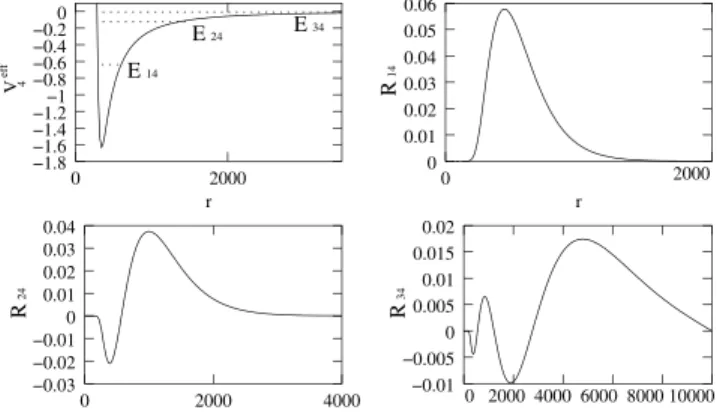
In Fig. 3 we present our numerical results for the potential and the corresponding radial eigenfunctions concerning the first three bound states in the specific case ofl4. The associated energies areE14 6:375 01
107 MeV; E
24 1:2536 107MeV; E34
5:224 41 109 MeV:
The graphics shown in Fig. 3 exhibit, in a sense, the generic features of the potential and of the radial eigen-functions, although they have been composed using par-ticular values of the parameters,4,l, anda. A detailed study of the modifications of the effective potential in-duced by radioactive corrections, as well as the corre-sponding alterations to the eigenvalue structure, will be published elsewhere [2].
A. A. thanks CNPq-Brazil and M. D. thanks CAPES-Brazil for financial support.
[1] R. Jackiw, Diverse Topics in Theoretical and Mathematical Physics (World Scientific, Singapore, 1995).
[2] A. Accioly and M. Dias (to be published).
[3] B. Numerov, Mon. Not. R. Astron. Soc.84, 592 (1924). [4] J. Frenkel, Phys. Rev. E54, 5859 (1996).
[5] J. Frenkel and R. Santos, Int. J. Mod. Phys. B13, 315 (1999).
R R
R
E
E14 24
24 34
14
eff
4
34
E
0 0.01 0.02 0.03 0.04 0.05 0.06
0
r
−0.03 −0.02 −0.01 0 0.01 0.02 0.03 0.04
0 2000 4000 r
−0.01 −0.005 0 0.005 0.01 0.015 0.02
r −1.8
−1.6 −1.4 −1.2−1 −0.8 −0.6 −0.4 −0.20
0 2000 r
V
2000
2000 4000 6000 8000 10000 0
FIG. 3. Veff
4 with the lowest three allowed energies and the
corresponding energy eigenfunctions. Here Veff
4 eV,r
MeV1,8,42000, anda0:009 52 MeV1.
BRIEF REPORTS PHYSICAL REVIEW D70107705