molecules
ISSN 1420-3049 www.mdpi.com/journal/molecules Review
Antiplasmodial Natural Products
Cláudio R. Nogueira and Lucia M. X. Lopes *
Instituto de Química, Universidade Estadual Paulista, UNESP, C. P. 355, 14801-970, Araraquara, SP, Brazil; E-Mail: [email protected] (C.R.N.)
* Author to whom correspondence should be addressed; [email protected]; Tel.: +55-16-33019663; Fax: +55-16-33019692.
Received: 25 January 2011; in revised form: 15 February 2011 / Accepted: 2 March 2011 / Published: 4 March 2011
Abstract: Malaria is a human infectious disease that is caused by four species of Plasmodium. It is responsible for more than 1 million deaths per year. Natural products contain a great variety of chemical structures and have been screened for antiplasmodial activity as potential sources of new antimalarial drugs. This review highlights studies on natural products with antimalarial and antiplasmodial activity reported in the literature from January 2009 to November 2010. A total of 360 antiplasmodial natural products comprised of terpenes, including iridoids, sesquiterpenes, diterpenes, terpenoid benzoquinones, steroids, quassinoids, limonoids, curcubitacins, and lanostanes; flavonoids; alkaloids; peptides; phenylalkanoids; xanthones; naphthopyrones; polyketides, including halenaquinones, peroxides, polyacetylenes, and resorcylic acids; depsidones; benzophenones; macrolides; and miscellaneous compounds, including halogenated compounds and chromenes are listed in this review.
Keywords: malaria; antimalarial; antiplasmodial; Plasmodium
1. Introduction
Malaria is an infectious disease caused by four protozoan species of the genus Plasmodium (Plasmodium falciparum, Plasmodium malariae, Plasmodium ovale, and Plasmodium vivax) [1]. Small human infection outbreaks caused by a malaria parasite of monkeys, Plasmodium knowlesi, have also been reported in Southeast Asia [2]. The majority of the cases of malaria and deaths (malaria kills 1-2 million people each year) are caused by P. falciparum. P. vivax is generally considered less
dangerous than P. falciparum, although both can cause deadly complications in infected people. Nearly 3 billion people are at risk of infection with the malaria parasite P. vivax. A new map of areas where this parasite has been reported, including risk areas, has been drawn [3]. These grim statistics could become even worse if resistance to the existing antimalarial drugs develops further [4]. According to WHO [5], the elimination of malaria from countries with high transmission rates is a long-term goal that will depend on the success of research and development to deliver a more robust arsenal of tools than those available today – tools of greater potency and effectiveness, especially those with an impact on transmission, and replacements for medicines and insecticides that are being lost to resistance. The growing resistance to existing antimalarial drugs could nullify efforts to eliminate this deadly disease. Unfortunately, there are still very few drugs that are active against malaria (artemisinin, atovaquone, and chloroquine analogues) [4, 6] and vaccines against malaria are not yet available [6].
At present, drug resistance of the malaria parasite is widespread, no new chemical class of antimalarials has been introduced into clinical practice since 1996, and there has recently been an increase in parasite strains with reduced sensitivity to the newest drugs [7]. Meanwhile, recent advances in genome-based technologies and in vitro screening of whole parasites and a great number of compounds (natural and synthetic) have broadened the range of therapeutic targets and are accelerating the development of a new generation of treatments for both the control and eradication of malaria [6].
Several excellent reviews on antiplasmodial compounds, including natural products, have been published in recent years [8-18]. Thousands of chemicals have been assayed for antiplasmodial activity, such as those described by Gamo et al. [7].
The current review provides an overview of a great number of bioactive natural products that have recently been described in the literature (from January 2009 to November 2010) as showing antiplasmodial activity (in vitro), along with a few compounds that were tested for antimalarial activity in animal models [19] using Plasmodium knowlesi (in simians), Plasmodium yoelii, Plasmodium berghei, Plasmodium chabaudi (in mice), and Plasmodium gallinaceum (in birds). In most of these bioassays, antiplasmodial activities were assessed using different P. falciparum strains, which include chloroquine-sensitive (NF54, NF54/64, 3D7, D6, F32, D10, HB3, FCC1-HN, Ghana, MRC-02, TM4), chloroquine-resistant (BHz26/86, Dd2, EN36, ENT30, FcB1, FCM29, FCR3, FCR-3/A2, FCR3F86, S20, W2,), chloroquine-resistant and pyrimethamine-resistant (K1, TM91C235), pyrimethamine-resistant (HB3), cycloguanil-resistant (CDC1), and chloroquine- and antifolate-resistant (K1CB1). Most of evaluations used the [3H]-hypoxanthine-incorporation assay to assess parasite inhibition of growth in the presence of the test-drugs. Antimalarial activity of new compounds has also been determined by using: i) the fluorometric method based on the intercalation of the fluorochrome PicoGreen (SYBR) in the parasite DNA, [20]; ii) enzyme-linked immunosorbent assays (ELISAs) with monoclonal antibodies, which measure the P. falciparum-specific antigen histidine-rich protein 2 (HRP2) or lactate dehydrogenase protein (pLDH). A chemical reaction using ferriprotoporphyrine biocrystallization (FBTI Inhibition Test) has been used to provide a possible action mechanism for presumed antimalarial compounds [21]. Protein farnesyltransferase (FTase) bioassays have also been used to provide insight into their mode of action against P. falciparum [22]. The effects of natural products on glutathione (GSH), which plays a key role in redox mechanisms, and on cysteine (Cys), which is one of the substrates needed for the de novo synthesis of P. falciparum GSH, as well as their impact on
advantages and disadvantages of the different in vitro screening methods have been discussed by Krettli et al. [24] and Wein et al. [25]. For in vivo bioassays P. berghei and P. chabaudi chabaudi have been used most often. The cytotoxicities of the active compounds compiled in this review have generally been evaluated in HEK293, Vero or HeLa cells. For the details of the methodologies, see the appropriate references cited herein.
Several criteria have been proposed for considering a compound as active. Generally, a compound is considered to be inactive when it shows an IC50 > 200 μM, whereas those with an IC50 of 100-200 μM
have low activity; IC50 of 20-100 μM, moderate activity; IC50 of 1-20 μM good activity; and IC50 < 1 μM
excellent/potent antiplasmodial activity [12]. In this review, regardless of the in vitro or in vivo method adopted for antiplasmodial or antimalarial evaluation, we list the active and moderately active compounds in accordance with the corresponding cited literature (data for inactive compounds are not shown in this review).
A total of 360 antiplasmodial natural products comprised of terpenes, including iridoids, sesquiterpenes, diterpenes, terpenoid benzoquinones, steroids, quassinoids, limonoids, curcubitacins, and lanostanes; flavonoids; alkaloids; peptides; phenylalkanoids; xanthones; naphthopyrones; polyketides, including halenaquinones, peroxides, polyacetylenes, and resorcylic acids; depsidones; benzophenones; macrolides; and miscellaneous compounds, including halogenated compounds and chromenes are listed in this compilation (Figures 1-44).
2. Terpenes
2.1. Iridoids and halogenated monoterpenes
Phenylpropanoid conjugated iridoids 1-5 (Figure 1) have been isolated from Morinda morindoides (Rubiaceae). All of these compounds except for 3 potently inhibited parasite proliferation (P. falciparum strain CDC1, IC50 values of 0.04 to 4.1 µM) with little cytotoxicity against the host
mammalian cells (KB 3-1) [26]. The iridoid swertiamarin (6) has been obtained from Enicostemma littorale (Gentianaceae) and showed promising results in vitro in a schizont maturation inhibition assay, with an IC50 value of 44.4µ [27].
Figure 1. Structures of iridoids and halogenated monoterpenes 1-9.
R1 R2 R3 R4
1 Ac OMe H OH
2 Ac H H OH
3 H OMe H OH
4 H H H OH
5 H OMe =O
O O
O
CO2Me
H H
O O O H
OH OH
OR1
R3
OH R2 R4
O
O O
O H
OGlc H
6
Cl CHO
Cl Cl
8
Cl Cl
Cl Cl
Cl
7
Cl Cl Cl
Cl
Halogenated monoterpenes 7-9 with a 3,7-dimethyl-3,4-dichloro-octa-1,5,7-triene skeleton obtained from the marine red alga Plocamium cornutum (Plocamiaceae) exhibited antiplasmodial activity toward a chloroquine-sensitive strain of P. falciparum. Those bearing a 7-dichloromethyl substituent showed higher activity, with IC50 values ranging from 16 to 27 μM.
2.2. Sesquiterpenes
The eremophilane sesquiterpenoids berkleasmins A (10) and C (11) (Figure 2), obtained from the saprobic fungus Berkleasminum nigroapicale, showed antiplasmodial activity with IC50 values of 6.0
and 5.4 µ, respectively [29]. The sesquiterpene lactones vernaguline A and B, vernodalol, and vernodalin (12-15) were isolated from Distephanus angulifolius (Asteraceae), and while they exhibited antiplasmodial activity against chloroquine-sensitive (D10) and chloroquine-resistant (W2) P. falciparum strains (IC50 values of 1.5 to 4.9 μM), they also exhibited cytotoxicity in a hamster ovarian
cell line [30].
Figure 2. Structures of sesquiterpenes 10-17.
O OH
H O O O OH
O H
10 11
O OH O O OH
O H
O
12
H O
O
O O O
O H
O O
H O
O
O O O
O H
O O
13 14
O O
OH O
O H
O O
H O
O O
O O H
H O
O O
15
16
O O
H
O OH
H
17
O
O O
O
Okundoperoxide (16) was isolated by the bioassay-guided fractionation of extracts from Scleria striatinux (syn. S. striatonux, Cyperaceae). This compound contains a cyclic endoperoxide structural moiety and showed antiplasmodial activity against W2 and D6 (IC50 ~1.8 µ), K1 (IC50 = 5.6 µ),
and NF54 (IC50 = 4.9 µ) [31].
51.2 mg/kg, while doses of 124 mg/kg and above were found to be lethal to mice. DDV (2, 5, 10 mg/kg/day) exhibited a significant blood schizonticidal activity in 4-day early infection, repository evaluation and in an established infection with a significant mean survival time comparable to that of the standard drug (chloroquine, 5 mg/kg/day) [32].
Figure 3. Structures of sesquiterpenes 18-46.
O O O
O H
H O
O H
H O
33 O
O O
O
31
O
O H
O H
32 O
O O
30
34 O
O O
O H
H O
H
H O
O
O
O O AcO
H
35
O O
36
O O O
37 O
O R2O R3
H R1O
R1 R2 R3
23 Ac H H 24 H H H 25 H tig OH
26 H H Otig 27 Ac Ac H
28 Ac H OAc
O O O
H H AcO
OAc
29 O
O O RO
H
R1
18 Ac 19 i-but
20 i-val
O O O RO
H
R1
21 H
Figure 3. Cont.
O O
O O O
RO
R
41 H
42 Ac O
O O O
O
H OH
O H
40 O
R
H
O R1
R R1
38 H OH 39 OH H
O O
O
O O
O R
R
43 OH
44 OAc
O O
O O O
O H
OAc
45 46 O
O O
In tests of 33 sesquiterpene lactones from several genera, including Arnica, Xanthium, and Inula (Asteraceae), Schmidt et al. [33] found that the antiprotozoal activities were significantly correlated with cytotoxicity, and the major determinants of this activity were α,β-unsaturated structural elements. Among the tested sesquiterpene lactones, 29 (compounds 18-46, Figure 3) showed activity against P. falciparum (K1) with IC50 values of 0.3 to 27.5 µM [33].
2.3. Diterpenes
Aberrarone A (47, Figure 4) is a natural product from the Caribbean sea whip Pseudopterogorgia elisabethae (Gorgoniidae). This compound, together with colombiasin A (48), showed in vitro activity against a chloroquine-resistant strain of P. falciparum (W2, IC50 values of 30.3 and 31.8 μM,
respectively) with the use of a fluorometric method (PicoGreen) [34]. Figure 4. Structures of diterpenes 47 and 48.
O
O HH
O O
H
47 48 O
O OH
The dolabellanes 49-63 (Figure 5) and dolastane 64 from a Eunicea species Caribbean octocoral (Gorgoniidae) were tested for their inhibitory activity toward the growth of P. falciparum (W2). These compounds were active with IC50 values of 9.4 to 59.6 μM [35].
Figure 5. Structures of dolabellanes 49-63.
O
H
O O
H
O OAc
H
O
HOO H
O OAc
O H
49 50 51 52
H
O O
H O H
H O
HOO
H HOO
O
H
O
53 54 55 56
H O
H O
H OH
57 58
H O
O H
H
64
H
O OR
R
59 H
60 Ac
H O O
H R1
R
R R1
61 H H
62 OAc H
63 H OAc
Gomphostenin clerodane diterpenes 65 and 66 (Figure 6) obtained from Gomphostemma niveum (Lamiaceae) were tested against P. berghei in mice and produced a dose-dependent chemo-suppression effect. Diterpene 65 exhibited the highest percent of chemo-suppression, i.e. 92.65% at a dose of 200 mg/kg/day. In a curative test, the survival period of the infected mice was significantly prolonged at 200 mg/kg dose of 66 [36]. Gomphostenin (65) and Gomphostenin-A (66) exhibited in vitro antiplasmodial activities against the MRC-02 strain of P. falciparum with IC50 values of 114.9 and
Figure 6. Structures of clerodane and kaurane diterpenes 65-67.
H
CO2H
67
O H
OR O O
R
65 H
66 Ac
2.4. Nitrogenated diterpenes
Isonitrile diterpenes 68-71 (Figure 7) of the amphilectane family have been isolated from the sponge Ciocalapata sp. (Halichondriidae). They exhibited strong activities against P. falciparum (K1) with IC50 values of 0.09 to 1.07 µM. Except for 8,15-diisocyano-11(20)-amphilectene (68), which was
cytotoxic against both MCF-7 and fibroblast cell lines, these diterpenes showed no significant cytotoxicity against either of the targeted cell lines [39]. Alkaloid 72 is also a formamide and isonitrile, diterpene that was isolated from the tropical marine sponge Cymbastela hooperi (Axinellidae). In in vitro antiplasmodial bioassays using three strains (FCR3F86, W2, and D6) of the malaria parasite P. falciparum, 72 was found to have good activity (IC50 = 1.5 µM), whereas the corresponding
di-formamide derivative 73 showed only moderate activity (IC50 = 41.0 µM) [40].
Figure 7. Structures of nitrogenated diterpenes 68-73.
CN H H
H NC
NC
H H H
H H
H NC
H H
H NC
68 69 70 71
H
H H
H
H H
NH R
H O
R
72 NC
73 NHCHO
2.5. Tetranorditerpenes
Tetranorditerpenoid dilactones 74-81 and an oidiolactone 82 (Figure 8), isolated from the fungus Sclerotinia homoeocarpa, exhibited excellent to good antiplasmodial activity (IC50 values of 0.1 to
Figure 8. Structures of tetranorditerpenes 74-82.
R
74 H
75 OH
R
77 H
78 OH
76 R R1
79 H OH
80 OH H
81 H H
O O
O
O O R
O O
O O R
O O
O O
R1 R O
O
O
O O O
H O
O
OH
CO2H
82
2.6. Terpenoid benzoquinones and analogues
Terpenoid benzoquinones and analogues 83-89 (Figure 9) isolated from the root extract of Cordia globifera (Boraginaceae) exhibited antiplasmodial activity against the P. falciparum strain K1 with IC50 values of 0.8 to 13.9μM. The antifungal and cytotoxic activities of these compounds were also
evaluated [42].
Figure 9. Structures of terpenoid benzoquinones and analogues 83-89.
O
O
O H
OH
CHO 83
O
O H
O
O H
84 85
88
O O
H
CHO
89
OR
OR H
R
86 H
87 Ac
2.7. Steroids
The major steroid 90 together with three other steroids 91-93 (Figure 10) isolated from the marine sponge Callyspongia fibrosa (Callyspongiidae) showed antiplasmodial activity (P. falciparum strains 3D7 and K1 with IC50 values of 20.5 to 54.8 µM). Parasite growth was assessed as pLDH activity and
Ciocalapata sp. (Halichondriidae) showed antiplasmodial activity against P. falciparum K1 (IC50 values of 6.28 and 7.13 µM, respectively), and cytotoxicity against human cells in a breast cancer
cell line MCF-7 (IC50 values of 0.025 and 0.003 µM, respectively), with very little toxicity against
human fibroblasts [39].
An evaluation of the effects of four steroid derivatives 96-99 and a sapogenin 100 extracted from Solanum nudum (Solanaceae) on the total glutathione (GSH) and cysteine contents in P. falciparum in vitro showed that 96 increased total glutathione and cysteine concentrations while 99 decreased the concentrations of both thiols. Acetylation at C16 was crucial for the effect of 96 while type furostanol and terminal glucosidation were necessary for the inhibitory properties of 99. The combination of steroids and buthionine sulfoximine, a specific inhibitor of a step-limiting enzyme in GSH synthesis, did not modify the glutathione contents. In addition, 96 inhibited more than 80% of
β-hematin formation at 5.0 mM, while the other steroids did not show any effect [23].
Figure 10. Structures of steroids 90-100.
O H
OH
OAc
R H R1
O H
OH OH
H OH
R R1
90 OH H
91 H H
92 OH OH
93
O H
H H
O O
94
O H
O
O O
95
O
O
R2
R1
R1 R2
96 OAc OH
97 OH OH
98 OAc OGlu
O
OH
OGlu O
O
O O
99 100
2.8. Quassinoids
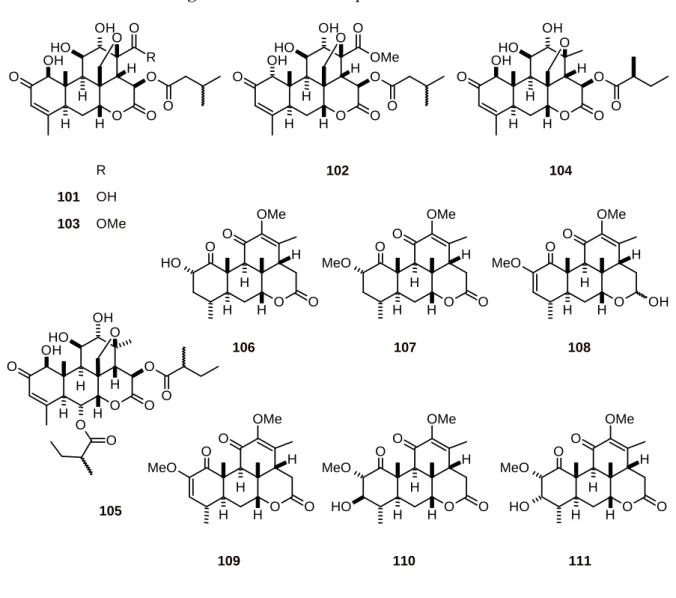
Delaumonones A (101) and B (102) (Figure 11) have been isolated from the bark of Laumoniera bruceadelpha (Simaroubaceae). These quassinoids showed antiplasmodial activity against the P. falciparum strain 3D7 (IC50 values of 0.6 and 1.2 µM, respectively) and cytotoxicity against HL-60
cells (IC50 101: 3.1 µM; 102: 4.6 µM). Another isolated quassinoid, the isobrucein A (103)
cytotoxicity against HL-60 cells (IC50 = 0.01 µM) [44]. The tea of young leaf of Quassia amara
(Simaroubaceae) also contains several quassinoids 104-111, including simalikalactone D (104) and simalikalactone E (105) [45, 46]. These quassinoids inhibited the growth of P. falciparum cultured in vitro (with IC50 values of 1 to 420 nM), independently of the strain sensitivity to chloroquine.
Compound 105 decreased gametocytemia with an IC50 value seven-fold lower than that of primaquine,
and was also less toxic than simalikalactone D (104) when tested on nontumorogenic cells. In vivo, 105 inhibited murine malaria growth of P. vinckei petteri by 50% at 1 and 0.5 mg/kg of body weight/day, by the oral or intraperitoneal routes, respectively [45, 46].
Figure 11. Structures of quassinoids 101-111.
O O O O O R O OH O H OH H H H H O O O O O O OMe O OH O H OH H H H H O O O O O O OH O H OH H H H H O R 101 OH
103 OMe
102 104 O O H O OMe O O H H H H O MeO O OMe O O H H H H O MeO OH OMe O O H H H H
106 107 108
O O O O O OH O H OH H H H H O O O O MeO O OMe O O H H H H 105 109 O MeO O OMe O O H H H H O H O MeO O OMe O O H H H H O H 110 111 2.9. Limonoids
Figure 12. Structures of limonoids 112-121.
R
113 H
115 =O
R
112 OAc
117 OH
O H H OAc O R O H R O O O H O 116 O H H OAc O O O O H H OAc O O H OAc H 114 O H H OAc O O H H O H H OAc H O OH H OH 118 119 O H H OAc O H OH OH OH 120 O H H OH H
O H O
AcO
H
H
121
Figure 13. Structures of cucurbitacins 122-134.
O H H O H OH O O H H O H OH 124 122 O H H O H OH O 123 O H H R1 H R2 R R3
R R1 R2 R3
125 OH OH OH H
126 OMe OH OH H
127 OMe OGlu H H
128 OH OMe H OH
129 OH OH H H
130 OH OH H OH
O H H OH H OH OH OH 131 O H H H OH O 132 O H H R H OH OH R 133 OH
2.10. Cucurbitacins
Thirteen cucurbitane-type triterpenes 122-134 (Figure 13) have been isolated from Momordica balsamina (Curcubitaceae) and have been shown to exhibit antiplasmodial activity against the P. falciparum chloroquine-sensitive strain 3D7 and the chloroquine-resistant strain Dd2. Triterpenes 130 and 133 had the highest antiplasmodial effects against both strains (IC50 130: 4.6 and 133: 7.4 μM,
3D7; 130: 4.0 and 133: 8.2 μM, Dd2). Furthermore, a preliminary evaluation of the toxicity of compounds 122-126 and 130 toward human cells in a breast cancer cell line (MCF-7) showed that these triterpenes were inactive or showed only weak toxicity (IC50 values >19.0 μM) [48].
2.11. Lanostanes
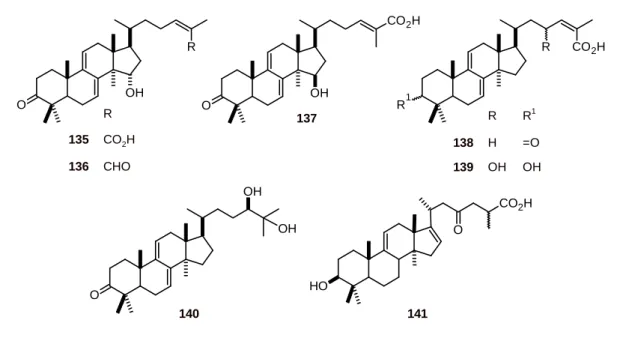
Ethyl acetate extract of the mushroom Ganoderma lucidum (Polyporaceae) yielded six lanostanes 135-140 (Figure 14). These lanostanes exhibited in vitro antiplasmodial activity with IC50 values of
6 to 20 μM [49]. Another lanostane, garcihombronane D (141), from Garcinia cymosa (Clusiaceae) showed a selective activity against P. falciparum (IC50 7.7 µM) [50].
Figure 14. Structures of lanostanes 135-141.
O
OH
CO2H
137
O
OH
R
R
135 CO2H
136 CHO
R1
CO2H R
R R1
138 H =O
139 OH OH
O
CO2H
O H
141
O
OH
OH
140
2.12. Other triterpenes
The triterpene 3-hydroxy-glutin-5-ene, which was also isolated from Garcinia cymosa (142) (Figure 15), showed activity against P. falciparum (IC50 31.0 µM) and a cytotoxicity of 6.9 µM toward
MRC-5 cells [50]. Hop-17(21)-en-6R,12-diol (143) was isolated from the scale insect pathogenic fungus Aschersonia paraphysata. It exhibited antiplasmodial activity with an IC50 value of 15 μM [51].
Tingenin B, (22- hydroxytingenone) (144), has been isolated as the main antibacterial constituent from Elaeodendron schlechteranum (Celastraceae). It was active against T. cruzi (IC50 < 0.6 μM),
T. brucei (IC50 < 0.6 μM), L. infantum (IC50 = 1.2 μM), and P. falciparum (IC50 = 0.8 μM). Tingenin B
(145) has been isolated from Schefflera umbellifera (Araliaceae), and exhibited good antiplasmodial activity (IC50 = 7.2 μM) against a chloroquine-susceptible strain (D10) [38]. Betulinic acid (146)
showed antiplasmodial activity against chloroquine-resistant P. falciparum parasites (W2 strain, chloroquine-resistant and mefloquine sensitive) in vitro, with an IC50 value of 9.9 μM [53].
Figure 15. Structures of terpenes 142-146.
CO2H
O H
142
H
H
H OH
OH
143
O H
O
OH O
144
R R1
145 H CH2OH
146 H CO2H
R1
RO
3. Flavonoids
Flavonoids 147 and 148 have been isolated from Neoraputia magnifica (Rutaceae). These flavonoids, together with 149 (Figure 16), isolated from Lonchocarpus subglaucescens (Leguminosae), exhibited antiplasmodial activity against the P. falciparum strain 3D7 with IC50 values of 7.6, 6.9, and
9.5 µM, respectively [54]. The luteolin 7-O--D-glucopyranoside 150 also showed antiplasmodial activity (IC50 = 4.9 M for the D6 strain and 4.0 M for the W2 strain), and this compound did not
exhibit cytotoxicity in Vero cells up to a concentration of 10.6 M [55].
The flavone 3-methoxycarpachromene (151) isolated from Pistacia atlantica (Anacardiaceae) showed an IC50 value of 3.4 µM toward the P. falciparum strain K1 [56], whereas dalparvone (152)
from the stems of Dalbergia parviflora (Leguminosae) exhibited moderate antimalarial activity with an IC50 value of 24.8 μM [57].
The in vitro antiplasmodial activities of the main hop chalcone xanthohumol (153) and seven of its derivatives were evaluated against two strains of P. falciparum (poW, Dd2). Xanthohumol had the highest activity, with IC50 values of 8.2 (poW) and 24.0 M (Dd2) [58].
Compounds obtained from Morinda morindoides (Rubiaceae) were evaluated in vitro for antiplasmodial activity against a Congolese chloroquine-sensitive strain of P. falciparum. Quercetin (154) exhibited good antiplasmodial activity with an IC50 value of 19.2 , whereas alizarin and
chrysazin displayed only moderate activity (58.3 < IC50 < 124.9 M) [59].
Figure 16. Structures of flavonoids 147-155. OMe O O O O O O O O OH OH OMe O O O H OH OH OMe OMe O O MeO OMe O O OMe O MeO OH OMe OMe OMe GluO O O OH OH OH 149 151 152 150 147 148 O O O H OH OH OH 154 O O O H OH OH OH OH 155 O H OMe O OH OH 153
Ormocarpum kirkii also gave four biflavonoids 156-159 (Figure 17) that showed antiplasmodial activity toward P. falciparum strain K1; isochamaejasmin (159) was the most active, with an IC50 of
7.3 μM, but its selectivity was rather limited [60].
Figure 17. Structures of biflavonoids 156-159.
4. Alkaloids
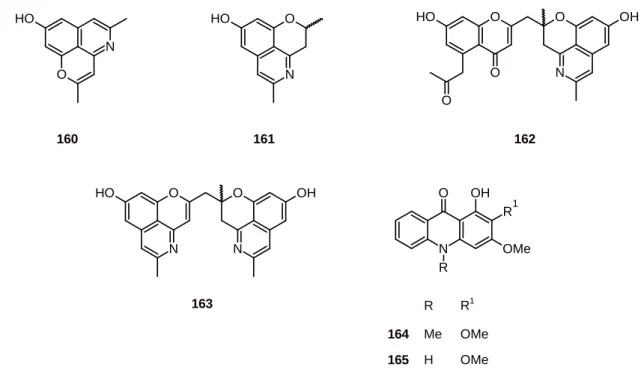
Cassiarin A (160) (Figure 18) from the leaves of Cassia siamea (Leguminosae) showed promising antimalarial activities. Cassiarin A had inhibitory effects against P. falciparum (IC50 = 0.02 M).
Antimalarial activity was assessed in vivo using the 4-day suppressive test procedure. The ED50 value
of cassiarin A was 0.17 [61]. In contrast, cassiarins C-E (161-163) exhibited moderate antiplasmodial activity (IC50 values of 24.2 to 2.3 µM) and no cytotoxicity (IC50 100 µM) [62].
Acridone alkaloids have been isolated from the fruits of Zanthoxylum leprieurii (Rutaceae), and among them arborinine (164) and xanthoxoline (165) (Figure 18) exhibited a good in vitro antiplasmodial activity against the P. falciparum strain 3D7, with IC50 values of 15.8 and 17.0 μM,
respectively [63].
Figure 18. Structures of alkaloids 160-165.
N O
H
O
160
O
N O
H O
N
OH O
O O O H
161 162
R R1
164 Me OMe
165 H OMe
N R O
OMe OH
R1 O
N
OH O
N O
H
163
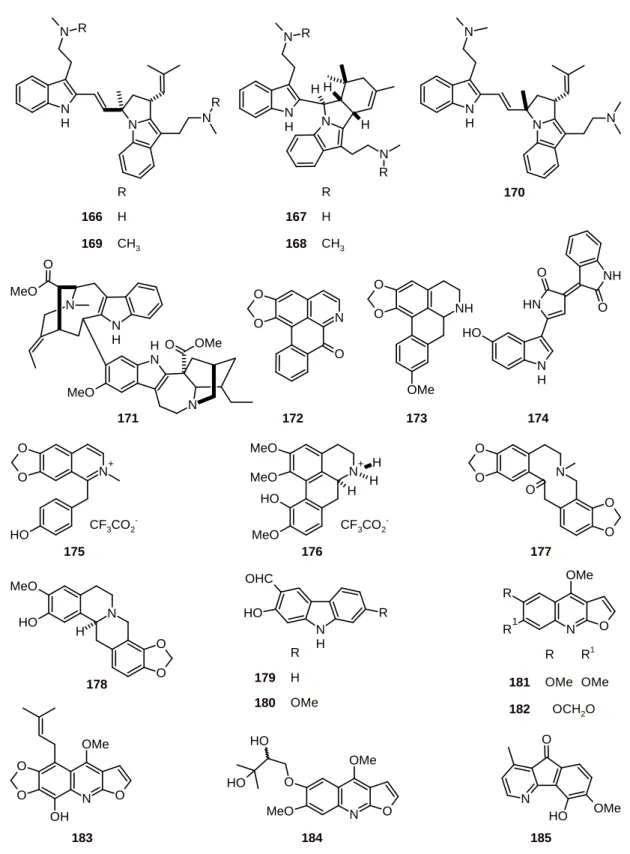
Flinderole A (166) and isoborreverine (167) have been isolated from Flindersia acuminata (Rutaceae) and dimethylisoborreverine (168), flinderoles B (169), and C (170) (Figure 19) have been isolated from Flindersia ambionensis. These indole alkaloids were found to have selective antiplasmodial activities, with IC50 values of 0.08 to 1.42 μM against the P. falciparum strain Dd2 and
with selectivity assessed using the mammalian cell line HEK-293 [64]. In addition, the antiplasmodial activities of alkaloids 166-170 and voacamine (171) were evaluated using P. falciparum strains with different drug-resistance profiles (3D7, FCR3, HB3, and K1). Some differences in the IC50 values
between the strains were observed. Among these alkaloids, including lirodenine (172) and xylopine (173), the dimethylisoborreverine (168) was the most active, with IC50 values between 0.02 μM and
0.81 μM [65].
(S20) P. falciparum strains in vitro, inhibited parasitemia in vivo, even after parasite-establishment; and protected P. chabaudi chabaudi-infected mice from a lethal challenge [66].
Figure 19. Structures of alkaloids 166-185.
N
H N N
N N H N H N R H H N R N
H N N
R N R
R
166 H
169 CH3
R
167 H
168 CH3
170 N H N MeO N H N OMe O O MeO N O O O NH O O OMe 172 173 171 174 N OMe O O O OH N OMe O O MeO O H O H O O N + O
H CF3CO2
-MeO MeO N + MeO H H O H H O O O O N O
175 176 177
MeO O H O O N H 178 N H OHC O H R R
179 H
180 OMe
N OMe R
R1 O
R R1
181 OMe OMe
182 OCH2O
183 184 N O O H OMe 185 N H N H O NH O O H
CF3CO2
human embryonic kidney cell line (HEK293) and showed no activity at 120 μM [67]. The alkaloidal components of the Bhutanese medicinal plant Corydalis calliantha (Fumariaceae), which is used for the treatment of malaria, have been assessed. Among them, protopine (177) and the cheilanthifoline (178) showed promising in vitro antiplasmodial activities against P. falciparum, both wild type (TM4) and multidrug-resistant (K1) strains, with IC50 values of 2.78 to 4.29 µM [68]. Alkaloids 179 and 180
have been isolated from Clausena harmandiana (Rutaceae) and they showed antiplasmodial activity with IC50 values of 15.5 and 12.2 µM, respectively, against the P. falciparum strain K1 [69].
Furoquinoline alkaloids (181-184) have been obtained from Teclea afzelii (Rutaceae). When evaluated against P. falciparum (NF54) in vitro, 3 µM of compounds 181-184 showed a partial suppression of parasitic growth [70]. The azafluorenone 5-hydroxy-6-methoxyonychine (185) obtained from Mitrephora diversifolia (Annonaceae) was shown to be active against P. falciparum strains 3D7 and Dd2, with IC50 values of 9.9 and 11.4 μM, respectively [71].
Figure 20. Structures of guanidine alkaloids 186-194.
N+ N N H H O O NH N NH O O NH N H2 NH 7 6
X- X
-N+ N N H H O O NH N H2 NH 8 N N N H O H H O O O N O NH2 N H2 15 N N N H H O O NH N NH O O NH N H2 NH H 9 n n
186 6
187 7
N N N H H H O O N N N H H H n 7 n
188 7
189 8
N+ N H N H H O O NH N NH O O NH N H2 NH H 9 8 X -190 191 192 193 X -N+ N N H H HO2C
6
Nine guanidine alkaloids 186-194 (Figure 20) from Caribbean marine sponges, including Monanchora arbuscula and Clathria calla, were evaluated to determine their activities against human cancer cell lines and malaria protozoa; they exhibited IC50 values of 0.1 to 4.5 μM using the
P. flaciparum strain FcB1 [72]. Zamamidines 195-198 and manzamine A (199) (Figure 21) have been isolated from the marine sponge species Amphimedon and have been shown to exhibit inhibitory activities against T. brucei (IC50: 1.4, 1.4, 0.4, 7.9, and 0.1 µM, respectively), and P. falciparum (IC50:
9.6, 16.3, 0.8, 12.4, and 1.8 µM, respectively) in vitro [73].
Figure 21. Structures of alkaloids 195-202.
N
N H
N N
H H
N NH
H
OH
N
N H
N+ N
H O
-H
OH
N
N H
N N
H H
OH
197 198
N
N H
N N
H H
N NH
H
OH
195
N
N H
N N
H H
N NH
H
O H
196
199
N
N H
N N
H H
OH
HCl
N
N H
N N
H H
OH O
H
N
N H
N N
H H
OH O
H
HCl
202 201
200
60.7 nM, respectively), while 199 was >3-fold less potent than 202 (IC50 = 37.9 and 47.1 nM vs. 10.5
and 12.5 nM, respectively) [74].
Atisinium chloride (203) (Figure 22) is the major alkaloid from Aconitum orochryseum (Ranunculaceae). It was tested for in vitro antiplasmodial activity against the malarial P. falciparum strains TM4/8.2 (wild type) and K1CB1 (chloroquine- and antifolate-resistant), and was shown to have good antiplasmodial activities, with IC50 values of 4.0 and 3.6 µM, respectively, against the TM4 strain
and the K1 strain of P. falciparum [75].
Glycoalkaloids have been isolated from Solanaceae species, and five of them, chaconine (204), solanine (205), solamargine (206), solasonine (207), and tomatine (208) (Figure 22), were evaluated against P. yoelii 17XL in mice at different concentrations with a 4-day parasitemia suppression test. Chaconine (204) showed a dose-dependent suppression of malaria infection, with an ED50 of
4.49 mg/kg; therapeutic index (TI) 9. At a dose of 7.50 mg/kg, the percent parasitemia suppression values of chaconine, tomatine, solamargine, solasonine, and solanine were 71.38, 65.25, 64.89, 57.47, and 41.30%, respectively. At 3.75 mg/kg, the percent parasitemia suppression of chaconine was 42.66% [76].
Figure 22. Structures of alkaloids 203-208.
The pyridinone alkaloid 209 (Figure 23) has been isolated from an EtOAc extract of a culture medium of the fungus Septoria pistaciarum. It exhibited excellent in vitro antiplasmodial activity against chloroquine-sensitive (D6) and -resistant (W2) strains of P. falciparum (IC50 values of 0.9 and
0.5 µM, respectively) and cytotoxic activity toward Vero cells [77].
Pyrroloiminoquinone alkaloids, discorhabdins A (210) and C (211), and dihydrodiscorhabdin C (212) (Figure 23), have been isolated from a deep-water Alaskan sponge species of the genus Latrunculia (Latrunculiidae). These alkaloids exhibited anti-HCV activity, antiplasmodial activity against P. falciparum strains D6 and W2 (IC50 values of 53, 2800, and 170 nM vs. 53, 2000, and 130
nM, respectively), and selective antimicrobial activity. Although compounds 210 and 212 displayed potent and selective in vitro antiprotozoal activity, P. berghei-infected mice did not respond to these metabolites due to their toxicity in vivo [78].
Figure 23. Structures of alkaloids 209-212.
N H
N
N H O
O Br
S
N H
N
N H O
O Br Br
N H
N
N H OH
O Br Br
210 211 212
N OH
O OH
O H H
209
The bromotyrosine alkaloids psammaplysin G (213) and psammaplysin F (214) (Figure 24) have been isolated from the marine sponge Hyattella sp. (Spongiidae). When tested against two different strains of the parasite P. falciparum (Dd2 and 3D7), 214 displayed IC50 values of 1.4 and 0.87 μM,
respectively, while 213 showed 98% inhibition at 40 μM against a chloroquine-resistant (Dd2) strain of P. falciparum [79].
Figure 24. Structures of alkaloids 213-216.
O
Br Br
MeO
O N
O H
O
NH O
Br Br
N R
R
213 CONH2 214 H
N H O O H
O
OH R
R
215 Cl 216 H
falciparum (3D7 and Dd2) and parasite growth inhibition of ~16-41% was achieved at 25 µM. Citotoxicity toward mammalian cell lines (MCF-7 and NFF) was also evaluated, and modest in vitro activity in all assays was observed [80].
The β-carboline (+)-7-bromotrypargine (217) (Figure 25) has been isolated from the marine sponge Ancorina sp. (Ancorinidae). This alkaloid was tested against both a chloroquine-resistant (Dd2) and chloroquine-sensitive (3D7) P. falciparum strains. Preliminary toxicity toward human cells was investigated using a human embryonic kidney cell line (HEK293),and 217 had IC50 values of 5.4 μM
(Dd2) and 3.5 μM (3D7), and was not cytotoxic toward the HEK293 cell line at up to 80 μM [81]. Figure 25. Structures of β-carboline and bromopyrrole alkaloids 217-232.
217 N H Br NH NH NH2 N H R
220 H 221 OH N H Br O N N N NH2 O H H R N H Br R O NH NH N NH2 R 218 H 219 Br
+ N H Br Br O NH N N NH2 H H TFA -222 N H NH Br O NH N NH2 Br N H NH O Br NH N NH2 O N H NH Br O O
223 224 225
N Br
NH Br
O
CO2H
N Br NH Br O O H NH N NH2 NH N NH2 N N H O H Br N N H O H Br N H N N H2 O H
Cl NH2
N N O N N H H N H2 H Br Br H
226 227 228 229
N H Br
O N
CO2H H N NH NH2 H N H Br O O N H N
CO2H N H Br
O O
N+ CO2
-230 231 232
donovani and P. falciparum (strain K1). Longamide B (226) and dibromopalau’amine (229) have been shown to be promising trypanocidal and antileishmanial agents, while dispacamide B (220) and spongiacidin B (224) showed the highest antiplasmodial activity (IC50 values of 3.3 and 3.4 µM,
respectively). In addition, an evaluation of the activity of the alkaloids (218-232) tested against three different enzymes (PfFabI, PfFabG, PfFabZ), that are involved in de novo fatty acid biosynthesis in
P. falciparum (PfFAS-II), identified bromopyrrolohomoarginin (230) as a potent inhibitor of PfFabZ. Tests against the mammalian L6 cells revealed important clues regarding the therapeutic index of the metabolites [82].
5. Peptides and Macrocyclic Compounds
Gallinamide A (233) (Figure 26) from the cyanobacteria Schizothrix sp. (Schizotrichaceae) showed a reasonably effective antimalarial potency against the P. falciparum strain W2 (IC50 8.4 μM) and
cytotoxicity toward mammalian Vero cells (IC50 10.4 μM). However, it did not show in vitro
cytotoxicity toward NCI-H460 human lung tumor or neuro-2a mouse neuroblastoma cell lines at the highest concentration tested (16.9 μM) [83].
The macrocycles 234 and 235 (Figure 26) are histone deacetylase inhibitors (HDACi) that cause a diverse range of responses in biological systems [84]. The antiparasitic capabilities of these macrocyclic HDACi were determined against malarial and leishmanial pathogens. Antiparasitic activities of macrocyclic HDACi derived from macrolide skeletons are dependent on the length (n) of the spacer group that separates their zinc-binding and surface-recognition moieties. Antimalarial activities peak when n=6 (IC50 234: 95 nM), whereas antileishmanial activities are optimum when
n=8–9 (IC50 235: ~3.3 µM). This observation could facilitate the identification of other HDACi that are
more selective for either parasite [84].
Figure 26. Structures of peptide and macrocyclic compounds 233-235.
O N
O N
OH O
H
O O O
OH OMe O
N N N O
H OH
O
N OH H n
n
234 6
235 9
N O
O
NH NH
O
O
O
N
O
O
233
6. Phenylalkanoids
6.1. Phenylpropanoids
The lignan butyrolactone 236 (Figure 27) from the fungus Aspergillus terreus BCC 4651 showed antiplasmodial activity against the P. falciparum strain K1 with an IC50 value of 18 µM [85]. The main
This compound, together with isochavicol (238) and isochavicol propionate (239), exhibited antiplasmodial activity against P. falciparum (strain FcB1) with IC50 values of 68.7, 14.2 and 70.0 µM,
respectively [86]. In contrast, coumarin 240 did not exhibit any significant antiplasmodial activity (IC50 value of 146.9 µM against strain D10) [38].
Figure 27. Structures of phenylpropanoids 236-240.
O O O H
O
H O OMe
O
OH
236
O H O
O
238 237
O O
O O
MeO
O H
239 240
6.2. Phenylethanoids
Jacaranda glabra (Bignoniaceae) yielded phenylethanoid glucosides (241-244) and jacaranone (245) (Figure 28), which were found to be active in vitro against the P. falciparum strain K1 (IC50 241:
1.5; 242: 1.0; 243: 0.8; 244: 0.8 and 245: 7.3 μM). All of the compounds except for 241 showed low cytotoxicity toward L-6 cells [87].
Figure 28. Structures of phenylethanoids 241-245.
O O O
H O H
O O O
OHO
O O
OH
O
242
O O O
H O
O O O
OHO
O O
OH
O O
R1 R
R R1
241 H H
243 H OH
244 OH H
O H
O MeO
O
245
6.3. Phenylmethanoids, benzylesters, and phenolics
A phenol 246 and two phenolic glycosides 247 and 248 (Figure 29) have been isolated from Flacourtia indica (Flacourtiaceae), and they have been shown to have antiplasmodial activity toward the W2 strain of P. falciparum (IC50 values of 0.7 to 27 µM) [88]. Norbergenin derivatives 249-251
8.4 μM; CC50 137.4 μM, 251: IC50 11.3 μM; CC50 147.5 μM, 250: IC50 1.3 μM; CC50 51.5 μM).
Compound 251 possesses an O-p-hydroxybenzoyl group at C-11, while 249 and 250 have O-galloyl, and O-(3′-methylgalloyl) groups, respectively, at C-4, which may play an important role in their antimalarial activity [89].
Figure 29. Structures of phenylmethanoids and phenolics 246-251.
O
O O
O H
O
H OH
H
H
OH OH
O O
O
H 251
R
249 OH 250 OMe O
O O
O H
O
H OH
H
H
OH O
O H
O O
H OH
R 246
OH
OH O
O O O H
O H
OH O
OH
O O
O O O O H
O H
OH O
OH OH
247
248
7. 4-Aryl-3,4-dihydrocoumarins
In addition to antiplasmodial biflavonoids, Ormocarpum kirkii (Papilionaceae) yielded 4-aryl-3,4-dihydrocoumarins 252 and 253, which were active against the P. falciparum strain K1 (IC50
values of 39.5 and 21.1 μM, respectively) (Figure 30) [90].
Figure 30. Structures of 4-aryl-3,4-dihydrocoumarin dimers 252 and 253.
O
O O
O
OH O
H
R
OH
R
OH H
H
H
H
R
252 OH
8. Xanthones, Naphthopyrones, and Analogues Vismiones
The xanthone 1,5-dihydroxy-3,6-dimethoxy-2,7-diprenylxanthone (254) (Figure 31) showed selective activity against P. falciparum with an IC50 value of 7.25 µM. When screened for activity
against T. cruzi, T. brucei, L. infantum (Ghana strain), S. aureus, and E. coli, and for cytotoxicity against MRC-5 cells, it showed IC50 values >64 µM [50]. Xanthones 255-258 and their analogues
259-261 have been isolated from Cratoxylum maingayi and Cratoxylum cochinchinense (Clusiaceae) [91]. These compounds showed antiplasmodial activity against P. falciparum at concentrations of 11.0 to 1.9 µM. Most of these compounds also showed cytotoxicity toward the NC1-H187 cancer cell line [91].
Aschernaphthopyrone A (262) has been isolated from the scale insect pathogenic fungus Aschersonia paraphysata, and its antiplasmodial activity against the P. falciparum strain K1 (IC50 =
7.3 μM) is higher than that of hopene triterpene 143 (Figure 15) isolated from the same fungus [51]. Figure 31. Structures of xanthones, naphthopyrones, and analogues vismiones 254-262.
O
O OH
OMe OH
MeO
O O
H
OH
O OH
OH HO O
OH
O OH
O
254 255 256
O O
H
OH
O OH
O O
O OH
OH O
H
257 258
OH O
O H
OH
OMe
259
O O
O H
OH
OMe
OH O
O H
OH
OMe O
O
O
O
OH OH
OH O
H
OH OH
262
260 261
9. Anthraquinones and Anthrones
[21]. The anthrone–anthraquinones scutianthraquinones A, B, and C (264–266), and the bisanthrone–anthraquinone scutianthraquinone D (267) have been isolated from the bark of Scutia myrtina (Rhamnaceae). Compounds 264-267 and 268 (aloesaponarin I, which was isolated from Aloe saponaria - Asphodelaceae) exhibited good antiplasmodial activities against the P. falciparum Dd2 (IC50 values of 1.1 to 5.6 μM), while compounds 264, 265, and 267 also exhibited good antiplasmodial
activity against the P. falciparum strain FCM29 (IC50 values of 1.2 to 5.6 μM), these compounds also
showed weak antiproliferative activity against the ovarian cancer cell line A2780 [92]. Figure 32. Structures of anthraquinones and anthrones 263-268.
O
OH Me
OH
OMe O
O OH
O
O Me OH
OMe O
O
O
OH Me
OH
OMe O
O OH
O
O Me OH
OMe O
O
264 265
O H
O
O
OH OH
263
O
OH Me
OH
OMe O O
H
OH O
O Me OH
OMe O
266
O
OH Me
OH
OMe O O
OH O
O Me OH
OMe O O
O
OMe O OH
Me
OH O O
OH O Me
OH O
OMe O
267
268
10. Halenaquinone Derivatives
Compounds 269-271 (Figure 33) were the most active of a series of halenaquinone derivatives from South Pacific marine sponges of the genus Xestospongia (Petrosiidae). The exhibited antiplasmodial activity did not depend on the chloroquine-sensitivity of the strain tested, since there was no significant difference between the IC50 values for strains FcB1 (IC50 1.1, 3. 9, and 9.2 μM, respectively) and 3D7
(IC50 1. 7, 4.1, and 10.9 μM, respectively). The three active compounds were also active in protein
Figure 33. Structures of halenaquinone derivatives and analogues 269-271.
O O
O
O
O N H
S O O
O O
O
O
O S
N H O O
269 270
O
O
O O
H
271
11. Endoperoxides, Peroxides and Other Polyketides from Sponges
Endoperoxyketal polyketides manadoperoxides A-D (272-275) (Figure 34) have been isolated from the Indonesian sponge Plakortis cfr. Simplex (Plakinidae), and were assayed in vitro against the D10 and W2 strains of P. falciparum, where they showed good antimalarial activity (IC50 values of 4.5 to
10.4 and 2.3 to 7.9 µM, respectively) compared to those of plakortin (276, IC50 value of 0.9 and
0.4 µM, respectively) and peroxyplakoric B3 ester (277, P. falciparum strain FCR3, IC50 = 1.1 µM),
the latter of which differs from manadoperoxide B (P. falciparum strain FCR3, IC50 = 6.8 µM) by only
minor structural details. This difference in the antiplasmodial activity has been explained on the basis of a model for the interaction of 1,2-dioxanes with heme and the production of C-centered radicals that are toxic to the parasite. For the manadoperoxides, either the endoperoxide linkage is inaccessible to the heme iron or the O1 radical cannot evolve to produce a C-centered radical [93]. Another polyketide-peroxy, plakortide F (methyl ester 278), has been isolated from a species of Plakortis (Plakinidae) from Jamaica. It exhibited good in vitro antiplasmodial activity (IC50 values of 3.4 and
2.5 µM against P. falciparum D6 and W2 strains, respectively), whereas a non peroxide-polyketide, plakortone D (279) (Figure 35), exhibited IC50 values of 7.8 and 8.7 µM, respectively [94].
Five-membered-ring polyketide endoperoxides 280 and 281, and a cyclic peroxide 282 (Figure 34) have been isolated from the sponge Plakortis halichondrioides (Plakinidae). Biological screening of these cycloperoxides for cytotoxic activity against various human tumor cell lines revealed that compounds 281 and 282 are very active. In assays for antiplasmodial activity, compounds 280-282 also showed good activity against the pathogenic microbe P. falciparum (IC50 values of 4.0, 0.3 and
3.0 µM, respectively). Compound 280 also showed antitubercular activity against Mycobacterium tuberculosis (IC50 values of 62 and 71 µM, respectively) [95].
Gracilioethers A-C (283-285) (Figures 34 and 35) have been isolated from the marine sponge, Agelas gracilis (Agelasidae), and they showed antimalarial activity against the ItG strain of P. falciparum with IC50 values of 1.6 to 31 μM, and gracilioether B (284) also showed antileishmanial
activity [96]. Malyngolide dimer (286) (Figure 35) has been isolated from the marine cyanobacterium Lyngbya majuscule (Oscillatoriaceae). It exhibited moderate in vitro antiplasmodial activity against chloroquine-resistant P. falciparum (W2, IC50 = 19 μM), but roughly equivalent toxicity toward H-460
Figure 34. Structures of peroxide polyketides 272-278 and 280-282.
274
O O OMe
CO2Me O
O O OMe
CO2Me R
R
272 CH3
273 CH2CH3
O
O CO2Me
O O OMe
CO2Me
O O OMe
CO2Me
O H O H
O O O
O O O
H
H H
O O R
CO2Me
R
280 CH3
282 H
278 276
277 275
283
O O
CO2Me
HO2C
O O
CO2H
281
Figure 35. Structures of other polyketides 279 and 284-286 from sponges.
O O
H
O
O
O O O
O
O O O H
2 8 4 2 7 9
2 8 6
O O
O O H
O H O
2 8 5
12. Acetylenes
against the RCR-3 strain of P. falciparum) [98, 99]. Compound 287 when tested in vitro showed an IC50 = 37.2 µM (P. falciparum strain NF54), while compound 288 showed an IC50 = 1.8 µM. In in vivo
assays the average 32.8% malaria parasite growth (P. berhei strain NK-65) diminished to 12.1% by administration of a dose 0.8 mg/kg of 288 for four days in mice [98, 99].
The roots of Tagetes erecta (Compositae) yielded 2-hydroxymethyl-non-3-ynoic acid 2-[2,2']-bithiophenyl-5-ethyl ester (290). This compound was evaluated for its in vitro antiplasmodial activity using the schizont maturation inhibition assay, and showed significant schizonticidal activity against both chloroquine-sensitive (MRC-pf-2) and -resistant (MRC-pf-56) strains of P. falciparum with IC50 values of 26 and 53 nM, respectively [100].
Figure 36. Structures of polyacetylenes 287-290.
H OR OH
R 288 H 289 Glc 287
290
S S O
O OH
-Resorcylic Acid Lactones
The -resorcylic acid lactones paecilomycins (291-294), aigialomycin B (295), aigialomycin D (296), and aigialomycin F (297) (Figure 37) were isolated from the mycelial solid culture of Paecilomyces sp. (Trichocomaceae, fungus). These lactones exhibited antiplasmodial activity against the 3D7 line of P. falciparum, and 294 and 297 were the most active, with IC50 values of 20.0 and 10.9
nM, respectively, whereas compounds 293-295 showed good activity against the P. falciparum strain Dd2, with IC50 values of 1.7 to 13.5 µM [101].
Figure 37. Structures of -resorcylic acid lactones 291-297.
MeO
O O
O OH
OH OH
OH MeO
O O OH
O
OH OH O
H
MeO
O O
OH
OH OH
OH
Figure 37. Cont.
MeO
O O
O OH
OH OH
OH MeO
O O
OH
OH OH
OH
O H
O O
OH OH
OH
OH
MeO
O O
OH OH
OH
OH OH
295
294 296
297
14. Depsidones
The depsidones mollicellins B (298), C (299), E (300), K-M (301-303), and J (304) (Figure 38) isolated from Chaetomium brasiliense (Chaetomiaceae) exhibited in vitro antimalarial activity against P. falciparum (K1 multidrug-resistant, IC50 = 12.3, 22.0, 7.2, 7.0, 3.1, 8.6, and 12.2 µM, respectively).
These compounds also showed in vitro cytotoxicity against KB, BC1, and NCI-H187 cells, as well as five cholangiocarcinoma cell lines [102].
Figure 38. Structures of depsidones 298-304.
O
O O
O H
CHO
OH
OMe
O R
O
O O
O H
CHO
R2 R
R1
R R1 R2
302 H =O OH
303 H =O OMe
304 Cl H OH O
O O
O H
CHO
O O R
R
298 H 301 Cl
R
299 H 300 Cl
15. Benzophenones
A series of antiplasmodial benzophenones 305-318 (Figure 39), with IC50 values of 3.3 to
37.2 μM, were isolated from Moronobea coccinea (Clusiaceae). The benzophenone cytotoxicities were also evaluated toward the human cell line MRC-5 [103]. Isoxanthochymol (330) from Garcinia spp. (Clusiaceae) exhibited broad but non-selective antiprotozoal activity, with an IC50 value of 4.47 µM
against P. falciparum, and was also cytotoxic (IC50 7.46 µM) [50]. Symphonia globulifera (Clusiaceae)
also contains polycyclic polyprenylated acylphloroglucinol compounds 317-327 and two oxidized derivatives 328 and 329 (Figure 39). All compounds showed antiplasmodial activity when evaluated in vitro against a chloroquine-resistant strain of P. falciparum (FcB1), with IC50 values of 2.1 to
Figure 39. Structures of benzophenones 305-330.
O O
O O
OH
OH
O O
O O
OH
OH
O O
O O
OH
OH
H
O O
O O
OH
OH
O H
O O
O O
OH
OH
O H
O O
O O
OH
OH
R
OH
O H
O O O
OH
OH
306
305 307
308 309
312
O H
O O O
OH
O H
O O O
OH OH
313 314
O H
O O O
OH OH
O H
O O O
OH OH
315 316
O
H O
O
OH
O
OH R
310 311
OH
OH
Figure 39. Cont.
O O
O
OH
O
OH
O O
O
OH
O
OH
OH
O O
O
OH
O
OH
O H
320
321 322
O O
O
OH
OH
O
O O
O
OH
O
318 319
O O
O
OH
O
OH
O H
R
O O
OH
O
OH
O
OH
O O
OH
O
OH
O
OH
325 326
O O
O
O
OH OH
O O
O
OH OH
OH
328 329
O O
O
OH
O
OH
327
O O
O O
OH
OH
H H R
323 324
OH
OH
16. Miscellaneous Compounds
16.1. Diterpene-benzoate macrolides and analogues
Several bromophycolides 331-347 (Figure 40) with a diterpene-benzoate macrolide carbon skeleton have been obtained from the red alga Callophycus serratus (Solieriaceae), and have been shown to exhibit excellent to moderate antiplasmodial activity against the P. falciparum strain 3D7 (IC50 values
of 0.3 to 56 μM) [105].
Figure 40. Structures of diterpene-benzoate macrolides and analogues 331-347.
O H
O O
O H
B r O H
O H
O O
O H
B r
O H
O O
O H
B r B r
O H
O O
O H
B r B r
O H
O O
O H
B r B r
B r
O
O H
O O
B r B r
O
O H
O O
B r B r
O H
O O
O H
B r B r
B r
331 332 333
334 335 336
337 338 339
O H
O O
O H
B r
MeO
O H
O O
O H
B r O H
B r
O H
O O
O H
B r B r
B r
O H
O O
O H
B r B r
Figure 40. Cont.
O H
O O
H OH
Br O
O H
O O
Br Br
Br OH
O H
O O
Br OH
Br OH
343 344 345
O H
O O
Br Br
Br OH
O H
O O
Br OH
Br OH
346 347
16.2. Strobilurins
Strobilurins 348-352, two of which (348 and 349) are monochlorinated (Figure 41), have been obtained from the fungus Favolaschia tonkinensis. In addition to their antifungal and cytotoxic activities, they also exhibited antiplasmodial activity against the P. falciparum strain K1, with IC50
values of 0.06 to 10.3 µM [106].
Figure 41. Structures of strobilurins 348-352.
MeO
Cl
OMe
MeO2C OMe
OMe
MeO2C OMe
OMe
OMe OMe CO2Me MeO
Cl
348 349 350
OMe
MeO2C OMe
O
O O
OMe
OMe CO2Me
16.3. Other compounds
Isariotin F (353) (Figure 42) isolated from the fungus Isaria tenuipes also exhibited activity against the malaria parasite P. falciparum K1 with an IC50 value of 5.1 μM, as well as cytotoxic activities
toward cancer cell lines (IC50 values of 15.8, 2.4, and 1.6 μM, in KB, BC, and NCI-H187, respectively)
and nonmalignant (Vero) cells (IC50 = 2.9 μM) [107].
Figure 42. Structures of compounds 353-355.
O O
H H
O Cl
NH OH
O
353
OMe O OH
Br Br
OH
354
O
O H
355
From the marine sponge Pseudoceratina sp. (Pseudoceratinidae) was isolated a derivative of homogentisic acid (354) (Figure 43), which inhibited a specific protein kinase of P. falciparum (Pfnek-1) with an IC50 of around 1.8 μM. This product was active in vitro assays against the P. falciparum strain
FcB1 (IC50 = 12 μM) [108].
Compound 355 (Figure 42) has been obtained from the fungus Emericella rugulosa. It exhibited good antiplasmodial activity against the P. falciparum strain K1 (IC50 value of 5.1 μM),
antimycobacterial (MIC value of 33.1 μM) activity, and cytotoxicity against three cancer cell lines (IC50 value of 3.5, 6.9, and 3.5 μM, in BC1, KB, and NCI-H187, respectively) [109].
Chromenes from Cassia siamea (Leguminosae) 356-358 (Figure 43) exhibited good antiplasmodial activity against the P. falciparum strain 3D7 (IC50 356: 2.3 μM; 357: 4.7 μM; 358: 8.6 μM) and no
cytotoxicity (IC50 100 µM) [62].
Figure 43. Structures of chromenes 356-358.
O
O O
356 357 358
O
O
O O
O
O O H
activity against M. tuberculosis, and antiplasmodial activity against the parasite P. falciparum strain K1 with an IC50 value of 8.6 μM [111].
Figure 44. Structures of compounds 359 and 360.
OH
OH O
360 CO2H
5
359
4. Conclusions
A few drugs, alone or in combination—chloroquine, primaquine, mefloquine, halofantrine, artemisinin, atovaquone, among others—have been used in chemotherapy for malaria. However, the evolution of drug- or multidrug-resistance has been a challenge for the effectiveness of such chemotherapy. None of the papers in this review claim to have discovered the next antimalarial drug. Instead, they provide a remarkable diversity of new natural products on which to base the discovery and development of antimalarial drugs. This considerable structural diversity is represented in the 360 relevant structures that we examined (as illustrated in Figures 1-44). Several potent antiplasmodial natural products have been described, and those belonging to alkaloid (manzamine, pyridinone, and pyrroloiminoquinone), polyacetylene, phenylethanoid, anthraquinone, polyketide (endoperoxide), nonpeptide macrocyclic, and β-resorcylic lactone classes have high antiplasmodial activity. Most of the active compounds described here have only been evaluated by in vitro assays, few have been evaluated for cytotoxicity, and still fewer have been assayed in vivo. The compounds listed (Figures 1-44) have been included based on the potency and/or selectivity of their biological properties, and reflect the tremendous effort that is being devoted to recognizing the potential of natural products as lead compounds in the treatment of malaria.
Acknowledgements
The authors thank the Fundação de Amparo à Pesquisa do Estado de São Paulo (FAPESP) and Conselho Nacional de Desenvolvimento Científico e Tecnológico (CNPq/MCT/MS/PRONEX, Brazil, Process nos. 555675/2009-2 and 575746/2008-4) for financial support and fellowships.
References
1. Watts, K.R.; Tenney, K.; Crews, P. The structural diversity and promise of antiparasitic marine invertebrate-derived small molecules. Curr. Opin. Biotechnol. 2010, 21, 808-818.
3. Vogel, G. Infectious disease - New map illustrates risk from the 'other' malaria. Science 2010, 329, 618-618.
4. Fidock, D.A. Drug discovery - Priming the antimalarial pipeline. Nature 2010, 465, 297-298. 5. Mendis, K.; Rietveld, A.; Warsame, M.; Bosman, A.; Greenwood, B.; Wernsdorfer, W.H. From
malaria control to eradication: The WHO perspective. Trop. Med. Intern. Health 2009, 14, 802-809.
6. Wells, T.N.C.; Alonso, P.L.; Gutteridge, W.E. New medicines to improve control and contribute to the eradication of malaria. Nat. Rev. Drug Discov. 2009, 8, 879-891.
7. Gamo, F.J.; Sanz, L.M.; Vidal, J.; de Cozar, C.; Alvarez, E.; Lavandera, J.L.; Vanderwall, D.E.; Green, D.V.S.; Kumar, V.; Hasan, S.; Brown, J.R.; Peishoff, C.E.; Cardon, L.R.; Garcia-Bustos, J.F. Thousands of chemical starting points for antimalarial lead identification. Nature 2010, 465, 305-310.
8. Camargo, L.M.; de Oliveira, S.; Basano, S.; Garcia, C.R. Antimalarials and the fight against malaria in Brazil. Ther. Clin. Risk Manag. 2009, 5, 311-317.
9. Fattorusso, E.; Taglialatela-Scafati, O. Marine Antimalarials. Mar. Drugs 2009, 7, 130-152. 10. Bero, J.; Frédérich, M.; Quetin-Leclercq, J. Antimalarial compounds isolated from plants used in
traditional medicine. J. Pharm. Pharmacol. 2009, 61, 1401-1433.
11. Magadula, J.J.; Erasto, P. Bioactive natural products derived from the East African flora. Nat. Prod. Rep. 2009, 26, 1535-1554.
12. Batista, R.; Silva, A.D.J.; de Oliveira, A.B. Plant-derived antimalarial agents: new leads and efficient phytomedicines. Part II. Non-alkaloidal natural products. Molecules 2009, 14, 3037-3072.
13. Sivonen, K.; Leikoski, N.; Fewer, D.P.; Jokela, J. Cyanobactins-ribosomal cyclic peptides produced by cyanobacteria. Appl. Microbiol. Biotechnol. 2010, 86, 1213-1225.
14. Mariath, I.R.; Falcão, H.D.; Barbosa-Filho, J.M.; de Sousa, L.C.F.; Tomaz, A.C.A.; Batista, L.M.; Diniz, M.F.F.M.; Athayde, P.F.; Tavares, J.F.; Silva, M.S.; da Cunha, E.V.L. Plants of the American continent with antimalarial activity. Rev. Bras. Farmacogn. 2009, 19, 158-192.
15 Gademann, K.; Kobylinska, J. Antimalarial natural products of marine and freshwater origin. Chem. Rec. 2009, 9, 187-198.
16 Wright, C.W. Recent developments in research on terrestrial plants used for the treatment of malaria. Nat. Prod. Rep. 2010, 27, 961-968.
17. Krettli, A.U. Antimalarial drug discovery: screening of Brazilian medicinal plants and purified compounds. Expert Opin. Drug Discov. 2009, 4, 95-108.
18. Kaur, K.; Jain, M.; Kaur, T.; Jain, R. Antimalarials from nature. Bioorg. Med. Chem. 2009, 17, 3229-3256.
19. Ikegami-Kawai, M.; Arai, C.; Ogawa, Y.; Yanoshita, R.; Ihara, M. Selective accumulation of a novel antimalarial rhodacyanine derivative, SSJ-127, in an organelle of Plasmodium berghei. Bioorg. Med. Chem. 2010, 18, 7804-7808.
21. Ibáñez-Calero, S.L.; Jullian, V.; Sauvain, M. A new anthraquinone isolated from Rumex obtusifolius. Rev. Boliv. Quím. 2009, 26, 49-56.
22. Longeon, A.; Copp, B.R.; Roué, M.; Dubois, J.; Valentin, A.; Petek, S.; Debitus, C.; Bourguet-Kondracki, M.L. New bioactive halenaquinone derivatives from South Pacific marine sponges of the genus Xestospongia. Bioorg. Med. Chem. 2010, 18, 6006-6011.
23. Pabón, A.; Deharo, E.; Zuluaga, L.; Maya, J.D.; Saez, J.; Blair, S. Plasmodium falciparum: Effect of Solanum nudum steroids on thiol contents and β-hematin formation in parasitized erythrocytes. Exp. Parasitol. 2009, 122, 273-279.
24. Krettli, A.U.; Adebayo, J.O.; Krettli, L.G. Testing of natural products and synthetic molecules aiming at new antimalarials. Current Drug Targets 2009, 10, 261-270.
25. Wein, S.; Maynadier, M.; Van Ba, C.T.; Cerdan, R.; Peyrottes, S.; Fraisse, L.; Vial, H. Reliability of antimalarial sensitivity tests depends on drug mechanisms of action. J. Clin. Microbiol. 2010, 48, 1651-1660.
26. Tamura, S.; Kubata, B.K.; Syamsurizal; Itagaki, S.; Horii, T.; Taba, M.K.; Murakami, N. New anti-malarial phenylpropanoid conjugated iridoids from Morinda morindoides. Bioorg. Med. Chem. Lett. 2010, 20, 1520-1523.
27. Soni, S.; Gupta, S. In vitro anti-plasmodial activity of Enicostemma littorale. Am. J. Infect. Dis. 2009, 5, 259-262.
28. Afolayan, A.F.; Mann, M.G.A.; Lategan, C.A.; Smith, P.J.; Bolton, J.J.; Beukes, D.R. Antiplasmodial halogenated monoterpenes from the marine red alga Plocamium cornutum. Phytochemistry 2009, 70, 597-600.
29. Isaka, M.; Srisanoh, U.; Veeranondha, S.; Choowong, W.; Lumyong, S. Cytotoxic eremophilane sesquiterpenoids from the saprobic fungus Berkleasmium nigroapicale BCC 8220. Tetrahedron 2009, 65, 8808-8815.
30. Pedersen, M.M.; Chukwujekwu, J.C.; Lategan, C.A.; van Staden, J.; Smith, P.J.; Staerk, D. Antimalarial sesquiterpene lactones from Distephanus angulifolius. Phytochemistry 2009, 70, 601-607.
31. Efange, S.M.N.; Brun, R.; Wittlin, S.; Connolly, J.D.; Hoye, T.R.; McAkam, T.; Makolo, F.L.; Mbah, J.A.; Nelson, D.P.; Nyongbela, K.D.; Wirmum, C.K. Okundoperoxide, a bicyclic cyclofarnesylsesquiterpene endoperoxide from Scleria striatinux with antiplasmodial activity. J. Nat. Prod. 2009, 72, 280-283.
32. Kim, J.J.; Chung, I.M.; Jung, J.C.; Kim, M.Y.; Moon, H.I. In vivo antiplasmodial activity of 11(13)-dehydroivaxillin from Carpesium ceruum. J. Enzyme Inhib. Med. Chem. 2009, 24, 247-250.
33. Schmidt, T.J.; Nour, A.M.M.; Khalid, S.A.; Kaiser, M.; Brun, R. Quantitative structure- antiprotozoal activity relationships of sesquiterpene lactones. Molecules 2009, 14, 2062-2076.
34. Rodríguez, I.I.; Rodríguez, A.D.; Zhao, H. Aberrarone: A gorgonian-derived diterpene from Pseudopterogorgia elisabethae. J. Org. Chem. 2009, 74, 7581-7584.