Uranium glass in museum collections
Filipa Lopes
a,b,*
,2, Andreia Ruivo
c, Vaˆnia S.F. Muralha
c, Augusta Lima
a,c,1, Pedro Duarte
b,2,
Isabel Paiva
b, Rom
~
ao Trindade
b,2, Anto´nio Pires de Matos
a,b,c,*
,1,2aDepartamento de Conservac¸
~
ao e Restauro, FCT/Universidade Nova de Lisboa, 2829-516 Caparica, Portugal
bInstituto Tecnolo´gico e Nuclear, Estrada Nacional 10, 2686-953 Sacave´m, Portugal cResearch Unit VICARTE
eVidro e Ceraˆmica para as Artes, FCT/Universidade Nova de Lisboa, 2829-516 Caparica, Portugal
Received 30 March 2008; accepted 4 August 2008
Abstract
The presence of uranium glass objects in museum and private collections has raised radiation protection concerns resulting from possible exposure to ionizing radiation emitted by this type of object. Fourteen glass objects with different uranium contents were studied. Dose rates (bþgradiation) were measured with a beta/gamma probe at several distances from the glass objects. In general, the determined dose rates did not raise any concern as long as some precautions were taken. Radon (222Rn), usually the most important contributor for the overall natural dose exposure resulting from radium (226Ra) decay in the uranium natural series, was also evaluated and it was found to be within the background values. Non-invasive analyses of the uranium content were made using micro-EDXRF analysis, measuring the radiation emitted by the objects and fluorescence spectroscopy. Ó2008 Elsevier Masson SAS. All rights reserved.
Keywords:Uranium glass; Uranium analysis; Glass; Museology; Radiological protection
1. Research aim
The objective of this work was to assess the contribution of uranium glass objects radiation dose for the total dose received by museum workers and general public in order to verify compliance with dose limits. At the same time three non-invasive analytical methods were used for the determination of the uranium content of glass objects.
2. Introduction
Uranates such as Na2U2O7, K2U2O7 and (NH4)2U2O7
(sodium, potassium and ammonium uranate, respectively), and
uranium oxides have been used for colouring glass and as colouring agents in ceramic glazes since the 19th century. In spite of Klaproth who discovered the uranium element and other authors who mentioned its role as a colouring agent for glass objects, the history of uranium in glass is not very clear. As reported by Lole, the earliest reference appears to date from 1817 in the book of C. S. Gilbert, ‘‘An Historical Survey of The Country of Cornwall’’, where it is written that uranium oxides impart bright colour to glass [1]. Paolo Brenni states that due to secrecy maintained by the glass manufacturers there is no reliable literature that can be referred to[2]. Franz Anton Riedel (1786e1844) began the production of uranium
glass in the 1830s and Josef Riedel (1816e1894) developed
two types of coloured glass named by him as Annagelb, (yellow) and Annagru¨n(green), in honour of his wife Anna. About the same time similar uranium glasses were produced in England and in France[3e7]. Uranium glass continued to be used in a great variety of objects.
Natural uranium has three isotopes, all of them radioactive [238U (99.285%), 235U (0.711%) and 234U (0.005%)]. The radioactivity emitted by glass objects arises mainly from238U and its daughter products234Th and234Pa[8]. In 1943, in the
* Corresponding authors. Departamento de Conservac¸~ao e Restauro, FCT/ Universidade Nova de Lisboa, 2829-516 Caparica, Portugal. Tel./fax:þ351 21 294 8322.
E-mail addresses:fi[email protected](F. Lopes),[email protected]
(A. Ruivo),[email protected](V.S.F. Muralha),[email protected](A. Lima),
[email protected] (P. Duarte), [email protected] (R. Paiva), [email protected]
(R. Trindade),[email protected](A. Pires de Matos).
1 Tel./fax:þ351 21 294 8322.
2 Tel.:þ351 21 994 6000; fax:þ351 21 994 1455.
1296-2074/$ - see front matterÓ2008 Elsevier Masson SAS. All rights reserved.
United States and the United Kingdom, new legislation introduced safeguards and controls for radioactive substances [9]. Between 1943 and 1958 the American government banned uranium salts from any commercial use due to their strategic importance during the Second World War. Since then the use of natural uranium for glazes, enamels and glasses has been discontinued throughout the world and depleted uranium started to be used. As natural uranium was used as a colourant in the production of glass between 1830s and 1940s, its isotopic composition can be useful in authenticity studies. This will be the object of further research.
As far as is known, even at low doses, radiation may act as a mutational initiator of tumorigenesis[10]. This is the main reason why dose rates were measured, even low doses, on uranium glasses.
Radioactivity measurements on uranium glass objects were previously made by Donna Strahan from the Asian Art Museum, San Francisco [3] and Kierzek et al. [11], yet no radon exhalation measurements were made. Only Kierzek et al. used gamma radiation spectrometry to evaluate the uranium concentration in one object.
3. Experimental
3.1. Micro-EDXRF measurements
Preliminary chemical characterisation of the glass objects was made using non-destructive analysis by micro energy dispersive X-ray fluorescence spectrometry (m-EDXRF). This analysis was carried out at the Department of Conservation and Restoration of the Universidade Nova de Lisboa using a portable spectrometer ArtTAX which consists of an air-cooled low-power X-ray tube with a molybdenum target, a silicon drift detector electro-thermally cooled and a measurement head fixed on a tripod with a motor-driven XYZ stage for sample positioning. This system is combined with a colour CCD camera that provides a magnified digital image of the area under investigation. The primary X-ray beam is focused by means of polycapillary X-ray minilens and the excitation and detection paths can be purged with helium to allow the detection of low-Z elements.
Measurements were carried out directly on the surface of the objects without any previous preparation. Each object was measured at three different points of the surface, and in each point just a single measurement was made. The measuring conditions were the following: voltage 40 kV, intensity 0.6 mA and live time 300 s.
Helium purging was used to allow the determination of elements down to aluminium. Sodium oxide was determined by difference after analysing all the other oxides.
WinAxil analytical software was used for quantification of major and minor element oxides. Calibration was made using two reference glasses prepared by adding 1 and 1.2% of uranium oxide to a soda-lime silicate glass standards from the Society of Glass Technology (SGT 7). The accuracy of the method, determined by the quantification of the reference glasses, was found to be less than 10% for the major elements
oxides (1%) and 15% for the minor elements oxides (<1%). The detection limit for uranium was 50 ppm[12].
3.2. Dose rate
The dose rate was measured in contact with the objects and at two different distances (20 and 50 cm) with a beta/ gamma probe (that contains two G-M tubes with a minimum detectable level of 0.1mGy/h) coupled to a RadiacSet AN/VDR-2 unit. This probe detects beta radi-ation from background to 50 mGy/h and gamma radiradi-ation from background to 9990 mGy/h. The measurements were made with the end window opened. The accuracy was about 20% at 5mGy/h.
3.3. Radon exhalation assessment
For the radon exhalation measurements, objects were inserted in closed cylindrical containers (used as accumulation chambers). After an accumulation period of about 30 days, an air sample was taken from each container, filtered through a Millipore type AA 0.8mm filter and collected into a 125 cm3 scintillation cell (Lucas cell). Radon (222Rn) concentration was measured in equilibrium (after 3 h) using a photo-multiplier counter (NOVELECÒ
).
3.4. Uranium content estimation measuring the emitted radiation
In order to estimate the uranium concentration in the glass objects, their radiation was measured with a Ratemeter type RM2/1 with a dual phosphor probe (sensible to alpha and beta radiation) and a scintillation counter using plastic phosphor, coated on one face with zinc sulphide with a thickness of 12 m/cm2. The radiation was measured through a window 22 cm made in a lead sheet, in order to get the same area for both the small and large objects.
3.5. Luminescence intensity
The luminescence intensity of the objects was evaluated under UV light of 380 nm wavelength. The emission spectra were measured with an Avantes AvaSpec-2048 fibre optic spectrometer (Avantes, Eerbeek, Netherlands). It is a fibre optic spectrometer with a 300 lines/mm grating. The opera-tional range is 200e1100 nm and the instrument has an
FWHM resolution of 2.4 nm. The light emitted was measured using a 200mm reflection probe (Avantes FCR 7-UV-200). It consists of six illuminating fibres surrounding one central reading fibre; the diameter of each of these fibres is 200 microns.
4. Results and discussion
Fourteen glass objects from a private collection were used for this study (Figs. 1 and 2).
4.1. Micro-EDXRF
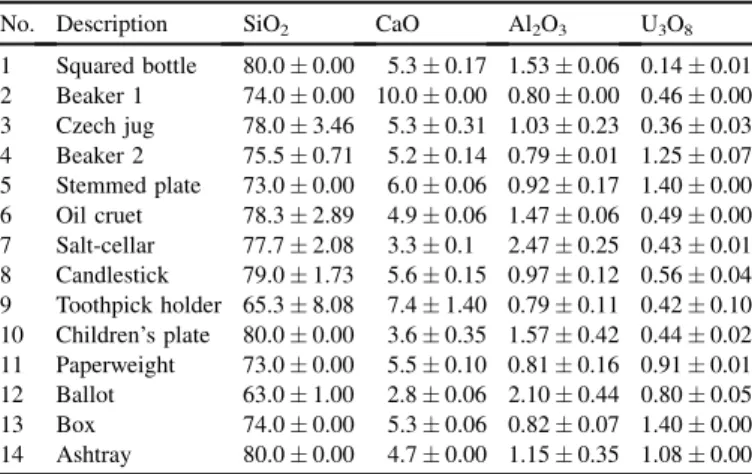
Coloured glasses usually contain uranium oxide in amounts of 0.5% and at the most 4% (wt%). However, the colour intensity does not increase significantly with increasing uranium oxide content, so that commercial glasses usually contain ca. 0.5% of U3O8 [13]. The results obtained by m-EDXRF show that uranium oxide content varies between 0.14% and 1.40% (wt%) being in agreement with the values found in the literature (Table 1). All these 14 objects are soda-lime silicate glasses.
Due to the geometry of the m-EDXRF probe and the irregular surface of the toothpick holder, the measurement
conditions for this object were not ideal, and so the relative standard deviation was very high.
4.2. Dose rate
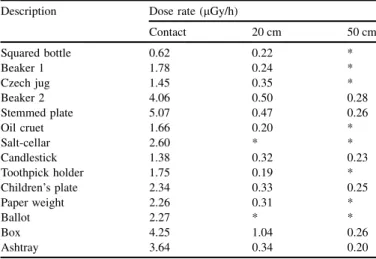
Table 2 shows that for 20 and 50 cm distances, dose rate values show a significant decrease when compared to the contact measurements, which is in agreement with the fact that the radiation involved is basically provided by beta emitters such as 234mPa (238U daughter). In terms of radiological protection, the worst case scenario would be a worker exposed at a dose rate of 0.28mGy/h, therefore an annual dose of 0.56 mSv, which is well below the dose limit for the public, 1 mSv (Council Directive 96/29/EURATOM).
4.3. Radon exhalation
Using the accumulation chamber method and Lucas cells to sample air, radon exhalation results were found to be within the background values. This result would be expected if all natural isotopes present in raw uranium ore 238U, 235U and
Fig. 1. Uranium glasses from a private collection (1, squared bottle; 2, beaker 1; 3, Czech jug; 4, beaker 2; 5, stemmed plate; 6, oil cruet; 7, salt-cellar; 8, candlestick; 9, toothpick holder; 10, children’s plate; 11, paperweight; 12, ballot; 13, box; 14, ashtray).
Fig. 2. Uranium glasses from a private collection under UV light (stemmed plate, toothpick holder and oil cruet).
Table 1
Silicon, calcium, aluminium and uranium oxides content (wt%) and standard deviation on the glass objects analysed bym-EDXRF
No. Description SiO2 CaO Al2O3 U3O8
234
U had been chemically removed from the decay chain of the daughter products.
However if 226Ra had been removed from the uranium breaking decay chain of the daughter products, and230Th was left, the quantity of radium in a glass with 150 years would be appreciable. On the other hand it would be very improbable that through the pigment manufacture230Th would be left, and subsequently226Ra.
4.4. Uranium content estimation measuring the emitted radiation
The radiation of the objects was measured with a Ratemeter type RM2/1 in counts per second (cps). The values measured ranged between 2.5 and 25 cps showing a good correlation (r¼0.98) between this technique andm-EDXRF (Fig. 3).
4.5. Luminescence intensity
In accordance with Weyl, not only the shape of the spec-trum, but also the distribution of intensities changes
considerably when base glasses of different composition are compared [14]. In the studied objects no significant shape differences were observed. The emission spectra obtained presented the characteristic bands of U6þ
at 530 and 565 nm [15](Fig. 4). It was possible to observe that the luminescence intensity increases with the concentration of uranium in the glass. There are some exceptions, like stemmed plate, child-ren’s plate and paperweight, probably because of the geometry of the objects. The optimisation of experimental conditions is still under study.
5. Conclusions
The two analytical methods for the determination of uranium were evaluated in comparison with X-ray fluores-cence analysis.
The measurement of the emitted radiation through a small window gave only the relative uranium concentration, which showed a good relation to the uranium concentration deter-mined by X-ray fluorescence. If glass standards were used, it would be a simple method to determine the concentration of uranium. The thickness of the glass objects does not vary much within the objects studied so no corrections were made. Concerning the luminescence measurements under UV light, the results obtained indicate that for the majority of the objects the luminescence intensity is proportional to the uranium concentration. The geometry at which the measure-ment is made is quite critical. Further studies are in progress to use a fluorimeter where UV light and higher light emission can be conducted in the same optical fibre within the probe. This process would eliminate the errors due to geometry effects and only the thickness of the glass walls of the uranium objects could slightly affect the results. Standards with several thick-nesses have to be prepared for comparison.
Concerning the dose rates, it was shown there is no danger for the public or for conservators. For the conservators it is recommended that each object should be handled separately to maintain the radiation exposure as low as possible.
Acknowledgments
We thank the Fundac¸~ao para a Cieˆncia e a Tecnologia (FCT) for financial support (REF: POCI 2010 under contract
Table 2
Dose rate at different distances, in contact with the object, at 20 and 50 cm Description Dose rate (mGy/h)
Contact 20 cm 50 cm Squared bottle 0.62 0.22 *
Beaker 1 1.78 0.24 *
Czech jug 1.45 0.35 * Beaker 2 4.06 0.50 0.28 Stemmed plate 5.07 0.47 0.26 Oil cruet 1.66 0.20 *
Salt-cellar 2.60 * *
Candlestick 1.38 0.32 0.23 Toothpick holder 1.75 0.19 * Children’s plate 2.34 0.33 0.25 Paper weight 2.26 0.31 *
Ballot 2.27 * *
Box 4.25 1.04 0.26
Ashtray 3.64 0.34 0.20 * Identical to background (0.15mGy/h).
Fig. 3. Alpha and beta radiation in counts per second (cps) of the objects for different concentrations of U3O8.
POCI/HAR/55882/2004) and Jose´ Luı´s Liberato for technical assistance. V.S.F. Muralha also acknowledges FCT for a grant (SFRH/BPD/16519/2004).
References
[1] F. Lole, Notes: uranium glass in 1817, Journal of Glass Studies 37 (1995) 139e140.
[2] P. Brenni, Uranium glass and its scientific uses, Bulletin of the Scientific Instrument Society No. 92 (2007) 34-39.
[3] D. Strahan, Uranium in glass, glazes and enamels: history, identification and handling, Studies in Conservation 46 (2001) 181e195.
[4] E. Landa, D. DiSantis, A brief history of radioactive glassware, Radio-Graphics 13 (1993) 697e699.
[5] J. Marshall, Glass Source BookeA Visual Record of the World’s Great
Glassmaking Tradition, Quantum Books Ltd, London, 1998.
[6] P. Philips (Ed.), The Encyclopedia of Glass, Springs Books, London, 1987.
[7] D. Klein, W. Lloyd, The History of Glass, Tiger Books International, London, 1997.
[8] K. Lieser, in: Nuclear and Radiochemistry, second revised ed. Wiley-VCH, Weinheim, 2001.
[9] International Atomic Energy Agency Report, IAEA-TECDOC-1403, August 2004.
[10] UNSCEAR, Sources and effects of ionizing radiation Sources, , In: Report to the General Assembly with Scientific Annexes, vol. I, United Nations Scientific Committee on the Effects of Atomic Radiation, 2000. [11] J. Kierzek, J. Kunicki-Golfinger, A. Kasprzak, Measurements of natural radioactivity in historical glasses, Glass Science and Technology 73 (2000) 351e355.
[12] L. Currie, Limits of qualitative detection and quantitative determination, Analytical Chemistry 40 (1968) 586e593.
[13] M. Volf, Chemical approach to glass, Glass Science and Technology, Elsevier, Amsterdam, 1984.
[14] W. Weyl, Coloured Glasses, Society for Glass Technology, Sheffield, 1999. [15] J.M. Fernandez-Navarro, in: El Vidrio, CSIC, third ed. Sociedad
Espa-~