Back-to-back correlations for finite expanding fireballs
Sandra S. Padula and G. Krein
Instituto de F´ısica Te´orica, Universidade Estadual Paulista, Rua Pamplona 145, 01405-900 Sao Paulo, SP, Brazil˜
T. Cs¨org˝o
MTA KFKI RMKI, H - 1525 Budapest 114, P.O. Box 49, Hungary
Y. Hama
Instituto de F´ısica, Universidade de Sao Paulo, Caixa Postal 66318, 05389-970 S˜ao Paulo, SP, Brazil˜
P. K. Panda
Departamento de F´ısica-CFM, Universidade Federal de Santa Catarina, Caixa Postal 476, 88040-900 Florian´opolis, SC, Brazil
(Received 28 December 2005; published 21 April 2006)
Back-to-back correlations of particle-antiparticle pairs are related to the in-medium mass-modification and squeezing of the quanta involved. They are predicted to appear when hot and dense hadronic matter is formed in high energy nucleus-nucleus collisions. The survival and magnitude of the back-to-back correlations (BBC) of boson-antiboson pairs generated by in-medium mass modifications are studied here in the case of a thermalized, sized, spherically symmetric expanding medium. We show that the BBC signal indeed survives the finite-time emission, as well as the expansion and flow effects, with sufficient intensity to be observed at BNL Relativistic Heavy Ion Collider (RHIC).
DOI:10.1103/PhysRevC.73.044906 PACS number(s): 25.75.Gz, 25.75.Ld
I. INTRODUCTION
Recently, it has been shown [1,2] that large back-to-back correlations (BBC) of particle-antiparticle pairs of bosonic particles might appear in high energy nucleus-nucleus colli-sions as a consequence of in-medium mass modification of the bosons. Detailed calculations indicate that the BBC signal appears for values of transverse momenta below 1–2 GeV/c. More recently, it was shown [3] that BBC of similar strength might appear for fermionic particles as well. The main physical ingredient used in the evaluation of the effects of in-medium modified masses on two particle correlation functions is a quantum-mechanical correlation induced by a nonzero overlap between in-medium and free states. The induced quantum mechanical correlation can be represented in terms of two-mode squeezed states of the asymptotic, observable states and is implemented through a Bogoliubov-Valatin transformation. The possibility of measuring a significant BBC signal in heavy-ion collisions opens new interesting possibilities for accessing the properties of the matter formed in such collisions. The BBC signal is linked to in-medium mass modifications of hadrons in the hot and dense environment the detected particles experience before freezing out and in this sense BBC measurements provide independent pieces of information on medium modifications from the ones obtained from dilepton yields and spectra. However, there are several additional physical effects that interfere with mass modifications of the detected particles in the interpretation of the BBC signal.
All studies in Refs. [1–3] were restricted to infinite, static media. For testing the robustness of the effect, we generalize the previous studies to a more realistic situation of mass modification in a finite-sized, expanding thermalized medium. In this first investigation of such effects, we use a
simple hydrodynamical model for the expansion and simple three-dimensional Gaussian profile for the size of the system. Although simple, the model is rich enough to indicate the influence of the expansion and finite-size effect on BBC.
In the next section we review the basic ingredients of the model and in Sec. III we generalize the model to include expansion effects. Numerical results are presented in Secs. IV and V presents our conclusions and future perspectives.
II. REVIEW OF THE MODEL—INFINITE HOMOGENEOUS MEDIUM
In the present paper we concentrate on bosonic BBC and restrict the discussion to cases where the boson is its own antiparticle—like theφmeson. We are interested in the two-particle correlation function
C2(k1,k2)=
N2(k1,k2) N1(k1)N1(k2)
, (1)
where N1(ki) and N2(k1,k2) are, respectively, the invariant single-particle and two-particle momentum distributions
N1(k1)=ωk1
d3N dk1 =
ωk1
a†k
1ak1
, (2)
N2(k1,k2)=ωk1ωk2
a†k
1a
†
k2ak2ak1
=ωk1ωk2
ak†
1ak1
ak†
2ak2
+
ak†
1ak2
ak†
2ak1
+ak†
1a
†
k2
ak2ak1
, (3)
of four operators into products of expectation values of two operators in Eq. (3) has been derived as a generalization of Wick’s theorem for locallyequilibrated (chaotic) systems in Refs. [4–6]. Introducing the chaotic and squeezed amplitudes as
Gc(k1,k2)=√ωk1ωk2
ak†1ak2
, (4)
Gs(k1,k2)=√ωk1ωk2
ak1ak2
, (5)
the two-particle correlation function can be written as
C2(k1,k2)=1+ |
Gc(k1,k2)|2 Gc(k1,k1)Gc(k2,k2) + |Gs(k1,k2)|
2
Gc(k1,k1)Gc(k2,k2)
. (6)
The Gc(1,2) is the usual Hanbury-Brown–Twiss (HBT) amplitude andGs(1,2) is BBC amplitude.
The thermal average of an operator ˆO,Oˆ =Tr( ˆρOˆ), is calculated with a density matrix ˆρcorresponding to medium-modified, thermalized quanta. The crucial point is that the in-medium thermalized quantaare notthe ones detected. The detected quanta have energy-momentum kµ=(ωk,k), ωk2= k2+m2 and are described by the creation and annihilation operatorsa†kandak. However, if we denote bybk†andbkthe creation and annihilation operators of in-medium, thermalized quanta withk∗µ=(k,k), k2 =k2+m2∗(|k|), we can relate
the (ak†, ak) to (bk†, bk) through a Bogoliubov-Valatin (BV) transformation. Specifically, the annihilation operatorak1for the asymptotic quanta with momentum k1 is related to the in-medium operatorsbk1andb
†
k1as [1]
ak1=ck1bk1+s−∗k1b
†
−k1≡C1+S
†
−1, (7)
where we have introduced the notationC1 =ck1bk1andS−1=
s−∗k
1b
†
−k1to simplify later notation, and
ck=cosh[fk], sk=sinh[fk], fk= 1 2log
ωk
k
. (8) The BV transformation for the creation operatorak†
1is obtained from Eq. (7) by Hermitian conjugation. As is well known, the Bogoliubov transformation is equivalent to a squeezing operation, and this motivates callingfkthe mode-dependent squeezing parameter. In this way, it is the squeezing parameter
fkthat carries the in-medium effects. Using the BV relation, we obtain for the thermal averages in Eqs. (4) and (5)
Gc(k1,k2)=√ωk1ωk2[C
†
1C2 + S−1S−†2], (9) Gs(k1,k2)=√ωk1ωk2 [S
†
−1C2 + C1S−†2]. (10) After performing the thermal averages indicated above, with the help of a thermal density matrix ˆρ corresponding to the in-medium modified, thermalized quanta, the resulting expressions for the case of an homogeneous medium are
Gc(1,2)=
E
1,2 (2π)3[|c1,2|
2n 1,2
+ |s−1,−2|2(n−1,−2+1)]
V δ1,2, (11)
Gs(1,2)=
E
1,2 (2π)3[s
∗
−1,2c2,−1n−1,2
+c1,−2s−∗2,1(n1,−2+1)]
V δ1,−2. (12) From Eqs. (11) and (12) it is easily seen that, in the approximation of a sudden freeze out, and in the case of a homogeneous medium,Gc(k1,k2)∝V δ1,2andGs(k1,k2)∝ V δ1,−2. Therefore, the amplitudesGc(k1,k2) andGs(k1,k2) are nonvanishing only fork1=k2andk1= −k2, respectively. In the expression for the two-particle correlation function the volume factors cancel out, and we obtain [2]
C2(k,k)=2, (13)
C2(k,−k)=1+|
cksk∗nk+c−ks−∗k(n−k+1)|2
n1(k)n1(−k)
, (14) wheren1(k) is defined by
N1(k)= V
(2π)3ωkn1(k), (15) with
n1(k)=[|ck|2nk+ |s−k|2(n−k+1)], (16) and nk is the Bose-Einstein distribution function of the in-medium quanta with energy k at temperature T. The exact value of the intercept,C2(k,k)=2, is a characteristic signature of a chaotic Bose gas without dynamical two-body correlations outside the domain of Bose-Einstein condensa-tion.
We should note that Eq. (14) is validonlyin the rest frame of the medium, i.e., the correlation is back-to-back only in the rest frame of the matter. In the next section we extend the model to a medium with finite size corresponding to a fireball, which is exploding with a position dependent flow velocity field distribution, so that only the central point of this exploding fireball is at rest in the frame of the observation.
III. SPECTRA AND CORRELATIONS FOR MASS-SHIFTED BOSONS IN FINITE EXPANDING SYSTEMS
We are mainly interested here in the study of the squeezed correlation function—first and third terms of Eq. (6). For studying the expansion of the system we adopt for the emission function the nonrelativistic hydrodynamical parametrization of Ref. [7], which was shown later to actually be a nonrel-ativistic hydrodynamical solution. In this model the fireball expands in a spherically symmetric manner with nonrela-tivistic four-velocity uµ
=γ(1,v), withγ =(1−v2)−1/2 ≈ 1+v2/2, where
v= ur/R,
derived by Makhlin and Sinyukov [4], which are given by Eqs. (22) and (23) of Ref. [2], namely,
Gc(k1,k2)=
d4σµ(x) (2π)3 K
µ 1,2e
iq1,2·x
{|c1,2|2n1,2(x)
+ |s−1,−2|2[n−1,−2(x)+1]}, (17)
Gs(k1,k2)=
d4σµ(x) (2π)3 K
µ 1,2e
2iK1,2·x
{s−∗1,2c2,−1n−1,2(x) +c1,−2s−∗2,1[n1,−2(x)+1]}. (18) Hered4σµ(x)=d3 µ(x;τf)F(τf)dτf is the product of the normal-oriented volume element depending parametrically on the freeze-out hypersurface parameterτf and on its invariant distribution function F(τf). We should notice that, in the particular case in which eachd4σµ(x) of Eqs. (17) and (18)
is parallel touµ, that is, the emission from an elementary cell
mentioned above occurs instantaneously in its proper frame, the exponential factor there will give rise, upon integration over the cell assuming it is large enough, to the same factor
δ1,2orδ1,−2that were present in Eqs. (11) or (12), respectively. As mentioned at the end of Sec. II, the arguments ofδhere are notk1andk2of the left-hand side, but should be understood as given in the proper frame of the cell. In what follows, the condition of instantaneous emission in the proper frame of each cell is assumed to be approximately verified, since our calculation is nonrelativistic. However, we should remark that due to the fact that our elementary cells are not always large, the correlation described above is only approximately back-to-back.
The other quantities appearing in Eqs. (17) and (18) are
ni,j(x)≡n(x, Ki,j), the local density distribution, andci,j =
cosh[fi,j(x)] andsi,j =sinh[fi,j(x)], squeezed functions with
fi,j(x)=
1 2log
Ki,jµ(x)uµ(x)
K∗ν
i,j(x)uν(x)
, (19)
where uµ(x) is the local flow vector at freeze-out. The relative and the average pair four-momentum coordinates are defined asq10,2=ω1−ω2,q1,2=k1−k2, K10,2=(ω1+ ω2)/2, andK1,2=(k1+k2)/2. Also, we identify in-medium and squeezed quantities by superscripted asterisks. The relative
qi,jµ (x) and total four momentaKµof particles 1 and 2 are given by
qi,jµ(x)=kiµ(x)−kjµ(x), Ki,jµ(x)=1 2
kiµ(x)+kjµ(x)
,
(20) wherekiµ(x) fori= ±1,±2 are given by
k±µi(x)=ωki(x)u µ(x)
±k˜iµ(x),
(21)
ωki(x)=
m2−k˜ i
µ˜
ki µ=kiµuµ(x),
with ˜kiµorthogonal touµ(x):
˜
kiµ=kµi −ki·u(x)uµ(x), (22)
The corresponding in-medium quantities are given by
qi,j∗µ(x)=ki∗µ(x)−k∗jµ(x), Ki,j∗µ(x)= 12
k∗iµ(x)+kj∗µ(x)
,
(23) and
k∗±µi(x)=ki(x)u µ(x)
±k˜∗iµ(x),
(24)
ki(x)=
m2
∗(x,k˜)−k˜ ∗µ i k˜iµ∗ =k
∗µ i uµ(x),
with
˜
k∗iµ=k∗iµ−ki∗·u(x)uµ(x). (25) Now, it is not difficult to show that ˜ki∗µ(x)=k˜µi(x) and therefore no star is necessary in ˜kfor the in-medium quantities. It should be noted that this equality was not clearly emphasized in Ref. [2]. An important aspect of these relations is that due to the mass modification, the energy in the local comoving frame is modified from ωki(x)=k
µ
i (x)uµ(x)=k µ
±i(x)uµ(x)
to ki(x)=k
∗µ
i (x)uµ(x)=k∗ µ
±i(x)uµ(x), without modifying
the component of the four-momentum orthogonal to the four-velocity. The above definitions are the detailed write-up of similar definitions of Ref. [2], where a more succinct notation has been used and the misprint signs (∓, instead of ±) in Eqs. (27) and (28) of Ref. [2] have been corrected, respectively, in expressions fork±µi(x) andk∗±µi(x) above. These definitions of momenta are illustrated in Fig. 1, corresponding to the relativistic and nonrelativistic limits, in parts (a) and (b), respectively.
Using the above expressions, the squeezing parameter can be evaluated as
fi,j(x)=1 2log
Ki,jµ(x)uµ(x)
K∗ν
i,j(x)uν(x)
=1 2log
ω
ki(x)+ωkj(x) ki(x)+kj(x)
≡f±i,±j(x), (26)
where the spatial coordinate dependence enters through the position dependence of either the four-velocity or the in-medium mass modification, or both. However, it does not matter which of the locally back-to-back momenta are used for the evaluation of the amount of squeezing.
In this paper, we focus on the effects of expansion on the back-to-back correlations—or, in other words, does the flow wash out the signal for these correlations or not? Although the formalism of the squeezed back-to-back correlations was worked out with expanding systems in Ref. [2], no detailed investigations were performed to quantitatively study, e.g., the strength of the signal with varying the strength of the flow.
Here we intend to investigate this question in one of the simplest geometrical cases. For the sake of clarity, we evaluate the flow effects for a nonrelativistically expanding, spherically symmetric fireball, that freezes out at a constant temperature Tand has a Gaussian density profile. In this sense, we adopt the model emission function of Ref. [7], that was developed to study single particle spectra and Bose-Einstein (HBT) correlation functions in the simplest possible case of expanding systems. Later on it has been realized, that this emission function corresponds to the simplest member of a new family of exact solutions of nonrelativistic hydrodynamics [8], which can be generalized in a straightforward manner to cylindrically and ellipsoidally symmetric [9] expansions, as well as to the case of relativistic expansions [10], and in all cases, systems that expand with inhomogeneous temperature profiles [9,11].
Before investigating in detail the effects of various kind of inhomogeneities in the flow profiles and in the temperature profiles, let us turn our attention to the nonrelativistic limit adopting the simplest possible scenario for the expansion that leads to analytic forms [7,8].
For the sake of clarity, we present the explicit expressions in the nonrelativistic limit of the above quantities, which is the appropriate limit for our nonrelativistic flow model. Writing
uµ
=γ(1,v) and usingγ =(1−v2)−1/2
≈1+v2/2≈1, we have that Eq. (22) leads to
ki−mv=k∗i −m∗v, (27)
and therefore
k±i(r)=mv(r)∓mv(r)±ki, (28)
k∗±i(r)=m∗v(r)∓m∗v(r)±k∗i. (29) With this, we obtain
Ki,j∗µ(x)uµ≈m∗+
1 2m∗
[K∗i,j−m∗v(r)]2+1 4(q
∗ i,j)2
,
(30) where the total and relative local in-medium momenta are given by
K∗1,2(r)= 12(k1+k2)+(m∗−m)v(r),
(31) q∗1,2(r)=(k1−k2)
K∗1,−2(r)=m∗v(r)+12(k1−k2),
(32) q∗1,−2(r)= −2mv(r)+(k1+k2)
K∗−1,2(r)=m∗v(r)−1
2(k1−k2),
(33) q∗−1,2(r)=2mv(r)−(k1+k2)
K∗−1,−2(r)=(m∗+m)v(r)−12(k1+k2),
(34) q∗−1,−2(r)= −(k1−k2).
The unstarredKi,j andqi,j momenta are obtained from the
above by replacingm∗ bymin these expressions. Note that q∗i,j =qi,j, as it should be. These relations imply, that in the
nonrelativistic limit,
K∗ij −m∗v=Kij−mv. (35)
In discussing finite-size effects, we distinguish between the volume of the entire thermalized medium, denoted byV, and the volume filled with mass-shifted quanta, denoted by
Vs. Naturally, VsV in the general case. In the derivation of the expressions for Gc(1,2) and Gs(1,2), for simplicity, we introduce a Gaussian profile function in the integrands, i.e., we consider that the volumetric region where the mass
m∗is significantly modified is smooth and Gaussian in shape. In other words, instead of considering a particular domain of integration, we perform the spatial integrals forGc(1,2) and
Gc(1,2) using a Gaussian weighte−r2/2R2
s in the integrands,
extending the integration region to infinity. Specifically, we have forGc(1,2) andGs(1,2)
Gc(k1,k2)= E1,2 (2π)3 d
3re−i(k1−k2)·re−r2/2R2s(|c(1,2)|2n∗ 1,2(x) + |s(−1,−2)|2[n∗
−1,−2(x)+1]) +
1−e−r2/2R2sn
1,2(x), (36) Gs(k1,k2)=
E1,2 (2π)3 d
3r e−i(k1+k2)·re−r2/2R2s(s∗(−1,2) ×c(2,−1)n∗−1,2(x)+c(1,−2)s∗(−2,1) ×[1+n∗1,−2(x)]), (37) wheren∗
i,j(x) means that the local distribution function is to be
evaluated with in-medium momenta, i.e.,n∗
i,j(x)≡n(x, Ki,j∗ ).
The integral over the factor (1−e−r2/2Rs2) represents the
integration over the region where there is no mass shift, corresponding to the regionV −Vs. In this region, we have that the squeezing factors becomec(i, j)→1 ands(i, j)→0. In order to proceed, we need the expressions forn∗(i, j)
andn(i, j). We consider their Boltzmann limit
n(x, Ki,j)≈exp
−K
µ
i,juµ(x)−µ(x) T(x)
, (38)
and the same for n∗i,j(x) with Ki,j(x) replaced by Ki,j∗ (x). Considering that the chemical potential in the model of Ref. [7] can be written asµ(x)/T(x)=µ0/T −r2/2R2, and making use of Eq. (30), it is easy to show that
n∗1,2(r)=n∗0exp
− r 2
2R2 −
[(k1+k2)/2−mur/R]2 2m∗T
− (k1−k2) 2
8m∗T
where
n∗0=exp
−m∗−µ0
T
. (40)
This factor is proportional to the mean multiplicity, and can be determined in principle from the absolute normalization of the single particle spectra. The corresponding unstarredni,j(r)
are obtained fromn∗
i,j(r) by replacingm∗bymin Eq. (39).
When evaluating the spectra and the correlations from this model, we realize that a mathematically equivalent problem has already been considered in Ref. [7]. By replacingm→m∗
andt0→RGm∗/umin the equations of Ref. [7], the results
obtained there can be directly transcribed here.
Due to the equality in Eq. (35), we see that the accounting for the squeezing effects can be simplified for small mass shifts (m∗−m)/m≪1, such that the squeezing parameter can be written as
f(i, j,r)=1 2log
Kµ(i, j, x)uµ(x) Kν
∗(i, j, x)uν(x)
≈12log
m
m∗
. (41) The neglected terms are order of (kinetic energy/mass)2 (masshift/mass)2 and hence are of fourth order in small quantities. This limit is important, because in this case the coordinate dependence enters the squeezing parameterfonly through the possible position dependence of the mass-shift and so the flow effects on the squeezing parameter can be neglected. In principle, the position dependence of the mass shift can be calculated from thermal field models in the local density approximation. Therefore, in an approximation that the position dependence of the in-medium mass is neglected, thec(i, j)=c0ands(i, j)=s0factors can be removed from the integrands and all what remains to be done are Fourier transforms of Gaussian functions. The final result forGcand Gscan be written as
Gc(k1,k2)= E1,2 (2π)3
n∗0(|c0|2+ |s0|2)I1c,2(Rs, R, T , m∗)
+ |s0|2I1c,2(Rs,∞,∞, m∗)+n0I1c,2(∞, R, T , m) −n0I1c,2(Rs, R, T , m)
, (42)
Gs(k1,k2)= E1,2 (2π)3 c0|s0|
2n∗0I1s,2(Rs, R, T , m∗) +I1s,2(Rs,∞,∞, m∗)
, (43)
whereI1c,2andI1s,2are the resulting Fourier integrals
I1c,2(Rs, R, T , m(∗))=(2πρ(2∗)) 3/2exp
−
k21+k22 4m(∗)T −
ρ(2∗)
2
×(k1−k2)+i
mu(k1+k2) 2m(∗)T R
2
,
(44)
I1s,2(Rs, R, T , m∗)=(2πρ∗2)
3/2exp
−
k21+k22 4m∗T
−ρ 2
∗
2
1+i mu
2m∗T R
2
(k1+k2)2
, (45)
with
1
ρ(2∗) ≡
1
R2 s
+ 1
R2
1+m 2
u2 m(∗)T
. (46)
Finally, we include finite-time emission effects in a schematic way using for the invariant functionF(τ), that ap-pears in the expression ford4σµ(x), the following expression:
F(τ)= θ(τ −τ0)
t e
−(τ−τ0)/t, (47)
where t is a free parameter. This finishes the derivation of all the ingredients needed to evaluateC2(k1,k2), Eq. (6). In the next section we will present numerical results.
IV. NUMERICAL RESULTS
We present numerical results for two situations regarding the volumes over which mass modification occurs. In the first situation the mass shift occurs over the entire volume of the expanding system, i.e., Vs =V. This amounts to removing the factore−r2/2Rs2in Eqs. (36) and (37) or, equivalently, take Rs → ∞inIc andIs. In the second situation, we consider
Vs< V. In order to comply with the nonrelativistic nature of the expansion model used in this paper, we present numerical results for the back-to-back correlations of aφmeson pair. In free space, theφmeson mass ismφ=1020 MeV.
A. Bulk decay of a volume filled with mass-shifted quanta
In this case, we suppose that the mass-shift occurs in the entire volume of the system, for simplicity considered here as a Gaussian with rms radius R. We will focus on the BBC correlation function, whose generic expression consists of the first and third terms on the right-hand-side of Eq. (6). The detailed expressions for the amplitudes are given in Appendix A. In what follows, we will concentrate on the value of momenta of the participant pair that maximizes the BBC signal, i.e., the case in whichk1 = −k2=k. The BBC correlation function can then be written as
CBBCmax(k1,k2)=CBBC(k,−k) =1+ |Gs(k,−k)|
2
Gc(k,k)Gc(−k,−k) =1+|Gs(k,−k)|
2
[Gc(k,k)]2
. (48)
In the above equation, we have used the fact that the single-inclusive distribution,Gc(k,k)=Gc(−k,−k) depends only
on the absolute value of the momentum, as can be seen in Eq. (A8). With the aid of this equation, as well as of Eq. (A6), the expression of the BBC correlation function is finally written as
CBBCV (k,−k)=1+ |c0 s0|2 ×
2n∗
0R∗3exp(−k2/2m∗T)+R3 n∗
0R3∗
|c0|2+ |s0|2exp(−k2/2m∗T∗)+R3|s0|2
2
where 1
R2
∗
=R12
1+m 2u2
m∗T
, T∗=T +m 2
m∗u
2, (50) as given in Table I of Appendix A. The quantitiesR∗andT∗are, respectively, the flow-modified radius and the flow-modified temperature of the system where the mass-shift occurs in the entire volume.
In Fig. 2 we present the results forCV
BBCforT =140 MeV, R=7 fm and a finite emission time t=2 fm/c, for two different flow values. We clearly see in this figure that the presence of a radial flow causes the BBC correlation to be higher than the case with no flow in the low momentum region and for the same values ofm∗andk1= −k2=k, but it grows more slowly than in the no-flow case for increasing values of kand samem∗. We also see that for a flow ofu =0.5, the BBC signal increases for values of the momenta |k|< ∼ 1000 MeV/c, but the no-flow case surpasses the previous case for |k|>
∼1000 MeV/c. This conclusion is more easily achieved by looking into the right panel of Fig. 2. The inversion of the BBC behavior for that value ofkroughly coincides with the limit of applicability of our nonrelativistic approximation. This result is very interesting, suggesting that we would have bigger chances of observing the BBC effect in the lower|k| side of the BBC×m∗× |k|region. The numerical predictions should provide some incentive for experimental groups to extract the predicted correlation functions from data.
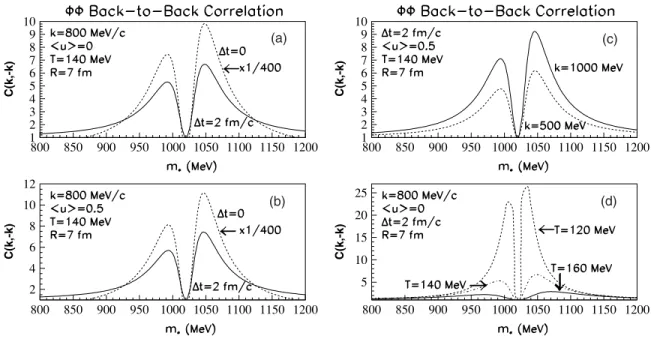
In Fig. 3 we present results for different combinations of temperatures and flow velocities and emission times. We see again that flow enhances the BBC correlation function for
small values of|k|. The effect of the temperature is such that the BBC signal is stronger for lower values ofT, and decreases the signal for higher values ofT.
B. Decay of a volume partly filled with mass-shifted quanta
Here we consider the scenario in which the mass shift of the bosons occurs in part of the system volume only. In this case, the expression for the BBC correlation function is more complex, even in the simpler limit of the maximal effect, i.e., when k1= −k2=k. The expression of CBBCmax can again be obtained from Eq. (48), but this time we must replace the amplitudes by the expressions of Eqs. (B10) and (B11) of Appendix B, in the limit that the particles are back-to-back. In this case, we must use for the squeezing parameters in the region where there is no medium modification their appropriate limiting values
lim
m∗→m
c0 s0
−→
1 0
. (51)
With this, we obtain after a long but straightforward calculation the expression
CBBC2V (k,−k)=1+ |c0s0|2
2n∗0ρ3∗ exp
− k
2
2m∗T
+Rs3
2
×
n∗0ρ∗3(|c0|2+ |s0|2)
2 4 6 8 10 12 14 16
800 850 900 950 1000 1050 1100 1150 1200
2 4 6 8 10 12 14 16
800 850 900 950 1000 1050 1100 1150 1200
C(k,-k)
C(k,-k)
0 500
1000
900 1000
1100 5
10 15
0 500
1000
900 1000
1100 5
10 15
(d)
(c) (a)
(b)
1 2 3 4 5 6 7 8 9 10
800 850 900 950 1000 1050 1100 1150 1200
2 4 6 8 10 12
800 850 900 950 1000 1050 1100 1150 1200
C(k,-k)
C(k,-k)
1 2 3 4 5 6 7 8 9 10
800 850 900 950 1000 1050 1100 1150 1200
5 10 15 20 25
800 850 900 950 1000 1050 1100 1150 1200
C(k,-k)
C(k,-k)
(a) (c)
(b) (d)
FIG. 3. The effect of a finite emission interval on the back-to-back correlation function, as compared to instant emission, is illustrated in the left panel. The dashed curves have been reduced by a factor of 400, and the solid curves correspond to the suppression by a finite emission duration, of aboutt≃2 fm/c. The plot in (a) shows this effect in the absence of flow, already discussed in our previous paper. The plot in (b) shows the corresponding result when flow is included, withu =0.5 (the other parameters adopted to produce the curves areR=7 fm/c,
T =140 MeV andt=2 fm/c). In part (c), we fixed the other parameters and study the influence of increasing values of|k|(the dashed curve corresponding to|k| =500 MeV/cand the solid one, to|k| =1000 MeV/c). Finally, the plot in (d) considers the variation of the BBC curve for increasing values of the temperature,T, as indicated by the arrows, keeping all the other variables fixed to their values above.
×exp
−
R2+R2 s
k2 2m∗
R2T +R2 sT∗
+Rs3|s0|2
+n0R˜3exp
− k 2
2mT˜
−n0ρ˜3
×exp
− (R 2
+Rs2)k2
2m(R2T +Rs2T˜)
−2
, (52)
where the parameters ˜T =T +mu2,R˜−2
=R−2(1 +m
u2/T),ρ˜−2=R˜−2+R−2
s , ρ∗−2=R−2(1+m2u2/m∗T)+ Rs−2 are given in Table II of Appendix B. The two are, respectively, the flow-modified temperature and the flow-modified radius in the region of no mass-shift. On the other hand, ˜ρ and ρ∗ are effective radius parameters corresponding to the no mass-shift region and the region where the mass-shift occurred, respectively. We see that they are functions of the flow parameteruand the parameterRs, which corresponds to the radius of the mass-shift region. The parameterT∗=T +m2u2/m∗, is the same as before, also written in Table I of Appendix A.
Similarly to Eq. (49), the above Eq. (52) has also very interesting limiting cases. The first one is the case of vanishing squeezing,m∗→m, which implies that|s0| →0 and|c0| →1, and the squeezed back-to-back correlations vanish.
The large momentum limit is also very interesting. In this case, the exponential, thermal contributions disappear, and the surviving terms come from the decay of the squeezed vacuum to the asymptotic quanta. Both the numerator and the
denominator of Eq. (52) will be proportional to the square of the squeezed volume, hence Eq. (52) and Eq. (49) will be reduced to a form similar to
C(k,−k)=1+ |c0/s0|2
which has no upper limit, and diverges for small but non-vanishing amount of squeezing, where |c0| →1 and|s0| → 0. This property, the unlimited strength of the squeezed BBC-s—even if the mass modification does not happen in the whole volume—makes it worthwhile to look for these effects experimentally as signals of in-medium mass modifications. Again, for large in medium mass modifications and large momenta, the strength of the squeezed BBC-s will be similar to that of the HBT effect:
C(k,−k)→2
if|c0|,|s0| → ∞, as in this limit,|c0|/|s0| →1.
The single particle spectra also behaves interestingly in these limits, which is discussed in Appendices A and B.
1 2 3 4 5 6 7
800 850 900 950 1000 1050 1100 1150 1200
1 2 3 4 5 6 7
800 850 900 950 1000 1050 1100 1150 1200
C(k,-k)
C(k,-k)
0 500
1000
900 1000
1100 2
4 6
0 500
1000
900 1000
1100 2
4 6
(a)
(b)
(d) (c)
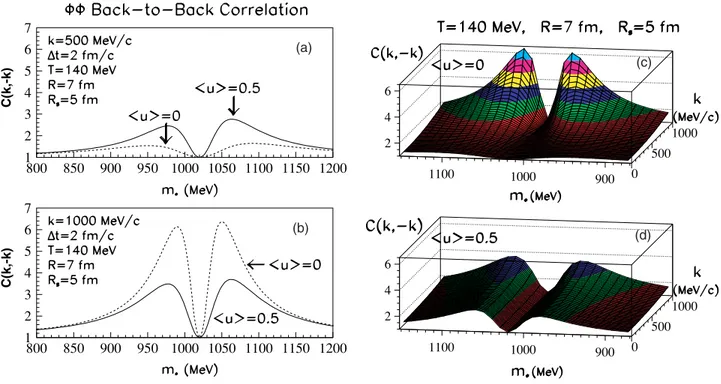
FIG. 4. (Color online) The plots in this panel are similar to the ones on Fig. 2. The main difference is that here we assumed that the mass-shift occurred only in a smaller part of the system volume. Here, the back-to-back correlation is shown as a function of the shifted mass
m∗on the left panel, and as function of bothm∗and the momentum of each particle (k1= −k2=k), on the right ones, forR=7 fm/c,Rs = 5 fm/c,T =140 MeV andt=2 fm/c. The plots in parts (a) and (b) illustrate better the behavior of the BBC signal seen in parts (c) and (d), for|k| =500 MeV/cand for|k| =1000 MeV/c. In both cases, the dashed curve corresponds tou =0 and the solid curve, tou =0.5. In the 3D plot in (c), no flow (u =0) was considered, whereas a radial flow withu =0.5 included in the (d) plot.
V. CONCLUSIONS AND FUTURE PERSPECTIVES
In this paper we discussed the effects of the system expansion and flow on the back-to-back correlations, also limiting the system to a more realistic finite size. For simplicity, we restricted our analysis to the nonrelativistic domain. In our study, we have also considered that the flow effects on the squeezing parameter were negligible. For simplicity, we have also assumed a 3D Gaussian profile for the system. As a result, we have shown that the back-to-back particle-antiparticle correlations survive the diluting effects of a spherical hydrodynamical expansion and, therefore, of flow effects in general. Nevertheless, more detailed studies would be necessary for estimating how the results would change when considering a less symmetric and relativistic expansion scenario.
We showed the effects of the decoupling temperature on the BBC signal, fixing all other parameters, as in the bottom right plot of Fig. 3. In this case, we observed that the BBC signal survives stronger if the decoupling temperature is lower. FixingTand the other parameters, we also showed the effect of increasing momentum on the signal survival. More striking, we showed in Figs. 2 and 4 the conclusion about the best region for looking into the BBC effect in them∗× |k|plane: the search for the signal is more pronounced in the small|k| region, when we are to take into account the system expansion and the presence of moderate to strong flow. For higher values of|k|, the BBC signal would be more pronounced if the system flow could be neglected.
From the exposed results we see that the qualitative property of the back-to-back correlation function,C(k,−k), deviating from unity is not significantly altered by the flow effects, remaining a sensitive measure of the in-medium hadronic mass modification. In any case, what remains as the most encouraging point coming out of our present study is that the BBC seems to survive with measurable intensity in the more realistic situation of finite size systems subjected to hydrodynamical expansion and consequent flow.
ACKNOWLEDGMENTS
We are deeply grateful to Prof. Mikl´os Gyulassy for stimulating discussions and to Prof. Roy Glauber for inspiring conversations. This research has been supported in part by CNPq, FAPESP grants 00/04422-7, 04/10619-9, 02/11344-8, 99/08544-0, by the Hungarian OTKA T038406, T043514 and T049466, by a Hungarian - US MTA - OTKA - NSF grant and by the NATO PST CLG.980086 grant.
APPENDIX A: MASS-SHIFTED IN THE ENTIRE VOLUME
the subject of this appendix. It is also possible, that, e.g., due to density inhomogeneities, the volume where the mass shift is nonzero is different (smaller) than the totality of the volume filled out by thermalized quanta. This case will be investigated in the next appendix.
For the case of nonrelativistic hydrodynamics, as-suming for the sake of simplicity a sudden freeze-out,
d4 µKijµ=d3rdt δ(t−t0)Eij =Eij
d3r, the chaotic and the squeezed amplitudes are easily obtained from the ones previously derived in Eqs. (42) and (43) by taking the limitRs → ∞in those equations as well as in all the others that immediately follow them, i.e., Eqs. (44), (45), and (46). The intuitive way to understand this limit is to consider the mass-shift region as extended so as to include the entire volume of the system, by simply taking the limitRs→ ∞. The volume
of the system, however, will be still delimited by the Gaussian profile with rmsR. In this limit, the last two terms in Eq. (42) exactly cancel, since
lim
Rs→∞
I1c,2(Rs, R,u, m)=I1c,2(∞, R,u, m). (A1) Consequently, the effective squeezing region becomes
Rs →R.
Before writing the resulting expression for Gc(1,2), Gs(1,2), and Gc(i, i), it is usefull to define two parameters
in terms of which we can write those expressions, i.e., the flow-modified temperatureT∗and the flow-modified radius of the single volume case
R∗ = lim
Rs→∞
ρ(Rs, R, m(∗)) (A2) as given in Eq. (46). We can then write the chaotic amplitude,
Gc(k1,k2) as G1cV(k1,k2)= lim
Rs→∞
E
1,2 (2π)3
n∗0(|c0|2+ |s0|2) ×I1c,2(Rs, R, T , m∗)
+ |s0|2I1c,2(Rs, R,∞, m∗)
= E1,2 (2π)3|s0|
2(2π R2)3/2exp
−R 2
2 (k1−k2) 2
+ E1,2 (2π)3n
∗
0(|c0|2+ |s0|2)(2π R2∗)3/2 ×exp
−
k2 1+k22
4m∗T − R2
∗
2 [(k1−k2) +i mu(k1+k2)
2m∗T R
2
. (A3)
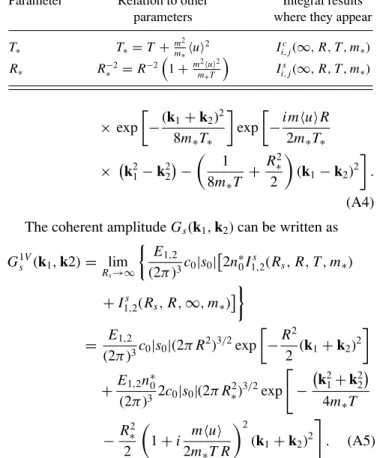
We can rearrange the above terms in a more compact form, and explicitly writing in terms of the variables defined in Table I (from which we can see thatR∗2/RT =R/T∗) we have
G1cV(k1,k2)= E1,2 (2π)3/2R
3
|s0|2exp
−R 2
2 (k1−k2) 2
+E1,2n
∗
0 (2π)3 (|c0|
2
+ |s0|2) (2π R2∗)3/2
TABLE I. Parameters used in the single volume case.
Parameter Relation to other Integral results parameters where they appear
T∗ T∗=T +mm2
∗u
2 Ic
i,j(∞, R, T , m∗)
R∗ R−2
∗ =R−
21
+ mm2∗uT2
Is
i,j(∞, R, T , m∗)
×exp
−(k1+k2) 2
8m∗T∗
exp
−imuR 2m∗T∗
× k21−k22
−
1
8m∗T + R2∗
2
(k1−k2)2
.
(A4) The coherent amplitudeGs(k1,k2) can be written as G1sV(k1,k2)= lim
Rs→∞
E1,2 (2π)3c0|s0|
2n∗0I1s,2(Rs, R, T , m∗)
+I1s,2(Rs, R,∞, m∗)
= (2Eπ1,2)3c0|s0|(2π R
2)3/2exp
−R 2
2 (k1+k2) 2
+E1,2n
∗
0
(2π)3 2c0|s0|(2π R 2
∗)
3/2exp
−
k21+k22 4m∗T
−R 2
∗
2
1+i mu
2m∗T R
2
(k1+k2)2
. (A5) Similarly to what was done before, can also rewrite the expression forGs(k1,k2) explicitly in terms of the variables defined in Table I, leading to
G1sV(k1,k2)= E1,2
(2π)3c0|s0|(2π R
2)3/2exp
−R 2
2 (k1+k2) 2
+ E1,2n
∗
0 (2π)3/2 (2π R
2
∗)
3/2(2c 0|s0|) ×exp
−(k1−k2) 2
8m∗T
exp
−imuR 2m∗T∗
×(k1+k2)2−
1
8m∗T∗+ R2∗
2
(k1+k2)2
.
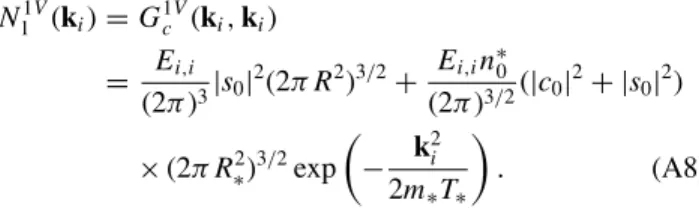
(A6) Also, the single-particle distribution, the amplitude appearing in the denominator of both the BBC and the HBT correlation functions can be written as
N11V(ki)=Gc1V(ki,ki)
= lim
Rs→∞ Ei,i
(2π)3
n∗0(|c0|2+ |s0|2)Ii,ic(Rs, R, T , m∗)
+ |s0|2Ii,ic(Rs, R,∞, m∗)
= Ei,i (2π)3|s0|
2(2π R2)3/2
+Ei,in
∗
0 (2π)3(|c0|
2
+ |s0|2)
×(2π R∗2)3/2exp
− k
2 i
2m∗T + R2∗
2
m
uki m∗T R
2
.
Analogously, we can rewriteGc(ki,ki) explicitly in terms of T∗andR∗, as
N11V(ki)=G1cV(ki,ki)
= (2Ei,iπ)3|s0|
2(2π R2)3/2
+ Ei,in
∗
0 (2π)3/2(|c0|
2
+ |s0|2)
×(2π R2∗)3/2exp
− k
2 i
2m∗T∗
. (A8)
Let us investigate the vanishing squeezing and the large momentum limits of the single particle spectra, similarly to the analysis of the correlation functions as was done after Eq. (49).
In case of vanishing squeezing, m∗→m,|s0| →0 and |c0| →1, hence the spectra will contain a thermal and a flow contribution, and we recover the results of Ref. [7]. In the large momentum limit, for nonvanishing squeezing, rather surprisingly the single particle spectra becomes a constant. This corresponds to the decay of a modified vacuum with a fixed volume, described by the first term of Eq. (A8). This is the direct consequence of our neglecting for the present purposes the position dependence of the in-medium mass modification. Also, this result implies that the squeezing mechanism not only makes strong signals in the back-to-back correlations, but there is also an interesting signal for squeezing in the single particle spectra.
APPENDIX B: MASS-SHIFTED IN PARTIAL VOLUME
If the mass shift occurs only in a certain portion of volume
Vs of the whole system V(>Vs), the expressions for the amplitudes contain other terms besides the ones discussed in the Appendix A. Again, in order to avoid too much clutter it is useful to define appropriate flow-modified variables. However, in this case, we will need to define two sets of such parameters as flow-modified radii and temperatures, one set corresponding to the region where there is no mass-shift, which we will denote by ˜R,ρ˜, and ˜T, and another for the inside of the mass-shifted region, denoted byR∗ andT∗, this last one, naturally, being the same as defined in Table II.
In the case where the mass-shift occurs in a small portion of the system volume,Vs< V, the chaotic amplitude is given
TABLE II. Parameters used in the two-volume case.
Parameter Relation to other Integral results parameters where they appear
˜
T T˜ =T +mu2 Ic
i,j(∞, R, T , m) &Ic(Rs, R, T , m) ˜
R R˜−2
=R−2
1+m Tu
2
Ic
i,j(∞, R, T , m) ˜
ρ ρ˜−2
=R˜−2
+R−2
s I c
i,j(Rs, R, T , m)
T∗ T∗=T +m2
m∗u
2 Ic
i,j(Rs, R, T , m∗)
ρ∗ ρ−2
∗ =R−
21
+m2u2
m∗T
+R−2
s I s
i,j(Rs, R, T , m∗)
by Eqs. (42) and (44), i.e.,
G2cV(1,2)= E1,2 (2π)3
n∗0(|c0|2+ |s0|2)I1c,2(Rs, R, T , m∗)
+ |s0|2I1c,2(Rs,∞,∞, m∗)+n0I1c,2(∞, R, T , m) −n0I1c,2(Rs, R, T , m)
. (B1)
Working out each of the integrals above separately, we have
I1c,2(Rs, R, T , m∗)=(2πρ∗2)3/2exp
−
k21+k22
4m∗T
− ρ 2
∗
2
(k1−k2)+i
mu(k1+k2) 2m∗T R
2
=(2πρ∗2)3/2exp
−imuρ 2
∗
k21−k22
2m∗RT
×exp
−
1
8m∗T + ρ∗2
2
(k1−k2)2
−
R2+R2s(k1+k2)2 8m∗R2T +R2
sT∗
, (B2)
I1c,2(Rs,∞,∞, m∗)=
2π R2s3/2exp
−R 2 s
2 (k1−k2) 2
,
(B3)
I1c,2(∞, R, T , m)=(2πR˜2)3/2exp
−
k2 1+k22
4mT
− ˜ R2
2
(k1−k2)+i
mu(k1+k2) 2mT R
2
=(2πR˜2)3/2exp
−iu
˜ R2
k21−k22 2RT
×exp
−
1 8mT +
˜ R2
2
(k1−k2)2
− (k1+k2) 2
8mT˜
, (B4)
I1c,2(Rs, R, T , m)=(2πρ˜2)3/2exp
−
k21+k22
4mT
− ρ˜ 2
2
(k1−k2)+i
mu(k1+k2) 2mT R
2
=(2πρ˜2)3/2exp
−iuρ˜ 2
k21−k22
2RT
×exp
−
1 8mT +
˜
ρ2 2
(k1−k2)2
−
R2+R2s(k1+k2)2 8mR2T +R2
sT˜
Substituting these into Eq. (B1), the complete expression for the chaotic amplitude can finally be written as
G2cV(1,2)=n∗0 ρ∗3[|c0|2+ |s0|2] exp
−imuρ 2
∗
k2 1−k22
2m∗RT
×exp
−
1
8m∗T + ρ∗2
2
(k1−k2)2
−
R2+R2s(k1+k2)2 8m∗R2T +R2
sT∗
+ E1,2 (2π)3/2R
3 s|s0|2
×exp
−R 2 s
2 (k1−k2) 2
+E1,2n0 (2π)3
(2πR˜2)3/2
×exp
−iu
˜ R2
k21−k22 2RT ×exp − 1 8mT +
˜ R2
2
(k1−k2)2
−(k1+k2) 2
8mT˜
−(2πρ˜2)3/2
×exp
−iuρ˜ 2
k2 1−k22
2RT ×exp − 1
8mT +
˜
ρ2
2
(k1−k2)2
−
R2+Rs2(k1+k2)2 8mR2T +R2
sT˜
. (B6)
The coherent amplitude is given by Eqs. (43) and (45), as
G2sV(k1,k2)= E1,2 (2π)3c0|s0|
2n∗0I1s,2(Rs, R, T , m∗) +I1s,2(Rs,∞,∞, m∗)
, (B7)
where
I1s,2(Rs, R, T , m∗)=(2πρ∗2)3/2exp
−
k2 1+k22
4m∗T
−ρ 2
∗
2
1+i mu
2m∗T R
2
(k1+k2)2
=(2πρ∗2)3/2 exp
−imuρ 2
∗(k1+k2)2 2m∗RT
×exp
−(k1−k2) 2
8m∗T − ρ∗2
2 (k1+k2) 2
−
R2+Rs2
(k1+k2)2 8m∗R2T +R2
sT∗
, (B8)
I1s,2(Rs,∞,∞, m∗)=
2π Rs23/2exp
−R 2 s
2 (k1+k2) 2
.
(B9) By substituting the above two terms, Eqs. (B8) and (B9) into Eq. (B7), we get the final form of the coherent amplitude
G2sV(1,2)= E1,2 (2π)3
2π Rs23/2(c0s0) exp
−R 2 s
2 (k1+k2) 2
+E1,2n
∗
0 (2π)3 (2πρ
2
∗)
3/2(2c 0s0)
×exp
−imuρ 2
∗(k1+k2)2
2m∗RT
×exp
−(k1−k2) 2
8m∗T − ρ∗2
2 (k1+k2) 2
−
R2+R2s
(k1+k2)2 8m∗R2T +R2
sT∗
. (B10)
The single-particle distribution for this situation of two volumes can be written as
N12V(ki)=G2cV(i, i)
= Ei,i (2π)3
n∗0(|c0|2+ |s0|2)Ii,ic(Rs, R, T , m∗)
+ |s0|2Ii,ic(Rs,∞,∞, m∗)+n0Ii,ic(∞, R, T , m)
−n0Ii,ic(Rs, R, T , m)
= Ei,i (2π)3
2π Rs23/2|s0|2
+n∗0 (2πρ∗2)3/2(|c0|2+ |s0|2)
×exp
−
R2+Rs2k2i 2m∗R2T +R2 sT∗
+n0(2πR˜2)3/2exp
− k 2 i
2mT˜
−n0(2πρ˜2)3/2
×exp
−
R2+R2 s
k2i 2m
R2T +R2 sT˜
. (B11)
Note again that in the large momentum region only the first term survives, which corresponds to a constant contribution given by the modified vacuum, and the size of this contribution is less than in case of Eq. (A8), as the in-medium modified quanta do not fill the entire volume in the present case:
[1] M. Asakawa and T. Cs¨org˝o, Heavy Ion Phys. 4, 233 (1996); in Proceedings of the Strong and Electroweak Matter’97 Conference, Eger, Hungary, May 1997, edited by F. Csikor and Z. Fodor (World Scientific, Singapore, 1998), p. 332 [quant-ph/ 9708006].
[2] M. Asakawa, T. Cs¨org˝o, and M. Gyulassy, Phys. Rev. Lett.83, 4013 (1999).
[3] P. K. Panda, T. Cs¨org˝o, Y. Hama, G. Krein, and S. S. Padula, Phys. Lett.B512, 49 (2001).
[4] A. Makhlin and Yu. Sinyukov, Sov. J. Nucl. Phys.46, 354 (1987); Yad. Fiz.46, 637 (1987); Yu. Sinyukov, Nucl. Phys.A566, 589c (1994).
[5] M. Gyulassy, S. K. Kauffmann, and L. W. Wilson, Phys. Rev. C 20, 2267 (1979).
[6] I. Andreev and R. Weiner, Phys. Lett.B373, 159 (1996). [7] T. Cs¨org˝o, B. L¨orstad, and J. Zim´anyi, Phys. Lett.B338, 134
(1994); P. Csizmadia, T. Cs¨org˝o and B. Luk´acs,ibid.B443, 21 (1998).
[8] T. Cs¨org˝o, Cent. Eur. J. Phys.2, 556 (2004).
[9] T. Cs¨org˝o, F. Grassi, Y. Hama, and T. Kodama, Phys. Lett.B565, 107 (2003).
[10] T. Cs¨org˝o, L. P. Csernai, Y. Hama, and T. Kodama, Heavy Ion Phys. A21, 73 (2004).