300 Brazilian Journal of Physics, vol. 34, no. 1A, March, 2004
High-p
T
Results from the STAR Experiment at RHIC
∗
A.A.P. Suaide for the STAR Collaboration
Instituto de F´ısica, Universidade de S˜ao Paulo,Departamento de F´ısica Nuclear, Laborat´orio Pelletron, CP 66318, 05315-970, S˜ao Paulo, SP, Brazil
Received on 15 August, 2003.
High-pTmeasurements in relativistic heavy ion collisions provide a unique set of tools to investigate the early stages of the collision. In this paper we report the high-pTmeasurements of inclusive hadron spectra, azimuthal
anisotropies and two particle correlations performed by the STAR detector for 200 GeV Au+Au, p+p and d+Au collisions at RHIC. The results suggest that the phenomena observed uniquely in central Au+Au collisions are due to strong final state interactions in the hot and dense medium created in such collisions.
One of the main goals in the study of heavy ion col-lisions at relativistic energies is the understanding of the matter behavior at extreme temperature and densities con-ditions. QCD calculations predict that a phase transition from hadronic matter to a deconfined plasma of quarks and gluons may occur in such conditions [1]. Energetic partons propagating through the medium are expected to loose en-ergy [2] and the magnitude of the enen-ergy loss is strongly dependent on the gluon density of the medium. Hard scat-tering of partons occurs early in the collision. In this case, partons emerging from such collisions probe the early phase of the evolution of the system and may provide important information about the characteristics of the hot and dense matter that is created. The hard scattering and subsequent fragmentation of these partons usually generates jets of cor-related hadrons. In a clean, low multiplicity event it is pos-sible to reconstruct the jet, making it pospos-sible directly to measure the parton characteristics. In a high multiplicity event, as the one originated from central Au+Au collisions, the soft background makes the jet reconstruction impossible. In this case, indirect studies of parton hard scattering, such as high-pT single hadron spectra and high-pTazimuthal
cor-relations, may reveal important information about the prop-agating parton. Parton energy loss in the medium softens the fragmentation of jets, leading to a suppression of the high-transverse momentum hadrons [3]. Several high-pT results
from RHIC have already been reported [4-11] and are con-sistent with large partonic energy loss in high energy density matter. This paper reports the results from the data taking with the STAR detector [12] for the Au+Au, p+p and d+Au systems at GeV. Details of the analysis can be found in Ref. [4,7-11].
The invariant yields for charged hadrons (h+
+h−)/2
at mid-rapidity are found in Fig. 1. Each curve represents a different centrality selection with different scale factors for clarity purposes. Event centrality selection is made us-ing the uncorrected number of primary tracks with number of fit points larger than 10 in the pseudorapidity range of
|η| < 0.5 . The bottom curve is the yield obtained for p+p collisions. Spectra are corrected for tracking efficiency, background and momentum resolution [9]. The errors in-dicated include both statistical and systematic uncertainties and are visible only in the high momentum region.
In order to understand any modification in the spectra due to nuclear effects we compare the Au+Au spectra with the one obtained from p+p collisions using the nuclear mod-ification factor:
RAA(pT) =
d2NAA/dp Tdη
TAAd2NN N/dpTdη
(1)
whereTAAaccounts for the nuclear collision geometry [4].
Fig. 2 shows RAA(pT) for different centrality selections.
The horizontal dashed lines represent the expected value obtained from a Glauber model [4] if the Au+Au yield is scaled with the number of binary collisionsNbinor the
num-ber of participants Npart. The gray bands represent their
respective systematic errors, including both the model and p+p normalization uncertainties. In this figure the high-pT hadron spectrum is suppressed by a factor 4-5 in
cen-tral Au+Au collisions with respect to p+p collisions. In this figure it is also shown pQCD-I calculations [13] and the in-fluence of each nuclear effect separately. The absolute scale of the energy loss for central collisions is a fit parameter while the dependence withpT and centrality is constrained
by the theory. Initial state effects such as shadowing and the Cronin effect [14] do not account for the strong suppres-sion observed in the data. This suppressuppres-sion can be explained only when a partonic energy loss in the dense medium com-ponent is included in the calculation. The calculation agrees very well with the data if the initial parton density in central collision is set to be 15 times that of cold nuclear matter. In this figure we also show calculations from pQCD-II [14] that was used to predict apT-independent suppression factor
in the high-pT region of the figure.
A.A.P. Suaide for the STAR Collaboration 301
Figure 1. Invariant cross section for charged hadrons in the region of|η|<0.5for Au+Au and p+p collisions at√sN N = 200GeV.
Each curve represents a different centrality selection.
Figure 2.RAA(pT)for charged hadrons in the region of|η <0.5
for different centralities. Error bar include both statistical and sys-tematic uncertainties. Calculations are described in the text.
When the reaction zone has a spatial anisotropy, pQCD predicts a strong coupling of momentum and coordinate space in the case of existence of partonic energy loss in the medium due to high initial gluon densities. This can be easily understood with a nave view that partons propagat-ing through a larger path length would loose more energy than others propagating through a shorter one. This leads to initial spatial anisotropies that are transferred to momen-tum space. These momenmomen-tum anisotropies can be quanti-fied using the second Fourier component (v2) of the high-pT hadrons azimuthal distribution with respect to the
reac-tion plane. Details of this analysis can be found in Ref. [7].
Fig. 3 showsv2as a function of the transverse momentum for mid-central Au+Au collisions. We observe a finite value ofv2up to pT = 12GeV/c, well into the pQCD regime,
which makes the interpretation in terms of partonic energy loss quite interesting.
Figure 3. Azimuthal anisotropyv2for charged hadrons as a
func-tion of the transverse momentum for mid-central Au+Au colli-sions. The results are still preliminary.
In order to understand better the origin of the high-pT
hadrons we looked for jet-like structures within the events analyzed. As mentioned earlier, jet reconstruction is nearly impossible in central Au+Au collisions due to the enormous soft background present in the events. In this case, we searched for azimuthal correlations between high-pT
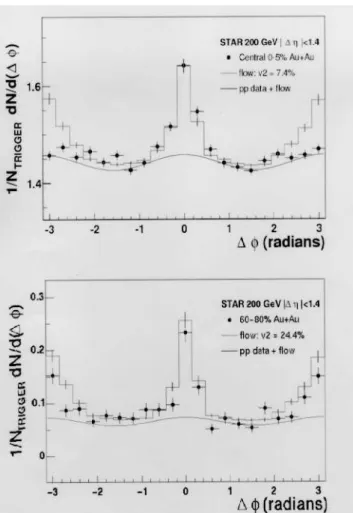
par-ticles. It is known, from N+N collisions that the jet cone has a typical width of∆η ∼0.5−0.7. To extract the jet-specific structures we compared the azimuthal correlations for pseudorapidity intervals of ∆η < 0.5 and ∆η > 0.5 . In addition to the correlations due to jets, it is expected that the azimuthal correlations also show a structure due to an elliptic flow anisotropy of single particles with re-spect to the reaction plane that needs to be taken into ac-count in order to isolate the jet-like correlations. Fig. 4 shows the azimuthal correlations for a trigger particle with 4 < ptriggerT <6GeV/c and all associated particles in the event with2< pT < ptriggerT GeV/c, for two Au+Au
cen-trality selections and p+p collisions at√sN N = 200GeV. In
order to compare the correlations observed in Au+Au with p+p collisions a simple model was adopted where the mea-suredv2 and a constant background are added to the p+p measurement. Details can be found in Ref. [8]. The well pronounced peak at small ∆φ is suggestive of jets. The peaks at large∆φfor p+p and peripheral Au+Au suggest the presence of back-to-back jet-like structure, not present in central Au+Au.
The suppression of back-to-back jets, the strong sup-pression of the inclusive hadrons in central Au+Au colli-sions and the finitev2at high-pT suggest a picture in which
hadrons withpT > 3−4GeV/c are mostly fragments of
hard-scattered partons that strongly interact with the nuclear medium. The observed hadrons result preferentially from partons generated on the periphery of the nuclear collision zone and heading outwards. In this picture, the inclusive yield is suppressed relative to the binary scaling expecta-tion and also explains the finite v2 observed at high-pT.
302 Brazilian Journal of Physics, vol. 34, no. 1A, March, 2004
Figure 4. Azimuthal correlations for Au+Au collisions for two dif-ferent centrality selections. The histogram is the measurement for p+p collisions in which the measuredv2 for Au+Au and a
con-stant background is added in order to compare it with the Au+Au measurement.
picture also explains the suppression of back-to-back cor-relations in central Au + Au, in which the parton scattered towards the nuclear collision zone is reabsorbed due to the strong interaction with the medium. Alternatively, the phe-nomena observed might result from initial-state effects prior to the hard scattering, such as the saturation of gluon densi-ties in the incoming nuclei [15]. Models incorporating both pictures can describe the central Au+Au data [9]. In order separate initial and final-state effects d+Au measurements were performed. In this case it is expected that the hot and dense medium shall not be created in the collisions and only initial-state effects are present. Fig. 5 shows preliminary re-sults forRAA(pT)in d+Au collisions at√sN N = 200GeV
compared to peripheral and central Au+Au results. There is no suppression with respect to binary scaling observed. The enhancement above the binary scaling is understood in terms of the Cronin effect. Fig. 6 shows preliminary results from azimuthal correlations analysis for d+Au. Results from cen-tral Au+Au and p+p are also shown. In this case, the corre-lations in d+Au collisions behave like the ones observed for p+p collisions. No evidence for back-to-back suppression is observed in this case.
Figure 5.RAA(pT)for charged hadrons in the region of|η|<0.5
for d+Au, peripheral and central Au+Au collisions at√sN N =
200GeV. No evidence for hadron suppression with respect to bi-nary scaling is observed in d+Au collisions.
Figure 6. Azimuthal correlations for minimum bias d+Au, p+p and central Au+Au collisions at√sN N = 200GeV. No evidence for
back-to-back jet suppression is observed in d+Au collisions.
In summary, the study of high transverse momentum is capable of reveal important information about the early stages of the nuclear collision. STAR has measured high-pT
hadrons for Au+Au, p+p and d+Au collisions at√sN N =
200GeV at RHIC. The combined evidence observed in the high-pT region, such as the yield suppression with respect
to binary scaling, the finite azimuthal anisotropy (v2) and the suppression of back-to-back jets, not observed in d+Au collisions strongly suggest that the phenomena observed in central Au+Au collisions are due to final-state interactions with the dense and hot medium created in the collision.
A.A.P. Suaide for the STAR Collaboration 303
Republic, DAE, DST, and CSIR of the Government of In-dia; the Swiss NSF.
References
[1] J. W. Harris and B. M¨uller, Annu. Rev. Nucl. Part. Sci.46, 71 (1996).
[2] X. N. Wang and M. Gyulassy, Phys. Rev. D44, 3501 (1991). [3] X. N. Wang, Phys. Rev. C61, 064910 (2000).
[4] C. Adleret al.Phys. Rev. Lett.89, 202301 (2002); S.S. Adler
et al., nucl-ex/0306021.
[5] K. Adcoxet al., Phys. Rev. Lett.88, 022301 (2002); Phys. Lett. B561, 82 (2003); S.S. Adleret al., nucl-ex/0304022; B.B. Backet al., nucl-ex/0306025.
[6] B. B. Backet al., nucl-ex/0302015.
[7] C. Adleret al.Phys. Rev. Lett.90, 032301 (2003).
[8] C. Adleret al.Phys. Rev. Lett.90, 082302 (2003).
[9] J. Adamset al., nucl-ex/0305015 (2003).
[10] J. Adamset al., nucl-ex/0306024 (2003).
[11] I. Arseneet al., nucl-ex/0307003.
[12] K. H. Ackermannet al., Nucl. Instr. Meth. A499, 624 (2003).
[13] X.N. Wang, nucl-th/0305010.
[14] I. Vitev and M. Gyulassy, Phys. Rev. Lett.89, 252301 (2002).