Summary
Six healthy crossbred rabbits (New Zealand white & Chinchilla) were assigned to each of three isocaloric rations viz: treatment A (control) with 20% crude protein on dry matter basis (CP), treatment B with 14% CP and treatment C with 24% CP. The performance parameters considered included dry matter and CP digestibility, feed intake, growth rate, and reproduction parameters like paired testes weight, paired testes volume/density, gonadal sperm reserves and daily sperm production. The results showed that CP
digestibility was signiicantly affected (P= 0.05) while dry matter digestibility was not signiicantly affected. Average weight gain was signiicantly different (P= 0.05) between treatment B and C but not between B and C and control. There was no signiicant dietary
effect on relative testis weight among treatments but
testis volume was signiicantly enhanced by dietary
CP. Daily sperm production and gonadal sperm
reserves were signiicantly enhanced (P= 0.05) with
increasing dietary CP. It is concluded that dietary
crude protein signiicantly enhances the reproduction eficiency of pubertal rabbits.
The Effect of Three Dietary Crude Protein Levels on
Digestibility and Tests Function in Male Pubertal Rabbits
A.O. Ladokun*, G.N. Egbunike, D.O. Adejumo & O.A. SokunbiKeywords: Crude protein- Pubertal rabbits- Growth rate- Digestibility- Testis function- Nigeria
Animal Physiology Laboratory, Dept. of Animal Science, University of Ibadan, Ibadan, Nigeria. *All correspondence should be addressed to the irst author.
Received on 30.03.04. and accepted for publication on 24.02.05.
Résumé
Effet de trois niveaux de protéine brute diététique sur la digestibilité et la fonction de tests dans un lapin mâle en puberté
Six lapins hybrides en bonne santé (Blanc néozéelandais et Chinchilla) étaient assignés à chacun des trois rations isocaloriques viz: traitement A (témoin) avec 20% de protéine brute (PB) sur base de la matière sèche de base, B avec 14% de protéine brute et C avec 24% de protéine brute. Les paramètres de performances pris en considération sont: la matière sèche, la digestibilité des protéines brutes, l’ingestion alimentaire, le taux de croissance. Les paramètres de reproduction sont: le poids des paires de testicules, le volume et la densité des paires de testicules, les réserves de sperme dans les gonades et la production quotidienne de sperme. Les résultats indiquent que la digestibilité des protéines
brutes était inluencée de façon signiicative. La prise de poids moyen différait d’une façon signiicative (P= 0,05) entre le traitement B et C mais pas ceux-ci avec le traitement témoin. Il n’y avait pas d’effet signiicatif de
la ration sur le poids des testicules entre les traitements mais le volume testiculaire augmentait avec les protéines brutes de la ration. La production quotidienne de sperme et les réserves de sperme dans les gonades
étaient augmentées d’une façon signiicative (P= 0,05)
lorsque la digestibilité des protéines brutes augmentait. La recherche conclut que les protéines brutes de la ration
augmentent d’une manière signiicative l’eficacité de
la reproduction des lapins juvéniles.
Introduction
Animal protein supply and intake in Nigeria are presently at a very ridiculously low level compared with what obtains in the developed world.
This poor protein supply is as a result of the inferior genetic make up of most of our animals, probably due to non-selection, our harsh environment, and our undeveloped animal husbandry practices while the low intake is based mainly on our cultural beliefs. However, in order to ameliorate this situation immediately, it is essential that animals with very fast and eficient reproductive ability and short generation interval be taken for intensive production. The rabbit
is one of the animals of choice that produces ine-grained low fat containing and delicious meat, and so can serve as a suitable alternative to other types of meat.
The production of rabbit meat is not as demanding as beef, pork, and chicken in terms of feed, land and other requirements. Thus, rabbit meat can help to reduce the protein deiciency in the meals of Nigerians in both the short and long terms and it is known that production per dam is higher than what obtains in other herbivorous farm animals because of its high growth rate.
TROPICULTURA, 2006, 24, 1, 3-6
ARTICLES ORIGINAUX
OORSPRONKELIJKE ARTIKELS
TROPICULTURA
4
However, special attention needs to be given to the type of feed provided for the rabbit as this must meet the requirement for energy, proteins, vitamins, minerals, and other micronutrients necessary for normal growth and development. Apart from the increasing cost of feed ingredients in the country, it is worthy to note that reports on crude protein (CP) requirement for rabbits are not consistent. For example while Rao
et al. (16) had recommended 12-16% CP, Owen (14)
and later Kuit (11) suggested between 18 and 22% CP content in rabbit grower diet. It was therefore on the basis of this that we decided to determine the level of dietary CP that would be best for pre-pubertal bucks and their testis function at puberty. As far as rabbits are concerned, it is known that there are many problems associated with their nutrition in the tropics (11). Although there has not been any planned investigation of the effects of dietary CP on the development of puberty in the buck and the subsequent functioning of the testis in the hot humid tropics, that animal reproduction and especially testis function in the boar are highly depressed by the tropical environment is not in doubt even for animals that have become adapted.
For instance, we have shown that gonadal sperm or sperm reserves of boars raised and maintained in Iba-dan are 10% of those of their European counterparts (7) while total epididymal sperm was only 1%. Also, in the tropics some of the protein concentrates get infected after improper drying or processing by fungi whose mycotoxins seriously affect spermatogenesis (4). The importance of these in animal production is deinitely without doubt considering the development of hard freezing of semen for use in the insemination of females in most species over a long time (10).
Materials and methods
Six healthy crossbred rabbits (New Zealand White & Chinchilla) were assigned to each of three isocaloric rations viz: A with 20% CP and serving as control, B with 14% CP and C with 24% CP on dry matter (DM) basis. The gross composition of the diets is as shown in table 1.
The animals were obtained three to four weeks post weaning (i.e. 9-10 weeks of age) and were placed on a commercial rabbit weaver-grower diet for one week for acclimatization to our environment and manage-ment before being assigned to the experimanage-mental diets at about 820-900 g live weight. All animals were housed individually in conventional rabbit cages fed and given water ad libitum and weighed weekly until they were 18 weeks of age.
Thereafter, feed samples and faecal droppings were collected for the next seven days for digestibility estimation. The droppings were then dried in the oven (80 0C), bulked per animal, ground, and analyzed
as the feeds (diets) for DM and CP using (2) AOAC
Table
Gross composition of experimental diets (%)
___________________________________________________________ Diets
_________________________________________ Ingredients A (control) B C ___________________________________________________________ Maize 56.80 68.04 59.14 Groundnut cake 21.65 9.95 17.81 Blood meal 2.50 2.96 4.00 Palm kernel meal 15.00 15.00 15.00 Oyster shell 1.00 1.00 1.00 Bone meal 2.00 2.00 2.00 Premix* 0.25 0.25 0.25 Salt 0.50 0.50 0.50 Methionine 0.20 0.20 0.20 Lysine 0.10 0.10 0.10 _________________________________________ Calculated crude
Protein (%) 20.02 14.00 24.00 _________________________________________
Determined CP level 20.41 14.30 24.02
Calculated metabolizable
Energy (kcal kg) 2900 2900 2900 ___________________________________________________________ *Premix supplies 1.43 N/kg
methods. Apparent digestibility coeficients were calculated from the resultant values.
For testicular function, all the animals were sacriiced at 19 weeks of age. The testes were dissected free of all adhering fat and connective tissue and processed for the determination of maximum daily sperm production (DSP) from two slides per testis by quantitative testicular histology (6) while known weight of the testis were homogenized in phosphate - buffered saline and used for the estimation of gonadal sperm reserves which were than divided by 3.43 days (1) to obtain sperm production. From the processed slides the kinetics of spermatogenesis were studied by determining the relative frequencies of the occurrence of the stages of the cycle of seminiferous epithelium as per earlier studies (5). All data obtained were then subjected to one-way analysis of variance by the method of Dunn and Clark (3).
Results and discussion
The DM and CP digestibility estimates of the diets are given in table 2.
Table 2
Dry matter and crude protein digestibility estimates of the experimental diets by rabbits (means + sem)
___________________________________________________________ Diets
_____________________________________________ Parameters A (control) B C ___________________________________________________________ Dry matter 71.36 + 0.02 72.56 + 0.01 71.75 + 0.01 digestibility
Crude protein 62.72 + 0.01a 68.72 + 0.02b 69.98 + 0.01b
digestibility
___________________________________________________________
ab: values differently superscripted differ signiicantly (P< 0.05)
TROPICULTURA
Only CP digestibility was signiicantly (P= 0.05)
affected by diets with diet A being less digestible than the others suggesting no relationship between DM and CP digestibility as reported by Fekeke and Gippest (8).
Performance characteristics (Table 3) show that the initial live weight and daily feed intake did not vary with CP level unlike average daily gain (ADG) inal live weight, feed eficiency, and feed conversion ratio (FCR).
The changes in the live weight of the rabbits on the different diets are shown in igure 1. While animals in treatment C were heavier than the others at the end of the study, indicating enhanced growth rate, ADG was poorest at 14% CP followed by 20% and 24% CP. This may be a relection of the CP digestibility, which varies with the protein concentration in the diet (13).
Table
Performance characteristics of rabbits fed diets with different crude protein levels (mean + sem)
___________________________________________________________ Diets
_________________________________________ Parameters A (control) B C ___________________________________________________________ Initial live weight (g) 857 + 29 848 + 48 861 + 34
Daily feed intake (g) 66 + 1 65 + 3 65 + 2
Average daily gain (g) 1.57 + 1a 8 + 3 14 + 3c
Final live weight (kg) 1.57 + 0.07a 1.34 + 0.02b 1.78 + 0.03b Feed eficiency 3.92a 5.36b 2.96b
Feed conversion ratio 1: 0.26a 1: 0.19b 1: 0.34a
___________________________________________________________
abc: values differently superscripted differs signiicantly (P< 0.05).
0 200 400 600 800 1000 1200 1400 1600 1800 2000
1 2 3 4 5 6 7 8 9 10
DURATION OF EXPERIMENT (WEEKS)
L
IV
E
W
E
IG
HT
O
F
R
A
BB
IT
S
(
G
R
A
MS
)
24% CP 20% CP 14% CP
Figure 1: Changes in the live weight of rabbits on three dietary crude protein levels (mean + sem).
That feed eficiency and FCR were poorer with 14% CP than the other is a suggestion that rabbit could not convert the nutrients at this CP level probably because of an imbalance of calorie/protein even though (9) claimed that at any protein level, additional
energy improves nitrogen balance up to a plateau. The results thus conirm that pre-pubertal male rabbits will do best on diet with 20-24% CP.
The results of testis function are summarized in table 4.
Table 4
Testis function in pubertal rabbits on three dietary crude protein levels (mean + sem)
___________________________________________________________ Dietary CP (%)
______________________________________ Parameters 20 14 24 ___________________________________________________________ Paired testes weight (g) 3.50 + 0.07a 2.90 + 0.06b 3.16 + 0.09a
Paired testes weight (%) 0.23 + 0.01 0.12 + 0.01 0.20 + 0.02
Testis density (g/ml) 1.16 + 0.02a 1.40 + 0.03b 1.21 + 0.03a
Gonadal sperm reserve 0.62 + 0.03a 0.04 + 0.01b 0.75 + 0.05a
(x 108)
Daily sperm production (x 108)
(a) Testicular histology 0.02 + 0.001a 0.01 + 0.004b 002 + 0.002a
(b) Testis homogenate 0.18 + 0.004a 0.12 + 0.004b 0.22 + 0.007a
___________________________________________________________
ab: Values with different superscript differ signiicantly (P= 0.05)
along the same row.
Absolute but not relative paired testes weight was drastically (P= 0.05) depressed in rabbits on 14% CP ration while testis density increased compared to the others. This is an indication that the testis in the animals on the 14% CP diets were shrunken and had narrower seminiferous tubules. In the same light, gonadal sperm reserves with the maximum daily sperm production potential therefrom and that from the quantitative testicular histology were depressed (P= 0.05) by the 14% CP diet. It is worthy to note that the sperm production from histology was 8-11% of that from the testicular sperm reserves, an indication that these pubertal rabbits were still to attain the adult testicular histology as suggested by Egbunike (5) especially as regards the volumetric proportion of spermatids with round nuclei on which the sperm production by histology is based.
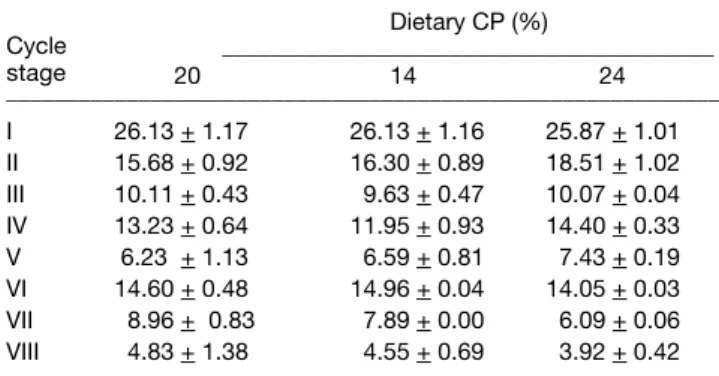
Table 5 shows the variations in the kinetics of spermatogenesis of the rabbits with three dietary CP levels.
Table
The variation of the cycle of the seminiferous epithelium of pubertal rabbits on three dietary crude protein levels (mean + sem)
___________________________________________________________ Dietary CP (%)
_________________________________________ Cycle
20 14 24 stage
______________________________________________________ _____
I 26.13 + 1.17 26.13 + 1.16 25.87 + 1.01 II 15.68 + 0.92 16.30 + 0.89 18.51 + 1.02 III 10.11 + 0.43 9.63 + 0.47 10.07 + 0.04 IV 13.23 + 0.64 11.95 + 0.93 14.40 + 0.33 V 6.23 + 1.13 6.59 + 0.81 7.43 + 0.19 VI 14.60 + 0.48 14.96 + 0.04 14.05 + 0.03 VII 8.96 + 0.83 7.89 + 0.00 6.09 + 0.06 VIII 4.83 + 1.38 4.55 + 0.69 3.92 + 0.42 ___________________________________________________________
TROPICULTURA
The three diets seem to follow a similar pattern except that those on 24% CP diet showed tendencies for increased incidence of stages II, IV and V of the cycle of seminiferous epithelium. This indicates a slight elevation in the frequencies of spermatid nuclear elongation and the maturation divisions of the spermatocytes as outlined by Swierstra and Foote (17) in these animals.
The results therefore indicate that pre-pubertal male rabbits require diets with 20-24% CP for proper development in the humid tropics in conirmation of the indings of Ladokun (12). However, they also show, judging from the signiicant differences between the DSP determined by the two methods that these rabbits were yet to reach the age at which they could be used for successful mating of does.
Conclusions
From the results obtained in this experiment the following conclusions can be made on dietary crude protein and performance on male rabbits at puberty. The dietary CP level of feed does not signiicantly enhance feed intake. Average body weight and weight gain were signiicantly enhanced (P= 0.05) by increase in dietary CP level. DM digestibility is not signiicantly affected but CP digestibility is signiicantly affected (P= 0.05).
Gonadal sperm reserves, daily sperm production, and paired testes weight were signiicantly (P= 0.05) inluenced by dietary CP.
The dietary CP level signiicantly (P= 0.05) increased the volume percent of the round spermatid nuclei of the testes.
Thus, it can be concluded that pre-pubertal rabbits on 20-24% CP in the diet have the potential to perform better at puberty and should be selected for mating at adulthood.
1. Aman R.P. & Lambiase Jr. J.T., 1969, The male rabbit lll. Determination of daily sperm production by means of testicular homogenates. J. of Ani. Sci. 28, 369-374.
2. A.O.A.C., 1984, Oficial Methods of Analysis. 12th ed. Association of
Oficial Analytical Chemists, Washington D.C.
3. Dunn O.J. & Clark V.A., 1972, Applied statistics: analysis of variance and regression. Wiley, New York.
4. Egbunike G.N., 1979, The relative importance of dry-and wet-bulb temperatures in the thermoregulatory function in the chicken. Zentralblatt für Veterinärmedizin A, 26, 573-579.
5. Egbunike G.N., 1981, Testis characteristics of pubertal Large White boars reared in a humid tropical environment. Andrologia, 13, 184-290.
6. Egbunike G.N. & SteinbachJ., 1979, Seasonal variations in the sperm production rates of boars in a humid tropical environment. Nig. J. Agric. Sci. 1, 21-26.
7. Egbunike G.N., Holtz W., Endell W. & Smith D., 1975, Reproductive capacity of German Landrace boars. l.Gonadal and extragonadal sperm reserves. Züchthygiene, 10, 184-187.
8. Fekeke S. & Gippert T., 1985, Effect of crude ibre on protein utilisation. J. Appl. Rabbit Res. 8,1, 31-36.
9. Friedman M. & Gumbmann M.R., 1985, Nutritional improvement of legume proteins through disulide exchange. J. Agric. & Food Chemistry, 44, 357-389.
Literature
A.O. Ladokun, B.Sc, M.Sc, Ph.D, Lecturer, Research Scientist, Animal Physiology Laboratory, Dept. of Animal Science, University of Ibadan, Ibadan, Nigeria. G.N. Egbunike, Nigerian, B.Sc, Ph.D, Professor, Dept. of Animal Science, University of Ibadan, Ibadan, Nigeria.
D.O. Adejumo, Nigerian, B.Sc, M.Sc, Ph.D, Senior Lecturer, Fisheries and wild life resources, University of Ibadan, Ibadan, Nigeria.
O.A. Sokunbi, Nigerian, B.Sc in Animal Science, M.Sc in Animal Physilogy, Ph.D (in view), Lecturer II in Animal Physiology, University of Ibadan, Ibadan, Nigeria.
10. Irritani A., 1998, Application of biotechnology for reproductive manipulation. Proc. 8th World Conference on Animal Production, Seoul:
Special symposium and plenary sessions, pp. 353-363.
11. Kuit A.R., 1987, Rabbit production and development in the Netherlands. Journal of Applied Rabbit Research, 0, 4, 169-170.
12. Ladokun A.O., 1997, Effect of dietary crude protein level on performance and sperm production in male pubertal rabbits. M.Sc. Thesis. Dept. of Animal Science, University of Ibadan, Ibadan.
13. McDonald P., Edwards R.A. & Greenhalgh J.F.D., 1994, Animal nutrition. 4th edition. Longman scientiic and technical publications. England,
260-283.
14. Omole T.A., 1982, Effect of level of dietary protein on growth ands reproductive performance in rabbits. J. Appl. Rabbit Res. 5, 54-60.
15. Owen J.E., 1981, Rabbit meat for developing countries. World Animal Review, 39, 2-11
16. Rao D.R., Sunki G.R., Johnson W.M. & Chen C.P., 1977, Postnatal growth of New Zealand White Rabbits (Oryctolagus cuniculus). J. Anim. Sci. 44, 6, 1021-1025.