Microstructure and mechanical properties of a
compound reinforced Mg
95
Y
2.5
Zn
2.5
alloy with
long period stacking ordered phase and W phase
*Jin-shan Zhang
Male, born in 1955, Ph.D., Professor. He is mainly engaged in research on wear resistant metallic materials, and strengthening-toughening and molding technology of magnesium alloy. He is an author of over 100 technical papers and 8 patents.
E-mail: [email protected]
Received: 2016-06-05; Accepted: 2016-09-07
Shou-zhong Wu, *Jin-shan Zhang, Chun-xiang Xu, Kai-bo Nie, Xiao-feng Niu, and Zhi-yong You 1. College of Materials Science and Engineering, Taiyuan University of Technology, Taiyuan 030024, China
2. Shanxi Key Laboratory of Advanced Magnesium-based Materials, Taiyuan 030024, China
M
agnesium alloys as the lightest structure materials have attracted extensive concerns because of theirlow density, high speciic strength, and good shielding
characteristics. However, the disadvantages of lower strength and poorer formability in magnesium alloys seriously limit their extensive applications in industry.
Composite strengthening is an important means to improve the properties of the alloys. So, it is important to explore an effective strengthening phase. Recently, magnesium alloys with long period stacking ordered (LPSO) structure have attracted much attention due to their excellent mechanical properties. Luo et al [1] irstly
identiied that the 18R-LPSO phase was identical to the X-Mg12YZn phase. It was also found that there are other two phases (I phase and W phase) in Mg-Y-Zn alloys under conventional casting according to the diferent Zn/
Y atomic ratio [2-3]. Because of the composition luctuation
(segregation) and non-equilibrium solidiication, LPSO
Abstract:
The microstructure evolution of Mg100-2xYxZnx (x=2, 2.5, 3, 3.5) alloys was investigated. Results showthat the Mg100-2xYxZnx alloys are composed of α-Mg, long period stacking ordered (LPSO) phase and eutectic
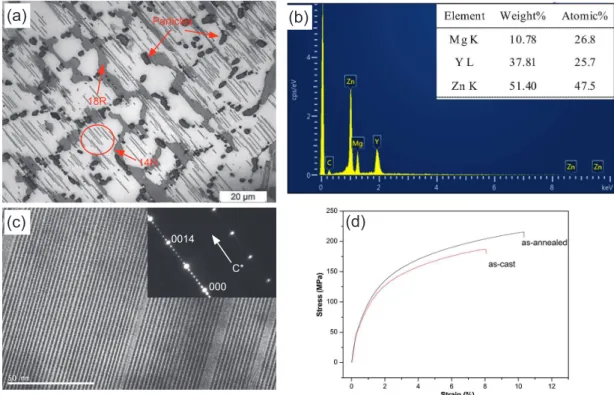
structure phase (W phase), and the Mg95Y2.5Zn2.5 alloy has the best comprehensive mechanical properties. Subsequently, the microstructure evolution of the optimized alloy Mg95Y2.5Zn2.5 during solidification and heat treatment processes was analyzed and discussed by means of OM, SEM, TEM, XRD and DTA. After heat treatment, the lamellar phase 14H-LPSO precipitated in α-Mg and W phase transforms into particle phase (MgYZn2). Due to the compound reinforcement effect of the particle phase and LPSO phase (18R+14H), the mechanical
properties of the alloy are enhanced. The tensile strength and elongation of the Mg95Y2.5Zn2.5 alloy is improved by
9.1% and 31.3% to 215 MPa and 10.5%, respectively, after solid-solution treatment.
Key words:
magnesium alloys; Mg95Y2.5Zn2.5 alloy; long period stacking ordered (LPSO); W phase;compound reinforcement
CLC numbers: TG146.22 Document code: A Article ID: 1672-6421(2017)01-034-05
phase and W phase can coexist when the value of Zn/
Y (at.%) was 1, as discussed in the study of Li et al [4]. A variety of high strength magnesium alloys containing LPSO phase have been developed. However, there was
little research on the Mg-Y-Zn alloys containing LPSO phase and W phase in as-cast condition. Therefore,
it is very necessary to study the effect of composite reinforcement of LPSO phase and W phase.
Meanwhile, mechanical properties are controlled by
the content and morphology of α-Mg, LPSO phase and W phase in the Mg-Y-Zn (atomic ratio Zn/Y=1) alloys.
In order to develop a compound reinforced magnesium alloy with LPSO phase and W phase, the present research investigated the effect of different Y and Zn contents on microstructure evolution and mechanical
properties of the Mg-Y-Zn alloys with Zn/Y (at.%) ratio of 1. Subsequently, the formation of LPSO phase and W phase in the process of solidiication and the efect of the microstructure after solid-solution treatment on
mechanical properties in the optimized Mg95Y2.5Zn2.5
alloy were studied.
1 Experimental procedure
by using pure Mg (99.95 wt.%), Y (99.95 wt.%) and Zn (99.95
wt.%). The metals were melted in an electric resistance furnace
under the protective atmosphere of N2 and CH2FCF3 at 760
°C for 20-30 min. When the temperature was down to 720 °C, the melt was poured into a preheated steel mold (inner diameter 21 mm, outer diameter 70 mm, high 160 mm) with the
temperature of 200 °C. The collected cast samples were held at 500 °C for 8 h in a SX2-8-10 box type high-temperature electric resistance furnace, followed by air cooling. The actual chemical compositions of four Mg-Y-Zn alloys are listed in Table 1. The microstructures of the alloys were investigated using an
optical microscope (OM, Leica DM2500M), a scanning electron
microscope (SEM, TESCAN-MIRA3) equipped with an X-ray energy dispersive spectrometer (EDS OXFORD) and X-ray difraction (XRD, Cu-Kα, Y-2000). The samples for OM and
SEM examination were taken from the bottom part of the ingot by wire cutting, then by polishing and etching with a
solution of 4 ml nitric acid and 96 ml ethanol. Thin foils for TEM observation were prepared by cutting the bulk samples into about 0.3 mm slices and grinding them to the thickness of about 50 μm, followed by electropolishing with a solution of 30 ml nitric acid and 70 ml ethanol, and finally, by ion milling. Microhardness was measured using a HVS-1000A
Vickers hardness testing machine, with a load of 10 g and a loading time of 15 s. Brinell hardness was measured by means
of a HB-3000 Brinell hardness testing machine with a load of 62.5 kg and loading time of 30 s. The alloys were analyzed by diferential thermal analysis (DTA, HCT-1) with a heating rate of 5 °C•min-1. Tensile specimens were cut into sheet with a gauge dimension of 18 mm × 4 mm × 2.5 mm and tested on a
DNS100 electronic universal testing machine with a crosshead
speed of 0.5 mm•min-1 at room temperature.
Alloys Y Zn Mg
A 1.98 2.03 Bal.
B 2.59 2.43 Bal.
C 3.10 2.89 Bal.
D 3.46 3.57 Bal.
Table 1: Chemical compositions of experimental alloys (at.%)
2 Results and discussion
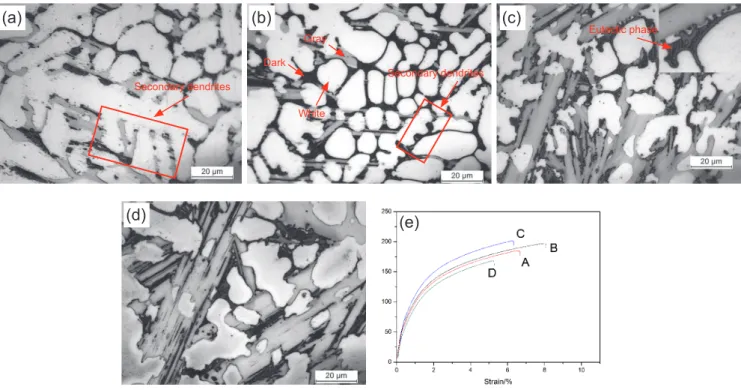
Figure 1 shows the morphology and microstructures of as-cast
A, B, C, D alloys. It can be seen that all the alloys are composed
of α-Mg, gray phase and dark phase. With the increase in
the contents of Y and Zn, the following phenomena can be observed: (i) the amount of second phase increases obviously; (ii)
α-Mg grains are reined and the length of secondary dendrites
becomes shorter; (iii) the size of gray phase and dark phase
becomes larger. Compared with alloy A, the grain size of α-Mg in alloy B is iner and the grain boundaries are smoother. The
secondary dendrites in alloy A are developed, as shown in Fig. 1a, while only a few secondary dendrites can be observed in alloy B, and the growth of secondary dendrites is limited, as
shown in Fig. 1b. The constitutional undercooling generated by the segregation of Y element in the front of liquid/solid interface can restrict the growth of α-Mg grains and the secondary
dendrites [5-6]. The reason for having iner α-Mg grains in alloy
C and D is that the growth of second phase requires a lot of Mg. The dark phase clearly presents typical eutectic structure morphology, as shown in Fig. 1c. The area fractions of the dark phase in the four alloys are about 9.6%, 15.8%, 19.4% and
21%, respectively. Xu et al [7] reported that eutectic structure can degrade the mechanical properties of the Mg-Zn-Y-Zr
Fig. 1: Microstructures of as-cast alloys: A (a), B (b), C (c), D (d) and tensile stress-strain curves (e)
(d)
(e)
(a)
(b)
(c)
Secondary dendrites Secondary dendrites
White
Dark
alloys when area fraction of eutectic structure phase exceeds 17.5%. As can be seen from Fig. 1e, alloy B has the best tensile properties, which is in agreement with Xu’s result. In order to investigate the microstructures of the four alloys, the optimized alloy Mg95Y2.5Zn2.5 is chosen as the research object.
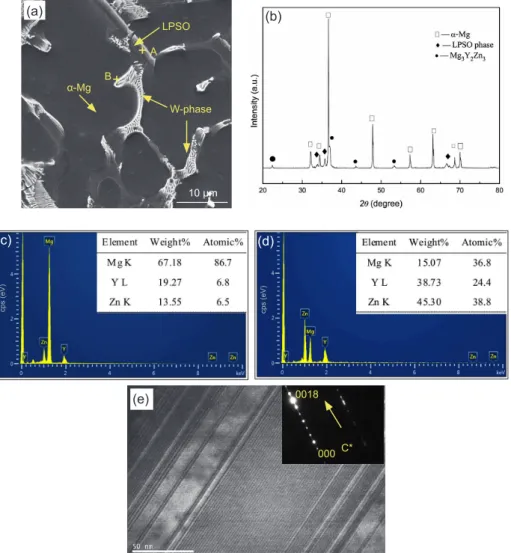
Figure 2a shows the SEM image of as-cast Mg95Y2.5Zn2.5 alloy. The corresponding EDS results of points A and B are
shown in Fig. 2c and Fig. 2d, respectively. It can be concluded that the Mg95Y2.5Zn2.5 alloy is composed of α-Mg, LPSO phase and ishbone-like W phase based on EDS and XRD (Fig. 2b)
Fig. 2: SEM image (a), XRD (b), EDS result of LPSO phase (c) and W phase (d), and bright-ield TEM image of 18R-LPSO
phase (e) in as-cast Mg95Y2.5Zn2.5 alloy, and corresponding SEAD pattern is shown in insets
analysis. The LPSO phase in the as-cast Mg95Y2.5Zn2.5 alloy was confirmed as 18R-LPSO phase from Fig. 2e. W phase and 18R-LPSO phase correspond to the dark phase and gray
phase, respectively in Fig. 1, and alternately locate at the grain
boundaries. The results of Ref. [2-3] showed that 18R-LPSO phase was easier to form when the value of Zn/Y (at.%) was less than 1 , and W phase was easier to form when the value of Zn/ Y (at.%) was between 1 and 6. Thereby, the 18R-LPSO phase and W phase can coexist when the value of Zn/Y (at.%) was 1 because of the composition luctuation in the melt.
Figure 3a shows DTA curve of the as-cast Mg95Y2.5Zn2.5
alloy. According to the reports [8-9], the melting peaks of
α-Mg, 18R-LPSO phase and W phase are 632 °C, 535 °C and 489 °C, respectively. It is well-known that the high melting point phase will precipitate from the liquid prior to the low
melting point phase during solidification process. When the
temperature dropped to 632 °C, α-Mg irstly formed from the melt and phase transformation reaction occurred: L → α-Mg. As primary crystal α-Mg grew gradually, the concentration of Y and Zn solute atoms increased in the liquid, leading to the
enrichment area of Y and Zn. With the decrease of temperature
in the melt, the content of Y and Zn in the remaining liquid increased continuously. Then, the phase transformation reaction
L → α-Mg + Mg12YZn (18R-LPSO phase) occurred at 535 °C.
Meanwhile, the residual Y and Zn were further enriched in the
unsolidified liquid phase, and phase transformation reaction occurred at 489 °C: L → α-Mg + Mg3Y2Zn3. At 489 °C, α-Mg irstly precipitated and promoted the growth of W phase as the core of heterogeneous nucleation. W phase and α-Mg alternately grew, resulting in the formation of fishbone-like eutectic structure. The isothermal section of Mg-Y-Zn ternary system phase
diagram [10] at 400 °C is shown in Fig. 3b. It can be seen that the compositions of the four alloys locate at the Mg + W + X region. Therefore, the microstructures of the Mg100-2xYxZnx (x=2,
2.5, 3, 3.5) alloys are composed of α-Mg, 18R-LPSO phase and ishbone-like W phase.
(c)
(e)
cps (eV) cps (eV)
(b)
(d)
0018
000C*
(a)
LPSO
W-phase
α-Mg
+ +
A
B
Fig. 3: DTA curve of as-cast Mg95Y2.5Zn2.5 alloy (a) and isothermal section of Mg-Y-Zn ternary system phase diagram at 400 °C [10]
(b)
Figure 4 shows the Brinell hardness of the as-cast alloys. It
can be seen that Brinell hardness of the alloys increased with
X value. The results of microhardness testing indicate that the
microhardness of α-Mg matrix and 18R-LPSO phase are 80.6
HV0.01 and 108.9 HV0.01, respectively, while the microhardness
of W phase is 150.5 HV0.01. Microhardness of LPSO phase and
W phase also increased with X value. W phase and 18R-LPSO
phase with high microhardness together improve the hardness of the alloys. However, the W phase is a hard and brittle phase, which can strengthen the alloys to some extent but is not conducive to the deformation [7]. Solid solution treatment can not only make the composition uniformity, but also dissolve certain phases that are not conducive to improve the mechanical
properties of the alloys. Thus, solid solution treatment is
necessary for the alloys.
Fig. 4: Brinell hardness of as-cast alloys
thermodynamically stable phase, LPSO, still maintains the block
morphology. The lamellar phase in as-annealed Mg95Y2.5Zn2.5 alloy is conirmed as the 14H-LPSO phase from Fig. 5c. The
reports [11-12] showed that simultaneous addition of Y and Zn in magnesium alloys could decrease the formation energy of
stacking faults (SF) on basal planes of Mg alloys. The solute
atoms Y and Zn concentrated at the grain boundaries during the
non-equilibrium solidiication and difused into the α-Mg matrix during high temperature treatment. When Y and Zn difused into the SF area, the lamellar phase 14H-LPSO precipitated [13]. The 14H-LPSO phase would grow along the direction of basal plane
and appear in a thin strip shape [14], as shown in Fig. 5a.
The tensile stress-strain curves of the as-cast and solid-solution
treated Mg95Y2.5Zn2.5 alloys are shown in Fig. 5d. The tensile strength and elongation of the as-cast Mg95Y2.5Zn2.5 alloy are 197 MPa and 8%, respectively, which are improved remarkably by 9.1% and 31.3% to 215 MPa and 10.5%, respectively, after solid-solution treatment. As compared with W phase in
as-cast condition, the stress concentration caused by the particle
phase is relatively weak. The crack is not easy to form, which is conducive to deformation of alloy. The 14H-LPSO phase
has precipitation strengthening effect, hinders the dislocation
motion and improves the deformability of the alloy. The thermodynamically stable phase, 18R-LPSO, still maintains the block morphology, and strengthens the alloy. The improvement in tensile properties of the alloy after the solid-solution treatment
is the result of the coordination of the above factors.
3 Conclusions
According to the above experiment, the following conclusions can be drawn:
(1) The microstructures of Mg100-2xYxZnx (x=2, 2.5, 3, 3.5)
alloys are composed of α-Mg, 18R-LPSO phase and ishbone-like W phase under conventional casting condition. The contents of Y and Zn have a signiicant efect on the microstructure of Mg-Y-Zn alloys. With an increase in contents of Y and Zn, the
amount of secondary phase in the alloys increases, and the grain
size of α-Mg decreases. Element Y plays a signiicant role in reining α-Mg grains. The Mg95Y2.5Zn2.5 alloy has the best tensile Figure 5a shows the microstructure of the solid-solution
treated Mg95Y2.5Zn2.5 alloy. It can be seen that there are three diferent phases: the particle phase, the block shaped phase and
the lamellar phase. At the high temperature of 500 °C, the
solute atoms Y and Zn broke away from W phase and difused into α-Mg matrix, leading to the eutectic phase disconnected and transformed into the particle phase. The chemical composition
(as shown in Fig. 5b) of the particle phase is Mg26.8Y25.7Zn47.5 with the atomic ratio of Mg: Y: Zn being about 1:1:2. Thus,
it can be concluded that the particle phase is MgYZn2. The
(a)
400 °C
(b)
properties in as-cast condition.
(2) The fishbone-like W phase transforms into the particle
phase MgYZn2, and the lamellar 14H-LPSO phase precipitates in α-Mg matrix after solid-solution treatment in the Mg95Y2.5Zn2.5 alloy. The particle phase (MgYZn2) and the (18R+14H) LPSO
phase jointly improve the mechanical properties of the alloy.
The tensile strength and elongation of the Mg95Y2.5Zn2.5 alloy is improved by 9.1% and 31.3% to 215 MPa and 10.5%, respectively, after solid-solution treatment.
References
[1] Luo Z P, Zhang S Q. High-resolution electron microscopy on the X-Mg12ZnY phase in a high strength Mg-Zn-Zr-Y
magnesium alloy. Journal of Materials Science Letters, 2000, 19: 813-815.
[2] Lee J Y, Kim D H, Lim H K, et al. Effects of Zn/Y ratio on microstructure and mechanical properties of Mg-Zn-Y alloys. Materials Letters, 2005, 59: 3801-3805.
[3] Luo S Q, Tang A T, Pan F S, et al. Effect of mole ratio of Y to Zn on phase constituent of Mg-Zn-Zr-Y alloys. Transactions of Nonferrous Metals Society of China, 2011, 21: 795-800. [4] Li D, Zhang J S, Que Z P, et al. Effects of Mn on the
microstructure and mechanical properties of long period stacking ordered Mg95 Zn2.5Y2.5 alloy. Materials Letters, 2013, 109: 46-50.
[5] Wang T, Zhang M L, Niu Z Y, et al. Influence of Rare Earth Elements on Microstructure and Mechanical Properties of
Mg-Li Alloys. Journal of Rare Earths, 2006, 24: 797-800.
[6] Xu D K, Tang W N, Liu L, et al. Effect of Y concentration on the microstructure and mechanical properties of as-cast Mg-Zn-Y-Zr alloys. Journal of Alloys and Compounds, 2007, 432: 129-134. [7] Xu D K, Tang W N, Liu L, et al. Effect of W-phase on the
mechanical properties of as-cast Mg–Zn–Y–Zr alloys. Journal of Alloys and Compounds, 2008, 461: 248-252.
[8] Gröbner J, Kozlov A, Fang X Y, et al. Phase equilibria and transformations in ternary Mg-rich Mg-Y-Zn alloys. Acta Materialia, 2012, 60: 5948-5962.
[9] Zhang J S, Chen C J, Cheng W L, et al. High-strength Mg93.96Zn2Y4Sr0.04 alloy with long-period stacking ordered
structure. Materials Science and Engineering: A, 2013, 559: 416-420.
[10] Shao G, Varsani V, Fan Z. Thermodynamic modelling of the Y-Zn and Mg-Zn-Y systems. Computer Coupling of Phase Diagrams and Thermochemistry, 2006, 30: 286-295.
[11] Suzuki M, Kimura T, Koike J, et al. Effects of zinc on creep strength and deformation substructures in Mg-Y alloy. Materials Science and Engineering A, 2004, 387-389: 706-709.
[12] Suzuki M, Kimura T, Koike J, et al. Strengthening effect of Zn in heat resistant Mg-Y-Zn solid solution alloys. Scripta Materialia, 2003, 48: 997-1002.
[13] Abe E, Kawamura Y, Hayashi K, et al. Long-period ordered structure in a high-strength nanocrystalline Mg-1at%Zn-2at%Y alloy studied by atomic-resolution Z-contrast STEM. Acta Materialia, 2002, 50: 3845-3857.
[14] Zhang J S, Chen C J, Que Z P, et al. 18R and 14H long-period stacking ordered structures in the Mg93.96Zn2Y4Sr0.04 alloy and
the modiication effect of Sr on X-phase. Materials Science and Engineering: A, 2012, 552: 81-88.
Fig. 5: Microstructure of as-annealed Mg95Y2.5Zn2.5 alloy (a); EDS of particle phase (b); bright-ield TEM image of
14H-LPSO phase (c) in as-annealed Mg95Y2.5Zn2.5 alloy, corresponding SEAD pattern is shown in insets;
tensile stress-strain curves (d) of as-cast and solid-solution treated Mg95Y2.5Zn2.5 alloy
This study was inancially supported by the National Natural Science Foundation of China (Nos.50571073, 51574175 and 51474153), Ph.D. Programs Foundation of Ministry of Education of China (20111402110004) and Natural Science Foundation of Shanxi Province (Nos.2009011028-3 and
2012011022-1).
14H 18R
Particles
C* 0014
000
![Fig. 3: DTA curve of as-cast Mg 95 Y 2.5 Zn 2.5 alloy (a) and isothermal section of Mg-Y-Zn ternary system phase diagram at 400 °C [10] (b)](https://thumb-eu.123doks.com/thumbv2/123dok_br/18125230.324671/4.892.145.767.118.362/dta-curve-alloy-isothermal-section-ternary-phase-diagram.webp)