19
PHYSICAL AND MECHANICAL PROPERTIES OF TORREFIED
Ceiba pentandra
WOOD
Ebenezer A. IYIOLA*
Graduate/Research Assistant - Department of Forestry and Wood Technology Address: Federal University of Technology, Akure, P.M.B. 704, Ondo state Nigeria
Email: [email protected]/+234-8038058909
Babatola OLUFEMI
Professor - Department of Forestry and Wood Technology
Address: Federal University of Technology, Akure, P.M.B. 704, Ondo state Nigeria Email: [email protected]
Abstract:
The need for improving or enhancing the performance of wood to meet the use for high economic value is a necessity. Physico-mechanical properties of torrefied Ceiba pentandra wood were investigated. Thirty nine defect-free specimens of dimensions 20mm × 20mm × 60mm (breadth × thickness x length) were prepared for the determination of dimensional stability and compression test. For the evaluation of static bending strength tests, thirty nine specimens of dimensions 20mm × 20mm x 300mm were prepared. The specimens (at constant m.c. of 12%) were thermally treated at temperatures of 120, 140, 160 and 180oC for 60, 90 and 120 minutes duration. The wood samples were introduced into the furnace and ramped to the temperature at which the actual heat treatment occurred. Density, Moisture content, Weight Loss, Void Volume, Water absorption, Volume swelling, Modulus of Elasticity (MOE), Modulus of Rupture (MOR), Maximum Compression Strength (MCS) and Hardness of the torrefied and untreated samples were investigated. The mean values of the density showed a significant reduction as a function of treatment condition. The mean values of the moisture content of the wood samples varies 7.40% to 3.35% which is the highest reduction found in the treatment180oC for 120minutes. High weight loss was observed at 180oC for 2hrs (6.99%). The value of the volumetric swelling ranges from 7.52% to 1.39% compared to control (28.94%) in 24hrs. The mean values of thermally treated samples for Modulus of Elasticity ranging from 10401 N/mm2(180°C at 60 min) to 1757N/mm2 (120°C at 90 min) compared to control (MOE = 1694N/mm2). The Modulus of Elasticity of the heat-treated samples increased rapidly as the temperature rises to 180oC for 60minutes but decreased as the time increases. It can be concluded that thermal modification improved dimensional stability and mechanical properties of wood samples.
Key words: Ceiba pentandra; torrefied wood; Modulus of Rupture; physical properties; hygroscopicity
.
INTRODUCTION
Wood is a renewable natural resource that has been used in a wide range of applications for millennia. For certain uses, the natural wood properties of many wood species do not give adequate performance and it is necessary to treat or modify wood. Over the years, a range of processes based on chemical, physical and heat treatments have been developed and applied to enhance material properties of wood, such as dimensional stability, stiffness, hardness and durability. Traditional wood preservation is based on chemicals toxicity to wood-degrading microorganisms and insects, and has been widely used in the past to extend the durability of wood in service. More recently, the treatment of wood with suitable (sometimes more benign) chemicals can also enhance other desirable properties, such as dimensional stability, hardness and resistance to weathering (Hill 2006).
There has been a huge increase in research, and commercial wood modification operations in recent years. Key drivers for this include the uncertainty around supply and sustainability of naturally durable wood species, a desire to move away from traditional heavy-metal based preservatives to reduce the source of toxicity. The need to address dimensional instability of many plantation species (Greaves 2014). Many wood modification technologies offer protection in above-ground applications, improved dimensional stability so that coating performance is improved and distortion in service reduced, and some also offer desirable darker colours for softwoods, similar to highly valued hardwoods (Dubey et al. 2011). Wood modification is an increasingly popular way to turn low-value, sustainably grown wood species into high-value products. Thermal treatment occurs between 140 and
*
20
260°C because temperatures lower than 140°C do not significantly affect the structure of material while temperatures higher than 260°C result in undesirable degradation (Hill 2006). Temperature is the parameter responsible for the highest effect of modification in the properties of thermally treated wood (Mitchell 1988, Korkut and Guller 2008).
OBJECTIVE
The objective of this study this study was carried out to investigate the effect of heat on the physical and mechanical properties of torrefied Ceiba pentandra for effective utilization by expanding their end uses.
METHODS
The samples for this study was obtained from a local sawmill in Akure, Ondo state. The planks were air-dried to reduce level of moisture content and then machined into the required dimensions in the direction parallel to grain with a circular saw. Thirty nine defect-free specimens of dimensions 20mm × 20mm × 60mm (breadth × thickness x length) were prepared for the determination of dimensional stability. For the evaluation of static bending strength tests (modulus of rupture and modulus of elasticity), thirty nine specimens of dimensions 20mm × 20mm x 300mm (breadth × thickness × length) were prepared. Another thirty-nine specimens of dimensions 20mm x 20mm x 60mm (breadth × thickness x length) were prepared for compression test. In total, 117 specimens, both treated and untreated were prepared. All the samples were properly labeled. The specimens were oven dried at 10 °C until constant weight is achieved; then cooled in desiccators over silica gel. Thereafter, the weights and dimensions of the specimens were measured to determine the moisture content in the samples using.
MC (%) =
Thermal Modification Process
The heat treatment were conducted in a closed process vessel, a Muffle furnace, a temperature controlled heating unit. The specimens (at constant moisture content (m.c.) of 12%) were thermally treated at temperatures of 120, 140,160 and 180oC for 60, 90 and 120 mins. The wood samples were introduced into the furnace and was ramped to the temperature at which the actual heat treatment occurred. At the end of each treatment period, the samples were removed from the furnace, and their weights and dimensions were determined after cooling in a dessicator to account for the weight change. The weight loss (WL), was determined using eq (1):
(1)
where: Wo (g) is the oven-dry weight of specimens before the treatment; Wt is the dry weight of specimens after the thermal treatment.
Dimensional Stability Tests
Modified and untreated wood samples were submerged in distilled water in a stainless steel container. A metal screen was placed over the samples to hold them approximately 2.5cm below the surface but will not impart load on them. Water absorption and thickness swelling were assessed after 24, 48 and 72 hrs of water soak. Mass and volume measurements were recorded.
From the measurement of the dimensions and weights of specimens, the following properties were measured; the water absorption (WA), Void Volume, volumetric swelling (S) were calculated using:
(2)
where:
Wwet = Weight of the samples after soaking in water; Vdry = Weight of the oven dried samples.
21
(4)
where:
S%= Volumetric swelling;
Vwet = Volume of the samples after soaking in water; Vdry = Volume of the same sample after oven drying.
Density Determination
The change in mass per unit volume of the samples were calculated using the formulae below:
(Kg/m3) (5)
where: ρ = Density; M = Mass (kg); V = Volume (m3).
Mechanical Properties Tests Static Bending
For evaluation of static bending strength, three points flexural tests were performed on both control and modified samples in accordance with ASTM 143 standard (2009). The dimensions of wood samples for the test were 20mm × 20mm × 300mm. Three replicates were performed for each treated wood sample on an Instron 5500R-1137 Universal Test Machine equipped with a 454kg load cell. Data are collected and processed using Bluehill v2 software (Instron) in which MOR, MOE and toughness were calculated by the software.
(N/mm2) (6)
(N/mm2) (7)
where: P is the load, L is the length, y is the deflection, w is the width and h is the depth or thickness of the specimen.
Determination of Maximum Compressive Strength (MCS) parallel to grain
The ability of a material to resist a crushing force or stress applied on the body. Test sample size of 20mm x 20mm x 60mm samples ASTM 143 standard (2009) were used.
The values obtained were used to calculate the compressive strength using the equation below.
∂c = P N/mm2 (8)
bd
were:
∂c = Maximum Compressive Strength in N/mm2; b = width in mm;
d = depth in mm; P = Load in Newton.
Fig. 1. Bending test.
Fig. 2.
22 RESULTS AND DISCUSSION
Physical properties of torrefied Ceiba pentandra
Differences have been noted between the different wood species and the way they respond to heat treatment. The most important differences were reported between softwoods and hardwoods (Zaman et al. 2000, Militz 2002, Hill 2006). Due to these, the wood sample investigated have been grouped as hardwood and discussed.
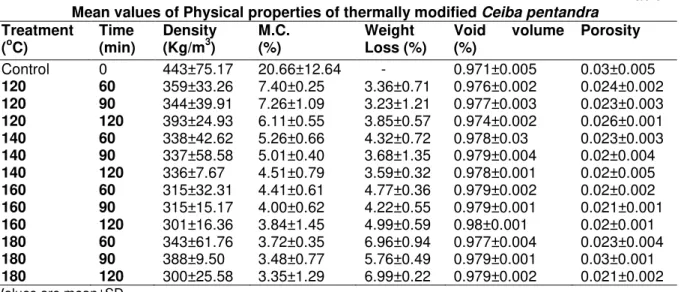
Tables 1 and 2 summarize the physical properties of the investigated Ceiba pentandra samples, respectively. After treatment the moisture content and density of the wood samples decreased. The density of the treated wood samples also decreased significantly compared to the untreated samples. The mean values of the density showed a significant decrease as a function of treatment condition. The values ranged from 393Kg/m3 at 120oC for 120minutes to 300kg/m3 at 180oC for 120minutes compared to the control (ρ=443kg/m3). This showed that density decrease with increase in temperature and time. The decrease of the density is caused by lower moisture content due to evaporation of extractives during heat treatment, degradation of wood components, especially the hemicelluloses, and evaporation of degradation products. The decrease of the density of wood is mainly caused by the degradation of wood components (cellulose and especially the hemicelluloses), (Boonstra et al. 2007). When the treatment temperature was 180ºC for 2hr, density decreased as expected even though the density have started to decrease at120oC and increase again at180oC for 60minutes which might be as a result of either sapwood and heartwood being used together which might make initial density of wood to vary arbitrarily (Leijten 2004). A marked reduction in specific density of heat-modified wood was previously detected in hardwoods (Welzbacher & Rapper 2007, Korkut 2012) and conifers, including P. elliottii (Severo et al. 2012).
Esteves and Pereira (2009) also reported that the degradation of hemicelluloses into volatile products and the evaporation of extractives are the main reasons. In this study, it was discovered that heat treatment causes weight loss in the wood, which has a negative effect on density. Thus, the greatest weight loss occurred for treatment conditions of 180ºC for 120minutes. The mean values of the moisture content of the wood samples varies from 7.40% to 3.35% which is the highest reduction found in the treatment at180oC for 120minutes.This is in line with the report by Gunduz and Aydemir (2009) in their findings that Equilibrium moisture content decreases in Carpinus btulus wood after thermal modification at 170-210oC for 4-12hrs.The weight loss of the wood was correlated to the treatment temperature (Table1). High weight loss was observed at 180oC for 2hrs (6.99±0.22%). Sundqvist et al (2006) reported that hemicelluloses present a massive change in its chemical structure of wood when treated at 180-200oC for 2.5 and 4hr, which generate significant weight loss of wood. Heat treatment at lower temperatures results in low weight loss mainly associated with loss of volatiles and bound water. Loss of macromolecular components can occur at temperatures above 100oC, and this assumes greater significance as time and heating temperature are increased (Millett and Gerhards 1972).
The mean values for the physical properties of thermally modified Ceiba pentandra wood are presented in Table 1.
Table 1 Mean values of Physical properties of thermally modified Ceiba pentandra
Treatment (oC)
Time (min)
Density (Kg/m3)
M.C. (%)
Weight Loss (%)
Void volume (%)
Porosity
Control 0 443±75.17 20.66±12.64 - 0.971±0.005 0.03±0.005
120 60 359±33.26 7.40±0.25 3.36±0.71 0.976±0.002 0.024±0.002
120 90 344±39.91 7.26±1.09 3.23±1.21 0.977±0.003 0.023±0.003
120 120 393±24.93 6.11±0.55 3.85±0.57 0.974±0.002 0.026±0.001
140 60 338±42.62 5.26±0.66 4.32±0.72 0.978±0.03 0.023±0.003
140 90 337±58.58 5.01±0.40 3.68±1.35 0.979±0.004 0.02±0.004
140 120 336±7.67 4.51±0.79 3.59±0.32 0.978±0.001 0.02±0.005
160 60 315±32.31 4.41±0.61 4.77±0.36 0.979±0.002 0.02±0.002
160 90 315±15.17 4.00±0.62 4.22±0.55 0.979±0.001 0.021±0.001
160 120 301±16.36 3.84±1.45 4.99±0.59 0.98±0.001 0.02±0.001
180 60 343±61.76 3.72±0.35 6.96±0.94 0.977±0.004 0.023±0.004
180 90 388±9.50 3.48±0.77 5.76±0.49 0.979±0.001 0.03±0.001
180 120 300±25.58 3.35±1.29 6.99±0.22 0.979±0.002 0.021±0.002
23
Table 2 Mean values of Physical properties of thermally modified Ceiba pentandra
Treatment (oC)
Time (min) WA (%) (24HRS) WA (%) (48HRS) WA (%) (72HRS) VS (%) (24HRS) VS (%) (48hrs) VS (%) (72hrs)
Control 0 86.28±19.5 112.2±24.1 123±24.65 28.94±0.89 26.37±2.27 31.32±2.02
120 60 87.94±10.3 114.6±13.7 129±15.99 1.85±0.48 5.13±1.41 9.25±1.35
120 90 87.42±17.9 119.4±16.1 135±13.54 1.46±1.13 6.66±0.71 8.84±0.90
120 120 69.89±2.19 98.79±7.78 116±10.91 3.47±1.32 8.83±2.33 10.37±0.75
140 60 84.11±6.45 117.7±12.2 138±18.69 2.47±0.99 8.60±1.65 9.95±2.80
140 90 96.58±21.8 124.4±22.9 149±30.79 2.56±2.72 6.51±0.70 7.84±0.47
140 120 88.47±3.76 117.5±1.73 132±6.13 3.13±1.34 5.17±1.06 9.18±1.44
160 60 111±2.71 133.1±12.6 151±10.71 7.52±3.23 2.82±1.91 7.26±1.12
160 90 103±15.56 129.1±13.3 148±15.54 8.26±3.12 1.19±2.41 7.39±1.15
160 120 106.2±9.05 128.1±9.62 152±6.95 6.93±0.59 2.07±1.57 6.28±0.94
180 60 93.13±7.16 122.9±10.9 133±13.31 3.16±3.06 7.64±2.28 5.89±2.05
180 90 68.93±19.5 96.9±16.6 107±16.23 3.11±2.14 8.62±1.74 8.40±2.72
180 120 102.5±12.6 137.8±25.2 149±34.52 1.39±2.99 7.05±1.87 6.42±0.39
Values are mean±SD
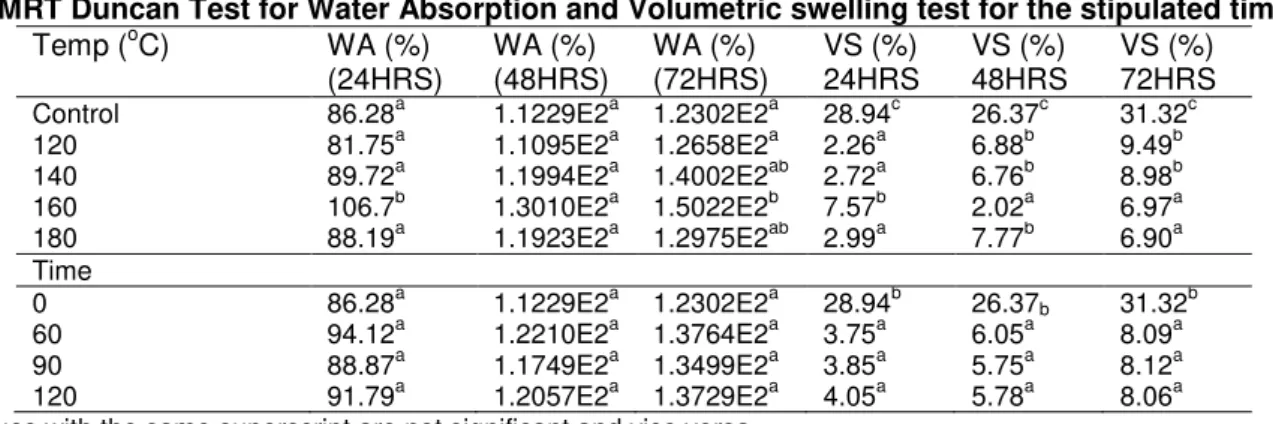
In order to statistically evaluate the reduction in swelling of the torrefied wood under different treatment and experimental variations, Duncan multiple comparison range test (DMRT) was used in the analysis. Table 2 represents the volumetric swelling for different hours of soaking, and DMRT result in Table 4. It shows that the volumetric swelling for different soaking hours were significantly reduced after the thermal treatment at any temperature/time (p<0.05).
There were decrease in swelling coefficient of the mean values when Ceiba pentandra samples were treated at 180°C for 120 minutes in Table 2.The value of the volumetric swelling ranges from 7.52% to 1.39% compared to control (28.94%) in 24hrs. A decrease in swelling results indicates an increase in dimensional stability, which is required for several uses of wood. This reduces the swelling of the cell wall preventing or limiting the penetration of (non-) enzymatic systems necessary for fungal decay. Moreover, a reduction in water absorption reduces the overall swelling and shrinkage of wood thereby improving its dimensional stability (Boonstra 2008). The treatment does not really show positive contribution on the water Absorption of the wood and this may be as a result of the increase in the void volume of treated samples compared to the control in Table 1 as the wood were heated up. The Duncan Multiple Range test showed that there were no significant difference between the temperatures(120oC, 140oC and 180oC) and the control at the stipulated times (24hrs, 48hrs) of soaking in distilled water but the temperature at 160oC at 24hrs of soaking were slightly significant.
Table 3 DMRT Duncan Test for Weight loss
Temp (oC) Weight loss
Control
120 3.48a
140 3.86ab
160 4.66b
180 6.47c
Values with the same superscript are not significant and vice versa
Table 4 DMRT Duncan Test for Water Absorption and Volumetric swelling test for the stipulated time
Temp (oC) WA (%)
(24HRS) WA (%) (48HRS) WA (%) (72HRS) VS (%) 24HRS VS (%) 48HRS VS (%) 72HRS
Control 86.28a 1.1229E2a 1.2302E2a 28.94c 26.37c 31.32c
120 81.75a 1.1095E2a 1.2658E2a 2.26a 6.88b 9.49b
140 89.72a 1.1994E2a 1.4002E2ab 2.72a 6.76b 8.98b
160 106.7b 1.3010E2a 1.5022E2b 7.57b 2.02a 6.97a
180 88.19a 1.1923E2a 1.2975E2ab 2.99a 7.77b 6.90a
Time
0 86.28a 1.1229E2a 1.2302E2a 28.94b 26.37b 31.32b
60 94.12a 1.2210E2a 1.3764E2a 3.75a 6.05a 8.09a
90 88.87a 1.1749E2a 1.3499E2a 3.85a 5.75a 8.12a
120 91.79a 1.2057E2a 1.3729E2a 4.05a 5.78a 8.06a
24
Table 5 Analysis of Variance of Weight Loss of Torrefied Ceiba pentandra
Source
Type III Sum
of Squares Df Mean Square F Sig.
Temperature 47.745 3 15.915 25.547 .000*
Time 2.818 2 1.409 2.262 .124ns
Temp * Time 2.026 6 .338 .542 .771ns
Error 16.197 26 .623
Total 111.076 38
P≤0.05 are significant, P˃0.05 are not significant
Mechanical Properties of thermally treated Ceiba pentandra
Table 6 Mean values of Mechanical properties of thermally modified Ceiba pentandra
Treatment (oC)
Time (min)
Modulus of Elasticity (N/mm2)
Modulus of Rupture (N/mm2)
Compressive strength (N/mm2)
HRF Hardness Test
Control 0 1694 28.58 22.25±0.83 81.37
120 60 1855 35.68 23.01±3.22 77.05
120 90 1757 34.66 18.46±6.95 70.68
120 120 1821 30.74 23.46±5.64 71.25
140 60 2155 41.56 24.91±1.49 74.24
140 90 2259 40.54 26.51±1.74 68.45
140 120 2173 37.06 26.74±2.6 81.53
160 60 7797 35.31 25.05±0.23 72.82
160 90 7977 35.58 29.19±2.58 59.46
160 120 8166 34.24 25.66±1.89 81.43
180 60 10401 41.19 26.85± 3.09 81.59
180 90 7465 33.55 21.94±0.72 82.27
180 120 9589 33.51 22.51±4.78 82.15
Table 7 Analysis of Variance of Modulus of Elasticity of torrefied wood
Source
Type III Sum
of Squares Df Mean Square F Sig.
Temperature 3.945E8 3 1.315E8 91.044 .000*
Time 3256272.711 2 1628136.356 1.127 .339ns
Temp * Time 1.078E7 6 1795955.739 1.244 .317ns
Error 3.755E7 26 1444185.896
Total 4.817E8 38
P≤0.05 are significant, P˃0.05 are not significant
Table 8 Analysis of Variance of Modulus of Rupture of torrefied wood
Source
Type III Sum
of Squares Df Mean Square F Sig.
Temperature 591.298 3 197.099 3.813 .022*
Time 106.686 2 53.343 1.032 .370ns
Temp * Time 562.586 6 93.764 1.814 .135ns
Error 1344.137 26 51.698
25
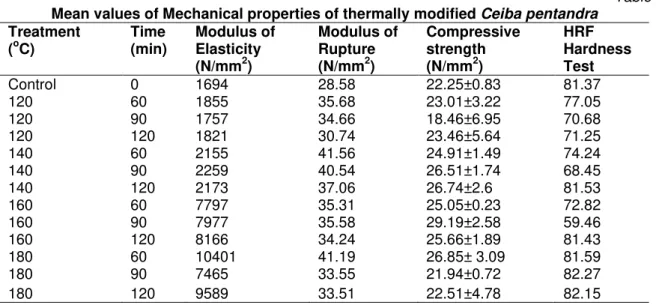
The variations in mechanical properties of heat-treated wood were showed in Table 6 at different temperatures and durations. From the results presented in Table 6, it was shown that the mean values of thermally treated samples for Modulus of Elasticity ranging from 10401N/mm2 (180°C at 60min) to 1757N/mm2 (120°C at 90 min) compared to control (MOE = 1694N/mm2). The Modulus of Elasticity of the heat-treated samples increased rapidly as the temperature rises to 180oC for 60minute but decreased as the time increases. After heat treatment wood becomes more rigid and fragile, and the mechanical resistance decreases (Poncsak et al. 2006, Korkut et al. 2008). Depending on the treatment parameters such as the maximum treatment temperature, the heating rate, the holding time at the maximum temperature, cracks can appear and the cell structure can be partially degraded as well (Poncsak et al. 2006, Kocaefe et al. 2007). Temperature has a greater effect on many wood properties than does treatment time (Kartal et al. 2007). Temperatures over 150ºC permanently alter the physical and mechanical properties of wood (Mitchell 1998).
This result is very important for the strength of treated wood. It is well known that, usually, in heat treatments, the wood loses strength due to depolymerization reactions, especially hemicelluloses which are less stable than lignin and are more sensitive to temperature. Changes in the composition or loss of hemicelluloses may contribute significantly to changes in the strength properties of the treated wood to high temperatures as it showed from this study that the Modulus of Elasticity start to reduce as the temperature rises. Thus, as the temperature used was not very high (180°C for 60 minutes) there was no loss of stiffness and mechanical strength of the wood. On the contrary, these properties were slightly improved even though there has not been a great modification of wood. It was concluded that treatment temperature could affect the improvement of the wood greatly. However, longer treat time had negative effect on the improvement percentage of MOR and MOE. When the treat time were 90 minutes and 120 minutes at 180oC, the MOR and MOE of heat-treated wood maintained a downward trend. It could be concluded that high temperature would put adverse effect on MOE because high temperature would make fibers in wood crack so as to destroy the stability of wood structure, then the mechanical properties of wood would be weakened (Bekhta 2003).
The lower equilibrium moisture content might affect positively the strength properties of heat-treated wood under service conditions, but this effect is superseded by the degradation of the chemical compounds (Borrega 2011).
The ANOVA of Modulus of Elasticity of thermal treated Ceiba pentandra in Table 7 revealed that the temperatures were significantly different while the time and the interaction between temperature and time are not significantly different. The analysis of Variance of Modulus of Rupture of thermally modified and untreated also revealed in Table 8 that the treatment temperature were statistically significant.
The mean value of the maximum compressive strength ranged from 18.46±6.95N/mm2 at 120oC for 90 minutes to 29.19±2.58N/mm2 at 160oC for 90 minutes compared to control 22.25±0.83N/mm2 and decreases gradually as the temperatures increases. Süleyman K. et al (2015) reported similar result for wild cherry who reported the Compression strength values of wild cherry wood samples were decreased with increasing treatment time. The maximum reduction in compression strength for wild cherry (23.59%) wood was obtained for the treatment at 212°C for 2,5h. Statistically, it showed that the treatment-time were not significantly different. The data were statistically evaluated by Factorial experiment to determine the influence of heat treatment on compression strength. Differences between heat treatment and control specimens were statistically insignificant at the 5% confidence level. It is clear from Table 6 that there is slight increase in the hardness number of wood with a decrease in the moisture content and as the temperature increases with time (Ohsawa and Miyajima 1959)
CONCLUSION
Based on the result from this finding, it can be concluded that thermal modification is effective to improve dimensional stability and mechanical properties of wood samples. Physical-technological properties generally decreased with increasing heat-treatment intensity.
26
wood should be studied further in order to provide a solid theoretical foundation for the future industrialization and application of the industry.
REFERENCES
Bekhta P (2003) Effect of high temperature on the change in color, dimensional stability and mechanical properties of spruce wood. Holzforschung 57:539-546.
Boonstra MJ (2008) A two-stage thermal modification of wood. Ph.D. dissertation in cosupervision Ghent University and Université Henry Poincaré - Nancy 1, pp. 297.
Boonstra MJ, Van Acker J, Pizzi A (2007)Anatomical and molecular reasons for property change of wood after full-scale industrial heat-treatment. In: Proceedings Third European Conference on Wood Modification, 15-16th October, 2007, Cardiff, UK, pp. 343-358.
Borrega M (2011) Mechanisms affecting the structure and properties of heat-treated and high-temperature dried Norway spruce (Picea abies) wood. University of Eastern Finland Faculty of Science and Forestry School of Forest Sciences, Dissertationes Forestales 134, pp. 52.
Dubey MK et al. (2011) Effect of oil heating age on colour and dimensional stability of heat treated Pinus radiata. European Journal of Wood and Wood Products 69(2):255-262.
Esteves BM, Pereira HM (2009) Wood modification by heat treatment: A review. BioResources
4(1):370-404.
Greaves H (2014) Australian and NZ Wood Treatment Standards. Recent and Proposed changes and implications for local wood treatment companies. Presentation given at Wood Innovations 2014, Melbourne Australia.
Gunduz G, Aydemir D (2009) Some physical properties of heated treated hornbeam (Carpinus betulus
L) wood. Drying technology 27(5):714-720.
Hill CAS (2006) Wood Modification: Chemical, Thermal and Other Processes. Wiley Series in newable resources (Series Editor: Christian V. Stevens). Published by John Wiley & Sons Ltd, England.
Hill CAS (2006) Wood modification – chemical, thermal and other processes. JohnWiley & Sons, Chichester, pp. 239.
Kartal SN, Hwang WJ, Imamura Y (2007)Water absorption of boron-treated and heat-modified wood.
Journal of Wood Science 53(5):454-457.
Kocaefe D, Chaudhry B, Poncsak S, Bouazara M, Pichette A (2007) Thermogravimetric study of high temperature treatment of aspen: Effects of treatment parameters on weight loss and mechanical properties. J Mater Sci 42, pp. 854–866.
Korkut DS, Bectas B (2008) The effects of heat treatment on physical properties and surface roughness of red-bud maple (Acer trautvetteri Medw.) wood. Bioresource Technol 99:2846-2851.
Korkut S (2012) Performance of three thermally treated tropical wood species commonly used in Turkey. Industrial Crops and Products 36(1):355-362.
Leijten AJM (2004) Heat treated wood and the influence on the impact bending strength. Heron (49):349-359.
Millett MA, Gerhards GC (1972) Accelerated aging: residual weight and flexural properties of wood heated in air at 115°C to 175°C. Wood Science, 4(4):193–201.
Militz H (2002) Thermal treatment of wood. European processes and their background. International Research Group on Wood Preservation. Doc. No. IRG/WP 02-4021.
Mitchell PH (1988) Irreversible property changes of small loblolly pine specimens heated in air, nitrogen, or oxygen. Wood and Fiber Science 20:320-355.
Ohsawa M, Miyajima H (1954) Deformation of wood due to ball indentation and its measuring method. Memo. Fac. Agr., Hokkaido Univ. 2, 1.1-5. Japanese with English summary, pp. 5.
27
Severo ETD, Calonego FW, Sansigolo CA (2012) Physical and chemical changes in juvenile and mature woods of Pinus elliottii var. elliottii by thermal modification. European Journal of Wood and Wood Products 70:741-747.
Süleyman K, Ayhan A (2015) Evaluation of Physical and Mechanical Properties of Wild Cherry Wood Heat-Treated Using the Thermowood Process.MaderasCiencia y tecnología 17(1):171–178.
Sundqvist B et al. (2006) Determination of formic-acid and acetic acid concentrations formed during hydrothermal treatment of birch wood and its relation to colour, strength and hardness. Wood Sci. Tech., v. 40, pp. 549–561.
Welzbacher CR, Brischke C, Rapp AO (2007) Influence of heat treatment temperature and duration on selected biological, mechanical, physical and optical properties of thermally modified timber. Wood Material Science Engineering 2(2):66-76.