Rheological, Morphological and Mechanical Characterization of Recycled Poly (Ethylene
Terephthalate) Blends and Composites
Laurenice Martins Pereiraa, Ana Carolina Corrêab, Men de sá Moreira de Souza Filhoc,
Morsyleide de Freitas Rosac, Edson Noriyuki Itod*
Received: November 22, 2016; Revised: February 26, 2017; Accepted: April 9, 2017
This study evaluated the efect of adding poly (ethylene methyl acrylate) (EMA) and cotton linter (CL) on the properties of recycled poly (ethylene terephthalate) (PETrec). For this, PETrec/EMA blend and PETrec/EMA/CL composite were developed. In order to improve the interfacial adhesion and the properties of these materials, ethylene/methyl acrylate/glycidyl methacrylate terpolymer (EMA-GMA) and polyethylene-grafted maleic anhydride (PE-g-MAH) were added. The rheological results
showed that the addition of EMA increased and the addition of 1 wt% of CL reduced the viscosity. The morphological analysis of the non-compatibilized blend and composite showed poor interfacial adhesion. Polymer blends with 2 and 6 wt% of EMA had better mechanical properties, since these formulations have the smallest average particle diameter of 0.58 and 1.00 µm, respectively. The mechanical testing of composites showed a material with higher maximum strength and elasticity modulus than polymer blend when analyzed at the same EMA phase concentration. The use of EMA-GMA was efective in reducing the size of particles of the EMA in the blend.
Keywords: Cotton linter, Poly (ethylene methyl acrylate), Poly (ethylene terephthalate), Polymer blend, Polymer composite
* e-mail: [email protected]
1. Introduction
The search for new materials to meet the needs of technological advances is a challenge. Regarding polymeric materials, strategies such as making blends and composites are convenient alternatives for the development of polymeric materials which gather the desirable properties that cannot be separately obtained in commercially available polymers1.
Polymer blends are an alternative to obtain polymeric materials with properties that are generally not found in a single material such as toughness, heat resistance and barrier properties. Due to polymer-polymer incompatibility, many polymer blends are immiscible and have more than one phase. Such systems generally exhibit poor mechanical properties, which is a direct consequence of unstable morphology and poor interfacial adhesion. Thus, polymer mixtures usually need a compatibilizer to improve the interfacial adhesion, reduce surface tension and promote morphological stability of the blend2,3.
Poly (ethylene terephthalate) (PET) is recognized as one of the most versatile engineering plastics; it is mainly used in soft drink bottles and textile industry, being one of the
most disposed packing materials4. The increasing economic and environmental value of the PET recycling industry has caused interest worldwide. However, the use of recycled PET in applications with higher added value is limited due to the lack of desirable mechanical properties5. Thus, the
development of PET blends with other polymers seems to be a promising alternative to increase the possibilities for application of this material. However, most polymers are incompatible with PET. Thus, some alternatives have been used to form PET blends compatible with non-polar polymers such as compatibilizers with elastomeric components such as poly co-vinyl acetate) (EVA), poly
(ethylene-co-acrylic acid) (EAA) and poly (ethylene-methyl acrylate)
(EMA) or a third functionalized component6,7. The addition of elastomeric particles inely dispersed into thermoplastic matrices such as PET has succeeded in improving the ability of these materials to absorb mechanical energy8.
Poly (ethylene-methyl acrylate) (EMA) is available with 5-35 wt% of methyl acrylate comonomer, with characteristics ranging from a thermoplastic response to the low methyl acrylate content, to a rubbery behavior with higher methyl acrylate contents9. The behavior of stress-strain curves for EMA is similar to that of elastomeric polymers. The increase in the methyl acrylate content signiicantly reduces the
a Graduate Program in Materials Science and Engineering, Federal University of Rio Grande do Norte - UFRN, Avenida Senador Salgado Filho, 3000, CEP 59078-970, Natal, RN, Brazil
b Embrapa Instrumentation, Rua 15 de Novembro, 1452, CEP 13560-970, São Carlos, SP, Brazil c Embrapa Tropical Agroindustry, Rua Dr. Sara Mesquita, 2270, CEP 60511-110, Fortaleza, CE, Brazil
tensile strength and the elasticity modulus, but increases the elongation at break10.
Studies conducted with the PET/EMA blend showed that the addition of rubber can lead to toughening of PET8. How
most binary polymer blends is immiscible, the addition or generation in situ interfacially active copolymers are often employed to improve the inal properties of the material. This interfacial compatibilization tends to (1) reduce interfacial tension; (2) reduce the size of particles of the dispersed phase; (3) partially or completely prevent static and dynamic processes of coalescence; (4) improve interfacial adhesion; (5) stabilize the microstructure and (6) provide greater control over various processing parameters and hence on the inal properties of the material obtained. Interfacial compatibilizers act as steric barriers at the interfaces and this mechanism is very important to stabilize the microstructure11,12.
The compatibility of the PBT/EMA blend with EMA-GMA has resulted in materials with good mechanical properties due to interfacial compatibilization, from reactions between the chemical bond of end carboxyl groups of the PBT chain with the epoxy group of the EMA-GMA copolymer3,13,14. Reactive elastomers such as EMA-GMA can be excellent tenacity agents for PET because they improve the interfacial adhesion, reduce the interfacial tension and thus allow the formation of smaller rubber particles in the matrix15.
Despite the improvement in the ability to absorb energy, the addition of elastomeric particles in polyesters has as disadvantage the loss of tensile strength and stifness of blends7,16. However, these properties can be improved by adding more rigid components such as micron size ibers, particles, platelets, etc8.
The use of natural ibers as reinforcement for thermoplastics has attracted growing interest, mainly for recycled thermoplastics due to low cost, use of locally available renewable resources and reduction of waste generation17.Cotton linter is a good option to be incorporated to thermoplastics as reinforcement for being a short iber with 3-12 mm and availability as a by-product from the textile industry. One of the side products of cotton cleaning factories is linter, which is considered as waste material. Approximately 3-5% of cotton ibers is waste linters. The amount of linter produced in the world is about 2.5 million tones, considering the 42 million tons of cotton linter produced in 201018,19.
One of the main diiculties when dealing with natural composites is the adhesion between ibres and matrices, mainly due to the hydrophilic and hydrophobic characteristics showed by the ibres and the polymers, respectively20. Various surface treatment methods as well as coupling agents and compatibilizers such as maleic anhydride grafted polymers, silane, alkali treatment and etc have been used to increase the compatibility between natural ibers and thermoplastic matrices, thereby enhancing the composites performance21.
The aim of this study was to develop PETrec/EMA blends and add cotton linter ibers to obtain PETrec/EMA/
CL composite and evaluate the inluence of the variation in the EMA concentration, the addition of linter and coupling agents through rheological, morphological and mechanical behavior.
2. Experimental
2.1. Materials
Recycled poly (ethylene terephthalate) (PETrec) with MFI = 63.48 g/10min (285 ºC and 2.16 kg) and Tonset = 384.12 ºC (degradation temperature), used in this work was donated by company Global PET S.A. Poly (ethylene methyl acrylate) (EMA) - Elvaloy® AC 1224 with MFI = 2 g/10 min (190 ºC and 2.16 kg) and Tonset = 317.26 ºC, contain 24 wt% of methyl acrylate was donated by company DuPont S.A. Cotton linter ibers with Tonset = 263.46 ºC used were donated by company Delta Opal. The ibers used in this study had diameter of 20 ± 4 µm and length of 240 ± 79 µm.
The compatibilizing agent used for PETrec/EMA blend was terpolymer ethylene - methyl acrylate - glycidyl methacrylate (EMA-GMA) Lotader AX 8900 with MFI = 6 g/10min (190 ºC/2.16 kg) and Tonset = 383.29 ºC, containing 8 wt% GMA and 24 wt% methyl acrylate, from company Chemtura.
The coupling agents used to improve the adhesion of the cotton linter iber to the blend was polyethylene grafted with 1 wt% of maleic anhydride (PE-g-MAH) Polybond 3009 (MFI = 5 g/10min, 190 ºC/2.16 kg) and Tonset = 351.14 ºC, from Arkema.
2.2. Preparation of blends and composites
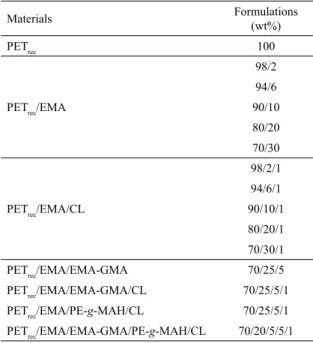
PETrec/EMA blends were prepared with levels from 2 to 30 wt% EMA, and PETrec/EMA/CL composites were prepared by adding 1 wt% cotton linter iber to polymer blends formulations to assess the inluence of cotton ibers on polymer blends. To evaluate the compatibilization efect in the polymer blends and composites were used 5 wt% of EMA-GMA and 5 wt% of PE-g-MAH, respectively. A summary of formulations prepared is shown in Table 1.
All formulations were prepared by melt mixing using a single screw extruder 16 mm diameter (L/D = 26) from AX Plásticos Máquinas Técnicas LTDA. The temperature proile from the feeding zone to the matrix was 240/240/240 ºC, with screw speed of the 60 rpm and using a Maddock, dispersive element to enhance mixing.
After extrusion, the materials were granulated and dried in a vacuum oven for 24 hours at constant temperature of 60 ºC before being injection molded.
Table 1. Formulations of processed materials.
Materials Formulations(wt%)
PETrec 100
PETrec/EMA
98/2
94/6
90/10
80/20
70/30
PETrec/EMA/CL
98/2/1
94/6/1
90/10/1
80/20/1
70/30/1
PETrec/EMA/EMA-GMA 70/25/5
PETrec/EMA/EMA-GMA/CL 70/25/5/1
PETrec/EMA/PE-g-MAH/CL 70/25/5/1
PETrec/EMA/EMA-GMA/PE-g-MAH/CL 70/20/5/5/1
2.3. Rheological analysis
The rheological properties of blends and compatibilized and non-compatibilized composites were measured by melt low index and torque rheometry.
The melt low index (MFI) of polymers was performed in equipment Modular Melt Flow Line (Ceast), where test temperature was set at 252 ºC and nominal load of 2.16 kg. The torque rheometry of polymers was measured in an internal mixer coupled to rheometer label HAAKE Polylab model Reomix 600 OS with a roller-type mixing element. Rotation speed of 60 rpm and temperature of 240 ºC were used, with 70% by weight of the illed chamber and a processing time of 30 min. For torque rheometry characterization, mixtures were directly prepared in the rheometer without prior extrusion.
2.4. Morphological analysis
The morphology of binary blends, the level of interfacial adhesion and the distribution of the dispersed phase (EMA) were analyzed by Scanning Electron Microscopy (SEM) in Shimadzu SSX-550 Superscan. The morphology of compatibilized blend, cotton linter ibers, composites and compatibilized composites was analysed in equipment FEI INSPECT S50. The polymer blends and composites were cryofractured with liquid nitrogen to avoid the deformation of particles of the dispersed phase, and then all the materials were metallized with thin layer of gold.
After SEM analysis, the length and diameter of milled linter ibers and the average diameter of particles of the EMA phase were quantiied with the aid of an image analysis software (Image J).
2.5. Mechanical analysis
The mechanical properties were evaluated by tensile testing conducted according to ASTM D63822 using the specimen type I in a universal testing machine Shimadzu model AG-X 300kN with speed of 1 mm·min-1 for the
calculation of the module in the segment from 0.05% to 0.25% of deformation, and then, test speed of 50 mm·min-1
was used. Once test conditions were deined, a series of ive specimens for each composition was used. In this test, maximum tensile strength, elasticity modulus and elongation at break were determined.
3. Results and Discussion
3.1. Melt low index measures
Figure 1 shows the melt low index of pure polymers, non-compatibilized blends, blends compatibilized with EMA-GMA, non-compatibilized composites and compatibilized composites with PE-g-MAH.
Figure 1. Melt low index of pure polymers, non-compatibilized
blends, blends compatibilized with EMA-GMA, non-compatibilized composites and compatibilized composites with PE-g-MAH at
252 ºC (lower low temperature for PETrec) and 2.16 kg.
EMA showed lower melt low index, or higher viscosity compared to PETrec. This is due to the presence of a rubbery phase in EMA. Thus, with increasing EMA content in the polymer blends, a small increase in the viscosity of the PETrec/EMA blend was observed, as shown in Figure 1. The viscosity of the PETrec/EMA blend for all formulations showed values close to those of PETrec,i.e., the rheological behavior of the polymer blends in the shear rate of the MFI test is determined by PETrec, even for formulation with 30 wt% of EMA.
The use of 5 wt% of compatibilizing agent (EMA-GMA) was determined in function of the works developed by Hale
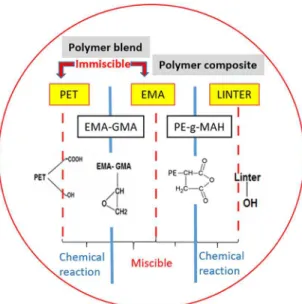
showed higher viscosity compared to PETrec/EMA blend with 30 wt% of EMA due to the reaction of the epoxy group with end groups of the PET chain (Figure 2), increasing the molar mass. Studies have found that the melt low index of EMA-GMA is lower than that of PET under the same load and temperature conditions. Thus, in blends of PET with EMA-GMA, as the EMA-GMA content increases, the melt low index decreases due to the reaction of the epoxy group of GMA with PET24.
between the polymer blends phases, and 5 wt% PE-g-MAH
as compatibilizer between ibers and matrix in PETrec/EMA blend with 30 wt% EMA and 1 wt% linter iber. Since 5 wt% of the coupling agent was used as a function of the concentration of 1 wt% of MAH in PE-g-MAH.
Compatibilized PETrec/EMA/EMA-GMA/CL, PETrec/ EMA/PE-g-MAH/CL and PETrec/EMA/EMA-GMA/PE-g
-MAH/CL composites showed higher viscosity compared to PETrec/EMA/CL composite. This was due to the presence of coupling agents EMA-GMA and PE-g-MAH that showed
higher viscosity, and chemical reactions of the epoxy group of GMA with end groups of the PET chains and reactions of maleic anhydride of PE-g-MAH with linter ibers in the
composite (Figure 2), these reactions led to an increase in the molar mass.
Zimmermann and Zattera.26 observed thatcoupling agents promote covalent chemical bonds or hydrogen bond between phases of ibers. Hristov and Vlachopoulos.27 studied with HDPE and wood powder showed that coupling agent increase in the viscosity of composites, and these results were attributed to the eicient compatibilization of polar wood powder with the nonpolar HDPE matrix provided by the coupling agent.
3.2. Torque rheometry
Figure 3 shows the proiles of the torque rheometry curves of pure polymers.
Figure 2. Schemes of the reactions that occur in the materials studied.
PETrec/EMA/CL composite showed lower viscosity compared to the pure polymer, that is, the addition of 1 wt% of raw linter was suicient to cause a pronounced reduction in the composite viscosity.
The addition of 1 wt% of linter to the PETrec/EMA blend made the melt index values to increase when compared with pure polymer and the PETrec/EMA blend, i.e., it caused a reduction in the material viscosity.
In general, the incorporation of ibers in polymer systems increases the viscosity and goes on increasing with iber content. According to Nair et al25 at low concentration levels,
the viscosity is expected to increase rapidly with increasing concentration of the ibers because of the rapidly increasing collisions between particles as they become packed more closely to each other. However, at a critical concentration level, random packing ceases to be possible and further increase in iber concentration leads to a more orderly anisotropic structure of the ibers in suspension, and these may now slide readily past one another. Hence, above the critical concentration level, further increase in iber concentration progressively decreases the viscosity of the system until very high concentration levels of ibers are reached.
The efect of the coupling agents on polymer composites was evaluated by adding 5 wt% of EMA-GMA as compatibilizer
Figure 3. Torque curves for PETrec, EMA, EMA-GMA and PE-g
-MAH polymers.
Figure 4 shows torque results of pure polymers, non-compatibilized blends, blends non-compatibilized with EMA-GMA, non-compatibilized composites and compatibilized composites with PE-g-MAH.
index results, where compatibilized composites exhibited higher viscosity compared to non-compatibilized composites.
3.3. Scanning electron microscopy
The photomicrographs of the PETrec/EMA and PETrec/ EMA/EMA-GMA immiscible blends (Figure 5) presented the EMA dispersed phase with a spherical morphology, without structural deformation as a function of fragile fracture with liquid nitrogen (-196 ºC), which froze the microstructure.
Figure 4. Torque results of pure polymers, non-compatibilized
blends, blends compatibilized with EMA-GMA, non-compatibilized composites and compatibilized composites with PE-g-MAH.
due to the higher amount of EMA dispersed phase distributed in the PETrec matrix.
The increase in torque occurred due to replacement of the PETrec matrix by EMA, i.e., there was no evidence of the presence of any compatibilization reaction between components because EMA copolymer has no functional groups reactive with PETrec.
PETrec/EMA and PETrec/EMA/EMA-GMA blends showed an intermediate torque value compared with pure polymers. The torque value of compatibilized blend considering experimental error is equal to the non-compatibilized blend. This can be attributed to the fact that 5 wt% EMA-GMA has not been suicient to produce the necessary reactions. Chen28
showed, by means of FTIR analysis, the presence of reaction between end groups of -COOH or -OH of rPET chain and the epoxy group of E-GMA, observed from the decrease in intensity or disappearance of the E-GMA epoxy peak.
The torque curves for all PETrec/EMA/CL composite formulations stabilized at a value equal or close to 0.7 N.m, which was smaller than torque value for PETrec and EMA polymers. The addition of 1 wt% of raw cotton linter (0.48 cm3 linter) reduced the material viscosity, which led the equipment to lose sensitivity. Although the analyses conditions are diferent, this result is consistent with the melt low index result, where composites showing higher luidity, i.e., lower viscosity, may facilitate the processing conditions. Compatibilized composites showed torque value greater than non-compatibilized composites probably due to chemical reactions between epoxy group of GMA with carboxyl and hydroxyl groups of the PET chain and reactions of maleic anhydride with hydroxyl groups of linter ibers (Figure 2). Wu29 observed through FTIR and NMR of poly(hydroxyalkanoates) (PHA) composites grafted with maleic anhydride and tea plant ibers the formation of ester group in the composites formed by reactions between the hydroxyl groups of the iber and the carboxyl groups of the maleic anhydride. This result is consistent with the melt low
Figure 5. Photomicrographs of PETrec/EMA blends (a) 98/2, (b)
94/6, (c) 90/10, (d) 80/20 (e) 70/30 and compatibilized PETrec/EMA/
EMA-GMA blend (f) 70/25/5, in composition of weight percentage.
The increase of the dispersed phase concentration was presented in the photomicrographs (Figure 5 (a) to 5 (e)) of the PETrec/EMA binary blends led to the increase in the size of the EMA dispersed phase, where it was possible to verify a detachment between the EMA dispersed phase and the PETrec matrix. In the PETrec/EMA/EMA-GMA compatibilized blend, it was observed an eicient interfacial adhesion, in which the fracture of the EMA particle was visualized in Figure 5 (f), maintaining the PETrec/EMA interface intact.
Figure 6. Size of particles of EMA in non-compatibilized PETrec/
EMA blend and compatibilized PETrec/EMA/EMA-GMA blend.
The compatibilized PETrec/EMA/EMA-GMA blend with 25 wt% of EMA and 5 wt% of EMA-GMA (Figure 6) showed smaller particle size compared to its corresponding PETrec/EMA blend with 30 wt% of EMA, and the reduction in particle size was due to the presence of EMA-GMA compatibilizer. Macosko et al.31 attributed this to entropic repulsion of molecules located at the compatibilizer interface while balancing the Van der Waals forces and reducing coalescence. Huber et al.12 found a decrease in interfacial tension due to the presence of the compatibilizing agent that decreased the size of the dispersed phase, in which the coalescence probability drops to a negligible value.
According Collyer32 the particle size and size distribution of the dispersed particles will depend on the miscibility of the two phases and on the way in which they are mixed. If the miscibility is good the particles of the rubber will be too small to promote toughening and may even be distributed on a molecular scale. If the two phases are immiscible; which is more likely, the rubber may be dispersed as macroscopic particles too large to give toughening.
Figure 7(a) shows the dispersion and morphological form of cotton linter ibers. Figure 7(b) shows the cotton linter iber surface, which has cylindrical shape with smooth and homogeneous surface. As linter was submitted to no previous
Figure 7. SEM photomicrographs: (a) raw linter ibers, (b) surface of raw linter ibers and (c) PETrec/EMA/CL (70/30/1).
treatment, the smooth surface may be due to presence of waxes, hemicellulose and lignin, which keeps the ibrils together and protect them thermally.
Cotton linter ibers used in this study had diameter of 20 ± 4 µm and length of 240 ± 79 µm, resulting in L/D ratio of 12, which are short and of low size dispersion.
Photomicrograph of Figure 7(c) shows linter iber on the fractured surface of PETrec/EMA/CL composite. The analysis of photomicrographs showed that there was poor adhesion of iber with the blend as evidenced by the pull out of ibers, where voids can be observed between iber and matrix, as well as the absence of polymer on the iber surface. According Iozzi et al.33 a limitation in the use of natural ibers as reinforcements in thermoplastic matrices to obtain composites with improved mechanical properties and dimensional stability is the low wettability and the weak interfacial bonding with the polymer due to the poor compatibility between hydrophilic cellulosic ibers and hydrophobic thermoplastic. Abdullah and Ahmad34 showed that this occurs due to the presence of hydroxyl groups in natural ibers, resulting in high moisture absorption by ibers, thereby reducing wettability and the interfacial iber/ matrix interaction.
3.4. Mechanical uniaxial tensile test
The maximum tensile strength, elasticity modulus and elongation at break of PETrec, PETrec/EMA and PETrec/ EMA/EMA-GMA blends, and PETrec/EMA/CL and PETrec/ EMA/EMA-GMA/CL, PETrec/EMA/PE-g-MAH/CL and PETrec/EMA/EMA-GMA/PE-g-MAH/CL composites were determined by tensile testing, evaluating the efect of the EMA concentration on the blend, the efect of the presence of linter on the composites and the presence of compatibilizing agent (Figures 8 and 9).
phase, and this increase may further enhance the efect of the decrease in the tensile strength and also the modulus of elasticity when compared to the non-compatibilized blend with the same EMA content.
There was a tendency of PETrec/EMA/CL composites presented a higher average in the values of the results of maximum strength and elasticity modulus when compared to the corresponding blends, however the PETrec/EMA blends showed a greater dispersion in the values in almost all the compositions in relation to the maximum resistance. The compatibilized blends and composites presented a low dispersion in the results of maximum strength and elasticity modulus, and lower values than the binary blend with 30 wt% of EMA. This increase in mechanical properties of composites in relation to blends occurred due to the presence of linter ibers (iber are harder than the matrix), providing increased strength and improving rigidity. Chen35 observed a
remarkable increase of the Young’s modulus with increasing rice husk (RH) concentration, which can be attributed to the increased stifness that is caused by the intrinsic properties of RH. In comparison with PETrec, the composite with 2 wt% of EMA and 1 wt% of CL was not observed change of the maximum tensile strength. For other formulations, tensile strength was lower due to the presence of higher EMA levels, the presence of elastomeric particles causes a reduction in the mechanical strength of the material.
Compatibilized composites show mechanical properties of maximum tensile strength and elasticity modulus lower than non-compatibilized PETrec/EMA/CL composite formulations, indicating that reactions that occurred between maleic anhydride of PE-g-MAH and hydroxyl groups of the linter iber (Figure 2) minimized the stifness efect of CL on the composite, with the exception of formulation with 30 wt% of EMA and 1 wt% of CL that showed results similar to compatibilized composites, indicating that the highest percentage of elastomeric phase decreases the tensile strength and elasticity modulus.
The results of elongation at break for PETrec, compatibilized blends, compatibilized blends, non-compatibilized composites and non-compatibilized composites are shown in Figure 10.
The PETrec showed an increased elongation at break, possibly due to its low molecular ordering. Crawford36 observed that polymers with low crystallinity degree exhibit low regular packing than polymers with high crystallinity degree, thus facilitating deformation.
Kelnar et al.8 showed that EMA with 21.5% methyl acrylate
presented elongation at break of 638 ± 76%, and those with 29% methyl acrylate, elongation at break was 847 ± 101%. Leads us to believe that EMA with 24% methyl acrylate would show elongation at break values within this range.
With respect to non-compatibilized blends, a reduction in the elongation at break with increasing EMA content in the blend was observed, and from composition with 20
Figure 8. Maximum strength of PETrec, non-compatibilized blends,
blends compatibilized with EMA-GMA, non-compatibilized composites and compatibilized composites with PE-g-MAH.
Figure 9. Elasticity modulus of PETrec, non-compatibilized blends,
blends compatibilized with EMA-GMA, non-compatibilized composites and compatibilized composites with PE-g-MAH.
thermoplastic matrix by a greater volume fraction of EMA with lower stifness, as expected due to the presence of the elastomeric phase incorporated into the thermoplastic matrix. As observed, the PETrec/EMA blend with lower EMA percentage has maximum strength almost equal to that of PETrec matrix, considering the standard deviation. The formulation with higher EMA percentage showed lower maximum strength and elasticity modulus. According Collyer32 increasing the concentration of the elastomeric phase reduces the tensile strength and elasticity modulus of the blend, regardless if the matrix is brittle or ductile.
4. Conclusion
Morphological analysis of the PETrec/EMA blends and PETrec/EMA/CL composites showed the requirement of using an interfacial compatibilizing agent. The strategy of adding EMA-GMA with compatibilizing agent of the PETrec/EMA blends and the addition of PE-g-MAH for the compatibilization of EMA/CL composite was eicient in function the results of melt low index and torque rheometer, which were corroborated by the results of the mechanical testing. The mechanical results showed that the PETrec/ EMA blend up to 6 wt% of EMA had better performance. And the addition linter iber in the mixture not led to a satisfactory mechanical performance, even with eicient interfacial compatibilization. The results could be diferent depending on the use of a iber with more surface area, i.e., a nanoiber linter to reduce stress concentration with increased contact area, thereby increasing the tensile strength and thus a composite with superior properties to the PET matrix.
5. Acknowledgments
The authors acknowledge to company Global PET for donating PETrec, Dupont for donating EMA, and Delta Opal for donating linter. To CAPES for inancial support. To Professor Dulce Maria de Araújo Melo (IQ-UFRN), Professor Thomas Jeferson Alves de Melo (DEMa-UFCG) and Helena Racy (DEMa-UFSCar) by infrastructure support and materials.
6. References
1. Hellati A, Benachour D, Cagiao ME, Boufassa S, Baltá Calleja FJ. Role of a compatibilizer in the structure and micromechanical properties of recycled poly(ethylene terephthalate)/polyolein blends with clay. Journal of Applied Polymer Science.
2010;118(3):1278-1287.
2. Araújo EM, Hage Jr E, Carvalho AJF. Compatibilization of polyamide 6/ABS blends using MMA-GMA and MMA-MA reactive acrylic copolymers. Part 1. Rheological and mechanical properties of blends. Polímeros. 2003;13:205-211.
3. Martin P, Maquet C, Legras R,Bailly C, Leemans L, van Gurp M, et al. Conjugated efects of the compatibilization and the dynamic vulcanization on the phase inversion behavior in poly(butylene terephthalate)/epoxide-containing rubber reactive polymer blends. Polymer. 2004;45(15):5111-5125.
4. Inoya H, Leong YW, Klinklai W, Takai Y, Hamada H. Compatibilization of recycled poly(ethylene terephthalate) and polypropylene blends: Efect of compatibilization on blend toughness, dispersion of minor phase, and thermal stability.
Journal of Applied Polymer Science. 2012;124(6):5260-5269.
5. Awaja F, Pavel D. Statistical models for optimisation of properties of bottles produced using blends of reactive extruded
Figure 10. Elongation at break of PETrec, non-compatibilized
blends, blends compatibilized with EMA-GMA, non-compatibilized composites and compatibilized composites with PE-g-MAH.
wt% EMA, there was no marked reduction in the elongation of the material, as observed in the standard deviation; the formulations containing 20 and 30 wt% EMA had similar elongation at break.
Blends with 2 to 6 wt% EMA showed higher elongation at break than PETrec, i.e., the addition of EMA into the PET matrix favored elongation in these formulations. Morphological analysis showed that the formulations with 2 and 6 wt% EMA were those that showed the lowest average diameter of the EMA dispersed phase. Increasing the rubber volume fraction causes an increase in the average particle size of the dispersed phase. This factor is critical since the properties of polymer blends are largely afected by size and distribution of particles of the dispersed phase.
PETrec/EMA/EMA-GMA compatibilized blend showed lower elongation than PETrec/EMA blends probably due to the anchoring of the dispersed phase caused by physical mixing of EMA with EMA-GMA and the chemical reaction of the epoxy group of GMA with end components of the PETrec chain. In non-compatibilized blend, EMA particles showed low adhesion with PET, facilitating elongation.
PETrec/EMA/CL composite formulations showed lower elongation at break than PETrec and corresponding blend formulations possibly due to the low adhesion of the blend with the linter.
The efect of interfacial compatibilization in the composite with 30 wt% of EMA phase and 1wt% of CL showed an increase in elongation at break of the composite of the PETrec/ EMA blends phase with 5 wt% EMA-GMA indicating the compatibilization eiciency in this system. The addition of 5 wt% PE-g-MAH in the EMA/CL composite phase
reduced the elongation at break due to the rigidity of CL. And adding together 5 wt% EMA-GMA and 5 wt% PE-g-MAH
recycled PET and virgin PET. European Polymer Journal.
2005;41(9):2097-2106.
6. Fung KL, Li RKY. Mechanical properties of short glass ibre reinforced and functionalized rubber-toughened PET blends.
Polymer Testing. 2006;25(7):923-931.
7. Dimitrova TL, La Mantia FP, Pilati F, Toselli M, Valenza A, Visco A. On the compatibilization of PET/HDPE blends through a new class of copolyesters. Polymer. 2000;41(13):4817-4824.
8. Kelnar I, Sukhanov V, Rotrekl J, Kaprálková L. Toughening of recycled poly(ethylene terephthalate) with clay-compatibilized rubber phase. Journal Applied Polymer Science.
2010;116(6):3621-3628.
9. Gururajan G, Froude V, Riutta S, Thomas A, Gao I, Samuels SL, et al. Efect of poly(ethylene methyl acrylate) copolymer on thermal, morphological, and mechanical properties of polypropylene copolymer blown ilms. Journal Applied Polymer Science. 2008;107(4):2500-2508.
10. Kanis LA, Generoso M, Meier MM, Pires ATN, Soldi V. Poly(ethylene-co-methyl acrylate) membranes as rate-controlling barriers for drug delivery systems: characterization, mechanical properties and permeability. European Journal of Pharmaceutics and Biopharmaceutics. 2005;60(3):383-390.
11. Cerclé C, Favis BD. Generalizing interfacial modiication in polymer blends. Polymer. 2012;53(20):4338-4343.
12. Huber T, Misra M, Mohanty AK. Mechanical properties of compatibilized nylon 6/polypropylene blends; studies of the interfacial behavior through an emulsion model. Journal Applied Polymer Science. 2014;131(18):40792.
13. Kurusu RS, Demarquette NR, Gauthier C, Chenal JM.Efect
of ageing and annealing on the mechanical behaviour and biodegradability of a poly(3-hydroxybutyrate) and poly(ethylene-co-methyl-acrylate-co-glycidyl-methacrylate)blend. Polymer International. 2014;63(6):1085-1093.
14. Feng Y, Zhao G, YinJ, Jiang W.Reactive compatibilization of high-impact poly(lactic acid)/ethylene copolymer blends catalyzed by N,N-dimethylstearylamine. Polymer International.
2014;63(7):1263-1269.
15. Scheirs J. Additives for the modiication of poly(ethylene terephthalate) to produce engineering-grade polymers. In: Scheirs J, Long TE, eds. Modern Polyesters: Chemistry and Technology of Polyesters and Copolyesters. Hoboken: John
Wiley & Sons; 2003. p. 495-540.
16. Bishara AE, Shaban HI. Thermal, Mechanical and Rheological Properties of Polypropylene/Poly(ethylene-co-methyl acrylate) Blends. International Journal of Polymeric Materials and Polymeric Biomaterials. 2009;59(2):134-149.
17. Bonelli CMC, Elzubair A, Suarez JCM, Mano EB. Thermal, mechanical and morphological behavior of recycled high- density polyethylene reinforced with piassava iber. Polímeros.
2005;15(4):256-260.
18. Morais JPS, Rosa MF, Souza Filho MSM, Nascimento LD, Nascimento DM, Cassales AR. Extraction and characterization of nanocellulose structures from raw cotton linter. Carbohydrate Polymer. 2013;91(1):229-235.
19. Hivechi A, Bahrami SH, Arami M, Karimi A. Ultrasonic mediated production of carboxymethyl cellulose: Optimization of conditions using response surface methodology. Carbohydrate Polymer. 2015;134:278-284.
20. Silva LJ, Panzera TH, Christoforo AL, Rubio JCC, Scarpa F. Micromechanical analysis of hybrid composites reinforced with unidirectional natural ibres, silica microparticles and maleic anhydride. Materials Research. 2012;15(6):1003-1012.
21. Simão JA, Carmona VB, Marconcini JM, Mattoso LHC, Barsberg ST, Sanadi AR. Efect of iber treatment condition and coupling agent on the mechanical and thermal properties in highly illed composites of sugarcane bagasse iber/PP. Materials Research.
2016;19(4):746-751.
22. ASTM International. D638: Standard Test Method for Tensile Properties of Plastics. West Conshohocken: ASTM International;
2010.
23. Hale W, Keskkula H, Paul DR. Compatibilization of PBT/ABS blends by methyl methacrylate-glycidyl methacrylate-ethyl acrylate terpolymers. Polymer. 1999;40(2):365-377.
24. Alyamac E, Yilmazer U. Reactive extrusion of poly(ethylene terephthalate) - (ethylene/methyl acrylate/glycidyl methacrylate) - organoclay nanocomposites. Polymer Composites.
2007;28(2):251-258.
25. Nair KCM, Kumar RP, Thomas S, Schit SC, Ramamurthy K. Rheological behavior of short sisal iber-reinforced polystyrene composites. Composites Part A: Applied Science and Manufacturing. 2000;31(11):1231-1240.
26. Zimmermann MVG, Zattera AJ. Recycling and reuse of waste from electricity distribution networks as reinforcement agents in polymeric composites. Waste Management. 2013;33(7):1667-1674.
27. Hristov V, Vlachopoulos J. Inluence of Coupling Agents on Melt Flow Behavior of Natural Fiber Composites. Macromolecular Materials and Engineering. 2007;292(5):608-619.
28. Chen RS, Ab Ghani MH, Salleh MN, Ahmad S, Gan S. Inluence of Blend Composition and Compatibilizer on Mechanical and Morphological Properties of Recycled HDPE/PET Blends.
Materials Sciences and Applications. 2014;5(13):943-952.
29. Wu CS. Preparation, characterization and biodegradability of crosslinked tea plant-ibre-reinforced polyhydroxyalkanoate composites. Polymer Degradation and Stability.
2013;98(8):1473-1480.
30. Favis BD, Willis JM. Phase size/composition dependence in immiscible blends: Experimental and theoretical considerations.
Journal of Polymer Science Part B: Polymer Physics.
1990;28(12):2259-2269.
31. Macosko CW, Guégan P, Khandpur AK, Nakayama A, Marechal P, Inoue T. Compatibilizers for Melt Blending: Premade Block Copolymers. Macromolecules. 1996;29(17):5590-5598.
32. Walker I, Collyer AA. Rubber toughening mechanisms in polymeric materials. In: Walker I, Collyer AA, eds. Rubber toughened engineering plastics. London: Chapman & Hall;
1994. p. 29-53.
of sisal ibers on the properties of composites with nitrile rubber.
Polímeros. 2010;20(1):25-32.
34. Abdullah NM, Ahmad I. Potential of using polyester reinforced coconut iber composites derived from recycling polyethylene terephthalate (PET) waste. Fibers and Polymers.
2013;14(4):584-590.
35. Chen RS, Ahmad S, Gan S. Rice husk bio-iller reinforced polymer blends of recycled HDPE/PET: Three-dimensional stability under water immersion and mechanical performance.
Polymer Composites. 2016. DOI: 10.1002/pc.24260.
36. Crawford RJ. Plastics Engineering. 3rd ed. Oxford: