STUDIES CONCERNING THE EFFECT OF GAMMA RADIATION AND
MAGNETIC FIELD EXPOSURE ON GLADIOLUS
STUDII PRIVIND EFECTUL RADIAŢIILOR GAMMA ŞI A CÂMPULUI
MAGNETIC LA GLADIOLE
CANTOR
*M., POP I., KÖRÖSFÖY S.
ABSTRACT
Gladiolus (Gladiolus sp.) is one of the most floral species cultivated over in the world and in Romania. There are many studies concerning the effect of gamma radiation on ornamental plants but little is known about the synergetic effect of gamma radiation and exposure to magnetic fields on Gladiolus.
In our investigation we have tested the effect of gamma irradiation and magnetic field exposure of gladiolus corms and cormels of the cultivars: Her Majesty, Applause and Speranţa. The corms and cormels were irradiated for 72 hrs with 137 Cs gamma source on cylindrical exposure geometry. At medium dose of 1 Gy has been accumulated for each corm and cormel. For each variety we used 10 corms and 30 cormels in five variants.
The comportment of various varieties was evaluated by recording the following characteristics: length of roots and growth tip.
Significant effect was obtained at the variants which was irradiated with 1 Gy gamma radiation and 3 Gauss magnetic fields.
KEYWORDS: ,gladiolus, corm, cormel, gamma radiation, magnetic field
REZUMAT
Gladiolele (Gladiolus sp.) sunt unele dintre cele mai cultivate specii floricole pe plan mondial dar şi în România. Au fost efectuate multe cercetări privind efectul radiaţiilor gamma asupra plantelor ornamentale, dar se cunoaşte foarte puţin despre efectul sinergetic a radiaţiilor gamma şi a câmpului magnetic la gladiole. In cercetările noastre a fost testat efectul radiaţiilor gamma şi a câmpului magnetic asupra tuberobulbilor şi tuberobulbililor soiurilor de gladiole: Her Majesty, Applause şi Speranţa. Bulbii şi bulbişorii au fost iradiaţi timp de 72 de ore cu 137 Cs surse de radiaţii gamma într-un câmp cilindric. Pentru fiecare varietate au fost au fost utilizaţi 10 tuberobulbi şi 30 de tuberobulbili în cinci variante de expunere.
Au fost efectuate observaţii şi determinări privind comportamentul soiurilor luate în studiu asupra principalele caracteristici: lungimea rădăcinii şi lungimea vârfului de creştere.
Cele mai bune rezultate au fost obţinute la varianta care a fost iradiată cu radiaţii gamma 1Gy şi expusă în câmpul magnetic 3 Gauss.
DETAILED ABSTRACT
Gladiolus (Gladiolus sp.) is one of the most floral species cultivated over in the world and in Romania. Experimental mutagenesis to increase possibilities of creation of new starting material with high ornamentation [2]. In Romania only a few natural mutations were observed in Gladiolus [5] and any artificial mutations was known until now.
There are many studies concerning the effect of gamma radiation on ornamental plants but little is known about the synergetic effect of gamma radiation and magnetic fields exposure on Gladiolus [4]. The studied synergetic effect of gamma radiation, magnetic field will be used in floriculture for improving the culture technology of the ornamental plants or in future breeding programs.
In our investigation we have tested the effect of gamma irradiation and magnetic field exposure of gladiolus corms and cormels of the cultivars: Her Majesty, Applause and Speranţa. The corms and cormels were irradiated for 72 hrs with 137 Cs gamma source on cylindrical exposure geometry. At medium dose of 1 Gy has been accumulated for each corm and cormel. For each variety we used 10 corms and 30 cormels in five variants:
• Gamma radiation (1Gy)
• Gamma radiation (1 Gy) + 3 Gauss magnetic field
• 3 Gauss magnetic field
• 0 Gauss magnetic field
• Control in natural magnetic field (0,5 Gauss)
The comportment of various varieties was evaluated by recording the following characteristics: length of roots and growth tip. From the results statistical averages were calculated.
Significant effect was obtained at the variants which were irradiated with 1 Gy gamma radiation and 3 Gauss magnetic fields. In these cases the major parts of the recorded characteristics were increased.
Also for the variants V1 and V3 stimulation was obtained for these cultivars.
INTRODUCTION
Gladiolus (Gladiolus hybridus L.) is one of the most widespread flower cultures. Experimental mutagenesis permits to increase possibilities of creation of new starting material with high ornamentation [2]. There are many studies concerning the effect of gamma radiation on ornamental plants but little is known about the synergetic effect of gamma radiation and exposure to magnetic fields on Gladiolus.
Many researchers demonstrated that the mutation could be induced to Gladiolus [1]. The corms were irradiated with gamma 2,5-15kR and were obtained a great variability in the color of flowers. The fervency of mutation is higher in VM2 (more 60%) then in VM1.
Induced mutation with gamma irradiation and chemical mutagens in ornamentals plants have been used for genetic changes: high yield, flower, disease resistance, early maturity, etc.
In Romania only a few natural mutations were observed in Gladiolus [7] and any artificial mutations was known until now.
The geomagnetic field (GMF) has been regarded as an environmental factor that has accompanied life on Earth since its beginning [5]. The present value of the GMF on the surface of the Earth is about 0,5 Gauss at mid latitudes. A simple way to study the role of this field for the present status of life is to investigate the behavior of various living systems or their components in condition of lower or higher magnetic field intensities than the geomagnetic field [6].
A survey of the literature shows a great diversity of exposure conditions, and thus it is difficult to extract a meaningful picture for the behavior of living processes exposed from zero up to higher fields. However, at this stage we may accept as a working hypothesis the fact that exposure to magnetic field of lower or higher intensities than the geomagnetic field may induce effects that represent an adaptive process [3]. Nevertheless, some effects appear to depend in a simple monotonic fashion on field intensity.
Our investigation is concerned with the effect of the static component of GMF - 0,5 Gauss, the effect of its absence (conventionally regarded as Zero Magnetic Field - ZMF) - 0 Gauss and the value of GMF about 2000 years ago - 3 Gauss.
MATERIAL AND METHOD
In our investigation we have tested the effect of gamma irradiation and magnetic field exposure of Gladiolus corms and cormels of three cultivars: Her Majesty, Applause and Speranţa. For each variety we used 10 corm and 30 cormels in five experimental variants:
V1 = Gamma radiation (1Gy) - γI;
V2 = Gamma radiation (1 Gy) + 3 GMF - γI + CMI;
V3 = 3 Gauss magnetic field - CMI
V4 = 0 Gauss magnetic field - CM0
V5 = Control in natural magnetic field (0,5 Gauss) -
Control
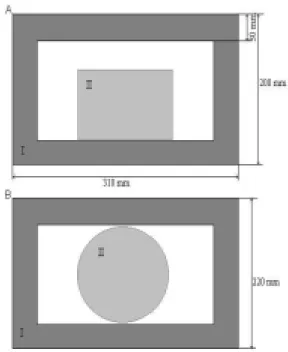
Figure 1: Obtaining ZMF – A and 3 Gauss magnetic field – B
A
Two pair of Helmholtz coils having a 1, 2 m diameter, placed in different rooms, was used to compensate and increase the GMF. The devices were oriented along the local geomagnetic line forces. In the first coil an equal countersigns magnetic field was generated (B1) sufficient to buck out the main static component of the natural field, obtaining ZMF (Figure 1.A). In the second coil was generated a complementary magnetic field of the same sense with GMF, obtained 3 Gauss magnetic field (Figure 1.B).
The middle point of the exposure volume within the coils was placed at about 1,5 m above ground level.
All metal object and electric devices were removed from the room and the neighboring spaces. A chart of magnetic field in the coils was drawn, so that the most uniform sites in the coils were chosen for exposure the samples. Only the static component of magnetic field was checked.
The corms and cormels were irradiated for 72 hrs with 137 Cs gamma source on cylindrical exposure geometry. The facility (Figure 2) was made for the experiment. A medium dose of 1 Gy has been accumulated for each corm and cormel. For better radioprotection the facility was introduced in Pb (Figure 3).
Figure 2. Exposure Facility for gamma irradiation Figure 3. Exposure in Pb
RESULTS AND DISCUSSION
After 7 days were effectuated measurements on root’s length and growth tip length. Then the corms and cormels were planted in the field and were made observations about their evolution.
The analysis of rooting process and growth tip of the
of the influence synergetic of gamma radiation and magnetic field (Table 1).
The comportment of cultivars was evaluated by recording the characteristics length of roots and growth tip.
A
B
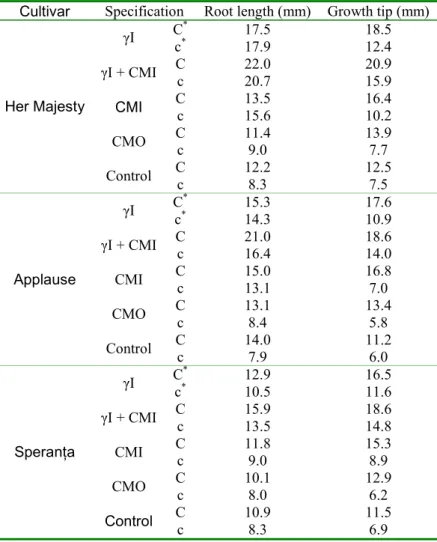
Table 1: Effect of gamma irradiation combined with magnetic field on root length and growth tip
Cultivar Specification Root length (mm) Growth tip (mm)
C* 17.5 18.5
γI c* 17.9 12.4
C 22.0 20.9
γI + CMI c 20.7 15.9
C 13.5 16.4
CMI c 15.6 10.2
C 11.4 13.9
CMO c 9.0 7.7
C 12.2 12.5
Her Majesty
Control c 8.3 7.5
C* 15.3 17.6
γI c* 14.3 10.9
C 21.0 18.6
γI + CMI c 16.4 14.0
C 15.0 16.8
CMI c 13.1 7.0
C 13.1 13.4
CMO c 8.4 5.8
C 14.0 11.2
Applause
Control c 7.9 6.0
C* 12.9 16.5
γI c* 10.5 11.6
C 15.9 18.6
γI + CMI c 13.5 14.8
C 11.8 15.3
CMI c 9.0 8.9
C 10.1 12.9
CMO c 8.0 6.2
C 10.9 11.5
Speranţa
Control c 8.3 6.9
*C=corms; *c=cormels Root length presents the best results for the V2
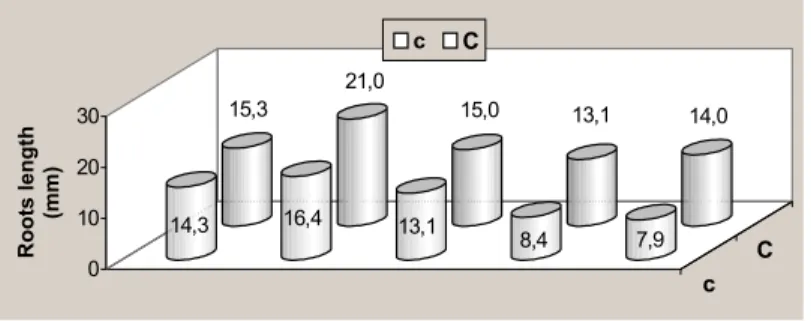
irradiated with 1 Gy gamma radiation plus 3 Gauss magnetic fields. Thus these root of the cultivars Her Majestic had between 22.0 mm for corms and 20.7 mm for cormels, Applause had between 21.0 mm for corms and 16.6 mm for cormels and Speranţa had between 15.9 mm for corms and 13.5 mm for cormels.
Also for the V1 and V3 were obtained good stimulation for the roots. In the case of the V4 and V5 give the worst effect of the roots and growth length
Concerning the growth tip of corms and cormels give the best results for the variant V2 (γI + CMI) for the cultivar Her Majesty (20.9 mm – corm and 15.9 mm – cormel), comparatively with 11.2 mm – corm and 5.8 mm – cormel.
The effect is also preserved after planting the corms and cormels in the field. There was no significant different on flowers, but appeared 7-10 days earlier for the experimental variant γI + CMI.
Figure 4: Roots length of the corms and cormels of Her Majesty
17,5
22,0
13,5 11,4 12,2
17,9 20,7 15,6
9.0 8,3
0 10 20 30
Roots l
ength
(mm)
c C
c C
Figure 5: Roots length of the corms and cormels of Applause
15,3 21,0 15,0 13,1 14,0
14,3 16,4 13,1 8,4 7,9
0 10 20 30
Ro
ots
len
gth
(mm)
c C
c C
Figure 6: Roots length of the corms and cormels of Speranţa
18,5 20,9 16,4 13,9
12,5
12,4 15,9 10,2 7,7 7,5 0
10 20 30
G
ro
w
th
ti
p
(mm)
c C c C
Figure 7: Growth tip of the corms and cormels of Her Majesty
12,9 13,3 11,8 10,1
8,3
10,5 13,5 9,0 8,0 8,3
0,0 5,0 10,0 15,0
Ro
ots
len
gth
(mm)
c C
Figure 8: Growth tip of the corms and cormels of Applause
16,5 18,6 15,3
12,9 11,5
11,6 14,8 8,9 6,2 6,9
0,0 10,0 20,0
G
ro
w
th
ti
p
(mm)
c C c C
Figure 9: Growth tip of the corms and cormels of Speranţa
17,6 18,6 16,8
13,4 11,2
10,9 14,0 7,0 5,8 6,0 0,0
5,0 10,0 15,0 20,0
G
ro
w
th
ti
p
(mm)
c C
c C
CONCLUSION
The investigation effectuated on rooting process and entire plant showed the variability of the influence of gamma radiation and magnetic field over the
Gladiolus.
Treatment with 1Gy gamma radiation at 3 Gauss magnetic field give the best effect of the roots and growth plants.
The cultivars used in our studies responded differently to the treatments applied. Also appeared differences between the corms and cormels.
At the cultivars Her Majesty the length roots was of 22.0 mm( corms) and 20.7mm (cormels) for the
variant γI + CMI comparatively with 12.2 mm( corms) and 8.3 mm (cormels) at the Control variant. Also the same cultivars give the best result about the growth tip for the variant γI + CMI( 20.9mm-corms and 15.9mm-cormels).
The effect is also preserved after planting the corms and cormels in the field. There was no significant different on flowers, but appeared 7-10 days earlier for the experimental variant γI + CMI.
The studied synergetic effect of gamma radiation, magnetic field will be use in Floriculture for improving the culture technology of the ornamental plants or in future breeding program in order to obtain new mutants.
REFERENCES
[1] Brialti, M., Ragasini, R., Togneni, F., 1965 :
Al XII-lea al Academiei Româno-Americane de Ştiinţe şi Arte, Târgovişte, p. 12-16.
[5] Dubrov, A. P., 1978: The Geomagnetic Field and Life: Geomagnetobiology, Plenum, New York.
[6] Morariu, V. V., Ciorba, D., Neamtu, S., 2000: Life in Zero Magnetic Field. Part I, Electro- and Magnetobiology, 19(3), p. 289-302.
[7] Palocsay, R., 1960; Experienţele mele în ameliorarea florilor, Bucureşti, p.95-97
Maria CANTOR, [email protected], * correspondence author, Ioana POP,
Sandor KÖRÖSFÖY