DOI: 10.2298/AVB1203227C UDK 577.123.3:591.16:599.325.1
THE cAMP ANALOGUE, dbcAMP CAN STIMULATE RABBIT REPRODUCTIVE FUNCTIONS. I. EFFECT ON OVARIAN FOLLICULOGENESIS, OVULATION AND EMBRYO PRODUCTION
CHRENEK P*,**, PIVKO J*, MAKAREVICH AV*, KUBOVI^OVÁ HELENA*, BALAZI A* and SIROTKIN AV*,***
*Institute of Animal Genetics and Reproduction, Animal Production Research Centre Nitra, Lu`ianky, Slovak Republic
**Slovak University of Agriculture in Nitra, Slovak Republic ***Constantine the Philosopher University, Nitra, Slovak Republic
(Received 1stSeptember 2011)
The aim of our study was to examine the influence of administration of N6,2’-dibutyryladenosine 3’5’-cyclic monophosphate
(dbcAMP), a cAMP agonist, on ovarian folliculogenesis and atresia, as well as on reproductive efficiency in rabbits, whose ovarian cycle and ovulation was induced by gonadotropins.
Ovarian cycle and ovulation of control rabbits were induced by 20 IU/kg PMSG followed by 35 IU/kg hCG administration. Experimental animals received PMSG and hCG together with dbcAMP (at 5, 25 or 50 mg/animal). After ovulation and insemination, the animals were sacrificed. Ovaries were weighted, histological sections of ovaries were prepared, and the presence of ovulated and not ovulated follicles and different stages of atresia was evaluated by light microscopy. The eggs were flushed from the oviducts after insemination and cultured up to blastocyst cell stage. Numbers of ovarian Corpora lutea, ovulated oocytes and oocyte-derived zygotes and embryos reaching hatched blastocyst stage were determined.
Administration of dbcAMP (at doses 25 or 50mg/animal, but not at 5mg/animal) was able to increase the proportion of follicles with cystic and luteinization-related atresia. Furthermore, dbcAMP (50mg/animal, but not lower doses) increased the ovarian mass, number of Corpora lutea, number of harvested oocytes, zygotes and embryos at blastocyst stage derived from these zygotes after culture.
These data demonstrate that dbcAMP can stimulate rabbit ovarian follicle atresia, ovulation, oocyte, zygote and embryo yield and development. Furthermore, they confirm in the involvement of cyclic nucleotide-dependent intracellular mechanisms in the control of rabbit reproductive functions and potential practical usefulness of dbcAMP in improving animal reproduction and fertility.
INTRODUCTION
There is a growing body of evidence, that cyclic adenosine monophosphate (cAMP) is involved in the control of ovarian functions.
The cAMP/cAMP-dependent protein kinase (PKA) system plays an important role in the control of ovarian cell proliferation, apoptosis, secretory activity, oocyte maturation and in mediating the effect of hormonal stimulators on these processes (Makarevich and Sirotkin, 2000; Conti, 2002; Mehlmann, 2005; Sirotkin, 2005; Hunzicker-Dunn and Maizels, 2006). Furthermore, cAMP can mediate the effects of some hormonal stimulators on oviductal functions (Makarevich and Sirotkin, 1997; Orihuella et al., 2003). Temporal changes in cAMP activity, which can be regulated by pharmacological blockers of cAMP-specific phosphodiesterases (PDEs, catalysers of cAMP degradation) can control sexual maturation and ovarian cyclicity (Wang et al., 2007). Synthetic inhibitors of cAMP-specific PDEs were able to increase cAMP accumulation in ovarian cells, as well as number of ovulations, embryos and born pups in gonadotropin-stimulated rats (McKenna et al., 2005). Administration of IBMX, the inhibitor of cAMP- and cGMP-specific PDEs, stimulated rabbit ovarian follicullogenesis, affected ovarian and oviduct cell proliferation, apoptosis and release of hormones (Sirotkin et al., 2010b) and promoted ovulation and embryo production (Sirotkin et al., 2008, 2010a). These findings indicate, that pharmacological activators of cAMP/PKA could be promising promoters of ovarian functions, as well as enhancers or even alternative to classical hormonal stimulators of reproductive processes in agriculture, human and veterinary medicine and assisted reproduction. Nevertheless, the previous stimulation of reproductive processes in vivo via cAMP/PKA was achieved only by administration of PDE inhibitors, which effect on PKA is not specific (IBMX affects both cAMP and cGMP) and indirect (via inhibition of cyclic nucleotide degradation, but not via direct activation of cAMP and cGMP targets). The effect of direct PKA activator, stabile and cell-permeable cAMP analogue, N6,2’-dibutyryladenosine 3’5’-cyclic monophosphate (dbcAMP; Posternak and Weiman, 1974), on rabbit ovarian steroidogenesis has been observed (Chrenek et al., 2010c), but its action on reproduction and fertility have not been previously studied yet.
The aim of our study was to examine the influence of administration of dbcAMP on ovarian folliculogenesis, atresia and luteogenesis, as well as on the reproductive efficiency (oocyte and zygote recovery end embryo yield and development) in rabbits, whose ovarian cycle and ovulation was induced by gonadotropins.
MATERIALS AND METHODS
Manipulations with animals and embryo production
pregnant mare serum gonadotropin (PMSG, Werfaser, Alvetra und Werfft AG., Vienna, Austria, 20 IU/kg) followed after 72 h by human chorionic gonadotropin (hCG, Werfachor, Alvetra und Werfft AG, 35 IU/kg). Control animals were treated only with these gonadotropins, whilst experimental females received gonadotropins together with dbcAMP (Life Science Institute, Bremen, Germany, at 5, 25 or 50 mg/animal). Gonadotropins and dbcAMP were dissolved in PBS
immediately before injection. All substances (0.7 mL solution of gonadotropin with or without dbcAMP per animal) were injected intramuscularly. At 19-20h after artificial insemination with freshly diluted sperm, the females were killed by decapitation. The ovaries were collected, weighted, numbers ofCorpora luteain both ovaries were determined by visual inspection, and the ovaries were subjected to histological analysis (see below).
The pronuclear stage zygotes were flushed from the oviduct with PBS supplemented with 10% FCS (Gibco BRL/Invitrogen Corp., Carlsbad, CA, USA) and washed in CIM medium +10% FCS (Gibco BRL). The eggs were cultured in k–DMEM + 10% FBS (Gibco BRL) at 5% CO2and 39oC up to blastocyst cell stage. Stages of embryogenesis were determined in different times of culture under a stereomicroscope at 40- or 100-fold magnification. Detailed description of animal and zygote treatment was published previously (Chrenek et al., 1999).
All experiments were carried out with the approval of a local ethical commission in accordance to Slovak and EU regulations concerning animal experiments.
Histological analysis
The ovaries were fixed 24 h in 10% formalin, washed 2 h in flowing water, dehydrated in 70%, 96% and 100% ethanol (2h each) and embedded in paraffin or Technovit 7100 (Heraeus Kulzer GmbH&CoKG, Wehrheim/Ts., Germany) according to instruction of manufacturer. Thereafter the ovaries were serially sectioned by using a standard rotation microtome at 5 or 10mm thickness. The
Figure 1. Histological sections of rabbit ovarian antral not ovulated follicles. Staining with eosin-haematoxylin. Magnification x 300.
A: Healthy follicle (control group) with intact granulosa and theca externa and theca interna cells (arrow).
B: First stages of atresia (control group). Interstitial cells (IC) are intact, some granulose cells contain pyknotic nuclei, some granulosa cells are present in follicular fluid (arrow).
C: Luteinization-associated atresia of follicle (treatment with dbcAMP, 50 µg/animal), hypertrophy of both granulose and theca cells is visible (arrow).
D: Cystic atresia (control group). No epithelial granulose cells in the follicular wall (arrow).
E: Hemorrhagic follicular cyst (asterisk). Some granulose cells with picnotic nuclei are visible in both follicular wall and follicular fluid. Ovary of rabbit treated with dbcAMP (50 µg/animal).
F: Hypertrophied luteinized granulosa and intestinal cells (IC) with pyknotic nuclei (arrows). The large capillaries in intestinal layer are visible (asterisk). The ovary of control animal.
A B
C D
E F
Statistics
Each experiment was performed on 4 control animals and 4 animals treated with dbcAMP at each dose. Each animal from each group was killed, and ovaries and embryos harvested for subsequent analysis. Each experiment was performed 6 times. Histological data represent the data obtained by inspection of slices from 6 ovaries per experiment. The data shown are means of values obtained in 6 separate experiments performed in different days. Significant differences between the groups were evaluated by one-way ANOVA followed by paired t-test or chi-square test by using Sigma Plot 9.0 statistical software (Systat Software, GmbH, Erkrath, Germany). Differences atp<0.05 were considered as significant.
RESULTS
Administration of gonadotropins and subsequent mating of females induced development and ovulation of their ovarian follicles, formation ofCorpora luthea, expulsion of oocytes into the oviduct, and subsequent embryo developmentin vitro(see below).
Histological examination of ovaries after ovulation induced with either with gonadotropins alone or gonadotropins in combination with dbcAMP revealed the presence of ovulated and non-ovulated follicles. Some non-ovulated follicles had signs of luteinization and atresia. Substantial part of ovarian follicles expressed signs of obliteral atresia, cystic atresia and atresia associated with luteinisation. Description of these morphological signs (reduced cell proliferation and appearance of nuclear vacuolization, pyknosis of nuclei, degeneration and disappearance of cells by obliteral and cystic atresia, degeneration the follicular wall, nuclear picnosis, light cytoplasm, cell hypertrophy and intensive multiplication of cells by luteinization and luteinization-associated atresia) is present in Materials and Methods and illustrated in Fig.1.
Micromorphometric analysis of ovarian slices showed the influence of dbcAMP treatment on the occurrence of some forms of follicular atresia of different classes in the ovary (Table 1). Administration of dbcAMP tended to increase percentage of ovulated follicles and decrease the proportion of non-ovulated follicles, but these changes were statistically not significant. Injections of dbcAMP did not substantially affect the proportion of non-ovulated follicles without expressed atresia or with obliteral atresia. On the other hand, ovaries of rabbits treated with dbcAMP at doses 25 and 50mg/animal, but not 5mg/animal,
had higher proportion of follicles with signs of cystic atresia. Moreover, administration of dbcAMP at the dose of 25mg/animal, but not at other doses,
resulted in increased percentage of follicles with atresia associated with luteinization.
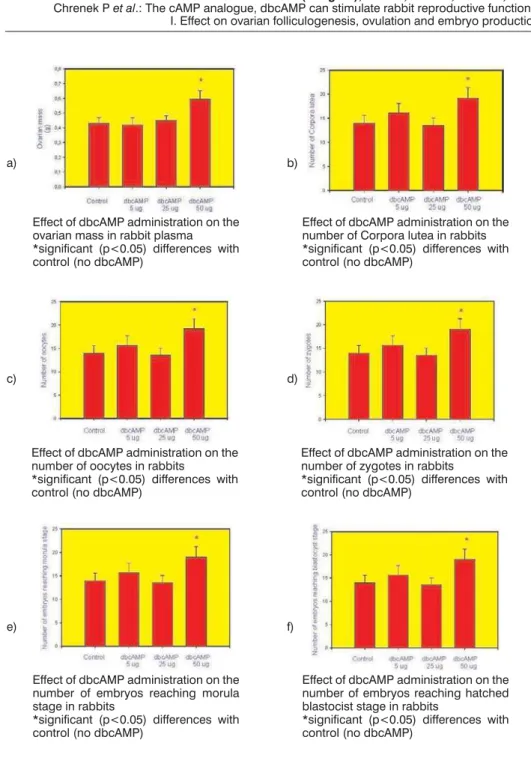
Macromorphometric analysis of ovaries and subsequent evaluation of oocyte and embryo yield and development demonstrated, that administration of dbcAMP at doses 50, but not 5 or 25mg/animal significantly increased the ovarian
Figure 2. Effects of dbcAMP treatment (5, 25 or 50mg/animal) on reproductive parameters
in rabbit females: ovarian mass (a), number of Corpora lutea, (b), number of harvested oocytes (c), zygotes (d), embryos reaching morula stage (e) and embryos reaching blastocyst stage (f). Values are means±S.E.M., * – significant (p<0.05) differences with control (no dbcAMP treatment)
Effect of dbcAMP administration on the ovarian mass in rabbit plasma *significant (p<0.05) differences with control (no dbcAMP)
Effect of dbcAMP administration on the number of Corpora lutea in rabbits *significant (p<0.05) differences with control (no dbcAMP)
Effect of dbcAMP administration on the number of oocytes in rabbits
*significant (p<0.05) differences with control (no dbcAMP)
Effect of dbcAMP administration on the number of zygotes in rabbits
*significant (p<0.05) differences with control (no dbcAMP)
Effect of dbcAMP administration on the number of embryos reaching morula stage in rabbits
*significant (p<0.05) differences with control (no dbcAMP)
Effect of dbcAMP administration on the number of embryos reaching hatched blastocist stage in rabbits
*significant (p<0.05) differences with control (no dbcAMP)
a) b)
c) d)
not at lower doses, significantly increased the number of harvested ovulated oocytes (Fig. 2c), zygotes (Fig. 2d), embryos reaching the morula stage (Fig. 2e) and later hatching the blastocyst stage (Fig.2f) derived from these zygotes after culture.
Table 1. State of rabbit ovarian follicles after ovulation induced by gonadotropins with and without dbcAMP given at different doses
Stage of follicullogenesis
Control (no dbcAMP
treatment) n/%
dbcAMP treatments at dose 5 µg/animal
n/% 25 µg/animaln/% 50 µg/animaln/% All examined follicles 380/100 166/100 159/100 278/100 Follicles after ovulation 116/30,5 64/38,5 51/32,1 102/36,7 Not ovulated follicles total 264/69,5 102/61,4 108/68,6 176/63,3 Not ovulated follicles,
no or small atresia 76/28,8 26/25,5 25/23,1 45/25,6 Not ovulated follicles,
expressed obliteral atresia 51/19,3 21/20,6 19/17,6 34/19,3 Not ovulated follicles,
cystic atresia 23/8,7 9/8,8 21/19,4* 29/16,5* Not ovulated follicles, atresia
associated with luteinisation 39/14,8 17/16,7 26/24,1* 36/20,4 Legend:
n – number of follicles at particular stage of folliculogenesis presented in ovaries; % – percentage of follicles at particular stage of folliculogenesis versus total number of
follicles presented in ovaries;
* – significant (p<0.05) differences with control (no dbcAMP treatment).
DISCUSSION
2006), but not on suppression (Vigas et al., 2008) of ovarian cell apoptosis. These effects of dbcAMP are similar to the effects of gonadotropins, known promoters of ovarian follicles ovulation, luteinization and atresia (Hillier, 2001).
Macromorphometric analysis of ovaries and subsequent evaluation of oocyte and embryo yield and development demonstrated, that administration of dbcAMP can significantly increase the ovarian mass, number ofCorpora luthea
and ovulated oocytes. These effects of dbcAMP are in line with the ability of PDE inhibitors to increase the number of ovulations and Corpora lutea in rats (McKenna et al., 2005) and rabbits (Sirotkin et al., 2008; 2010a) as reported previously. These data confirm the previous data on involvement of cAMP/PKA-dependent intracellular mechanisms in the stimulation of ovarian functions. Furthermore, the present observations represent the firstin vivodemonstration, that dbcAMP can promote ovarian growth, ovulation and oocyte production. Since these effects are similar to known effects of gonadotropins (Hillier, 2001), it suggest that dbcAMP can have gonadotropin-like action on rabbit ovarian cells functions. Moreover, the stimulatory effects of dbcAMP was expressed in rabbits treated with gonadotropins. The additive stimulatory action of dbcAMP suggests, that this molecule can increase the action of gonadotropins on ovarian functions.
It is well-known, that stimulation of ovaries by exogenous gonadotropins can increase ovulation rate and number of ovulated oocytes, but decrease the quality and developmental potential of harvested oocytes (Hillier, 2000; Craig et al., 2007). In our experiments, administration of dbcAMP was able not only significantly to increase the number of harvested oocytes but also the number of fertilized oocytes (zygotes) and subsequent embryos reaching stages of morula and hatching blastocysts after culture. Therefore, the stimulatory action of dbcAMP on rabbit ovarian functions was not associated with negative effects on quality of harvested oocytes and their ability to be fertilized and to develop to embryos up to preimplantation (hatched blastocyst) stage.
Comparison of effects of dbcAMP given at different doses on both ovarian histological indexes and reproductive parameters showed, that low dbcAMP dose (5 mg/animal) was not efficient at all. dbcAMP, when administrated at medium
dose (25 mg/animal), was able to increase cystic and luteinization-associated
atresia of ovarian follicles detected by histological analysis, but these changes did not result in significant changes in rabbit reproductive parameters. It suggests, that medium (25 mg/animal) dose of dbcAMP can potentially affect ovarian
functions and promote gonadotropin-induced atresia, but not stimulatory gonadoitropin effects on ovarian functions. Finally, the dbcAMP, when administrated at high (50mg/animal) dose, promoted cystic, but not
luteinization-associated atresia, as well as increased all reproductive indexes. It demonstrates, that this dose of dbcAMP is high enough to promote not (or not only) gonadotropin-induced follicular atresia, but also follicular development up to ovulation and yield of oocytes and embryos of good quality. This suggests that dbcAMP can control different reproductive events relatively independently and that different ovarian targets have different sensitivity to the dbcAMP action.
ovarian follicullogenesis and increased number of ovulations/Corpora lutea, harvested oocytes, zygotes and embryos without loss of their quality. Practical application of this molecule and other promoters of cAMP/PKA-dependent intracellular mechanisms as additional or alternative stimulator of reproduction in assisted reproduction, animal production, human and veterinary medicine should not to be excluded. Nevertheless, prior to practical application of synthetic cAMP analogues in control of animal and human reproduction and fertility, some key questions should be addressed. In our experiments, dbcAMP given at different doses affected different reproductive parameters, and only one dose (50mg/animal) was really efficient. The optimal dose for animals of different ages
from both physiological and economical viewpoints, should be chosen. Mechanisms of dbcAMP action, including hormonal mechanisms, should be elucidated. The cAMP-related substances should be tested on other species (especially on large farm animals and human). Possible side-effects should be carefully examined in large-scale and long-term studies. Nevertheless, the present observations are the first demonstration, that cAMP analogue, in addition to gonadotropins, could be successfully used for stimulation of rabbit ovarian development, ovulation, oocytes and embryos production.
ACKNOWLEDGEMENTS:
The authors thank Dr. J. Rafay, for kindly providing their animals and facilities for performing the present experiments and Ing. J. ^ulrej, Ing. @. Kuklová and Mrs. K. Tothová for technical assistance. The present study was supported by the Ministry of Agriculture of Slovakia (project MP SR 01).
Address for correspondence:
Assoc. Prof., Dr. Alexander V. Sirotkin, PhD., DrSc. Institute of Animal Genetics and Reproduction Animal Production Research Centre Nitra Hlohovecka 2
951 41 Lu`ianky near Nitra Slovak Republic
E-mail: sirotkinªcvzv.sk
REFERENCES
1.Amsterdam A, Sasson R, Keren-Tal I, Aharoni D, Dantes A, Rimon E et al., 2003, Alternative pathways of ovarian apoptosis: death for life,Biochem Pharmacol, 66, 1355-62.
2.Cheadle C, Nesterova M, Watkins T, Barnes KC, Hall JC, Rosen A et al., 2008, Regulatory subunits of PKA define an axis of cellular proliferation/differentiation in ovarian cancer cells,BMC Med Genomics, 1, 43.
3.Chrenek P, Petrovi~ová I, Rafay J, Bulla J,1999, Superovulation and recovery of zygotes suitable for double-microinjection in three rabbit populations,Czech J Anim Sci, 44, 471-4.
4.Chrenek P, Grossmann R, Sirotkin AV, 2010, The cAMP analogue, dbcAMP affects release of steroid hormones by cultured rabbit ovarian cells and their response to FSH, IGF-I and ghrelin,Eur J Pharmacol, 640, 202-5.
5.Craig J, Orisaka M, Wang H, Orisaka S, Thompson W, Zhu C et al., 2007, Gonadotropin and intra-ovarian signals regulating follicle development and atresia: the delicate balance between life and death,Front Biosci,12, 3628-39.
7.Hillier SG, 2001, Gonadotropic control of ovarian follicular growth and development,Mol Cell Endocrinol, 179, 39-46.
8.Hillier SG, Tetsuka M, 1997 Role of androgens in follicle maturation and atresia,Baillieres Clin Obstet Gynaecol, 11, 249-60.
9.Hinzucker-Dunn M, Maizels ET, 2006, FSH signaling pathways in immature granulosa cells that regulate target gene expression: branching out from protein kinase A,Cell Signal, 18, 351-1359.
10.Makarevich AV, Sirotkin AV, 1997, The involvement of the GH/IGF-I axis in the regulation of secretory activity by bovine oviduct epithelial cells,Anim Reprod Sci, 48, 197-207.
11.Makarevich A, Sirotkin A, Chrenek P, Bulla J, Hetenyi L, 2000, The role of IGF-I, cAMP/protein kinase A and MAP-kinase in the control of steroid secretion, cyclic nucleotide production, granulosa cell proliferation and preimplantation embryo development in rabbits,J Steroid Biochem Mol Biol, 73, 123-33.
12.Makarevich AV, Sirotkin AV, Genieser HG, 2004a, Action of protein kinase A regulators on secretory activity of porcine granulosa cellsin vitro,Anim Reprod Sci, 81, 125-36.
13.Makarevich AV, Sirotkin AV, Franek J, Kwon HB, Bulla J, 2004b, The role of oxytocin, protein kinase A, and ERK-related MAP-kinase in the kontrol of porcine ovarian follicle functions,Exp Clin Endocrinol Diabetes, 112, 108-14.
14.McKenna D, Pietropaolo M, Tos EG, Clark A, Fischer D, Kagan D et al., 2005, Pharmacological inhibition of phosphodiesterase 4 triggers ovulation in follicle-stimulating hormone-primed rats, Endocrinology, 146, 208-14.
15.Orihuela PA, Parada-Bustamante A, Cortés PP, Gatica C, Croxatto HB, 2003, Estrogen receptor, cyclic adenosine monophosphate, and protein kinase A are involved in the nongenomic pathway by which estradiol accelerates oviductal oocyte transport in cyclic rats,Biol Reprod, 68, 1225-31.
16. Posternak T, Weiman G, 1974, The preparation of acylated derivatives of cyclic nucleotides, Methods Enzymol, 38, 399-409.
17.Peluso JJ, 2006, Multiplicity of progesterone's actions and receptors in the mammalian ovary,Biol Reprod, 75, 2-8.
18.Poon SL, An BS, So WK, Hammond GL, Leung PC, 2008, Temporal recruitment of transcription factors at the 3',5'-cyclic adenosine 5'-monophosphate-response element of the human GnRH-II promoter,Endocrinology,149, 5162-71.
19. Ramakrishnappa N, Rajamahendran R, Lin YM, Leung PC, 2005, GnRH in non-hypothalamic reproductive tissues,Anim Reprod Sci, 88, 95-113.
20.Sirotkin AV, 2005, Control of reproductive processes by growth hormone: extra- and intracellular mechanisms,Vet J, 170, 307-17.
21.Sirotkin AV, Makarevich AV, 1999, GH regulates secretory activity and apoptosis in cultured bovine granulose cells through the activation of the cAMP/protein kinase A system,J Endocrinol, 163, 317-27.
22. Sirotkin AV, Nitray J, Kolena J, Bulla J, 1994, Cooperation between LH-RH and LH in the direct action on the ovary: LH-RH stimulation of LH/hCG receptors, basal and LH-induced cAMP and cGMP release by porcine granulosa cellsin vitro,Cell Signal, 6, 135-40.
23.Sirotkin AV, Chrenek P, ^urlej J, Záhradníková M, 2008, Effect of 3-isobutyl-1-methyl-xanthine on rabbit superovulation and egg recovery,Slovak J Anim Sci, 41, 57-59.
24.Sirotkin AV, Chadio S, Chrenek P, Xylouri E, Fotopouloy H, 2010a, Phosphodiesterase inhibitor 3-isobutyl-methyl-xanthine affects ovaria moprphology and stimulates reproduction in rabbits, European J Inflammation,8, 173-9.
25. Sirotkin AV, Chrenek P, Chadio S, Xylouri E, Fotopouloy H, Makarevich AV, 2010b, Phosphodiesterase inhibitor 3-isobutyl-methyl-xanthine affects rabbit ovaries and oviduct,Eur J Pharmacol, 643, 145-51.
27.Viegas LR, Hoijman E, Beato M, Pecci A, 2008, Mechanisms involved in tissue-specific apopotosis regulated by glucocorticoids,J Steroid Biochem Mol Biol, 109, 273-8.
28.Wang Z, Shi F, Jiang YQ, Lu LZ, Wang H, Watanabe G et al., 2007, Changes of cyclic AMP levels and phosphodiesterase activities in the rat ovary,J Reprod Dev, 53, 717-25.
ANALOG cAMP-a, dbcAMP MO@E DA STIMULI[E REPRODUKTIVNE FUNKCIJE KUNI]A. I - UTICAJ NA FOLIKULOGENEZU U JAJNICIMA, OVULACIJU I
NASTANAK EMBRIONA
CHRENEK P, PIVKO J, MAKAREVICH AV, KUBOVI^OVÁ HELENA, BALAZI A i SIROTKIN AV
SADR@AJ
Cilj na{ih ispitivanja je bio da se ispita uticaj aplikacije N6 ,2’-dibutiril-adenozin 3’5’-cikli~nog monofosfata (dbcAMP), agoniste cAMP-a, na folikuloge-nezu i atreziju u jajnicima, kao i na reproduktivnu efikasnost `enki kuni}a, kod ko-jih su ovarijalni ciklus i ovulacija indukovani gonadotropinom.
Ovarijalni ciklus i ovulacija kontrolnih `enki kuni}a su indukovani sa 20 IU/kg PMSG, i ne{to kasnije aplikovanjem 35 IU/kg hCG. @enke eksperimentalne grupe su dobijale PMSG i hCG zajedno sa dbcAMP-om (5,25 ili 50mg/`ivotinji). Posle
ovulacije i inseminacije, `ivotinje su `rtvovane, a zatim je merena masa jajnika. Svetlosnom mikroskopijom je vr{ena histolo{ka analiza i odre|ivano je prisustvo ovuliranih i neovuliranih folikula i kao i folikula sa razli~itim stepenom atrezije. Jajne }elije su posle inseminacije ispirane iz jajovoda i uzgajane do faze blasto-cite. Utvr|ivan je brojcorpora luteana jajnicima, broj ovuliranih oocita i zigota iz-dvojenih iz oocita kao i broj embriona koji su dostigli fazu blastocita
Aplikacija dbcAMP-a u dozama 25 or 50mg/`ivotinji (ali ne i 5mg/ `ivotinji) je
dovodila do pove}anja udela folikula sa cisti~nom atrezijom i atrezijom po-vezanom sa luteinizacijom. Dodatno je dbcAMP u dozi od 50mg/ `ivotinja (ali ne i
u ni`im dozama) pove}avao masu jajnika, broj corpora lutea i broj dobijenih oocita, zigota i embriona u stadijumu blastocista izolovanih od ovih zigota posle kultivacije.