Citius Altius Fortius $ Journal of Physical Education and Sport, University of Pite-ti
39
Online Publication Date: 20 September, 2010ORIGINAL RESEARCH
THE PATTERN OF IPPON APPEARANCE IN MAJOR JUDO COMPETITIONS IN THE PERIOD 2008 $ 2009
Ro-u Daniel $Associate professor PhD
Faculty of Physical Education and Sport, University of Pite ti, Romania [email protected]
Abstract
Purpose:Determining the trends manifested in the current competition judo, in relation to the incidence of the Ippon.
Methods: 26 major judo competitions during 2008 2009 are analysed in terms of the incidence of Ippon, based on gender, age, weight category and the importance of competition.
Results: Ippon appears, on average, at 55.52% of the meetings of males and 51.95% of the meetings of the females. Independent Samples T test shows that these averages are significantly different at p = 0.033.
In men's competitions Ippon represents an increasing share to the extent that increases the weight category: 52.34% in light categories, 57.15% in medium categories, 59.98% in heavy categories. One Way Anova shows that these differences are significant at p = 0.002. The lowest frequency of Ippon occurs in light female categories: 48.90%. The Independent Samples T test shows that between this value and the frequency of 53.91% corresponding to the occurrence of Ippon in the middle categories, there are also statistically significant differences at p = 0.025.
Conclusions:in Judo competitions Ippon occurs following a normal statistical law, yet, some variables such as sex and the weight category can significantly influence the frequency of its occurrence. The age and the importance of the competition do not significantly influence the frequency of Ippon in the competition.
Keywords:Judo, competition, ippon.
Introduction
Judo is a sport of direct adversity, in which each of the partners is trying to surprise the opponent through projections made in the standing fight ( in Nage Waza) and fixations, sprains or strangulations in the mat fight (in Ne Waza). In the competition of judo the referee evaluates these actions designating a winner at the end of the meeting. In certain circumstances the referee may grant Ippon1
,
which is a maximal score that determines the interruption of the meeting before the time limit. Obtaining Ippon represents the fundamental objective of each judo sportsperson, ensuring victory before the time limit. The extent to which Ippon is generally granted in competitions influences the spectacular character of the competition and represents the aspect most appreciated by sportspersons, specialists, spectators and mass media factors.1
Ippon or victory before the limit is given to a judoka in the following situations: after making a perfect throw; after fixing the opponent on the ground for 25 sec.; for the application of an elbow sprain or a strangulation following which the opponent gives up fighting.
Purpose: Determining the trends manifested in current competition judo, in relation to the incidence of the Ippon.
Working hypotheses:
Hypothesis 1. It is assumed that the occurrence of Ippon in the Judo competitions is done observing a normal Statistic.
Hypothesis 2. It is alleged that certain variables significantly influence the Ippon in Judo competitions
Metods:
In this research we to analysed part of the major judo competitions held in the years 2008 and 2009, coded as follows:
Olimpyc Games 2008: OG 08,
World Championships (W): U23 08, S 09, U17 09,
European Championships (EU): U23 08, U20 08, U17 08, S 09, U17 09, U20 09, Grand Slam (GS): 09 BRA, 09 RUS, 09 FRA,
Grand Prix (GP): 09 TUN, 09 GER,
Super World Cup (SWC): 08 HOL, 08 RUS,
World Cup (WC): 09 BRA, 09 EST, 09 ROU, 09 HUN, 09 SPA, 09 POR, 09 CZE, 09BUL Legend: 08 or 09: year 2008 or 2009; S Seniors judoka; U23 youngers judoka under 23; U20 juniors judokas under 23; U17 cadets judokas under 23; BRA Brazilia
The age and gender characteristics of the 25 competitions analysed are described in Table 1: Table 1. The tipes of the competitions
Competition 2008/2009 Seniors U23 U20 U17 Total
For Male 14 2 2 3 21
For Female 15 2 2 3 22
Total 18 2 2 3 25
Variables: considering the fact that the number of meetings that ended before the time limit due to Ippon is dependent on the number of meetings, the latter being dependent in its turn on the number of judoka enrolled in the competition, we’ll calculate the indicator, called the Ippon's % per contest (IP), based on the following formula:
100 .
.
x fights no
ippon no IP
IP analysis aimed at obtaining the pattern of Ippon's occurrence depending on the following criteria: a. Gender: malesversusfemales
b. Age: seniors,versusyounger’s (U23), juniors (U20), cadets (U17)
Weight categories: all seven or eight weight categories was grouping that:
Light categories: the first and the second categories (in classic competition) or first, second and third categories ( at U20 i U17).
Middle categories: next three weight categories Heavy categories: the last two weight categories c. Olympic year (2008)versuspost Olympic year (2009),
d.
Maximum importance competitions (Olympic Games, World Championships, European Championships) versus major competitions (Grand Slam, Grand Prix, Super World Cup, World Cup)e. Combining the criteria above so that they reflect possible statistically significant differences All analyses were performed with the statistical software package SPSS v.13 for Windows. Statistical significances was set at p≤0,05.
Results and interpretation of the data:
1. IP calculation for the main categories of data
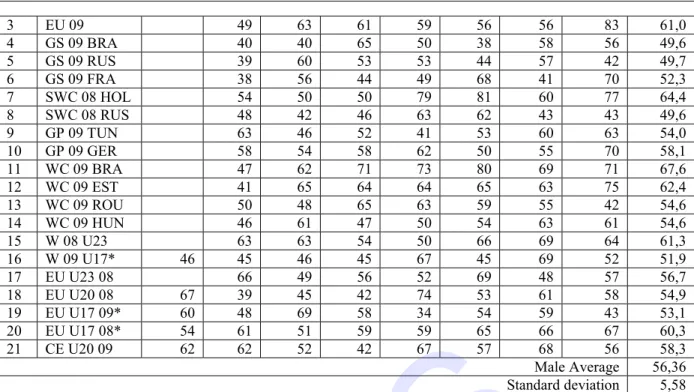
IP calculation for the male competitions is made in Table 2, and for female competitions in Table 3. Table 2. Average of IP (%) for major male competitions from periods 2008 and 2009
No Competition 55kg 60 kg 66kg 73kg 81kg 90kg 100kg +100kg Average
1 OG 08 39 36 51 39 61 51 51 46,9
2 W 09 63 54 60 60 63 67 71 62,6
Citius Altius Fortius $ Journal of Physical Education and Sport, University of Pite-ti
41
3 EU 09 49 63 61 59 56 56 83 61,0
4 GS 09 BRA 40 40 65 50 38 58 56 49,6
5 GS 09 RUS 39 60 53 53 44 57 42 49,7
6 GS 09 FRA 38 56 44 49 68 41 70 52,3
7 SWC 08 HOL 54 50 50 79 81 60 77 64,4
8 SWC 08 RUS 48 42 46 63 62 43 43 49,6
9 GP 09 TUN 63 46 52 41 53 60 63 54,0
10 GP 09 GER 58 54 58 62 50 55 70 58,1
11 WC 09 BRA 47 62 71 73 80 69 71 67,6
12 WC 09 EST 41 65 64 64 65 63 75 62,4
13 WC 09 ROU 50 48 65 63 59 55 42 54,6
14 WC 09 HUN 46 61 47 50 54 63 61 54,6
15 W 08 U23 63 63 54 50 66 69 64 61,3
16 W 09 U17* 46 45 46 45 67 45 69 52 51,9
17 EU U23 08 66 49 56 52 69 48 57 56,7
18 EU U20 08 67 39 45 42 74 53 61 58 54,9
19 EU U17 09* 60 48 69 58 34 54 59 43 53,1
20 EU U17 08* 54 61 51 59 59 65 66 67 60,3
21 CE U20 09 62 62 52 42 67 57 68 56 58,3
Male Average 56,36 Standard deviation 5,58 *U17) weight categories in order left to right:)50kg, )55kg,)60kg, )66kg, )71kg, )81kg, )90kg, +90kg
Interpretation table 2: 60% of male´s competition averages are in male average interval´s ± 1 standard deviation, and 100% are in male average interval´s ± 2 standard deviation.
Table 3. . Average of IP (%) for major female competitions from periods 2008 and 2009
No Competition 44kg 48 kg 52kg 57kg 63kg 70kg 78kg +78kg Average
1 OG 08 38 26 39 55 63 45 62 46,9
2 W 09 56 43 56 55 50 37 78 53,6
3 CU 09 54 71 38 46 60 50 65 54,9
4 GS 09 BRA 54 47 63 53 83 43 50 56,1
5 GS 09 RUS 44 30 45 37 48 65 67 48,0
6 GS 09 FRA 25 48 65 47 48 52 53 48,3
7 SWC 08 HOL 41 55 50 64 38 58 67 53,3
8 SWC 08 RUS 36 33 75 62 62 36 69 53,3
9 GP 09 TUN 67 67 50 80 40 44 50 56,9
10 GP 09 GER 40 58 52 41 41 28 65 46,4
11 WC 09 BRA 50 77 79 50 42 69 43 58,6
12 WC 09 SPA 56 36 68 25 50 47 40 46,0
13 WC 09 POR 67 69 59 35 61 25 14 47,1
14 WC 09 CZE 29 45 44 48 55 41 50 44,6
15 WC 09 BUL 61 59 61 70 63 68 65 63,9
16 W 08 U23 44 47 53 59 65 55 55 54,0
17 W 09 U17* 59 48 53 60 54 42 48 56 52,5
18 EU U23 08 63 38 48 47 53 60 67 53,7
19 EU U20 08 42 41 59 59 51 61 38 48 49,9
20 EU U17 09* 43 45 48 52 54 48 44 63 49,6
21 EU U17 08* 47 46 49 49 58 51 56 55 51,4
22 EU U20 09 27 67 48 63 65 50 61 56 54,6
Female average 51,97 Standard deviation 4,71 *U17 weight categories in order left to right:)40kg, )44kg,)48kg, )52kg, )57kg, )63kg, )70kg, +70kg
Interpretation table 3: 63% of female´s competition averages are in female of average interval´s ± 1 standard deviation, 95% are in female average interval´s ± 2 standard deviation and 100% are in female average interval´s ± 3 standard deviation.
2.
Comparison of IP means based on the gender criterion Se aplică Independent Samples T test (table 4)Table 4. Analiza statistică a diferenŃelor dintre medii pe criteriul sex
Gender n average Sx t p 0,05
male 21 55,52 5,73
female 22 51,95 4,82
2,213 0,033 p<0,05
Interpretation table 4: the means of the share in which they obtain Ippon in the male and female competitions differ significantly in the male competitions, the Ippon being achieved to a greater extent (in approx. 56% of meetings) than in the female ones (in about 52% of meetings).
3.
Analysis of IP variance on the criterion of light, medium and heavy weight categories Results of aplication One Way Anova for male IP i female IP is in table 5.Table 5. Comparison the groups of weight categories (IP average) Gender Weight
categories
n average Sx Homogenity of
variances (sig.)
Anova (sig.)
light 47 52,34 9,26
medium 62 57,15 10,46
males
heavy 41 59,98 10,32
0,930 0.002
light 49 48,90 12,51
medium 66 53,91 11,09
females
heavy 44 52,45 13,15
0,428 0,089
Interpretation table 5:
a.
There is a significant difference between the three groups of weight regarding male categories comparatively, and the frequency of Ippon is growing almost proportionally with the increase of the weight class.b.
One can notice that variances are not homogeneous, and a One Way ANOVA indicates that women's groups do not differ significantly.c.
We must, however, compare the means of the light categories (48.90) compared to the middle categories (table 6).Table 6. Comparison light and medium female weight categories (IP average)
Part of female weight categories n average Sx t p 0,05
Light 49 48,90 12,51
Medium 66 53,91 11,09
2,269 0,025 p<0,05
Interpretation table 6: The means of the female light categories differs significantly from the corresponding female medium categories
(
p<0,05)4. Comparison of IP based on age criterion (table 7)
Table 7. Comparison seniors IP average versus U23, U20, U17(IP average)
Gender Age N average Sx t p
Seniors 14 56,24 6,47
Male
U23, U20, U17 7 56,64 3,55
0,151 p>0,05
Seniors 15 51,86 5,61
Female
U23, U20, U17 7 52,24 2,00
0,234 p>0,05
Interpretation table 7: The calculation of the statistical meaning of IP regarding the age criterion based on the Independent Samples T test did not identify significant differences between the IP media of the seniors versus U23, U20 and U17, both in males (p> 0.05) and females (p> 0.05).
5. Comparison of IP based on the importance of competitions criterion (table 8)
Table 8. Comparison maximum importance competitions versus major competitions (IP average)
Gender Competition N average Sx t p
OG, W, EU 11 56,67 4,75
Male
GS,GP,SWC,WC 10 56,73 6,21
0,024 p>0,05
OG, W, EU 11 51,87 6,06
Female
GS,GP,SWC,WC 12 52,11 2,60
0,114 p>0,05
Interpretation table 8: The calculation of the statistical meaning of IP based on the Independent Samples T test did not identify significant differences between the IP media of the maximum importance competitions (Olympics, World Championships and European Championships) versus major competitions (GS, GP, SWC and WC), both in males (p> 0.05) and females (p> 0.05).
Citius Altius Fortius $ Journal of Physical Education and Sport, University of Pite-ti
43
6. The Comparison of IP for different year (table 9)Table 9. ComparisonOlympic year versus a post Olympic year(IP average)
Gender Competition N average Sx t p
2008 3 53,63 9,42
Male
2009 11 56,95 5,83
0.776 p>0,05
2008 3 51,16 3,69
Female
2009 12 52,03 6,12
0,231 p>0,05
Interpretation table 9:The Comparison of IP for an Olympic year versus a post Olympic year for the competitions for seniors did not reveal statistically significant differences in males or female, either.
Conclusion
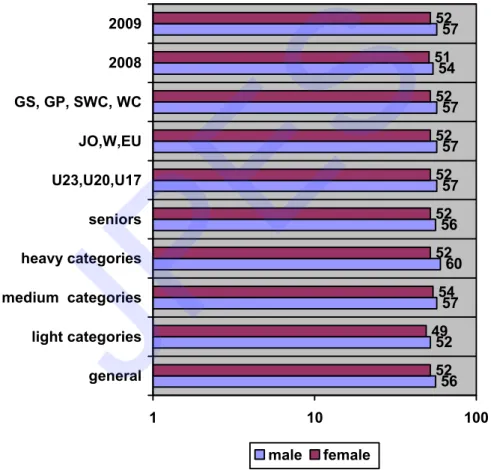
1. The occurrence of the Ippon in major Judo competitions happens based on a normal law, validating the research hypothesis no 1. (table 1, table 2, graph. 1). Under this law Ippon appears, on average, at 55.52% of the meetings of males and 51.95% of the meetings of the females. Independent Samples T test shows that these averages are significantly different at p = 0.033.
Graph 1. General model of IP (ippon%/contest)
! "# "$ # % %
&
'
2. In men's competitions Ippon represents an increasing share to the extent that increases the weight category: 52.34% in light categories, 57.15% in medium categories, 59.98% in heavy categories. One Way Anova showed that these differences are significant at p = 0.002. The lowest frequency of Ippon occurs in light female categories: 48.90%. The Independent Samples T test shows that between this value and the frequency of 53.91% corresponding to the occurrence of Ippon in the middle categories, there are also statistically significant differences at p = 0.025. These results validate the research hypothesis 2.
3. Common to the male and female light weight categories is the aspect of occurrence of the lowest rate of Ippon situations (about 52% in the male categories and 49% in the female categories).
4. The age of the competitors (seniors, youth, juniors or cadets) does not significantly influence the rate of occurrence of the Ippon in the competition.
5. The importance of the judo competition does not significantly influence the rate of occurrence of the Ippon in the competition.
6. Between the share of the Ippon in the senior competitions in the Olympic and post Olympic years there are no statistically significant differences.
7. The identification of the specificities of occurrence of the Ippon, can be fructified in the various areas of functioning and development of judo as a sport, of which one can notice:
a. Optimising the conduct of differentiated sports training, by weight categories in particular in males.
b. Identification of the technical ways through which the rate of the Ippon increases for some of the competition sectors.
c. Identification of the 'health of competitions": the competitions with a very low rate of the Ippon suggest a weak technical training of the judokas registered, while the competitions with too high a rate suggest a great technical imbalance among the judokas.
d. The promotion of Judo image based on capturing the most spectacular moments by the mass media factors.
Bibliography
1. Hantău Ioan, Judo, Instruire si antrenament, București, 2005, p.59 75.
2. Howitt Dennis, Cramer Duncan,Introducere în SPSS pentru psihologie, Traducere de Andrei Popescu i Cristina Popa, Polirom, 2006.
3. Rateau Patrick,Metodele ;i statisticile experimentale în ;tiinŃele umane, Traducere de Andreea Gruev Vintilă, Polirom, 2004.
4. Ro u Daniel et al.,Judo studii, analize ;i sinteze, Ed. Ecademică, GalaŃi, 2006, p.84 116.
5. Ro u Daniel, ApariŃia punctelor IPPON în competiŃiile majore de judo, Buletin UtiinŃific, Seria EducaŃie Fizică i Sport, nr 9 (1/2005), Volum dedicat Simpozionului internaŃional ,,EducaŃie prin sport”, vol I, p. 152 157.
6. www.ippon.org
7. http://www.intjudo.eu/index.php?Menu=Result&Action=List&lang_id=2
SUBSCRIPTION INFORMATION
Subscription online
On the CITIUS ALTIUS FORTIUS – JOURNAL OF PHYSICAL EDUCATION AND SPORT: [email protected]
Print ISSN:1582$8131
Online ISSN: 2066$2483
Annual institutional subscription: 50 euro per year 25 euro per yearAnnual individual subscription: 25 euro per year 10 euro per year
An institutional and individual subscription to the print edition include hard copy of 4 issue per year
An institutional and individual subscription to the online edition include electronic copy of 4 issue per year in pdf format