Considering Positive Psychology Constructs of Life Satisfaction and
School Connectedness When Assessing Symptoms Related to
Attention-Deficit/Hyperactivity Disorder
Emily B. Mancil Jason M. Bird
Mike Lyons Kathryn Van Eck
Bradley H. Smith University of South Carolina
Children and adolescents diagnosed with Attention-Deficit/Hyperactivity Disorder (ADHD) demonstrate significant difficulty with academic and
behavioral functioning. This, in turn, can lead to lower educational attainment and vocational achievement, which has serious long-term consequences and costs to individuals and society (Barkley, 2002, 2006; Mannuzza, Klein, Bessler, Malloy, & LaPadula, 1993). Researchers from a positive psychology framework suggest that ADHD symptoms (i.e., inattention, hyperactivity/impulsivity) alone may not fully explain academic impairment (Diener, Scollon, & Lucas, 2004). From the standpoint of positive psychology, life satisfaction and school
connectedness are important constructs that examine positive life functioning; however, they have been understudied, particularly in the area of ADHD. The current study investigated the relationship between ADHD symptoms and these positive psychological constructs. Results indicate that as ADHD symptoms increase, life satisfaction decreases; however, no relationship between ADHD symptoms and school connectedness was found. Beyond our primary analysis, we examined the relationship between gender and these variables. Results suggest that gender significantly moderates the relationship between ADHD and life satisfaction, with life satisfaction ratings decreasing for males as ADHD symptoms increase, yet remaining stable for females. ADHD symptoms did not significantly predict changes in school connectedness. Furthermore, gender did not significantly moderate the relationship between school connectedness and ADHD symptoms.
Keywords: ADHD, life satisfaction, school connectedness, assessment, intervention, quality of life
Numerous studies have demonstrated that youth diagnosed with Attention-Deficit/Hyperactivity Disorder (ADHD) show significant academic and behavioral impairments compared to their nondiagnosed peers. For example, compared to nondiagnosed peers, students with ADHD are more likely to experience more educational problems (Barry, Lyman, & Klinger, 2002;
Fergusson & Horwood, 1995; Rapport, Scanlan, & Denney, 1999), including lower grades, higher rates of grade retention, elevated use of remedial academic services, and disproportionate placement in special education classes (Biederman et al., 1996). Relative to the general
population, students with ADHD are more likely to experience disciplinary problems that lead to suspension and expulsion (LeFever, Villers, Morrow, & Vaughn, 2002). These difficulties often lead to lower educational attainment and vocational achievement (Barkley, 2002, 2006;
Mannuzza et al., 1993). Over time, these difficulties can have long-term consequences and costs to individuals and society.
Although ADHD symptoms are related to impairment, symptom severity does not account for all of the variance in academic impairment. Traditional methods of school- and clinically-based assessment have focused primarily on negative outcomes of mental health, such as a child’s level of psychopathology, cognitive disability, or disruptive behaviors (Suldo, Huebner, Savage, & Thalji, 2011). These traditional methods of assessment are generally referred to as a “deficit-focused” or “disease” model of mental health. Researchers in the field of positive psychology have identified the need to study and intervene in critical areas of development related to optimal functioning and positive well-being (Proctor, Linley, & Maltby, 2009; Seligman, 2002;
Seligman, Steen, Park, & Peterson, 2005). It has been argued that the assessment of positive well-being and developmental assets (e.g., life satisfaction and school connectedness) are
important for evaluating the overall impact of school-based interventions, as many of the current interventions focus on reducing problem behaviors (e.g., disciplinary referrals), rather than increasing positive behaviors (Suldo & Huebner, 2004).
Life Satisfaction and School Connectedness
Life satisfaction (LS) has emerged as an important developmental construct of study in the field of positive psychology (Gilman & Huebner, 2003), particularly as it relates to students’
Valle, Huebner, & Suldo, 2006). Thus, LS appears to have a strong positive relationship with students’ academic achievement and school connectedness.
School connectedness (SC) is defined as a student’s perceived social bonding and quality of relationships with peers and teachers (Karcher, 2005; You et al., 2008). In a recent study, Whitlock (2006) proposed a conceptual model based on SC as a protective factor leading to increased (a) student involvement in meaningful roles at school, (b) safety at school, (c)
opportunities for creative engagement, and (d) opportunities for academic engagement (as cited in You et al., 2008). Research that emphasizes positive, or strengths-based, factors for students with ADHD-related symptoms is needed in order to improve outcomes for this population.
To date, little empirical research has been conducted on positive developmental factors for children with ADHD. There is some support for academic engagement as an important factor in classroom interventions for students with ADHD (Martin, 2012; Ozdemir, 2011), suggesting that this positive construct may buffer the impact of ADHD behaviors on academic impairment. Several researchers have found that as ADHD behaviors increase, LS decreases in college students and adults (Gudjonsson, Sigurdsson, Eyjolfsdottir, Smari, & Young, 2009; Mick, Faraone, Spencer, Zhang, & Biederman, 2008). However, to the authors’ knowledge, there is a limited amount of research that has examined these positive factors for children and adolescents with ADHD, particularly in terms of self-reported LS and SC (e.g., Coghill, 2010). Given the high prevalence of school-related problems in students with ADHD, it is critical to examine these constructs in school-aged children in order to develop strategies to increase their opportunities for success in school.
Oppositional Defiant Disorder (ODD) is a disruptive behavior disorder that is often comorbid with ADHD (Barkley, 2006; The MTA Cooperative Group, 1999; Wilens et al., 2002). Youth with ODD symptoms display significantly lower academic achievement and increased rates of special classroom placement, compared to youth without these symptoms (Greene, Beszterczey, Katzenstein, Park, & Goring, 2002; Kuhne, Schachar, & Tannock, 1997). The increased school-based impairment associated with ODD symptoms may lead to decreased life satisfaction and school connectedness, confounding the link between ADHD symptoms and these constructs.
girls. Thus, it was predicted that the male gender would amplify the negative relationship between ADHD symptoms and both outcome variables (LS and SC). ODD symptoms were controlled for in analyses.
Method
Setting
Data were collected at two afterschool sites of the Challenging Horizons Programs of South Carolina (CHP-SC), provided as a partnership between a large, southeastern university and a local school district. The CHP-SC is a multimodal, evidence-based service-learning program that provides afterschool instruction in schools to at-risk students (Langberg et al., 2007). These students are referred to the afterschool program by school administrators and teachers, who are asked to consider family income (i.e., free or reduced lunch status), course grades (e.g., receiving a grade of “D” or “F” in one or more core classes), and standardized test scores (e.g., failing to score above the standards set by the state standardized achievement test or failing to meet growth goals on standardized tests) when recommending students for the program.
Participants
General demographic information was collected for this study (e.g., gender, age, race, free or reduced lunch status) using self-report surveys. Participants included students and their parents from both an elementary and middle school site located in a single school district. As there was a discrepancy between the number of measures completed, with 94 students completing LS measures, 78 students completing SC measures, and 69 parents completing ADHD and ODD measures, missing data were handled using listwise deletion for each set of analyses conducted. Participants included students in grades 3-8 who were enrolled in the CHP-SC afterschool programs and their parents. Students were mostly African American (73%, n = 72) and ranged in age from 7 to 14 years (M = 10.57, SD = 1.86). The remaining 27% of students were
identified as Caucasian (13%, n = 13), Hispanic/Latino (2%, n = 2), and “other” (7%, n = 7). Four participants (4%) did not respond to this item. It was reported that 95% of the students received free or reduced lunch (n = 93).
Measures
Brief Multidimensional Students’ Life Satisfaction Scale (BMSLSS). The BMSLSS
(Huebner, 1997) is a 5-item scale assessing students’ overall life satisfaction. It was developed for situations when only brief measures of life satisfaction are needed. The scale yielded reliable
Huebner, & Valois, 2006; Seligson, Huebner, & Valois, 2003, 2005). Each item is designed to measure life satisfaction in one of five domains (family, friends, school, self, and living
environment), with a sixth item that evaluates overall life satisfaction. Items are rated using a Likert scale that ranges from 1 (terrible) to 7 (delighted).
Hemingway Measure of Adolescent Connectedness (Hemingway). The Hemingway (Karcher, 2001) is a self-report survey consisting of 47 items that fall into three dimensions of
connectedness to self, to others, and to society. The three overall dimensions of connectedness are measured with 15 subscales that include four to six items each. For this study, only the “school” subscale from the society connectedness dimension was used. This subscale consists of 6 items that are rated on a Likert scale with answer choices ranging from 1 (not at all true) to 5
(very true). The scale yielded reliable internal consistency (α = .73).
The Vanderbilt ADHD Diagnostic Parent Rating Scale (Vanderbilt). The Vanderbilt (Wolraich et al., 2003) is a 49-item measure comprised of two subscales: a diagnostic and an academic rating scale. The diagnostic scale (α = .95) includes all 18 criteria of the Diagnostic and Statistical Manual of Mental Disorders, 4th edition text revision(American Psychiatric
Association, 2000) for ADHD (α = .94), 8 criteria for Oppositional Defiant Disorder (ODD; α = .89), 12 criteria for conduct disorder, and 7 criteria that screen for anxiety and depression. Only the 33 items assessing ADHD- and ODD-related behaviors were used for this study. Parents were asked to rate the severity of each behavior on a 4-point scale ranging from 0 (never) to 3 (very often). Items from each subscale (ADHD and ODD) were totaled to create total scores for each student in order to evaluate ADHD and ODD symptom severity.
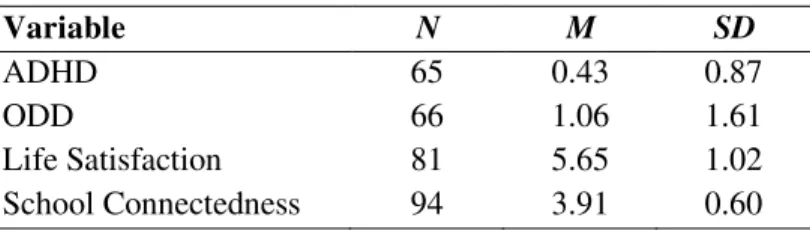
Descriptive statistics for the variables used in the study are shown in Table 1.
Table 1. Descriptive Statistics
Variable N M SD
ADHD 65 0.43 0.87
ODD 66 1.06 1.61
Life Satisfaction 81 5.65 1.02 School Connectedness 94 3.91 0.60
Procedure
survey. The first author administered self-report measures (i.e., the BMSLSS and the
Hemingway) to students who voluntarily completed them in a computer lab at the afterschool program using Qualtrics, a website commonly utilized for data collection.
Data Analytic Strategy
As the data used in this study were collected at two different time points (fall and spring semesters), participants could have differed in terms of ADHD symptoms, LS, and SC. First, Multivariate Analyses of Variance (MANOVA) was used to examine potential group differences across the two time points prior to running further analyses. Second, multiple regression was used for the first set of analyses to examine the main effects of ADHD-related symptoms on LS and SC. The ODD and gender variables were included as covariates in the model. Finally, an interaction term between ADHD and gender was also specified. The ADHD variable was centered prior to creating the interaction term. A post-hoc power analysis using G* Power 3
(Faul, Erdfelder, Buchner, & Lang, 2009) for linear multiple regression, with fixed group differences, was .81 to detect a small effect (.15) with a sample size of 69 students. Power to detect a medium effect (.30) was estimated at .98.
Results
The assumptions of multiple regression were met, indicating an absence of outliers, homogeneity of variance, no major deviations from normality, and independence of errors. The first analysis examined potential group differences across the two time points. Results indicated no group differences between the participants in the fall and spring groups based on the relationship between ADHD and LS, F(16, 49) = .755, p = .72, and ADHD and SC, F(24, 60) = .9, p = .6; thus, the time point variable was not included as a covariate.
Figure 1. Relationship between ADHD Symptoms and Life Satisfaction for Males and Females
Table 2. Multiple Regression Analyses for Life Satisfaction (LS)
B SE t-value p-value
Intercept 5.65 0.20 28.15 0.00
Gender -0.05 0.24 -0.21 0.83
ADHD -0.89 0.21 -4.16 0.00
ODD 0.01 0.08 0.10 0.92
Gender*ADHD 0.86 0.32 2.71 0.01
Note: R2 = 0.30; F(4,46) = 4.90, p < 0.00. ADHD and ODD variables are used to describe parent-reported symptoms.
0 1 2 3 4 5 6 7
-.87 (-1 SD) 0 (mean) 0.87 (+1 SD)
L
if
e S
at
si
fact
io
n
Ratings of ADHD Symptoms Predicted Life Satsifaction
Females
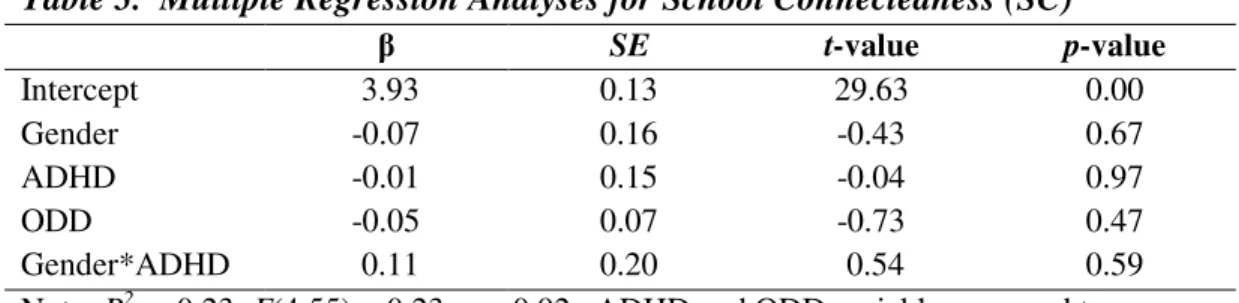
The second set of analyses examined the main effect of ADHD on SC. Results suggest that gender and ODD symptoms were not significant predictors of SC. Contrary to our hypothesis, ADHD symptoms also did not significantly predict changes in SC, β = -0.01; t(55) = 0.15, p > 0.05. Furthermore, gender did not significantly moderate the relationship between SC and ADHD symptoms, β = 0.11; t(55) = 0.20, p > 0.05. The complete results of these analyses are reported in Table 3.
Table 3. Multiple Regression Analyses for School Connectedness (SC)
β SE t-value p-value
Intercept 3.93 0.13 29.63 0.00
Gender -0.07 0.16 -0.43 0.67
ADHD -0.01 0.15 -0.04 0.97
ODD -0.05 0.07 -0.73 0.47
Gender*ADHD 0.11 0.20 0.54 0.59
Note: R2 = 0.23; F(4,55) = 0.23, p = 0.92. ADHD and ODD variables are used to describe parent-reported symptoms. β and SE values indicate unstandardized variables.
Discussion
Results of the first analysis supported the hypothesis that as parent report of ADHD symptoms increased, student ratings of LS decreased. Studies have consistently demonstrated that
untreated ADHD symptoms have an adverse impact on quality of life (Danckaerts et al., 2010). Nevertheless, quality of life (e.g., life satisfaction) is not routinely used to assess students with ADHD, and we recommend greater attention to this construct. Results from the interaction indicated that gender significantly moderated the relationship between ADHD and LS. As ADHD symptoms increased, ratings of LS for males decreased, whereas these ratings for females generally remained stable. This might suggest that social-ecological factors at school may impact boys differently than girls. It is well known that boys with ADHD tend to
demonstrate higher rates of externalizing behaviors and “rule breaking” in the classroom when compared to girls (Abikoff et al., 2002). It is plausible that because boys tend to get “called out” for more problems at school, this may decrease their perceptions of satisfaction with life.
Contrary to our hypothesis, results of the second analysis indicated that parent report of ADHD symptoms did not significantly predict changes in students’ SC. Furthermore, gender did not significantly moderate the relationship between SC and ADHD symptoms.
factor model has emerged as a promising approach for comprehensive mental health assessment (Diener, Suh, Lucas, & Smith, 1999). This approach examines symptoms and positive
psychology constructs simultaneously, placing individuals into 4 distinct categories: flourishing (low symptoms, high well-being); vulnerable (low symptoms, low well-being); symptomatic, but content (high symptoms, high well-being); and troubled (high symptoms, low well-being). This joint consideration of symptoms and positive constructs leads to greater clarity about functioning and prognosis (Diener et al., 1999). Further investigation of these considerations is, therefore, strongly indicated in applied and research settings.
Limitations of the Study
This publication should be viewed primarily as a conceptual, rather than empirical, paper. The primary purpose is to call attention to the need to consider both symptoms and positive
psychological constructs when examining students’ impairment in school settings. The theoretical support for consideration of both ADHD symptoms and positive psychological constructs, such as LS and SC, is strong. However, empirical aspects of this study are limited by the sample and preliminary nature of our results. Nevertheless, these data help to showcase some constructs that may be impacted by ADHD. Results from this study suggest that examining these constructs in relation to ADHD symptoms for youth may provide a better
picture of impairment and help to inform prevention and intervention strategies for school mental health.
A limitation of this study is that it relies on single sources for the measures collected cross-sectionally. ADHD symptoms were solely based on parent report and positive constructs were measured cross-sectionally, using self-report. A multimethod approach to collect data would be preferred and could yield a different pattern of results. Likewise, longitudinal studies would be highly informative.
As access to student health records was not available for this study, medication use (i.e.,
stimulant or other medications used for the treatment of ADHD) was not included as a covariate. Future studies should control for medication use, as this may impact students’ ratings of life satisfaction and school connectedness, along with parent report of ADHD symptomology.
As little research exists, specifically pertaining to African American students with ADHD, these results may provide useful information for future researchers who wish to study this group. However, because the sample in the current study is selected as a high risk, racially
Findings related to SC raise questions regarding the stability and validity of the data. As the study had a small sample size, chances of making a Type II error were elevated. Further, self-reports were conducted at two time points (some students reported in the fall and some reported in the spring), which may have contributed to the error variance in responses. This suggests further investigation of the relationship between ADHD and SC in order to form stronger interpretations of the results.
Future Implications
Future research on school-based interventions should examine ADHD gender differences in LS and how SC relates to social functioning and other areas of impairment (e.g., academic
performance). It is important to study how cultural and social expectations shape the way boys and girls respond to academic failure in order to develop strategies that will increase LS before academic failure occurs. In addition, the distinct effects of teacher-, peer-, and school-related connectedness on students’ LS should be further evaluated to develop more appropriate interventions for children with ADHD and disruptive behavior problems who are struggling in school. Integrating positive behavioral strategies in schools has been effective in improving students’ well-being and positive school functioning. Previous intervention strategies have included goal-setting and progress monitoring (Marques, Pais-Ribeiro, & Lopez, 2007), gratitude exercises (Froh, Sefick, & Emmons, 2008), and problem-solving skills (Cauce, Comer, &
Schwartz, 1987). Examining the impact that positive psychology interventions have on the relationship between symptomology, LS and SC, and measures of academic impairment (e.g., course grades, disciplinary referrals) may inform intervention for this population more precisely than examining symptoms alone.
References
Abikoff, H. B., Jensen, P. S., Arnold, L. E., Hoza, B., Hechtman, L., Pollack, S., . . . Wigal, T. (2002). Observed classroom behavior of children with ADHD: Relationship to gender and comorbidity. Journal of Abnormal Child Psychology, 30(4), 349–359.
American Psychiatric Association. (2000). Diagnostic and statistical manual of mental disorders
(4th ed., Text Rev.). Washington, DC: American Psychiatric Association. Barkley, R. A. (2002). Major life activity and health outcomes associated with
attention-deficit/hyperactivity disorder. Journal of Clinical Psychiatry, 63(12), 10–15. doi:v63s1202
Barry, D. T., Lyman, R. D., & Klinger, L. G. (2002). Academic underachievement and attention-deficit/hyperactivity disorder: The negative impact of symptom severity on school performance. Journal of School Psychology, 40, 259–283. doi:10.1016/S0022-4405(02)00100-0
Biederman, S., Farone, S., Milberger, S., Guite, J., Mick, E., Chen, L., . . . Perrin, J. (1996). A prospective 4-year follow-up study of attention-deficit hyperactivity and related disorders. Archives of General Psychiatry, 53(5), 437–446.
doi:10.1001/archpsyc.1996.01830050073012
Biederman, J., Mick, E., Faraone, S. V., Braaten, E., Doyle, A., Spencer, T., . . . Johnson, M. A. (2002). Influence of gender on attention deficit hyperactivity disorder in children referred to a psychiatric clinic. American Journal of Psychiatry, 159(1),36–42.
doi:10.1176/appi.ajp.159.1.36
Cauce, A. M., Comer, J. P., & Schwartz, D. (1987). Long term effects of a systems-oriented school prevention program. American Journal of Orthopsychiatry, 57(1),127–131. doi: 10.1111/j.1939-0025.1987.tb03519.x
Ciarrochi, J., Heaven, P. C. L., & Davies, F. (2007). The impact of hope, self-esteem, and
attributional style on adolescents’ school grades and emotional well-being: A longitudinal study. Journal of Research in Personality, 41(6), 1161–1178.
doi:10.1016/j.jrp.2007.02.001
Coghill, D. (2010). The impact of medications on quality of life in attention-deficit hyperactivity disorder: A systematic review. CNS Drugs, 24(10), 843–866. doi:10.2165/11537450-000000000-00000.
Danckaerts, M., Sonuga-Barke, E. J., Banaschewski, T., Buitelaar, J., Döpfner, M., Hollis, C., . . . Coghill, D. (2010). The quality of life of children with attention deficit/hyperactivity disorder: A systematic review. European Child & Adolescent Psychiatry, 19(2), 83–105. doi:10.1007/s00787-009-0046-3
Diener, E. (1994). Assessing subjective well-being: Progress and opportunities. Social Indicators Research, 31(2),103–157. doi:10.1007/BF01207052
Diener, E., Scollon, C. N., & Lucas, R. E. (2004). The evolving concept of subjective well-being: The multifaceted nature of happiness. In P. T. Costa & I. C. Siegler (Eds.), Advances in cell aging and gerontology (Vol. 15, pp. 187–220). Amsterdam: Elsevier Science. Diener, E., Suh, E. M., Lucas, R. E., & Smith, H. L. (1999). Subjective well-being: Three decades of progress. Psychological Bulletin, 125(2),276–302. doi:10.1037/0033-2909.125.2.276
Faul, F., Erdfelder, E., Buchner, A., & Lang, A. G. (2009). Statistical power analyses using G* Power 3.1: Tests for correlation and regression analyses. Behavior Research Methods, 41(4),1149–1160. doi:10.3758/BRM.41.4.1149
Froh, J. J., Sefick, W. J., & Emmons, R. A. (2008). Counting blessings in early adolescents: An experimental study of gratitude and subjective well-being. Journal of School Psychology,
46(2), 213–233. doi:10.1016/j.jsp.2007.03.005
Funk, B. A., Huebner, E. S., Valois, R. F. (2006). Reliability and validity of a brief life satisfaction scale with a high school sample. Journal of Happiness Studies, 7, 41–54. doi:10.1007/s10902-005-0869-7
Gilman, R., & Huebner, E. S. (2003). A review of life satisfaction research with children and adolescents. School Psychology Quarterly, 18, 192–205.
doi:10.1521/scpq.18.2.192.21858
Gilman, R., & Huebner, E. S. (2006). Characteristics of adolescents who report very high life satisfaction. Journal of Youth and Adolescence, 35(3),311–319. doi:10.1007/s10964-006-9036-7
Greene, R. W., Beszterczey, S. K., Katzenstein, T., Park, K., & Goring, J. (2002). Are students with ADHD more stressful to teach? Patterns of teacher stress in an elementary school sample. Journal of Emotional and Behavioral Disorders, 10, 79–89.
doi:10.1177/10634266020100020201
Gudjonsson, G. H., Sigurdsson, J. F., Eyjolfsdottir, G. A., Smari, J., & Young, S. (2009). The relationship between satisfaction with life, ADHD symptoms, and associated problems among university students. Journal of Attention Disorders, 12(6), 507–515.
doi:10.1177/1087054708323018
Huebner, E. S. (1997). Happiness and life satisfaction. In G. Bear, K. Minke, & A. Thomas (Eds.), Children’s needs II (pp. 271–278). Bethesda, MD: National Association of School Psychologists.
Huebner, E. S., Valois, R. F., Paxton, R. J., & Drane, J. W. (2005). Middle school students’ perceptions of quality of life. Journal of Happiness Studies, 6, 15–24.
doi:10.1007/s10902-004-1170-x
Karcher, M. J. (2001). The Hemingway: Measure of adolescent connectedness: Validation studies. ERIC no. ED477969; ERIC/CASS no. CG032433. Available at
http://www.eric.ed.gov/PDFS/ED477969.pdf.
Karcher, M. J. (2005). The effects of developmental mentoring and high school mentors’ attendance on their younger mentees’ self-esteem, social skills, and connectedness.
Psychology in the Schools, 42(1),65–77. doi:10.1002/pits.20025
Kuhne, M., Schachar, R., & Tannock, R. (1997). Impact of comorbid oppositional or conduct problems on attention-deficit hyperactivity disorder. Journal of the American Academy of Child & Adolescent Psychiatry, 36(12), 1715–1725. doi:10.1097/00004583-199712000-00020
LeFever, G. B., Villers, M. S., Morrow, A. L., & Vaughn, E., III. (2002). Parental perceptions of adverse educational outcomes among children diagnosed and treated for ADHD: A call for improved school/provider collaboration. Psychology in the Schools, 39, 63–71. doi:10.1002/pits.10000
Lewis, A. D., Huebner, E. S., Malone, P. S., & Valois, R. F. (2011). Life satisfaction and student engagement in adolescents. Journal of Youth and Adolescence, 40, 249–262.
doi:10.1177/0734282908330571
Mannuzza, S., Klein, R. G., Bessler, A., Malloy, P., & LaPadula, M. A. (1993). Adult outcome of hyperactive boys: Educational achievement, occupational rank, and psychiatric status.
Archives of General Psychiatry, 50, 565–575. doi:10.1001/archpsyc.1993.01820190067007
Marques, S. C., Pais-Ribeiro, J. L., & Lopez, S. J. (2007, December). Hope intervention and psychological benefits in middle-school students. Paper presented at the International Society for Quality-of-Life Studies Annual Conference, San Diego, CA.
Martin, A. J. (2012). The role of personal best (PB) goals in the achievement and behavioral engagement of students with ADHD and students without ADHD. Contemporary Educational Psychology, 37(2),91–105. doi:10.1016/j.cedpsych.2012.01.002 Mick, E., Farone, S. V., Spencer, T., Zhang, H. F., & Biederman, J. (2008). Assessing the
validity of the Quality of Life Enjoyment and Satisfaction Questionnaire—Short Form in adults with ADHD. Journal of Attention Disorders, 11(4), 504–509.
doi:10.1177/1087054707308468
Ozdemir, S. (2011). The effects of the First Step to Success program on academic engagement behaviors of Turkish students with attention-deficit/hyperactivity disorder. Journal of Positive Behavior Interventions, 13(3), 168–177. doi:10.1177/1098300710373503 Proctor, C. L., Linley, P. A., & Maltby, J. (2009). Youth life satisfaction: A review of the
literature. Journal of Happiness Studies, 10, 583–630. doi:10.1007/s10902-008-9110-9 Rapport, M. D., Scanlan, S. W., & Denney, C. B. (1999). Attention-deficit/hyperactivity disorder
and scholastic achievement: A model of dual developmental pathways. Journal of Child Psychology and Psychiatry, 40(8),1169–1183. doi:10.1017/S0021963099004618 Seligman, M. E. P. (2002). Authentic happiness: Using the new positive psychology to realize
your potential for lasting fulfillment. New York, NY: Free Press.
Seligman, M. E. P., Steen, T. A., Park, N., & Peterson, C. (2005). Positive psychology progress: Empirical validation of interventions. American Psychology, 60(5),410–412.
doi:10.1037/0003-066X.60.5.410
Seligson, J. L., Huebner, E. S., & Valois, R. F. (2003). Preliminary validation of the Brief Multidimensional Students’ Life Satisfaction Scale (BMSLSS). Social Indicators Research, 61(2),121–145. doi:10.1023/A:1021326822957
Suldo, S. M., & Huebner, E. S. (2004). Does life satisfaction moderate the effects of stressful life events on psychopathological behavior in adolescence? School Psychology Quarterly, 19(2), 93–105. doi:10.1521/scpq.19.2.93.33313
Suldo, S. M., Huebner, E. S., Savage, J., Thalji, A. (2011). Promoting subjective well-being. In M. A. Bray & T. J. Kehle (Eds.), The Oxford handbook of school psychology (pp. 504– 522). New York, NY: Oxford University Press.
The MTA Cooperative Group (1999). A 14-month randomized clinical trial of treatment strategies for attention-deficit/hyperactivity disorder. Archives of General Psychiatry, 56(12),1073–1086. doi:10.1001/archpsyc.56.12.1073
Thorell, L. B., & Rydell, A-M. (2008). Behaviour problems and social competence deficits associated with symptoms of attention-deficit/hyperactivity disorder: Effects of age and gender. Child: Care, Health and Development, 34(5), 584–595. doi:10.1111/j.1365-2214.2008.00869.x
Valle, M. F., Huebner, E. S., & Suldo, S. M. (2006). An analysis of hope as a psychological strength. Journal of School Psychology, 44(5), 393–406. doi:10.1016/j.jsp.2006.03.005 Vera, E. M., Moallem, B. I., Vacek, K. R., Blackmon, S., Coyle, L. D., Gomez, K. L., . . . Steele,
J. C. (2012). Gender differences in contextual predictors of urban, early adolescents’ subjective well-being. Journal of Multicultural Counseling and Development, 40(3), 174–183. doi:10.1002/j.2161-1912.2012.00016.x
Whitlock, J. L. (2006). Youth perceptions of life at school: Contextual correlates of school connectedness in adolescence. Applied Developmental Science, 10(1), 13–29. doi:10.1207/s1532480xads1001_2
Wilens, T.E., Biederman, J., Brown, S., Tanguay, S., Monuteaux, M. C., Blake, C., & Spencer, T. J. (2002). Psychiatric comorbidity and functioning in clinically referred preschool children and school-age youths with ADHD. Journal of the American Academy of Child & Adolescent Psychiatry, 41(3), 262–268. doi:10.1097/00004583-200203000-00005 Wolraich, M. L., Lambert, W., Doffing, M. A., Bickman, L., Simmons, T., & Worley, K. (2003).
Psychometric properties of the Vanderbilt ADHD Diagnostic Parent Rating Scale in a referred population. Journal of Pediatric Psychology, 28(8), 559–568.
doi:10.1093/jpepsy/jsg046
You, S., Furlong, M. J., Felix, E., Sharkey, J. D., Tanigawa, D., & Green, J. G. (2008). Relations among school connectedness, hope, life satisfaction, and bully victimization. Psychology in the Schools, 45(5), 446–460. doi:10.1002/pits.20308
Emily Mancil is a School Psychology doctoral student at the University of South Carolina.
Jason Bird is a School Psychology doctoral student at the University of South Carolina.
Kathryn Van Eck is a Clinical/Community doctoral student at the University of South Carolina and visiting graduate student at Johns Hopkins University, Bloomberg School of Public Health.
Bradley Smith is an Associate Professor in the Department of Psychology at the University of South Carolina.
Acknowledgment