521 Srp Arh Celok Lek. 2016 Sep-Oct;144(9-10):521-526 DOI: 10.2298/SARH1610521P
ОРИГИНАЛНИ РАД / ORIGINAL ARTICLE UDC: 616.98:579.862(497.113); 615.371(497.113)
Correspondence to: Vladimir PETROVIĆ Institute of Public Health of Vojvodina
Futoška 121
21000 Novi Sad, Serbia [email protected] SUMMARY
IntroductionStreptococcus pneumoniae is the most common causative agent of bacterial pneumonia and meningitis. Mandatory childhood immunization against pneumococcal diseasesis introduced in the new Law on Protection of Population against Communicable Diseases in Serbia.
Objective The objective of this study was to determine the prevalence of pneumococcal serotype dis-tribution in Vojvodina region before routine use of pneumococcal conjugate vaccine in Serbia.
Methods A total of 105 isolates of Streptococcus pneumoniae were collected in the period from January 2009 to April 2016. Based on the results of serotyping in the National Reference Laboratory, we analyzed distribution of circulating serotypes and coverage of conjugate and 23-valent polysaccharide pneumo-coccal vaccines in different age groups.
Results Among 105 isolates, a total of 21 different serotypes of Streptococcus pneumoniae were deter-mined. The most frequent serotypes were 3 (21.9%), 19F (20.0%), and 14 (10.5%). The serotype coverage of pneumococcal conjugate vaccines (PCV7, PCV10, and PCV13) was 48.6%, 54.3%, and 84.8%, respectively, while pneumococcal polysaccharide vaccine (PPV23) covered 89.5% of the total number of isolates in all age groups. Serotypes included in PCV7, PCV10, and PCV13 represented 72.0%, 76.0%, and 88.0% of the total number of isolates in children ≤5 years, respectively. Vaccine serotype coverage of PCV13 and PPV23 ranged from 87.1% to 90.3% in adults 50–64 years of age, and 77.8% to 85.2% in adults ≥65 years old.
Conclusion Serotype distribution of Streptococcus pneumoniae in the population fairly overlaps with the serotypes contained in pneumococcal vaccines, so that implementation of childhood immunization is justified. The study was done in the Province of Vojvodina but the findings may be applied to Serbia as a whole.
keywords: Streptococcus pneumoniae; serotypes; vaccine serotypes
Streptococcus pneumoniae
serotype distribution in
Vojvodina before the introduction of pneumococcal
conjugate vaccines into the National Immunization
Program
Vladimir Petrović1,2, Zorica Šeguljev1,2, Mioljub Ristić1,2, Jelena Djekić-Malbaša1,2, Biljana Radosavljević1, Deana Medić1, 2, Mira Mihajlović-Ukropina1,2, Mirjana Hadnadjev3, Ina Gajic4, Nataša Opavski4
1Institute of Public Health of Vojvodina, Novi Sad, Serbia; 2University of Novi Sad, Faculty of Medicine, Novi Sad, Serbia;
3Institute for Pulmonary Diseases of Vojvodina, Sremska Kamenica, Serbia;
4University of Belgrade, School of Medicine, Institute for Microbiology and Immunology, National
Refer-ence Laboratory for Streptococci, Belgrade, Serbia
INTRODUCTION
Streptococcus pneumoniae (pneumococcus) is
the most common causative agent of bacterial pneumonia and meningitis. Prior to introduc-tion of pneumococcal conjugate vaccines, 6–11 serotypes accounted for ≥70% of all invasive pneumococcal disease (IPD) occurring in chil-dren worldwide [1]. Incidence rates, as well as case fatality rates of invasive pneumococcal diseases (IPD) are the highest in children un-der two years old and elun-derly, even in devel-oped countries. In the European Union (EU)/ European Economic Area (EEA) countries in 2012, average case fatality rate was 11%, rang-ing 4–29% [2].
Development of pneumococcal vaccines and immunization enabled efficient prevention of infections. Pneumococcal polysaccharide vaccine (PPV23), which contains 23 serotypes (1, 2, 3, 4, 5, 6B, 7F, 8, 9N, 9V, 10A, 11A, 12F, 14, 15B, 17F, 18C, 19A, 19F, 20, 22F, 23F, and
33F) was licensed in 1983. PPV23 is poorly im-munogenic in the most vulnerable group, chil-dren younger than two years of age. Therefore, pneumococcal conjugate vaccines (PCVs) were developed, including pneumococcal polysac-charides conjugated with highly immunogenic protein carrier. First conjugate vaccine, PCV7, was licensed in Europe in 2001 and contains seven serotypes (4, 6B, 9V, 14, 18C, 19F, and 23F). Ten-valent conjugate vaccine (PCV10) was licensed in 2009 and contains additional three serotypes (1, 5, and 7F). The last, 13-va-lent vaccine (PCV13), licensed in 2010, con-tains all previously mentioned and three more serotypes (3, 6A, and 19A). Unlike the PPV23, conjugate vaccines trigger both humoral and cellular immune response and are therefore ef-ficient in all age groups including infants and children under two years of age [1].
522
Petrović V. et al. Streptococcus pneumoniae serotype distribution in Vojvodina
tion programs (NIPs) [2]. In Serbia so far, pneumococcal vaccines were only used for immunization according to clinical indications [3]. Mandatory childhood immuni-zation against Streptococcus pneumoniae is introduced in the new Law on Protection of Population against Com-municable Diseases, (LPPCD) adopted in March 2016 [4]. World Health Organization considers that it should be a priority to all countries to include conjugate vaccine in national immunization programs for children. Countries are encouraged to conduct appropriate surveillance of IPD and to monitor the impact of vaccination, including the occurrence and magnitude of replacement disease. Sur-veillance should be introduced at least two years prior to and maintained at least five years after the immunization introduction [1]. It is also recommended to follow up the trends in serotype distribution in order to (i) monitor changes, (ii) guide most adequate strategy of immuniza-tion, and (iii) assess the impact of immunization on the population structure of circulating pneumococcal sero-types [1, 2, 5].
Surveillance of IPD in Serbia is based on reporting of clinically diagnosed illness with different clinical presenta-tions (pneumonia, sepsis, bacterial meningitis) with etio-logical agent being identified in a small number of cases. New LPPCD introduces reporting of IPD as a separate entity that will improve surveillance [4].
OBjECTIvE
The objective of this study was to determine the preva-lence of pneumococcal serotype distribution in Vojvodina region before routine use of pneumococcal conjugate vac-cine in Serbia.
METHODS
A total of 105 pneumococcal isolates were collected from the same number of patients in the period from January 2009 to April 2016. The youngest patient was a newborn, five days old, while the oldest one was 82 years old. In children under five years of age, adults 50–64 years of age and older than 65, a total of 25, 31, and 27 isolates were obtained, respectively.
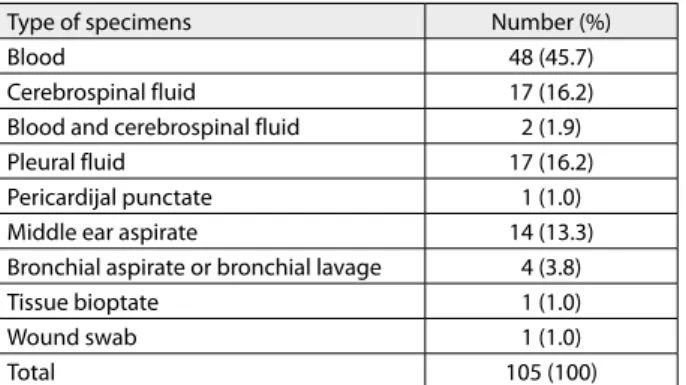
Analyses encompassed isolates from middle ear aspirate (14), bronchoalveolar lavage fluid (4), tissue bioptate (1), and wound swab (1). Invasive strains (83) were obtained from blood (48), cerebrospinal fluid (17), pleural fluid (17), and pericardial fluid (1) (Table 1).
A total of 52 Streptococcus pneumoniae strains were isolated in the clinical microbiological laboratory of the Institute of Public Health of Vojvodina from the clini-cal specimens of patients treated in the Cliniclini-cal Centre of Vojvodina (Clinic for Otorhinolaryngology, Clinic for Internal Medicine and Clinic for Infectious diseases) as well as from the Institute for Child and Youth Health Care of Vojvodina. Forty-three isolates were collected from microbiological laboratory of the Institute for Pulmonary
Diseases of Vojvodina, Institute for Cardiovascular Dis-eases of Vojvodina, Institute for Oncology of Vojvodina, and the remaining 10 strains were obtained from Regional Public Health Institutes in Vojvodina (Sombor, Kikinda, Subotica). All isolates were identified using standard mi-crobiological methods – colony morphology, optochin susceptibility, and bile solubility.
Streptococcus pneumoniae isolates were transported in
Amies transport media to the National Reference Labora-tory for Streptococci, Institute for Microbiology and Im-munology, School of Medicine, Belgrade. Capsular sero-typing was done by the Quellung reaction, using the anti-sera from Statens Serum Institut (Copenhagen, Denmark). We analyzed whether the isolates are covered by pneu-mococcal vaccines related to the target groups for the im-munization by conjugate vaccines (children ≤5 years old) and PCV13 and PPV23 (adults 50–64 years of age and elderly ≥65 years).
RESULTS
Among 105 isolates, a total of 21 different serotypes of
Streptococcus pneumoniae were determined, whereas only
one isolate was non-typable. The most frequent serotypes were 3 (21.9%), 19F (20%), and 14 (10.5%) (Graph 1).
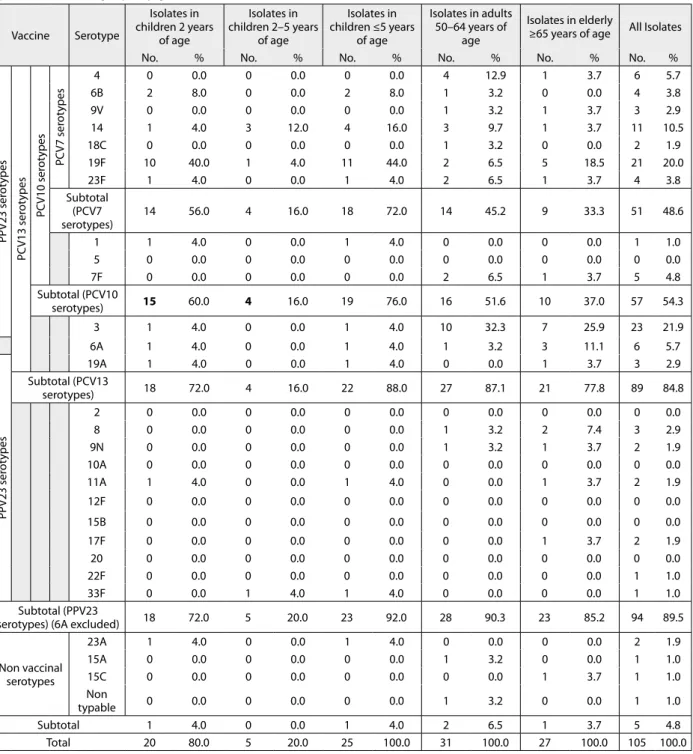
Serotypes included in seven-, 10-, and 13-valent con-jugate vaccines and a 23-valent polysaccharide vaccine represented 48.6%, 54.3%, 84.8%, and 89.5% of the total number of isolates, respectively (Table 2).
Among 25 isolates from children ≤5 years of age, a total of 11 different serotypes of Streptococcus pneumoniae were detected, out of which three are not included in conjugate vaccines (11A, 23A and 33F). The most frequent serotypes were 19F (44%) and 14 (16%), which are incorporated in all three conjugate vaccines. The serotype coverage by PCV7, PCV10, and PCV13 in this age group were 72%, 76%, and 88%, respectively. In a subset of children ≤2 years of age, 20 strains were isolated and 19F was the most com-mon one (10 out of 20 strains). Acom-mong children younger than two years of age, coverage with PCV7, PCV10, and PCV13 was 56%, 60%, and 72%, respectively. Three out of five strains isolated from children aged two to five years belonged to type 14, one was 19F, and the remaining 33F is present in PPV23 only.
Table 1. Type and number of examined specimens
Type of specimens Number (%)
Blood 48 (45.7)
Cerebrospinal fluid 17 (16.2)
Blood and cerebrospinal fluid 2 (1.9)
Pleural fluid 17 (16.2)
Pericardijal punctate 1 (1.0)
Middle ear aspirate 14 (13.3)
Bronchial aspirate or bronchial lavage 4 (3.8)
Tissue bioptate 1 (1.0)
Wound swab 1 (1.0)
523 Srp Arh Celok Lek. 2016 Sep-Oct;144(9-10):521-526
Serotypes included in PPV23 and PCV13 represented 90.3 % and 87.1% of the total number of isolates in adults 50–64 years of age. The most frequent was serotype 3 (32.3%), which is present in both vaccines. Serotypes 8 and 9N presented only on PPV23 were detected in two isolates, which is 6.4% of the total number of isolates in this age group.
Vaccine coverage among adults aged ≥65 years were 85.2% and 77.8% for PPV23 and PCV 13, respectively. In this age group, the most frequent serotypes were 3 (25.9%), 19F (18.05%) and 6A (11.1%), incorporated in both vac-cines. Serotypes present only in PPV23 (8, 9N, 11A, 17F) accounted for 18.5% of all isolates in the oldest age group.
DISCUSSION
There are over 90 serotypes of Streptococcus pneumoniae
with only 20 of them responsible for >80% of IPD cases in all age groups, and 13 leading serotypes caused 70–75% of IPD cases in children worldwide, before the introduction of immunizations [6]. Distribution of serotypes still varies geographically, according to age, clinical form and severity of illness, and is also subject to change over time [1].
In countries that introduced conjugate vaccine in NIP for children, direct and indirect (herd) protection rapidly reduced IPD incidence across all age groups. [7]. However, PCV immunization led to changes in the circulating sero-types and serotype replacement was detected. Significant reduction of the vaccinal serotypes and an increased fre-quency of serotypes not included in vaccine were noticed [7]. Before the introduction of PCV7, the most frequent types were those included in the vaccine (4, 6B, 9V, 14, 18C, 19F, and 23F). At the end of the 20th century these serotypes caused 59% of IPD cases in adults and 87% in children [7]. After the introduction of PCV7 in the United States in 2000, most European countries have gradually
introduced this vaccine in their vaccination schedules be-tween 2006 and 2009 [8]. They reported a drastic reduc-tion of vaccine preventable serotypes in IPD cases, but the emergence of serotype 19A was noticed. After the in-troduction of PCV13 in the United States in 2010, the oc-currence of serotype 19A decreased by 58% [9]. However, even after introduction of PCV10, a significant reduction in frequencies of both PCV10-related IPD and 6A and 19A (not included in PCV10) was observed, suggesting that PCV10 may also provide cross-protection against vaccine-related serotypes [10].
In this study we provide data on serotype distribution in Vojvodina region in Serbia in the period before the introduction of mandatory vaccination against IPD in children, which is implemented in the new National Im-munization Schedule for 2016. Among 105 isolates, a total of 21 different serotypes of Streptococcus pneumoniae were determined and the most frequent in all age groups were serotype 3 (21.9%), which is included only in PCV13, and PPV23, followed by serotypes 19F (20.0%) and 14 (10.5%), which are included in all the vaccines. Unlike the serotype 3, which is susceptible to antibiotics, 19F and 14 are most often antibiotic-resistant types [2]. Our results indicate that one third of all pneumococcal isolates and 60% of isolates from children ≤5 years old belong to 19F and 14 serotypes, which is worrisome. Clinical impact of pneu-mococcal antibiotic resistance is a worldwide problem. High level of pneumococcal resistance has already been documented in our country, especially in 19F and 14 sero-types. Besides the effect on IPD, it was demonstrated that the introduction of PCV has been associated with a reduc-tion in antimicrobial-resistant pneumococcal disease. This is particularly important in countries such as ours, with relatively high incidence rate of pneumococcal resistance to penicillin and macrolides. In the period from 2009 to 2011, 34% and 36% of pneumococcal invasive isolates in Serbia were nonsusceptible to penicillin and erythromycin,
524
respectively [11]. More than one third (36.4%) of pneumo-coccal isolates in Serbia in the 2009–2012 period expressed co-resistance to macrolides and penicillin. Multiresistant isolates were significantly more prevalent among children than adults [12].
Serotypes included in pneumococcal seven-valent, 10-valent, and 13-valent vaccines represented 48.6%, 54.3%, and 84.8% of the total number of our isolates, re-spectively. In children ≤5 years of age, who are the target group for the immunization with conjugate vaccines, cov-erage of circulating isolates was higher – 72% for PCV7, 76% for PCV10, and 88% for PCV13, because majority of serotypes in this age group belonged to serotypes 14 and
19F, which are in all vaccines. The serotypes presented only in PCV13-3 and 19A, were found in two (one from each) of 25 strains isolated in this age group. Average cov-erage of circulating isolates by PCV7 in European coun-tries in the period before 2008 was 71%, and rose to 78% for PCV10 and to 87% for PCV13 [13]. In Europe and North America, the serotypes included in PCV10 and PCV13 are estimated to cover approximately 80–85% and 85–90% of IPD, respectively, in children younger than five years of age [14]. Nevertheless, the majority of isolates of children in Vojvodina were obtained from younger than two years, who are the target group for conjugate vaccines only. Vaccine-preventable serotypes covered by PCV7,
Table 2. Circulating serotypes of Streptococcus pneumoniae by age groups for immunization in Vojvodina in the period from January 2009 until April 2016 and coverage by conjugate vaccines and PPV23
Vaccine Serotype
Isolates in children 2 years
of age
Isolates in children 2–5 years
of age
Isolates in children ≤5 years
of age
Isolates in adults 50–64 years of
age
Isolates in elderly
≥65 years of age All Isolates
No. % No. % No. % No. % No. % No. %
PPV23 ser
ot
ypes
PC
V13 ser
ot
ypes
PC
V10 ser
ot
ypes
PC
V7 ser
ot
ypes
4 0 0.0 0 0.0 0 0.0 4 12.9 1 3.7 6 5.7
6B 2 8.0 0 0.0 2 8.0 1 3.2 0 0.0 4 3.8
9V 0 0.0 0 0.0 0 0.0 1 3.2 1 3.7 3 2.9
14 1 4.0 3 12.0 4 16.0 3 9.7 1 3.7 11 10.5
18C 0 0.0 0 0.0 0 0.0 1 3.2 0 0.0 2 1.9
19F 10 40.0 1 4.0 11 44.0 2 6.5 5 18.5 21 20.0
23F 1 4.0 0 0.0 1 4.0 2 6.5 1 3.7 4 3.8
Subtotal (PCV7 serotypes)
14 56.0 4 16.0 18 72.0 14 45.2 9 33.3 51 48.6
1 1 4.0 0 0.0 1 4.0 0 0.0 0 0.0 1 1.0
5 0 0.0 0 0.0 0 0.0 0 0.0 0 0.0 0 0.0
7F 0 0.0 0 0.0 0 0.0 2 6.5 1 3.7 5 4.8
Subtotal (PCV10
serotypes) 15 60.0 4 16.0 19 76.0 16 51.6 10 37.0 57 54.3
3 1 4.0 0 0.0 1 4.0 10 32.3 7 25.9 23 21.9
6A 1 4.0 0 0.0 1 4.0 1 3.2 3 11.1 6 5.7
PPV23 ser
ot
ypes
19A 1 4.0 0 0.0 1 4.0 0 0.0 1 3.7 3 2.9
Subtotal (PCV13
serotypes) 18 72.0 4 16.0 22 88.0 27 87.1 21 77.8 89 84.8
2 0 0.0 0 0.0 0 0.0 0 0.0 0 0.0 0 0.0
8 0 0.0 0 0.0 0 0.0 1 3.2 2 7.4 3 2.9
9N 0 0.0 0 0.0 0 0.0 1 3.2 1 3.7 2 1.9
10A 0 0.0 0 0.0 0 0.0 0 0.0 0 0.0 0 0.0
11A 1 4.0 0 0.0 1 4.0 0 0.0 1 3.7 2 1.9
12F 0 0.0 0 0.0 0 0.0 0 0.0 0 0.0 0 0.0
15B 0 0.0 0 0.0 0 0.0 0 0.0 0 0.0 0 0.0
17F 0 0.0 0 0.0 0 0.0 0 0.0 1 3.7 2 1.9
20 0 0.0 0 0.0 0 0.0 0 0.0 0 0.0 0 0.0
22F 0 0.0 0 0.0 0 0.0 0 0.0 0 0.0 1 1.0
33F 0 0.0 1 4.0 1 4.0 0 0.0 0 0.0 1 1.0
Subtotal (PPV23
serotypes) (6A excluded) 18 72.0 5 20.0 23 92.0 28 90.3 23 85.2 94 89.5
Non vaccinal serotypes
23A 1 4.0 0 0.0 1 4.0 0 0.0 0 0.0 2 1.9
15A 0 0.0 0 0.0 0 0.0 1 3.2 0 0.0 1 1.0
15C 0 0.0 0 0.0 0 0.0 0 0.0 1 3.7 1 1.0
Non
typable 0 0.0 0 0.0 0 0.0 1 3.2 0 0.0 1 1.0
Subtotal 1 4.0 0 0.0 1 4.0 2 6.5 1 3.7 5 4.8
Total 20 80.0 5 20.0 25 100.0 31 100.0 27 100.0 105 100.0
525 Srp Arh Celok Lek. 2016 Sep-Oct;144(9-10):521-526
1. World Health Organization. WHO position paper on pneumococcal vaccines 2012. Wkly Epidemiol Rec. 2012; 87(14):129–144. 2. European Centre for Disease Prevention and Control. Surveillance
of invasive bacterial diseases in Europe, 2012. Stockholm: ECDC; 2015. Available online http://ecdc.europa.eu/en/publications/ Publications/Surveillance%20of%20IBD%20in%20Europe%202012. pdf
3. Pravilnik o imunizaciji i načinu zaštite lekovima, Službeni glasnik Republike Srbije br. 11/2006, 25/2013, 63/2013, 99/2013, 118/2013, 65/2014 i 32/2015. Available online http://www.paragraf.rs/propisi/ pravilnik_o_imunizaciji_i_nacinu_zastite_lekovima.html 4. Zakon o zaštiti stanovništva od zaraznih bolesti, Službeni glasnik
Republike Srbije br.15/2016. Available online http://www.paragraf. rs/propisi/zakon_o_zastiti_stanovnistva_od_zaraznih_bolesti.html 5. Tatochenko V, Sidorenko S, Namazova-Baranova L, Mayanskiy N,
Kulichenko T, Baranov A, et al. Streptococcus pneumoniae serotype distribution in children in the Russian Federation before the introduction of pneumococcal conjugate vaccines into the National Immunization Program. Expert Rev Vaccines. 2014; 13(2):257–264. [DOI: 10.1586/14760584.2013.871205] [PMID: 24350587] 6. WHO. Pneumococcal conjugated vaccine for childhood
immunization – WHO position paper. Wkly Epidemiol Rec. 2007; 82(12):93–104. [PMID: 17380597]
7. Feikin DR, Klugman KP. Historical changes in pneumococcal serogroup distribution: implications for the era of pneumococcal conjugate vaccines. Clin Infect Dis. 2002; 35:547–555.
[DOI: 10.1086/341896] [PMID: 12173128]
8. Drijkoningen JJC, Rohde GGU. Pneumococcal infection in adults: burden of disease. Clin Microbiol Infect. 2014; 20 (Suppl. 5):45–51. [DOI: 10.1111/1469-0691.12461] [PMID: 24313448]
9. Kaplan SL, Barson WJ, Lin PL, Romero JR, Bradley JS, Tan TQ, et al. Early trends for invasive pneumococcal infections in children after the introduction of the 13-valent pneumococcal conjugate vaccine. Pediatr Infect Dis J. 2013; 32:203–207.
[DOI: 10.1097/INF.0b013e318275614b] [PMID: 23558320] 10. Jokinen J, Rinta-Kokko H, Siira L, Palmu AA, Virtanen MJ, Nohynek
H, et al. Impact of Ten-Valent Pneumococcal Conjugate Vaccination on Invasive Pneumococcal Disease in Finnish Children – A Population-Based Study. PLoS One. 2015; 10(3):e0120290. [DOI: 10.1371/journal.pone.0120290] [PMID: 25781031] 11. Gajić I, Mijač V, Ranin L, Andjelković D, Radičević M, Opavski
N. Invasive isolates of Streptococcus pneumoniae in Serbia: antimicrobial susceptibility and serotypes. Srp Arh Celok Lek. 2013; 141(1-2):48–53. [DOI: 10.2298/SARH1302048G] [PMID: 23539910] 12. Hadnađev M, Gajić I, Mijac V, Kurucin T, Považan A, Vulin A, et al.
Phenotypes and genotypes of macrolide-resistant Streptococcus REFERENCES
PCV10, and PCV13 were represented in somewhat lower percentages – 56.0%, 60.0%, and 72.0% of the total number of isolates in the youngest, respectively – but it is still high enough to justify implementation of immunization.
A polyvalent polysaccharide vaccine, PPV23, comprises only T-cell-independent antigens and therefore induces only B-cells that are short-lived and produce low-affinity antibodies. This vaccine is recommended for adults ≥65 years old and for those two years or older at high risk for IPD [15]. PPV23 is not effective in infants and the main advantage of this vaccine is that it protects against 23 types of pneumococci. There were only five isolates obtained from children aged two to five years in Vojvodina, and all of them are covered by PPV23. Still, four out of five strains are also covered by PCVs. PPV23, unlike conjugate vac-cines, has no impact on nasopharyngeal carriage and does not alter circulating serotypes. Although the efficacy for prevention of non-bacteriaemic pneumonia is question-able, epidemiological studies showed that the immuniza-tion with PPV23 reduced the risk of IPD by 60% [16]. Additionally, recent meta-analysis provided evidence sup-porting the recommendation for PPV23 to prevent IPD in adults. However, the evidence from randomized clinical trials was less clear with respect to adults with chronic illness. Same meta-analyses did not provide compelling evidence to support the routine use of PPV to prevent all-cause pneumonia or mortality [17]. Out of total number of identified isolates, PPV23 covered 85.2% and 90.3% in elderly and adults 50–64 years of age, respectively. Ap-proximately one third of the isolates in both age groups belonged to type 3 (25.9% in ≥65 and 32.3% in 50–64 age group) which is related to higher risk of death com-pared to other serotypes [2, 16]. Having in mind higher immunogenicity and effectiveness of PCV13 compared to PPV23, we should consider introduction of this vac-cine for adults older than 50 years, especially those at high risk (immunocompromised, persons with functional or anatomic asplenia, those with chronic illness, etc.) similar
to practice adopted in some European countries and the United States [18].
CONCLUSION
Although the number of isolates included in this analysis is relatively low, our results contribute to overall compre-hension of circulating serotypes of Streptococcus
pneu-moniae in Vojvodina region in the pre-vaccinal period.
Serotype distribution of Streptococcus pneumoniae in the population fairly overlaps with the serotypes contained in pneumococcal vaccines, so that implementation of child-hood immunization is justified. The study was done in the Province of Vojvodina but the findings may be applied to Serbia as a whole. The introduction of PCV13 into the National Immunization Programme should be considered for adults older than 50 years, with risk factors, such as chronic illness.
Further follow-up of circulating serotypes of
Streptococ-cus pneumoniae in our population will enable assessment
of impact of immunization on distribution and possible changes in the circulation of serotypes.
ACkNOWLEDGMENT
526
pneumoniae in Serbia. Arch Biol Sci. 2014; 66:99–105. [DOI: 10.2298/ABS1401099H]
13. Isaacman DJ, McIntosh ED, Reinert RR. Burden of invasive pneumococcal disease and serotype distribution among Streptococcus pneumoniae isolates in young children in Europe: impact of the 7-valent pneumococcal conjugate vaccine and considerations for future conjugate vaccines. Int J Infect Dis. 2010; 14(3):e197–209. [DOI: 10.1016/j.ijid.2009.05.010] [PMID: 19700359] 14. Lee LH, Gu XX, Nahm MH. Towards New Broader Spectrum
Pneumococcal Vaccines: The Future of Pneumococcal Disease Prevention. Vaccines. 2014; 2:112–28.
[DOI: 10.3390/vaccines2010112.] [PMID: 26344470]
15. Centers for Disease Control and Prevention. Pneumococcal disease. In: Epidemiology and Prevention of Vaccine-Preventable Diseases.
Hamborsky J, Kroger A, Wolfe S, eds. 13th ed. Washington D.C. Public Health Foundation, 2015; 279–296.
16. Martens P, Worm SW, Lundgren B, Konradsen HB, Benfield T. Serotype-specific mortality from invasive Streptococcus pneumoniae disease revisited. BMC Infect Dis. 2004; 4:21. [DOI: 10.1186/1471-2334-4-21] [PMID: 15228629] 17. Moberley S, Holden J, Tatham DP, Andrews RM. Vaccines for
preventing pneumococcal infection in adults. Cochrane Database Syst Rev. 2013; 1:CD000422. [DOI: 10.1002/14651858]
[PMID: 23440780]
18. Centers for Disease Control and Prevention. Licensure of 13-Valent Pneumococcal Conjugate Vaccine for Adults Aged 50 Years and Older. MMWR. 2012; 61(21): 394–395. [PMID: 22647745]
КРАТАК САДРжАЈ
УводStreptococcus pneumoniae је најчешћи изазивач бак-теријске пнеумоније и менингитиса. Нови Закон о зашти-ти становништва од заразних болесзашти-ти у Србији предвиђа увођење обавезне имунизације деце против обољења изаз-ваних пнеумококом.
Циљ Циљ ове студије је био да сеодреди заступљеност цир-кулишућих серотипова пнеумокока у Војводини у периоду пре увођења обавезне конјуговане пнеумококне вакцине у Србији.
Метод У периоду од јануара 2009. до априла 2016. године сакупљено је 105 изолата Streptococcusa pneumoniae. Ана-лизирали смо резултате серотипизације пнеумокока, која је урађена у Националној референтној лабораторији и утвр-дили каква је дистрибуција циркулишућих серотипова и њи-хова покривеност конјугованим вакцинама и 23-валентном полисахаридном вакцином у различитим узрасним групама.
Резултати У колекцији од 105 изолата Streptococcusa pneu-moniae нађен је 21 серотип. Најзаступљенији су били
серо-типови 3 (21,9%), 19F (20,0%) и 14 (10,5). Подударност изола-та са серотиповима садржаним у вакцини била је 48,6% за
PCV7, 54,3% за PCV10 и 84,8% за PCV13, док је пнеумококна полисахаридна вакцина (ППВ23) покривала 89,5% од укуп-ног броја изолата. Серотипови садржани у PCV7, PCV10 и
PCV13 били су заступљени код 72,0%, 76,0% и 88,0% изолата деце млађе од пет година. Подударност изолата са сероти-повима садржаним у PCV13 и ППВ23 износила је 87,1% и 90,3% код одраслих старости 50–64 године и 77,8% и 85,2% код старијих од 65 година.
Закључак Заступљеност циркулишућих серотипова S. pneumoniae у популацији се у великој мери преклапа са се-ротиповима садржаним у пнеумококним вакцинама, што оправдава увођење имунизације у дечјем узрасту. Иако је истраживање спроведено у Војводини, налази се могу при-менити на целу Србију.
Кључне речи: Streptococcus pneumoniae; серотипови; вак-цинални серотипови
Дистрибуција серотипова
Streptococcus pneumoniae
у Војводини у периоду
пре увођења конјуговане вакцине у Национални програм имунизације
Владимир Петровић1,2, Зорица Шегуљев1,2, Миољуб Ристић1,2, Јелена Ђекић-Малбаша1,2, Биљана Радосављевић1,
Деана Медић1,2, Мира Михајловић-Укропина1,2, Мирјана Хаднађев3, Ина Гајић4, Наташа Опавски4
1Институт за јавно здравље Војводине, Нови Сад, Србија;
2Универзитет у Новом Саду, Медицински факултет, Нови Сад, Србија;
3Институт за плућне болести Војводине, Сремска Каменица, Србија;
4Универзитет у Београду, Медицински факултет, Институт за микробиологију и имунологију, Национална референтна лабораторија
за стрептокок, Београд, Србија