Vol-7, Special Issue-Number5-July, 2016, pp16-26 http://www.bipublication.com
Review Article
Qualitative Analysis of Iranian Crack to Determine the Active Ingredient in
Committing Crime in order to Determine Criminal Punishment
Ali Hassan Rahmani1*, Mary, Mosaiee2, Seied F. Hosseini3
and Masoud Salehi Moghadam4 1The Medical Toxicologist,
The Department of Medical Toxicology,Razi Hospital ,Ahvaz Jundishapur ,University of Medical Sciences,Ahvaz,Iran ([email protected])
2MA inGeneral Biochemistry, Department of Forensic Medicine,
province of Khuzestan, Legal Medicine Organization 3
The General Director, Department of Forensic Medicine, province of Khuzestan, Legal Medicine Organization 4PHD Clinical Biochemistry, A Professor of Biology Department,
University of Mashhad Payam Nour
ABSTRACT:
Crime (the basis of criminal law) is the behavior that intentionallyleadsto violation of legal orders and one of the things that hinder the realization of criminal liability is the condition called insanity. People lacking the healthy will, or unaware of the essence of the consequences their acts if they commit crimes they are not addressed in the law and do not have criminal responsibility.In a cross sectional study in Khuzestan forensic toxicology lab after 61 TLCsamplesof crack street, drug recognition tests was doneby HPLC and GC / MS. Examination of data (V22) SPSS (p value <0.05):% 93/4of crack samples were containing morphine,% 83/6 with caffeine, noscapine or dextromethorphan,% 27/9 heroin and codeine,% 37/7 six mono-acetylphloroglucinol morphine,% 34/4 acetyl codeine,% 13/1 narceine and acetaminophen, % 16/4 diazepam and% 9/8 chloramphenicol and other components of methyl amphetamines, diphenhydramine, lidocaine, thebaine, amoxicillin, amitriptyline and nortriptyline % 6/6 of samples were a mixture of methyl amphetamine - diphenhydramine and acetaminophen, it was a special type of Iraniancrack, due to the existence of amphetamines play a major role in dementia and mental illness like schizophrenia.Iraniancrack is not only different from a real crack (cocaine), but differs in the types, number and amount of additives drug ,Opioid and diluent. Crack has different amount of effective substances on the central nervous system pharmacological and non-pharmacological and psychedelic properties.Different Clinical manifestations like dementia and lack of determinationthat leads to crime.As a result, the need to determine the ingredients in the crack used in the examination of crime and helpingthe criminal justice system in determining the penalty is definite.
Key words: Forensic Toxicology, Iranian crack, GC-MS, HPLC, crime, criminal penalty
INTRODUCTION
The basis for the proposed law isconstituted by theunlawful behavior. Crime is a voluntary behavior that leads to the violation of the legal orders and the only creature that can have an aware will is the human. One of the points that is
of the consequences acts. If these people commit crimes they are not addressed by the law and do not have criminal responsibility. The legislature considersnecessary the lack of will or power of recognition for patients to prohibit punishment in the amended of the Islamic Penal Code, is included to a broader range forthe Mental Disorders in the Islamic Criminal Law and the expansion possibility of Insanity Defense is provided inIranian criminal law. From the
beginning Iran's Penal Code brings into
consideration the criminal responsibility of the insane and each one according to its approach to madness and mental disorder have been legislated and in the last amendment of the bill, has considered the lack of will or ability to distinguish the as the criterion of lack of responsibility that is defined as the very definition of criminal capacityas well as the spiritual element. (1and2) Drug abuse and narcoticshaveconsequences as mental disorders, physical and detrimental social, cultural and economicconsequences, especially threatens public and personal hygiene. Expansion of urban life and increasing consumption of
narcoticdrugs, especially syntheticdrugs is
encouraging the international community to cooperate to control and repress actions that promote and behaviors leading to the misuse of these substances to issue the 1971 Convention on narcotic Substances United Nations asits best
manifestation.Iranian legislatoralsonecessarily
took action in the related narcotic drug law (adopted in 1354) to the criminalization of some acts that is related or led to the abuse of narcotic drugs.But diversity and spread of drug abuse of these substances, along with its extremely detrimental effects to public health indicates the need to amend the law relating to the suitable anticipated effective support measures and measures to create appropriate suppression. On the other hand misuse of narcotic drugs, sometimes leads to mental disorder and shake the foundations of and criminal liability and committing crime that in the examination of individual criminal liabilityat this point is an
important issue.In this study we tried to identify the types of drugs (crack) on and then survey the committing criminal liability in the consumption of these materials and committing different crimes. (3and 4)
The term Drug Abuse has several definitions in different societies and cultures. Drug Abuse is different from Drug Misuse. Drug abuse is referred to any deliberate use of drugs for non-medical use, including changing the mood, fitness and… (10)
Drug abuse leads to mental disorders, physical consequences detrimental social, cultural and
economic consequences, especially threats
individual and public health. Cocaine
The history of cocaine use can be traced back thousands of years. When the inhabitants of South America, used coca leaves for their effect breezy and it gave them more energy and felt less tired and hungry. (6) They are often called the coca plant as a "gift of God".
In the 1980s (AC.),the chemists and
manufacturers could obtaincocaine using the method to condense it out of hydrochloride and earnedalmost % 100purecocaine.
extracted from coca leaves and mixing it with beverages such as wine and drinks containing cocaine even soft drinks such as Coca-Cola, it entered in the world market.
Medicinal use of cocaine was discovered in the nineteenth century. At the time, it was found that cocaine as an anesthetic agent (or numbness) actsstrongly and it can be used in different local numbness in surgery such as, ear, nose, eye, throat surgery. Cocaine sometimes was used to relieve toothache.Because cocaine causes narrowing of the blood vessels, sometimes it is used to control bleeding and healing heart disease, including irregular heartbeats. German soldiers in World War II were given cocaine to increase the steadfastness in physical activity and military maneuvers.
In 1912,America's government announced 5,000 deaths resulting from cocaine use. Finally, in 1914, "Harrison Narcotics Act" was passed. Following the Harrison law enforcement, taking recreational drugs such as cocaine and heroin were diverted to the underground black market. Crack came to the fore:
Crack for the first time in the late summer and early fall of 1985 entered the New York market. Usually by chemical reactions cocaine becomes
freebase, (7)This means that cocaine
hydrochloride is turned to pure cocaine. This is pure cocaine that is resistant to heat and can also be consumed through smoking.This substance referred to is called Crack.
Thesubstance today has entered in the country market since 1384 as the crack is a new substancewhich is nothing like the crack from cocaine. And symptoms of its use are similar to cocaine, not cocaine. Appearance of this substance is usually like a lump of earth-shaped, cream-colored and has lint is like cotton candy.And it is also very similar to the pieces of curd withlow density and light weight.
In recent years the new material has entered on the market ofIran and has led many addicts when referring to the drug dealers to take opium or heroin, thenew material was introduced that
worked faster and was easier to use, it was easier to hide and, above all, low-cost. The new material is crack. (20)
Crack Street (Street Crack)
According to studies undertaken on street crack referred to Iranian forensic toxicology laboratories theIranian crackcontainsa high percentage of heroin and narcotic pills and other additives (Adulterants). These additives are mainly from the category affecting the central nervous system (benzodiazepines, barbiturates, etc.) and materials increasing the volume (starch, talc, etc.). Identifying the compounds in the crack obtained from the accused by the judiciary and law enforcement are submitted to forensic toxicology
laboratories.It includes a wide range
ofinvestigations of toxicologylaboratories.
Identifying the components in samples of obtained crack and getting the relative frequency of components could help in unison proper treatment protocol in dealing with patients poisoned by these chemicals and issues related to security and judiciary.
In reference books, the street heroin withthe name of crack is not mentioned. According to books and articles on Crack, it isthe street name for cocaine. (18)Etymology of crack comes from the breaking sound for this type of cocaine by the effect of heating. Crack or rock (Rock), in fact, is the solid
form of cocaine which can be used
throughsmoking or inhaled through sniffing. (10 and 11)
Crack use is very easy and fast so that even with a lighter can be consumed anywhere. Hence , the crack is entitled as1, 2, 3because it can be consumed by counting three. And that no certain smell can be felt while taking usingsubstanceand this is the advantage of this substance compared with other drugs.But the clinical effects and complications after crack use is very strong and terrible. (12)
It seems that the ingredients usedmanufacturingin
the crack substancein Iranat the market
heroin as a raw material base exists in all of them. Iraniancrack, due to its many impurities compared to the American type is far more dangerous. (5) Overall additives (Adulterants) primarily are substances with pharmacological properties or drugs that are to change the pharmacological effects of heroin, to which are added,the compounds can be administered acetaminophen,
dextromethorphan, antihistamines,
benzodiazepines, tri-cyclic antidepressants,
barbiturates, stimulants of central nervous system cited such as caffeine.Alkaloids in opium as a source of morphine are used to provide heroin. Other side products such as Acetyle codeine induced from codeine acetylation of opium, papaverine, noscapine and other opium alkaloids are found in heroin. (14-15)
Diluents substances are such as starch or sugar, which serve to increase the volume or weight are added illegallyto this substance.
Additives during production, before or after the smuggling and trafficking in time of micro-marketing availability can be added toheroin. (16) Due to major differences in the structure of the crack available in Iran comparing to the known crack in other parts of the world, it seems necessary to do research to determine the component of the crack referred to forensic toxicology laboratory.
On the other hand, the results of this study to guide physicians in treatment centers, addiction, poisoning and ...in adopting the appropriate treatment protocol due to nonspecific clinical signs and symptoms are valuable.
In aplace that crack is consumed a certain bitter smell can be felt its atmosphereindicating the presence of heroin.Some crack consumers say some timeago when taking the drug a particular pickle smell was felt that may be caused by the presence of ammonia.Others say recently strong acidic compounds used in the manufacturing of cleaning drainage channels such as (Chante) is also used, in the preparation of crack.
Others believe in making crack hallucinogenic substances like methamphetamine is also used.
Crack clinical signs and symptoms:
Apart from the effects on the brain, cocaine and crack, cause the most problems cardiovascular system, including heart and blood vessels. In fact, with the release of adrenaline causes tachycardia. (17) Another neurological problems caused by cocaine, , by which the muscles ofsome parts of the body involuntarily contract, and causes a person to lose their movement control and like strong seizures or convulsions stroke fall on the ground.
Another cocaine harmful effect on the nervous system is disorders of movement. (In Huntington diseaseis known as "Dyskinesia disease") (17)In
addition, abnormal movements caused by
continuous use of cocaine are called "The Crack Dancing". People who frequently inhale cocaine often have nasal inflammation (rhinitis) and cartilage separating the nostrils is corroded. (17) On the other hand crack is leaving other typical
symptoms. For example, eye injury or
inflammation refers to as the cornea crack that due to the frequent exposure ofeyes to crack smoke. These vulnerable areas are susceptible to the virus or bacteria. (17)
Doctor Ali Farhoudian in scientific research meeting entitled "A Survey on the crackuse as a
narcotic" held at the ShaghayeghCultural
Complex,Said:All over the world crack is a name for thefree form of thealkaloid cocaine. Butin Iran, the clinical signs and symptoms of crack use and the withdrawal signs in suspension time of its dependent patients indicates that the crack in Iran market is different fromthe crack existing in other countries which is a form ofcocaine. (17) Generally, the effects of crack and cocaine in consumers because of high density of active ingredients as well as various chemicals are far much stronger and the cases associated with deaths of the consumers are greater.
And excessive intake, especially of
Crack works up to 8 hours after taking. In case quitting its use,the side effects such as lethargy and depression makes the possibility to leave zero.Vomiting and reducing the pain, feeling hot, hot flashes, itchy nose, heavy hands and feet and sedation, dry mouth and eventually cancers in the mouth and gums, reducing blood pressure, contraction of the pupil, big eye, ureteral and biliary smooth muscle contraction, disorders in the blood, weakening effect on blood platelets and white blood cells.
Long-term complications of crack: darkening of the skin, decreased libido, infertility, weight loss and malnutrition, multiple wounds in the body and
delay wound healing, aging, dementia,
psychological diseases like schizophrenia
including visual and auditory hallucinations and paranoid mental illness like and aggression, behavioral or psychological changes (initially euphoric and then apathy, irritability and aggressiveness, restlessness or slow and impaired judgment)and finally, Dementia among the symptoms as a series of bad clinical functions manifests including memory disorders, language disorders, psychiatric and psychological changes, and impaired daily activities. Intravenous infusion reactions, abscesses, skin infections, endocarditis, tetanus, AIDS, hepatitis B and transferring them to others,all these symptoms and different clinical symptoms requires appropriate treatment protocol in dealing with drug abusers and malicious poisoning substance is required.
AnalysisMethod
This cross sectional study was conductedfor six months on all crack samples referred to forensic toxicology laboratories in Khuzestan from the years91-92.
All samples in miscellaneous section of
toxicology laboratory were evaluated in regard to physical properties such as color, shape and weight.
To perform the sieve test thesamples to the TLC (TLC) method of thin chromatography for initial laboratory investigation were first evaluated and tested.
Crack samples referredobtained for about 0.1 to 0.01 g depending on the amount of samples available in 10 cc of methanol% 99 were resolved and then the samples for 10 minutes were centrifugedin a centrifuge at around 13000rpm to remove impurities.
After the tubes were centrifuged supernatant of the experimental tube was used to perform TLC. Each of the pellets contains samples of unknown crack with pharmaceutical standards in the laboratory (Opium, heroin, etc.).Two solvent systems were used for the screening test.
Tank with the above-mentioned solvents were made ready and are placed in the solvent tanks. After climbing spots in the tank and separating the ingredients of the spot, plates were removed of solvent tank and were prepared to paintwith acid Platinum iodide. It should be noted that the plates are dry before painting with Platinum iodide acids. After preparing the spray solution, the plates in the space under the hood were lightly sprayed with acid Platinum iodideto make the stains appear. After acidification approximately 2 to 3 hours (depending on volatility and percentage of solvent used in the mobile phase) In cases of noticing spots on the plate, the results of screening test is considered positive and a positive result in a more sensitive and more specific method such as HPLC and MS / GC is confirmed.
HPLC Method:
Column: Eruouspher 100-5 C18 -250× 4/6mm with precolumn
Injeatiou volume: 20ml Flow rate: 1ml/min
Staitionary phase: Methanol merk (Germany) / Dilution water (0.20×0.80)
Mobile phase:
AcetouitrileMerk (Germany) / phosphat buffer ph= 2/3 mixtures (0.63×0.37)
Agilent
GC Method: GC: 7890A
Column: HP5-MS30mx0.25 mmx0.25 Injection type: Splitless
Ramp 1:20°C/min up to 300°C Inlet Temperature:250°C
Carrier Gas Flow: Helium 1.5 ml/min MS Method: MS: 5975 C
Source Temperature: 230°C Quardrapole Temperature: 150°C Mode of Scan: Full Scan
HPLC Method: Column: Eruouspher 100-5 C18 -250× 4/6mm with precolumn
Injeatiou volume: 20ml Flow rate: 1ml/min
Staitionary phase: Methanol merk (Germany) / Dilution water (0.20×0.80)
Mobile phase:
AcetouitrileMerk (Germany) / phosphat buffer ph= 2/3 mixtures (0.63×0.37)
Agilent
GC Method: GC: 7890A
Column: HP5-MS30mx0.25 mmx0.25 Injection type: Splitless
Injection volume:0.2 Oven Temperature: 60°C Ramp 1:20°C/min up to 300°C Inlet Temperature:250°C
Carrier Gas Flow: Helium 1.5 ml/min MS Method: MS: 5975 C
Source Temperature: 230°C Quardrapole Temperature: 150°C
Mode of Scan: Full Scan All data related to the files will be kept in secret
laboratory sectors.
The information contained in duration of 6 months assessmentand statistical analysis was analyzed. The method of calculating sample size and the number:
The current cross-sectional study was conducted in the period of two years and the entirecrack referred in this interval was analyzed. Now after the completion of the research, the total 61 samples are analyzed. All 61 cases were extracted from databases of the years 91-92.
In the present study, thecrack street referred to forensic toxicology lab to Khuzestan province was qualitatively assessed. 61 cases of crackswere analyzed in the laboratory. The information
contained in duration of 6 months (the time of implementation) assessment, statistical analysis and was analyzed.
RESULTS
In terms of appearance, 52 (%85/2) caseswere in the form of a cream-colored clods and 9 (%14/8) in the form of brown powder.
In the weight study it wasfound that of a minimum weight of 0/2 g, maximum weight of samples5.55 an average weight of samples were 0/99 g.
Of the total samples, 36 (%59) cases weighing less than 1 gram, 14 (%23) cases weighted between 1 and 3 grams and 11 (%18) cases had the weight of more than 3 grams.
After qualitative analysis of data by the HPLC method the following results were obtained: 57 (93/4) cases of the total cracksreferred contained caffeine, 50 (%83/6) cases had the
noscapine or dextromethorphan, 10
(%16/4)caseshad the diazepam, 8 (%13/1) cases had acetaminophen andnarceine , 4 (%6/6) had diphenhydramine and Methyl-amphetamines. Other components of referred cracks include phenobarbital, thebaine, Lidocaine, Amoxicillin, amitriptyline and nortriptyline.
After qualitative analysis of data by GC_MASS method, the following results were obtained using this method was more specific, and did not have the problems related to the lack of standards of heroin.
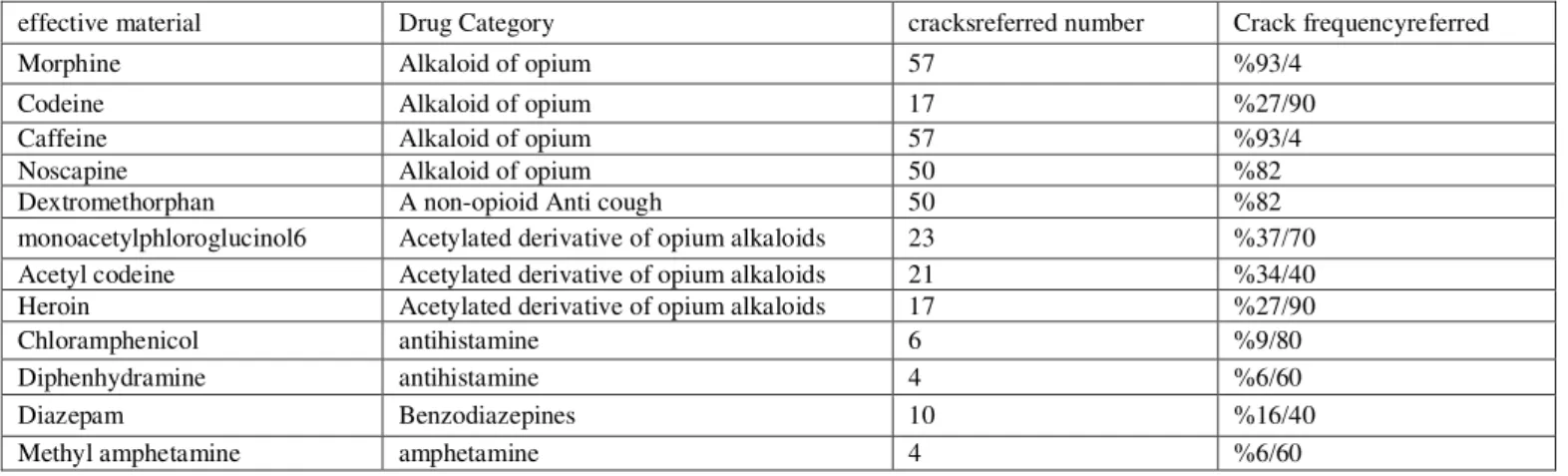
57 (%93/4) cases of the total cracks referred had caffeine, 50 (%83/6) cases had the morphine, noscapine or dextromethorphan, 23 (%73/7) cases had 6-mono acetyl morphine, 21 (%34 / 4) cases had Acetyl codeine, 17 (%27/9) cases had heroin and codeine, 10 (%16/4) cases had diazepam, 4
(%6/6) cases had diphenhydramine and
methylamphetamines.
On the survey in the relationship between weight and components of thereferred cracks to the Khuzestan forensic toxicology lab, following results were obtained.
acetyl codeine, heroin, dextromethorphan and chloramphenicol p (v) <0/05 This relationship was significant.
From14 (%22/9) cases of crackssamples referred that were weighing between 1 to 3 grams, all (%100) was observed to containnoscapine and none (%0) had morphine. P (v) = 0
• From 11 (%18) crack cases referred to Khuzestan forensic toxicology lab weighed more
than 3 grams:
• From 7 (%6/36) cases had a mono-acetyl-
morphine, acetyl-codeine, heroin,
dextromethorphan were diazpam. P (V) <0/05 In fact, the samples that were too heavy and too light had heroin.
On the surveyon the relationship between appearance and components of referred cracks to forensic Khuzestan forensic, following results were obtained.
From 9 (%14/7) cases ofstreet crack that were in the form of brown powder did not contain any codeine that this relationship was significant with pv = 0/04. Also, half of the samples had acetaminophen with pv = 0/03 was significant. And from 52 (%85/2) of the street crack samples were cream-colored clod that about half of the samples had codeine that this relationship was
significant with pv =0/30
Table 1: Frequency of pharmaceutical active ingredients, and much the street crack referred to the Khuzestan forensic by hplc method
effective material Drug Category cracksreferred number Crack frequencyreferred
Caffeine Opiumalkaloid 57 %93/4
Noscapine Opiumalkaloid 50 %82
Narceine Opiumalkaloid 8 %13/10
Dextromethorphan A non-opioid Anti cough 50 %82
Chloramphenicol Antihistamine 6 %9/8
Diphenhydramine Antihistamine 4 %6/60
Diazepam Benzodiazepines 10 %16/40
MethBenzodiazepines Amphetamines 4 %6/60
Acetaminophen pain reliever 10 %16/40
Amoxicillin Antibiotics 1 %1/60
Amitriptyline Tri-cyclic antidepressants 2 %3/25
Nortriptyline Tri-cyclic antidepressants 2 %3/25
Lidocaine Local anesthetic and anti-arrhythmic 2 %3/25
Phenobarbital Barbitrates 1 %1/60
Thebaine Opiumalkaloid 2 %3/25
total 206
Table 2: Frequency of active ingredients and pharmaceutical categories in crack referred to the Forensic Khuzestan by GC-MASS method
effective material Drug Category cracksreferred number Crack frequencyreferred
Morphine Alkaloid of opium 57 %93/4
Codeine Alkaloid of opium 17 %27/90
Caffeine Alkaloid of opium 57 %93/4
Noscapine Alkaloid of opium 50 %82
Dextromethorphan A non-opioid Anti cough 50 %82
monoacetylphloroglucinol6 Acetylated derivative of opium alkaloids 23 %37/70 Acetyl codeine Acetylated derivative of opium alkaloids 21 %34/40
Heroin Acetylated derivative of opium alkaloids 17 %27/90
Chloramphenicol antihistamine 6 %9/80
Diphenhydramine antihistamine 4 %6/60
Diazepam Benzodiazepines 10 %16/40
Lidocaine A local anesthetic mucosal 2 %3/25
Phenobarbital Barbiturates 1 %1/60
Thebaine Alkaloid of opium 2 %3/25
total 264
Graph 1: The frequency components referred Crack
In this study, we examined 61 sample cases referred to the KhuzestanForensic Medicine, and we found that constituents of the street crack using two methods of HPLC and GC-MASS contains caffeine, morphine, noscapine, dextromethorphan, 6-mono acetyl morphine, acetyl codeine, heroin, codeine, narceine, diazepam, acetaminophen, diphenhydramine, methamphetamine, papaverine,
thebaine, lidocaine, chloramphenicol,
phenobarbital, amitriptyline, nortriptyline, and Amoxicillin.
In our country studies were conducted by doctor Jokar and Akhgary and their colleagues on 80 samples of street crack referred to Tehran forensic Medicineand also by doctor Ali Farhoudian and his colleagues on the 18 samples street crackscollected from the city of Tehran that after comparing the current study data and the results of
this study, we observed differences and
similarities.
In the 3 studies done,none of the street crack samples were found to contain cocaine. This shows the big difference between thestreet crack
and the real crack in the world which is the main ingredient of cocaine.
Amphetamine and diphenhydramine that about 6/6 were found in the referred crack samples were not observed in any of the previous studies. Meanwhile, in 4 samples of the referred cracks,
tri-compounds including Amphetamine,
diphenhydramineand acetaminophen that this compound was not observed in any of the samples studied in the previous studies. Acetaminophen at a ratio of 16/ 4in samples of crack was found that the amount of acetaminophen in the referred crack to Tehran Forensic Medicine in only one instance 2/2 of 80 cases and the survey of the cracks in the city of Tehran from18 samples 22/2 had acetaminophen.
Amphetamine and diphenhydramine referred to in 6.6 crack were found in the samples were not observed in any of the previous study.
Perhaps it can be said that the active ingredient of the referred cracks to Khuzestanforensic Medicine was caffeine while the active ingredient in the sample examined in Tehran had more than (%90) heroin.
Heroin in cracks referred to Khuzestanforensic Medicine was 9/27 that is to say the ratio of heroin had been reduced and the crack structure has changed.
In large quantities (Large scale) heroin
traditionally is synthesizedby a stage reaction of acetylation of raw morphine. To a large degree, three substances are used for acetylation of morphine: acetic anhydride, Acetyl chlorideand Atilidyndiacetate.
In the cracks referred to Khuzestanforensic Medicine 6 -mono-acetyl- morphine 73 /7 acetyl- codeine 34/4 codeine 27 in the present study were found that the amount of these compounds in the study of doctor Farhoudian on 18 samples and in the study of doctor Jokar and Akhgary in 80 samplesmono- acetyl morphine and acetyl- codeine at a ratio of about 80 and codeine about 35 have been found.
In fact, the amount of heroin and acetylated
derivatives in the samples referred to
Tehranforensic Medicine and the samples across the city of Tehranat that time has been more than Khuzestan that is an evidence for the changes in the structure of the street crack in specifictime and geographical situation.
Dextromethorphan in the cracks referred to Legal Medicine in Tehran and Khuzestan provinceswas found in more than 80 as an additive.
In the case of other compounds found in the present study it can be said phenobarbital, amoxicillin, amitriptyline, nortriptyline, lidocaine and thebaineislessin ratio that in the survey of the cracks referred to Tehran forensicmedicine also these additive compounds with differences and similarities including phenobarbital, thebaine,
pheneramyn, chloroquine, biperiden, and
tramadol.
The diversity of these compounds is an evidence for the existence of types of impurities in the
existing cracks investigated and no fixed structural
formula was found. In fact,
thesecombinationsinclude additives that the
manufacturers use to make the cracksheavier.
DISCUSSION AND CONCLUSION:
Finally, we found that the street crack in Iran is not only different from a real crack in the world with its original materialcocaine but also differ in the types and amounts of additives and opioid drug and diluents.
Due to differences in the components of Iranian Crack at different times in different studies, we found that Iraniancrack does not have a fixed structure and every day it has undergone many changes and has varying amounts of effective on
the central nervous system and other
drugscontaining pharmacological and
non-pharmacological substances. And of course,the existing amphetamines in the cracks are highly important issue because a consequence of its taking isthe dementia of the mind of the person would bring about frequent threats to the person, his family and the society.
The change in the purity of ingredients of the street crack could bring high risks for consumers of these compounds and different clinical symptoms and complications for the consumers would appear and the need for appropriate treatment protocol in dealing with these consumers is a necessity.
The effects of dementia and mental impairment on the responsibility
The responsibility is the ability to bear the consequences for the criminal acts. On the amendmentbill and especially on criminal liability a great importance is to attach to the criminal capacity. Criminal capacity is based on two principles: (6)
1-Awareness (sense of discernment): the ability to understand the nature of their behavior and assess its consequences
have a healthy will A) The effect of psychological state in sentencing In the Penal Code in this regard there was not a clear act issued or the person was with dementia and the punishment was eradicated from himeven though he hadcommon sense for recognition andwas responsible. The only act that yielded the doubt was Paragraph 5 of Article 22 of the Penal Code that says: the court could alleviate if taking directions mitigating inhibitor punishment: the special situation of the defendant or his history a wide range of terms used so much that some believed, this lack of attention is due to abandoning Article 5 of the abovementioned from mental disorders or seems of legislation to It seems special status of defendant is absolute title andbeing at one of the mentally disordered
situationand non prevents (eradicationas
interpreted by the law) the criminal responsibility is not ignored, therefore, in this case if there is a mental disorder the privilege is given to be the judge first if the case is brought before a judge to detect any mental disorder must be done by a specialist psychiatrist and secondly, after the diagnosis, the judge should be bound by the terms of her specialty because it is outside the scope of rights and social issues and Article 22 differs fromother provisions in this respect (7)
Criminal responsibility is one of the most important issues of criminal law, that has principlesi.e. having common sense is among the major principles and its absence is one of the
obstacles of responsibility and
punishment.Insanity in 1370 Penal Code has been recognized as factors to eradicate the punishment but in the amendment bill there is chaptercalled criminal responsibility which has a popular aspect has become and the legislative deleted the old
divisions and all-justified causes and
eradicationcauseswere given under the constraints. It should be said the best verseof criminal responsibility, is the will (desire) and thinking (discriminatingability). If weviewgenerally both laws, we will see that inamendment bill, mental health has been priority. The idea that court shall
consider in the first place the defendant's mental status is very good and interesting. Also, in the
amended bill, the condition of criminal
responsibility has changed and respectively comes the wisdom, maturity and authority. It seems that the legislator deliberately has replacedintellect as the first condition to create liability. For example, in Article 90 of the bill (8) regardless of maturity in people less than 18 years for creatingcriminal
liabilityhas lost its relevance and crime
attributable in cases that:
1- Understanding the nature of the crime
2-Understandingits Reverence
3-There is no doubt in the perfection of their wisdom
On this basis, it can be said that the amendment bill on criminal responsibility and criminal capacity, holds a great importance and also in the amendment bill, there are two categories of mental patients to exempt from responsibility. The first group is those without a sense of discernment and, in fact, isinsane and psychotic, that according to 1370 law, these people are irresponsible. This group is considered in the amendment bill as irresponsible and is exempt from punishment. But the Bill, the second category of mental illness that has a sense of discernment and these people are aware of their actions and behavior, but because of some mental disorders, have no control over their behavior, are subject to exemption. Therefore,insanity Defense Policy has become easier and the Bill was clearly more substantial. But does lack of the will and the sense of discernment from the perspective of psychiatric are also consideredInsanity?
defense of insanity and mental disorder is in all legal systems. (9)
As a result of the detection of the use of a variety of narcoticsubstances and determining the nature of these substances and their impact on a person's mental state when committing the crime is very helpful in determining criminal penalties.It is hoped that this study could contribute to the judicial system even though very trivial.
REFERENCES:
1. Muhammad Ali Ardabili, (1385).General
Criminal Law, Vol. 2,MizanPublication
2. Ismail Afrasyabi, (1377).General Criminal
Law, Vol. 2 1th ed.,Ferdowsi
3. Aghaeenia, Hussein, (1384).Crimes Against
Persons
(criminal),1thed.,Tehran:MizanPublication,
4. Saki, M.R., (1390).Drug Offenses and
Criminal Law from the Perspective of
Criminal Sciences, Tehran:Rah Novin
Publication
5. M - Foster Olive, (---).Collection of Obvious Facts of the Drug "Crack", (trans. by doctor
Seied Mohammad MehrdadMozafar and
TahuraZarabian) Headquarters for Combating Drugs: Office of Research and Education
6. A. Zeraat, (1384).Tehran ContrastivePublic
Criminal Law,1th ed. Fekrsazan publication
7. SeiedMousaviMojab. (1388).TheRole of Will
in the Determination of Criminal
Responsibility,Tehran:Behnami
8. AbolqasemKhoi, (1391).The Principles of
Talk Releasing the Innocent,
Itrans.,AlirezaKhorsandVol., I
9. David Aibrahmisen,
(1371).CriminalPsychology, trans.,
ParvizSanei, publishingGanjDanesh
10.SehumacherMA, baslaumAL,
OpioidAnalgesies& Antagonists In:
KatzungBG, (2004).Basic and Clinical
Pharmacology, 9thed., Lange Medical Book,
McGraw Hill, New York, USA,.
11.No authors listed. "Classics Revisited.Uber Co.ca.By Sigmund
12.Ali Farhodian,MandanaSadeghi, Hamid Reza
KhoddamiVisheteh.BabakMoazen, MonirFekri
and Afarin Rahimi Movaghar. (2014).
Component Analysis of Iranian Crack; A Newly Abused Narcotic Substances in Iran. Iranian Journalof Pharmaceutical Research 13 (1): 337-344.
13.Street-level Heroin Seizures in Iran: a Survey of component, Authors: Akhgari, Maryam1;
Jokar, Farzaneh1; Bahmanabadi, Leila1;
Aleagha, Afshar Etemadi2
Source: Journal of Substance Use, Volume 17, Number 4, August 2012, pp. 348-355 (8) 14.Huizer H.(1983).Analytical Studies on Illicit
Heroin. I .The occurrence of 0-3-mono-acetyl-morphine. J. Forensic Sci. 28: 32-39.
15.CharottiM, FucciN, FurnariC. (1991).
Comparative Analysis of Illicit Heroin
Samples.Forensic Science International; 50 (1): 47-55.
16.de La Funete, et.al., (1996).Common Original;
Comparative Analysis; Heroin. Drug and Alcohol Dependence; 40 (3): 185-194.
17.Treadwell, S.d.,
andTG.Robinson.,(2007)."Cocaine Use and Strock," postgraduate Medical Journal 83, 389-3
18.Ruetsch Y.A., T.Boni, and
A.Borgeat.,(2001)."From Cocaine to