Too difficult to manage, too big to ignore:
Party choice in multiparty presidential systems*
Very, Very Preliminary Version
Carlos Pereira, Samuel Pessoa, Frederico Bertholini and Helloana Medeiros
Abstract:
In consensual (proportional) highly fragmented multiparty settings, political parties have two historical choices to make or pathways to follow: i) playing a majoritarian role by offering credible candidates to the head of the executive; or ii) playing the median legislator game. Each of those choices will have important consequences not only for the party system but also for the government. The purpose of this paper is to investigate the role played by median legislator parties on coalition management strategies of presidents in a comparative perspective. We analyze in depth the Brazilian case where the Partido do Movimento Democrático Brasileiro (PMDB) has basically functioned as the median legislator party in
Congress by avoiding the approval of extreme policies, both on the left and on the right. Based on an expert survey in Latin America, we built an index of Pmdbismo and identified that there is a positive correlation between partisan fragmentation and median legislator parties. In addition, we investigate the effect of having a median legislator party in the governing coalition. We found that it is cheaper and less difficult for the government to manage the coalition having the median
legislative party on board.
* This preliminary paper was prepared to be presented at the workshop “Institutional Determinants
of Legislative Coalition Management” that will take place in Tel Aviv, Israel, on November 16-19. We
are grateful to FGV applied research program for funding this project. We thank Natalia Rezende for
1) Introduction:
Coalitional presidentialism has become increasingly common in the democratic world: it is now the modal form of democratic governance in Latin America, and analogous regimes exist in Africa, Asia, and post-communist Europe as well. It is already known that it is very costly to govern a multiparty presidential coalition with too many parties, ideologically heterogeneous, and without sharing proportional power with them (Pereira, Berthilini and Raile 2015).
However, the role-played by the organizational profile and structure of political parties to the management of a presidential coalition has been under investigated. In fact, the impact of the party choice (playing a majoritarian versus a median legislator game) on coalition management of multiparty presidential regimes has been under theorized. In the comparative literature and in the existing theoretical models, coalitional presidentialism occupies a vague space between classic works on U.S. presidentialism (where one-partisan governments are the norm) and on European parliamentarism (in which multiparty cabinets are routine, but in which is there is no directly elected executive and the functioning of
governments is distinct from multiparty presidentialism).
leaders trying to maximize their own political interests and survival. On the one hand, having a party like this on board may help the president to achieve a confortable majority in Congress. On the other hand, it can make the president politically vulnerable by facing potential hold up problems and increasing difficulties of governing.
In Brazil, for instance, the centrist Partido do Movimento Democrático
Brasileiro (PMDB) is the largest political party in the country and has participated in
about all governing coalition regardless of the ideological orientation of the government. The PMDB has basically functioned as the median voter party in Congress by avoiding the approval of extreme policies, both on the left and on the right. Nevertheless, there are growing concerns that governing with an ally like the PMDB has generated predatory policies and rent seeking behaviors.
Mainwaring et al (2015) argue that Brazil has an especial combination an exceptionally fragmented party system in congress and a consistent dominance of the same two parties over many (six) presidential elections. They claim that this specific combination “is unique in the history of presidential democracies. In other presidential democracies with highly fragmented congressional party systems, no set of two parties has consistently dominated presidential elections (…) The
differences in the party system across these levels are so great that it makes sense to distinguish between the presidential and the congressional party systems in Brazil.”
The purpose of this paper is to investigate the role played by parties like the PMDB on coalition management strategies of presidents in a comparative
allies similar to the PMDB on board. To what extent the existence of a political party, with the characteristics of the PMDB, is particular feature of the Brazilian political system or it is a common feature of other multiparty presidential regimes? If it is so, is it easier for the president to manage a majority coalition with a full-size partisan ally or with a myriad of small parties? And how about the ideological distance of those coalition partners?
We are also concerned in this paper with the degree of difficulty a president faces if the governing coalition would have to rely on the support of a median legislator party in order to govern. Precisely, we aim at analyzing the effect of the size of the median legislator on the cost and difficult of governing. On the one hand, trusting on the support of the median legislator could generate a confortable majority for the executive. On the other hand, the president could face hold up problems. Since the literature is not conclusive about the effect of party size in coalition costs and no formal model was able to respond such question in
generalized terms, we will seek to provide an empirical answer for the Brazilian case.
thus explaining their functioning and specific characteristics. The second part accounts for the historical constraints that choosing a specific track might impose on political parties, and the costs and benefits they might achieve if they decide to switch their political strategy.
The historical choices parties make in the past shape their contextual
environment in the present and their prospective aspirations for playing either the majoritarian or the median legislator game. Therefore, analyzing the role of PMDB as the median legislator of recent governments in Brazil, it is crucial to understand the historical development of the party in order to fully comprehend how the party’s decisions and their results have shaped its political nature. Thus we provide this historical background highlighting the party’s early development in military regime as a majoritarian player and its switch to the median legislator game in recent years.
The third session of this paper answers the following question: is the PMDB a particularity to Brazilian political system? We investigate this empirical question by investigating the extent to which other parties in Latin American multiparty
presidential systems bear particular similarities we identify with the PMDB, features that we hypothesized that also characterizes median legislator players in general. We found that median legislator parties’ characteristics are more likely to occur in fragmented party systems, thus providing evidence for the Sartorian theoretical claim that in systems with centrifugal tendencies the center provides a comfort zone for party members and governments in multiparty systems.
legislator parties. Is it cheaper or more expensive to govern with median legislators? We found that although median legislator parties receive the biggest share of
government perks, the relative cost of a seat for the government is smaller than the relative cost of smaller parties. In conclusion, we claim that though in fragmented systems the center tendencies become a more secure point for parties positioning, thus enhancing the probability of median legislator parties to emerge; the
underpayment of its members might provide incentives for dispersion. A preliminary explanation for such contradictory results is thus presented.
2) Theory
The great majority of the comparative literature on political parties has been intellectually rooted in the historical legacy of parliamentary regimes in the Western Europe (Janda 1993). It became a common wisdom the idea that strong and
institutionalized political parties are synonym of parliamentary regime and that the study of parliamentary parties is the study of political parties. Samuels and Shugart (2010: 7) argue that the “starting point for much research is not institutional structure but rather social structure, focusing on how culture and economic cleavages translate into parties and party System.”
electoral systems (Durverger 1954; Carey and Shugart 1995); and on the
relationship between separation of powers system and political parties themselves in the sense that presidential constitutions encourage the development of
presidentialized parties, which are characterized by the combination of weak and nationalized parties (Samuels and Shugart 2010).
Nonetheless the literature so far has ignored the role played by the
majoritarian and consensual components of a political system on the political choice parties make to play the median legislator game. In the following section we aim at analyzing the theoretical specificities that multiparty presidentialism impose on the coalition formation process, formulating an innovative theory that highlights the problems that parties face both in the majoritarian and in the proportional settings. 2.1) Divided authority in multiparty presidential systems: majoritarian and median
legislator games
In a majoritarian institutional setting (single member past the post), if there were two political parties, the median voter theory, proposed by Anthony Downs, predicts that those parties would tend toward to the center of the ideological spectrum producing centrist political preferences and policy results.1 That is, there
would have endogenous survival incentives in the majoritarian electoral system to push parties toward the position of the median voter in order to win the election. A party that does move to the median can always defeat the party that fails to
1 On a single-issue dimension if it is assumed tat the preferences of voters are single-picked, the
converge nearly to the median. The key stage for the majoritarian environment is therefore the electoral competition.
Once elected, the single-party majority that was able to better locate itself at the median preference would form an identifiable and responsible government that would be essentially unconstrained by other parties in the policymaking process. That is, the winner party will subsequently dominate the policymaking process and implement the promised policy platform consistent to the median voter preferences. The remaining policymaking room for the opposition in this majoritarian game is minor and as such there would be a small chance of partisan cooperation with the government.
Revisiting the downsian paradigm, Sartori (1976) stresses that while the median voter theorem can work considerably well for explaining the functioning of party systems composed of four parties or less, for some multiparty systems (with more than five relevant parties) Downs’ theoretical framework cannot provide a reliable explanation. What Sartori early perceived is that Downs’ theory assumes a centripetal force driving parties’ electoral competition that is absent in some multiparty systems. Therefore, as an electoral system that permits multipartism, proportional representation can change the way the competitive systems operates, affecting the strategies and functioning of political parties (Sartori, 1976).
reasonable to expect that in proportional systems parties do not compete with each other alongside a continuous ideological spectrum. Because the PR electoral system permits a more inclusive representation of the electorates’ diversity, parties can maximize their utility by focusing on subgroups of voters consistent with their preferences. Therefore, the competition in a PR system is discontinuous in the sense that it provides a maximization area that is limited to the parties’ closest
competitors.
Therefore, the strategies and profile political parties decide to follow and the party politics they choose to implement differ under distinct institutional
environments. Some parties, for instance, may historically prioritize to focus their actions on executive positions and to play a protagonist role pursuing their policy platforms and political agendas. Other parties, however, may prefer to adjust their political ambitions by playing a supporting role for the government in the legislative branch trying to position itself as the median legislator of the governing coalition.
We claim that, in a majoritarian system, political parties have no choice other than playing a median voter game. That is, the median voter strategy and behavior of political parties is endogenous in a winner takes all system and becomes the protagonist strategy if the party ambitious is to win the election. If some position other than the median is adopted, than a minority has prevailed over a majority.
In a proportional representation system, however, parties do have different choices to make. They may either play the majoritarian game or the median
represented in the race for the presidency; and a proportional dimension of the competitive game, in which parties have to maximize their votes in order to obtain a relevant number of seats inside the Congress (Strom and Nyblade 2007). Although scholars have assumed that voters and party preferences would naturally align in both dimensions, there is no clear reason for such alignment in presidential multiparty systems.
While in the presidential race the majoritarian rules select a single median voter preference, in the legislative race the proportional representation rules select several different sub-median preferences that different parties will try to maximize. Its is misleading therefore to assume that in proportional representation a party on the left is directly competing with a party on the right for voter’s preferences. On the contrary, different parties on the left are competing with each other to win the representation of this specific subgroup. Depending on the dominance and
centrality (Roozendaal 1990; Jelnov 2014, Stom and Nayblade 2007) of each party after the election, they will try to locate themselves for the median legislative position between the government’s majoritarian preference and the Congress’s preference. It is expected that the party that successfully manages to occupy the median legislative position will not be bounded by strong commitments in order to flexibly to negotiate with whoever won the presidential election, and locate as the median legislator in a fragmented environment.
preference of the electorate is distributed over those two dimensions. Thus, while voters can have similar distribution of preferences for the executive and for the legislative, especially in systems where the party identification with the electorate is weak, there might be incentives for disconnection of voters’ preferences between the executive and Congress. It means that the same party strategy can be a winner in the proportional game and, at the same time, a looser strategy for the majoritarian race, and vice-versa. In other words, in multiparty presidential regimes, the median preference of the president’s party could be very distinct from the median
preference in Congress, configuring thus the equivalent of a divided government in a classic presidential plurality system, in which a party would hold the presidency and its opposition would hold the majority in Congress.
It is important to bear in mind that the party choice for either the
majoritarian or median legislator game is historically contextualized, based on the incentives and constraints generated by past electoral performances as well as on payoffs obtained by each particular strategy.
Furthermore, both majoritarian and median legislator strategies engender costs and benefits. Under the majoritarian game, for instance, parties might achieve a higher payoff by occupying the presidency (See Figure 1). This is particularly true in political environments in which presidents are constitutionally powerful and enjoy great discretion on budgetary policies and other political and bureaucratic resources. Thus, once success is achieved in the presidential election, it is very likely that this party will keep playing the majoritarian game aiming at accumulating the highest payoff generated in the political system.
Figure 1 here
presidential election. In that case, they will probably try to play what we call the “embarrassed median” legislator game. In such condition, the embarrassed median will probably enjoy a less advantageous payoff in the short run than if it would had played the median legislator since the beginning rather than took the risk of playing the majoritarian race.
In addition to the costs associated to losing a presidential election, parties have also to take into account that choosing to participate in presidential races engenders internal coordination costs of dealing with partisan factions, which sometimes might be extremely controversial and competitive. Some of those
factions may get very disappointed and decide to leave the party and try to bet their own chances of building a new party, for instance.
Positioning at the median legislator is not costless either. The median party, almost by definition, gives up the protagonist role of the presidency in a
proportional representation system and the great majority of the political and financial benefits that this top position offers and concentrates. On the other hand, the median party could be able to extract some rents controlled by the executive in exchange for the median legislator political support in Congress in typical pork for policy game (Alston and Mueller 2006). The median legislator would be the
equivalent of a “comfort zone”, achieving an intermediate payoff between the majoritarian winner and the majoritarian loser.
other office. The key for the electoral success of legislators is to have access to rents controlled by the executive. That is, playing the median legislator game in a
multiparty presidential regime may not generate the highest payoff, but it would provide enough resources to survive and to keep playing the political game while waiting for a window of opportunity to switch for the more rewarding, though riskier, majoritarian track.
2.2) The Costs of Switching Political Tracks
The majoritarian and the median legislator strategic choices function as pathways or tracks for political parties, which define their specific nature. Once a political track is chosen and consistently played, both party members and voters rely on this path for further information and positioning.Nevertheless, choosing a particular track cannot be understood as a straitjacket. That is, once a party takes a particular track it can change for a different one. However, changing political tracks generates costs of all sorts. For instance, a party that once played the median
legislator role and decided to change the strategy to play the majoritarian game will have to bear the risk of losing the majoritarian election and get a smaller payoff than the median legislator strategy used to provide. Similarly, if a party played the
It is important to bear in mind that those costs are not the same for all parties though. The costsare also affected by the probability of beating the
incumbent executive. The higher the threat the former median legislator party poses to the incumbent executive, the higher the probability of changing the political track. In other words, if a party evaluates that its chance of winning the election is high, this party may decide to take the risk, considering ex-ante uncertainty of playing the majoritarian game.
However, if this party reveals itself a strong contender and does perform well in the election but not enough to be the winner, there wouldprobably have a point of no returnfor this party in the majoritarian game. How come a second runner up or a close 3rd place in a majoritarian race would immediately join the winning coalition,
gathering forces with the ones that they vociferously debated during the campaign? It turns out that if a party poses a credible threat to the incumbent, and decides to play the majoritarian game, the reputational cost of changing track back to the median legislator become unbearable.
track changing. It may signal a reliable measure of the party’s autonomous survival in the case it decides to challenge the incumbent.
Usually a forgotten aspect of path dependence, the organizational structure of parties can also affect their ability to perform a successful switch. As before mentioned, the majoritarian and the median legislator games create opposing pressures over a party’s organization structure, requiring different specific rules and routinized patterns of functioning. Thus we can expect that the more a party chooses to play successively a single game, the more it loses its capacity to switch from it. Therefore, although it can extract higher success rates, a strongly rooted organization structure, very specialized in a single strategic game, is also highly vulnerable to drastic changes in the environment, since its organizational specialization would make it less likely to quickly change and adapt its organizational format.
The degree of partisan fragmentation is another component for the partisan strategy to follow a median legislator track. It is reasonable to expect that the greater the fragmentation of the party system the higher the incentives for a party to play the median legislator role.
Additionally, as Sartori (1976) has pointed out, fragmented systems - with more than five parties - engender a “competitive pattern that is no longer
Although Sartori has insightfully highlighted the centrifugal forces that drive multiparty systems, he has mistakenly attributed this tendency to the presence of extremists and anti-systemic parties. However, this component cannot explain, for instance, the clear existence of hyper-fragmentation tendencies in multiparty presidential regimes, like the Brazilian party system.
We, otherwise argue that it is the presence of an institutional environment that consistently under-rewards the median legislator that could be responsible for the centrifugal forces that generates an incentive-structure for partisan fragmentation. That is, because small parties tend to be over-rewarded by the executive, few parties would have incentives to play the median legislator game given that the president does not take into account the political power and influence of median legislator party in the process of allocating political and financial resources to political allies.
Who is this animal called PMDB? Short history of PMDB
Brazilian political institutions are a complex mix of consensual rules that seek to enhance representativeness and majoritarian rules that pursue governability and accountability at some expense to fairness and representation (Lijphart 1999; Powell 2000). Electoral institutions, for example, allow for the representation of diverse interests in the political game, but are often blamed for encouraging levels of fragmentation and decentralization that can complicate the policy-making process (Ames 1995a, 1995b). The 1988 Constitution maintained several features from the earlier democratic period, such as a President; proportional representation (PR); an open list for the legislative electoral system; a fragmented party system; federalism; and an independent judiciary.
During the 21 years of military regime (1964-1985), however, the political process was instead very much centralized. After being unexpectedly defeated in five states in the gubernatorial election of 1965, the military government decided to extinguish the multiparty system and impose, via the unilateral act # 2, the creation of a two-party system, with a political party, Aliança Renocadora Nacional (ARENA), aggregating the political interests of the government and the a second political party, Movimento Democrático Brasileiro (MDB), representing the opposition.
dictatorship by eroding its popular support – which in fact proved to be a successful, though protracted, strategy.
While the MDB did not have real power in Congress in the early years of military dictatorship, and thus boycotted the indirect presidential elections, in the late 1970s the MDB began mobilizing national support and was able to elect (still indirectly) the first civilian president in 1984. The year of 1974 is considered the turning point of MDB’s history from a minority opposition to the major party in the house. In addition to the more combative line that opened space for community leaders, other factors contributed significantly to the growth of MDB: the oil crisis caused by the end of the economic miracle and the collapse of the armed struggle. The MDB definitely assumed the role of fostering popular dissatisfaction at all levels. It becomes an opposition front. The helmsman in this torn was the deputy Ulysses Guimarães. The Authentic Group MDB, which was already maturing the idea in the early 70s, decided to launch Ulysses as an “anti-candidate” in the passage of
Garrastazu Medici government to Ernesto Geisel’s. In his anti-campaign, Ulysses runs the country's capitals preaching opposition’s ideas.
party a competitive advantage when the military power eroded and the process of liberalization became non-reversible.
As a consequence of a stagnated economy and a more aggressive political campaign, in the Brazilian 1974 elections the MDB took almost enough seats to gain a majority. The MDB used the campaigns to gain the attention of the global media, and denounce the "democratic" facade of the Brazilian dictatorship and MDB began to score legislative gains. Moreover, in the 1974 election the MDB was able to raise issues of social justice and civil liberties.
MDB’s political organization was characterized since its early phase by two very important characteristics. First, the necessity to expand support for the oppositional movement led the party to develop a top-down organizational
structure, which provided local and regional political penetration. Because MDB was created by legislators already established in Congress forced to the opposition by the military coup, the party had to develop connections with regional and local political elites in order to open and sustain sub-national offices.
The two-party system lasted until 1979, when the multiparty system was reestablished as a military government strategy of trying to weaken the opposition party, MDB, which was growing stronger. Prior to the deep recession of that year, the administration restored the multiparty system. The military soft-liners realized that the two-party system was no longer capable of preserving the legislative
majority supporting the military regime. On the contrary, it electorally consolidated the opposition under the big partisan MDB umbrella that was about to win not only the control of Congress but also state assemblies and many municipal governments in the upcoming general elections, as a result of a typical majoritarian winner strategy.
To avoid this massive defeat, the alternative was to fragment the opposition by reestablishing a restricted (no Marxist parties allowed) multiparty system with the emergence of several new parties, especially on the center and on the left of the ideological spectrum. This decision pleased segments of the opposition and factions that would no longer have to squeeze under the MDB partisan umbrella. This
military strategy of preserving open-list proportional representation without restricting the number of political parties proved successful with the creation of several new political parties, including the Worker’s Party (PT) founded by unionists, intellectuals, and members of the church under the leadership of Luis Inacio Lula da Silva.
January 1985, the coalition between the Brazilian Democratic Movement Party (PMDB) and the Party of the Liberal Front (PFL), known as the Democratic Alliance, under the leadership of Tancredo Neves, was indirectly elected by Congress as the first civilian president in about 25 years. Nevertheless, the just elected president Tancredo Neves died in the night eve of his inauguration and the vice-president, José Sarney from the PFL, took power as the new president.
Performance of PMDB since the Re-Democratization
The first civilian government after twenty-one years of authoritarian regime took place in Brazil under great demand for political and social inclusion, and the PMDB was the natural stronghold of an emerging democracy. In order to obtain political support for the new government, the Democratic Alliance, under the
leadership of Tancredo Neves and José Sarney respectively, got heavily involved not only on reforming political issues, but also strong reform promises of social and economic nature.
The general expectation relied mostly on the personal ability and leadership of Tancredo Neves, which would be able to overcome the structural weakness of the democratic alliance coalition and guarantee the implementation of the New
Republic ambitious agenda of reform. The formation of the coalition itself depended largely on the personal credibility and skillful negotiations of Tancredo Neves
elections. The brand new PMDB had 40% of the seats in chamber in 1982, with 168 out of 420 seats. The party had the same share in the Electoral College in 1985 presidential elections (180 of 686 seats) but Tancredo was able to manage a tremendous win, with 70% of the votes. These electoral results reinforced the majoritarian trajectory the PMDB would trail in the following years.
The newborn Brazilian party system did not have yet felt the impact of electoral rules over time, so legislature fragmentation was low. There was a de facto two-party system (since PMDB and PDS combined for 92% of the seats). Thus, like a big party would do in a majoritarian system, the ambition to control the executive, at that point, was the most viable track for the PMDB. According to our theoretical framework discussed earlier, in a given state of the world, majoritarian or median legislator, parties will observe the nature (elections) to decide on which path they will go. The PMDB followed its initial destiny and galvanized the opposing forces to dictatorship under Tancredo’s umbrella.
It is very clear that political opportunity structures shape party’s emergence, evolution and strategy (Strom 1990), however critical junctures can reshuffle the expectations in a way that parties will have to rethink their strategies. Those unexpected facts jointly conform party evolution altogether with the political
opening of the Brazilian democracy and the circumstances of a negotiated transition without a clear rupture made the Sarney’s government even more suspicious.
Sarney had long been identified with the right wing party, as head of the Arena, and supporter of the military dictatorship.
The lack of political legitimacy of the new president made the transition to the first civilian government vulnerable to all kinds of pressure for immediate structural changes not only on economic and political spheres, but also on social policies. Sarney tried to respond to those pressures by imprinting the label “Tudo Pelo Social” (everything for the social policy) as the top priority of his
administration. The requisite of a comprehensive and inclusive agenda of reform could be noticed in the political manifesto of Tancredo-Sarney, called “commitment to the nation,” which enumerated the main policy concerns of their electoral
campaign on social, political, and economic policies. The all-encompassing feature of the inclusive agenda of the New Republic generated too much expectation and soon revealed the limits that a heterogeneous coalition like that with a politically
vulnerable president could deliver.
what policy direction the government was pursuing. On the one hand, the government had promised to address the country’s difficult social agenda.
The Minister of Planning, João Sayad, who pressured for a heterodox economic policy, somehow supported this policy direction. On the other hand, the Minister of Finance, Francisco Dorenelles, a nephew of Tancredo Neves, was a fiscal conservative and put forward an orthodox approach through domestic fiscal and monetary austerity establishing a 10 percent cut in public spending, a two month suspension of all government bank lending, and one-year freeze of all public sector hiring.
After twenty-one years of dictatorship, the majority of the Congress, including the leader of the PMDB Ulysses Guimarães, was very disappointed with such policies. They wanted to demonstrate to their constituents, especially prior to the November 1986 elections, that they were responsive to voters’ expectations on social inclusion. According to the Folha de São Paulo (January 14, 1986), only 20 percent of legislators demonstrated support to the Sarney's administration, 55.5 percent were politically neutral, and 24.5 percent were clearly hostile to him.
Brazil, despite resurgent economic growth in 1985, was then confronting annual inflation rates exceeding 200 percent. Daily life was inherently constructed around ways to minimize the real losses inherent in such circumstances. The poorest, of course, in the absence of interest paying bank deposits, could not avoid the inflationary tax on their meager cash balances. In a struggle to impose his
businessman of the São Paulo Federation of Industry - FIESP who favored growth over fiscal austerity and used to be very critical of IMF demands for adjustments. Funaro had also served as the president of the National Bank of Economic and Social Development - BNDES in the first months of Sayney's administration.
Subsequent to the introduction of the Austral Plan in Argentina, the
heterodox Plano Cruzado was enacted by decree at the end of February 1986. The plan quickly achieved both its economic and political objectives: it tamed the
inflation, on the one hand, and it was able to stop the bleeding of the presidency and its governing coalition, on the other. The Cruzado plan, which was designed to reduce the inflation via a combination of price and wage freezes, boosted the presidential popularity, calmed down the political criticisms and reunified the Democratic Alliance. However, the redistribution of income contained in the price freeze led quickly to an explosive demand for consumer goods which overhead the entire economy. Business sector reacted by reducing the supply and intensifying their political pressure.
After this successful start the Plan soon disappointed. The price freeze had to be short-lived so that prices could again help to allocate resources. However, the coming general election of November, which was also scheduled to elect legislators who would form the Constituent Assembly, placed enormous pressure for
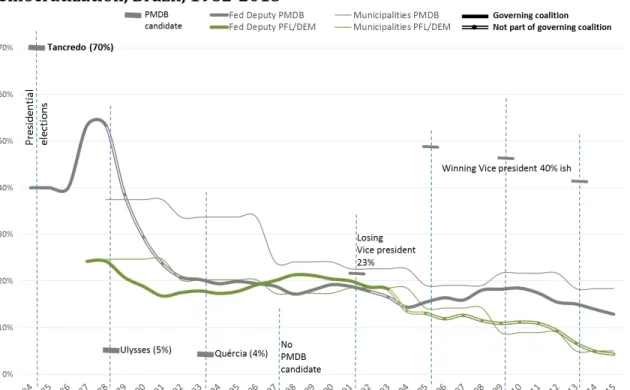
new economic plan, the PMDB held an unprecedented majority in congress. It was the first and the only period in recent democracy that a single party had the control of the executive and was a single majority party in legislature. It was the largest electoral victory ever won by a political party in a proportional representation multiparty system. This story we are telling is well decribed in Figure 2.
Figure 2 here
The necessary adjustments were painfully implemented just after the election in an abrupt way, which suggested a clearly opportunistic electoral maneuver from government to win the general election. The impact of the adjustment package, which was named Cruzado Plan II, upon the authority and popularity of Sarney was very negative. The general mood of optimism generated by the Cruzado plan I was transformed in disillusionment as voters felt they were cheated with the Cruzado II which had been designed before the election but made public only afterwards. Sarney's political capital eroded quickly and he was no longer capable of unifying his Democratic Alliance coalition.
election, Lula was the runner up and Ulysses had melancholic 4.73% of the votes. Even though the figure of Ulysses was still respectful, the PMDB paid the price of Sarney’s (awful) administration and the 1986 ‘electoral burglary’ episode of unfreezing the prices one day after the general elections.
The inauguration of Fernando Collor generated great expectation and hope. Population believed that the first civilian legitimately elected president after 29 years could offer a definitive solution to the problem of hyperinflation, to endemic corruption and to fulfill voters' expectations of economic development. This positive expectation can be captured by the huge popular support Collor achieved (70
points) at the beginning of his administration.
However, Collor seemed to interpret this popular support as a free ticket to ride the political rollercoaster without taking into account the necessity of
politicians' support. Collor preferred, therefore, to develop direct connection with voters instead of making use of traditional political institutions such as Congress, political parties, or building a sustainable majority coalition.
extinguished and his coalition shrunk even further to 26 percent of seats in the Chamber of Deputies.
A new unexpected event, however, could have significantly change the PMDB history. In May 1992 Collor was accused by his younger brother, Pedro Collor, of involvement in a corruption scheme of influence peddling. Federal Police and
Congress began independent investigations soon after. On August 26, 1992, the final congressional inquiry report was released; as a result of this report, a petition was presented, formally accusing President Collor of having committed crimes of responsibility (the Brazilian equivalent of "high crimes and misdemeanors") warranting removal from office per the constitutional and legal norms regulating impeachment proceedings. On that formal petition, impeachment proceedings were initiated in the Chamber of Deputies, the lower house of Congress. On September 29, 1992, Collor was impeached by a vote of 441 for and 38 votes against.
On October 2, 1992, President Collor received formal notice from the
Brazilian Senate that the Chamber of Deputies had accepted the charges presented against him and that he was now a defendant in a trial of impeachment that the Senate would conduct. Per the Brazilian Constitution, upon receipt of that notification, Collor's powers were suspended for 180 days, and Vice President Itamar Franco became acting president. Facing almost certain conviction and
removal from office by the Senate, Collor resigned on December 29, 1992 just as the trial was underway, in the last day of the proceedings.
of “salvation government.” With the exception of the Worker's Party (PT), that preferred not to occupy formal positions in the government, all political parties that supported Collor’s impeachment decided to take part of Franco's governing
coalition. Franco’s administration, therefore, re-established the coalition-based presidentialism. This decision, somehow, helped to rebuild bridges between executive and legislative branches that had been broken under Collor's administration.
Here is when history, again, make the presidency fall in the leaps of the PMDB, in a very erratic way. Franco, elected by the PRN was now a PMDB partisan. Once again, a PMDB president was in charge, once again, he was not directly elected and once again he was far from being a central figure to the party. Even with that chance, the PMDB was not able to develop a viable candidacy in the forthcoming elections. The party did not give up the majoritarian game however and in 1994 the candidate was Orestes Quercia. The 4.38 share of votes obtained by Quercia was a symbolic end for last presidential candidate the PMDB had.
Figure 3 here
share consistently decreased in the next local elections. On the other hand, the PSDB and the PT dramatically increased their numbers of controlled municipalities in this period (Figure 3). Obviously, not participating in the governing coalition has an even worse effect, but giving up the majoritarian game might be dangerous. The
DEM/PFL is paying the price of playing both games, giving up a single candidacy and being an opposition party (Figure 2).
The electoral evidence of those two cycles unveils an often hidden cost of playing the majoritarian game. Usually small parties have candidates in national elections even knowing that a victory is implausible. Those small parties do as best as they can in the elections in order to extract bigger rents from their support to presidential coalition in the future. With big parties whatsoever it can work the other way around. The expected return for playing the majoritarian game in the case of big parties is relatively high, so a major defeat in national elections can imply a decreased bargain power within coalition and a shrinking share of municipalities in the future.
The first and decisive track change occurred in 1998, when the party decided not having a candidate. At that time the PMDB was still the biggest party in congress and by far the one with more municipalities under its political control. The PMDB was satisfied in playing a supporting role for the PSDB and PFL/DEM whatsoever.
In 2002 the PMDB played the game of the ‘embarrassed median’, they lost the vice-president elections but after only one year rapidly joined the PT winning
Looking for PMDB-like parties across the world: The PMDB Index
In our search for a party with the aforementioned characteristics of the PMDB, we developed a measure of proximity. We were looking for large coalition partner with no ambition to control the executive, which has ample distribution in the national territory of the country, by governing several municipalities and many states and by holding a substantial number of seats in Congress, ideologically
amorphous, without a clear-cut political agenda or platform, and with many regional leaders trying to maximize their own political interests. Our objective was to
account for resemblance between the PMDB and parties across the world. This measure was based on eight indicators concerning eight different party attribute dimensions. These eight indicators were given values from 0 to 1, where 0 is the most distant from the PMDB and 1 is the closest to the PMDB.
Data on parties was gathered through a expert survey, conducted with 74 specialists on Latin American politics.2 The specialists were able to choose a country
they would like to respond and answered few questions concerning political parties in that specific country. We compared then their answers to a PMDB benchmark on each question, and applied a formula to generate an index going from 0 to 1 on each dimension. Dimensions D1 to D4 have observable benchmark values. On dimensions D5 to D8, values for the PMDB were given by the authors (table 1).
Table 1 Here
2 The first wave of surveys considered only Latin American countries. There were 37 complete
We decided to take into consideration only data points with three or more responses and where specialists consistently agreed on their evaluations, which is, the coefficient of variation on the aggregate responses was lower than 50%.3 Here
we plot only the best-fit for PMDB in each country we have data for (Figure 4). The PDC in Chile is by far the most similar party to the PMDB in Latin America, followed by the PRI in Mexico. All the parties considered tend to play the median role, have a national distribution and a center ideology. The differences appear on the other dimensions and one of them has the most intriguing and striking result: candidate to executive. No PMDB-like party in Latin America decided, as the PMDB did, to give up from a leading majoritarian role in presidential elections. What could explain such a puzzle? The fear of playing the majoritarian game with an expected low probability of win seems a possible reason.
Figure 4 here
Previous theoretical developments in this paper mentioned a space for PMDB-like parties in fragmented environments. Plotting the PMDB Index against a fragmentation measure (like the effective number of parties) among Latin American countries can give us an idea of how this theory holds or not (Figure 5). There is an interesting correlation between the PMDB Index and the level of fragmentation. Countries where the PMDB-like party has the highest value on the PMDB index are usually the same countries where the level of fragmentation is high. Although censored data still limit our analytical strength, this correlation partially supports the idea that a fragmented environment would generate such animals like the
PMDB. Causality is still a concern whatsoever. Even though there is a clear
theoretical explanation to support causality, more sophisticated empirical strategies are waiting to be developed.
Figure 5 here
Two main reasons explain why such a correlation is so strong. The first one is related to the need of a cooperation anchor under over-fragmented legislatures. In the absence of this anchor, system would become dysfunctional, so in order to defend itself the system would generate such parties. The second one has to do with Sartori (1976) predictions for fragmented systems encompassing a “centrifugal competitive pattern”. The center of the distribution becomes a very appealing position in which parties compete, struggling for expansion and control over policies, the more fragmented, the bigger the struggle.
The problem now is: how to find a counterfactual for Brazil? It might be the case that the singularity of the PMDB has to do with Brazilian political system singularities. In this sense, our empirical search for a party can be elusive. We will never find it
Political Difficulties of managing the median legislator in the coalition
achieve a greater or lesser degree of satisfaction that, in turn, has the potential to generate higher of smaller governability cost.
An important aspect of our model is to understand how the president, as the coalition manager in a fragmented multiparty environment, allocates her political and monetary resources to coalition partners in exchange for political support in Congress. A strategic president who is concerned about policy outcomes and about her various management functions will consider these costs in working toward an optimal strategy. Once elected, the president faces at least three interconnected exogenous constraints: (1) the level of party fragmentation in the legislature; (2) the size of the president’s party relative to the sizes of other parties; and (3) the
ideological distances between the president’s party and the other political parties in the legislature. Working within such constraints, the executive makes decisions about the size and ideological heterogeneity of his coalition and the proportionality of rewards of cabinet seats and financial resources.
Raile et al. (2015) demonstrate that governing costs increase with cabinet disproportionality, ideological heterogeneity, and coalition size. Specifically with regard to this last component, they assume that the greater the number of coalition allies, the higher the governability cost. The theoretical rationale of their hypothesis is that presidents would face higher coordination problems managing a coalition with a larger number of parties; therefore, higher costs.
president would face higher risk of facing hold up problems from being too close or too dependent on a large median partner. Therefore, in order to avoid this potential vulnerability the president would prefer to build a numerically very large coalition.
On the other hand, it also reasonable to infer that smaller parties could extract a higher premium relative to their size. Their inclusion in the coalition generally means that party is necessary for the president and, as a consequence, such a party might be able to extract disproportionate rewards. For the manager of the coalition, therefore, it might be cheaper to buy small parties in the retail (Varejo) rather than to buy the median legislator in the wholesale (atacado). The executive could also fell threatened by a strong median legislative partner that would have the capacity to challenge the executive by switching to the majoritarian track and
offering a presidential candidate in the near future.
In order to initially access the status of this relation, we estimate a basic correlation test, considering monetary transfers (individual legislative amendments to the annual budget) to parties, political transfers (cabinet positions) to parties and seat share (the percentage of seats held by each party) in the chamber of deputies. We operationalized both monetary and political transfers with regard to the size of the party. Thus, we have been able to have a glimpse if political and financial
rewards were proportionally distributed.
Figure 6 here
size increases. Therefore, it might be the case that bigger median legislator parties are cheaper to buy out with political transfers, while smaller parties are cheaper to buy out with monetary transfers, suggesting thus a substitute effect between those two governing currencies (Raile et al 2011). In other words, there are economies of scale when it comes to monetary transfers and diseconomies of scale when it comes to political transfers.
However, the strength of those relations matter and the negative correlation in this case is far more consistent. Figure 6 shows the relation between “Seat Share” in the Chamber of Deputies and “Coalition Surplus”. Coalition Surplus measures if a coalition party is under or over rewarded by the president.4 The higher the Surplus,
the greater a party will be over rewarded vis-a-vis its contribution to the governing coalition.
Looking at the overall picture, the first noticeable fact is that there has been a very strong and negative correlation between Seat Share and Coalition Surplus over time. That is, the bigger the party, the lower the relative political reward it will receive by the president. The data for Brazil is fairly consistent and suggests that smaller parties extract a higher premium. We can also infer that the strength of this relation increases while the Seat Share decreases, observing the narrowing of the confidence interval.
4The Coalition Surplus of party p (CSp) formula is defined by CSp =mp/jm
j - sp/sc where sp accounts for
the number of seats party p holds, sc accounts for the overall number of seats the coalition c holds, mp
is the number of ministries occupied by the party p and jmjis the total number of available cabinet
This correlation result lends support the hypothesis that the president will face higher governing costs if she decides to have a coalition with many small parties rather than relying on the support of a big median legislator.
The second aspect to highlight is that different presidents in different terms had different strategies. Few big parties took part of president Cardoso’s coalitions most of the time. On the other hand, many small parties formed Lula and Rousseff’s governing coalitions. As a consequence, it is reasonable to expect that PT
governments to account for more pressure on the distribution of political goods, since those small parties might expect to receive more rewards in order to achieve a surplus.
References:
Ames, Barry (1995). “Electoral Strategy under Open-List Proportional Representation.” American Journal of Political Science 39:406-33.
Shugart, Matthew & Carey, John (1992) “Presidents and Assemblies,” in Dahl at al. The Democracy Sourcebook, pp. 272-276
Cheibub, José Antônio (2002). Minority governments, deadlocks situations, and the survival of presidential democracies. Comparative political studies, 35 (3): 284-312.
Cheibub, José Antônio; Przeworski, Adam., and Saiegh, S. 2004. Government coalitions and legislative success under presidentialism and parliamentarism. British Journal of Political Science, 34 (4): 565-87.
Cox, Garry (1997) Making Votes Count: Strategic Coordination in the World’s Electoral System. Cambridge: Cambridge University Press.
Cox, Gary, and Matthew Soberg Shugart. (1995) “In the Absence of Vote Pooling: Nomination and Vote Allocation Errors in Colombia.” Electoral Studies 14:441-60.
Crisp, Brian F. (1997) “Presidential Behavior in a System with Strong Parties.” In Presidentialism and Democracy in Latin America, ed. Scott Mainwaring and
Huber, John and Powell, Bingham (1994) “Congruence Between Citizens and
Policymakers in Two Visions of Liberal Democracy” World Politics, 46 (3): 291-326.
Janda, Kenneth. (1993) Comparative political parties: research and theory. In Political Science: the state of the discipline II, eds. A.W.Finifter. Washington, DC:
American Political Science Association, 163-92.
Jelnov, A. (2014 ). Existence of dominant players and their role in the formation of a cabinet coalition. Available in
http://artyomjelnov.weebly.com/uploads/4/5/7/5/45750305/dominant7.pdf
Maciel, N. R. A. (2014). Velhas raposas, novos governistas: o PMDB e a democracia Brasileira. Doctorate Thesis.
Mainwaring, Scott; Power, Timothy; and Bizzarro, Fernando (2015) “The Uneven Institutionalization of a Party System: Brazil” in Scott Mainwaring…
Mainwaring, Scott and Matthew Soberg Shugart. (1997). “Conclusion: Presidentialism and the Party System.” In Presidentialism and Democracy in Latin America, ed. Scott Mainwaring and Matthew Soberg Shugart. New York: Cambridge
University Press.
Pereira de Melo, P. V. T. (2013) O PMDB e a sua manutenção no centro do jogo político: de catch all a cartel. Master thesis.
Raile, Eric
Samuels, David J., and Matthew S. Shugart. 2010. Presidents, Parties, and Prime
Ministers: How the Separation of Powers Affects Party Organization and Behavior.
Cambridge University Press.
Samuels, David. (2000). “The gubernatorial coat-tails effect: Federalism and Congressional elections in Brazil.” The Journal of Politics. Vol. 62 (1)
Sartori, G. (1976) Parties and Party Systems: A Framework for Analysis. Cambridge: Cambridge University Press
Figures
Figure 1: Partisan Choices on Consensual (Proportional) Systems
Nature (election)
Majoritarian
Winner
Majoritarian (winner)
(10)
Loser
Majoritarian (Opposition)
(4)
Embarrassed Median
(2)
Median Legislator
Majoritarian
Median Legislator
Table 1: PMDB Index Dimensions
Dimension Question PMDB
D1 Coalition participation frequency
How often does the party participate in the governing
(presidential) coalition? (0% to 100%) 85% D2 Ideology How would you place the following parties about
their ideological position? (1 to 10) 5.5
D3 Credible candidate
In the last five elections, has this party launched any credible candidate to the presidency with real chances of winning? (0 to 5)
0
D4 Post-seat differential
Usually in coalition governments the executive distribute cabinets according to the number of seats that parties hold in the Congress. Considering this, what is the relation between [ Cabinet Share (%) - Seat Share (%) ] of theses parties when taking part in governing coalitions? (+100 to -100)
-15
D5 Median role
Does the political party play a median vote role? That is, how would you consider the political party in terms of avoiding extreme-left or extreme-right policy decisions? (0 to 6)
3
D6 Internal cohesion To what extent members of those political parties
have presented internal party cohesion? (1 to 10) 2
D7
Ability to pass legislation or veto the executive
How do you rank the parties concerning the ability/power to veto and pass legislation
(constraining the executive’s preferences)? (1 to 10)
9
D8 National distribution
Concerning the distribution of voters and
sympathizers, would you consider the political party to be? (1 to 10)
Annex I PMDB Index values
country-party
D1 D2 D3 D4 D5 D6 D7 D8
Bra-PMDB 1.00 1.00 1.00 1.00 1.00 1.00 1.00 1.00
Chi-PDC 0.94 0.99 0.50 0.69 1.00 0.63 0.80 0.94
Mex-PRI 1.00 0.98 0.22 0.57 1.00 0.57 0.80 0.97
Chi-PD 0.93 0.81 0.58 0.70 0.85 0.56 0.67 0.96
Arg-PJ 0.77 0.97 0.20 0.65 0.98 0.73 0.67 0.91
Arg-UCR 0.40 0.97 0.50 0.92 1.00 0.69 0.46 0.91
Chi-PS 0.93 0.78 0.40 0.84 0.80 0.51 0.66 0.93
Mex-PAN 0.86 0.72 0.39 0.84 0.80 0.63 0.70 0.73
Chi-RN 0.43 0.81 0.54 0.93 0.80 0.56 0.59 0.99
Arg-FPV 0.86 0.85 0.21 0.46 0.89 0.46 0.77 0.94
Uru-FA 0.53 0.80 0.07 0.78 0.89 0.52 0.86 0.93
Uru-PN 0.64 0.79 0.34 0.88 0.85 0.56 0.45 0.82
Uru-PC 0.69 0.76 0.47 0.88 0.81 0.61 0.39 0.62
Chi-UDI 0.43 0.68 0.52 0.94 0.68 0.40 0.59 1.00
Ven-AD 0.34 0.95 0.60 0.65 0.96 0.56 0.24 0.90
Ven-COPEI 0.25 0.91 0.60 0.65 1.00 0.78 0.24 0.66
Ven-PSUV 0.91 0.63 0.00 0.39 0.68 0.42 0.80 0.98
Mex-PRD 0.37 0.75 0.44 0.82 0.80 0.77 0.35 0.50