Departmento de Informática e Matemática Aplicada Programa de Pós-Graduação em Sistemas e Computação
Mestrado Acadêmico em Sistemas e Computação
Evolving Future Internet Clean-Slate Entity
Title Architecture with Quality-Oriented
Control-Plane Extensions
José Castillo Lema
Evolving Future Internet Clean-Slate Entity Title
Architecture with Quality-Oriented Control-Plane
Extensions
Dissertação de Mestrado apresentada ao Pro-grama de Pós-Graduação em Sistemas e Computação do Departamento de Informá-tica e MatemáInformá-tica Aplicada da Universidade Federal do Rio Grande do Norte como re-quisito parcial para a obtenção do grau de Mestre em Sistemas e Computação.
Linha de pesquisa:
Sistemas Integrados e Distribuídos
Orientador
Augusto Venâncio Neto, Ph.D.
Co-orientador
Flavio de Oliveira Silva, Ph.D.
PPgSC – Programa de Pós-Graduação em Sistemas e Computação DIMAp – Departamento de Informática e Matemática Aplicada
CCET – Centro de Ciências Exatas e da Terra UFRN – Universidade Federal do Rio Grande do Norte
Natal-RN
UFRN / Biblioteca Central Zila Mamede Catalogação da Publicação na Fonte
Lema, José Castillo.
Evolving Future Internet clean-slate Entity Title Architecture with quality-oriented control-plane extensions. / José Castillo Lema. – Natal, RN, 2014.
60 f.: il.
Orientador: Prof. PhD. Augusto Venâncio Neto. Co-orientador: Prof. PhD. Flávio de Oliveira Silva.
Dissertação (Mestrado) – Universidade Federal do Rio Grande do Norte. Centro de Ciências Exatas e da Terra. Programa de Pós-Graduação em Sistemas e Computação.
1. Internet do futuro – Dissertação. 2. Clean-slate - Dissertação. 3. QoS/QoE - Dissertação. I. Venâncio Neto, Augusto. II. Silva, Flávio de Oliveira. III. Universidade Federal do Rio Grande do Norte. IV. Título.
Lema e aceita pelo Programa de Pós-Graduação em Sistemas e Computação do Departa-mento de Informática e Matemática Aplicada da Universidade Federal do Rio Grande do
Norte, sendo aprovada por todos os membros da banca examinadora abaixo especificada:
Augusto Venâncio Neto, Ph.D. Presidente
DIMAp – Departamento de Informática e Matemática Aplicada UFRN – Universidade Federal do Rio Grande do Norte
Flavio de Oliveira Silva, Ph.D. Examinador
Faculdade de Computação (FACOM) UFU – Universidade Federal de Uberlândia
Sergio Takeo Kofuji Examinador
Departamento de Engenharia de Sistema Eletrônicos USP – Universidade de São Paulo
Marcos Cesar Madruga Alves Pinheiro, Ph.D. Examinador
DIMAp – Departamento de Informática e Matemática Aplicada UFRN – Universidade Federal do Rio Grande do Norte
The work described in this thesis was conducted at the Department of Informatics and Applied Mathematics (DIMAp) of the Federal University of Rio Grande do Norte (UFRN) and at OFELIA experimental testbed in Brazil in the Federal University of Uberlândia
(UFU), within the context of the following projects:
• OFELIA - OpenFlow in Europe: Linking Infrastructure and Applications - Project funded by the European Community’s Seventh Framework Programme, under grant agreement n. 258365. The project creates a unique experimental facility that allows researchers to not only experiment on a test network but to control and extend the network itself precisely and dynamically.
• EDOBRA - Extending and Deploying OFELIA to Brazil - Project composing a new
workpackage in OFELIA, combining the work of Instituto de Telecomunicações, Pólo Aveiro, from the Universidade de Aveiro, Portugal, with the work from Universidade Federal de Uberlândia and Universidade de São Paulo, both from Brazil.
The work done during this thesis resulted in the following publications regarding dynamic over-provisioning network resource allocation techniques:
• J. Castillo-Lema, E. Cruz, A. Neto and E. Cerqueira. “Advanced resource
provisio-ning in context-sensitive converged networks", in 2013 International Conference on Computing, Networking and Communications (ICNC), San Diego, USA, January 2013.
• S. Jardim, A. Neto, J. Castillo-Lema, E. Cerqueira and H. Barros. “Enhancing
de-pendability in Future Internet systems by applying over-provisioning centric resource allocation control", in 2013 International Conference on Computing, Networking and Communications (ICNC), San Diego, USA, January 2013.
• S. Jardim, A. Neto, J. Castillo-Lema, E. Logota, J. Rodriguez and E. Cerqueira.
• S. Jardim, A. Neto, J. Castillo-Lema, E. Cerqueira and F. Silva. “Over-provisioning Centric Network Resource Control in Future Internet Systems", in The Eighteenth IEEE Symposium on Computers and Communications (ISCC’13), Split, Croatia, July 2013.
In addition, regarding the quality-oriented control plane extensions proposed to the ETArch architecture:
• J. Castillo-Lema, F. Silva, A. Neto, F. Silva, P. Frosi, C. Guimarães, D. Corujo and
R. Aguiar. “Evolving Future Internet Clean-Slate Entity Title Architecture with Quality-Oriented Control Plane Extensions", in The Tenth Advanced International Conference on Telecommunications (AICT), Paris, France, July 2014.
• F. Silva, J. Castillo-Lema, A. Neto, F. Silva, P. Frosi, D. Corujo, C. Guimarães
and R. Aguiar. “Entity Title Architecture Extensions Towards Advanced Quality-oriented Mobility Control Capabilities", in IEEE Symposium on Computers and Communications 2014 (ICNC), Madeira, Portugal, June 2014.
• F. Silva, J. Castillo-Lema, A. Neto, F. Silva, P. Frosi, D. Corujo, C. Guimarães and
da Arquitetura Entidade-Título
Autor: José Castillo Lema Orientador: Augusto Venâncio Neto, Ph.D.
Co-orientador: Flavio de Oliveira Silva, Ph.D
Resumo
A Internet atual vem sofrendo vários problemas em termos de escalabilidade, desempenho, mobilidade, etc., devido ao vertiginoso incremento no número de usuários e o surgimento
de novos serviços com novas demandas, propiciando assim o nascimento da Internet do Futuro. Novas propostas sobre redes orientadas a conteúdo, como a arquitetura Entidade Titulo (ETArch), proveem novos serviços para este tipo de cenários, implementados sobre
o paradigma de redes definidas por software. Contudo, o modelo de transporte do ETArch é equivalente ao modelo best-effort da Internet atual, e vem limitando a confiabilidade das suas comunicações. Neste trabalho, ETArch é redesenhado seguindo o paradigma do sobre-aprovisionamento de recursos para conseguir uma alocação de recursos avançada integrada
com OpenFlow. Como resultado, o framework SMART (Suporte de Sessões Móveis com Alta Demanda de Recursos de Transporte), permite que a rede defina semanticamente os requisitos qualitativos das sessões para assim gerenciar o controle de Qualidade de Serviçovisando manter a melhorQualidade de Experiência possível. A avaliação do planos de dados e de controle teve lugar na plataforma de testes na ilha do projeto OFELIA, mostrando o suporte de aplicações móveis multimídia com alta demanda de recursos de transporte com QoS e QoE garantidos através de um esquema de sinalização restrito em comparação com o ETArch legado.
Architecture with Quality-Oriented Control-Plane
Extensions
Author: José Castillo Lema
Supervisor: Augusto Venâncio Neto, Ph.D. Co-supervisor: Flavio de Oliveira Silva, Ph.D.
Abstract
Current Internet has confronted quite a few problems in terms of network mobility,
qua-lity, scalabiqua-lity, performance, etc., mainly due to the rapid increase of the number of end-users and various new service demands, requiring new solutions to support future usage scenarios. New Future Internet approaches targeting Information Centric Networking,
such as the Entity Title Architecture (ETArch), provide new services and optimizations for these scenarios, using novel mechanisms leveraging the Software Defined Networking (SDN) concept. However, ETArch approach is equivalent to the Best Effort capability of current Internet, which limits achieving reliable communications. In this work, ETArch
was evolved with both quality-oriented mobility and resilience functions following the over-provisioning paradigm to achieve advanced network resource allocation integrated with OpenFlow. The resulting framework, called Support of Mobile Sessions with High Transport Network Resource Demand (SMART), allows the network to semantically
de-fine the quality requirements of each session to drive network Quality of Service control seeking to keep bestQuality of Experience. The SMART evaluation in both data and con-trol plane was carried out using a real testbed of the OFELIA Brazilian island, showing that its quality-oriented network functions allowed supporting bandwidth-intensive
mul-timedia applications with high QoS and QoE over time through a signalling restricted scheme in comparison with the legacy ETArch.
1 DTS, DTSAs, Entities and the Workspace. . . p. 18
2 Entity Title Architecture Protocol Stack. . . p. 20
3 Messages Exchanged to Create and Adapt the Workspace. . . p. 20
4 Proposed framework. . . p. 35
5 System setup overview. . . p. 38
6 System Bootstrap scenario signaling. . . p. 39
7 SMART enhanced header with quality metrics. . . p. 39
8 System Setup scenario signalling. . . p. 42
9 Use case. . . p. 44
10 Use case (continuation). . . p. 45
11 Scenario environment description. . . p. 47
12 Delay. . . p. 47
13 QoE metrics for multimedia video streaming. . . p. 49
14 Video snapshot comparison. . . p. 50
15 Network topology with correlated communications paths. . . p. 51
16 Overall signalling load of SMART enabled and ETArch only experiments. p. 51
17 Forwarding Table Entries in edge and core nodes. . . p. 52
18 Readjustments events up to 100% network saturation. . . p. 53
19 Blocked sessions for Multimedia Streaming service class. . . p. 54
1 Services and their semantic regarding OpenFlow. . . p. 21
2 Comparison of the related work. . . p. 30
ICN – Information Centric Networking
SDN – Software Defined Networking
ETArch – Entity Title Architecture
QoS – Quality of Service
QoE – Quality of Experience
DTS – Domain Title Service
IEEE – Institute of Electrical and Electronics Engineers
DTSA – Domain Title Service Agent
IntServ – Integrated Services
RSVP – Resource Reservation Protocol
MPSL – Multi-Protocol Label Switching
LER – Label Edge Router
LSR – Label Switch Router
LSP – Label Switched Path
LSD – Label Switching Domain
DiffServ – Differentiated Services
CoS – Class of Service
IETF – Internet Engineering Task Force
SLS – Service Level Specifications
DARIS – Dynamic Aggregation of Reservations for Internet Services
SIDSP – Simple Inter-Domain QoS Signalling Protocol
MN – Mobile Node
MADM – Multiple Attribution Decision Making
SAW – Simple Additive Weighting
1 Introduction p. 13
1.1 Organization of this Dissertation . . . p. 15
2 Background p. 17
2.1 Entity Title Architecture . . . p. 17
2.1.1 Entity Title Architecture Protocol Stack . . . p. 19
2.1.2 DTSA as the Controller . . . p. 19
2.2 QoS approaches . . . p. 22
2.2.1 QoS Over-Provisioning . . . p. 25
2.3 Conclusion . . . p. 27
3 Related work p. 28
3.1 Support for QoS in Future Internet proposals . . . p. 28
3.2 Conclusion . . . p. 31
4 SMART Proposal p. 32
4.1 General concepts . . . p. 32
4.2 Architecture Organization . . . p. 34
4.2.1 Advanced QoS Resource Allocator . . . p. 35
4.2.2 Admission Controller . . . p. 36
4.2.3 Route Manager . . . p. 36
4.2.4 Protocol Manager . . . p. 37
4.3.2 Session Setup . . . p. 38
4.3.3 Over-reservation Control . . . p. 41
4.4 Use case . . . p. 43
4.5 Conclusion . . . p. 45
5 SMART Evaluation p. 46
5.1 Evaluation Scenario . . . p. 46
5.2 Performance Evaluation . . . p. 47
5.3 Control Plane Evaluation . . . p. 50
5.4 Conclusion . . . p. 55
6 Conclusions p. 56
6.1 Future Work . . . p. 56
1
Introduction
The Internet is constantly evolving, motivated by its natural growth and by the intro-duction of new services and applications to fulfill emerging needs. New requirements are
being placed over its architecture, such as mobility, security and scalable content distribu-tion. To cope with this new set of requirements, several enhancements are being defined, increasing the complexity of the overall Internet architecture, with many core components reaching their limit, and hindering further evolutions (HANDLEY, 2006). In addition, the
current Internet still cannot address many of today’s and emerging requirements ade-quately, such as efficient transmission of content-oriented traffic and effective congestion control. As a result, clean-slate attempts are being carried out as the next step towards an efficient Future Internet approach.
Information Centric Networking (ICN) (ICNRG, ) is one of such proposed approaches focusing on content access and delivery beyond current host-to-host communications. Content has a more central role in the network operations, motivated by the need to meet data-intensive applications. This paradigm shift leverages in-networking caching and replication, improving efficiency, scalability and robustness.
However deploying ICN capable nodes into current networks would require the update or replacement of existing networking equipment and protocols.Software Defined Networ-king (SDN) (SHIN; NAM; KIM, 2012) emerges as a promising solution to overcome this, since it could not only facilitate the deployment of ICN functionalities in current networks without requiring new clean-slate designs, but it could also improve and enhance current and future Internet network management mechanisms by providing a development
en-vironment with an architecture composed of algorithms and protocols that allow joint operations on the infrastructure to separate the data plane from the control plane. SDN facilitates both deploying and experimenting new functionalities/architectures on top of current networks cost-efficiently and easily. Moreover, it also allows improving and
entity, that creates network state and communicates it to network nodes, or even hosts, programming the network forwarding-plane through an open interface, such as OpenFlow (MCKEOWN et al., 2008). Although the promising aspects and facilities, SDN imposes per-formance penalties by both upper layer (software) and centric dependencies (centralized
controller), which jeopardizes scalability capacities(BIANCO et al., 2010).
The Entity Title Architecture (ETArch) (SILVA et al., 2012) is an emerging Future
Internet clean-slate approach that share the vision of content-oriented paradigms, where entities request content by subscribing to it, triggering the network to dynamically confi-gure itself in order to provide the users with the intended content. The content is delivered trough a channel that gathers multiple communication entities, calledWorkspace, allowing communicating entities to express their requirements over time. Despite its innovative ap-proach, ETArch does not consider reliable communications provisioning in its design, and omits important factors to determine the connection, such as the quality requirements of demanding applications and the level of quality of the network nodes. Thus, ETArch
lacks quality-oriented mechanisms for establishing workspaces, which means that network control functions seriously restrict data dissemination over the best-effort transport model of the current Internet. Moreover, ETArch operates in a per-flow driven way, and it is well known that such signaling approach overloads the system performance with the increasing
session-flow admissions, mainly in terms of signaling and processing overheads (MANNER, 2005). As a result, the entire system can reveal increasingly high latency (network proces-sing) and bandwidth use (exceeding signalling), which may increase energy consumption levels while degrading users perception.
This way, it is evident that ETArch is unable to accommodate bandwidth-intensive
session flows (e.g., real-time multimedia) guaranteeing both Quality of Service (QoS) and Quality of Experience (QoE) over time, in terms of setting workspaces connections with limited delay, error and loss rates experience. This drawback seriously restricts the scope of ETArch in Future Internet scenarios, especially when is taken into account the
fact that traffic forecasts (CISCO, 2013) predict that 80% of the total data flows will stream multimedia content by 2017. In view of this, the session setup control functions of ETArch must take into consideration quality parameters to guide quality-oriented sessi-ons, specially real-time ones, where losses above 5% generally lead to very poor effective
to changing network conditions. This diversity of applications makes the current ETArch approach of offering the same “best-effort"service to all applications inadequate.
The limitations described above motivate this work in the sense that there is a need to extend the control plane of legacy ETArch with quality-oriented functions to improve the session admission mechanism. First of all, it is required to define the application session requirements that will semantically describe the quality demands that must be
fulfilled over time, by defining the minimum quality requirements of each mobile session flow (bitrate, tolerance to packet delay/loss/error, etc.). Adopting both QoS -connectivity over-provisioning capabilities and QoS-oriented mobility would benefit ETArch system to establish personalized multiparty sessions while improving the system scalability. For
this reason, this work proposes a new network architecture, denoted as Support of Mo-bile Sessions with High Transport Network Resource Demand (SMART), which redesigns the legacy ETArch with advanced QoS and mobility control functions to accommodate bandwidth-intensive mobile sessions over truly reliable and robust communication
chan-nels, while optimizing the network control plane.
The SMART proposal owns the following contributions:
• allow session sources to semantically express QoS session requirements;
• OpenFlow extensions to enforce per-class bandwidth reservations;
• deployment of a control scheme of super-dimensioned resources to achieve scalability through a signaling-restricted approach;
• deployment of an aggregation based transport paradigm to optimize forwarding
costs in the network core.
The SMART evaluation was carried out on a real Testbed scenario by using the
OFE-LIA (OpenFlow in Europe: Linking Infrastructures and Applications) Brazilian Island. The results demonstrate its superior benefits with regard to the legacy ETArch confi-guration in both control (signaling load, forwarding state table entries) and data planes (objective and subjective QoE analysis).
1.1
Organization of this Dissertation
The second chapter presents the background for this work, highlighting not only the supporting technologies, but also other related approaches.
In the third chapter the related work on QoS in SDN and Future Internet networking is presented.
The fourth chapter presents the proposed framework, defining its main requirements and guidelines and the interaction between its elements. It explains the architecture imple-mentation, and a detailed description of the mechanisms and main functions is presented,
as well as the principal structures and agents constructed.
The fifth chapter presents an evaluation of the framework, by testing the efficiency
and scalability of the architecture, and also the performance of the network in specific scenarios and conditions.
2
Background
This section describes the Entity Title Architecture that uses a Clean Slate appro-ach to provide seamlessly multicast and mobility based on an OpenFlow substrate. The
following subsections explain how this object will be accomplished.
Since Quality of Service (QoS) is an essential requirement to implement the solution presented in this work, the current state of art of QoS methods and its signalling will also be studied. It will be described network resource provisioning aspects, as well as different methods of applying QoS in the network
2.1
Entity Title Architecture
The Entity Title Architecture is an instance of the Entity Title Model (SILVA et al., 2012). Some basic concepts of this architecture are the Domain Title Service (DTS), an Entity, its Title and a clean slate naming and addressing scheme, where Multicast and Mobility are seamlessly provided.
An Entity is a thing which has communication requirements and capacities that can be semantically understood from top to bottom layers. Some examples are: a content;
a sensor like device; a smart phone; an application; a system; a process and so on. The entity has at least one title, requirements, capacities and location that are variable over time.
The Title is a topology independent designation to ensure an unambiguous identifi-cation of an entity. One title designates only one entity, but one entity may have more
than one title. The title plays a key role in order to provide the horizontal addressing of the entities (PEREIRA; KOFUJI; ROSA, 2010).
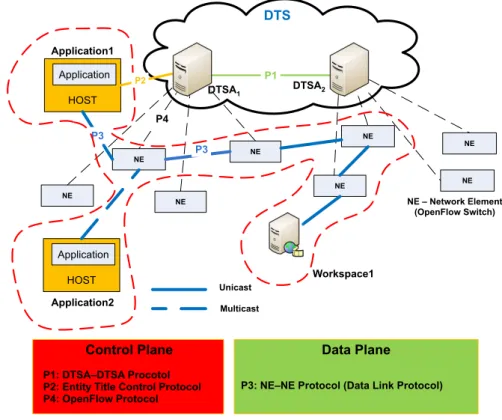
network and maintains the knowledge, inside the network, about itself. DTS plays an important role at central aspects of networking such as naming and addressing and has the ability to share the context among communicating entities.
NE NE NE NE NE NE NE NE P1 Workspace1 P4 P3 Application
DTSA1 DTSA2 HOST P3 Application HOST Application1 Application2 DTS
NE – Network Element (OpenFlow Switch)
Unicast
Multicast
P1: DTSA–DTSA Procotol P2: Entity Title Control Protocol P4: OpenFlow Protocol
P3: NE–NE Protocol (Data Link Protocol)
P2
Control Plane Data Plane
Figura 1: DTS, DTSAs, Entities and the Workspace.
This sharing is provided by the workspace. A workspace is created when an entity needs to communicate with another one for a specific purpose, such as video- conferencing
or file sharing. In order to create a workspace, the entity must specify the requirements it has and capabilities it may offer in conversing with other entities in the workspace. For example, the entity may require secrecy and delivery guarantees from its peers, while also offering a maximum bandwidth value. If the requirements change during the conversation,
the DTS brokers their renegotiation between the entities attached to the workspace. A Do-main Title Service Agent (DTSA) is responsible for keeping the entities’ and workspaces’ metadata.
All entities that share a workspace see the same message exchange. That is, any mes-sage sent by one entity is sent to all the other entities in that workspace, a native multicast
workspace, the entity passes any authentication and authorization restrictions associated to the workspace.
Figure 1 presents the main components of the Entity Title Architecture, where some entities are associated using a workspace.
2.1.1
Entity Title Architecture Protocol Stack
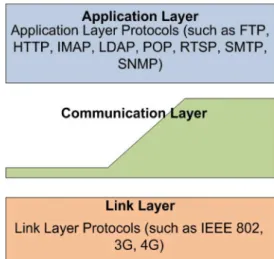
Considering the previously presented concepts, the Entity Title Architecture assumes that a new protocol stack for networking must be defined, especially at the Transport and
Network layers. In fact, it is considered a new layer, called Communication Layer, which contains functionality that today are related to these layers, as depicted at Figure 2. This protocol stack considers that current application protocols can still be used, as denoted by some application layer protocols presented, but not limited to them. This
unusual representation of the Communication Layer, highlights that this layer can contain functionalities only as required. Then, at a local network, only a packet ordering can be required and no routing is necessary, thus, the thin portion of layer is used. When handling interworking, with secrecy and QoS, for example, the full layer is used instead. Link layer
considers at this moment the IEEE 802 family of protocols.
In order to handle the dynamic behavior of the Communication Layer, a protocol with
a variable header was defined. The frame data is based on 802.1Q, and the used address is the Title of an entity. In most situations, these entities can be the DTS, in case of control primitives; or the workspace, in case of the data plane. This approach represents a paradigm change regarding naming and addressing at current networks.
After this header, a payload data contains the data from the Application Layer. Using
this approach the Entity Title Architecture retains, in most cases, compatibility with current Application Layer services. Experiments executed until this moment showed that just some few lines of code need to be changed in order to be compatible with the Entity Title Architecture.
2.1.2
DTSA as the Controller
The DTS may be divided into in several parts, being the Domain Title Service Agent
network elements, which is not viable at the current networks. However, by using the SDN abstraction, the architecture can come to life and experimentations become possible by using OpenFlow.
Figura 2: Entity Title Architecture Protocol Stack.
OpenFlow flow table handles the information to produce the workspace materializa-tion. It is important to notice that the implementation assumes the use of OpenFlow 1.0 based switches and in this case almost all the headers used by OpenFlow to perform the
match against the flow table are not suitable to be used, because the communication does not rely on the TCP/IP stack.
As the DTSA’s task of coordinating network elements is closely related to that of managing flows by an OpenFlow controller, the first was implemented on top of the latter.
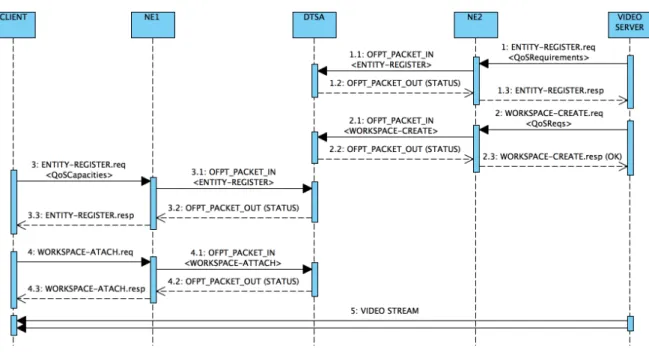
Figura 3: Messages Exchanged to Create and Adapt the Workspace.
ser-vice. This service will be forwarded by the switch to the DTSA, using the OFPT_PACKET_IN message. DTSA will receive this indication and by using the OpenFlow OFPT_FLOW_MOD message, this rule will be added to the flow table.
A registered entity that wants to receive the data provided by the newly created workspace, should attach to it by requesting a WORKSPACE_ATTACH service. This service also will be forwarded to the DTSA and in the same manner by using the OpenFlow
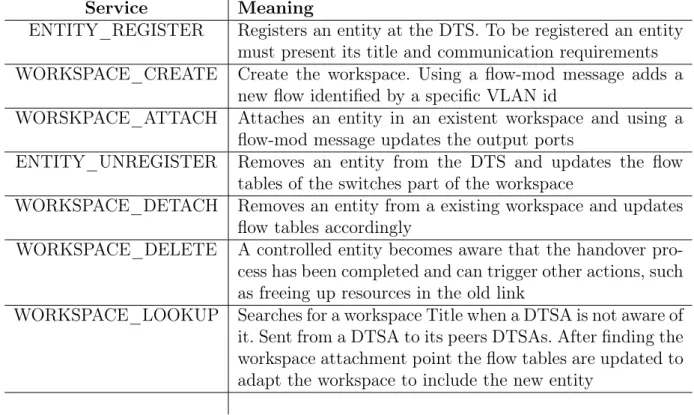
OFPT_PACKET_IN and OFPT_FLOW_MOD messages will modify the flow table to include the physical port of the requesting entity into the current workspace. Another entity could be attached to the workspace by pursuing the same procedure and becoming part of the sharing entities, as depicted in Figure 3. Table 1 summarizes ETArch main
operations.
Tabela 1: Services and their semantic regarding OpenFlow.
Service Meaning
ENTITY_REGISTER Registers an entity at the DTS. To be registered an entity
must present its title and communication requirements
WORKSPACE_CREATE Create the workspace. Using a flow-mod message adds a
new flow identified by a specific VLAN id
WORSKPACE_ATTACH Attaches an entity in an existent workspace and using a
flow-mod message updates the output ports
ENTITY_UNREGISTER Removes an entity from the DTS and updates the flow
tables of the switches part of the workspace
WORKSPACE_DETACH Removes an entity from a existing workspace and updates
flow tables accordingly
WORKSPACE_DELETE A controlled entity becomes aware that the handover
pro-cess has been completed and can trigger other actions, such as freeing up resources in the old link
WORKSPACE_LOOKUP Searches for a workspace Title when a DTSA is not aware of
it. Sent from a DTSA to its peers DTSAs. After finding the workspace attachment point the flow tables are updated to adapt the workspace to include the new entity
DTSA handles the exchange of DTS control primitives by listening to the communi-cation with the OpenFlow switch. By default, all primitives that do not match any of the
2.2
QoS approaches
Quality of Service is the ability to minister different priorities to different applications, users, or data flows, or even to guarantee a certain level of performance to a data flow such
as maintaining a required bit rate, delay, jitter, packet dropping probability or bit error rate. These warranties are very important if the network capacity is a limited resource, especially for real-time streaming multimedia applications since they often require a fixed bit rate and are delay sensitive.
In order to efficiently support multiparty sessions, the network provisioning
mecha-nism must consider the resources to implement QoS, because the main objective of QoS resource allocation is to guarantee that different flows composing a session are sent with guaranteed end-to-end throughput. Network resource allocation encompasses a set of methods to make decisions about how to use the available resources. It is essential to
control both network access and the usage of resources, in order to verify the requi-rements of session-flows and optimize the bandwidth used, because each of these flows might hold different needs concerning bandwidth, latency and packet loss.
One way to accomplish QoS is by applying traffic conditioning, that deals with methods for classification, queuing disciplines, congestion management, packet schedu-ling and enforcing policies.
There are Internet Engineering Task Force (IETF) standards that enhance Internet
with QoS support, such as Integrated Services (IntServ), Differentiated Services (DiffServ) and Multi-Protocol Label Switching (MPLS).
The IntServ (WROCLAWSKI, 1997) defines an architecture that guarantees QoS th-rough traffic classification and scheduling algorithms at network routers. It is associated with a standard mechanism to exchange information and requirements of QoS, called
Resource Reservation Protocol (RSVP) (R.BRADEN L. ZHANG; JAMIN, 1997). This infor-mation is filled into a message used to determine which guarantees the flow must receive by describing the token bucket rate, traffic peak rate, minimum policed unit and maxi-mum packet size. Each flow is transmitted with a shared part of guaranteed bandwidth. It
is necessary to consider the QoS requirements described in each RVSP signalling message whenever policy and admission control are applied. On one side, policy control determines if the user can access the requested service, and on the other hand, the admission control analyzes if the router has enough resources to support the requested QoS. IntServ is based
problems because its performance decreases with the increasing number of admitted flows (MANNER, 2005). These scalability issues brought difficulties in the IntServ deployment. Besides, this technology also has low flexibility and high complex mechanisms.
The MPLS (ROSEN A. VISWANATHAN, 2001) is a switching architecture that uses
a connection-oriented label-based method to route packets. It also relies in RSVP to reserve resources across the network. There are various specific network elements and
concepts that form this technology, as LSDs (Label Switching Domains), LERs (Label Edge Routers) that are the border routers of a LSD, and LSRs (Label Switch Routers) which are core routers that perform routing only based in the packets label. In MPLS architecture scheme, LERs are responsible to add a label in the incoming packets so that
the LSRs can switch them based in this label, which describes how packets are forwarded along the communication path, achieving then QoS. The communication path in which the packet goes through is named LSP (Label Switched Path), and the same LSP is used for all the packets with the same label. Once these control functions have to be implemented
by all the nodes of LSD and all of them have to examine the label and decide based on it, the overall process introduces high complexity and overload issues in the network.
Therefore, DiffServ (BLAKE D. BLACK, 1999) appeared with the objective of decreasing the overload in the core network by applying most of the QoS mechanisms only at edge routers, while the core network should mainly perform packet routing, in order to improve
network performance. DiffServ is a class-based model that permits different treatments to different flows by previously classifying them. Thus, at edge routers, each packet is associated with a certain network service named Class of Service (CoS). Each one of these CoS is treated differently by the routers that forward the packets, providing to higher
priority traffic preferential treatment. DiffServ is the most scalable model among the standard QoS approaches, because it maintains the traffic control in the network edges, leaving core routers with simple control functions, besides handling aggregations of flows instead of performing a per-flow approach. However, the lack of an admission control
strategy based on network resource capabilities is inefficient to prevent packet dropping and guarantee QoS under congestion situations. Thus, the quality of the session cannot be fulfilled during its propagation due to unavailable network resources in a congested situation.
In addition to the IETF solutions, other architectures have been proposed for
sca-lable form and the second economizes bandwidth in the network. Still, this integration is not trivial, as QoS achieves scalability by pushing the complexity to edge routers, IP multicast operates on a per-flow basis throughout the network.
The approach presented in (NETO et al., 2007) implements a double control of both QoS and multicast resources, in order to overcome the issues that may result of a dyna-mical addition of new group members, which can affect the existing traffic. The solution
described in this paper, Multi-servIce Resource Allocation (MIRA), is a multicast-aware resource reservation protocol for class-based networks that considers routing asymmetries. It provides the QoS requested for each flow by adapting the resources of the respective CoS. Moreover, it supports the construction of QoS-aware multicast trees for each
session-flow. In this way, it controls the resources of several CoSs and IP multicast trees, being the resources of inter-networks links controlled based on Service Level Specifications (SLS). The update process of the CoS bandwidth in a session establishment is done in a a unique operation from the ingress to the egress router placed in the direction of the access-router
of the client.
In MIRA, in each router is updated the CoS bandwidth associated with the sessions. As the egress router is placed in the edge of the network and communicates with a neighbor network, the configuration of the selected CoS in this router is made taking into account the SLS established with the neighbor network. The agents placed in the interior routers
only store per-class reservation state for lightweight control and optimization of packet forward processing. However, the edge agents save important information of network state as the list of interior routers involved in the reservation paths, information about edge-to-edge per-class reservations, the definitions of session-flows and information about available
CoSs, e.g. loss tolerance and delay. This information is essential to improve the network performance. While the list of interior routers is important to maintain the resilience, the edge-to-edge per-class information is used for fast admission control and to support QoS mapping and adaptation functionalities. This solution also implements a protocol
to exchange signaling between a pair of edge agents. Periodic messages are sent for state maintenance and used to acquire network resource capability information for admission control and also to detect re-routing events.
In order to enhance the efficiency of network resources management, more relevant network information should be taken into account. The current network state and the
2.2.1
QoS Over-Provisioning
The future networks are expected to support new features to provide value added sessions (e.g. multimedia, personalized, etc.) over heterogeneous transport technologies with acceptable service quality. However, the current packet-based technologies cannot
allow data transport beyond best-effort, narrowing session flows to experience undesired delay, jitter, and even packets losses.
Hence, there is the need to allocate bandwidth and deploy signaling to install, main-tain, or remove resource reservation for sessions, with schedulers on nodes to ensure that each session receives the amount of bandwidth allocated to it by the bandwidth reservation
mechanisms.
Although QoS control approaches are known as indispensable to maximize the value of future networks, per-flow reservation approach such as IntServ introduce excessive states, processing and signaling overheads and therefore raise serious scalability problems. Hence, QoS models based on Class of Services (CoSs) appeared suitable to prevent the
performance degradations of per-flow approaches. In class-based networks (e.g. DiffServ), flows are classified into a set of services CoSs at network borders (e.g. ingress routers) or central stations, based on predefined policies regarding QoS, protocols, etc.
Hence, in per-class QoS control, the reservation states are maintained per CoS and not per-flow, allowing to reduce the control overheads. However, the per-class reservation mechanisms driven by per-flow signaling approaches still confront scalability issues since
the QoS control operations are triggered with the increasing number of session demands.
In other words, the excessive control messages placed by per-flow signaling strategies, not only put heavy processing load on core router’s Central Processing Unit (CPU), but also consume more bandwidth, memory and energy, while they affect the session setup time.
Alternatively to per-flow QoS control signaling approaches, aggregated over-provisioning techniques envision reserving to each CoS more bandwidth than currently required. This
way, multiple flows can be accepted without signaling the network nodes, as long as re-sources are still available in order to optimize the network overall performance.
However, previous solutions mostly waste resources, increase session blocking proba-bilities unnecessarily while they incur QoS violation.
Protocol (BGRP) (PAN; HAHNE; SCHULZRINNE, 1999) for aggregate flows destined to a certain domain– a Sink-Tree-Based Aggregation Protocol, is too static and therefore fails to efficiently utilize the network resources.
The Dynamic Aggregation of Reservations for Internet Services (DARIS) (BLESS, 2004) over-reserves bandwidth for aggregate flows over several domains. However, DARIS focuses on reservation aggregations and signaling performances rather in how to improve
system scalability.
The Simple Inter-Domain QoS Signaling Protocol (SIDSP) (PINTO et al., 2007) system over-provisions the so-called virtual trunks of aggregate flows. However, SIDSP bandwidth over-reservation based on predictive algorithm (e.g. based on past history) without any mechanism to dynamically control the shared resource between existing trunks is not
efficient, as it can lead to waste of bandwidth.
The recently patented Multi-user Aggregated Resource Allocation (MARA) (NETO
et al., 2008) distinguished itself from the previous solutions by dynamically configuring
and reconfiguring bandwidth over-reservation parameters for CoSs. Moreover, MARA deals with wasting bandwidth by attempting to grant a congested CoS with a portion of residual bandwidth over-reservation of remaining classes, taking into account current
resource demand and session requirements. It supports a dynamic control of surplus class-based bandwidth and multicast resources, instead of supporting a per-flow reservation scheme, as in MIRA. This solution assures the minimal quality level of multimedia group communications sessions and achieves the scalability of the network.
However, MARA confronts serious efficiency problems in its over-reservation control
mechanism, by wasting bandwidth especially when the network is near to congestion, while the signaling load is not too minimized. Moreover, MARA does not provide any information on how this approach could work in dynamic scenarios with unpredictable cross-traffic such as in decentralized networks.
As described in (LOGOTA; NETO; SARGENTO, 2010), communication paths happen to
correlate by sharing link(s), meaning that a CoS on a shared link is used by all paths on which it lies, while traffic loads in different paths are unpredictable.
Hence, the dynamics of bandwidth utilization in various CoSs on shared links make over-reservation approach very challenging. In other words, an efficient dynamic bandwidth over-reservation mechanism strongly requires appropriate functions to:
• compute appropriate bandwidth to over-reserve for each Class of Service (CoS);
• deal with residual bandwidth (reserved but unused) to reduce the waste of bandwidth
and prevent CoS starvation.
The SMART scheme introduced novel techniques to over-allocate bandwidth over
CoSs, in a way that avoids QoS violation while significantly minimizing the waste of bandwidth and the session blocking probability.
In this work, the capabilities of the SMART algorithm are evaluated in a centralized architecture (ETArch) through experimentation in a real testbed.
2.3
Conclusion
This chapter explained some technologies and mechanisms that are used to support the SMART architecture, through the work done in this Tesis.
3
Related work
This section describes QoS approaches in the context of SDN, OpenFlow and Future Internet Clean Slate proposals.
As explained in Section 2.2, in what concerns QoS there is a continuing debate on how to evolve the current Internet in order to efficiently accommodate multimedia
sessi-ons. Currently, there is no QoS architecture that is successful and globally implemented. Some researchers argue that fundamental changes should be done to fully guarantee QoS, while others think slight changes are enough to have soft guarantees which will provide the requested QoS with high probability. Future Internet requires QoS control approaches
beyond current Internet standards, which mainly leverage the per-flow approach to allo-cate network resources (queues, bandwidth, data paths, etc.). Drawbacks associated to per-flow approaches are well known (MANNER, 2005), mainly in terms of network
perfor-mance (state, processing and signaling overheads), severely jeopardizing system scalability and increasing energy consumption.
Our previous works (CASTILLO-LEMA et al., 2013) (CASTILLO-LEMA et al., 2012) pro-posed dynamic over-provisioning network resource allocation techniques, deploying a con-trolled oversizing strategy for both bandwidth and data paths and allowing the admission of several sessions without per-flow signaling exchanges and decisions in the entire network
systems. An optimized network control approach enabled by the over-provisioning techni-que will allow the evolution of ETArch towards a truly efficient and robust Future Internet network system in comparison to what it is available in the literature.
3.1
Support for QoS in Future Internet proposals
flow to have a complete visibility of flows, often referred as flow setup) also brings overhead concerns. Moreover, the adoption of OpenFlow has been mainly focused on core/wired networks
Limited action set brings another issue of flexibility. OpenFlow, of course, can always forward packets to the controller and let the controller do whatever action to the pac-kets on its discretion; however, there are certain actions (such as oblivious routing/link
failover, QoS, and flow tracking) that can be implemented locally for far less overhead due to the reduced signaling. Especially, the QoS support of OpenFlow is very limited (the only QoS action is the output queue assignment) it does not have an interface or related specification to extend local actions, relaying on manual external tools to manage
queue configuration. Several recent attempts have tried to overcome such limitation, such as QoSFlow (ISHIMORI et al., 2013), that made possible for administrators to manage resources on the controller level.
Several works have explored QoS control and OpenFlow integration in Future Internet architectures, as in the following.
(SONKOLY et al., 2012) proposes a QoS formulation to Ofelia Control Framework (OCF) and an overall need to use fine-grained QoS control on testbeds environments.
The adaptation includes an extension in the Ofelia Control Framework Expedient, Opt-In Manager, FlowVisor, and OpenFlow datapath. The main goal is to achieve resource guarantees for experimenters. The paper shows no proposal of evaluation.
(ISHIMORI et al., 2013) extends OpenFlow with multiple packet schedulers, improving the flexibility of QoS control by extending the standard OpenFlow datapaths and protocol.
It offers QoS messages to abstract queue configuration complexity, including a QoS policy-based framework to automate QoS control through a QoS policy definition language, but the proposal lacks a automatic QoS control model.
(DUAN, 2010) proposes and analytical model for end-to-end service provisioning in network virtualization and introduces techniques for allocating resources in network
in-frastructures to provide end-to-end QoS guarantees. The techniques developed in this paper are applicable to the various heterogeneous networking systems coexisting in the Future Internet, but the model is per-flow driven.
introduced, aiming to improve the user QoE and network manageability by using auto-nomic technologies. But resources are allocated in a per-flow basis.
OpenQoS (EGILMEZ et al., 2012) adds a service layer over an OpenFlow controller, by which network owners are able to configure flow definitions by using a new prioritization strategy based on routing. This proposal performs per-flow routing with or without QoS criterias.
(SONKOLY et al., 2012) and (ISHIMORI et al., 2013) are focused in enhancing OpenFlow
switches and OpenFlow testbeds with advanced QoS and virtualization capabilities, in order to make them capable of running QoS related experiments, but they do not propose any specific QoS control model. In the other hand, (DUAN, 2010), (WANG; GONG; QUE, 2011) and (EGILMEZ et al., 2012) are per-flow driven approaches, while the focus of this
work is to conceive QoS control mechanisms beyond IP and per-flow regular approaches.
In (PAN; PAUL; JAIN, 2011), key research topics in the area of future Internet
architec-ture are investigated. The most relevant research projects from United States, European Union, Japan, China, and other countries are introduced and discussed, aiming to draw an overall picture of the current research progress on the Future Internet architecture. Among all of them, only the Japanese proposal AKARI (AKARI. . ., ) briefly mentions
QoS in the design principles of one of its subarchitectures. Not only clean-slate proposals are not focusing on QoS (neither QoE), but most of them are not even taking it under consideration.
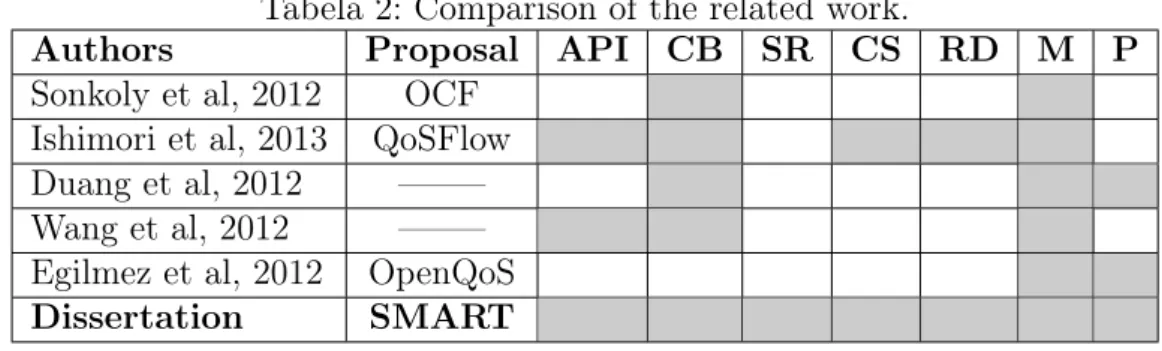
Table 2 summarizes the main characteristics of the proposals analyzed.
Tabela 2: Comparison of the related work.
Authors Proposal API CB SR CS RD M P
Sonkoly et al, 2012 OCF
Ishimori et al, 2013 QoSFlow
Duang et al, 2012 ——–
Wang et al, 2012 ——–
Egilmez et al, 2012 OpenQoS
Dissertation SMART
Legend:
• API - Application Programming Interface for QoS
• CB - Control of Bandwidth
• CS - Control of Scheduler
• RD - Dynamic Readjustment
• M - Monitoring
• P - Policies defined at a high level of abstraction
3.2
Conclusion
The analysis of the related work justifies this work, and reveals that none of the
proposals provides a QoS control approach with networking functions to allocate resources meeting truly reliable and robust QoS guaranteed transport over OpenFlow-enabled SDN systems.
The analysis of the realted work has also brought into consideration that SDNs and OpenFlow have several issues to overcome in terms of flexibility and scalibility in order to become a industry standard, and that most clean-slate proposals are not focusing on the
4
SMART Proposal
This chapter will describe the general concepts of the SMART proposal, as well as the main goals of its architecture. A description of its sub-components is also presented,
referring the function of each one and their interoperability.
4.1
General concepts
The Support of Mobile Sessions with High Transport Demand (SMART) has as main objective to enhance ETArch with new mechanisms supporting advanced network control capabilities aiming to enable QoS-guaranteed mobile multimedia applications over the
time. Quality requirements are semantically defined for each session in order to guide SMART functionalities, supported by an extended OpenFlow approach to support QoS control.
SMART envisions enabling a new integrated Future Internet clean-slate SDN system embedding new mechanisms to support advanced routing, resource reservation, admission
control and priority queuing functionalities. In order to fulfill the required end-to-end QoS, it was designed a dynamic QoS routing over-provisioning centric strategy to provision au-tomated, systematic and dynamic network resource allocation for multimedia workspaces.
The innovating aspect of the advanced QoS control adopted in SMART focuses on enabling the integrated use of admission control and over-provisioning centric network resource allocation to achieve a signaling constrained approach. SMART bootstraps the
system with oversized network resources, namely surplus workspaces enforced with over-reservations on all network interfaces, and books such information in the DTSA. As such information is available in advance, the DTSA is enabled to take multiple session admis-sion deciadmis-sions without any signaling events to enforce neither resource reservations nor
in order to over-provision the system again, allowing multiple session admissions with the least amount of signaling.
SMART was designed under the principle of pushing complexity to the network ed-ges (ingress and egress nodes), keeping the interior (core nodes) as simple as possible for scalability. Since a network edge has improved computational capacities, it can per-form complex operations (e.g., packet classification, traffic conditioning, etc.) at a fine
granularity. In contrast, core nodes may handle thousand flows simultaneously belonging to multiple ingress nodes, thus requiring optimized operations to meet high performance and scalability (ZHAO; OLSHEFSKI; SCHULZRINNE, 2000). For instance, it is desirable to keep core nodes with minimum amount of state and far from instant signalling, to avoid
forwarding table look-up overhead and additional CPU cycles.
The differentiation of network edge and core nodes was accomplished through the aggregated Workspace approach, which is vital for the scalability of SMART by allowing multiple session flows sharing the same forwarding state (i.e., Workspace entry). While ingress nodes aggregate multiple flow traffic in the same Workspace, egress nodes
disag-gregate them to deliver for the users accordingly. In the legacy ETArch, each session flow is allocated to an individual Workspace, and this per-flow approach is not scalable since each session flow requires one new forwarding state at all on-path nodes. The aggregated Workspace approach allows drastically reducing the forwarding tables at core nodes to
optimize the networking performance and response times.
The SMART QoS control approach is based on the over-provisioned network resource
concept. On one hand, over-provisioned Workspaces consist in surplus data paths, and on the other hand, over-reservation means an amount of bandwidth reserved beyond what it is demanded for a session flow at a given time. At the system boot up, SMART bo-otstraps surplus Workspaces enforced with per-class over-reservations on all associated
network interfaces. The bootstrapped QoS resource information is stored in the DTSA, to allow local decisions taken based on over-provisioned network resource state availa-ble in advanced. The over-provisioned centric network resource control scheme allows
a signaling-constrained approach, in which multiple session requests are accommodated without instant signaling. Therefore, this scheme defines that edge nodes of a given se-lected Workspace are signaled in a per admitted flow basis, to setup network state for both aggregation (at ingress) and disaggregation (at egress) tasks. Core nodes are only
future session admissions.
4.2
Architecture Organization
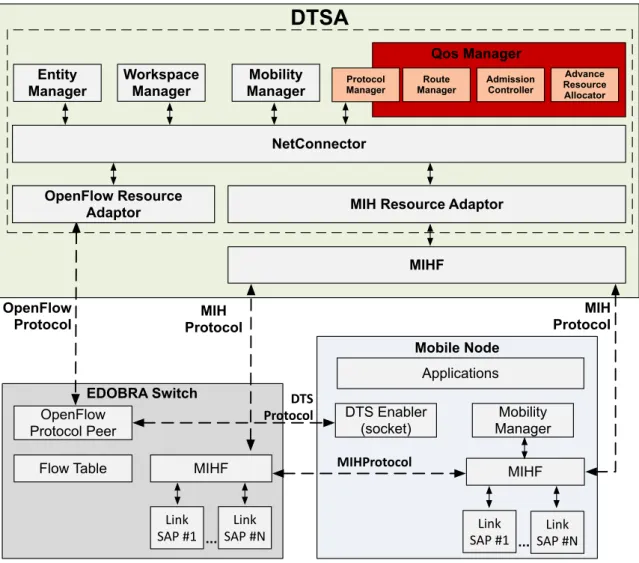
The SMART framework is presented in Figure 4, emphasizing on the new QoS-Manager, which embeds the QoS control-plane additions.
The DTSA acts as the OpenFlow controller of the network. In what concerns its func-tions as OpenFlow controller, the DTSA is responsible for storing information about the existing entities (Entity Manager), workspaces (Workspace Manager) and handover
pro-cedures (Mobility Manager), as well as for performing routing related tasks, implementing the workspaces into the switches. Moreover, these functions are interfaced by a central module (NetConnector), allowing the integration of procedures to optimize several as-pects of the network. Lastly, it features a Media Independent Handover Function (MIHF)
for exchanging IEEE 802.21 information with other nodes and an OpenFlow Channel for communication with the OpenFlow Switches.
The IEEE 802.21 is the IEEE standard for Media Independent Handover (MIH) (LAN/MAN Committee of the IEEE Computer Society, 2008). Its main purpose is to facilitate and optimize inter-technology handover processes by providing a set of media-independent primitives for obtaining link information and controlling link behavior in a heterogeneous
way, thus creating an abstraction regarding the link layer.
The EDOBRA Switch consists of an IEEE 802.21-enabled OpenFlow switch. Besides the standard OpenFlow switch capabilities for executing data packet forwarding operati-ons and for storing information on how packets of each workspace should be treated, the EDOBRA Switch is coupled with IEEE 802.21 mechanisms to control aspects of the link
interface regarding handover management, such as resource management and/or events about the attachment and detachment of nodes. Lastly, it is coupled with an MIHF for
interacting with the Mobile Node (MN) and the DTSA via IEEE 802.21 and an
Open-Flow Channel for communication via OpenOpen-Flow with the DTSA. The OpenOpen-Flow Channel
is also responsible for encapsulating DTS messages into OpenFlow messages.
The MN represents the user equipment that establishes connection with the end-point switches. The MN may be equipped with one or more access technologies, either wired (e.g., Ethernet) or wireless (e.g., WLAN or 3G). The MN deploys a MIHF, allowing higher-layer entities in the device itself (Mobility Manager) or external network entities
way, the MN is able to either retrieve link conditions on the current connection or to provide information about other networks in its range. In what concerns DTS procedures (such as register, workspace creation and attachment operations), the MN contains a DTS Enabler that allows it to communicate with endpoint switches via DTS. In addition, the
DTS Enabler is also used by applications to send their packets over DTS protocol.
MIHF OpenFlow Resource Adaptor OpenFlow Protocol MIH Protocol MIH Protocol
DTSA
Flow Table OpenFlow Protocol Peer MIHF MIHF !"#$% &'(%)* Mobility Manager ... EDOBRA Switch Mobile Node DTS Enabler (socket) Applications !"# $%&'&(&) !"#$% &'(%)+ !"#$% &'(%)* ... !"#$% &'(%)+MIH Resource Adaptor NetConnector Entity Manager Workspace Manager Mobility Manager *+,$%&'&(&) Route Manager Admission Controller Advance Resource Allocator Qos Manager Protocol Manager
Figura 4: Proposed framework.
The proposed new sub-components of the QoS-Manager are described in the following
sections.
4.2.1
Advanced QoS Resource Allocator
The QoS Advanced Resource Allocator (ARA) provides support to QoS and connec-tivity setup by controlling the usage of the network resources. It is responsible for:
works-paces can possibly satisfy the QoS requirements of a new session;
• for the enforcement of the new over-reservation patterns over the workspace switches
through the Protocol Manager;
• aggregation/disaggregation setup on the edge nodes of the selected aggregate
Works-pace.
4.2.2
Admission Controller
The QoS Admission Controller (AC) provides support to the network’s QoS manage-ment by regulating the access to the network only for session flows that can be supported by an available aggregate workspace while fully maintaining its quality requirements. It is responsible for:
• querying session requirements;
• querying candidate paths;
• querying resource availability for candidate paths;
• take the final decision, either accepting or rejecting the establishment of the
works-pace.
The minimum quality requirements for each mobile session flow (bitrate, tolerance to packet delay/loss/error, etc.) and the current conditions of the candidates workspaces (available traffic classes, packet delay/loss/error current rates, link technology, etc.) are taken into account.
The Admission Controller denies a session when the demanded QoS parameters cannot
be satisfied (i.e., there is no feasible workspace to accommodate the session), and informs the controller to take necessary actions.
4.2.3
Route Manager
support best aggregate workspace selections meeting the QoS requirements noticed in the session setup request.
Several routing algorithms, such as shortest path or a dynamic QoS-aware one, can run in parallel to meet the performance requirements and the objectives of different sessions. Network topology information is needed as input along with the service reservations.
4.2.4
Protocol Manager
The QoS Protocol Manager (PM) triggers the ETArch NetConnector for handling
intercommunication between the QoS-Manager and the extended OpenFlow API of the EDOBRA switches, and it is responsible for:
• enforce the over-reservation patterns across the network through the extended
Open-Flow API;
• collecting the flow definitions received from the QoS-Manager;
• efficient flow management by aggregation;
4.3
SMART Basic Operations
This section describes in details the operations supported by the SMART suite to deploy resource allocation, session setup, and over-reservation control, as well as to collect and configure traffic parameters in the switches through the QoSManager Protocol.
4.3.1
System Bootstrap
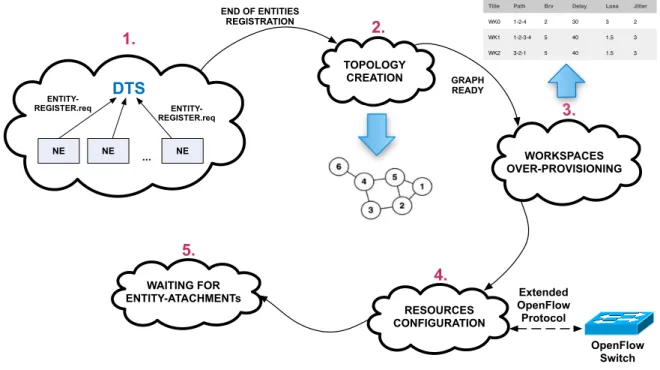
The System Bootstrap has as main objective to initialize the system with
oversi-zed network resources, namely surplus workspaces enforced with over-reservations on all network interfaces, and books such information in the DTSA. As such information is available in advance, the DTSA is enabled to take multiple session admission decisions without any signaling events to enforce neither resource reservations nor forwarding rules
in the selected workspace.
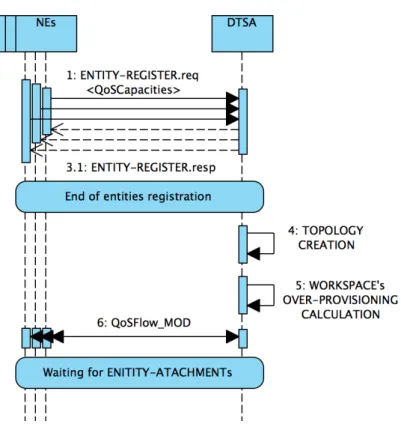
message, each switch initializes the per-class over-reservation patterns (according to the Initialization Index) in a way compatible with the underlying QoS approach (for instance, configuring the packet scheduling priorities) as can be seen in Figure 5.
DTS
NE NE NE
... ENTITY-REGISTER.req ENTITY-REGISTER.req 1.
END OF ENTITIES REGISTRATION 2. TOPOLOGY CREATION 3. WORKSPACES OVER-PROVISIONING 3 3-2-1 5 40 1.5 WK2 Title WK1 WK0 Path Brv 2 1-2-3-4 40 3 2 5 Loss Delay 30 1.5 Jitter 3 1-2-4 GRAPH READY 4. RESOURCES CONFIGURATION Extended OpenFlow Protocol OpenFlow Switch 5. WAITING FOR ENTITY-ATACHMENTs
Figura 5: System setup overview.
At this stage, the DTSA polls each switch of the network. The current condition of each switch must be taken into account (available traffic classes, packet delay/loss/error current
rates, link technology, ect). When the stats request is responded, the DTSA stores all the information in local state tables (i.e., unicast workspaces at this time). The generation of multicast workspaces is still a part of the System Bootstrap, which is a fundamental support for the workspace selection. To that, DTSA adopts a combinational algorithm
that takes unicast workpace registers to generate all possible combinations between each ingress and all core/egress sequentially, as can be seen in Figure 6.
4.3.2
Session Setup
This process is triggered whenever the DTSA receives a workspace attachment entity request (defined in legacy ETArch). It is necessary to decide the best-suited path in the core network in order to maintain the established QoS parameters of the multiparty
Figura 6: System Bootstrap scenario signaling.
Unlike ETArch, SMART allows network entities to semantically define its quality requirements (in terms of bitrate, delay, jitter, losses, etc.). ETArch original header was
enhanced with quality metrics in order to aid the controller for the workspace selection, as can be seen in Figure 7.
Bitrate Workspace
Title
Type of Service
Legacy ETArch SMART enabled
Figura 7: SMART enhanced header with quality metrics.
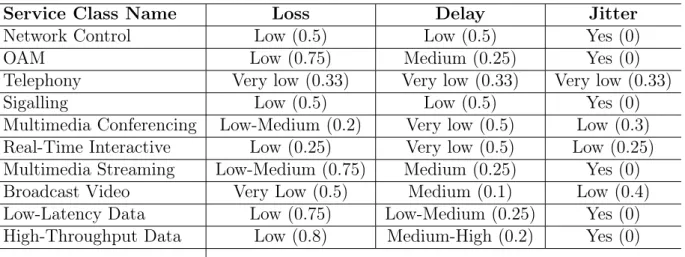
According to the Type of Service field of the SMART header, Multiple Attribution Decision Making (MADM) was applied to choose the best workspace available to allocate the required session. The Type of Service fields aids the SMART algorithm to match the requested workspace in one of the existing classes. The ToS field specify the workspace
alternatives. There are various MADM methods, while Simple Additive Weighting (SAW) is the simplest and still the widest MADM method. In SAW each attribute is given a weight, and the sum of all weights must be 1. Each alternative is assessed with regard to every attribute. The overall or composite performance score of an alternative is given by
the calculation indicated by (4.1).
Pi = M
X
j=1
wjmij, where (4.1)
Pi :Overall Score of Alternative Ai;
M :N umber of Attributes;
wj :W eight of Attribute j;
mij :M easure of P erf ormance of Alternative ij
The Decision Table is shown in Table 3. The Decision Table shows the alternativesAi in the left row, the attributes (for the purpose of this work, it was considered losses, delay and jitter) and the measures of performance of alternatives with respect to the attributes.
The measures of performance represent the tolerance to each attribute, according to (
BA-BIARZ K. CHAN, 2006). Every attribute was assigned the same weight. SMART divides
the alternatives into two major categories: Network Control Traffic (Network Control and Operations, Administration, and Management) and User/Subscriber Application/Services
(Telephony, Signaling, Multimedia Conferencing, Real-Time Interactive, Multimedia Stre-aming, Broadcast Video, Low-Latency Data and High-Throughput Data).
Tabela 3: MADM Decision Table for workspace selection.
Service Class Name Loss Delay Jitter
Network Control Low (0.5) Low (0.5) Yes (0)
OAM Low (0.75) Medium (0.25) Yes (0)
Telephony Very low (0.33) Very low (0.33) Very low (0.33)
Sigalling Low (0.5) Low (0.5) Yes (0)
Multimedia Conferencing Low-Medium (0.2) Very low (0.5) Low (0.3)
Real-Time Interactive Low (0.25) Very low (0.5) Low (0.25)
Multimedia Streaming Low-Medium (0.75) Medium (0.25) Yes (0)
Broadcast Video Very Low (0.5) Medium (0.1) Low (0.4)
Low-Latency Data Low (0.75) Low-Medium (0.25) Yes (0)
High-Throughput Data Low (0.8) Medium-High (0.2) Yes (0)
searching in the internal structures of the DTSA to determine whether there is already a workspace that is being used for the specified flow from the traffic source to the subscriber.
Algorithm 1: Setup Session
1 Query QoS requirements of the entity attachment request; 2 Get all workspaces from the traffic source to the subscriber; 3 ApplyMADM;
4 foreach candidate workspace do
5 if workspace able to acommodate QoS reqs then
6 Configure workspace flow using OpenFlow in source switch; 7 Consigure workspace flow using OpenFlow in dest switch; 8 Join the user to the existing workspace;
9 break;
10 foreach candidate workspace do
11 if readjusted workspace able to acommodate QoS reqs then
12 foreach switch needed of readjustment do
13 Setup new over-reservation patterns(extended OpenFlow)
14 Configure workspace flow using OpenFlow in source switch; 15 Consigure workspace flow using OpenFlow in dest switch; 16 Join the user to the existing workspace;
17 break;
18 Reject the entity attachment request;
If there is indeed a workspace able to acommodate the QoS requirements of the new session-flow, it is only necessary to join the user to the existing workspace, with requires no significant signalization overhead (only end switches are notified), as opposed
to the original ETArch architecture without the SMART extensions, in which all switches forming the workspace must be signalized.
The whole message exchange of a successful workspace allocation can be seen in detail in Figure 8.
4.3.3
Over-reservation Control
If the Admission Controller verifications notice the case of non-existence of available workspaces to accommodate the demanded session, a suitable workspace may be found
Figura 8: System Setup scenario signalling.
Bov(i) =
Bu(i)
M Rth(i)
(M Rth(i)−Bu−Brq(i)), where (4.2)
Bov :Overreservation Bandwidth of CoS i;
Bu :U sed Bandwidth of CoS i;
Brq :Required Bandwidth f or CoS i;
M Rth(i) :M aximum Reservation T hreshold of CoS i
IfBov > 0, then the Advanced Resource Allocator updates the currently CoS’s reserva-tion, as can be seen in (4.3). Following Cisco directives for implementing QoS provisioning (CISCO, 2013), it was reserved a 20% of bandwidth beyond the actual bitrate demanded.
Brv(i) = 1,2Bov+Brq(i)), where (4.3)
Brv :Reservation Bandwidth of CoS i;
Bov :Overreservation Bandwidth of CoS i;
Brq:Required Bandwidth f or CoS i;
thresholds of all the CoSs. When none of the available paths are able to accommodate the demanded session (not enough bandwidth in the network) and there is no workspace candidate with probability of acceptance, DTSA rejects the entity attachment request. The whole process is described in Algorithm 2.
Algorithm 2: Over-reservation Control
1 ACnotices that the session demanded cannot be admitted in any available workspace; 2 Get all workspaces from the traffic source to the subscriber;
3 Compute the new over-reservation as ineq. (4.2); 4 if Bov≥0 then
5 Updatethe new over-reservation patterns as ineq. (4.3);
6 else
7 Readjustthe MRth of all the CoSs;
8 if no available workspaces is able to accommodate the demanded session then
9 Rejectthe entity attachment request;
4.4
Use case
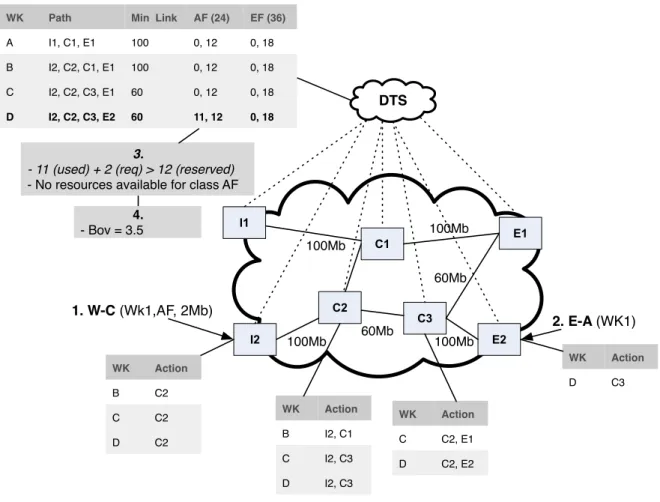
The whole use case of a successful workspace allocation can be seen in detail in Figure 9 and Figure 10.
It is presented a scenario were the system bootstrap has already took place. The network topology presented has 2 ingress routers, 2 egress routers and 3 core routers.
Hence, 4 communication paths were created such as (I1, C1, E1), (I2, C2, C1, E1), (I2, C2, C1, E1) and (I2, C2, C3, E2) as an example, and workspaces A, B, C and D were pre-reserved for corresponding to each communication path. For the sake of sim-plicity, we assumed that each communication link implemented two (2) service classes:
Assured Forwarding (AF) and Expedited Forwarding (EF). The state table maintained by the DTSA (shown in the upper-left side of both Figures) shows the communication paths, the capacity of each link and the bandwidth used/reserved for each communication path/service class. Resources were already initialized in the system bootstrap, as it can
be seen in DTSA state table.
The process starts when the DTSA receives a WORKSPACE-CREATE solicitation
from an entity placed on ingress router 2 (I2). It is requested the creation of a workspace named Wk1, corresponding to service class AF and with a bandwidth allocation of 2 Megabytes. Afterwards, an entity placed on egress router 2 (E2) sends an
ENTITY-ATTACHMENT request to the DTSA for workspace Wk1.
DTS EF (36) 0, 18 0, 18 0, 18 0, 18 60 AF (24) Path 0, 12 60 WK
I2, C2, C3, E2
I1, C1, E1 0, 12
A
0, 12
I2, C2, C3, E1 100
D
I2, C2, C1, E1 100 B
Min Link
11, 12 C I2 I1 C1 C2 C3 E1 E2 100Mb 100Mb 60Mb 60Mb 100Mb 100Mb C2 C2 Action C2 D B WK C I2, C3 I2, C1 Action I2, C3 D B WK
C C2, E2
WK C D Action C2, E1 WK D C3 Action
1. W-C (Wk1,AF, 2Mb)
3.
- 11 (used) + 2 (req) > 12 (reserved) - No resources available for class AF
2. E-A (WK1)
4. - Bov = 3.5
Figura 9: Use case.
between these two entities. The last communication path (I2, C2, C3, E2) is indeed able to establish a communication path between these two entities. Then the DTSA
checks if there are resources available for class AF in the selected communication path to accommodate the requested session. In this case, there are not and the DTSA calculates the new over-reservation patterns as was described in (4.2).
At this point, the DTSA updates the currently AF CoS’s reservation in its state table, as was explained in (4.3), and enforces this new over-reserved configurations in the
network nodes through the extended OpenFlow approach.
Finally, state tables of border nodes of the selected communication path (in this