EDITORIAL
The quality control theory of aging
Warren Ladiges*
Department of Comparative Medicine, University of Washington, Seattle, WA, USA
The quality control (QC) theory of aging is based on the concept that aging is the result of a reduction in QC of cellular systems designed to maintain lifelong homeostasis. Four QC systems associated with aging are 1) inadequate protein processing in a distressed endoplasmic reticulum (ER); 2) histone deacetylase (HDAC) processing of genomic histones and gene silencing; 3) suppressed AMPK nutrient sensing with inefficient energy utilization and excessive fat accumulation; and 4) beta-adrenergic receptor (BAR) signaling and environmental and emotional stress. Reprogramming these systems to maintain efficiency and prevent aging would be a rational strategy for increased lifespan and improved health. The QC theory can be tested with a pharmacological approach using three well-known and safe, FDA-approved drugs: 1) phenyl butyric acid, a chemical chaperone that enhances ER function and is also an HDAC inhibitor, 2) metformin, which activates AMPK and is used to treat type 2 diabetes, and 3) propranolol, a beta blocker which inhibits BAR signaling and is used to treat hypertension and anxiety. A critical aspect of the QC theory, then, is that aging is associated with multiple cellular systems that can be targeted with drug combinations more effectively than with single drugs. But more importantly, these drug combinations will effectively prevent, delay, or reverse chronic diseases of aging that impose such a tremendous health burden on our society.
Keywords: quality control theory of aging;endoplasmic reticulum;histone deacetylase;AMPK; beta-adrenergic receptor; aging intervention with drug combinations
*Correspondence to: Warren Ladiges, Department of Comparative Medicine, University of Washington, Seattle, WA 98195, USA, Email: [email protected]
Received: 5 May 2014; Accepted: 5 May 2014; Published: 23 May 2014
A
practical and blue collar theory of aging can be described as a reduction in cellular quality control (QC) systems designed to maintain life-long homeostasis. QC system failures associated with aging include: 1) inadequate protein processing in a distressed endoplasmic reticulum (ER); 2) histone deace-tylase (HDAC) processing of genomic histones and gene silencing; 3) suppressed AMPK nutrient sensing with inefficient energy utilization and excessive fat accumula-tion; and 4) beta-adrenergic receptor (BAR) signaling and environmental and emotional stress. Reprogramming these systems to maintain efficiency and prevent aging would be a rational strategy for increased lifespan and improved health.The QC theory of aging challenges several paradigms established over the years in an attempt to provide an explanation for why we age. The first paradigm is that aging is a slowly deteriorating condition that is driven by loss of cellular function. The theory challenges this para-digm by stating that it is a series of interactive systems that occur as the result of a reduction in QC. Therefore, cellular function can be targeted to overcome the lack of
QC. The second paradigm is that aging is the result of a single genetic pathway. The QC theory challenges this paradigm by proposing that aging is a series of genetic system pathways that interact to promote dysfunctional cellular activity associated with increasing age. Inherent in this challenge is the notion that these systems can be targeted in a pharmacological manner. The third para-digm consists of the unilateral concept that aging is a separate biological process unrelated to the development of chronic diseases that are prevalent in the aging population. The QC theory challenges this paradigm by proposing that a multifunctional approach to delay aging will also prevent or delay chronic diseases associated with increasing age. It is the chronic disease aspect that weighs heavily on the health burden of Americans and popula-tions worldwide.
The clinical relevance to humans is that no one wants to live longer only to be under severe suffering from co-morbid disease conditions. Living longer should not mean increased medical costs added on to an already bloated medical care system in financial crises. Rather, living longer means productive living that contributes to
Pathobiology of Aging &
Age-related Diseases
æ
Pathobiology of Aging & Age-related Diseases 2014.#2014 Warren Ladiges. This is an Open Access article distributed under the terms of the Creative Commons Attribution-Noncommercial 3.0 Unported License (http://creativecommons.org/licenses/by-nc/3.0/), permitting all non-commercial use, distribution, and reproduction in any medium, provided the original work is properly cited.
1
relieving the health care burden. Living longer in a disease-free manner means more productive people that are able to continue to make positive contributions to society. The retirement age would be extended by decades and more people would still be working and contributing to social security, and less people drawing social security checks for shorter periods of time. For example, a 20% increase in lifespan using 86 years as an average lifespan figure would mean an extra 17 years of life, with end of life coming at 103 years instead of 86 years. These additional years would be productive and relatively disease free. A 30% increase in lifespan would mean an additional 26 years of disease-free living.
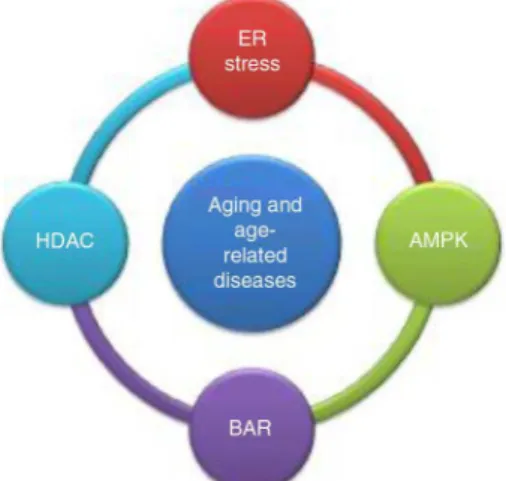
The four systems, ER stress response, HDAC proces-sing, AMPK nutrient senproces-sing, and BAR signaling, are involved in cellular activities that can influence aging and the development of age-related diseases (Fig. 1). They have all been shown to be responsive to pharmacological targeting. The first of the four QC systems is protein QC through the ER. Protein processing in the ER is dependent on strict QC to assure newly synthesized pro-teins are intact and functional. If the QC machinery fails or slips a bit, proteins will be released that are less efficient or even nonfunctional. The oxidizing environ-ment of the ER provides ideal conditions for membrane proteins as well as secretory proteins to fold into their natural conformation. However, ER stress occurs when the homeostatic environment of the ER is disrupted due to adverse physiological conditions such as nutrient deprivation, hypoxia, or viral infection leading to accu-mulation of unfolded polypeptides in the ER lumen. The majority of cells cope with the increased ER load by activating the unfolded protein response (UPR), an integrated signal transduction system consisting of dis-tinct mediators such as PERK and ATF6 (1), which act
to attenuate protein translation, clear misfolded proteins through degradation, increase ER folding capacity, and upregulate endogenous chaperones that assist in protein folding. An ability to mount a stress resistance under pressure is a major host defense mechanism and has been a fundamental force during evolution. However, the adaptation capacity clearly declines during aging and this loss of stress resistance accelerates the aging pro-cess exposing the organism to degenerative diseases (2). The effect of stress on organisms seems to be a dose-dependent response, that is, mild stress induces a stress tolerance and extends the lifespan whereas excessive stress accentuates the aging process. This paradox is known as hormesis in aging research. It is essential to distinguish the intensity of cellular stress and thus mount an appropriate host defense. Interestingly, ER stress transducers can distinguish the intensity of ER stress and induce a dose-dependent UPR, either adaptive response to stress or apoptotic cell death. The efficiency of the stress recognition system and UPR signaling declines during aging.
Increasing evidence indicates that ER stress is involved in various diseases. ER stress has been linked to condi-tions such as hyperinsulinemia and hyperglycemia, both of which promote adipocyte differentiation and weight gain (3). Further, nutrient imbalance, excessive lipid storage, and insulin resistance in adipocytes can lead to ER stress. ER stress signaling plays an important role in the pathogenesis of diabetes and heart disease. The latter is a common comorbidity of diabetes and worsens patient outcome. Results from clinical studies suggest beneficial effects of metformin (MET), a widely used oral drug for the treatment of type 2 diabetes, on the heart of diabetic patients with heart failure. MET has been found to activate ER stress but not ER-stress-induced apoptosis in cardiomyocytes (4). In the human heart, ischemia/reper-fusion has been correlated to ER stress, and several markers of the UPR participate during cardiac remodel-ing and fibrosis.
Protein misfolding in the ER is responsive to chemical chaperone compounds such as phenylbutyric acid (PBA). PBA is thought to act by stabilizing improperly folded proteins, reducing protein aggregation, and enhancing efficiency of endogenous chaperones (5). PBA has been shown to reduce ER stress and restore glucose home-ostasis in mice with type 2 diabetes (1,6). It also inhibits adipogenesis by modulating the ER stress response (3), and reduces amyloid plaques and rescues cognitive behav-ior in Alzheimer’s disease transgenic mice (7). Increas-ing the ER luminal foldIncreas-ing capacity with exogenously administrated PBA has been found to be a powerful strategy for preventing the development of isoproterenol-induced cardiac fibrosis and adverse remodeling (8). It would seem that the use of the BAR blocker propranolol (PROP) might help to accentuate these beneficial effects.
Fig. 1. The quality control theory of aging. ER stress response, HDAC processing, AMPK nutrient sensing, and beta-adrenergic receptor (BAR) signaling are systems involved in cellular activities that affect aging and age-related diseases, such as dementia, heart failure, diabetes, and cancer.
Warren Ladiges
2
The second system is HDAC processing, which leads to gene silencing. HDACs are known as HDACs because histones are the most important target. They catalyze the deacetylation of alpha-acetyl lysine that resides within the NH2-terminal tail of core histones resulting in increased binding to chromatin and suppression of gene transcrip-tion (9). A number of HDACs have been identified that are now classified into at least three different classes. Class 1 and 2 have Zn in their catalytic site and are inhibited by trichostatin, vorinostat, and PBA. Class 3 HDACs include sirtuins, which have an absolute require-ment for NAD, do not have Zn in their catalytic domains, and are targeted by activators rather than inhibitors.
Class 1 HDACs have ubiquitous expression, while class 2 HDACs are tissue specific, with highest expression in brain, heart and muscle. In the heart, they act as signal responsive repressors of cardiac hypertrophy. Recent evidence indicates that different HDACs participate in a variety of heart diseases, such as arrhythmias, heart failure, acute coronary syndrome, and cardiac hypertro-phy (10). First-line therapy for heart failure includes drugs aimed at inhibiting signaling pathways elicited by cell surface receptors such as ACE inhibitors, angiotensin inhibitors, and BARs (beta blockers). Despite efficacy of these drugs, the high mortality rate for patients with heart failure justifies the need to target alternative pathogenic mechanisms, such as HDACs. It has been shown that broad inhibitors for Class 1 and Class 2 HDACs can prevent cardiac hypertrophy in animal models (11). PBA is a relatively weak broad-spectrum inhibitor of Class 1 and Class 2 HDACs, and inhibits histone deacetylation such that gene transcription is allowed to occur with the activation of genes associated with an overall slowing of cell growth and proliferation (9).
It is of interest that HDAC1, HDAC2 and HDAC3, which are Class 1, have been shown to co-immunopreci-pitate with the ATP-dependent chaperone heat shock protein 70 (HSP-70) involved in the ER stress response (12). This is most likely the reason that PBA is active as an ER stress chaperone and an HDAC inhibitor, so it not only enhances protein folding and decreases ER stress, but it also inhibits histone deacetylation. There-fore, there is rationale to consider PBA as part of a treat-ment strategy for heart disease, cancer and inflammatory conditions associated with aging.
The third system is the AMPK nutrient sensing system. AMPK regulates cellular metabolism. When activated by a deficit in nutrients, AMPK stimulates glucose uptake and lipid oxidation to produce energy, while tuning off energy-consuming processes including glucose and lipid production to restore energy balance (13). Disruption of energy balance caused by over eating and a sedentary life style has led to an increased prevalence of type 2 diabetes, a metabolic disorder associated with insulin resistance
and suppressed AMPK activity. AMPK integrates sig-naling circuits between peripheral tissues and the hypo-thalamus to regulate food intake and whole body energy expenditure. There is evidence to suggest that AMPK mediates leptin activity to diminish adiposity by reducing food intake and improve insulin sensitivity. AMPK also signals to multiple pathways that regulate cell growth and proliferation. Prominent among these is the mTOR complex, which is blocked by activation of AMPK. mTOR integrates signals from growth factors and nutrients to control protein synthesis and is associated with oncogenesis (14).
The AMPK nutrient sensing system can be activated by the biguanide compound known as MET. MET has been shown to induce a dietary restriction-like status and oxidative stress response to extend lifespan inC. elegans
(15) and mice (16). MET acts at least in part by triggering AMPK and is a widely used drug for type 2 diabetes. MET acts to reduce cellular ATP production by inhibit-ing mitochondrial respiratory complex 1. This results in activation of AMPK. In the liver, this results in reduced gluconeogenesis, which reduces the hyperglycemia and hyperinsulinemia of type 2 diabetes. The systemic affects most likely reduce proliferation activity associated with cancer, but direct effects on tumor cells may also be a factor in reports of anticancer activity. For example, pharmacoepidemiological evidence shows a 50% reduc-tion in breast cancer risk in type 2 diabetic patients being treated with MET for their diabetes (17).
The fourth system is BAR signaling. Physiological stress responses are mediated through the release of catecholamines epinephrine and norepinephrine. These neurotransmitters are released from the adrenal medulla as a response to emotional and physiological stress. In addition, they regulate cell and organ response to the sympathetic branch of the autonomic nervous system (ANS) (18). They act by binding to adrenergic receptors, which are a family of G-protein-coupled receptors that initiate multiple cascades, including the adenyl cyclase/ cAMP/PKA pathway (19). BARs are receptors for epi-nephrine and norepiepi-nephrine and part of the ANS. BARs are expressed in multiple tissues to receive signals from the ANS regarding fight-or-flight reactions, that is, stress. The concept is that stress is associated with the devel-opment and progression of chronic disease. Stress is mediated by epinephrine or norepinephrine, which acti-vate BAR’s on the cell surface of multiple tissues. This triggers activation of cAMP and subsequently the protein kinase A system, which stimulates cellular activation of the transcription factor CREB, the EGFR pathway, the Src/STAT pathway, BAR-mediated release of the ara-chidonic acid cascade, and perpetuation of the stress response. Stress is a major factor in reducing resistance to such things as inflammation, tumor development, and cardiovascular disease associated with increasing age. Editorial
Blocking BARs will prevent PKA activation. Down regu-lation of PKA in mice has been shown to extend lifespan and enhance healthy aging (2022).
The beta adrenergic signaling system can be inhibited by antagonists referred to as beta blockers. PROP is a beta blocker that has been used safely as a cardiovascular therapeutic (mainly hypertension) for years (18). It also has anti-anxiety affects. Recently, PROP has been shown to reduce the proliferation, progression, angiogenesis and metastasis of common epithelial cancers including breast, prostate, lung, colon, and pancreas (19,23).
The QC theory of aging is referred to as a blue collar theory because it can be tested by pharmacologically targeting the four QC systems described above with a combination of PBA, MET, and PROP. A critical aspect, then, is that aging is associated with multiple cellular sys-tems that can be targeted with drug combinations more effectively than with single drugs. The QC theory of aging provides a solid scientific rationale for the development of a treatment strategy for aging and lifespan enhance-ment that also serves as a means for treating and pre-venting or delaying chronic age-related diseases. Therefore, the potential impact should have huge implications for pursuing treatment strategies for chronic diseases of aging with a major paradigm shift from the development of drugs specific for heart disease, diabetes, neurological disease, cancer, and other diseases to the development of synergistic drug combinations that delay aging and prevent chronic diseases at the same time. Three drugs, PBA, MET and PROP, can serve as a combination pro-totype for the QC theory of aging to help establish why we age and used as a platform to build on future analogs and derivatives to improve combination drug efficiency for aging intervention strategies.
Let us continue the discussion of this theory of aging concept with submission of papers and letters to the editor toPathobiology of Aging & Age-related Diseases.
References
1. Ladiges WC, Knoblaugh SE, Morton JF, Korth MJ, Sopher BL, Baskin CR, et al. Pancreatic beta-cell failure and diabetes in mice with a deletion mutation of the endoplasmic reticulum molecular chaperone gene P58IPK. Diabetes. 2005; 54(4): 107481.
2. Salminen A, Kaarniranta K. ER stress and hormetic regulation of the aging process. Ageing Res Rev. 2010; 9(3): 21117. 3. Basseri S, Lhota´k S, Sharma AM, Austin RC. The chemical
chaperone 4-phenylbutyrate inhibits adipogenesis by modulat-ing the unfolded protein response. J Lipid Res. 2009; 50(12): 2486501.
4. Quentin T, Steinmetz M, Poppe A, Thoms S. Metformin differentially activates ER stress signaling pathways without inducing apoptosis. Dis Model Mech. 2011; 5: 25969. 5. Perlmutter DH. Chemical chaperones: a pharmacological
strategy for disorders of protein folding and trafficking. Pediatr Res. 2002; 52(6): 8326.
6. Ozcan U, Yilmaz E, Ozcan L, Furuhashi M, Vaillancourt E, Smith RO, Go¨rgu¨n CZ, Hotamisligil GS. Chemical chaperones reduce ER stress and restore glucose homeostasis in a mouse model of type 2 diabetes. Science. 2006; 313(5790): 113740. 7. Wiley JC, Pettan-Brewer C, Ladiges WC. Phenylbutyric acid
reduces amyloid plaques and rescues cognitive behavior in AD transgenic mice. Aging Cell. 2011; 10(3): 41828. doi: 10.1111/ j.1474-9726.2011.00680.x.
8. Ayala P, Montenegro J, Vivar R, Letelier A, Urroz PA, Copaja M, et al. Attenuation of endoplasmic reticulum stress using the chemical chaperone 4-phenylbutyric acid prevents cardiac fibrosis induced by isoproterenol. Exp Mol Pathol. 2011; 92(1): 97104.
9. Dokmanovic M, Clarke C, Marks PA. Histone deacetylase inhibitors: overview and perspectives. Mol Cancer Res. 2007; 5(10): 9819.
10. Trivedi CM, Luo Y, Yin Z, Zhang M, Zhu W, Wang T, et al. Hdac2 regulates the cardiac hypertrophic response by modulat-ing Gsk3 beta activity. Nat Med. 2007; 13(3): 32431. 11. Zhang CL, McKinsey TA, Chang S, Antos CL, Hill JA, Olson
EN. Class II histone deacetylases act as signal-responsive repressors of cardiac hypertrophy. Cell. 2002; 110(4): 47988. 12. Johnson CA, White DA, Lavender JS, O’Neill LP, Turner BM.
Human class I histone deacetylase complexes show enhanced catalytic activity in the presence of ATP and co-immunopreci-pitate with the ATP-dependent chaperone protein Hsp70. J Biol Chem. 2002; 277(11): 95907.
13. Long YC, Zierath JR. AMP-activated protein kinase signaling in metabolic regulation. J Clin Invest. 2006; 116(7): 177683. 14. Hadad SM, Fleming S, Thompson AM. Targeting AMPK: a
new therapeutic opportunity in breast cancer. Crit Rev Oncol Hematol. 2008; 67(1): 17.
15. Onken B, Driscoll M. Metformin induces a dietary restriction-like state and the oxidative stress response to extend C. elegans Healthspan via AMPK, LKB1, and SKN-1. PLoS One. 2010; 5(1): 8758.
16. Anisimov VN, Piskunova TS, Popovich IG, Zabezhinski MA, Tyndyk ML, Egormin PA, et al. Gender differences in metfor-min effect on aging, life span and spontaneous tumorigenesis in 129/Sv mice. Aging (Albany, NY). 2010; 2(12): 94558. 17. Chlebowski RT, McTiernan A, Wactawski-Wende J, Manson JE,
Aragaki AK, Rohan T, et al. Diabetes, metformin, and breast cancer in postmenopausal women. J Clin Oncol. 2012; 30(23): 284452.
18. Wallukat G. The beta-adrenergic receptors. Herz. 2002; 27(7): 68390.
19. Schuller HM. Beta-adrenergic signaling, a novel target for cancer therapy? Oncotarget. 2010; 1(7): 4669.
20. Enns L, Morton J, Treuting P, Emond M, Wold N, McKnight GS, et al. Disruption of protein kinase A in mice enhances healthy aging. PLoS One. 2009; 4(6): e5963.
21. Enns L, Morton J, Magalindan R, McNight S, Schwartz M, Kaberlein M, et al. Disruption of the PKA catalyticbsubunit attenuates age-related metabolic dysfunction. J Gerontol BS. 2009; 64(12): 122131.
22. Enns LC, Bible KL, Emond MJ, Ladiges WC. Mice lacking the Cb subunit of PKA are resistant to angiotensin II-induced cardiac hypertrophy and dysfunction. BMC Res Notes. 2010; 3: 307.
23. Palm D, Lang K, Niggemann B, Drell TL, 4th, Masur K, Zaenker KS, et al. The norepinephrine-driven metastasis devel-opment of PC-3 human prostate cancer cells in BALB/c nude mice is inhibited by beta-blockers. Int J Cancer. 2006; 118(11): 27449.
Warren Ladiges