M
ONETARY
P
OLICY AND
C
OUNTRY
R
ISK
V
LADIMIRK
UHLT
ELESJ
OAQUIMP.
A
NDRADEOutubro
de 2009
T
T
e
e
x
x
t
t
o
o
s
s
p
p
a
a
r
r
a
a
D
D
i
i
s
s
c
c
u
u
s
s
s
s
ã
ã
o
o
TEXTO PARA DISCUSSÃO 223 • OUTUBRO DE 2009 • 1
Os artigos dos Textos para Discussão da Escola de Economia de São Paulo da Fundação Getulio Vargas são de inteira responsabilidade dos autores e não refletem necessariamente a opinião da
FGV-EESP. É permitida a reprodução total ou parcial dos artigos, desde que creditada a fonte.
Escola de Economia de São Paulo da Fundação Getulio Vargas FGV-EESP
Monetary Policy and Country Risk
Vladimir K¨uhl Teles
∗, Joaquim P. Andrade
†April 6, 2007
Applied Economics, forthcoming (2007).
Abstract
This article develops an econometric model in order to study country risk behavior for six emerging economies (Argentina, Mexico, Russia, Thailand, Korea and Indonesia), by expanding the Country Beta Risk Model of Harvey and Zhou (1993), Erb et. al. (1996a, 1996b) and Gangemi et. al. (2000). Toward this end, we have analyzed the impact of macroeconomic variables, especially monetary policy, upon country risk, by way of a time varying parameter approach. The results indicate an inefficient and unstable effect of monetary policy upon country risk in periods of crisis. However, this effect is stable in other periods, and the Favero-Giavazzi effect is not verified for all economies, with an opposite effect being observed in many cases.
Key-Words:country risk; risk modeling, fiscal dominance.
JEL Codes: E44, E52, O54
1
Introduction
How does monetary policy affect country risk? This question has become a central issue in the current theoretical debate, due to the fact that monetary policies aimed at fighting inflation have been undermined by fiscal dominance models, in which country risk is the base of monetary instability brought about by interest rate increases, having an adverse effect upon the control of inflation.
From this perspective, Favero and Giavazzi (2004) argue that increases in interest rates have a positive effect on the risk of default on the public debt, thus increasing country risk, but leading to a vicious circle of increases in interest and debt, making monetary control unsustainable, implicating a loss of inflationary control.
From another perspective, Blanchard (2004) argues that rises in interest rates may lead to increases in country risk and inflation. When the debt is at an unsustainable level, and when the primary surplus rates are at their limits, the increased risk of de-faulting on the debt would have a negative impact upon the influx of capital, reducing, instead of increasing, the capital account balance, triggering exchange rate deprecia-tion, and consequently, inflation. Thus, monetary policy is no longer effective.
Therefore, due to both its fiscal effect, as well as the effects upon external equilib-rium, monetary policy may be considered ineffective against inflation, if a restrictive monetary policy were to lead to a significant increase in the level of risk.
On the other hand, Loyo (2004) claims that Blanchard’s (2004) results are overesti-mated, and that the relation between interest and risk may not be significant. Andrade and Teles (2005) have estimated this relation for Brazil, using a time varying para-meter model, demonstrating that increases in interest rates tend to reduce, instead of increase, country risk in Brazil, in spite of a loss in efficacy with regard to this type policy in periods of crisis.
Therefore, it is essential to investigate the effects interest rates have on country risk so that the sign and significance of this relation may be determined, in order to better orient monetary policy. This article studies the effects of monetary policy on country risk in six emerging economies by applying the country beta risk model.
In this regard, Blanchard suggests that the effects of monetary policy on country risk are not constant in time, since they crucially depend on agents’ perception re-garding the probability of debt default. In other words, the effect of monetary policy on country risk may be insignificant in some periods, and be adverse in others, since increases in interest rates do not necessarily mean that the risk of defaulting will also increase, given that the level of indebtedness and its sustainability may not be critical. In order to better understand this phenomenon, the original model was expanded, with the use of the Kalman filter, so as to predict variations in this relation over time.
2
Modeling Country Risk
The starting point for measuring country risk is the use of a ”country beta model ”. According to this model, country risk reflects the relation between stock market returns in the source country and those of the rest of the world. 1The model assumes the
following form,
Rint =α+βRext+et (1)
whereRint represents the country’s stock market returns, andRext the stock market
returns of the rest of the world. Also, the parameter β is the base upon which the country risk is measured, where, whenβincreases, country risk diminishes, indicating an increase in returns on the internal market in relation to the returns for the rest of the world.
It then becomes necessary to model the country risk, and consequently the parame-terβ, as varying over time, instead of remaining a constant. Therefore, the parameter
βmust be considered as a time-varying parameter. This is fully justified by macroeco-nomic theory, in which the relation between country risk and/or returns on assets and macroeconomic variables has become increasingly recognized in the literature.
In this context, Fama and French (1989), and McQueen and Roley (1993), for ex-ample, point out that the expected returns on assets decisively depend on the behavior of macroeconomic variables throughout an economic cycle. These results are sup-ported by those obtained by Dumas (1994), Erb et. al. (1994, 1996a) and Diemonte et. al. (1996).
In fact, a certain degree of naivet´e is needed to believe the assertion that agents would expect that returns on assets would remain indifferent to periods of crisis and growth during an economic cycle. Therefore, if returns on assets are related to macro-economic variations, the country risk parameter,β, will tend to vary significantly in time in response to macroeconomic shocks.
Thus, the issue is not whether country risk is endogenous or exogenous with re-gard to macroeconomic variables, since its endogeneity appears to be well established; the issue is which macroeconomic variables are able to significantly affect country risk and, above all, how macroeconomic policies affect country risk. The variables considered in the model are listed in Table 1.
In our model, the variable GOV seeks to verify the sensitivity of the Brazil risk with regard to the fiscal situation of the public sector, i.e., if agents consider that an increase in public debt suggests an increase in a country’s risk rating. The inclusion of the variable JUR attempts to reflect how country risk is affected by monetary policy, the variable OIL is a proxy for supply shocks, and the variable RES seeks to detect how country risk reacts to external shocks and, above all, exchange rate pressure.
1
The significance and the sign of the coefficients provide information which is fun-damental to understand how agents perceive country risk in each case. In this regard, if the coefficient related to the variable JUR were positive, this would mean that an austere monetary policy would have a positive effect on country risk, indicating that agents would consider that said policy would not increase the risk of default on the debt, and also that a high interest rate policy would bolster the credibility of monetary policy, reducing risk.
If, on the other hand, this variable were significant and had a negative sign, it then may be affirmed that shocks brought about by unanticipated interest rate increases are adverse, increasing country risk. According to Favero-Giavazzi and Blanchard, this means that agents believe that this policy increases the probability of debt default. In this case, monetary policy would be totally ineffective in maintaining country risk, and may even be harmful, since it would lead to a loss of inflationary control, sterilizing monetary policy.
Reserves may play an important role in determining risk for two reasons: the first regards a fixed exchange rate scenario (as demonstrated by Andrade and Teles, 2005) in which a drop in reserves would mean an increase in the probability of an exchange rate depreciation, and thus risk. The second aspect is related to the supply of dollars on the domestic market, which is simultaneously regarded as a crucial factor affecting financial market risk. Besides, external shocks exert pressure on the exchange rate, and consequently on the rate of inflation, affecting the credibility of monetary policy. Lastly, the variable GOV is important to determine the extent to which agents are concerned with the behavior of the fiscal fundamentals, thus affecting country risk.
The source of data was the IMF for all cases. All variables are monthly, from January, 1991 to March, 2005, except data for Korea, which were between August, 1990 and November, 2000, and for Russia, between September, 1995 and February, 2005, due to variable information restrictions. In the case of Thailand, the IMF does not provide fiscal variables, and thus, in this case, this variable was excluded from the model.
In an efficient market, it is likely that only unexpected shocks upon macroeco-nomic variables would affect returns, whose relations comprise country risk. Thus, a sound econometric model is needed to consider the unpredictable components of re-lated macroeconomic series. Therefore, before series are handled, they must undergo an ex-ante whitening, by way of a univariate ARIMA process for each one of the indi-cated macroeconomic series.
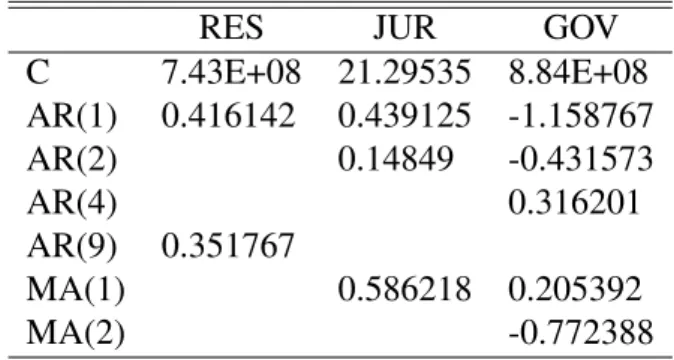
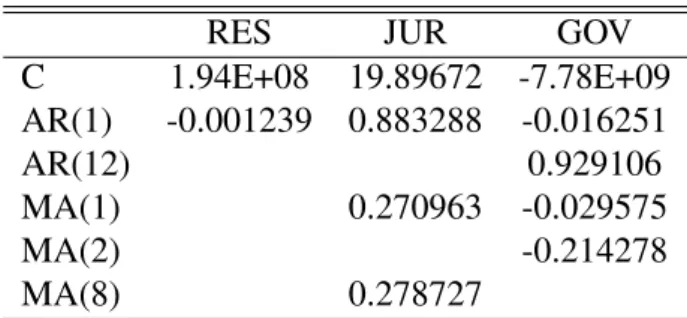
In other words, each one of the specified series must be submitted to the construc-tion of a ARIMA process by initially observing the possible non-staconstruc-tionarity of the series and by applying the first difference of these if necessary, and then by observing their autocorrelation and partial autocorrelation functions. The results of these esti-mates for the policy variables for each country are listed in Tables 2 to 7. Petroleum prices underwent the same whitening process.
residu-als are the parts of the series which may be considered totally unanticipated, i.e., they are the part of the series comprised of unexpected shocks. Hence, these residuals are the series used in the country risk model. Besides the theoretical advantages provided by this methodology, there are also clear econometric advantages, such as the station-arity of the series, which reduces the possibility of a corrupted regression, as well as multicolinearity.
Thus, the equation to be estimated in order to observe the effects of shocks in macroeconomic variables upon country risk is given by,
βt=b0+b1RESt+b2GOVt+b3OILt+b4J U Rt+ut (2)
where all variables are defined by their unanticipated components, according to the analysis outlined in the previous section.
It must be pointed out, however, that the direct estimation of this model is not possible, due to the inexistence of a time series forβ. But it is possible to substitute the above equations in equation (1), so that the country beta model may be specified with a time-varying parameter, estimated by,
Rbra =α+ (b0+b1RESt+b2GOVt+b3OILt+b4J U Rt)Rext (3)
or, by further development,
Rbra =α+b0Rext+b1REStRext+b2GOVtRext+b3OILtRext+b4J U RtRext (4)
Therefore, we reach an equation to be estimated with only observable variables. The estimation of (4) thus allows us to obtain the parameters of equation 2, and hence the construction of country risk series. In this regard, the estimation of this model must also consider that the coefficients of the estimated parameters, as well as their significance, may vary in time, as predicted by Lucas’ critique. Therefore, in order to avoid this theoretical problem, the model was re-estimated using the Kalman filter, to analyze the variations of the coefficients of the macroeconomic variables in time.
3
Results
3.1
Country Beta Risk Model
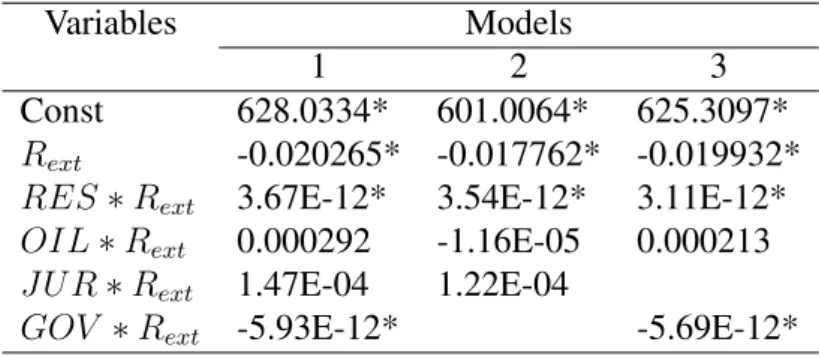
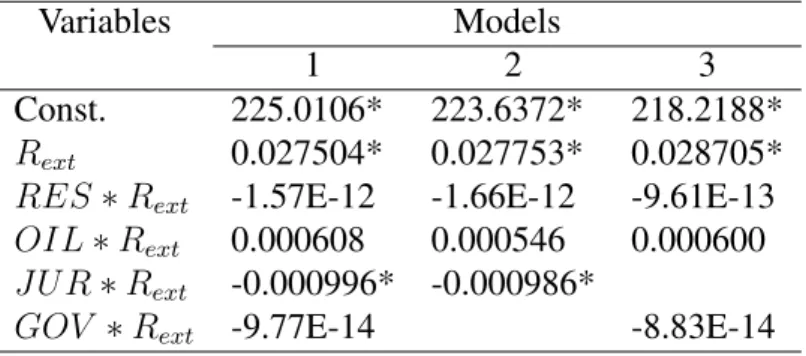
The results of the estimation of equation 4 for the countries analyzed are presented in Tables 8 to 13. The model was estimated with three different specifications. One included all variables, and the other two the variables JUR and GOV, each at a time. These alternatives are justified by the possible interdependence between the fiscal pol-icy variables and the monetary polpol-icy variable in the same model.
returns, and thus an increase in country risk. The fiscal surplus of the government, represented by the variable GOV, was significant in only two cases, and presented the expected sign in only one. The other variables, such as international reserves and the price of petroleum, were not significant in most cases.
The interest rate presented statistical significance in only two cases: Thailand and Mexico. However, the sign was not maintained in either case, and only in Mexico did the interest rate lead to an increase in country risk, as predicted by Favero-Giavazzi and Blanchard. In all other countries this effect was insignificant or positive, as in the case of Thailand.
These results raise doubts regarding the validity of the adverse effects of a high-interest monetary policy on country risk, since the variable JUR is normally insignif-icant or positive in most cases. Therefore, the effects of a possible fiscal dominance over the monetary authority’s capacity to control inflation are undermined. The im-mediate issue that must be addressed is whether these effects are also ineffective in periods of crisis. Toward this end, the next section shall develop an expansion of the original model in order to better assess the behavior of this relation in time.
3.2
Monetary Policy and Country Risk
Considering that the economies chosen underwent successive foreign exchange crises during the period studied, it is quite possible that the parameters were also subject to substantial changes during this period. In order to determine the relevance of this, we estimated the same model using the Kalman filter, in the specific case of interest rates, to determine whether fiscal dominance actually took place at any given moment in these economies. Therefore, the model was re-estimated, and the Kalman filter was applied to the monetary policy coefficients, thus obtaining the trajectories of these parameters. These trajectories are presented in Figure 1.
The interest rate, with the exception of Argentina, had a positive effect on country risk in certain periods, and a negative effect in others, the latter being particularly dominant during foreign exchange crises. This is the main reason why, in the simple model, the interest rate was not significant in most cases, which does not mean that monetary policy is ineffective with regard to country risk. In this context, significance presents an upward trend in this relation, i.e., the relation is significant and consistent in the new model.
However, one event is common to all economies. During the crises, the inverse relation is intensified, demonstrating that substantial interest rate increases introduced during these crises ended up increasing country risk, not reducing it. This took place during the 1997 Asian crisis in Thailand, Indonesia and Korea, during the 1998 crisis in Russia, the 1994 crisis in Mexico and the Argentinean crisis in 2000, for the respective countries. This evidence apparently confirms the effects predicted by Favero-Giavazzi and Blanchard for periods of crisis.
The results of this alternative version are listed in Figure 2. These results do not sig-nificantly alter the predictions of the previous model, corroborating the reliability of the results.
Overall, the results obtained indicate that monetary policy is completely ineffective in controlling country risk during periods of crisis, although this is not necessarily true in other periods.
4
Conclusions
The main objective of this article was to investigate the effects of monetary policy shocks on the country risk of emerging economies (Argentina, Mexico, Korea, Russia, Thailand and Indonesia). We attempt to determine the extent to which aspects of fiscal dominance, and consequently loss of inflationary control by monetary policy mecha-nisms, are significant in emerging economies, and the situations in which they occur. To achieve this, a country beta risk model was applied and expanded using a Kalman filter.
References
[1] Abell, J., Krueger, T. (1989). Macroeconomic influences on beta. Journal of Economics and Business4l:185–193.
[2] Andrade, J., Teles, V. (2005). An Empirical Model of the Brazilian Country Risk - An Extension of the Beta Country Risk Model.Applied Economics, forth-coming.
[3] Bekaert, G., Erb, C., Harvey, C., Viskanta, T. (1996). The behaviour of emerging market returns. InThe Future of Emerging Capital Flows. (E. Altman, R. Levich, and J. Mei, eds.). Boston: Kluwer Academic Publishers; 107–173.
[4] Diamonte, R.,Liew, J.,Stevens, R. (1996). Political risk in emerging and de-veloped markets.Financial Analysts JournalMay–June:71–76.
[5] Dumas, B. (1994). A test of the international CAPM using business cycle indi-cators as instrumental variables. In The Internationalization of Equity Markets (J. Frankel, ed.). Chicago: University of Chicago Press, pp. 23–50.
[6] ErbC.,Harvey, C., Viskanta, T. (1994). Forecasting international equity cor-relations.Financial Analysts JournalNovember–December:32–45.
[7] Erb, C. B.,Harvey, C.,Viskanta, T. (1996a). Political risk, economic risk and financial risk.Financial Analysts Journal52:28–46.
[8] Erb, C. B., Harvey, C. R., Viskanta, T. E. (1996b). Expected returns and volatility in 135 countries.Journal of Portfolio ManagementSpring:46–58.
[9] Fama, E.,French, K. (1989). Business conditions and the expected returns on stocks and bonds.Journal of Financial Economics25:23–50.
[10] Favero, C.Giavazzi, F. (2003) Targeting inflation when debt and risk premia are high: lessons from Brazil, mimeo,MIT.
[11] Gangemi, M. et. al., (2000) ”Modeling Australia’s Country Risk: A Country Beta Approach”Journal of Economics and Business. 52:259–276.
[12] Garcia, M.; Brand˜ao, T. (2001) Taxas de juros, risco cambial e risco Brasil. XXIX ENCONTRO NACIONAL DE ECONOMIA, Salvador. Anais. ANPEC.
[13] Groenewold, N., Fraser, P. (1997). Share prices and macroeconomic factors. Journal of Business Finance and Accounting24:1367–1383.
[14] Harvey, C. R.,Zhou, G. (1993) International asset pricing with alternative dis-tributional specifications.Journal of Empirical Finance1:107–131.
[16] McQueen, G., Roley, V. (1993). Stock prices, news, and business conditions. Review of financial studies6:683–707.
Table 1: List of the Explaining Variables
Variable Symbol Foreign Reserves RES Oil Price OIL Nominal Interest Rate JUR Fiscal Superavit GOV
Table 2: ARIMA Models to Korea Macroeconomic Series
RES JUR GOV
C 6.90E+08 -0.060093 -3.28E+10 AR(1) 0.443157 0.215979 -0.126056 AR(7) -0.272362
AR(12) 0.716294
MA(1) -0.97742
Table 3: ARIMA Models to Russia Macroeconomic Series
RES JUR GOV
C 7.43E+08 21.29535 8.84E+08 AR(1) 0.416142 0.439125 -1.158767 AR(2) 0.14849 -0.431573
AR(4) 0.316201
AR(9) 0.351767
MA(1) 0.586218 0.205392
MA(2) -0.772388
Table 4: ARIMA Models to Argentina Macroeconomic Series
RES JUR GOV
C 4.62E+07 -0.10216 -1.97E+08 AR(1) -0.087648 -0.569393 0.141193 AR(2) -0.217719 -0.337471 0.195283
AR(4) 0.176927
AR(7) -0.187624
Table 5: ARIMA Models to Indonesia Macroeconomic Series
RES JUR C 1.12E+08 -0.017562 AR(1) -0.122667 -0.215996 AR(2) 0.145835 -0.152509 AR(4) 0.148875
Table 6: ARIMA Models to Thailand Macroeconomic Series
RES JUR GOV
C 1.29E+08 -0.065888 -4.01E+08 AR(1) -0.01554 -0.287068 0.17504 AR(3) 0.346387 -0.215855 0.151048 AR(6) -0.20678
AR(12) 0.479235
Table 7: ARIMA Models to Mexico Macroeconomic Series
RES JUR GOV
C 1.94E+08 19.89672 -7.78E+09 AR(1) -0.001239 0.883288 -0.016251
AR(12) 0.929106
MA(1) 0.270963 -0.029575
MA(2) -0.214278
Table 8: “Country Beta Risk Model” to Korea Country Risk
Variables Models
1 2 3
Const 0.833285* 0.828600* 0.827134
Rext -4.07E-05* -3.96E-05* -4.01E-05*
RES ∗Rext 1.55E-15 1.34E-15 1.16E-15
OIL∗Rext 3.57E-06* 3.50E-06* 3.11E-06*
J U R∗Rext 1.88E-06 2.05E-06
GOV ∗Rext 1.47E-18 1.52E-18*
Table 9: “Country Beta Risk Model” to Russia Country Risk
Variables Models
1 2 3
Const 47.06792* 46.77639* 46.99712*
Rext -0.003588* -0.003546* -0.003579*
RES∗Rext 9.39E-15 1.76E-14 9.05E-15
OIL∗Rext -4.17E-05 -3.11E-05 -4.18E-05
J U R∗Rext -5.63E-07 -9.60E-07
GOV ∗Rext 1.32E-15 1.33E-15
Table 10: “Country Beta Risk Model” to Argentina Country Risk
Variables Models
1 2 3
Const 628.0334* 601.0064* 625.3097*
Rext -0.020265* -0.017762* -0.019932*
RES∗Rext 3.67E-12* 3.54E-12* 3.11E-12*
OIL∗Rext 0.000292 -1.16E-05 0.000213
J U R∗Rext 1.47E-04 1.22E-04
GOV ∗Rext -5.93E-12* -5.69E-12*
Table 11: “Country Beta Risk Model” to Indonesia Country Risk
Variables Results Const 0.220786*
Rext -1.68E-05*
RES∗Rext 4.55E-16
OIL∗Rext 1.22E-07
Table 12: “Country Beta Risk Model” to Thailand Country Risk
Variables Models
1 2 3
Const 41.02196* 38.62143* 41.05828*
Rext -0.003352* -0.003019* -0.003360*
RES∗Rext 1.08E-13 1.33E-13 9.70E-14
OIL∗Rext 4.31E-05 3.65E-05 4.35E-05
J U R∗Rext 5.59E-05* 6.02E-05*
GOV ∗Rext 7.86E-16 9.35E-16
Table 13: “Country Beta Risk Model” to Mexico Country Risk
Variables Models
1 2 3
Const. 225.0106* 223.6372* 218.2188*
Rext 0.027504* 0.027753* 0.028705*
RES∗Rext -1.57E-12 -1.66E-12 -9.61E-13
OIL∗Rext 0.000608 0.000546 0.000600
J U R∗Rext -0.000996* -0.000986*
Figure 1: Effects of Monetary Policy on Country Risk over Time -5 -4 -3 -2 -1 0 1 2
1994 1996 1998 2000 2002 2004 Argentina -800000 -600000 -400000 -200000 0 200000
1992 1994 1996 1998 2000 2002 2004 Mexico -.000004 -.000002 .000000 .000002 .000004 .000006 .000008
92 93 94 95 96 97 98 99 00 01
-1200 -800 -400 0 400 800 1200
1994 1996 1998 2000 2002 2004 Indonesia -.000016 -.000012 -.000008 -.000004 .000000 .000004
96 97 98 99 00 01 02 03 04 Russia -.3 -.2 -.1 .0 .1 .2
1994 1996 1998 2000 2002 2004 Thailand
Figure 2: Lagged Effects of Monetary Policy on Country Risk over Time -6 -5 -4 -3 -2 -1 0 1
1994 1996 1998 2000 2002 2004 Argentina -50000 0 50000 100000 150000 200000 250000
1992 1994 1996 1998 2000 2002 2004 Mexico -.000004 -.000002 .000000 .000002 .000004 .000006 .000008
92 93 94 95 96 97 98 99 00 01 Korea -1200 -800 -400 0 400 800 1200
1994 1996 1998 2000 2002 2004 Indonesia -.000014 -.000012 -.000010 -.000008 -.000006 -.000004 -.000002 .000000 .000002
96 97 98 99 00 01 02 03 04 Russia -.7 -.6 -.5 -.4 -.3 -.2 -.1 .0