68
Letter to the Editor
Is it more difficult to write or to cite a paper?
A. Ch. Mitropoulos*
Department of Petroleum Technology, Cavala Institute of Technology, St. Lucas 65 404 Cavala.
Received 4 May 2009; Accepted 15 June2009
Abstract
The structure of various indices that are used to evaluate the research output of a scientist is discussed on a moral base. Indices should be used with caution. Albeit scientists who work in the field of infometrics are aware on this, other scientists of other disciplines may not be fully aware. Measuring quality in science is only the half story. Some verbal description is required too.
Keywords: mean number of citations, h-index, bibliometrics, benign addition principle, repugnance conclusion, vague representation. Journal of Engineering Science and Technology Review 2 (1) (2009) 68-70
JOURNAL OF
Engineering Science and Technology Review
www.jestr.org
Dear Editor,
It is common knowledge within the research community that an
active scientist has to produce papers worth to be published in
proper journals. When an author of this kind writes a paper usu
-ally cites in his/her article the work of other authors. It seems to
be easier to gain a citation than to write a paper. But again before a
scientist earns a citation, it is probably necessary to write a paper.
It is reasonable therefore to assume that there is a correlation or
at least a naive correlation between the number of papers N
pand
the number of citations N
cthat a scientist has. Scholar data bases
[1-6] keep such records that may be used for measuring quality
in science. Citation analysis usually concludes to an index that
describes the performance of the scientist under consideration in
terms of a mean number of citations per paper; n
c=N
c/N
p.
A few years ago Hirsch [7] proposed an alternative index
de-fined as follows. A scientist has index h if h of his or her N
ppapers
have at least h citations each and the other (N
p-h) papers have ≤
h
citations each. The h-index has been tested in various case studies
[8-12] and its proponents believe that it reflects reasonably well
the potentiality of a scientist whereas any limitations that arise
[13-21] can be smoothed out by auxiliary indices; the most known
of which is the g-index [22].
Concisely there are 4 major single-number criteria
common-ly used to evaluate scientific output of a researcher, namecommon-ly: N
p,
N
c, n
c, and h. While the superiority of each one of these criteria
against the others is still the subject of intense debate [23,24], I
would like in this article to focus on the legitimacy of overusing
such indices in the frame of the following ethical issue. Evaluat
-ing the work of a scientist is not an easy exercise and in many
instances it is offensive to reduce the effort of many years in a
number. When necessary, a scientist is better to be judged by a
proper committee.
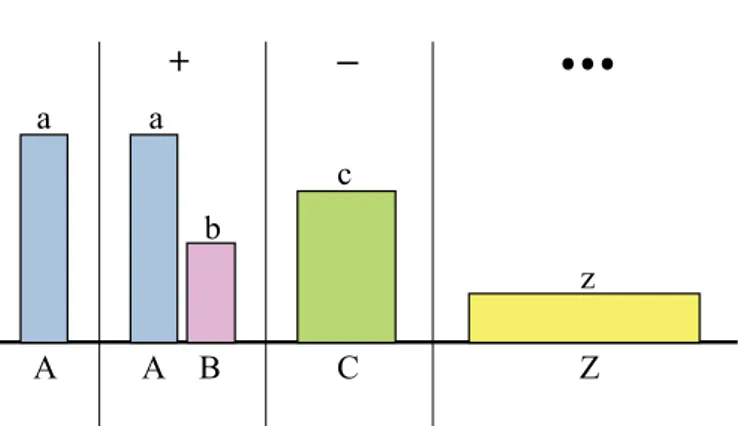
Figure 1. Benign addition principle. It starts with a scientist who has A papers that have earned (a) total citations; average utility a/A. (blank column). Then B papers are added with b total citations (b<a); the scientist has now (A+B) papers that have earned (a+b) total citations (+ column). Next is the average utility of the previous case (- column); i.e. C=(A+B) and c=(a+b)/(A+B). It follows the repugnant conclusion as a possible state; Z>>C but z<<c (… column).
Comparison
Let us assume that a scientist has N
ppapers which have earned N
ccitations. We start with the benign addition principle [25] i.e. it is a
good thing if this particular scientist in-creases the number of his/
her papers even if the new papers receive few only citations. As a
matter of fact even if the new papers do not gain any citations it is
worth to be published, since they are already published. Therefore it
is a good thing that this scientist adds more papers to his/her collec
-tion in any case. We can then repeat the argument and ask for more
papers and so on as before. It is possible then to arrive at a situation
with a large number of papers but a small mean number of citations
per paper (Fig.1). However citations are only the utility attributed
to the papers [26]; it is wrong a scientist to cease writing worth
published papers for they diminish the average utility of his/her col
-lection of papers. Therefore n
ceither contradicts the mere addition
ethical axiom or may end to a repugnance conclusion [27].
* E-mail address: [email protected]
69
A. Ch. Mitropoulos /Journal of Engineering Science and Technology Review 2 (1) (2009) 68-70
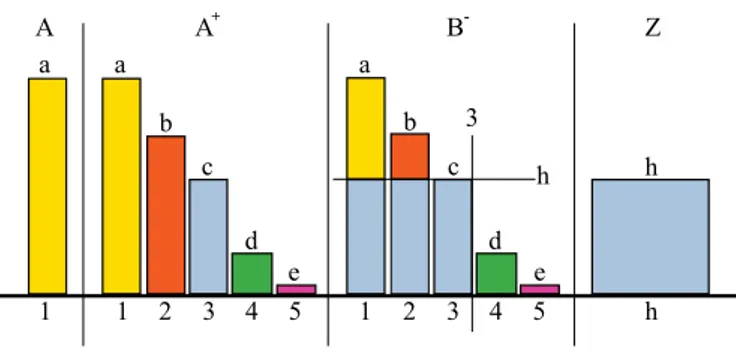
Figure 2. The h-index. It starts with a scientist who has 1 paper that has earned (a) citations (column A). New papers are added to the scientist’s collection that has now 5 papers in total. By numbering the papers in a decreasing order of cita -tions that each one has received we reach to column A+. The h-index is defined at the point where the number of the numbered paper is equal to the number of citations that it has received; in the present example the 3rd paper has c=3 cita
-tions and thus h=3 (column B-). The index underestimates the citations of the 1st
and 2nd paper and ignores the citations of the 4th and 5th paper (column Z).
Let us examine now the h-index. According to Hirsch,
N
c=αh
2; where α is a constant that ranges between 3 and 5. From
the definition of h there must be a number of significant papers
N
p* such that N
p*=h. Then Hirsch claims that the average util
-ity of the total N
ppapers is the number of significant papers N
p*.
Although the measure avoids the repugnance conclusion, because
any paper with citations less than h is ignored, it underestimates
the utility of any paper with citations more than h (Fig.2).
Appar-ently, h does not reflect the optimum point in terms of total utility
principle; the optimum is the point where total utility is greatest.
This would be the case of n
c*=N
c*/N
p*; where N
c* is the total
number of citations of the N
p* papers. But this is not a different
index, at least structurally, from n
c. It is always possible to avoid
repugnance conclusion by killing insignificant although worth
published papers. Consequently h can be distorted, although less
easily than n
c, more easily than N
cjust by finding a subtle way to
cite one’s own papers that are bubbling under [28].
Discussion
I argue that the problem of scientific excellence is not a problem of
measure but a problem of categories. Nevertheless measures may
help to categorise. For instance a scientist’s level may be defined
as:
(1)
where ν is a superscript, not a power, ν=0,1,2,3,4,5 and L is
R=[rounddown] to the first digit of the quotient; N*={1,2,3,…}.
Currently ν is highly unlikely to be >5; i.e. N
c>10
6. Now I will
follow the example of Ref.[24] where a given scientist A has 88
papers with 2,288 citations or; L
ν=2
3, n
c
=26, and h=29. None of
these measures however say anything to us unless there is a pre
-defined verbal description. Based on h, A must be a successful
scientist if he or she serves science for about 30 years. Based on
n
c, A’s work must be of great impact although his/her papers have
less than 187 citations each. Based on L
ν, A is a low high class
scientist (ν=3 but 2,000<N
c<3,000). In all 3 cases there is a vague
representation of scientist A and judging him/her involves some
kind of semi-principled decision-making [29]. The problem is
fur-ther complicated due to the fact that a global measure refers to the
inverse rather than to the direct procedure. For example the direct
procedure would be to ask, what is the e.g. h-index of a
success-ful scientist? The inverse is to linguistically describe what kind of
scientist is someone who has e.g. h=15.
Figure 3. The Lv classification. Evaluation of a scientist requires some kind of decision-making; only a number is not enough. The year’s line follows a Fibonacci sequence. In the present example it is assumed that the given scien-tist has reached to the mid (rank 6) of level 2 after about 16 years from his/her first publication. Presumably he or she moves from one level to the next a little faster than the following sequence: [8 years for level 0], [13 years for level 1], and [21 years for level 2]. A faster sequence would be (5, 8, 13) and a less fast would be (13, 21, 34). The decision-making line ends to three categories of verbal description: very, just, less. To my opinion the scientist under con-sideration is (just) influential and promising. Apparently all this is an arbitrary classification (just for the sake of discussion); but it is a moral one. Scientists are judged rather than numbered.
In this light I suppose that Eq.1 allows more tolerance. To
show this I will discuss the case of a scientist with an L
ν=6
2. This
scientist has at least a sum of 600 papers and citations; i.e. glo
-bally, he or she is at the upper middle level. Again, if his/her first
paper has been published 16 years ago, by sliding the years-bar
(see Fig.3) it is possible to guess how fast this particular
scien-tist develops the Fibonacci sequence. Next we have to define the
linguistic content of our judgment. Now, this is a very subtle
situ-ation because it may be influenced by secondary considersitu-ations.
To help on this I suggest a three fold expression. For instance a
scientist may be “very” influential, (“just”) influential, or “less”
influential. Similarly, according to how fast he/she moves from
one level to the next he or she may be very promising, promising,
or less promising. On this ground the scientist of the given
exam-ple is both promising and influential.
Conclusions
70
A. Ch. Mitropoulos /Journal of Engineering Science and Technology Review 2 (1) (2009) 68-70
relies on papers not on citations. It is therefore important in the
evaluation of a scientist research output to assess the number of
papers that he or she has contributed. On the other hand citations
are little prizes to an author’s work from his/her peer colleagues
that encourage him/her to continue writing papers. Let us now
evaluate a scientist who has written 10 articles that have gained 0
citations. Indices n
cand h are both 0; while L
ν=1
1. Is this zeroing
morally right? If it is, then ~200 citations that presumably were
granted to other authors by this annihilated work should be with
-drawn from their records. If it is not, then L
vis a better although an
arbitrary measure that reflects a less influential scientist.
1. E. Garfield, Citation analysis as a tool in journal evaluation. Science 178, 471–479 (1972).
2. E. Garfield, Citation Indexes to Science: A new dimension in documenta-tion through associadocumenta-tion of ideas, Science 122, 108-111 (1955).
3. E. Garfield, The history and meaning of the journal impact factor, Journal of the American Medical Association 295, 90-93 (2006).
4. P. Jacsó, Testing the calculation of a realistic h-index in Google Scholar, Scopus, and Web of Science, Library Trends, 56, 784-815 (2008). 5. P. Jacsó, The pros and cons of computing the h-index using Web of
Sci-ence, Online Information Review 32, 673-688 (2008).
6. L.I. Meho, and K. Yang, Impact of data sources on citation counts and rankings of LIS Faculty: Web of Science vs. Scopus and Google Scholar, Journal of the American Society for Information Science and Technology 58, 2105-2125 (2007).
7. J.E. Hirsch, An index to quantify an individual’s scientific research out-put, Proceedings of the National Academy of Sciences (USA) 102, 16569-16572 (2005).
8. B. Cronin and L. Meho, Using the h-index to rank influential information scientists, Journal of the American Society for Information Science and Technology 59, 1275-1278 (2006).
9. C. Oppenheim, Using the h-Index to rank influential British researchers in information science and librarianship, Journal of the American Society for Information Science and Technology 58, 297–301 (2007).
10. M. Schreiber, A case study of the Hirsch index for 26 non-prominent physicists, http://arxiv.org/abs/physics/0708.0120 (2007).
11. J. Imperial and A. Rodriguez-Navarro, Usefulness of Hirsch’s h-index to evaluate scientific research in Spain, Scientometrics 7, 271-282 (2007). 12. C.D. Kelly and M.D. Jennions, The h index and career assessment by
numbers, Trends in Ecology and Evolution 21, 167–170 (2006). 13. J.K. Vanclay, On the robustness of the h-index. Journal of the American
Society for Information Science and Technology 58, 1547-1550 (2007). 14. L. Bornmann, R. Mutz, H.D. Daniel, Are there better indices for
evalua-tion purposes than the h-index? A comparison of nine different variants of
the h index using data from biomedicine, Journal of the American Society for Information Science and Technology 59(5), 1-8. (2008).
15. R. Costas and M. Bordons, The h-index: advantages, limitations and its relation with other bibliometric indicators at the micro level, Journal of Informetrics 1, 193-203 (2007).
16. A. Sidiropoulos, D. Katsaros, and Y. Manolopoulos, Generalized h-index for disclosing latent facts in citation networks, Scientometrics 72, 253-280 (2006).
17. J. Panaretos and C. Malesios, Assessing scientific research performance and impact with single indices, MPRA Paper No. 12842, http://mpra. ub.uni-muenchen.de/12842 (2009).
18. R. Rousseau, New developments related to the Hirsch index, Science Fo-cus 1, 23-25 (2006).
19. W. Glänzel, On the opportunities and limitations of the h-index, Science Focus 1, 10-11 (2006).
20. Q.L. Burrell, On the h-index, the size of the Hirsch core and Jin’s A-index, Journal of Informetrics 1, 170-177 (2007).
21. R. Rousseau, The influence of missing publications on the hirsch index, Journal of Informetrics, 1, 2-7 (2007).
22. L. Egghe, Theory and practice of the g-index. Scientometrics 69, 131-152 (2006).
23. J.E. Hirsch, Does the h-index have a predictive power? http://arxiv.org/ abs/physics/0708.0646 (2007).
24. S. Lehmann, A.D. Jackson and B.E. Lautrup, A quantitative analysis of measures of quality in science, http://arxiv.org/abs/physics/0701311 (2007).
25. D. Parfit, Reasons and persons, Oxford, Clarendon (1984).
26. S.E. Cozzens, What do citations count? The rhetoric-first model, Sciento-metrics 15, 437-447 (1989).
27. M. Huemer, In defence of repugnance, Mind 117, 899-933 (2008). 28. A. Purvis, The h index: playing the numbers game, Trends in Ecology and
Evolution 21, 422 (2006).