Católica MOVE
in Sao Tome and Principe
Insightful strategic challenges
Exploratory research concerning the organization’s presence and performance in Sao Tome, its mission and activities alignment, and the strategic perspective from the
programme’s evolution
Student:
Ana Irene Murcho Fernandes
Supervisor:
Prof. Susana Frazão Pinheiro
Dissertation submitted in partial fulfillment of requirements for the Degree of MSc In Business Administration at the Católica Lisbon School of Business and Economics
ii ABSTRACT
Title: Católica MOVE in Sao Tome and Principe Sub-title: Insightful strategic challenges
Author: Ana Irene Murcho Fernandes
The present dissertation research invites thinking about foreign aid effectiveness, entrepreneurship and social sector’s action in developing countries, all addressing sustainable development. It focuses on the nongovernmental organizations’ potential as intermediary agents for change, as well as on the increasing pressure towards their partial or total autonomy while becoming more financially viable and achieving higher social impact.
The literature review addresses foreign aid issues, entrepreneurship as a worthwhile solution to build on developing countries’ sustainability, the evolution of the role of NGOs in the social sector and the promising future of social entrepreneurship. The Católica MOVE in Sao Tome and Principe case study aims to allow an insightful perspective of an NGO in a small African developing country over almost three years and six fellow teams, by presenting its different dynamics and activities. The teaching notes suggest approaching the case study by analyzing and discussing its programme’s strategic evolution in light of the country’s context. Brainstorming around to target a higher financial viability and social impact are suggested. The case study analysis suggests the organization’s increasing visibility and credibility have been emphasizing its positioning in the field through mission and activities’ alignment and coherency.
RESUMO
Título: Católica MOVE em São Tomé e Príncipe
Subtítulo: Desafios estratégicos perceptíveis e inspirativos Autor: Ana Irene Murcho Fernandes
A dissertação apresentada convida a reflectir sobre a efectividade da ajuda internacional, empreendedorismo e acção do sector social nos países desenvolvidos, em abordar o desenvolvimento sustentável. Esta destaca o potencial das organizações não-governamentais como agentes intermediários da mudança, e também a crescente pressão relativamente à sua parcial ou total autonomia, enquanto conseguindo uma maior viabilidade financeira e alcançando maior impacto social.
A revisão de literatura esclarece os pontos relativos à ajuda internacional, ao empreendedorismo como solução credível e capaz na construção de sustentabilidade nos países em desenvolvimento, ao papel das organizações não-governamentais no sector social e esclarece também quanto ao futuro promissor do empreendedorismo social. O estudo de caso da Católica MOVE em São Tomé e Príncipe visa dar uma perspectiva perceptível e inspirativa do trabalho de uma organização não-governamental num pequeno país africano em desenvolvimento em quase três anos de actividade e seis equipas de fellows através das suas diferentes dinâmicas e actividades. Nas notas dedicadas ao ensinamento do caso, é sugerida uma abordagem de análise e discussão da evolução estratégica do programa à luz daquele que é o contexto do país. É também sugerido que sejam discutidas e lançadas ideias sobre as possibilidades que a organização tem em conseguir uma maior viabilidade financeira e um maior impacto social. A análise do caso de estudo sugere que a crescente visibilidade e credibilidade da organização tem vindo a enfatizar o seu posicionamento no terreno através de um alinhamento e coerência entre a sua missão e as suas actividades.
iii TABLE OF CONTENTS
ABSTRACT ... ii
TABLE OF CONTENTS ... iii
ACKNOWLEDGMENTS ... v
LIST OF ACRONYMS ... vi
LIST OF ANNEXES AND EXHIBITS ... vii
CHAPTER 1: INTRODUCTION ... 8
CHAPTER 2: LITERATURE REVIEW ... 9
Foreign Aid Effectiveness ... 9
Foreign aid definition and system ... 9
Aid-growth relationship ... 9
Foreign Aid Effectiveness: the case of Africa ... 11
Entrepreneurship and Economic Development ... 12
The role of entrepreneurship in developing countries ... 12
Microfinance and Entrepreneurship ... 14
Non-Governmental Organizations in Social Sector ... 15
Social sector and NGO definition ... 15
NGOs’ issues and challenges ... 16
NGOs: from traditional to entrepreneurial mentality ... 17
Changing the face of Social Sector ... 18
SE definition ... 18
Social Enterprise Operating Models ... 20
Social Business definition ... 21
CHAPTER 3: CASE STUDY ... 23
MOVE: Damos crédito à esperança ... 23
Conception ... 23
Organizational structure and sustainability ... 24
Sao Tome and Principe field ... 24
Geography and dynamics ... 24
Social, economic and business context ... 26
NGOs in the field ... 28
iv
Mission’s beginning ... 29
From microcredit to entrepreneurs ... 30
From partnerships to impact ... 31
Independent activities ... 34
Right time to make a shift ... 35
EXHIBITS ... 36
CHAPTER 4: TEACHING NOTES... 66
Learning objectives ... 66
Suggested Teaching Methods ... 66
Teaching Questions (TQ) and Discussion ... 67
CHAPTER 5: CONCLUSION, LIMITATIONS OF THE STUDY AND FUTURE RESEARCH ... 76
ANNEXES ... 78
v For the friends I made in the field of Sao Tome, and those that are friends for long.
ACKNOWLEDGMENTS
Firstly I am thankful to my family, for having gladly supported me all the way and specially for understanding my decision to go to Sao Tome and Principe.
I would like to express here my gratitude to MOVE structure in Portugal, from top management to recruitment team that from the very beginning supported my idea of developing a dissertation regarding MOVE and made it possible to actually go to Sao Tome and Principe as sócia-terreno.
I am grateful to all the ex-fellows who answered the survey that allows a more accurate understanding of MOVE programme’s evolution in Sao Tome and Principe. Special thank to Joao Neto, ex-fellow currently living in Sao Tome, for providing insightful information about the country and MOVE project.
I felt very happy in Sao Tome and Principe. The current fellows’ enthusiasm and high sense of responsibility exceeded my expectations. I thank them for having me there and sharing everything. I felt overwhelmed by the deep talks, discussions and laughs. Most of all I thank them for taking challenges always bearing in mind helping young and adults in Sao Tome and Principe building a better future as simultaneously accepting their identity and working on their potential. Thank you, Ana, António, Joana, Madalena and Marta.
Also, I am very thankful to José Paulo, field manager, for his availability and frankness. And also for his tireless dedication to those who are in the field.
For the valuable feedback, availability, encouragement and interest, I would like to thank to Professor Susana Frazão Pinheiro, my dissertation supervisor.
vi LIST OF ACRONYMS
AfDB African Development Bank
CSR Corporate Social Responsibility
CPI Consumer Price Index
CSOs Civil Society Organizations
DAC Development Assistance Committee
FDI Foreign Direct Investment
FONG-STP Federação das Organizações Não-Governamentais em Sao
Tome and Principe
GDP Gross Domestic Product
GNI Gross National Income
LDCs Least Developed Countries
MFIS Monetary Financial Institutions
MDGs Millennium Development Goals
MOVE Católica MOVE
MPI Multidimensional Poverty Index
NGDOs Non-governmental Development Organizations
NGOs Non-governmental Organizations
NPOs Non-profit Organizations
ODA Official Development Assistance
OECD Organization for Economic Cooperation and Development
SE Social Entrepreneurship
SMEs Small and Medium-Enterprises
SSA Sub-Saharan African
WB The World Bank
vii LIST OF ANNEXES AND EXHIBITS
Page
Exhibit 1 MOVE organization structure 36
Exhibit 2 MOVE Income Statement 2012/2013 36
Exhibit 3 Sao Tome and Principe field expenditures 37
Exhibit 4 Map of Sao Tome and Príncipe 38
Exhibit 5 Multidimensional poverty across Sao Tome and Príncipe 39 Exhibit 6 Percentage of population vulnerable to MPI poverty (SSA countries) 39
Exhibit 7 List of Least Developed Countries (LDCs) 40
Exhibit 8 Goods imports vs. exports (BoP, current US$) 40
Exhibit 9 Sao Tome and Principe ODA Data 40
Exhibit 10 How Sao Tome and Principe ranks on Doing Business topics 41
Exhibit 11 SWOT analysis: Sao Tome and Principe country 42
Exhibit 12 Survey to the MOVE-STP ex and current fellows and answers’ analysis 42
Exhibit 13 MOVE-STP Microcredit representative scheme 53
Exhibit 14 Microcredit and Entrepreneurs Information 54
Exhibit 15 Partnerships and Projects Information 56
Exhibit 16 Private Companies Partners 60
Exhibit 17 MOVE Microcredit article in Kê Kuá 60
Exhibit 18 TVS News on “Move-te” competition 60
Exhibit 19 NGOs’ partners 61
Exhibit 20 Nh’a Banana Séco Project 63
Exhibit 21 Class regarding leadership topic 63
Exhibit 22 ‘Pros and Cons’ debate winning team 64
Exhibit 23 Major projects under discussion 64
Exhibit 24 Communities where were conducted Market Research 65
Annex 1 Aid System – Highly Simplified Financial Links and Flows 78 Annex 2 Net ODA and Aid dependency ratios in 2011 by World Region 78
Annex 3 Top 10 recipient countries ranking in 2011 79
Annex 4 NGO primarily programmes in promoting empowerment 79
Annex 5 Alter Social Enterprises Operational Models 80
Annex 6 Alter Social Enterprises Enhancing and Combining Models 81
8 CHAPTER 1: INTRODUCTION
The aim of the current research is to underline the role that social sector, in particular NGOs, can play in promoting sustainable development in developing countries, but also mention that those same organizations have the possibility to become more sustainable themselves.
The dissertation is in the case study form, introducing the MOVE nonprofit organization in Sao Tome and Principe. In this particular field, MOVE has been experiencing a moment of shifting on its strategy towards a better alignment between population necessities, organizations’ available and most effective tools for better impact, and also organizations’ funding necessities. The key Research Question is to understand the organization’s presence and performance in Sao Tome through understanding its mission and activities alignment and the strategic perspective from the programme’s evolution by making use of exploratory research.
In chapter 2 – Literature Review – firstly, different perspectives on foreign aid are explored under the Foreign Aid Effectiveness topic; secondly, the foreign aid conclusions lead to the focus on the future sustainable development in developing countries, notably Africa, that might be based on an entrepreneurial culture, explored in Entrepreneurship and Economic Development topic; thirdly, in Non-Governmental Organizations in Social Sector the changing role of NGOs as part of social sector in supporting sustainable development over time is presented; and at last in Changing the face of Social Sector, as a response to the NGOs funding increasing pressures, the social entrepreneurship notion is introduced and managerial frameworks are proposed.
In chapter 3 – Case Study – is divided into three sub-topics: the first concerning MOVE conception and structure, the second focusing on the Sao Tome and Principe context and the third referring specifically to MOVE in Sao Tome and Principe, exploring the organization’s mission and programme evolution in the field.
In chapter 4, – Teaching Notes – the author explains the main learning objectives, and reflects on the case study approach to be taken by the Professor in class by suggesting teaching methods, and teaching notes and discussion.
The last chapter in dedicated to Conclusion, Limitations of the Study and Future
9 CHAPTER 2: LITERATURE REVIEW
Foreign Aid Effectiveness
Foreign aid definition and system
According to the DAC of the OECD, the standard definition of foreign assistance is “financial flows, technical assistance, and commodities that are (1) designed to promote economic development and welfare as their main objective (thus excluding aid for military or other non-development purposes); and (2) are provided as either grants or subsidized loans.”1 The rationale behind foreign aid is humanitarian, political and economic.
International development is largely supported by the international aid flows system (Annex 1) that is based on ODA2 and private voluntary assistance3. For the purpose of methodological studies around aid effectiveness, ODA and foreign aid are treated as the same thing as it is the key measure of aid performance.
Aid-growth relationship
There has been a serious discussion regarding the controversy of aid effectiveness. The main goal of aid programs is poverty reduction, which goes hand in hand with economic growth and development. For decades, economists have heavily discussed results on cross-country relationship between foreign aid receipts and economic growth. Meanwhile, the voluminous literature resulted in three broad and prevailing views on aid: (1) conditionally (under certain circumstances), aid induces positive growth; (2) there is a positive and unconditional causal relationship between aid and growth, usually with diminishing returns and (3) aid effect on growth is null (or negative).
Boone (1996) had the first most complete research regarding aid and growth subject, which pointed to an inexistent relationship between aid receipts and investment: aid programs were not correlated with the basic components that cause growth4. The most
1 Source: CGDEV, http://international.cgdev.org/page/us-foreign-assistance-101, viewed 23.10.2013
2 ODA concerns loans and grants provided by donor governments to low- and middle-income countries
3
Private voluntary assistance concerns grants e.g. given by non-governmental organizations, non-profit organization, foundations, charitable institutions, private donors
4 In fact, large amount of aid is consumed or wasted rather than invested in development projects and thus contributes to the country’s economic growth, and it has to do with fungibility phenomenon (aid is not used for the purpose intended by donors) and aid type (contra-Boone).
10 influential subsequent studies on aid-growth literature after Boone were Burnside and Dollar (2000), Hansen and Tarp (2001) and Rajan and Subramanian (2008), each on behalf of one of the three prevailing views on aid previously mentioned.
Burnside and Dollar (2000) argued that there is a positive but conditional relationship between aid and growth. Burnside and Dollar concluded that aid encouraged growth in countries with good policies, but not otherwise5. Hansen and Tarp (2001) found that there is an unconditional positive relationship between aid and growth. Hansen and Tarp studies actually do not conclude that aid has always worked, but aid has been associated with higher (rapid) growth on average across countries. However, there is empirical support of diminishing returns: as the volume of aid increases, the impact it has on growth tend to decrease. Rajan and Subramanian (2008) supported Boone with evidence that there is no relationship.
There are causes for the divergence between the academic findings. Clemens (et al. 2004) found that aid type matters6 as supporting that different types of aid could have distinct growth impacts, in particular aid that is aimed directly at growth on average has a strong and positive impact on growth. Budget support and project aid concerning infrastructure and productive investments7are likely to have a short term growth impact (growth-oriented aid by Radelet et al. 2004). On the other hand, aid given under humanitarian and emergency purpose, technical cooperation and social sector investments8 are likely to have a long term impact. Hence, fungibility9 and the very complexity of aid definition are reasons why literature does not allow a definitive conclusion, as academic studies do not show robust evidence regarding the relationship between aid and growth. Additionally, aid effects towards growth diverge technically for the reason of using inappropriate time horizon for the analysis – usually looking at historical time series that are frankly too short – and for relying too much on weak or invalid instrumental variables. When adjusting the research studies, aid inflows are
5 Other analysts have additionally found that donor practices also influence aid effectiveness: bilateral and multilateral aid institutions as self-interested, inefficient, rent-seeking bureaucracies, thus contributing for perpetuating poor governance and corruption
6 Mavrota (2002) also disaggregates aid into project aid, technical assistance, programme aid and food aid 7
I.e. transport, communications, energy, agriculture and industry
8 I.e. disaster relief, education, health, population control, environment, legal and democracy support 9 Fungibility phenomenon has to do with aid not being used for the purpose intended by donors; instead, it is wasted by the recipient governments which had the control over the aid given. McGillivray and
11 systematically associated with modest, positive subsequent growth in cross-country panel data (Clemens et al. 2012).
The fact that some amount of growth typically follows aid receipts does not per se establish causation neither the results imply that aid ‘works’ everywhere. Moreover, any of the results of research studies conducted suggest that aid can or should be the main driver of growth and thus of poverty reduction (ibid.).
Foreign Aid Effectiveness: the case of Africa
There are several economies largely dependent on foreign aid. Mostly recipient countries are African, notably SSA10, the region that remains with the highest incidence of multidimensional poverty11 – in Annex 2 net ODA disbursements and aid dependency ratios in 2011 are presented. For instance, international aid finances up to 93% of Sao Tome and Principe investment programme12 as one of the top 10 listed net ODA recipients as percentage of GNI (Annex 3) in 2011. “In the last 50 years, foreign aid transfers to governments in Sub-Saharan Africa totaled a staggering $1 trillion (…) Nonetheless, over the same period of time, growth of GDP per capita in Africa actually registered a marked decline and was for many years even negative” (Abuzeid 2009, p. 1). Hence, half of a century of aid flows to SSA suggests that the foreign aid system does not work effectively in practice and that actually it might be part of the problem. Researchers such as Jeffrey Sachs (2005) are optimistic regarding the aid effectiveness, claiming that aid programs have supported some poverty reduction, and notably prevented worse performance from the poor, and defending that doubling worldwide aid flows would lead to the end of poverty. On the other hand researchers as Dambisa Moyo (2009) are skeptic about aid effectiveness, underlining precisely aid’s apparent incapacity in tackling poverty, – emphasizing the case of Africa – and defending a complete cessation of ‘systematic aid’13 flows. Moyo (2009) defends that ‘systematic aid’ is undermining growth in Africa. “With aid’s help, corruption fosters corruption, and nations quickly descend into a vicious cycle of aid14” (Moyo 2009, p. 49).
10 As an illustrative example, ODA represented more than 2.5 times the size of private flows in SSA in 2006 (Ratha, et. al 2008)
11
Source: UNDP http://hdr.undp.org/en/reports/global/hdr2010/summary/poverty/, viewed 02.12.2013 12 IMF (2012)
13 I.e. ODA
14 Corrupt governments interfere with the rules of the law; as opacity increases countries become unattractive to invest in and it results in fewer job opportunities, so it reduces economic growth and
12 Opportunities abound in every sector in Africa, – agriculture, power, telecommunications, infrastructure, banking and finance – there is “inordinate demand and supply is not coping” (Moyo 2009, p. 142). According to Moyo, economic life for the majority of Africans would be more likely if the aid stops, because corruption would fall and entrepreneurs would rise as investments would increase. Africa needs FDI, intentional and regional trade, bond markets, increasing domestic savings instead of aid (Moyo 2009), because Africans need jobs, actual opportunities to grow by self-reliance, not sympathy15.
Entrepreneurship and Economic Development
The role of entrepreneurship in developing countries
According to population data 2013, more developed countries account for 1.2 billion (1.3 billion in 2050) while the less developed countries account for 5.9 billion (8.4 billion in 2050)16 – poor countries urge fostering economic development in order to create jobs, wealth and well-being for the worldwide economy good.
“Africa has the fastest-growing and most youthful population in the world”17 . The African continent will have the largest population growth from now to 2050 (1.1 billion in 2013 to 2.4 billion in 2050)18 and almost 400 million Africans will be between the ages of 15 and 2419. This demographic scenario increases the pressure Africa faces towards job creation over the coming decades. Young population shall be offered jobs; otherwise it may negatively affect world economy. The WB admits that ODA “alone will not be adequate for funding efforts to accelerate growth and poverty alleviation and other MDGs in Africa. Ultimately the private sector will need to be the engine of
increaes poverty levels, leading to donors to give more aid, which continues the downward spiral of poverty (Moyo 2009)
15 Moyo's reply to Sachs in the Huffington Post:
http://www.telegraph.co.uk/finance/economics/8247831/The-wit-and-wisdom-of-Dambisa-Moyo-her-supporters-and-critics.html, viewed 23.11.2013
16 Source: Population Reference Bureau, http://www.prb.org/pdf13/2013-WPDS-infographic_MED.pdf,
viewed 01.12.2013
17 Source: AfDB,
http://www.afdb.org/fileadmin/uploads/afdb/Documents/Generic-Documents/AFDB%20youth%20doc.pdf, viewed 01.12.2013
18 Source: Population Reference Bureau, http://www.prb.org/pdf13/2013-WPDS-infographic_MED.pdf,
viewed 01.12.2013
19 Source: Population Reference Bureau, http://www.prb.org/pdf13/africa-demographicdividend-jobs.pdf,
13 growth and employment generation and official aid efforts must catalyze innovative financing solutions for the private sector (Ratha, et. al 2008) as the AfDB admits to focus on “encouraging the development of self-employment and SMEs through the provision of business development training, skills up-grading and the establishment of producers’ organizations with an emphasis on access to microfinance services and women’s empowerment”20
.
A culture of entrepreneurship might be the key concept to poverty reduction and job creation21. Hence, there is the necessity of stimulating the entrepreneurial aspect in human nature through education in order to leverage entrepreneurial action and lead to more economic development and sustainable growth (Boettke and Coyne 2003). Entrepreneurs perceive opportunities and take the risk of pursuing them as creating value through managing those same opportunities, but poor people are perceived as sharing an apparent lack of interest in seeking opportunities. They have pressing matters22 that take their time from seeking opportunities that might be scarce23 (Naudé 2008). Also, any entrepreneurial activity requires risk and it might compromise the household subsistence (ibid.). Experience, education and better health improve entrepreneurial ability and productivity. “Some evidence suggests that the type of knowledge imparted (e.g. more practical, general knowledge) is important, and also suggests that in building entrepreneurial capacity tacit knowledge and learning by doing may be vital” (ibid, p. 31). Understandably, a higher potential for entrepreneurship is dependent on cumulative training, planning and appropriate economic policies. And even though the primarily responsibility for promoting employment lies with governments, the social partners, civil society, international community and young people have an important role in the process24.
20 Source: AfDB,
http://www.afdb.org/fileadmin/uploads/afdb/Documents/Generic-Documents/AFDB%20youth%20doc.pdf, viewed 01-12-2013
21 Source: Mail&Guardian, http://www.southernafricatrust.org/docs/bread_africa.pdf, viewed 19.10.2013; and The guardian, http://www.theguardian.com/global-development/2012/apr/16/uk-funds-million-jobs-world-bank, viewed 19.10.2013
22 Poor people are still focused in satisfying the Psychological and Safety needs according to the Maslow’s Pyramid or the Existence need according to Clayton’s ERG Theory
23 Source: Mail&Guardian, http://www.southernafricatrust.org/docs/bread_africa.pdf, viewed 19.10.2013 24
14 Nonetheless, Ha-joon Chang (2010) makes a different point regarding entrepreneurship. Chang claims that developing countries have already a higher proportion of entrepreneurs than in developed ones, thus the lack of “raw individual entrepreneurial energy”25
is not the issue. As Chang states, “it is their inability to channel the individual entrepreneurial energy into collective entrepreneurship26”. Hence, more than leveraging entrepreneurial mindset and skills, developing countries can reduce poverty in a sustainable basis by building mechanisms of collective entrepreneurship which facilitates organizational upgrading and learning process as building and managing becomes more effective because of more collective ability over individual.
Microfinance and Entrepreneurship
Microfinance has been considered the financial innovation for developing countries. Notably, microcredit offers the poor the opportunity to capital access, so they can ask for loans and invest in small businesses, thus reducing poverty, improving well-being and ultimately creating employment. It can take the form of group or individual lending, and although MFIs have been switching from group lending to individual lending, the first has a stronger feature – joint liability27 – when it comes to repayment.
However, researchers there are skeptical towards microfinance as an effective tool in encouraging entrepreneurial activities and alleviating poverty. Bateman (2011) defends that it has not worked; instead it has created unsustainable indebtedness in developing countries28. The necessity to repay the microloans and the low success rate of microenterprises contribute to repayment problems worsening the poor living conditions. Bateman (2011) also finds that microloans are very much used to non-investment purposes, meaning that it does not fuels enterprises because it mostly fuels basic consumption. Thus, it is “urgent to refocus on the promotion of local microsaving, rather than microcredit, as the first step in the local accumulation of capital” (Bateman 2011, p. 4).
25 Source: UNU-WIDER
http://www.wider.unu.edu/publications/newsletter/articles-2010/en_GB/10-2010-Chang/, viewed 16.12.2013 26 Ibid.
27
I.e. The group members take responsibility for each other, thus when one group member does not repay the loan, the all group is in default. This generates a ‘repayment game’, which is positive in the sense that there is social pressure within the group to individual to repay the loans, and one successful borrower can help those that are in difficulty, although it is very negative when it happens that the entire group defaults 28
15
Non-Governmental Organizations in Social Sector
“Frustrated with government, many people who care about the problems of the world have started nonprofit organizations” – Muhammad Yunus29
Social sector and NGO definition
Social sector30 is highly connected to the aid industry as it concerns non-profit organizations and non-governmental organizations that undertake activities with pure social drive. Both NPOs31 and NGOs32 are concerned with social change, human rights and welfare. The differences between the concepts are much related to legal aspects. NGOs operate at many levels of society, having impact in so many aspects of peoples’ lives that defy attempts at exact classification. “There is a sheer diversity of organizations that fall into the general category of ‘NGO’. NGOs can be large or small, formal or informal, externally funded or driven by volunteers, charitable and paternalistic or radical and ‘empowerment-based’. One NGO might combine several of these different elements at any one time.” (Lewis 2001, Ch. 1 The growth of the NGO ‘management debate’ p. 4)
NGOs are a very important sub-set of social sector organizations engaged in development and national or international issues on the topic of the civil society33. These organizations are private, usually not-for-profit and task-oriented and may operate individually or collectively, as serving a range of particular societal interests by focusing advocacy or operational34 efforts on social, political and economic objectives, including equity, education, health, environment, protection and human rights (Teegen
29
Creating a World without Poverty: Social Business and the Future of Capitalism, 2007 30 Also known as third sector, voluntary sector, nongovernmental sector or nonprofit sector 31 E.g. public organizations, foundations and charitable organizations
32 Also known as NGDOs
33 NGOs may be defined as “the organizational manifestations of civil society interests” (Teegen et al. 2004, p. 4) thus they are also known as CSOs
34 “Advocacy NGOs work on the behalf of others who lack the voice or access needed to promote their
own interests; operational NGOs provide critical goods and services to clients with unmet needs” (Teegen et al. 2004, p. 5). There are also “hybrid NGOs, which use both advocacy and operational means to achieve social benefit” (Ibid.).
16 et al. 2004). NGOs may work locally, nationally or internationally but they work primarily in the developing world focusing in reducing poverty35.
NGOs’ issues and challenges
There are some factors that discourage positive impact from NGO: (1) conceptual issues; (2) funding pressures; (3) internal organizational factors; and (4) external context (Nicholls 2006, Ch. 12 Helping People is difficult: Growth and Performance in Social Enterprises Working for International Relief and Development by Alex Jacobs).
Difficulties specifying the organization’s approach tend to constrain the strategic planning. Also, many NGOs operate under tight budgets which limit NGO’s activities and scalability – once costs exceed the inflow grants and donations the NGO has to reduce either quantity or quality of the program activities. Donations and grants might also inhibit the autonomy of NGOs in choosing which activities to perform and the most effective strategy to achieve program goals.
Via working on critical arrangements among public and private sectors and civil society, NGOs got the recognition of their critical role in the aid industry and happened to increase donors’ interest in funding their activities. In the countries of the South, the prevalence of weak states, inefficient and corrupt governments or lack of official aid programmes led to the growth of a Southern NGO sector as an alternative to promote development (Lewis 2001, Ch. 3 NGO and development). There was a proliferation phenomenon in the last decade; the number of NGOs increased the competitiveness for funding. Moreover, macroeconomic instability and western crisis led to funding scarcity because of the shifting funder priorities36. Mobilizing donors has become more difficult in recent years and they are also more demanding in terms of the NGOs accountability due to aid effectiveness disbelief. Furthermore, surrounded by such competitiveness NGOs are in danger of having their work importance becoming increasingly marginal. Internal organizational and external factors such as distant management, overwhelming significance of complex local context and external factors, multiple stakeholders and such broad and complex activities hinder NGO management.
35 Poverty not merely as lack of access to commodities related to survival (e.g. food and shelter) but also related to people’s well-being (e.g. health and literacy) and empowerment (e.g. psychological and political) (Fowler 1997)
36
17 Additionally, NGO face a specific challenge concerning their own message which lies on supporting an unsolvable problem that no-one else is willing to address rather than helping solving the problem through local resources and inhabitants.
NGOs: from traditional to entrepreneurial mentality
NGOs have played a major role in the aid industry but their traditional approach has been falling short as the intensity and complexity of social sphere has grown. Also, in the last decade there have been shifts on aid discourse as providing goods or services straight to the poor increasingly has shown to reduce local governments’ accountability to people, potentially undermining the basis upon which long-term improvements in their lives must be built, not preparing communities for self-reliance.
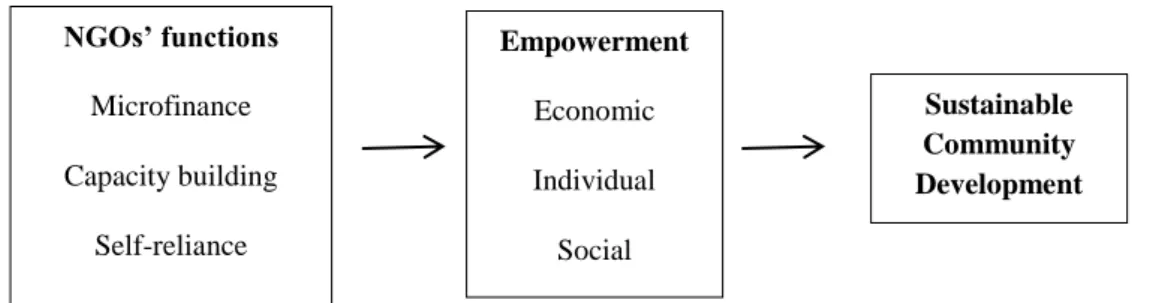
In developing countries, local people are very much dependent on local ecosystem for their subsistence (Nikkhah et al. 2010), accordingly sustainable development will rest on the relationship between NGOs and other local actors and their ability to leverage local capabilities and resources. Hence, NGOs are adopting programmes that lead to a major impact in poor communities, as microfinance, capacity building and self-reliance (ibid.). These programmes are defined in Annex 4. Through these programs, NGOs are in the path to promote empowerment among community members and thus community sustainable development (Figure 1).
Figure 1 Theoretical framework of the functions of NGO in promoting sustainable community
development37
Likewise, NGO bottom-up rather than top-down approach fosters empowerment and allows outcome local solutions to achieve sustainable development. It motivates community members to define their own problems and needs and allows them to be the
37 Source: Adapted from Nikkhah et al. (2010), “The Role of NGOs in promoting empowerment for
sustainable community development”, p.87 NGOs’ functions Microfinance Capacity building Self-reliance Empowerment Economic Individual Social Sustainable Community Development
18 ones who will solve those problems and needs by accessing the ability to do so having the appeal to do it together.
Yet, managerial and funding issues hold NGOs back. In general, NGOs need to become more sustainable even tough pursuing a social mission. Perhaps in order to become more engaging and sustainable, NGOs should take more entrepreneurial initiatives and understand business key dynamics38. Although shifting from traditional ‘beneficiary’ to ‘entrepreneurial’ shall not be the aim of every NGO, several should take part in stimulating actual sustainable development, attempting partnerships with local agents, building strategic alliances with private sector, starting income-generating activities or even adopting a social enterprise model.
The NGO traditional work importance is more and more perceived as marginal39 as business and entrepreneurial models are increasingly perceived as capable of playing a major role in sustainable development through job and wealth creation40.
Changing the face of Social Sector
SE definition
“The language of SE may be new, but the phenomenon is not. We have always had social entrepreneurs.” – Dee, J. Gregory41
SE “combines the passion of a social mission with an image of business-like discipline, innovation and determination” as “social entrepreneurs look for the most effective methods of serving their social mission” (Dee 2001 p. 1)
The social entrepreneurs “plays the role of change agent in the social sector by: Adopting a mission to create and sustain social value (not just private value);
38 Source: The Guardian,
http://www.theguardian.com/sustainable-business/financial-sustainability-ngos-fail-to-engage-investors, viewed 01.12.2013 39 Not referring to the humanitarian assistance
40 Source: The Guardian
http://www.theguardian.com/global-development-professionals-network/2013/sep/20/ngos-no-longer-set-agenda-development, viewed 22.10.2013 41
19 Recognizing and persistently pursuing for new opportunities to serve that mission;
Engaging in a process of continuous innovation, adaptation and learning; Acting boldly without being limited by resources currently in hand; and
Exhibiting heightened accountability to the constituencies served for the outcomes created” (Dee 2001 p. 4).
J. Gregory Dee (2001) does not mention earned income as a necessary condition regarding SE. In fact, he argues that “traditionally, social enterprises have been formally structured as nonprofit organizations” (Dee 1996, p. 1) which implies that they are not expected to generate any surplus42. Hence, social entrepreneurs create ‘social value’ and might or might not also create economic value. Oppositely, Boschee and McClurg (2003) state “unless a non-profit organization is generating earned revenue from its activitie, it is not acting in an entrepreneurial manner” (Boschee and McClurg 2003, p.2). Non-profit is traditionally dependent on donations, voluntarism and grants and it neither suits sustainability nor self-sufficiency; social entrepreneurs are innovative as they are tolerant to risk, pursuing competitiveness and sources of income through social drive, leading social enterprises through financing which is the one way to self-sufficiency (Boschee and McClurg 2003). Hence, social entrepreneurs are expected to create economic value as they create ‘social value’.
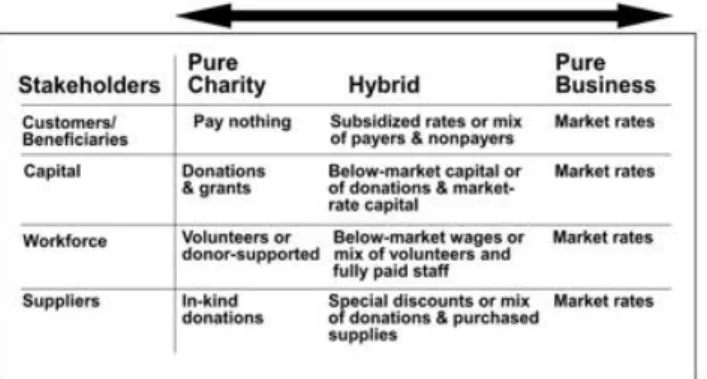
According to J. Gregory Dees (1996) a social enterprise may lay in one of three types among the spectrum: (1) purely philanthropic, (2) hybrid and (3) purely commercial. The three types differ in motives, methods and goals. The Social Enterprise Spectrum description is presented in Figure 2.
Figure 2 The Social Enterprise Spectrum43
42 I.e. economic residual as profit 43
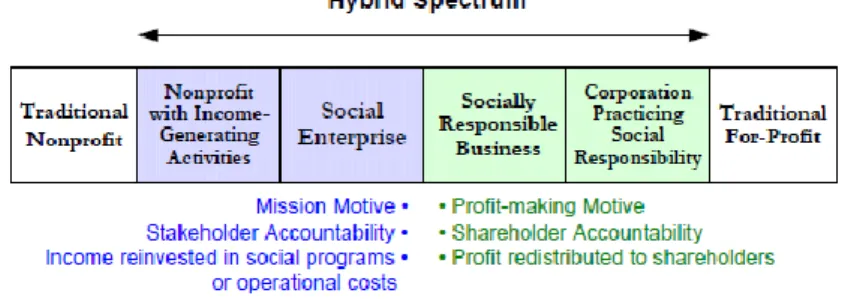
20 Alter (2007) has a different vision: social enterprises are hybrid only as they have dual value creation44. Social enterprise is one type of hybrid organization “as any business venture created for social purpose – mitigating/ reducing a social problem or a market failure – and to generate social value while operating with the financial discipline, innovation and determination of a private sector business” (Alter 2007, p. 18), but not the only one type as demonstrated in the Hybrid Spectrum in Figure 3. Alter (2007) separates those types of organizations in two families according to the (1) motive, (2) accountability and (3) use of income (Alter 2007 p. 14). Traditional nonprofit and traditional for-profit are not considered as hybrid organizations as they account for one purpose only45.
Figure 3 Hybrid Spectrum46
According to Alter (2007) there are two types of income-generating activities: cost recovery – discrete activity related to the organization’s mission – and earned income – ongoing activity related or unrelated to the organization’s mission. Both realize little revenue, but the former may progress the Nonprofit with Income-Generating Activity into Social Enterprise when activity’s implementation requires a business plan.
Social Enterprise Operating Models
Alter (2007) classifies social enterprises as ‘embedded’, ‘integrated’ or ‘external’ giving the level of integration between social programs and business activities as demonstrated in Figure 4. Embedded social enterprises imply that the social program is the business; integrated social enterprises imply that both social and business program overlap and external social enterprises mean that social program is distinct from business activity.
44 I.e. social enterprises must combine (in different proportions) both ‘social’ and economic value 45 I.e. traditional nonprofit create ‘social value’ only and traditional for-profit create economic value only 46
21
Figure 4 Social Enterprises Business/ Programme Integration47
Alter (2007) also elaborates on fundamental operational models concerning social enterprises which differ in accordance to their social and economic activities and possible synergies, central mission, target population, employees and owners. Each one of the fundamental models is described in Annex 5. Once seeking for social program growth, increased revenues and augmented breath or depth of social impact, Alter (2007) elaborates on combining or enhancing models, which are defined in Annex 6.
Social Business definition
Elkington and Hartigan (2008) argue that the central goal of social enterprises is to leverage48 and define three models regarding social enterprises: (1) Leveraged Nonprofit Ventures, (2) Hybrid Nonprofit Ventures and (3) Social Business Ventures. These different typologies are presented in Annex 7. Elkington and Hartigan (2008) do not exclude nonprofit from the social enterprise range and mention social business as a model of a social enterprise defining it as “for-profit entities focused on social missions” (Elkington and Hartigan 2008, p. 14).
In accordance, Yunus (2007) appeals to the fact that SE can be a very broad notion as it undertakes economic or non-economic, for-profit or not-for-profit initiatives and states that “social business is a subset of SE” (Yunus 2007, p. 32). According to Yunus (2007), “a social business is not charity. It is a business in every sense. It has to recover its full costs while achieving its social objective.” (Yunus and Weber (2007) p.22). In this sense, Boschee and McClurg’s (2003) social enterprise definition suits Yunus’ (2007) social business.
47
Source: Alter, K. (2007), “Social Enterprise Typology”, p.18
48 “It means leverage all kinds of resources – from indigenous capabilities and social capital to philanthropic and governmental support, business partnerships, and income from previously untapped markets.” (Elkington and Hartigan 2008, p.2)
22 Yunus (2007) defines “two possible kinds of social businesses:
1. Companies that focus on providing a social benefit rather than on maximizing profit for the owners, and that are owned by investors who seek social benefits;
2. Profit-maximizing business that are owned by the poor or disadvantage and in this case, the social benefit is derived from the fact that the dividends and equity growth produced by the PMB49 will go to benefit the poor” (Yunus 2007, p. 28).
Nevertheless, Yunus (2007) admits the hybrid social enterprises possibility.
49
23 CHAPTER 3: CASE STUDY
MOVE: Damos crédito à esperança50
Conception
MOVE is a Portuguese nonprofit organization51 founded by Católica Lisbon students back in 2009. Fundamentally, the organization believes in entrepreneurship as the way to fight poverty and its aim is to boost entrepreneurial skills among the poor and support their entrepreneurial initiates through training and microcredit activity.
In January 2009, the MOVE Microfinance project began its activity in Mozambique with 6 fellows52 for 6 month time. Meanwhile, in Portugal, the organizational structure and partnerships come to be defined. In 2010, MOVE – Associação de Microcrédito e Empreendedorismo53 – is officially registered.
MOVE potential led to growth through expansion to other countries. Primarily, the project should meet countries which had links to Portugal as Mozambique did: Portuguese spoken and other cultural similarities. In January 2011, MOVE expanded to another Portuguese-speaking African country: Sao Tome and Principe project began. In August 2011, activities were extended to East-Timor.
MOVE Microfinance project core activities in the fields are microcredit, training and consultancy in loco.
In 2012, MOVE created other project – Pro.MOVE – that takes place in Portugal. It aims to reintegrate unemployed people in the job market by giving them pragmatic knowledge and better qualification through specific training programmes.
MOVE mission is to contribute towards creating a world where ideas and hard work receive a fair return; its vision is to create positive and lasting impact on entrepreneurs and others adding value to communities through enhancing people’s abilities.
50 In English, ‘We give credit to hope’ – the MOVE slogan
51 MOVE is not yet recognized as a NGDO; it is currently working on the bureaucracy
52 MOVE volunteers in each field
53
24 Organizational structure and sustainability
The MOVE operational model requires a central structure in Portugal so it can provide support to the fellows. The central structure became more complex as it required more people to address further needs that came along with geographical expansion. Today, it is composed by up to 40 volunteers that assure the operational nonprofit organization sustainability. It supports both MOVE Microfinance (Mozambique, Sao Tome and Principe and East-Timor) and Pro.MOVE (Portugal) projects. The organizational structure is based on a board of directors and three offices (Exhibit 1) that work strategically aligned with field requests made by field managers54.
MOVE financial sustainability fully depends on fundraising and partners’ donations in Portugal (Exhibit 2), hence fundraising, partnerships and sponsorships and events scheduling play a vital role to ensure MOVE financial capacity to perform activities in each field – in fact, financial contribution to the operations undertaken in the field is limited (Exhibit 3).
Sao Tome and Principe field
Geography and dynamics
Democratic Republic of Sao Tome and Principe (Sao Tome and Principe henceforth) is a Portuguese-speaking small insular country in the Gulf of Guinea, 380 km off the western equatorial coast of Central Africa. It is the smallest country in Africa, composed by two islands – Sao Tome (850 km2) and Principe (300 km2) – both located in Equator about 250 and 225 km off the northwestern coast of Gabon, respectively. The islands are 150 km apart, both volcanic and characterized by tropical climate counting on two distinct seasons influenced by the mountainous topography and two heavy rain periods.
Sao Tome and Principe was inhabited until the Portuguese discovered it in 1470. The country remained a Portuguese dependency until 12 July 1975. In 15th century, the islands had a sugar-based economy, as Africa’s leading exporter of sugar, supported in slavery labor. In 19th century, Sao Tome and Principe specialized in coffee and cocoa plantations, well known as roças. The roças were strategically designed and spread all
54
25 over the country, and it ultimately allowed the country to become the world largest producer of cocoa in 1908.
Even though independence was achieved in 1975, the country only held its first free elections in 1991. Ever since, ithas been largely free of conflicts, holding regular and fair elections. Yet there have been frequent changes in Government55 as a result of internal political wrangling between political parties. Political scene has been marked by ‘Movimento de Libertação de São Tomé e Príncipe - Partido Social Democrata’ (MLSTP-PSD) and ‘Acção Democrática Independente’ (ADI).
The country is administratively divided into seven districts: Água Grande, Cantagalo, Caué, Lembá, Mé-Zochi (Sao Tome Island) and Pague (Principe Island56) (Exhibit 4). Each of the districts are subdivided into neighborhoods that host several communities, represented by a District Council. There are communities that play a key role either because of their population rate or geography or agriculture capacity. Nonetheless, it is possible to characterize a country’s common community by its lack of basic sanitation, water and energy, lack of school levels57 and infrastructures and transports, high agriculture dependency to subsist, and small and undeveloped businesses. Communities have representatives and might have their own rules. These are ‘micro environments’ operating separately and holding sub-societies.
Estimated population (2013) 186 817
Capital city Sao Tome, Água Grande district
Ethnic groups Mixed African58, Portuguese-African and European (primarily Portuguese)
Religion Christian (70%)
Life expectancy Around 64 years
Average age 17.6 years old. 63.6% overall pop. Is under 25 years old
Literacy 69% overall pop.
Source: CIA, https://www.cia.gov/library/publications/the-world-factbook/geos/tp.html, viewed
27.11.2013
55 Including two failed coup attempts in 1995 and 2003, according to CIA
56
At present, considered an Autonomous Region
57 Generally communities have primary school only; district capitals might offer until high school 58 Angolares, – descendants of Angolan slaves – forros, – descendants of freed slaves – servicais and – contract laborers from Angola, Mozambique and Cape Verde – tongas –
26 Population not living in the urbanized capital city live in periurban or rural areas where poverty remains widespread; decent housing is scarce, particularly in the southern region and on Principe. Sao Tome and Principe is ranked as 144th in 187 countries regarding human development59 and the multidimensional poverty index MPI60 shows that the South is the country’s poorest region (Exhibit 5). Although Sao Tome and Principe does not perform the worst regarding poverty incidence in SSA, the percentage of population vulnerable to poverty is one of the highest (Exhibit 6). CPI reached 290.9661 in 2011, the maximum value in 15 years, reflecting the increasing cost to the average consumer in acquiring a basket of goods and services.
Paved roads are scarce62 as the displacement of services, goods and people is not an easy process – distance is not far but the lack of quality roads leads to lengthy and unease travels. Hence, communities’ isolation is noticeable throughout the country. Job opportunities in rural communities are becoming scarce as population boosts, and a migration to the capital city increase the pressure on its infrastructure and feeds the informal sector. According to the African Economic Outlook 2011 for Sao Tome, the official minimum wage is approximately 400.000 STD (16 EUR63) per month and salaries for civil servant average reach 1.5 million STD (60 EUR).
Social, economic and business context
According to AfDB, Sao Tome and Principe is a ‘Fragile State’ due to “persisting poverty, economic vulnerability to external shocks, weak Government capacity and inadequate provision of basic social services to the population”64. It points out “its insularity, as well as an embryonic entrepreneurial base that suffers from a weak business environment and lack of infrastructure, notably as regards ports and transport, thereby impeding competitiveness. Furthermore, the country is highly dependent on external aid”65
.
59
Source: UNDP, http://hdrstats.undp.org/en/countries/profiles/STP.html, viewed 27.11.2013
60 The MPI has three dimensions (Health, Education and Living Standards) through 10 indicators and
results from the multiplication of the proportion of the population that is multidimensionally poor and the average proportion of indicators in which poor people are deprived
61 Source: Indexmundi, http://www.indexmundi.com/facts/s%C3%A3o-tom%C3%A9-and-principe,
viewed 27.11.2013
62 The three main paved roads: to the South (60 km), North (50km) and West (20 km)
63 STD (Santomean Dobra) to Euro conversion rate
64 AfDB (2011), Sao Tome and Principe Country Strategy Paper 2012-2016, point 6 p. 2.
65 Ibid.
27 Although considered a developing economy66, Sao Tome and Principe is listed as one of the LDCs (Exhibit 7) and it is the third smallest economy in the world67. The narrow exports base and high dependency from imports (Exhibit 8) contributes to country’s vulnerability to exterior shocks68. Besides, foreign exchange earnings are restricted to export of cocoa and some other agricultural crops, tourism and FDI; as a result, the country is characterized by high dependency on foreign aid69.
International prices for cocoa increased and devaluation of Sao Tome and Principe currency led to higher export revenues, but the country has limited production capacity70. FDI is generally related to tourism and oil exploratory as well as public sector investments in infrastructure. The country has strengthen commercial and economic ties with traditional partners but it is also seeking pro-actively for increasing engagement towards neighboring and emerging countries71. Tourism is an emergent industry in Santomean context72 as it plays an increasing role in the country’s economy development. Relatively to petroleum, since 2001 Sao Tome and Principe and Nigeria have a joint exploration, which revenues revert in 40% and 60%, respectively73. Recently, they found commercially viable oil in a block74, and even though not yet exploited the effective its production and export shall start in 201575.
In relation to foreign aid, Portugal is the main donor. ODA (as percentage of GNI) has not been diminishing as it still highly supports Sao Tome and Principe’s social and economic sectors (Exhibit 9).
Sao Tome and Principe GDP per capita based on purchasing power parity (constant 2005 international USD) has been gradually increasing over the last 10 years, reaching 1,83476 in 2011. The GDP per capita growth was 2.99% in 201177. The production and
66 Source: UNDP, http://hdrstats.undp.org/en/countries/profiles/STP.html, viewed 27.11.2013
67
IMF (2012) Report No. 12/216 68 Ibid.
69 IMF (2012) Report No. 12/216 and Sao Tome and Principe Country Strategy Paper 2012-2016, p. 2.
70 Ibid.
71 African Economic Outlook 2011 – Sao Tome
72 IMF (2012) Report No. 12/216
73 AfDB (2011), Sao Tome and Principe Country Strategy Paper 2012-2016
74 Source: Reuteurs, http://www.reuters.com/article/2011/11/30/idAFL5E7MU6LB20111130, viewed
30.11.2013
75 IMF (2012) Report No. 12/216
76 Source: Indexmundi, http://www.indexmundi.com/facts/s%C3%A3o-tom%C3%A9-and-principe,
viewed 27.11.2013 77
28 export of oil is expected to foster the GDP growth78. GDP composition per sector is approximately 14% in agriculture, 20% in industry and 66% in services79. In short term, GDP growth rate is expected to increase by stronger performances in the agriculture, fisheries, construction, and tourism80, which are crucial sectors to increase wealth. The small size of Sao Tome and Principe’s economy as its insularity result in natural constrains to private sector development; additionally, the lack of capacity in managing country’s available resources and opportunities, lack of entrepreneurship and poor physical infrastructures81 prevent developing it. Doing Business 201382 ranked the country as 160th out of 185 countries (Exhibit 10). Country’s economy is driven by micro-enterprises of informal sector83, focused on reselling activity, trivial trade with fragile retail procedures, artisanal fishery activities, and weak tourism services84.
A SWOT analysis on Sao Tome and Principeis presented in Exhibit 11.
NGOs in the field
In the 80s Sao Tome and Principe experienced the appearance of social sector because of the post-dependency scenario and state fragility; NGOs were very much related to technical issues such as education and agriculture. In 90s supporting the circumstances under the democratization movement, the country experienced social sector increasing trends shifting its mission to a broader spectrum. Because of the weak government capacity in tackling Santomean challenges, NGOs became the face of the ‘development industry’ as they play the main role in the social transformation working directly on micro-empowerment, through education and training.
In 2001, due to NGO proliferation, FONG-STP was created in order to coordinate and strengthen the country’s social sector. It represents the NGOs operating in the country. 98 NGOs are registered but there are more than 150 associations and foundations operating in Santomean social sector. According to FONG-STP recent study85, most
78
IMF (2012) Report No. 12/216
79 Source: CIA, https://www.cia.gov/library/publications/the-world-factbook/fields/2012.html, viewed
29.11.2013
80 AfDB (2011), Sao Tome and Principe Country Strategy Paper 2012-2016
81 I.e. airport, port, roads, energy and communications 82
Doing Business index is about the ease of doing business in a country, meaning the ease of a local entrepreneur to open a small to medium-size business regarding 11 areas in the life cycle of a business
83 Estimated in 63% of the country’s economy according to African Economic Outlook 2011 – Sao Tome
84 AfDB (2011), Sao Tome and Principe Country Strategy Paper 2012-2016
85
29 NGOs operating in the country are nationaland operate under a national purpose instead of local purpose, but they tend to operate through communities. Regularly, NGOs perform partnerships among themselves creating synergies for greater impact. NGOs are mainly targeting health, social intervention, environmental protection and education and they base their activity mostly in volunteering work (i.e. unpaid work) that is not permanent. Almost half of these NGOs are not developing any project, (i.e. not active). Financial restrictions, resource limitations and lack of capabilities (mainly IT, resource mobilization, accounting, management or project planning) are difficulties that NGOs point out (ACEP and FONG-STP 2010).
The country’s social sector is disordered, and even though it does not necessarily lack financial funds, it lacks managerial and efficiency orientation, but it plays an evident important role in Santomeans’ life as it gives them educational, health and other types of support86.
MOVE in Sao Tome and Principe
Mission’s beginning
MOVE in Sao Tome and Principe (MOVE-STP henceforth) is legally registered in FONG-STP87. The organization has received 5 to 6 fellows every 6 months since 2011. The 6th edition is currently in the field.
MOVE-STP started replicating the model that was working in Mozambique as having microcredit as the main focus. The decision of going to Sao Tome and Principe was due to expansion criteria, cultural proximity and local partners88. However, back then MOVE-STP had not been an opportunity to conduct a market research in the field. Therefore, when the first team arrived, they began to realize that the exact replication of the Mozambique model might not be as adequate to deliver positive impact in Santomean society as MOVE supposed.
In Mozambique, the microcredit project was applied to an island89 a particular reality in the country, but MOVE-STP was assumed to act nationally, which is a greater move.
86
This information is supported by fellows’ answers to the survey (Exhibit 12)
87 Mentioned previously in ‘Sao Tome and Príncipe’, subtopic ‘NGOs in the field’
88 Banco Internacional de São Tomé e Príncipe (BISTP) via Caixa Geral de Depósitos (CGD) and
Companhia Sãotomense de Telecomunicações (CST) via Portugal Telecom (PT) 89
30 Moreover, it had higher living costs in comparison to Mozambique Island and the microcredit loans would probably be too short to actually help entrepreneurs to start a business; consequently amounts would be higher leading to higher credit risk as it requires higher business performance to generate enough money to pay back the loan. At first those could be reasons why microcredit might not be the most effective tool in Santomean context to create opportunities to the poor and empower people.
MOVE-STP’s strategy could have to be redesigned.
Throughout the six editions in Sao Tome, fellows have experienced difficulties towards microcredit activity, and they tried harder to find other strategies to better impact Santomean society. It is possible to realize the projects’ progress – emphasizing the projects’ move for focusing in microcredit to partnerships – by the survey to the ex-fellows and current ex-fellows, and its statistical analysis (Exhibit 12).
From microcredit to entrepreneurs
Microcredit supports financial and social development through financial access to those excluded from the banking system. MOVE uses microcredit as a tool aimed to potential entrepreneurs so they can build their own rentable business and improve living conditions (family, community and society).
In order to provide microcredit, MOVE-STP did a partnership with a local bank – ‘Banco Internacional de Sao Tome and Principe’ (BISTP). The bank provides the loan to the entrepreneurs at 15% interest, but MOVE is responsible for choosing the entrepreneurs by evaluating their potential, providing them with the tools and monitoring their businesses in a daily or weekly basis in accordance to the need of the business and the entrepreneur. In the case of entrepreneurs defaulting, MOVE has to assume the entrepreneurs’ debt by taking the entrepreneurs’ risk in order to assure the interest to be low enough, so microcredit is provided and entrepreneurs are actually able to pay the amount borrowed. The illustrative scheme is in Exhibit 13.
To avoid not having effective entrepreneurs and businesses linked to the microcredit programme, MOVE designed a process that assures best practices. The process goes through different steps: the potential entrepreneur applies for the microcredit; there is an interview, management training and a final exam. Fellows also check the candidate’s living conditions. A business planning takes place and after the final selection microcredit is provided. The process takes 3 to 4 months.
31 In almost 3 years in the field, MOVE-STP has given a total of 12 microcredits to 13 entrepreneurs: 8 men and 5 women. There were 3 microcredit application seasons and, in total, up to 900 people applying for the microcredit programme. The maximum amount given was 20.000.000 STD (816,33 EUR90) and the total amount of money provided under the microcredit activity was 185.796.800 STD (7.583,55 EUR). Currently there are 4 entrepreneurs repaying their loans. Information concerning entrepreneurs is presented in detail in the Exhibit 14.
MOVE microcredit programme differential towards other microcredit programmes is the training provided to the entrepreneurs and all the monitoring after the credit is agreed upon as well as and some technical support even after the loan is paid. Idyllically the programme works perfectly, but microcredit programme in Sao Tome and Principe faced a few challenges. When the 5th edition came tothe field, BISTP was not accepting new entrepreneurs since there was too much bad credit standing; back then, there were 7 entrepreneurs repaying their loans91 (6 out of those were missing weekly payments) (Exhibit 15). One of the entrepreneurs actually went bankrupt and MOVE had to use the collateral for the first time in Santomean field.
Although entrepreneurs easily accept the compromise, they have difficulties on keeping it, thus challenging the loan payment. Generally, even though they are very interested in their business and they are ambitious, they lack of management skills and they are laid-back. Santomeans are not used to savings and often show difficulties in distinguishing personal life and expenses from the business unit92 and sometimes businesses simply struggle to generate revenues. Consequently, in every edition fellows felt some to great difficulty from the entrepreneurs in repaying their loans93.
From partnerships to impact
MOVE-STP has been increasingly investing in partnerships as those became a more important component for the organization’s strategy in the field over microcredit
90 STD (Santomean Dobra) to Euro conversion rate
91
Entrepreneurs in repayment process: Alex, Juares, Kiny, Filipe, Kita, Afonso and Cristel
92 Entrepreneurs as Kiny or Afonso are examples that can illustrate this problematic as Kiny mixed
business money with family’s money and Afonso actually mixed his personal consumption with selling bakery products
93