2012
RAQUEL
ALEXANDRA
PIRES PINELA
9 MONTHS EXPERIENCE AS A TRAINEE
REGULATORY AFFAIRS OFFICER
ESTÁGIO DE 9 MESES COMO GESTORA DE
ASSUNTOS REGULAMENTARES
2012
RAQUEL
ALEXANDRA
PIRES PINELA
9 MONTHS EXPERIENCE AS A TRAINEE
REGULATORY AFFAIRS OFFICER
ESTÁGIO DE 9 MESES COMO GESTORA DE
ASSUNTOS REGULAMENTARES
Relatório de estágio à Universidade de Aveiro para cumprimento dos requisitos necessários à obtenção do grau de Mestre em Biomedicina Farmacêutica, realizada sob a orientação científica do Doutor Ricardo Andrade, Coordenador do Departamento de Manutenção no Mercado da Phagecon – Serviços e Consultoria Farmacêutica, Lda., e do Doutor Bruno Gago, Professor Auxiliar Convidado da Universidade de Aveiro.
the jurors
president Doctor José Carlos Fontes das Neves Lopes
Auxiliary Professor, University of Aveiro
principal arguer Doctor Alexandra Isabel Cardador de Queirós
Coordinator Professor without Aggregation, University of Aveiro
supervisor Doctor Bruno Miguel Alves Fernandes do Gago
acknowledgments I would like to publically express my thankfulness towards some persons who, directly and indirectly, made this internship possible and contributed for the elaboration of the present document, namely:
Professor Luís Almeida and Professor Bruno Gago, for the amazing effort and enthusiasm during the 2 years of Pharmaceutical Biomedicine master.
To Phagecon’s team, for the excellent learning opportunity. To family and close friends, for unconditional support.
palavras-chave Medicamento, Medicamento veterinário, Autorização de introdução no mercado (AIM), Titular autorização de introdução no mercado (TAIM), Assuntos regulamentares, Renovação da AIM, Alteração da AIM, INFARMED, I.P., Direcção-Geral de Veterinária (DGV)
resumo O presente relatório tem como objetivo descrever as atividades desenvolvidas no âmbito do estágio curricular na área dos assuntos regulamentares, que decorreu entre 1 de Agosto de 2011 e 4 de Maio de 2012, no Departamento de Manutenção do Mercado da Phagecon – Serviços e Consultoria Farmacêutica, Lda.. Este estágio é parte integrante do programa de formação do mestrado em Biomedicina Farmacêutica e teve como principais objetivos a aquisição de experiência na realização das atividades comumente associadas aos assuntos regulamentares, bem como a consolidação de conhecimentos e o desenvolvimento de novas competências técnicas.
O primeiro capítulo introduz o estágio curricular em assuntos regulamentares, seguindo-se uma descrição generalista do contexto regulamentar aplicável às atividades realizadas. Os capítulos e secções posteriores destinam-se a descrever a empresa que proporcionou o estágio, os objetivos para este definidos e as atividades e tarefas desempenhadas. Por último, será feita uma discussão crítica do estágio, incluído a análise das principais dificuldades sentidas e as competências adquiridas.
x
keywords Medicine, Veterinary medicinal product (VMP), Marketing authorization (MA), Marketing authorisation holder (MAH), Marketing authorization renewal, Marketing authorization variation, Regulatory affairs (RA), INFARMED, I.P., Direcção-Geral de Veterinária (DGV)
abstract This report aims to describe the activities performed during the curricular internship in regulatory affairs, which took place from August 1, 2011 to May 4, 2012 at Marketing Maintenance Department of Phagecon – Serviços e Consultoria Farmacêutica, Lda.. The internship is an essential part of the training programme in Pharmaceutical Biomedicine and it main goals were: to gain experience in conducting common regulatory activities; to consolidate background knowledge and to develop new technical skills.
The first chapter introduces the internship and is followed by a general description of the regulatory environment applicable to the activities performed. The later chapters and respective sections intend to: describe the hosting company, define internship goals and give a detailed description of the activities and tasks performed during this 9 months experience. Finally, it will be presented a critical discussion of internship outcomes, including the analysis of the main difficulties and key competences acquired.
Index
List of Figures ... xiii
List of Tables ... xiv
List of Abbreviations ... xv
INTRODUCTION ... 1
State of Art ... 5
Internship Goals ... 13
Host Company Presentation... 15
ON-THE-JOB TRAINING IN REGULATORY AFFAIRS ... 19
Transdisciplinary Experience ... 23
Phagecon’s Quality Management System ... 23
Project Manager Software - Online Tool ... 26
Pharmacovigilance – Basic Concepts ... 28
Monodisciplinary Experience ... 29
Human Medicines ... 29
Marketing Authorisation Variations ... 29
Type I Variations ... 31
Type II Variations ... 47
Transfer of Marketing Authorisation ... 53
Marketing Authorization Renewals ... 56
Multilingual Notifications ... 66
Veterinary Medicinal Products ... 68
Marketing Authorisation Renewals ... 68
Marketing Authorization Variations ... 71
Periodic Safety Update Report’s Fees Payment ... 77
National Monitor Plan for Veterinary Antimicrobial Consumption ... 79
xii
DISCUSSION ... 83 CONCLUSION ... 89 REFERENCES ... 93
List of Figures
Figure 1 – Relationship between clinical development phases and type of studies, reproduced from reference (6) ... 8 Figure 2 – Common Technical Document Organization, reproduced from reference (7) ... 9 Figure 3 – Phagecon's Organogram, adapted from reference (10) ... 17 Figure 4 – Relationship of Phagecon´s quality defined processes, adapted from reference (10) ... 25 Figure 5 – Example from European guidance regarding type I variations
classification and requirements, reproduced from reference (14)... 31 Figure 6 – Example of EC Recommendation Annex I, adapted from reference (19) ... 33 Figure 7 – Example of EC Recommendation Annex III, adapted from reference (20) ... 34 Figure 8 – INFARMED, I.P.'s online information regarding referral procedures, adapted from reference (22) ... 35 Figure 9 – INFARMED, I. P.'s online access to electronic services, adapted from INFARMED, I.P.’s website... 36 Figure 10 – INFARMED, I.P. online login to type I variation electronic submission, adapted from INFARMED, I.P.’s website ... 36 Figure 11 – INFARMED, I.P.'s online application for type I variations electronic submission: cover page, reproduced from reference (24) ... 37 Figure 12 – INFARMED, I.P.'s online application for type I variations electronic submission: general form page, reproduced from reference (24) ... 38 Figure 13 – INFARMED, I.P.'s online application for type I variations electronic submission: example of variation’s specific form, reproduced from reference (24) ... 39 Figure 14 – INFARMED, I.P.'s online application for type I variations electronic submission: specific form of currently approved versus the proposed information, reproduced from (24) ... 39 Figure 15 – Example of INFARMED, I.P.’s track change file for product information texts ... 40 Figure 16 – Example of Annex IV of an EC Recommendation regarding a referral procedure: the nimesulide case, adapted from reference (27) ... 46
xiv
Figure 17 – Example of DGRM's notification letter, where PhVWP corresponds to Pharmacovigilance Working Party and RCM/FI to SmPC/PL ... 48 Figure 18 – Bill note request at INFARMED, I.P.’s online application for safety type II variations, adapted from reference (32) ... 51 Figure 19 – Answer to element request at INFARMED, I.P.’s online application for safety type II variations, adapted from reference (32) ... 52 Figure 20 – MA renewal request: folder organization within submission CD-ROM ... 57 Figure 21 – MA renewal request: folder organization within "Módulo 1", adapted from reference (35) ... 58 Figure 22 – MA renewal request: folder organization within "Módulo 2" and
"Módulo 5", adapted from reference (35)... 59 Figure 23 – MA renewal request: CTD folder structure for Module 3 of MA dossier ... 61 Figure 24 – MA renewal request: example of MA certificate emitted by
INFARMED, I.P. ... 62 Figure 25 – VPM MA renewal requests: CD-ROM folder organization ... 70 Figure 26 – VPM MA variation requests: excerpt from european guidance on VMP MA variations classification ... 73 Figure 27 – VMP’s MA variations CD-ROM structure: folder organization ... 75 Figure 28 – DGV's notification letter for the submission of antimicrobial
consumption in Portugal during 2010 ... 79 Figure 29 – Excel sheet developed by DGV for harmonized presentation of
antimicrobial data by the several MAHs ... 80 Figure 30 – Example of Veterinary Medical Product's mock-ups revision ... 81
List of Tables
Table 1 - List of Phagecon's services organized by specialization area, adapted from reference (10) ... 16 Table 2 - List of type I variation prepared and submitted during the internship .... 42
List of Abbreviations
AD – Administrative Department ADR – Adverse Drug ReactionCHMP – Committee for Medicinal Products for Human Use CP – Centralized Procedure
CRO – Contract Research Organization CTD – Common Technical Document
DAM – Direcção de Avaliação de Medicamentos
DAM-UMM – Direcção de Avaliação de Medicamentos – Unidade de Manutenção no Mercado
DCP – Decentralized Procedure
DGRM – Direcção de Gestão do Risco de Medicamentos DGV – Direcção-Geral de Veterinária
EC – European Commission
EDQM – European Directorate for the Quality of Medicines & HeathCare EMA – European Medicines Agency
ESVAC – European Surveillance of Veterinary Antimicrobial Consumption EU – European Union
FDA – Food and Drug Administration
GAVM – Grupo de Avaliação dos Medicamentos Veterinários GMP – Good Manufacturing Practices
INFARMED, I.P. – Autoridade Nacional do Medicamento e Produtos de Saúde, I.P.
ICH – International Conference on Harmonization MA – Marketing Authorisation
xvi
MedDRA – Medical Dictionary for Regulatory Activities MMD – Marketing Maintenance Department
MRP – Mutual Recognition Procedure NCA – National Competent Authority
ORIMED – Online Regulatory Information on Medicines PF – Process Form
PL – Package Leaflet
PMS – Project Manager Software
PRAC – Pharmacovigilance Risk Assessment Committee PSUR – Periodic Safety Update Report
QMS – Quality Management System QRD – Quality Review Documents RA – Regulatory Affairs
RD – Register Documents
R&D – Research and Development
SmPC – Summary of Product Characteristics USA – United States of America
VMP – Veterinary Medicinal Product WP – Written Procedure
The Training Programme in Pharmaceutical Biomedicine offers its students the opportunity to make a curricular internship during the second curricular year. I decided to make the curricular internship in the field of regulatory affairs (RA), because I wanted to put into practice and to test all the competences developed during Biomedical Sciences degree and the first year of this master.
The internship as a RA officer took place in Coimbra, at Phagecon – Serviços e Consultoria Farmacêutica, Lda., more specifically at Marketing Maintenance Department (MMD), responsible for all the projects related to the post-marketing phase of medicines, cosmetics, medical devices and biocide products. It was predicted to start at September 1, 2011 and finish at May 31, 2012 (9 month duration). However, due to outsourcing processes, paternity leaves and holidays, it was suggested to start 1 month earlier. Thus, the internship began at August 1, 2011 and finished at May 4, 2012. During the complete internship period I respected the regular working period, (9 AM to 6 PM) under the supervision of Ricardo Andrade, MMD’s coordinator.
The first chapter of this report is dedicated to the hosting company characterization, including foundation history, internal organization and general working methods. After that it is possible to find a comprehensive description of all the activities and tasks assigned and concluded during the 9 months internship. This description is organized in 2 main sections: transdisciplinary experience and monodisciplinary experience. For each activity or project type it will be presented: a legal and regulatory introduction, the general procedures that are usually undertaken and, finally, my personal experience, the knowledge acquired and main difficulties felted.
The last chapter is dedicated to the discussion of the entire experience and to the over whole balance of the 9 months internship experience.
State of Art
Medicines are an essential tool in the field of healthcare and hold particular importance for society, since they have contributing to the improvement of several health indicators during the latest decades, such as the increase of life expectancy and quality of life, or even the decrease of morbidity. Through the development, manufacturing and marketing of medicines, pharmaceutical industry also contributes largely for local economies growth and development (1, 2).
Despite the undeniable benefits of medicines, they can also present several risks which can lead to persistent disabilities or even death, like it happened with thalidomide in the 1960s. Unfortunately, due to this drastic events associated to medicines exposure it was mandatory to develop pharmaceutical legislation in order to implement control mechanisms intended to minimize and mitigate medicines’ risks (3). In this context, pharmaceutical legislation major goals are the protection of public health by promoting measures that enhance medicines’ safety, quality and efficacy. To accomplish this objective, pharmaceutical legislation it continuously under change in order to respond to new challenges or problems previously not identified. New legislation can also be developed to simplify the current legal status making it more clear and easy to understand, or even as part of the process of adaption to science’s advances (4).
For several decades, each country developed its own laws and regulations, which differ largely from country to country, leading to a very heterogenic and complex legislative framework. These differences turned out into global trading difficulties, at the same time pharmaceutical industry became more international and sought worldwide expansion. The obligation to respect different requirements leads very often to tasks duplication and consequently to unnecessary time and money consumption (5).
In this context, it was urgent to standardize procedures and requirements. This was first initiated in 1980s by the European Community, as an attempt to establish unique requirements across the member states, allowing creating a unique and internal market for pharmaceuticals. This same objective is maintained in the current perspective of European Union (EU), which efforts on harmonization are not just focused on medicines, but also on biocides or cosmetic products.
University of Aveiro
Health Sciences Department
6 Curricular Internship Report Raquel Pinela
It was also established a central authority, European Medicines Agency (EMA), which coordinates the scientific resources available for evaluation and supervision of medical products, giving advice and support national competent authorities (NCA). In Portugal, INFARMED, I.P. is the responsible entity for manage all national activities related to human medicines, medical devices and cosmetic products. On the other hand, Direcção-Geral de Veterinária (DGV) is responsible for veterinary medicinal products (VMP).
Later on, during 1990, the positive results of European effort for harmonization contributed to the establishment of a new entity dedicated to work on international harmonization on pharmaceuticals requirements for registration, the International Conference on Harmonization (ICH). ICH is constituted by members of industry and regulatory authorities from Europe, United States of America and Japan, who work together on the development of guidelines and recommendations, which will then be implemented on each region. Other entities with interest on ICH activities had been invited to participate as observers (5).
The greatest achievements of ICH, such as the harmonization of Marketing Authorization (MA) request contents (presented below), are the result of scientific consensus between industry and regulatory entities and the commitment to implement and to respect the final guidance (5).
The ultimate result of legislation harmonization procedures is the currently highly regulated environment for medicines, since their early phase of development up to post-marketing phase, embracing the entire medicines’ lifecycle.
Medicines’ Lifecycle
The development of new and innovate medicines represents the ultimate goal of research and development (R&D) activities developed by pharmaceutical industry. R&D projects for the development of innovative medicines are extremely long (10 to 15 years), expensive (between 800 million dollars and a 1 billion dollars), complex and risky (1). Thus, R&D of medicines presents several challenges for pharmaceutical industry, which ends up contributing to the extremely high level of competitiveness among different companies.
The R&D of a new medicine first takes place with the search for molecules that may have a positive pharmacologic effect in the human body. After optimization of these molecules, the R&D process moves on to non-clinical studies, in order to obtain safety, pharmacologic and pharmacokinetic information. The evaluation of the collected information regarding its implication on human subjects will determine whether or not human trials should be performed. Thus, if non-clinical results reveal potential positive results in humans, the molecule will advance in R&D process to clinical studies. Each clinical study will be specifically designed to answer a well-defined and relevant question and should respect all the applicable legislation and requirements. Clinical trials can be classified accordingly to the time they occur during clinical developed or by their objectives. Clinical trials are typically divided in 4 phases:
Phase I – usually performed in a small number of healthy volunteers, these studies intend to better define the medicine’s safety profile in humans. The most common type of studies is human pharmacology studies, which objectives may include to: assess tolerance, describe pharmacokinetics and drug metabolism.
Phase II – developed with a relatively small number of patients, usually without further complications associated. Therapeutic exploratory studies are the most commonly performed during this phase, their principal objectives are to: describe the relationship between dose and physiological answer and estimate the optimal doses that should be used in next studies, as well as endpoints and methodologies.
Phase III – involves large groups of patients, so that it is possible to confirm medicine’s efficacy and to better define its safety profile. It is essential that these therapeutic confirmatory studies provide all the needed information to determine a positive benefit-risk balance, essential to obtain MA approval. Phase IV – it takes place after MA is granted and it intends to evaluate the
therapeutic use of medicine in common clinical practice, which is a far less controlled environment than clinical trials. Through phase IV studies it will be possible to: complete medicine’s safety and efficacy profiles or identify rare adverse drug reactions (ADR) (1, 6).
University of Aveiro
Health Sciences Department
8 Curricular Internship Report Raquel Pinela
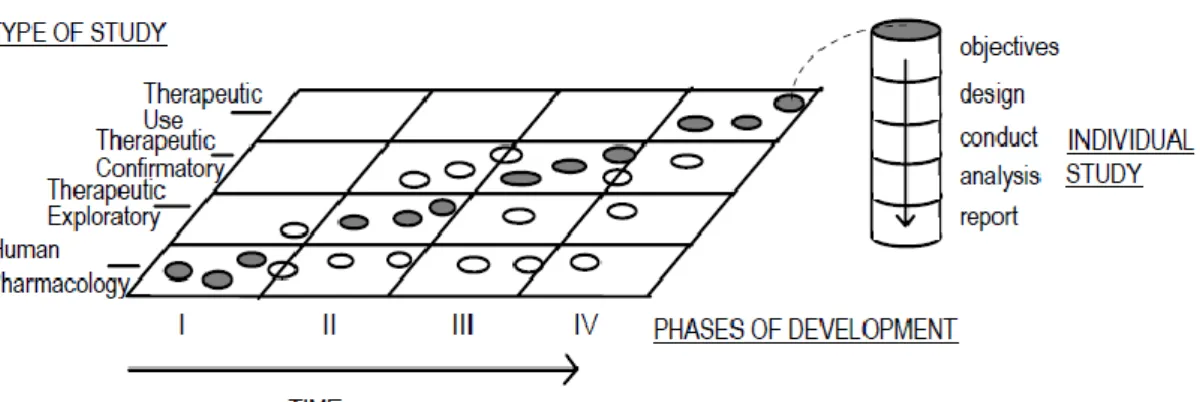
Nevertheless it is important to take in consideration that this temporal division of clinical trials does not defines the order in which studies are performed, since certain kind of studies may be developed in several phases, as depicted from figure 1 (6).
Figure 1 – Relationship between clinical development phases and type of studies, reproduced from reference (6)
As mentioned at the end of phase III, the pharmaceutical company developing the medicine expects to have collected all necessary information on safety and efficacy to prove medicine’s positive risk-benefit relationship.
However, before any new medicine can be introduced on the European market it has to have a valid MA, granted by a competent authority. At this point it is crucial to define the regulatory strategy for MA request preparation and submission. There are different procedures to request a MA, namely:
Centralized Procedure (CP). MA request is submitted to EMA and evaluated by experts’ committees. If granted the MA will be valid in all EU member states.
Decentralized Procedure (DCP). The applicant will submit the MA request simultaneously in several EU member states, to the respective NCAs. One of the member states will be appointed as the reference member state and will be responsible by the detailed analysis of the request and the elaboration of the report. This report will then be evaluated by the other NCA. This procedure is possible only if there is no MA in any of the EU member states.
Mutual Recognition Procedure (MRP). The process is similar to DCP, however there is an initial MA request to a single member state NCA. After MA is granted it is requested to other member states NCAs to recognize the MA on their own countries.
National Procedure. This process is used when the applicant intends to request a MA valid in a single country. The authority responsible for the evaluation will be the NCA of the concern member state.
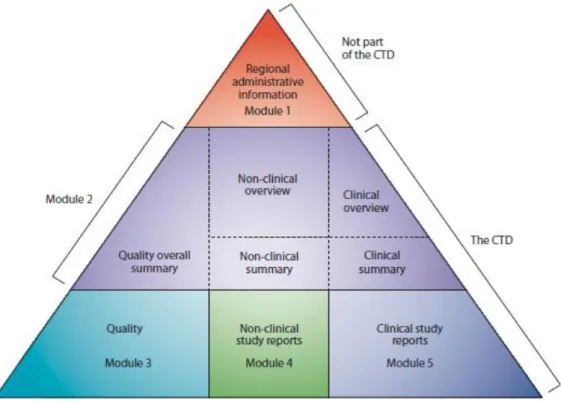
Independently from the procedure chosen, MA request is submitted together with the MA dossier, which has a well-defined structure and organization, commonly noun as Common Technical Document (CTD). CTD is one of the many harmonization products of ICH and it became mandatory for new MA requests submitted to Europe and Japan competent authorities, being strongly recommended by USA competent authority (Food and Drug Administration – FDA). Figure 2 shows CTD structure and organization (7).
Figure 2 – Common Technical Document Organization, reproduced from reference (7)
Despite the fact that Module 1 is specific for each region, including the specific MA request form or proposed product information texts. The other 4 modules should
University of Aveiro
Health Sciences Department
10 Curricular Internship Report Raquel Pinela
be common to the 3 regions. This brings great advantage for pharmaceutical industry, since it allows preparing a single dossier regarding medicine’s safety, efficacy and quality for different world regions, which ultimately saves time, resources and money (7).
Additionally, documents and information included on each CTD´s modules should respect the dispositions of the latest versions of ICH guidelines regarding this subject, namely:
M4 (R3): Organisation of the common technical document for the registration of pharmaceuticals for human use.
M4Q (R1): The common technical document for the registration of pharmaceuticals for human use: quality.
M4S (R2): The common technical document for the registration of pharmaceuticals for human use: safety.
M4E (R1): The common technical document for the registration of pharmaceuticals for human use: efficacy.
At European level, and as trend of harmonization within EU, some documents presented on CTD should also follow defined templates. It is the case of product information texts, which includes Summary of Product Characteristics (SmPC), Package Leaflet (PL) and labelling. Product information templates and contents are defined by the Working Group on Quality Review of Documents (QRD), an experts group of EMA (8). QRD latest versions are available at EMA’s website in word format and in all EU languages, so that they can be easily used.
The terms used on product information texts should be in accordance with Medical Dictionary for Regulatory Activities (MedDRA) and with the list of standard terms defined by the European Directorate for the Quality of Medicines & HealthCare (EDQM) (8).
Although obtaining MA for a new medicine is an unquestionable measure of success after years of work and effort, it does not mean that all activities concerning that medicine are finished. In fact, it is quite the opposite, since in this new phase of medicine’s lifecycle new information can come up at any time and it
will be necessary to maintain MA dossier updated, through regulatory procedures defined in legislation, noun as MA variations. In practical terms, MA variations represent changes to the initially approved information, thus they should be submitted to the competent authorities.
If the Marketing Authorisation Holder (MAH) has the intention to maintain the medicine on the market, the MA needs to be renewed. In this circumstance, a MA renewal request should be submitted to competent authorities, so that they can ensure that the benefit-risk balance remains positive.
Regulatory Affairs
RA professionals play important roles at each step of products’ lifecycle, from their early development phase through post-marketing activities. They will be the responsible for ensuring compliance to the applicable regulatory framework, which demands for an extensive technical knowledge and expertise, under continuous development and updating.
RA professionals have multidisciplinary knowledge and their areas of expertise embrace science, law and business. They can work in different entities, namely pharmaceutical industry, government agencies, competent authorities and contract research organization (CRO) (4).
From industry and CRO perspectives, RA professionals may be responsible for: Collect and organize all the information and documents required for
medicines’ MA request or biocides, cosmetic products or medical devices registration processes.
Identify the need of medicines’ MA variations, prepare and submit those accordingly to the applicable legislations.
Give technical support to company’s regulatory strategy definition.
Make a regular review of new legislation, both under preparation and already implemented.
University of Aveiro
Health Sciences Department
12 Curricular Internship Report Raquel Pinela
The efficient performance of these activities is essential to decrease competent authorities’ evaluation timing, contributing to save human and financial resources, and to faster provide quality products to general population. Simultaneously it is possible to avoid sanctions for non-compliance with applicable regulations.
The absolute respect for legislation dispositions will ultimately contribute to the recognition of the company’s high quality standards, not just by general public and regulatory authorities, but also by competitors and potential clients, in CRO’s perspective.
Internship Goals
At the time my internship at Phagecon began, I had no practical experience on RA activities, despite having the basic science and regulatory knowledge.
In this context, the following goals, to be achieved until the end of my internship, were established:
Develop depth knowledge on RA and medicines legal framework.
Become familiarized with the real standards and procedures of RA most common activities, which should be respected in order to obtain regulatory approvals.
Be able to think analytically and critically analyse new legislation and its potential impact on current regulatory practice.
Strengthen personal skills such as organization and communication.
Be capable of handle several tasks and projects simultaneously and prioritize them.
Efficiently manage deadlines.
Contribute to Phagecon’s internal objectives and success.
In short, the internship goals can be resumed to the acquisition of professional experience within the field of RA and the development of new skills that can bring competitive advantages in the job market.
Host Company Presentation
Phagecon – Serviços e Consultoria Farmacêutica, Lda. is a portuguese CRO, founded in January 2006, which is dedicated to provide quality services to pharmaceutical industry within the scope of regulatory, medical and scientific affairs and pharmacovigilance.
Phagecon is part of a large “group” of companies, including:
FHC Farmacêutica, Lda.. Founded in 1998 with objectives focused on exportation of pharmaceutical products. Currently it remains dedicated to the international management distribution and logistics, operating in several countries of Europe, Africa, Middle-East and Latin America (9).
Empipharma. Located in Coimbra and was also founded in 1998, it is dedicated to storage and distribution of pharmaceutical products within Portugal. Empipharma core business is the wholesale and pre-wholesale activity in Portugal (9).
Overpharma – Produtos Médicos e Farmacêuticos, Lda.. Was founded in 2001, with location in Lisbon, and it is dedicated to hospital market wholesaler in Portugal. Currently presents a large portfolio of disposable materials, medical devices and some medicines (9).
Laboratórios Basi – Indústria Farmacêutica, S.A.. Acquired in 2007 to establish a brand in pharmaceutical market, both national and international. Basi is dedicated to the manufacturing, galenic development and licensing of several medicines with different pharmaceutical forms (9).
Zeone – Informática, Lda.. Founded in 2008, it offers technic consulting services in IT field, such as software development, web design or informatics assistance (9). In this context it also gives informatics support to all companies of the “group”.
Paracélsia. The takeover took place in 2011; it is dedicated to the manufacturing of large volume parenteral solutions (9).
University of Aveiro
Health Sciences Department
16 Curricular Internship Report Raquel Pinela
At the foundation date, the main Phagecon’s clients were the companies from the “group”. As a result of Phagecon’s establishment in the CRO portuguese market, currently there is a large percentage of external clients.
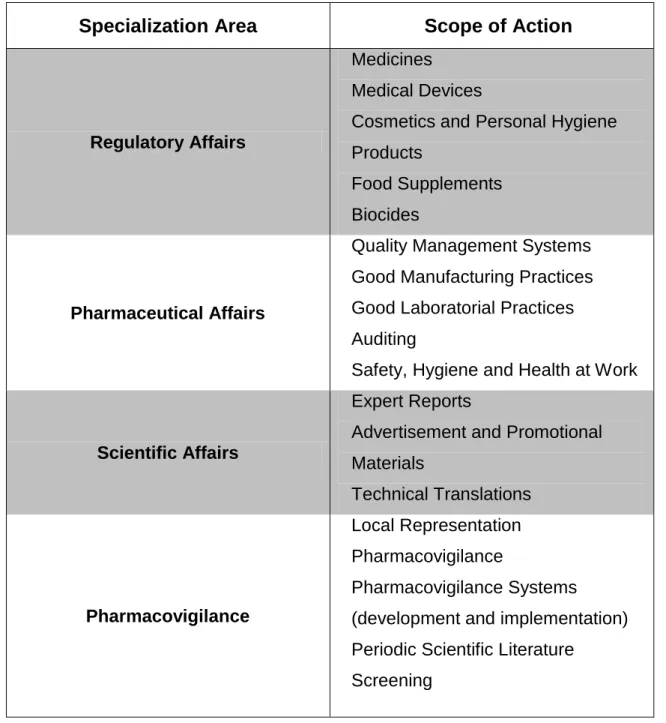
Phagecon presents a wide range of services to its national and international clients. The services’ portfolio is constantly being adapted to better respond to the ever-changing market requests and demands. As a result, new services can always be developed and added to those presented on table 1.
Table 1 - List of Phagecon's services organized by specialization area, adapted from reference (10)
Specialization Area Scope of Action
Regulatory Affairs
Medicines Medical Devices
Cosmetics and Personal Hygiene Products
Food Supplements Biocides
Pharmaceutical Affairs
Quality Management Systems Good Manufacturing Practices Good Laboratorial Practices Auditing
Safety, Hygiene and Health at Work
Scientific Affairs
Expert Reports
Advertisement and Promotional Materials Technical Translations Pharmacovigilance Local Representation Pharmacovigilance Pharmacovigilance Systems
(development and implementation) Periodic Scientific Literature
Periodic Safety Update Reports Typed II Safety Variations
Risk Management Systems
(development and implementation) Surveillance of Medical Devices and Cosmetics
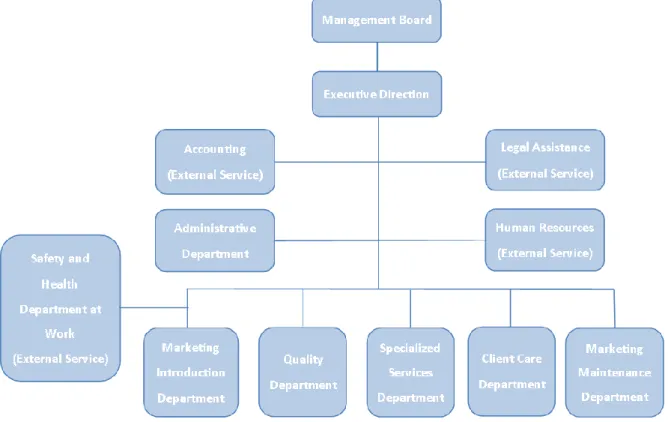
In August 2011, Phagecon had a 12 full-time employees team, distributed for several departments accordingly to their area of expertise, and experts contacted occasionally within specific projects to perform periodic tasks. The organogram shown in figure 3 identifies the several departments and their hierarchic relationship.
Figure 3 – Phagecon's Organogram, adapted from reference (10)
During 2010 Phagecon gained the certification for its Quality Management System (QMS), from the multinational Bureau Veritas. Through this process Phagecon assumed an internal and external commitment of high level and quality in all
University of Aveiro
Health Sciences Department
18 Curricular Internship Report Raquel Pinela
process developed at the company. A certificated management system brings great benefits since it enhances efficacy of all tasks developed, at the same time it promotes the recognition and trust of current and future clients.
QMS is described in detail at QMS manual, which is a core document to understand QMS principles and their implications on the performance of daily tasks. In this context, I was given training on this topic, which contents will be described on the further sections of this report.
ON-THE-JOB TRAINING IN
REGULATORY AFFAIRS
The present chapter of this report intends to describe in detail all the activities and tasks developed during the curricular internship at Phagecon. It is organized in 2 main sections: the transdisciplinary experience and the monodisciplinary experience.
The first will describe the coaching events which learning outcomes were essential to the performance of several projects tasks, accordingly to Phagecon’s established processes. In this perspective, these learning outcomes were present in all the activities performed, in other words, they are relevant to the complete internship.
On the other hand, the monodisciplinary experience section describes the specific activities or tasks performed during the major part of the internship, presenting a detailed description to each one.
Transdisciplinary Experience
This section is intended to describe the learning outcomes of all coaching events which I had the opportunity to participate during the internship. Their learning outcomes were put into practice during the performance of several activities and tasks assigned during the internship and were essential to achieve success. The training events I attended to during this internship were subordinated to the following themes: general presentation of Phagecon’s QMS; operational principals of project manager software and basic pharmacovigilance concepts. A detailed outline of each theme is given below.
Phagecon’s Quality Management System
Besides the deep knowledge of the several experts working at Phagecon, the quality of services provided to clients is also ensured by a certificated QMS.
QMS is described in detail at QMS manual, which is a living document suffering changes whenever considered important to fit company’s necessities and goals. I was first introduced to QMS at time internship began and refresh sessions were done every time a new version was launched and as a preparation to the Bureau Veritas annual audit.
Currently QMS is on the 4th Edition, dated March 3, 2012 and it is a central document that identifies Phagecon’s daily tasks and their interactions, disclosures responsibilities and clearly states the company’s goals for the future, i.e. company’s vision - “being a company with financial stability and globally recognized by its competence” (10).
QMS manual also establishes Phagecon’s mission, i.e. the roadmap for achieving the defined goals, as following: “contribute for the pharmaceutical sector success, especially regarding pharmaceutical industry and distribution activities, through the presentation of services of their interest, which are innovative, personalized and executed by a group of specialized collaborators who guarantee the quality of the services” (10).
University of Aveiro
Health Sciences Department
24 Curricular Internship Report Raquel Pinela
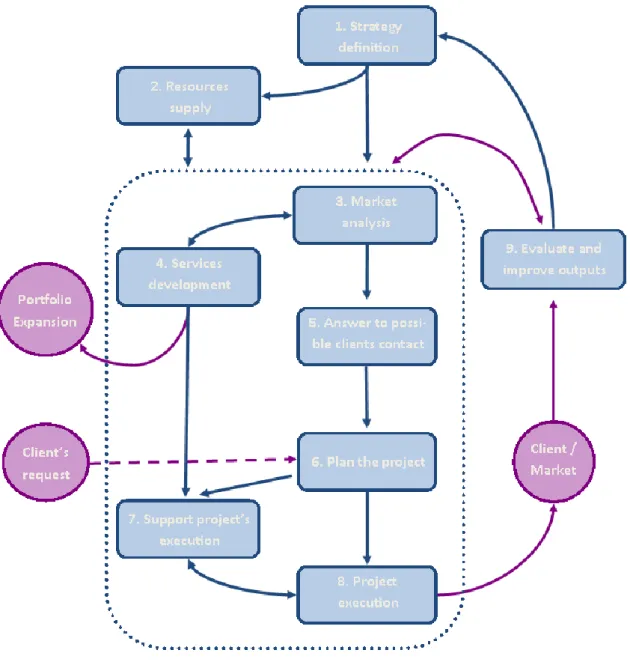
Everyday Phagecon’s team works to achieve the established goals, trough the execution of several tasks, each one of these belonging to one of the following nine processes (group of activities) (10):
1. Define strategy. 2. Resources supply. 3. Market analysis.
4. Services development.
5. Answer to possible clients contact. 6. Plan the project.
7. Support project’s execution. 8. Project execution.
9. Evaluate and improve outputs.
These nine processes are applicable to the different departments and they do not take place exactly on this order, since they can interact with each other as presented on figure 4.
Figure 4 – Relationship of Phagecon´s quality defined processes, adapted from reference (10)
The processes within the delimitation line correspond to the activities that take place frequently in order to complete the services offered. On the other hand, the processes placed outside the delimitation line are dedicated to the evaluation and support of QMS.
Identifying and studying the processes occurring at Phagecon and their interactions allow defining the best strategy to deliver the main outcome: high quality services personalized to each client needs. As a consequence of new strategies implementation, QMS will be under continuous improvement and company’s efficacy will be sequentially higher (10).
University of Aveiro
Health Sciences Department
26 Curricular Internship Report Raquel Pinela
A highly organized and effective QMS requires control over the documents generated within its scope, in other words it requires a structured documental management system. In Phagecon’s QMS different document types are organized hierarchically, from the most general to the most detailed as following (10):
1. QMS manual.
2. Processes Forms (PFs). 3. Written Procedures (WPs). 4. Work Instructions (WIs). 5. Register Documents (RDs).
Each one of the 9 processes previously identified has its own PF, which globally describes the activities taken and identifies the responsible collaborator.
For the purpose of this internship, the activities I developed belonged mostly to the processes number 7 (project plan) and 9 (project execution). In this context, PF number 7 and 9 were important documents for me to get familiarized with the general tasks that should be performed for each project and their correct sequence.
On the other hand, both WPs and WIs describe activities executed at Phagecon, present the sequence of operations to be performed for specific projects and activities (10). The lecture of these documents previously to the initiation of certain project types was useful, since they gave me a comprehensive description of all steps to be performed.
Finally the RDs result from the execution and implementation of QMS and include registration forms, plans, general templates, lists, among others.
Project Manager Software - Online Tool
An important tool that helps the execution of some QMS processes, such as planning or executing, is the online Project Manager Software (PMS).
PMS is accessed through the restricted area of Phagecon’s website and it displays all the closed out and on-going projects.
Each project has a cover page with a simply description and the identification of the client, the Phagecon´s responsible manager and the project charged value. There is another project specific page, dedicated to planning and execution, where the responsible manager is able to define the tasks that should be performed, its deadlines and responsible persons for execution and revision. After project plan is complete, it is submitted for department coordinator revision. At this point project manager software will block the project and no more tasks can be introduced or even updated, until the project is approved. In my particular situation MMD’s coordinator was the responsible collaborator to create my new projects on project manager software and to approve my planning for each one of those.
After project approval, and as it progresses, each task shall be updated with the amount of time spent every day until its conclusion, as well as any relevant information (whenever applicable).
Since I was responsible for several projects, the initial coaching on the functionalities of this online tool was essential for me to complete all the fields properly, including the initial planning and daily updates.
As a result of these functionalities, online PMS enables project manager or department’s coordinators to close monitoring the projects in real time, enhancing productivity and efficacy.
On the other hand, online PMS also gives top management the opportunity to evaluate the productivity of each employee by the analyses of daily reports containing all the tasks introduced in the different projects, in a certain day. Initially I was asked to print the daily report and archive it in the proper dossier, to be evaluated by the executive director. However, technological innovations applied to the initial PMS lead daily reports to be directly sent to executive director’s e-mail, at the end of each working day.
University of Aveiro
Health Sciences Department
28 Curricular Internship Report Raquel Pinela
Pharmacovigilance – Basic Concepts
As previously indicated, Phagecon offers pharmacovigilance services to several clients. In this context, everyone working at Phagecon must have basic pharmacovigilance knowledge in case it is necessary to record an ADR spontaneous notification.
This basic knowledge was transmitted to me in simple training event, followed by a quick quiz. Most of the topics discussed were in accordance with the knowledge acquired during the biomedical science degree and pharmaceutical biomedicine master, including:
Pharmacovigilance history. ADR definition.
Pharmacovigilance importance and goals. Difference between ADR and adverse event.
ADR spontaneous notification advantages and disadvantages.
The last point discussed constituted new information to me, since it was related to the essential information to be collected during an ADR spontaneous notification. Thus in case I received any type of communication (phone call, e-mail, letter or personal) regarding an ADR of a client’s product, I should collect, at least, the following information:
Name and contact of the person who is notifying. Description of the suspected ADR.
Medicine suspected of causing the ADR. Patient identification.
During the 9 months internship I never had to put in practice the knowledge reviewed and acquired during this training event.
Monodisciplinary Experience
As the title indicates this section is dedicated to the individual activities on which I participated during the internship. Each type of activity took place at a defined moment, but it was usually repeated several times, within the scope of similar project types.
Activities’ description is organized by product type. Thus, there will be 2 main subsections: the first is related to human medicines and the second to VMPs.
Human Medicines
The latest legislation defines medicinal product as:
“Any substance or combination of substances presented as having properties for treating or preventing disease in human beings;
or
Any substance or combination of substances which may be used in or administered to human beings either with a view to restoring, correcting or modifying physiological functions by exerting a pharmacological, immunological or metabolic action, or to making a medical diagnosis” (11).
This subsection gives details on the human medicine related activities performed during the internship, including: MA variations, transfers and renewals and also multilingual notifications for labelling and package leaflets.
Marketing Authorisation Variations
During medicines’ life cycle MAH may need to adjust or amend the information submitted at the time of MA request, in order to: update productions methods to current technologies; undertake changes demanded by competent authorities, like
University of Aveiro
Health Sciences Department
30 Curricular Internship Report Raquel Pinela
INFARMED, I.P.; or even to bring up to date manufacturers chain, among many others possibilities.
MA variations can be classified as major or minor accordingly to its: Impact on the already approved information.
Potential risk to public health.
Possible impact on medicine’s quality, safety and efficacy.
Similarly to other RA activities, MA variations are highly regulated by european and national legislations. From August 2011 to April 2012 the legislation applicable to MA granted by centralized, decentralized or mutual recognition processes should follow the disposition of Regulation (EC) No 1234/2008 of 24 November 2008. On the contrary, nationally authorized products (MA conceded by INFARMED, I.P., valid for portuguese territory only), should respect the national law, particularly the Decreto-Lei n.º 176/2006, de 30 de Agosto (12).
For future reference, it is important to take in consideration that a new European Regulation concerning MA variations was recently published. Regulation (EC) No 712/2012 of 3 August 2012 introduces several changes to the previous regulation, including the extension of its scope to MA variations of medicines nationally authorized. In Portugal, the application of the new regulation to nationally approved medicines will came into force from August 4, 2013 (13).
Hereupon, and considering that all MA variations projects I undertake during the internship were related to nationally authorized medicines, all the procedures described are referent to the applicable legislation at that time (Decreto-Lei n.º 176/2006, de 30 de Agosto).
Accordingly to portuguese applicable legislation, MA variations can be classified as:
Type IA. Type IB. Type II.
Further details on each one of these MA variations, including the regulatory procedures to be respected, the major learning and also difficulties felts while developing this kind of projects, are presented on the following pages.
Type I Variations
Overall Requirements
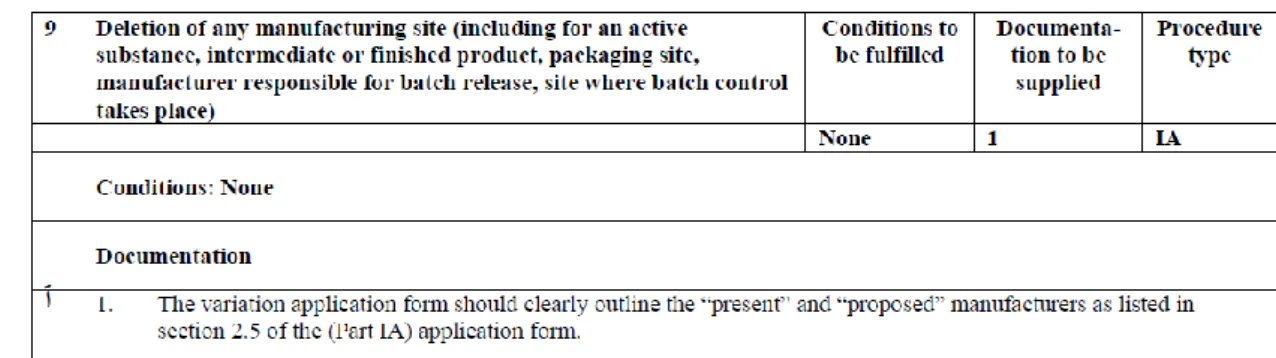
Type I variations correspond to those with the lowest risk regarding medicines’ safety, efficacy or quality. The accepted type I variations are listed at the guidance note “Guideline on dossier requirements for Type IA and IB notifications” (14). This guidance also encompasses, for each variation, the conditions that must be satisfied as well as the list of documentation to be submitted, including the relevant parts of MA dossier that should be updated. For each variation, the guidance also specifies the variation type in IA or IB and assigns an identification number (14). All the information is displayed in a simple manner by the use of tables, as depicted from the excerpt presented on figure 5.
Figure 5 – Example from European guidance regarding type I variations classification and requirements, reproduced from reference (14)
Despite the fact that different type I variations may have specific and unique documentation to be submitted, as identified in the referred guidance note, there is a board-spectrum set of documentation which is generally requested independently the variation to be submitted. In this context, for each MA variation project I was involved in I had to prepare the following set of documents (15):
University of Aveiro
Health Sciences Department
32 Curricular Internship Report Raquel Pinela
MA dossier sections modified as consequence of variation.
Proof of payment of applicable fees and the corresponding guide of payment duly completed.
Identification of other MA variations already presented or to be presented in a near future, related to the same MA.
Reviewed SmPC, PL and labelling versions (whenever the variation implies changes in product information texts).
Generally type I variations are intentionally undertaken by MAH, concerning company’s regulatory, manufacturing or marketing strategies. However, there is a particular type I variation that is a consequence of referral procedures, which on its turn result from an EC Decision, becoming mandatory in all EU countries (16, 17). Referral procedures may be invoked by the EC, any member state or any company that markets the medicine in matter, under well-established circumstances, which conducts to different referral types. INFARMED, I.P.’s nationally authorized generic products are most commonly affected by 2 types of referrals (16, 18):
Divergent decision referral – when it is identified a need of harmonization of national competent authorities’ decisions concerning the authorization, suspension or withdrawn of a certain medicine, as established by article 30 of directive 2001/83/EC. There are examples of harmonization needs across European Union the authorization of different indications or posology for the same medicine or similar medicines (reference and generics).
Community interest referral – if public health protection measures are considered necessary, as a consequence of newly identified concerns related to the quality, safety or efficacy of a certain medicine or class of medicines, as established by article 31 of directive 2001/83/EC.
After the initiation of the referral procedure, the question under study will be analysed by EMA’s specialized committees, usually Committee for Human Medicinal Products (CHMP) or Pharmacovigilance Risk Assessment Committee (PRAC), if the issue is related to medicines’ safety. The final recommendations for
a certain medicine or class of medicines follow an established format, which includes:
Opinion page, which presents the referral scope and legal basis.
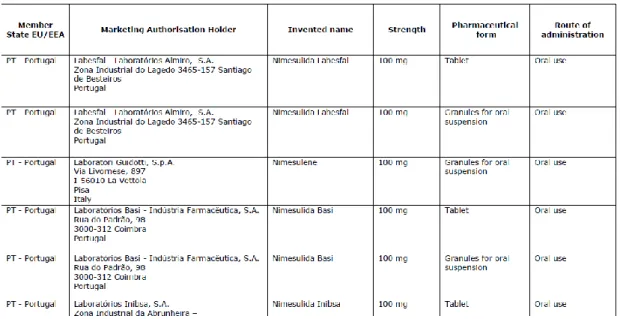
Annex I, listing of all medical products affected by the referral, organized by member state and including for each medical product the invented name, MAH and approved strengths, pharmaceutical forms and route of administration. An example of EC recommendation annex I can be analysed in figure 6.
Annex II, which presents the reasons and conclusions leading to the recommendation made.
Annex III, that represents the english harmonized proposal for SmPC, PL and labelling that will have to be implemented by all MAH which medicines are affected by referral procedure (18). An example of EC recommendation annex III can be analysed in figure 7.
University of Aveiro
Health Sciences Department
34 Curricular Internship Report Raquel Pinela
Figure 7 – Example of EC Recommendation Annex III, adapted from reference (20)
This recommendation is then evaluated and published by the EC. EC’s decision shall be implemented by all member states.
In Portugal, INFARMED, I.P. will notify all MAHs, whose medicines are under the scope of EC decision, to submit product information texts accordingly. Deadline for submission is usually presented on the notification letter sent to MAHs.
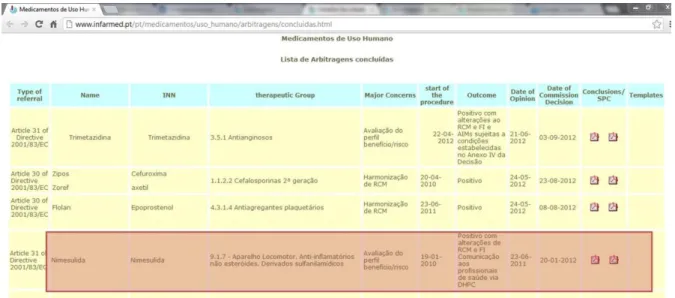
For generic medicines nationally authorized, product information texts should be prepared similarly to those published by the EC for the innovative medicine, in the relevant areas (21). In order to facilitate the text adaptation process, INFARMED, I.P., dedicated a section of its website to the presentation of all referral procedures which are already concluded and their respective decision annexes, including the portuguese version of the product information texts (22). The first look of this website can be observed in figure 8.
Figure 8 – INFARMED, I.P.'s online information regarding referral procedures, adapted from reference (22)
Submission to INFARMED, I.P.
Since September 2005 the submission of type I variations of nationally authorized medicines must be done electronically, through an INFARMED, I.P.’s website application (23).
This online application has limited access to MAHs, since each one has an unique username and password, giving access to the all submission processes, both closed and under evaluation, of their authorized products.
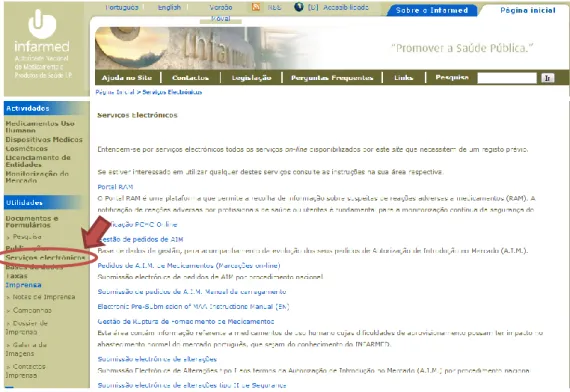
Every time I needed to access this application, I had to go to INFARMED, I.P.’s website and choose the option “Serviços Electrónicos”, under “Utilidades” on the left side menu, as it is highlighted in figure 9.
University of Aveiro
Health Sciences Department
36 Curricular Internship Report Raquel Pinela
Figure 9 – INFARMED, I. P.'s online access to electronic services, adapted from INFARMED, I.P.’s website
After left click on “Submissão electrónica de alterações” a new window opens and a login user and password are requested, as depicted from figure 10. These data are specific for each MAH, thus I needed to introduce the data accordingly to each client.
Figure 10 – INFARMED, I.P. online login to type I variation electronic submission, adapted from INFARMED, I.P.’s website
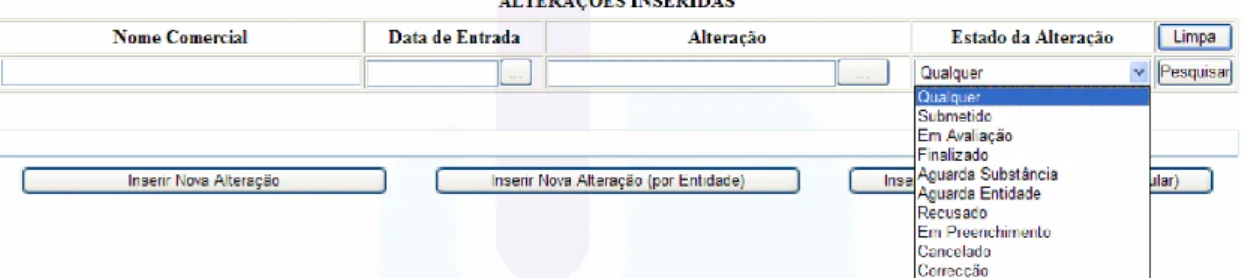
Once the login is completed, I was able to search all the variations submitted to any of the concerned client medicines and obviously to submit new variations, as demonstrated by figure 11.
Figure 11 – INFARMED, I.P.'s online application for type I variations electronic submission: cover page, reproduced from reference (24)
Every time a new variation insertion starts a standard form, identical to the one presented in figure 12, has to be fulfilled regarding:
Medicines identification (name, dosage and pharmaceutical form). Type of variation.
Information regarding the submission of other variations. Goals of variation.
University of Aveiro
Health Sciences Department
38 Curricular Internship Report Raquel Pinela
Figure 12 – INFARMED, I.P.'s online application for type I variations electronic submission: general form page, reproduced from reference (24)
As a result of the variation type previously chosen a variation specific form will show up in the next step of variation submission, listing:
All the conditions that must be completed, so that MA can submit changes under the scope of type I variations. It is important to mention that all conditions must be confirmed, as a way to guarantee that they will not be neglected.
The entire set of documents essential to support MA variation. All documents must be uploaded with the corresponding designation.
Figure 13 – INFARMED, I.P.'s online application for type I variations electronic submission: example of variation’s specific form, reproduced from reference (24)
For some variations, INFARMED, I.P. also requests the identification of the currently approved information versus the proposed information disposed in the tabular format of figure 14.
Figure 14 – INFARMED, I.P.'s online application for type I variations electronic submission: specific form of currently approved versus the proposed information, reproduced from (24)
After completing all forms, the variation can be submitted and sent to evaluation. At this point I could not make any change to the information submitted.
University of Aveiro
Health Sciences Department
40 Curricular Internship Report Raquel Pinela
Besides the access to type I variations, the INFARMED, I.P.’s online application for type I variations electronic submission also accomplishes a database of SmPCs and PLs. These versions must be used whenever a new variation with impact on SmPC and/or PL is submitted and for MA renewal requests. This obligation is applicable to all nationally authorized products since November 2006 (25). These versions available on INFARMED, I.P.’s online database have a special feature: all text changes and deviations from the approved version are registered as track-changes and it is not possible to unable this Microsoft Word’s functionally, as it can be observed in figure 15.
Figure 15 – Example of INFARMED, I.P.’s track change file for product information texts
Track-changes functionality is particularly important to INFARMED, I.P.’s variation managers, because it allows making an easy identification of the changes proposed and simultaneously avoid losing time comparing versions to find out if there are no other changes than those arising from the variation process.
Regarding type I variations, the new information introduced on track-changes documents cannot present other than the one resulting from the variation itself. The adaptation of texts templates to the latest version of QRD recommendations should be avoided, since texts evaluation will not be performed by INFARMED, I.P.. Additionally, from January 1, 2012 all product information texts (SmPC, PL
and/or labelling) submitted during variation procedures should implement the necessary changes to correct the text accordingly to the rules of the new orthographic deal (26).
Evaluation and Approval Timings
Type IA variations of nationally authorized products will be assessed by the portuguese national competent authority, INFARMED, I.P., within 14 consecutive days after its submission. If INFARMED, I.P. does not emit any decision within this period, variations will be considered tacitly approved (15).
On the other hand, type IB variations will be validated by INFARMED, I.P. within 5 days of submission date. Only then the evaluation period will start and it can take up to 30 days. Thus, a type IB variation can be considered as tacitly approved if there is no decision from INFARMED, I.P. for a period of 35 consecutive days after submission (15).
During the validation period INFARMED, I.P. will evaluate if the request complies with the applicable requirements. If nonconformities are detected, the applicant will be notified to complete or change the documentation submitted, so that the evaluation can proceed (15).
During the evaluation period of a valid variation request INFARMED, I.P., may also ask for the presentation of additional documentation in order to perform a more complete evaluation of the request. The new documentation should be present within the period established by INFARMED, I.P. (15).
The countdown for issuing decisions and tacit approval will be stopped from the day new documentation or information is requested, until its submission (15). In this context, it is very important to answer these element requests as soon as possible, so that the predicted date of approval is not too delayed. To accomplish this objective I used to include this type of task on my top priorities, unless otherwise indicated by MMD’s coordinator.
Additionally, variation requests will be refused if the requested information is not submit within the define deadlines (15). In these situations the applicant can
University of Aveiro
Health Sciences Department
42 Curricular Internship Report Raquel Pinela
submit a new request considering the correction of the points that lead to a negative position from the authority.
Personal Experience: Modus Operandi and Principal Handicaps
During the 9 months internship, I prepared, submitted and made follow-up of approximately 34 different type I variations, as presented on table 2.
Table 2 - List of type I variation prepared and submitted during the internship
Variation Identification
Number
Variation Description Variation type
Estimated number of variation projects
during internship 2 Change in the name of the medicinal
product IB 6
5
Change in the name and/or address of a manufacturer of the
finished product
IA 1
7 a)
Replacement or addition of a
manufacturing site for part or all of the manufacturing process of the finished product - Secondary packaging for all types of pharmaceutical forms
IA 1
7 b) 1.
Replacement or addition of a
manufacturing site for part or all of the manufacturing process of the finished product - Primary packaging site - Solid pharmaceutical forms, e.g. tablets and capsules
IA 1
7 c)
Replacement or addition of a
manufacturing site for part or all of the manufacturing process of the finished product - All other manufacturing operations except batch release
IB 1
8 b) 2
Change to batch release arrangements and quality control testing of
the finished product - Replacement or addition of a manufacturer responsible for batch release - Including batch control/testing
IA 1
9 Deletion of any manufacturing site
substance, intermediate or finished product, packaging site,
manufacturer responsible for batch release, site where batch control takes place)
15 a)
Submission of a new or updated
European Pharmacopoeia certificate of suitability for an active substance or starting material/reagent/intermediate in the manufacturing process of the active substance - From a manufacturer currently approved
IA 1
15 b) 2.
Submission of a new or updated
European Pharmacopoeia certificate of suitability for an active substance or starting material/reagent/intermediate in the manufacturing process of the active substance - From a new
manufacturer (replacement or addition)
IA 1
29 a )
Change in the qualitative and/or quantitative composition of the
immediate packaging material - All other pharmaceutical forms
IA 1
30 b)
Change (replacement, addition or deletion) in supplier of packaging components or devices (when mentioned in the dossier); spacer devices for metered dose inhalers are excluded - Replacement or addition of a supplier
IB 9
40 b)
Change of dimensions of tablets, capsules, suppositories or pessaries without change in qualitative or
quantitative composition and mean mass - All other tablets, capsules,
suppositories and pessaries
IA 1
42 a) 1. Change in: the shelf life of the finished
product – as packaged for sale IB 3
44
Change in the summary of product characteristics of an essentially similar product following a Commission Decision for a referral for an original medicinal product in accordance with Article 30 of Directive 2001/83/EC
University of Aveiro
Health Sciences Department
44 Curricular Internship Report Raquel Pinela
I consider important to outstand that for each type I variation identified on table 2, I had to follow all the requirements and procedures previously described, such as the preparation of documentation set, operating the INFARMED, I.P.'s online application for type I variations electronic submission, or answer to elements requests within the defined deadlines.
In general, the best method to start preparing a type I variation is to identify the feasible variation at the guidance note. After that it is important to make sure that all the conditions mentioned for the chosen variation are integrally respected. If so, it is then possible to start collecting and preparing all the documentation previously enumerated.
Notwithstanding the obligation to use the track-changes files for every variation of nationally authorised products, I should identify which file to use, because the version available at INFARMED, I.P.’s variations online application may not be the latest version in use. This important detail can be explained by the fact that new product information texts will be approved (i.e., stamped with INFARMED, I.P.’s approval imprint) only in case of type II variations or/and renewal processes. For all the other situations the changes made to the product information texts are approved and the new versions can be printed and normally used, however INFARMED, I.P. will not present new imprinted versions. As a consequence the versions available at Infomed (the portuguese database of medicines) and at INFARMED, I.P.’s online application for variations submission will remain the same until texts are fully evaluated and stamped with INFARMED, I.P.’s approval imprint.
The presented features may, in some cases, difficult the identification of the latest version of the SmPC and PL which embraces all the information referent to previously submitted type I variations. In this context, I established a sequence of steps to be followed in order to detect the latest SmPC and/or PL:
1. Identify the latest variations which had impact on product information texts. 2. Verify if the product information texts submitted on each variation, reflect all
the previous variations.
3. If it is concluded that all the previous variations are reflected on the latest versions submitted, that documents can be used and the changes reflecting