
EUROPEAN ORGANIZATION FOR NUCLEAR RESEARCH (CERN)
CERN-PH-EP/2012-036 2012/02/22
CMS-BPH-11-022
Inclusive b-jet production in pp collisions at
√
s
=
7 TeV
The CMS Collaboration
∗Abstract
The inclusive b-jet production cross section in pp collisions at a center-of-mass en-ergy of 7 TeV is measured using data collected by the CMS experiment at the LHC. The cross section is presented as a function of the jet transverse momentum in the range 18 < pT < 200 GeV for several rapidity intervals. The results are also given
as the ratio of the b-jet production cross section to the inclusive jet production cross section. The measurement is performed with two different analyses, which differ in their trigger selection and b-jet identification: a jet analysis that selects events with a b jet using a sample corresponding to an integrated luminosity of 34 pb−1, and a muon analysis requiring a b jet with a muon based on an integrated luminosity of 3 pb−1. In both approaches the b jets are identified by requiring a secondary vertex. The results from the two methods are in agreement with each other and with next-to-leading order calculations, as well as with predictions based on thePYTHIA event
generator.
Submitted to the Journal of High Energy Physics
∗See Appendix A for the list of collaboration members
arXiv:1202.4617v1 [hep-ex] 21 Feb 2012
1
1
Introduction
The experimental measurement of the b-quark production cross section has been pursued with interest at hadron colliders because of discrepancies between theoretical predictions and ex-perimental results, e.g., at the Tevatron [1–4] and at HERA [5–8]. Substantial progress has been made in understanding the b-quark production and fragmentation processes, and the mea-surements are now in reasonable agreement with the predictions in most regions of the phase space [9–12]. Theoretical uncertainties are, however, sizable, and there is great interest in ver-ifying the results at the higher center-of-mass energies provided by the LHC. Identification of b-quark jets by methods relying on the long b lifetime is almost independent of the details of the fragmentation of a b quark into a b hadron. Therefore, measuring the rate of b jets is a direct measurement of the b-quark production rate, with a negligible systematic uncertainty originating from fragmentation [13]. In addition, large logarithmic corrections due to hard collinear gluons are avoided when inclusive b jets are considered, leading to more sensitive comparisons between experimental results and theoretical calculations.
First results on bb production in pp collisions at√s = 7 TeV have been reported by the LHCb Collaboration using semi-inclusive decays in the forward rapidity region [14], and by the Com-pact Muon Solenoid (CMS) Collaboration [15] using inclusive b→µX decays [16] in the central
rapidity region and measuring the b-hadron production cross section as a function of the muon transverse momentum and pseudorapidity. CMS has also measured the production cross sec-tions of fully reconstructed B+[17], B0 [18], and Bs [19] mesons, as well as the angular
corre-lations between b and b hadrons, based on secondary vertex reconstruction [20]. The ATLAS Collaboration has measured the inclusive and dijet cross sections of b jets [21].
This paper presents CMS measurements of b-jet cross sections in several bins of jet rapidity y and transverse momentum pT. The b-jet cross section presented in this paper is defined as
the sum of the b and b jet contributions. Two independent analyses are presented: a jet anal-ysis, selecting events with a b jet, and a muon analanal-ysis, requiring in addition a muon in the b jet. Despite the difference in the corresponding integrated luminosity (34 pb−1 and 3 pb−1, respectively), the precisions of the two measurements are similar and dominated by systematic uncertainties, which differ because of the use of different triggers and b-jet identification crite-ria. Most of the analysis procedures are common in the two analyses, and the differences are explained in the sections concerned.
The inclusive b-jet production cross section is also presented as the ratio to the inclusive jet-production cross section measured by CMS in the same rapidity intervals [22]. The results are compared to theoretical predictions from next-to-leading order (NLO) perturbative quantum chromodynamics (QCD) calculations and to predictions from thePYTHIAevent generator [23].
2
CMS detector
The central feature of the CMS apparatus is a superconducting solenoid, 13 m in length and 6 m in diameter, which provides an axial magnetic field of 3.8 T. The bore of the solenoid is in-strumented with various particle detectors. Charged particle trajectories are measured with the silicon pixel and strip trackers, covering 0<φ<2π in azimuth and|η| <2.5 in
pseudorapid-ity, where η = −ln[tan θ/2], with θ being the polar angle of the track with respect to the coun-terclockwise beam direction. The resolution is typically about 15 µm on the impact parameter and about 1% on the transverse momentum for charged particles with pT <40 GeV. A crystal
electromagnetic calorimeter (ECAL) and a brass/scintillator hadron calorimeter (HCAL) sur-round the tracking volume. The forward region is covered by a an iron/quartz-fiber hadron
2 4 Event selection
calorimeter (HF). The ECAL provides coverage in|η| < 1.5 in a cylindrical barrel region and
1.5 < |η| < 3.0 in two endcaps. The ECAL has an energy resolution of better than 0.5% for
unconverted photons with transverse energies above 100 GeV. The hadron calorimeters cover
|η| <5.0 with a jet energy resolution of about 100%/ √
E, with the jet energy E in GeV. Muons are measured in gas-ionization detectors embedded in the steel return yoke, covering|η| <2.4.
A two-tier trigger system selects the most interesting pp collision events for use in physics anal-yses. A more detailed description of the CMS detector can be found elsewhere [15].
3
Monte Carlo simulation
A detailed Monte Carlo (MC) simulation was performed for comparisons with the data and to evaluate the selection efficiencies. Simulated events were generated withPYTHIA6.422 [23] using tune Z2 [24] for the underlying event, a b-quark mass of 4.8 GeV, and the CTEQ6L1 [25] proton parton distribution functions (PDF). The generated events were processed through the fullGEANT4 [26] detector simulation, trigger emulation, and event reconstruction chain.
The inclusive jet NLO theoretical prediction was calculated with NLOJET++ [27] using the CTEQ6.6M PDF set [25] and FASTNLO [28] implementation. The factorization and renormal-ization scales were set to µF = µR = pT. The inclusive b-jet cross section prediction was
calculated withMC@NLO[29, 30] using the CTEQ6M PDF set and the nominal b-quark mass of 4.75 GeV. The parton shower and hadronization were modeled using HERWIG6.510 [31]. The uncertainty on the predicted cross section was calculated independently by varying the renormalization and factorization scales by factors of two, the b-quark mass by±0.25 GeV, and by using the CTEQ6.6M instead of the CTEQ6M parton distribution functions [25].
4
Event selection
The data used for this measurement were collected in 2010 and were required to pass the stan-dard event quality criteria [16, 22], which reject data with anomalous or faulty behavior of the silicon tracker, calorimeters, or muon chambers. The total integrated luminosity amounts to 34 pb−1for the jet analysis and to 3 pb−1for the muon analysis.
The inclusive jet data were collected using a combination of minimum bias and single-jet trig-gers [15], where each trigger covers a separate continuous pT range (18–37, 37–56, 56–84, 84–
114, 114–153, and 153–196 GeV, for trigger thresholds of 0, 6, 15, 30, 50, and 70 GeV in uncor-rected pT, respectively). For each pT bin, the trigger with the highest integrated luminosity is
selected from those with >98% efficiency at all rapidities. For the muon analysis, the events are required to pass a trigger selection [15] that accepts events with muons having pµT > 9 GeV and|ηµ| <2.4.
Jets are reconstructed using a particle-flow algorithm [22], which uses the information from all CMS sub-detectors to reconstruct different types of particles produced in the event. The basic objects of the particle-flow reconstruction are the tracks of charged particles reconstructed in the central tracker, and energy deposits reconstructed in the calorimetry. These objects are clustered with the anti-kTalgorithm [32, 33] using the jet clustering distance parameter R=0.5.
Tight jet identification criteria [34] are applied to protect against poorly modeled sources of calorimeter noise. The jet energies are corrected using estimates based on simulated events for the pTdependence, while corrections measured from data [34] are applied for the absolute
3
The b jets are identified by finding the secondary decay vertex of the b hadrons [35]. The secondary vertices from b- and c-hadron decays can be distinguished by a selection on the rel-ative distance from the primary vertex, using the three-dimensional decay-length significance, which is typically larger for b jets than for c, light-quark, and gluon jets. In the jet analysis, a selection based on secondary vertices with at least three tracks containing signals from the silicon pixel detector provide a clean signal against light-quark and gluon-jet backgrounds. In the muon analysis, the minimum number of tracks to identify the secondary vertex is two, in order to keep the b-tagging efficiency high for semileptonic decays of b hadrons.
In the muon analysis, the offline selection requires at least one muon candidate in the pT
and η ranges of the trigger selection that fulfills a tight muon selection identical to that used in [16]. The reconstructed muon is associated with the highest-pT b-tagged jet within a∆R =
p
(∆η)2+ (∆φ)2 < 0.3 cone, where∆η and ∆φ refer to the angular separation between the
b-tagged jet and the muon. If several muons are associated with the b-b-tagged jet, the muon with the highest pTis considered. According to the simulation, the average efficiency of associating
the muon with the b-tagged jet is (76±2)%. The probability of a random muon association with a jet is estimated to be less than 0.5%.
The two b-jet cross-section measurement samples are collected with different triggers and are essentially statistically independent. The effective trigger efficiency of the muon trigger is sig-nificantly higher, thereby compensating for an order of magnitude smaller integrated luminos-ity. A total of 43 046 jets pass the event and jet selection for the jet analysis while in the muon analysis a total of 113 561 events pass the event and jet selections, making the two analyses comparable in terms of statistical power.
5
Cross section measurement
The production cross section for b jets is calculated as a double differential, d2σ
dpT dy
= Ntagged fbCunfold e∆pT∆yL
, (1)
where Ntagged is the measured number of tagged jets per bin from the jet analysis and the number of jets tagged with muons from the muon analysis, ∆pT and ∆y are the bin widths
in pT and y, fbis the b-tagged sample purity, Cunfold is the unfolding correction, andLis the
integrated luminosity. No distinction is made between b-quark jets and b-quark jets, so the cross section is the sum of b and b production.
The pT spectra are normalized by the respective integrated luminosities of the individual jet
triggers [22], and then combined into a continuous jet pT spectrum. Only one trigger is used
for each pT bin to simplify the analysis. In the jet analysis, the reconstructed pT spectra are
unfolded using the ansatz method [36, 37], with the jet pTresolution obtained with data-based
methods from dijet data [34]. In the muon analysis, an unfolding (jet migration) correction derived from simulated events is applied to the selection efficiency as the bin-by-bin ratio of the number of generated b jets in a given pT or rapidity bin to the number of reconstructed b
candidates in that bin. In the simulation, the generated jets are constructed by clustering the stable particles produced during the hadronization process including neutrinos in the muon analysis, but not in the jet analysis. The two unfolding methods produce consistent results within the uncertainties of the jet pT spectrum and the jet pT-resolution modeling, which are
negligible compared to the total systematic uncertainty.
4 5 Cross section measurement
identification efficiency, and the efficiency of tagging b jets. For the muon analysis, the muon reconstruction efficiency is also included.
In the jet analysis, the efficiency is about 0.1% to mistag light-quark and gluon jets as b jets, and the b-tagging efficiency is between 5% at pT ≈ 18 GeV and 56% at pT ≈ 100 GeV. The
efficiency rises at higher pT as the average b-hadron decay length increases. To moderate the
statistical fluctuations in the simulation, the b-tagging efficiency in each rapidity bin is fitted to a functional parameterization versus pTaccounting for various effects such as the b-hadron
proper time and the boost of secondary vertex decay products. The fit result is used in the analysis. In the muon analysis, the average b-tagging efficiency is about 60% in the barrel region (|y| <0.9) and about 55% for the endcap region (1.2< |y| <2.4). It increases from 50% to 75% for b-jet transverse momenta from 30 to 100 GeV. The data/simulation scale factor for the b-tagging efficiency applied in the analysis is 0.95, with an uncertainty of 10% [35].
In the jet analysis, the distribution of the invariant mass of the tracks originating from the secondary vertex is fitted with probability density functions corresponding to vertex mass dis-tributions for light-, charm-, and b-flavor jets taken from simulated events. The relative nor-malizations for the combined light- and charm-flavor distribution and the b-flavor distribution are free parameters in the fit. The resulting estimates of fbfrom data and simulated events are shown in Fig. 1 (left). The overall relative data/simulation scale factor is consistent with unity within uncertainties. Given the good agreement between data and simulation for pT >37 GeV,
the latter is used to predict the pT and y dependence of the purity, with no additional
correc-tions, and to extrapolate it to pT <37 GeV.
(GeV) T b-jet p 40 60 80 100 120 140 160 180 200 B-tagging purity 0.4 0.5 0.6 0.7 0.8 0.9 1 | < 2.2 b-jet |y Data MC = 7 TeV s -1 CMS L = 34 pb (GeV) rel T Muon p 0 0.5 1 1.5 2 2.5 3 0 1000 2000 3000 4000 5000 6000 7000 Number of events -1 CMS L = 3.0 pb s = 7 TeV Data Fit b c
Figure 1: The b-tagged sample purity obtained using fits to the secondary vertex mass from data and simulated events as a function of the b-jet pT (left). The distribution of the muon
transverse momentum prelT with respect to the closest b-tagged jet in data for pT >30 GeV and |y| < 2.4, together with the maximum-likelihood fit (solid line) and its components (dashed lines) (right). The light-flavor (udsg) distribution is not visible in the figure since its contribu-tion from the fit is consistent with zero.
In the muon analysis, the b-tagged sample purity is obtained from a fit to the distribution of the relative muon momentum prelT with respect to the b-jet axis, which effectively discriminates between b events and background. Figure 1 (right) shows the result of the prelT fit, using the ex-pected shapes from the simulated events for the muons from b-hadron decays and background
5
from charm quark and light-flavor jets. The normalizations of the three contributions are free parameters in the fit. A b fraction of (86±5)% is observed. The shapes obtained from the simulated events provide a reasonable description of the data. The prelT fit to the data gives a light-quark and gluon contribution to the b-tagged jet sample of less than 3% for all bins in pT
and|y|. This is confirmed in the simulated events where the light-quark and gluon fraction of the b-tagged jets is estimated to be less than 2%.
6
Systematic uncertainties
The inclusive b-jet differential cross section can be affected by uncertainties on the yield in each of the pT bins and on the measurement of the b-jet pT itself, which determines the amount of
smearing between the neighboring bins and is corrected by unfolding. The leading uncertain-ties affecting the yields are due to the b-tagging efficiency, the sample purity, and the integrated luminosity. The smearing of the pTbin assignment is dominated by the jet energy scale. In the
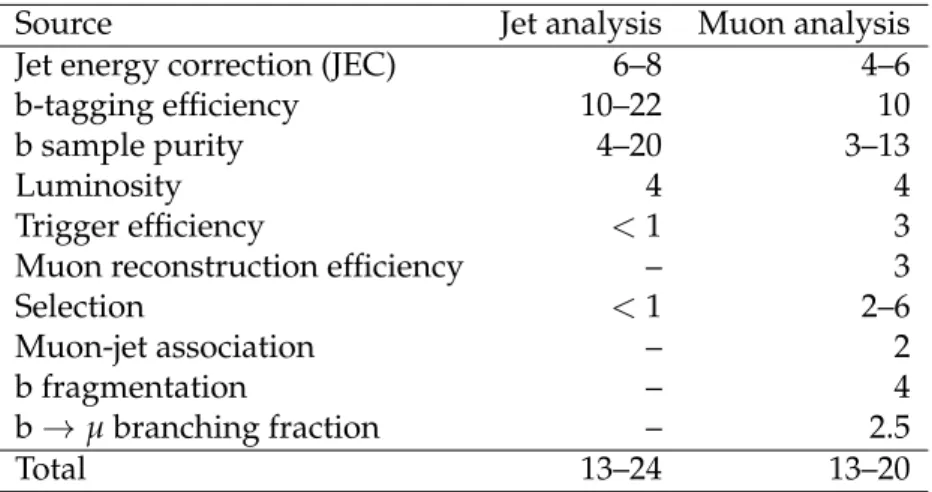
following, the systematic uncertainties common to the two analyses are discussed first, and those specific to each analysis are then described separately. All systematic uncertainties are summarized in Table 1.
The uncertainty of the jet energy correction (JEC) is estimated using photon+jet events with the jet in the barrel region, and dijet events where one jet is measured in the barrel region and the other in one of the endcaps [34]. These uncertainty estimates are further confirmed by indirect observations using comparisons of jet substructure between data and MC simulations, the reconstruction of the π0mass peak for the ECAL energy scale, and the measurement of the single-particle response in the calorimeters using isolated charged hadrons. The uncertainty of the jet pT resolution is estimated using a comparison of dijet pT balance between data and
simulated events [34].
The cross-section measurement uses the b-tagging efficiency obtained from simulated events and corrected by a scale factor measured in data. Several methods based on muon-tagged jets [35] or tt events [38, 39] are used to measure the b-tagging efficiency in data. The ratio between the efficiencies measured from data and estimated from simulated events determines the scale factor of 0.95±0.10.
The difference between the inclusive-jet and the b-jet energy corrections is estimated from MC fragmentation studies with PYTHIA andHERWIGto be 0.5–1.5%, while studies based on data
find the inclusive jet scale uncertainty to be about 1.5–3.5% for pT > 30 GeV and |y| < 2.2.
Because of the lack of direct constraints from data on the relative b-jet energy scale, the b-jet and the relative b-jet to inclusive JEC uncertainties are both taken to be the same as the inclusive JEC uncertainty [34]. Each 1% uncertainty in the JEC translates into a 2–5% uncertainty on the measured cross section because of the steeply falling pTspectrum.
Signals from the HF calorimeters are used to determine the instantaneous luminosity with a systematic uncertainty of 4% [40].
6.1 Systematic uncertainties specific to the jet analysis
The b-tagged sample purity from the fit of the secondary vertex mass distribution and the estimate from the simulated events are in agreement within 3–4%. The purity uncertainty is dominated by the uncertainty of the charm mistag rate across most of the kinematic range, leading to a small uncertainty variation versus pTand y. The light-flavor mistag rate is
6 6 Systematic uncertainties
Table 1: Summary of the systematic uncertainties on the b-jet cross-section measurement, given in percent for the two analyses. The systematic uncertainties can vary depending on the b-tagged jet transverse momentum and rapidity, as indicated by the range in the table.
Source Jet analysis Muon analysis Jet energy correction (JEC) 6–8 4–6 b-tagging efficiency 10–22 10
b sample purity 4–20 3–13
Luminosity 4 4
Trigger efficiency <1 3 Muon reconstruction efficiency – 3
Selection <1 2–6
Muon-jet association – 2
b fragmentation – 4
b→µbranching fraction – 2.5
Total 13–24 13–20
a reliable fit. This additional purity uncertainty is estimated by varying the light-quark and gluon mistag rate by±30%.
The dominant source of uncertainty is the b-tagging efficiency. In the ratio between the b-jet and the inclusive jet cross sections, the contribution from the luminosity uncertainty cancels, and the impact of the jet energy resolution is negligible. The contribution from the JEC in the ratio is not significantly reduced, however, because the relative b-jet JEC is assumed to be uncorrelated with the inclusive JEC. The JEC contributes 6–8% to the total uncertainty. The remaining systematic uncertainties from charm, light-quark, and gluon mistag rates contribute 3–4% to the b-tagged sample purity, except at high pT and y, where a 30% variation in the
light-quark and gluon mistag rate contributes up to 20%.
The consistency of the simulation-based corrections for the b-tagging efficiency, the b-tagged sample purity, the b-jet energy, and the inclusive jet energy scale, among others, is tested by running the full analysis chain on reconstructed simulated events and comparing the results to the particle-level pTspectra. This closure test produces good agreement between the generated
and reconstructed pT spectra to within 5%. This level of agreement is consistent with the
sta-tistical uncertainty of the simulation and the systematic uncertainties of the parameterizations of the b-tagging efficiency and b-purity.
6.2 Systematic uncertainties specific to the muon analysis
The muon trigger efficiency is determined from data using independent jet triggers. A sys-tematic uncertainty of 3% is assigned, which corresponds to the range of differences between trigger efficiencies derived from data for muons from Z decays, muons in b-tagged events, and muons with tight quality requirements.
The differences between the muon reconstruction efficiencies derived from data and simulated events is less than 2% in the barrel region and less than 3% in the endcap regions. A systematic uncertainty of 3% is assigned for the muon reconstruction efficiency.
The efficiency for associating a muon with a b-tagged jet agrees between data and simulation to within 2%.
7
The uncertainties due to variations in the prelT distributions between data and simulated events range from 3% to 13%. This systematic uncertainty is estimated by varying the binning, in-cluding or not inin-cluding the muon in the definition of the jet direction, using different Monte Carlo simulation tunes, and considering the overall difference between the data and fit results. The largest contribution (up to 12% for high-pTb jets) is from the difference between the signal
fraction obtained by the prelT fit and by a fit to the secondary vertex mass distribution.
The uncertainty from the event selection is estimated from the variation of the muon selection cuts and the jet reconstruction, and ranges from 2% to 6%. The uncertainty of the b-quark frag-mentation is determined by comparing the extrapolation factors to the total muon transverse momentum range betweenPYTHIAandHERWIG[41]. It leads to a 4% difference. The branching
fraction of b semileptonic decays into muons is known [42] to a precision of 2.5%. The signal fraction is also determined with an event selection based on calorimetric jets [34]. The mea-sured cross sections are consistent within the systematic uncertainty. The b fragmentation and b→ µbranching fraction uncertainties are taken into account only for the b-jet cross section
measurement extrapolated to cover the full pTand y range of the muons. The total systematic
uncertainty is 13% at low jet pTand increases to 20% for high-pTb jets.
7
Results
7.1 Jet analysis
The measured b-jet cross section from the jet analysis is shown as a function of the jet pT for
different rapidity bins in Fig. 2 (left). The values have been multiplied by the arbitrary factors given in the figure for easier viewing. The cross section decreases by four orders of magnitude over the pT range 18–200 GeV. This behavior is well described by the theoretical predictions
fromMC@NLO, shown by the solid lines in the figure. Figure 2 (right) shows the ratio between
the measured cross section and the theoretical predictions. The MC@NLO values tend to be
below the data in the central region (|y| < 1.0) for low pT and above the data in the forward
region (|y| > 2.0) at large pT. The predictions from the PYTHIA generator, in contrast, agree
with the data at high pT, but overestimate the cross section significantly in the pTregion below
50 GeV, with the difference extending to higher pTin the more forward region.
The ratio of the b-jet and the inclusive jet cross sections [22] is shown in Fig. 3 as a function of pT. The ratio increases as a function of pT by up to a factor of 2, particularly in the central
region. The measurements are compared to theMC@NLOprediction divided by the FASTNLO
prediction of the inclusive jet cross section [22]. The non-perturbative corrections for the inclu-sive jet cross section prediction are the average ofHERWIG6 [31] andPYTHIA (tune D6T [43]). The data and NLO predictions agree within experimental and theoretical uncertainties. Some difference between the NLO prediction and the data is observed in the central region, where the NLO values are lower than the data, and at pT >100 GeV and|y| >2, where the NLO
pre-diction is higher than the data. ThePYTHIAprediction for the ratio between the inclusive b-jet and inclusive-jet cross sections is in agreement with the data across the full kinematic range of the measurement.
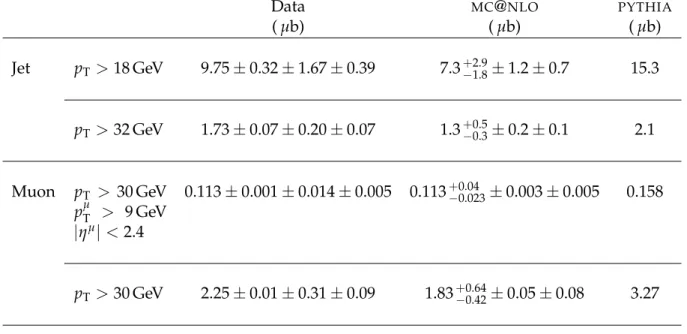
The total b-jet cross section is found by integrating the measured double-differential distribu-tions over|y| < 2.2 and two different pT ranges: 18< pT < 200 GeV and 32 < pT < 200 GeV.
The values and the corresponding MC@NLO and PYTHIA predictions are summarized in Ta-ble 2.
8 7 Results (GeV) T b-jet p 20 30 40 50 100 200 dy (pb/GeV) T /dp σ 2 b-jet d 1 10 2 10 3 10 4 10 5 10 6 10 7 10 8 10 9 10 |y| < 0.5 (0.5 < |y| < 1 (×625)×125) 25) × 1 < |y| < 1.5 ( 5) × 1.5 < |y| < 2 ( 2 < |y| < 2.2 MC@NLO Exp. uncertainty = 7 TeV s -1 CMS L = 34 pb R=0.5 T Anti-k 0 1 2 3 4 5 MC@NLO Pythia Exp. uncertainty 0 1 2 0 1 2 0 1 2 (GeV) T b-jet p 20 30 40 50 100 200 0 1 2 = 7 TeV s -1 CMS L = 34 pb Data / MC@NLO
Figure 2: Measured b-jet cross section from the jet analysis, multiplied by the arbitrary factors shown in the figure for easier viewing, compared to the MC@NLO calculation (left) and as a
ratio to theMC@NLOcalculation (right). The experimental systematic uncertainties are shown as a shaded band and the statistical uncertainties as error bars. The MC@NLO uncertainty is shown as dotted lines. ThePYTHIAprediction is also shown in the right panel.
0 0.02 0.04 0.06 0.08 0.1 |y| < 0.5 MC@NLO/FastNLO Pythia Exp. uncertainty 0 0.02 0.04 0.5 < |y| < 1 0 0.02 0.04 1 < |y| < 1.5 0 0.02 0.04 1.5 < |y| < 2
(GeV)
Tb-jet p
20
30
40 50
100
200
0 0.02 0.04 2 < |y| < 2.2 = 7 TeV s -1 CMS L = 34 pbb-jet / inclusive jet
Figure 3: Ratio of the measured b-jet cross section from the jet analysis to the inclusive jet cross section [22], as a function of the b-jet pT(the jet pTin the inclusive case). The predictions from
7.2 Muon analysis 9
Table 2: The b-jet cross sections (in µb) measured from the jet and muon analyses. The b-jet rapidity range is |y| < 2.2 and |y| < 2.4 for the jet and muon analyses, respectively. The value for pT > 30 GeV from the muon analysis is an extrapolated result. For the data, the
first uncertainty is statistical, the second is systematic, and the third is associated with the estimation of the integrated luminosity. For the MC@NLO prediction, the first uncertainty is from the variations in the QCD scale, the second from the b-quark mass, and the third from the parton distribution functions.
Data MC@NLO PYTHIA
( µb) ( µb) ( µb) Jet pT>18 GeV 9.75±0.32±1.67±0.39 7.3+−2.91.8±1.2±0.7 15.3 pT>32 GeV 1.73±0.07±0.20±0.07 1.3+−0.50.3±0.2±0.1 2.1 Muon pT > 30 GeV pµT > 9 GeV |ηµ| <2.4 0.113±0.001±0.014±0.005 0.113−+0.040.023±0.003±0.005 0.158 pT>30 GeV 2.25±0.01±0.31±0.09 1.83+−0.640.42±0.05±0.08 3.27
uncertainty of this prediction comes from varying the renormalization scale by factors of 0.5 and 2.0 (+40%,−25%), from variations in the parameters of the CTEQ PDF (+10%,−6%), and from the changing the b-quark mass from 4.5 to 5.0 GeV (+17%, −14%). The total uncertainty on the theoretical calculation is shown by the shaded bands in Figs. 2 and 3.
7.2 Muon analysis
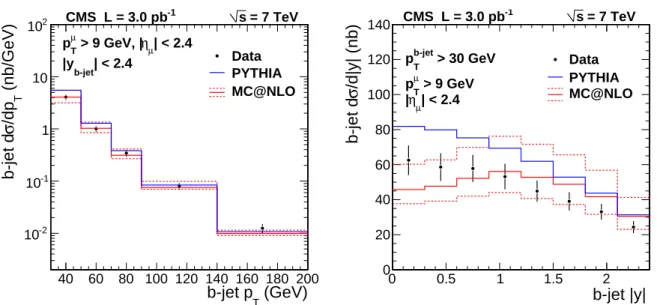
The measured differential cross sections for inclusive b-jet production of b hadrons decaying into a muon with pTµ>9 GeV and|ηµ| <2.4 are shown in Fig. 4 as a function of the b-jet pT(left)
and|y| (right). They are compared with the MC@NLO and PYTHIA predictions. The dashed
red lines illustrate theMC@NLOtheoretical uncertainty from variations in the QCD scale, the
b-quark mass, and the parton distribution functions. A difference between thePYTHIA predic-tion and the data is observed for b-jet pT < 70 GeV, where thePYTHIAvalues are higher than
the data. The data are in agreement with thePYTHIA prediction for the rapidity dependence of the cross section. However, a significant difference in shape is observed between the data and theMC@NLOpredictions for the rapidity dependence of the b-jet cross section. A similar behavior had been observed in an inclusive b measurement with muons [16]. The absolute nor-malization of the measured cross section is compatible with the NLO QCD predictions within the theoretical and experimental uncertainties.
The measured cross section for b jets with pT > 30 GeV,|y| < 2.4, and the b hadrons decaying
into muons in the kinematic range pµT>9 GeV and|ηµ| <2.4, is shown in Table 2. The value is
obtained by summing over all pTbins.
The measurements in the restricted muon kinematic range are extrapolated to cover the full muon pT and y ranges using thePYTHIA simulation, in order to obtain the b-jet cross section
10 8 Summary (GeV) T b-jet p 40 60 80 100 120 140 160 180 200 (nb/GeV) T /dp σ b-jet d -2 10 -1 10 1 10 2 10 -1 CMS L = 3.0 pb s = 7 TeV | < 2.4 b-jet |y | < 2.4 µ η > 9 GeV, | µ T p Data PYTHIA MC@NLO b-jet |y| 0 0.5 1 1.5 2 /d|y| (nb) σ b-jet d 0 20 40 60 80 100 120 140 -1 CMS L = 3.0 pb s = 7 TeV > 30 GeV b-jet T p > 9 GeV µ T p | < 2.4 µ η | Data PYTHIA MC@NLO
Figure 4: The differential b-jet cross section from the muon analysis as a function of the b-jet pT (left) and|y|(right), with pµT > 9 GeV and|ηµ| <2.4, and the predictions fromPYTHIAand
MC@NLO. The error bars on the points correspond to the experimental statistical and systematic
uncertainties added in quadrature. The dashed lines represent theMC@NLOuncertainty.
limited only by the b-jet pT and y. The extrapolation also corrects for the branching fraction
of b semileptonic decays into muons and for the muon acceptance. The extrapolation factor changes from 5% at low b-jet pT to 20% at high pT. The MC@NLO extrapolation factors are
similar to those of PYTHIA at high b-jet pT, while they are about 20% larger at low pT. The
cross section measured in data and the corresponding MC@NLOand PYTHIA predictions are
summarized in Table 2.
7.3 Comparison of results
The measurements from the two analyses are compared in Fig. 5 by adjusting the b-jet cross section from the muon analysis to have the same visible phase space definition as the inclusive b-jet analysis, usingPYTHIAfor the extrapolation. The overall extrapolation factor is between 0.85 at pT =30 GeV and 0.82 at pT =200 GeV, and accounts for the reduction in rapidity range
from|y| <2.4 to|y| <2.2, exclusion of neutrinos from the particle jet definition, and for count-ing all b-jets in the event. No additional uncertainty is assigned to the displayed cross sections beyond the experimental uncertainties quoted in Table 1 and discussed in Section 6. The closed circles in Fig. 5 correspond to the measured inclusive b-jet pTspectrum, and the closed squares
show the b-jet pT spectrum from the muon analysis, with the yellow band representing the
total experimental uncertainty. Two sets of b-jet cross-section measurements from the ATLAS Collaboration [21], also found using a jet analysis and a muon analysis, are shown in the figure for comparison. The CMS results are in good agreement with each other and with the ATLAS measurements to within their respective uncertainties. The theoretical prediction from the NLO calculation [29, 30] is displayed as the solid line in the figure, with the dotted lines showing the systematic uncertainties. The CMS results are consistent with the NLO predictions.
8
Summary
The b-jet production cross section has been measured in pp collisions at√s=7 TeV. The results were presented in several rapidity intervals as a function of the jet transverse momentum. The results were also given as the ratio of the b-jet production cross section and the inclusive
11
(GeV)
Tb-jet p
20 40 60 80 100 120 140 160 180 200
(pb/GeV)
T/dp
σ
b-jet d
210
310
410
510
610
| < 2.2 b-jet |y Jet based Muon based MC@NLO ATLAS jet ATLAS muon = 7 TeV s -1 CMS L = 3-34 pbFigure 5: Measured b-jet cross sections in the jet and muon analyses as a function of the b-jet pT, compared to theMC@NLOcalculation and to measurements from ATLAS [21].
jet production cross section. The results of two independent but compatible analyses were reported: a jet analysis selecting events with a b jet or a b jet, and a muon analysis requiring in addition the presence of a muon, based on integrated luminosities of 34 pb−1 and 3 pb−1, respectively.
The measured values of the cross section were found to lie between the MC@NLO and the
PYTHIA predictions. The previous CMS measurements of B+ [17], B0 [18], and Bs [19]
pro-duction cross sections, and an inclusive b-jet measurement with muons [16], also gave values between these two predictions. The measurement of the b-jet production cross section pre-sented here will provide valuable input for testing various theoretical models of b production and for further constraining their parameters.
Acknowledgements
We wish to congratulate our colleagues in the CERN accelerator departments for the excellent performance of the LHC machine. We thank the technical and administrative staff at CERN and other CMS institutes. This work was supported by the Austrian Federal Ministry of Science and Research; the Belgium Fonds de la Recherche Scientifique, and Fonds voor Wetenschappelijk Onderzoek; the Brazilian Funding Agencies (CNPq, CAPES, FAPERJ, and FAPESP); the Bul-garian Ministry of Education and Science; CERN; the Chinese Academy of Sciences, Ministry of Science and Technology, and National Natural Science Foundation of China; the Colom-bian Funding Agency (COLCIENCIAS); the Croatian Ministry of Science, Education and Sport; the Research Promotion Foundation, Cyprus; the Ministry of Education and Research, Recur-rent financing contract SF0690030s09 and European Regional Development Fund, Estonia; the Academy of Finland, Finnish Ministry of Education and Culture, and Helsinki Institute of Physics; the Institut National de Physique Nucl´eaire et de Physique des Particules / CNRS, and
12 8 Summary
Commissariat `a l’ ´Energie Atomique et aux ´Energies Alternatives / CEA, France; the Bundes-ministerium f ¨ur Bildung und Forschung, Deutsche Forschungsgemeinschaft, and Helmholtz-Gemeinschaft Deutscher Forschungszentren, Germany; the General Secretariat for Research and Technology, Greece; the National Scientific Research Foundation, and National Office for Research and Technology, Hungary; the Department of Atomic Energy and the Department of Science and Technology, India; the Institute for Studies in Theoretical Physics and Mathematics, Iran; the Science Foundation, Ireland; the Istituto Nazionale di Fisica Nucleare, Italy; the Ko-rean Ministry of Education, Science and Technology and the World Class University program of NRF, Korea; the Lithuanian Academy of Sciences; the Mexican Funding Agencies (CINVES-TAV, CONACYT, SEP, and UASLP-FAI); the Ministry of Science and Innovation, New Zealand; the Pakistan Atomic Energy Commission; the Ministry of Science and Higher Education and the National Science Centre, Poland; the Fundac¸˜ao para a Ciˆencia e a Tecnologia, Portugal; JINR (Armenia, Belarus, Georgia, Ukraine, Uzbekistan); the Ministry of Education and Science of the Russian Federation, the Federal Agency of Atomic Energy of the Russian Federation, Russian Academy of Sciences, and the Russian Foundation for Basic Research; the Ministry of Science and Technological Development of Serbia; the Ministerio de Ciencia e Innovaci ´on, and Programa Consolider-Ingenio 2010, Spain; the Swiss Funding Agencies (ETH Board, ETH Zurich, PSI, SNF, UniZH, Canton Zurich, and SER); the National Science Council, Taipei; the Scientific and Technical Research Council of Turkey, and Turkish Atomic Energy Authority; the Science and Technology Facilities Council, UK; the US Department of Energy, and the US National Science Foundation.
Individuals have received support from the Marie-Curie programme and the European Re-search Council (European Union); the Leventis Foundation; the A. P. Sloan Foundation; the Alexander von Humboldt Foundation; the Belgian Federal Science Policy Office; the Fonds pour la Formation `a la Recherche dans l’Industrie et dans l’Agriculture (FRIA-Belgium); the Agentschap voor Innovatie door Wetenschap en Technologie (IWT-Belgium); the Council of Science and Industrial Research, India; and the HOMING PLUS programme of Foundation for Polish Science, cofinanced from European Union, Regional Development Fund.
References
[1] D0 Collaboration, “Inclusive µ and b quark production cross-sections in p ¯p collisions at√ s =1.8 TeV”, Phys. Rev. Lett. 74 (1995) 3548.
doi:10.1103/PhysRevLett.74.3548.
[2] D0 Collaboration, “The b¯b production cross section and angular correlations in p ¯p collisions at√s=1.8 TeV”, Phys. Lett. B 487 (2000) 264, arXiv:hep-ex/9905024. doi:10.1016/S0370-2693(00)00844-3.
[3] CDF Collaboration, “Measurement of the bottom quark production cross-section using semileptonic decay electrons in p ¯p collisions at√s =1.8 TeV”, Phys. Rev. Lett. 71 (1993) 500. doi:10.1103/PhysRevLett.71.500.
[4] CDF Collaboration, “Measurement of the b-Hadron Production Cross Section using De cays to µ−D0X Final States in p ¯p Collisions at√s=1.96 TeV”, Phys. Rev. D 79 (2009) 092003, arXiv:0903.2403. doi:10.1103/PhysRevD.79.092003.
[5] H1 Collaboration, “Measurement of open beauty production at HERA”, Phys. Lett. B467 (1999) 156, arXiv:hep-ex/9909029. doi:10.1016/S0370-2693(99)01099-0.
13
[6] H1 Collaboration, “Measurement of beauty production at HERA using events with muons and jets”, Eur. Phys. J. C 41 (2005) 453, arXiv:hep-ex/0502010.
doi:10.1140/epjc/s2005-02267-0.
[7] ZEUS Collaboration, “Measurement of beauty photoproduction using decays into muons in dijet events at HERA”, JHEP 04 (2009) 133, arXiv:0901.2226.
doi:10.1088/1126-6708/2009/04/133.
[8] ZEUS Collaboration, “Measurement of charm and beauty production in deep inelastic ep scattering from decays into muons at HERA”, Eur. Phys. J. C 65 (2010) 65,
arXiv:0904.3487. doi:10.1140/epjc/s10052-009-1193-x.
[9] S. Frixione et al., “Heavy quark production”, Adv. Ser. Direct. High Energy Phys. 15 (1998) 609, arXiv:hep-ph/9702287.
[10] M. Cacciari, S. Frixione, M. Mangano et al., “QCD analysis of first b cross-section data at 1.96-TeV”, JHEP 0407 (2004) 033, arXiv:hep-ph/0312132.
doi:10.1088/1126-6708/2004/07/033.
[11] M. L. Mangano, “The Saga of bottom production in p ¯p collisions”, AIP Conf. Proc. 753 (2005) 247, arXiv:hep-ph/0411020. doi:10.1063/1.1896706.
[12] S. Frixione, “Bottom production”, arXiv:hep-ph/0408317.
[13] S. Frixione and M. L. Mangano, “Heavy quark jets in hadronic collisions”, Nucl. Phys. B 483(1997) 321–338, arXiv:hep-ph/9605270.
doi:10.1016/S0550-3213(96)00577-9.
[14] LHCb Collaboration, “Measurement of σ(pp− >b¯bX)at√s=7 TeV in the forward region”, Phys. Lett. B 694 (2010) 209, arXiv:1009.2731.
doi:10.1016/j.physletb.2010.10.010.
[15] CMS Collaboration, “The CMS experiment at the CERN LHC”, JINST 03 (2008) S08004. doi:10.1088/1748-0221/3/08/S08004.
[16] CMS Collaboration, “Inclusive b-hadron production cross section with muons in pp collisions at√s=7 TeV”, JHEP 03 (2011) 090, arXiv:1101.3512.
doi:10.1007/JHEP.03(2011)090.
[17] CMS Collaboration, “Measurement of the B+Production Cross Section in pp Collisions at√s=7 TeV”, Phys. Rev. Lett. 106 (2011) 112001, arXiv:1101.0131.
doi:10.1103/PhysRevLett.106.112001.
[18] CMS Collaboration, “Measurement of the B√ 0Production Cross Section in pp Collisions at s =7 TeV”, Phys. Rev. Lett. 106 (2011) 252001, arXiv:1104.2892.
doi:10.1103/PhysRevLett.106.252001.
[19] CMS Collaboration, “Measurement of the Bs0Meson Production Cross Section with J/ψφ Decays in pp Collisions at√s=7 TeV”, Phys. Rev. D 84 (2011) 052008,
arXiv:1106.4048. doi:10.1103/PhysRevD.84.052008.
[20] CMS Collaboration, “Measurement of b¯b angular correlations based on secondary vertex reconstruction at√s=7 TeV”, JHEP 03 (2011) 136, arXiv:1102.3194.
14 8 Summary
[21] ATLAS Collaboration, “Measurement of the inclusive and dijet cross-sections of b-jets in pp collisions at√s =7 TeV with the ATLAS detector”, Eur. Phys. J C 71 (2011) 1846, arXiv:1109.6833. doi:10.1140/epjc/s10052-011-1846-4.
[22] CMS Collaboration, “Measurement of the Inclusive Jet Cross Section in pp Collisions at√ s =7 TeV”, Phys. Rev. Lett. 107 (2011) 132001, arXiv:1106.0208.
doi:10.1103/PhysRevLett.107.132001.
[23] T. Sjostrand, S. Mrenna, and P. Z. Skands, “PYTHIA 6.4 Physics and Manual”, JHEP 05 (2006) 026, arXiv:hep-ph/0603175. doi:10.1088/1126-6708/2006/05/026. [24] R. Field, “Early LHC Underlying Event Data - Findings and Surprises”,
arXiv:1010.3558.
[25] J. Pumplin et al., “New generation of parton distributions with uncertainties from global QCD analysis”, JHEP 07 (2002) 012, arXiv:hep-ph/0201195.
doi:10.1088/1126-6708/2002/07/012.
[26] GEANT4 Collaboration, “GEANT4: A simulation toolkit”, Nucl. Instrum. Meth. A 506 (2003) 250. doi:10.1016/S0168-9002(03)01368-8.
[27] Z. Nagy, “Three-jet cross sections in hadron hadron collisions at next-to-leading order”, Phys. Rev. Lett. 88 (2002) 122003, arXiv:hep-ph/0110315.
doi:10.1103/PhysRevLett.88.122003.
[28] T. Kluge, K. Rabbertz, and M. Wobisch, “Fast pQCD calculations for PDF fits”, in 14th International Workshop on Deep Inelastic Scattering (DIS 2006), 20-24 Apr 2006, p. 483. Tsukuba, Japan, April, 2006. arXiv:hep-ph/0609285.
[29] S. Frixione and B. R. Webber, “Matching NLO QCD computations and parton shower simulations”, JHEP 06 (2002) 029, arXiv:hep-ph/0204244.
doi:10.1088/1126-6708/2002/06/029.
[30] S. Frixione, P. Nason, and B. R. Webber, “Matching NLO QCD and parton showers in heavy flavour production”, JHEP 08 (2003) 007, arXiv:hep-ph/0305252.
doi:10.1088/1126-6708/2003/08/007.
[31] G. Marchesini et al., “HERWIG: A Monte Carlo event generator for simulating hadron emission reactions with interfering gluons. Version 5.1 - April 1991”, Comput. Phys. Commun. 67 (1992) 465. doi:10.1016/0010-4655(92)90055-4.
[32] M. Cacciari, G. P. Salam, and G. Soyez, “The anti-kt jet clustering algorithm”, JHEP 04 (2008) 063, arXiv:0802.1189. doi:10.1088/1126-6708/2008/04/063. [33] M. Cacciari, G. P. Salam, and G. Soyez, “FastJet user manual”, arXiv:1111.6097. [34] CMS Collaboration, “Determination of jet energy calibration and transverse momentum
resolution in CMS”, J. Inst. 6 (2011) P11002. doi:10.1088/1748-0221/6/11/P11002.
[35] CMS Collaboration, “Performance of b-jet identification in CMS”, CMS Physics Analysis Summary CMS-PAS-BTV-11-001, (2011).
[36] S. Berman, J. Bjorken, and J. Kogut, “Inclusive Processes at High Transverse Momentum”, Phys. Rev. D 4 (1971) 3388. doi:10.1103/PhysRevD.4.3388.
15
[37] R. Feynman, R. Field, and G. Fox, “Quantum-chromodynamic Approach for the Large-transverse-momentum Production of Particles and Jets”, Phys. Rev. D 18 (1978) 3320. doi:10.1103/PhysRevD.18.3320.
[38] CMS Collaboration, “Measurement of the b-tagging efficiency using tt events”, CMS Physics Analysis Summary CMS-PAS-BTV-11-003, (2011).
[39] CMS Collaboration, “Measurement of the t¯t Production Cross Section in pp Collisions at 7 TeV in Lepton + Jets Events using b-quark Jet Identification”, Phys. Rev. D 84 (2011) 092004, arXiv:1108.3773. doi:10.1103/PhysRevD.84.092004.
[40] CMS Collaboration, “Measurement of CMS Luminosity”, CMS Physics Analysis Summary CMS-PAS-EWK-10-004, (2010).
[41] G. Corcella et al., “HERWIG 6: An Event generator for hadron emission reactions with interfering gluons (including supersymmetric processes)”, JHEP 01 (2001) 010, arXiv:hep-ph/0011363. doi:10.1088/1126-6708/2001/01/010.
[42] Particle Data Group Collaboration, “Review of particle physics”, J. Phys. G 37 (2010) 075021. doi:10.1088/0954-3899/37/7A/075021.
[43] L. Fan ´o, “Multiple Parton Interactions, Underlying Event and Forward Physics at LHC”, CMS Conference Report CMS-CR-2007-064, Geneva, (2007).
17
A
The CMS Collaboration
Yerevan Physics Institute, Yerevan, Armenia
S. Chatrchyan, V. Khachatryan, A.M. Sirunyan, A. Tumasyan Institut f ¨ur Hochenergiephysik der OeAW, Wien, Austria
W. Adam, T. Bergauer, M. Dragicevic, J. Er ¨o, C. Fabjan, M. Friedl, R. Fr ¨uhwirth, V.M. Ghete, J. Hammer1, M. Hoch, N. H ¨ormann, J. Hrubec, M. Jeitler, W. Kiesenhofer, M. Krammer, D. Liko, I. Mikulec, M. Pernicka†, B. Rahbaran, C. Rohringer, H. Rohringer, R. Sch ¨ofbeck, J. Strauss, A. Taurok, F. Teischinger, P. Wagner, W. Waltenberger, G. Walzel, E. Widl, C.-E. Wulz
National Centre for Particle and High Energy Physics, Minsk, Belarus V. Mossolov, N. Shumeiko, J. Suarez Gonzalez
Universiteit Antwerpen, Antwerpen, Belgium
S. Bansal, L. Benucci, T. Cornelis, E.A. De Wolf, X. Janssen, S. Luyckx, T. Maes, L. Mucibello, S. Ochesanu, B. Roland, R. Rougny, M. Selvaggi, H. Van Haevermaet, P. Van Mechelen, N. Van Remortel, A. Van Spilbeeck
Vrije Universiteit Brussel, Brussel, Belgium
F. Blekman, S. Blyweert, J. D’Hondt, R. Gonzalez Suarez, A. Kalogeropoulos, M. Maes, A. Olbrechts, W. Van Doninck, P. Van Mulders, G.P. Van Onsem, I. Villella
Universit´e Libre de Bruxelles, Bruxelles, Belgium
O. Charaf, B. Clerbaux, G. De Lentdecker, V. Dero, A.P.R. Gay, G.H. Hammad, T. Hreus, A. L´eonard, P.E. Marage, L. Thomas, C. Vander Velde, P. Vanlaer, J. Wickens
Ghent University, Ghent, Belgium
V. Adler, K. Beernaert, A. Cimmino, S. Costantini, G. Garcia, M. Grunewald, B. Klein, J. Lellouch, A. Marinov, J. Mccartin, A.A. Ocampo Rios, D. Ryckbosch, N. Strobbe, F. Thyssen, M. Tytgat, L. Vanelderen, P. Verwilligen, S. Walsh, E. Yazgan, N. Zaganidis
Universit´e Catholique de Louvain, Louvain-la-Neuve, Belgium
S. Basegmez, G. Bruno, L. Ceard, J. De Favereau De Jeneret, C. Delaere, T. du Pree, D. Favart, L. Forthomme, A. Giammanco2, G. Gr´egoire, J. Hollar, V. Lemaitre, J. Liao, O. Militaru, C. Nuttens, D. Pagano, A. Pin, K. Piotrzkowski, N. Schul
Universit´e de Mons, Mons, Belgium N. Beliy, T. Caebergs, E. Daubie
Centro Brasileiro de Pesquisas Fisicas, Rio de Janeiro, Brazil
G.A. Alves, M. Correa Martins Junior, D. De Jesus Damiao, T. Martins, M.E. Pol, M.H.G. Souza Universidade do Estado do Rio de Janeiro, Rio de Janeiro, Brazil
W.L. Ald´a J ´unior, W. Carvalho, A. Cust ´odio, E.M. Da Costa, C. De Oliveira Martins, S. Fonseca De Souza, D. Matos Figueiredo, L. Mundim, H. Nogima, V. Oguri, W.L. Prado Da Silva, A. Santoro, S.M. Silva Do Amaral, L. Soares Jorge, A. Sznajder
Instituto de Fisica Teorica, Universidade Estadual Paulista, Sao Paulo, Brazil
T.S. Anjos3, C.A. Bernardes3, F.A. Dias4, T.R. Fernandez Perez Tomei, E. M. Gregores3, C. Lagana, F. Marinho, P.G. Mercadante3, S.F. Novaes, Sandra S. Padula
Institute for Nuclear Research and Nuclear Energy, Sofia, Bulgaria
V. Genchev1, P. Iaydjiev1, S. Piperov, M. Rodozov, S. Stoykova, G. Sultanov, V. Tcholakov, R. Trayanov, M. Vutova
18 A The CMS Collaboration
University of Sofia, Sofia, Bulgaria
A. Dimitrov, R. Hadjiiska, A. Karadzhinova, V. Kozhuharov, L. Litov, B. Pavlov, P. Petkov Institute of High Energy Physics, Beijing, China
J.G. Bian, G.M. Chen, H.S. Chen, C.H. Jiang, D. Liang, S. Liang, X. Meng, J. Tao, J. Wang, J. Wang, X. Wang, Z. Wang, H. Xiao, M. Xu, J. Zang, Z. Zhang
State Key Lab. of Nucl. Phys. and Tech., Peking University, Beijing, China
C. Asawatangtrakuldee, Y. Ban, S. Guo, Y. Guo, W. Li, S. Liu, Y. Mao, S.J. Qian, H. Teng, S. Wang, B. Zhu, W. Zou
Universidad de Los Andes, Bogota, Colombia
A. Cabrera, B. Gomez Moreno, A.F. Osorio Oliveros, J.C. Sanabria Technical University of Split, Split, Croatia
N. Godinovic, D. Lelas, R. Plestina5, D. Polic, I. Puljak1 University of Split, Split, Croatia
Z. Antunovic, M. Dzelalija, M. Kovac Institute Rudjer Boskovic, Zagreb, Croatia
V. Brigljevic, S. Duric, K. Kadija, J. Luetic, S. Morovic University of Cyprus, Nicosia, Cyprus
A. Attikis, M. Galanti, J. Mousa, C. Nicolaou, F. Ptochos, P.A. Razis Charles University, Prague, Czech Republic
M. Finger, M. Finger Jr.
Academy of Scientific Research and Technology of the Arab Republic of Egypt, Egyptian Network of High Energy Physics, Cairo, Egypt
Y. Assran6, A. Ellithi Kamel7, S. Khalil8, M.A. Mahmoud9, A. Radi8,10 National Institute of Chemical Physics and Biophysics, Tallinn, Estonia A. Hektor, M. Kadastik, M. M ¨untel, M. Raidal, L. Rebane, A. Tiko
Department of Physics, University of Helsinki, Helsinki, Finland V. Azzolini, P. Eerola, G. Fedi, M. Voutilainen
Helsinki Institute of Physics, Helsinki, Finland
S. Czellar, J. H¨ark ¨onen, A. Heikkinen, V. Karim¨aki, R. Kinnunen, M.J. Kortelainen, T. Lamp´en, K. Lassila-Perini, S. Lehti, T. Lind´en, P. Luukka, T. M¨aenp¨a¨a, T. Peltola, E. Tuominen, J. Tuominiemi, E. Tuovinen, D. Ungaro, L. Wendland
Lappeenranta University of Technology, Lappeenranta, Finland K. Banzuzi, A. Korpela, T. Tuuva
Laboratoire d’Annecy-le-Vieux de Physique des Particules, IN2P3-CNRS, Annecy-le-Vieux, France
D. Sillou
DSM/IRFU, CEA/Saclay, Gif-sur-Yvette, France
M. Besancon, S. Choudhury, M. Dejardin, D. Denegri, B. Fabbro, J.L. Faure, F. Ferri, S. Ganjour, A. Givernaud, P. Gras, G. Hamel de Monchenault, P. Jarry, E. Locci, J. Malcles, L. Millischer, J. Rander, A. Rosowsky, I. Shreyber, M. Titov
19
Laboratoire Leprince-Ringuet, Ecole Polytechnique, IN2P3-CNRS, Palaiseau, France
S. Baffioni, F. Beaudette, L. Benhabib, L. Bianchini, M. Bluj11, C. Broutin, P. Busson, C. Charlot, N. Daci, T. Dahms, L. Dobrzynski, S. Elgammal, R. Granier de Cassagnac, M. Haguenauer, P. Min´e, C. Mironov, C. Ochando, P. Paganini, D. Sabes, R. Salerno, Y. Sirois, C. Thiebaux, C. Veelken, A. Zabi
Institut Pluridisciplinaire Hubert Curien, Universit´e de Strasbourg, Universit´e de Haute Alsace Mulhouse, CNRS/IN2P3, Strasbourg, France
J.-L. Agram12, J. Andrea, D. Bloch, D. Bodin, J.-M. Brom, M. Cardaci, E.C. Chabert, C. Collard, E. Conte12, F. Drouhin12, C. Ferro, J.-C. Fontaine12, D. Gel´e, U. Goerlach, P. Juillot, M. Karim12, A.-C. Le Bihan, P. Van Hove
Centre de Calcul de l’Institut National de Physique Nucleaire et de Physique des Particules (IN2P3), Villeurbanne, France
F. Fassi, D. Mercier
Universit´e de Lyon, Universit´e Claude Bernard Lyon 1, CNRS-IN2P3, Institut de Physique Nucl´eaire de Lyon, Villeurbanne, France
C. Baty, S. Beauceron, N. Beaupere, M. Bedjidian, O. Bondu, G. Boudoul, D. Boumediene, H. Brun, J. Chasserat, R. Chierici1, D. Contardo, P. Depasse, H. El Mamouni, A. Falkiewicz,
J. Fay, S. Gascon, M. Gouzevitch, B. Ille, T. Kurca, T. Le Grand, M. Lethuillier, L. Mirabito, S. Perries, V. Sordini, S. Tosi, Y. Tschudi, P. Verdier, S. Viret
Institute of High Energy Physics and Informatization, Tbilisi State University, Tbilisi, Georgia
D. Lomidze
RWTH Aachen University, I. Physikalisches Institut, Aachen, Germany
G. Anagnostou, S. Beranek, M. Edelhoff, L. Feld, N. Heracleous, O. Hindrichs, R. Jussen, K. Klein, J. Merz, A. Ostapchuk, A. Perieanu, F. Raupach, J. Sammet, S. Schael, D. Sprenger, H. Weber, B. Wittmer, V. Zhukov13
RWTH Aachen University, III. Physikalisches Institut A, Aachen, Germany
M. Ata, J. Caudron, E. Dietz-Laursonn, M. Erdmann, A. G ¨uth, T. Hebbeker, C. Heidemann, K. Hoepfner, T. Klimkovich, D. Klingebiel, P. Kreuzer, D. Lanske†, J. Lingemann, C. Magass, M. Merschmeyer, A. Meyer, M. Olschewski, P. Papacz, H. Pieta, H. Reithler, S.A. Schmitz, L. Sonnenschein, J. Steggemann, D. Teyssier, M. Weber
RWTH Aachen University, III. Physikalisches Institut B, Aachen, Germany
M. Bontenackels, V. Cherepanov, M. Davids, G. Fl ¨ugge, H. Geenen, M. Geisler, W. Haj Ahmad, F. Hoehle, B. Kargoll, T. Kress, Y. Kuessel, A. Linn, A. Nowack, L. Perchalla, O. Pooth, J. Rennefeld, P. Sauerland, A. Stahl, M.H. Zoeller
Deutsches Elektronen-Synchrotron, Hamburg, Germany
M. Aldaya Martin, W. Behrenhoff, U. Behrens, M. Bergholz14, A. Bethani, K. Borras, A. Burgmeier, A. Cakir, L. Calligaris, A. Campbell, E. Castro, D. Dammann, G. Eckerlin, D. Eckstein, A. Flossdorf, G. Flucke, A. Geiser, J. Hauk, H. Jung1, M. Kasemann, P. Katsas, C. Kleinwort, H. Kluge, A. Knutsson, M. Kr¨amer, D. Kr ¨ucker, E. Kuznetsova, W. Lange, W. Lohmann14, B. Lutz, R. Mankel, I. Marfin, M. Marienfeld, I.-A. Melzer-Pellmann, A.B. Meyer, J. Mnich, A. Mussgiller, S. Naumann-Emme, J. Olzem, A. Petrukhin, D. Pitzl, A. Raspereza, P.M. Ribeiro Cipriano, M. Rosin, J. Salfeld-Nebgen, R. Schmidt14, T.
20 A The CMS Collaboration
University of Hamburg, Hamburg, Germany
C. Autermann, V. Blobel, S. Bobrovskyi, J. Draeger, H. Enderle, J. Erfle, U. Gebbert, M. G ¨orner, T. Hermanns, R.S. H ¨oing, K. Kaschube, G. Kaussen, H. Kirschenmann, R. Klanner, J. Lange, B. Mura, F. Nowak, N. Pietsch, C. Sander, H. Schettler, P. Schleper, E. Schlieckau, A. Schmidt, M. Schr ¨oder, T. Schum, H. Stadie, G. Steinbr ¨uck, J. Thomsen
Institut f ¨ur Experimentelle Kernphysik, Karlsruhe, Germany
C. Barth, J. Berger, T. Chwalek, W. De Boer, A. Dierlamm, G. Dirkes, M. Feindt, J. Gruschke, M. Guthoff1, C. Hackstein, F. Hartmann, M. Heinrich, H. Held, K.H. Hoffmann, S. Honc, I. Katkov13, J.R. Komaragiri, T. Kuhr, D. Martschei, S. Mueller, Th. M ¨uller, M. Niegel, A. N ¨urnberg, O. Oberst, A. Oehler, J. Ott, T. Peiffer, G. Quast, K. Rabbertz, F. Ratnikov, N. Ratnikova, M. Renz, S. R ¨ocker, C. Saout, A. Scheurer, P. Schieferdecker, F.-P. Schilling, M. Schmanau, G. Schott, H.J. Simonis, F.M. Stober, D. Troendle, J. Wagner-Kuhr, T. Weiler, M. Zeise, E.B. Ziebarth
Institute of Nuclear Physics ”Demokritos”, Aghia Paraskevi, Greece
G. Daskalakis, T. Geralis, S. Kesisoglou, A. Kyriakis, D. Loukas, I. Manolakos, A. Markou, C. Markou, C. Mavrommatis, E. Ntomari
University of Athens, Athens, Greece
L. Gouskos, T.J. Mertzimekis, A. Panagiotou, N. Saoulidou, E. Stiliaris University of Io´annina, Io´annina, Greece
I. Evangelou, C. Foudas1, P. Kokkas, N. Manthos, I. Papadopoulos, V. Patras, F.A. Triantis KFKI Research Institute for Particle and Nuclear Physics, Budapest, Hungary
A. Aranyi, G. Bencze, L. Boldizsar, C. Hajdu1, P. Hidas, D. Horvath15, A. Kapusi, K. Krajczar16,
F. Sikler1, V. Veszpremi, G. Vesztergombi16
Institute of Nuclear Research ATOMKI, Debrecen, Hungary N. Beni, J. Molnar, J. Palinkas, Z. Szillasi
University of Debrecen, Debrecen, Hungary J. Karancsi, P. Raics, Z.L. Trocsanyi, B. Ujvari Panjab University, Chandigarh, India
S.B. Beri, V. Bhatnagar, N. Dhingra, R. Gupta, M. Jindal, M. Kaur, J.M. Kohli, M.Z. Mehta, N. Nishu, L.K. Saini, A. Sharma, A.P. Singh, J. Singh, S.P. Singh
University of Delhi, Delhi, India
S. Ahuja, B.C. Choudhary, A. Kumar, A. Kumar, S. Malhotra, M. Naimuddin, K. Ranjan, V. Sharma, R.K. Shivpuri
Saha Institute of Nuclear Physics, Kolkata, India
S. Banerjee, S. Bhattacharya, S. Dutta, B. Gomber, S. Jain, S. Jain, R. Khurana, S. Sarkar Bhabha Atomic Research Centre, Mumbai, India
R.K. Choudhury, D. Dutta, S. Kailas, V. Kumar, A.K. Mohanty1, L.M. Pant, P. Shukla Tata Institute of Fundamental Research - EHEP, Mumbai, India
T. Aziz, S. Ganguly, M. Guchait17, A. Gurtu18, M. Maity19, G. Majumder, K. Mazumdar, G.B. Mohanty, B. Parida, A. Saha, K. Sudhakar, N. Wickramage
Tata Institute of Fundamental Research - HECR, Mumbai, India S. Banerjee, S. Dugad, N.K. Mondal
21
Institute for Research in Fundamental Sciences (IPM), Tehran, Iran
H. Arfaei, H. Bakhshiansohi20, S.M. Etesami21, A. Fahim20, M. Hashemi, H. Hesari, A. Jafari20, M. Khakzad, A. Mohammadi22, M. Mohammadi Najafabadi, S. Paktinat Mehdiabadi, B. Safarzadeh23, M. Zeinali21
INFN Sezione di Baria, Universit`a di Barib, Politecnico di Baric, Bari, Italy
M. Abbresciaa,b, L. Barbonea,b, C. Calabriaa,b, S.S. Chhibraa,b, A. Colaleoa, D. Creanzaa,c, N. De Filippisa,c,1, M. De Palmaa,b, L. Fiorea, G. Iasellia,c, L. Lusitoa,b, G. Maggia,c, M. Maggia, N. Mannaa,b, B. Marangellia,b, S. Mya,c, S. Nuzzoa,b, N. Pacificoa,b, A. Pompilia,b, G. Pugliesea,c, F. Romanoa,c, G. Selvaggia,b, L. Silvestrisa, G. Singha,b, S. Tupputia,b, G. Zitoa
INFN Sezione di Bolognaa, Universit`a di Bolognab, Bologna, Italy
G. Abbiendia, A.C. Benvenutia, D. Bonacorsia, S. Braibant-Giacomellia,b, L. Brigliadoria, P. Capiluppia,b, A. Castroa,b, F.R. Cavalloa, M. Cuffiania,b, G.M. Dallavallea, F. Fabbria, A. Fanfania,b, D. Fasanellaa,1, P. Giacomellia, C. Grandia, S. Marcellinia, G. Masettia, M. Meneghellia,b, A. Montanaria, F.L. Navarriaa,b, F. Odoricia, A. Perrottaa, F. Primaveraa, A.M. Rossia,b, T. Rovellia,b, G. Sirolia,b, R. Travaglinia,b
INFN Sezione di Cataniaa, Universit`a di Cataniab, Catania, Italy
S. Albergoa,b, G. Cappelloa,b, M. Chiorbolia,b, S. Costaa,b, R. Potenzaa,b, A. Tricomia,b, C. Tuvea,b
INFN Sezione di Firenzea, Universit`a di Firenzeb, Firenze, Italy
G. Barbaglia, V. Ciullia,b, C. Civininia, R. D’Alessandroa,b, E. Focardia,b, S. Frosalia,b, E. Galloa, S. Gonzia,b, M. Meschinia, S. Paolettia, G. Sguazzonia, A. Tropianoa,1
INFN Laboratori Nazionali di Frascati, Frascati, Italy
L. Benussi, S. Bianco, S. Colafranceschi24, F. Fabbri, D. Piccolo
INFN Sezione di Genova, Genova, Italy P. Fabbricatore, R. Musenich
INFN Sezione di Milano-Bicoccaa, Universit`a di Milano-Bicoccab, Milano, Italy
A. Benagliaa,b,1, F. De Guioa,b, L. Di Matteoa,b, S. Fiorendia,b, S. Gennaia,1, A. Ghezzia,b, S. Malvezzia, R.A. Manzonia,b, A. Martellia,b, A. Massironia,b,1, D. Menascea, L. Moronia, M. Paganonia,b, D. Pedrinia, S. Ragazzia,b, N. Redaellia, S. Salaa, T. Tabarelli de Fatisa,b
INFN Sezione di Napolia, Universit`a di Napoli ”Federico II”b, Napoli, Italy
S. Buontempoa, C.A. Carrillo Montoyaa,1, N. Cavalloa,25, A. De Cosaa,b, O. Doganguna,b, F. Fabozzia,25, A.O.M. Iorioa,1, L. Listaa, M. Merolaa,b, P. Paoluccia
INFN Sezione di Padovaa, Universit`a di Padovab, Universit`a di Trento (Trento)c, Padova, Italy
P. Azzia, N. Bacchettaa,1, P. Bellana,b, M. Biasottoa,26, D. Biselloa,b, A. Brancaa,
R. Carlina,b, P. Checchiaa, T. Dorigoa, U. Dossellia, F. Gasparinia,b, F. Gonellaa, A. Gozzelinoa, M. Gulminia,26, K. Kanishchev, S. Lacapraraa,26, I. Lazzizzeraa,c, M. Margonia,b, A.T. Meneguzzoa,b, M. Nespoloa,1, M. Pegoraroa, L. Perrozzia, N. Pozzobona,b, P. Ronchesea,b, F. Simonettoa,b, E. Torassaa, M. Tosia,b,1, S. Vaninia,b, P. Zottoa,b
INFN Sezione di Paviaa, Universit`a di Paviab, Pavia, Italy
P. Baessoa,b, U. Berzanoa, M. Gabusia,b, S.P. Rattia,b, C. Riccardia,b, P. Torrea,b, P. Vituloa,b, C. Viviania,b
INFN Sezione di Perugiaa, Universit`a di Perugiab, Perugia, Italy
22 A The CMS Collaboration
G. Mantovania,b, M. Menichellia, A. Nappia,b, F. Romeoa,b, A. Santocchiaa,b, S. Taronia,b,1, M. Valdataa,b
INFN Sezione di Pisaa, Universit`a di Pisab, Scuola Normale Superiore di Pisac, Pisa, Italy P. Azzurria,c, G. Bagliesia, T. Boccalia, G. Broccoloa,c, R. Castaldia, R.T. D’Agnoloa,c, R. Dell’Orsoa, F. Fioria,b, L. Fo`aa,c, A. Giassia, A. Kraana, F. Ligabuea,c, T. Lomtadzea, L. Martinia,27, A. Messineoa,b, F. Pallaa, F. Palmonaria, A. Rizzi, A.T. Serbana, P. Spagnoloa, R. Tenchinia, G. Tonellia,b,1, A. Venturia,1, P.G. Verdinia
INFN Sezione di Romaa, Universit`a di Roma ”La Sapienza”b, Roma, Italy
L. Baronea,b, F. Cavallaria, D. Del Rea,b,1, M. Diemoza, C. Fanelli, D. Francia,b, M. Grassia,1, E. Longoa,b, P. Meridiania, F. Micheli, S. Nourbakhsha, G. Organtinia,b, F. Pandolfia,b,
R. Paramattia, S. Rahatloua,b, M. Sigamania, L. Soffi
INFN Sezione di Torino a, Universit`a di Torino b, Universit`a del Piemonte Orientale (No-vara)c, Torino, Italy
N. Amapanea,b, R. Arcidiaconoa,c, S. Argiroa,b, M. Arneodoa,c, C. Biinoa, C. Bottaa,b, N. Cartigliaa, R. Castelloa,b, M. Costaa,b, N. Demariaa, A. Grazianoa,b, C. Mariottia,1, S. Masellia, E. Migliorea,b, V. Monacoa,b, M. Musicha, M.M. Obertinoa,c, N. Pastronea, M. Pelliccionia, A. Potenzaa,b, A. Romeroa,b, M. Ruspaa,c, R. Sacchia,b, A. Solanoa,b, A. Staianoa, P.P. Trapania,b,
A. Vilela Pereiraa
INFN Sezione di Triestea, Universit`a di Triesteb, Trieste, Italy
S. Belfortea, F. Cossuttia, G. Della Riccaa,b, B. Gobboa, M. Maronea,b, D. Montaninoa,b,1, A. Penzoa
Kangwon National University, Chunchon, Korea S.G. Heo, S.K. Nam
Kyungpook National University, Daegu, Korea
S. Chang, J. Chung, D.H. Kim, G.N. Kim, J.E. Kim, D.J. Kong, H. Park, S.R. Ro, D.C. Son Chonnam National University, Institute for Universe and Elementary Particles, Kwangju, Korea
J.Y. Kim, Zero J. Kim, S. Song Konkuk University, Seoul, Korea H.Y. Jo
Korea University, Seoul, Korea
S. Choi, D. Gyun, B. Hong, M. Jo, H. Kim, T.J. Kim, K.S. Lee, D.H. Moon, S.K. Park, E. Seo, K.S. Sim
University of Seoul, Seoul, Korea
M. Choi, S. Kang, H. Kim, J.H. Kim, C. Park, I.C. Park, S. Park, G. Ryu Sungkyunkwan University, Suwon, Korea
Y. Cho, Y. Choi, Y.K. Choi, J. Goh, M.S. Kim, B. Lee, J. Lee, S. Lee, H. Seo, I. Yu Vilnius University, Vilnius, Lithuania
M.J. Bilinskas, I. Grigelionis, M. Janulis
Centro de Investigacion y de Estudios Avanzados del IPN, Mexico City, Mexico
H. Castilla-Valdez, E. De La Cruz-Burelo, I. Heredia-de La Cruz, R. Lopez-Fernandez, R. Maga ˜na Villalba, J. Mart´ınez-Ortega, A. S´anchez-Hern´andez, L.M. Villasenor-Cendejas
23
Universidad Iberoamericana, Mexico City, Mexico S. Carrillo Moreno, F. Vazquez Valencia
Benemerita Universidad Autonoma de Puebla, Puebla, Mexico H.A. Salazar Ibarguen
Universidad Aut ´onoma de San Luis Potos´ı, San Luis Potos´ı, Mexico E. Casimiro Linares, A. Morelos Pineda, M.A. Reyes-Santos
University of Auckland, Auckland, New Zealand D. Krofcheck
University of Canterbury, Christchurch, New Zealand A.J. Bell, P.H. Butler, R. Doesburg, S. Reucroft, H. Silverwood
National Centre for Physics, Quaid-I-Azam University, Islamabad, Pakistan
M. Ahmad, M.I. Asghar, H.R. Hoorani, S. Khalid, W.A. Khan, T. Khurshid, S. Qazi, M.A. Shah, M. Shoaib
Institute of Experimental Physics, Faculty of Physics, University of Warsaw, Warsaw, Poland G. Brona, M. Cwiok, W. Dominik, K. Doroba, A. Kalinowski, M. Konecki, J. Krolikowski Soltan Institute for Nuclear Studies, Warsaw, Poland
H. Bialkowska, B. Boimska, T. Frueboes, R. Gokieli, M. G ´orski, M. Kazana, K. Nawrocki, K. Romanowska-Rybinska, M. Szleper, G. Wrochna, P. Zalewski
Laborat ´orio de Instrumenta¸c˜ao e F´ısica Experimental de Part´ıculas, Lisboa, Portugal
N. Almeida, P. Bargassa, A. David, P. Faccioli, P.G. Ferreira Parracho, M. Gallinaro, P. Musella, A. Nayak, J. Pela1, P.Q. Ribeiro, J. Seixas, J. Varela, P. Vischia
Joint Institute for Nuclear Research, Dubna, Russia
S. Afanasiev, I. Belotelov, P. Bunin, M. Gavrilenko, I. Golutvin, I. Gorbunov, A. Kamenev, V. Karjavin, G. Kozlov, A. Lanev, P. Moisenz, V. Palichik, V. Perelygin, S. Shmatov, V. Smirnov, A. Volodko, A. Zarubin
Petersburg Nuclear Physics Institute, Gatchina (St Petersburg), Russia
S. Evstyukhin, V. Golovtsov, Y. Ivanov, V. Kim, P. Levchenko, V. Murzin, V. Oreshkin, I. Smirnov, V. Sulimov, L. Uvarov, S. Vavilov, A. Vorobyev, An. Vorobyev
Institute for Nuclear Research, Moscow, Russia
Yu. Andreev, A. Dermenev, S. Gninenko, N. Golubev, M. Kirsanov, N. Krasnikov, V. Matveev, A. Pashenkov, A. Toropin, S. Troitsky
Institute for Theoretical and Experimental Physics, Moscow, Russia
V. Epshteyn, M. Erofeeva, V. Gavrilov, M. Kossov1, A. Krokhotin, N. Lychkovskaya, V. Popov, G. Safronov, S. Semenov, V. Stolin, E. Vlasov, A. Zhokin
Moscow State University, Moscow, Russia
A. Belyaev, E. Boos, M. Dubinin4, L. Dudko, A. Ershov, A. Gribushin, O. Kodolova, I. Lokhtin,
A. Markina, S. Obraztsov, M. Perfilov, S. Petrushanko, L. Sarycheva†, V. Savrin, A. Snigirev P.N. Lebedev Physical Institute, Moscow, Russia
V. Andreev, M. Azarkin, I. Dremin, M. Kirakosyan, A. Leonidov, G. Mesyats, S.V. Rusakov, A. Vinogradov
24 A The CMS Collaboration
State Research Center of Russian Federation, Institute for High Energy Physics, Protvino, Russia
I. Azhgirey, I. Bayshev, S. Bitioukov, V. Grishin1, V. Kachanov, D. Konstantinov, A. Korablev, V. Krychkine, V. Petrov, R. Ryutin, A. Sobol, L. Tourtchanovitch, S. Troshin, N. Tyurin, A. Uzunian, A. Volkov
University of Belgrade, Faculty of Physics and Vinca Institute of Nuclear Sciences, Belgrade, Serbia
P. Adzic28, M. Djordjevic, M. Ekmedzic, D. Krpic28, J. Milosevic
Centro de Investigaciones Energ´eticas Medioambientales y Tecnol ´ogicas (CIEMAT), Madrid, Spain
M. Aguilar-Benitez, J. Alcaraz Maestre, P. Arce, C. Battilana, E. Calvo, M. Cerrada, M. Chamizo Llatas, N. Colino, B. De La Cruz, A. Delgado Peris, C. Diez Pardos, D. Dom´ınguez V´azquez, C. Fernandez Bedoya, J.P. Fern´andez Ramos, A. Ferrando, J. Flix, M.C. Fouz, P. Garcia-Abia, O. Gonzalez Lopez, S. Goy Lopez, J.M. Hernandez, M.I. Josa, G. Merino, J. Puerta Pelayo, I. Redondo, L. Romero, J. Santaolalla, M.S. Soares, C. Willmott
Universidad Aut ´onoma de Madrid, Madrid, Spain C. Albajar, G. Codispoti, J.F. de Troc ´oniz
Universidad de Oviedo, Oviedo, Spain
J. Cuevas, J. Fernandez Menendez, S. Folgueras, I. Gonzalez Caballero, L. Lloret Iglesias, J. Piedra Gomez29, J.M. Vizan Garcia
Instituto de F´ısica de Cantabria (IFCA), CSIC-Universidad de Cantabria, Santander, Spain J.A. Brochero Cifuentes, I.J. Cabrillo, A. Calderon, S.H. Chuang, J. Duarte Campderros, M. Felcini30, M. Fernandez, G. Gomez, J. Gonzalez Sanchez, C. Jorda, P. Lobelle Pardo, A. Lopez
Virto, J. Marco, R. Marco, C. Martinez Rivero, F. Matorras, F.J. Munoz Sanchez, T. Rodrigo, A.Y. Rodr´ıguez-Marrero, A. Ruiz-Jimeno, L. Scodellaro, M. Sobron Sanudo, I. Vila, R. Vilar Cortabitarte
CERN, European Organization for Nuclear Research, Geneva, Switzerland
D. Abbaneo, E. Auffray, G. Auzinger, P. Baillon, A.H. Ball, D. Barney, C. Bernet5, W. Bialas, G. Bianchi, P. Bloch, A. Bocci, H. Breuker, K. Bunkowski, T. Camporesi, G. Cerminara, T. Christiansen, J.A. Coarasa Perez, B. Cur´e, D. D’Enterria, A. De Roeck, S. Di Guida, M. Dobson, N. Dupont-Sagorin, A. Elliott-Peisert, B. Frisch, W. Funk, A. Gaddi, G. Georgiou, H. Gerwig, M. Giffels, D. Gigi, K. Gill, D. Giordano, M. Giunta, F. Glege, R. Gomez-Reino Garrido, P. Govoni, S. Gowdy, R. Guida, L. Guiducci, M. Hansen, P. Harris, C. Hartl, J. Harvey, B. Hegner, A. Hinzmann, H.F. Hoffmann, V. Innocente, P. Janot, K. Kaadze, E. Karavakis, K. Kousouris, P. Lecoq, P. Lenzi, C. Lourenc¸o, T. M¨aki, M. Malberti, L. Malgeri, M. Mannelli, L. Masetti, G. Mavromanolakis, F. Meijers, S. Mersi, E. Meschi, R. Moser, M.U. Mozer, M. Mulders, E. Nesvold, M. Nguyen, T. Orimoto, L. Orsini, E. Palencia Cortezon, E. Perez, A. Petrilli, A. Pfeiffer, M. Pierini, M. Pimi¨a, D. Piparo, G. Polese, L. Quertenmont, A. Racz, W. Reece, J. Rodrigues Antunes, G. Rolandi31, T. Rommerskirchen, C. Rovelli32, M. Rovere, H. Sakulin, F. Santanastasio, C. Sch¨afer, C. Schwick, I. Segoni, A. Sharma, P. Siegrist, P. Silva, M. Simon, P. Sphicas33, D. Spiga, M. Spiropulu4, M. Stoye, A. Tsirou, G.I. Veres16, P. Vichoudis, H.K. W ¨ohri, S.D. Worm34, W.D. Zeuner
Paul Scherrer Institut, Villigen, Switzerland
W. Bertl, K. Deiters, W. Erdmann, K. Gabathuler, R. Horisberger, Q. Ingram, H.C. Kaestli, S. K ¨onig, D. Kotlinski, U. Langenegger, F. Meier, D. Renker, T. Rohe, J. Sibille35


![Figure 5: Measured b-jet cross sections in the jet and muon analyses as a function of the b-jet p T , compared to the MC @ NLO calculation and to measurements from ATLAS [21].](https://thumb-eu.123doks.com/thumbv2/123dok_br/15654057.1059343/13.892.248.637.160.543/figure-measured-sections-analyses-function-compared-calculation-measurements.webp)
