CONSELHO PEDAGÓGICO
Dissertação de Mestrado Integrado em Medicina
Artigo de Revisão Bibliográfica
DORSAL ROOT GANGLIA NEURONS:
THE LINK BETWEEN ULTRASTRUCTURE AND FUNCTION
Fernando José Milhazes Mar
Orientadora:
Doutora Mónica Mendes Sousa
1
Dorsal root ganglia neurons: the link between ultrastructure and function
Ana Isabel Nascimento1, Mónica Mendes Sousa1,2 and Fernando Milhazes Mar1,2
1- Nerve Regeneration group, Instituto de Biologia Molecular e Celular – IBMC and Instituto de Inovação e Investigação em Saúde, University of Porto, Rua Alfredo Allen, 208, 4200-135 Porto, Portugal.
2- Instituto de Ciências Biomédicas Abel Salazar-ICBAS, Rua Jorge Viterbo Ferreira 228, 4050-313, Porto, Portugal.
Corresponding author: Mar FM, [email protected] and Sousa MM, [email protected]; p:
2 Co n ten ts Abstract ... 3 Keywords ... 4 Abbreviations list ... 4 1. Introduction ... 5
2. Embryonic development of DRG neurons. Different origin means different function? ... 5
3. Pseudo-unipolarization of DRG neurons: cell body elongation or fusion of the two opposing branches? ... 7
4. DRG neurons ultra-structure. Can structure determine function? ... 9
4.1. The DRG neuronal cell body: clusters, cell body projections and nests ... 9
4.2. An axon originating two axons: the stem axon ... 10
4.3. The axonal processes of DRG neurons: are there structural differences? ... 13
5. The Proximal Segment ... 15
5.1. Possible functions of the proximal segment ... 16
5.2. Mechanism of assembly of the proximal segment ... 18
6. Functional Asymmetry of Central and Peripheral DRG Axons ... 19
6.1. Nerve conduction velocity ... 19
6.2. Axonal regeneration, lessons from the peripheral nervous system to improve central regeneration ... 19
6.3. Axonal transport underlies axonal regeneration ... 21
7. How to study DRG neurons? In vitro and in vivo models. ... 22
8. Conclusion ... 23
9. Acknowledgements ... 24
3 Ab s trac t
Sensory dorsal root ganglia neurons are the first neurons of the sensory pathway: they are able to sense and then transmit sensory stimuli to higher neuronal structures. They represent a heterogeneous population of neurons that perceive different sensory modalities: pain, temperature and mechanical stimuli. An important feature of these neurons is their unique morphology. They possess a pseudo-unipolar morphology, where only one axon (the stem axon) emerges from the cell body and bifurcates into a peripheral and a central axon. Although these two axons are linked to the cell body through the stem axon, they possess different functional features regarding the conduction of action potentials, axon regeneration and axonal transport. Nevertheless, the structure and mechanisms leading to the formation and maintenance of this asymmetry are unknown and have been largely neglected in the field. In this context, the clarification of the ultrastructure of the stem axon may have great impact on understanding how polarity of dorsal root ganglia neurons is established and maintained. Here we critically review the current knowledge on the factors that may underlie the functional asymmetry of the peripheral and central dorsal root ganglia neuron axons. Ultimately, we suggest that a more detailed knowledge on the axonal ultrastructure of dorsal root ganglia neurons will be central to understand the mechanisms underlying the morphology, polarity and function of these neurons.
4 Ke yw o rds
Dorsal root ganglia neurons Proximal segment Axonal regeneration Axonal transport Neuropathic pain Ab b re vi a ti o n s li s t AnkG Ankyrin G
AIS Axon initial segment
BDNF Brain-derived growth factor CNS Central nervous system DRG Dorsal root ganglia E Embryonic day
Nav Voltage-gated sodium PNS Peripheral nervous system
5 1 . I n tro d uc ti on
In vertebrates, all sensory pathways (with the exception of those coming from the head) begin with the activation of the peripheral receptors of dorsal root ganglia (DRG) neurons. These peripheral neurons have a remarkably unique morphology: one axon emerges from the cell body (stem axon) and bifurcates within the ganglion into a peripheral and a central axon. This is known as a pseudo-unipolar morphology. The peripheral axon extends to a peripheral target; whereas the central axon enters the spinal cord via the dorsal roots and synapses in specific laminae of the spinal grey matter (Eide et al. 1997) or in the brainstem (Giuffrida et al. 1992). Action potentials are generated at the peripheral terminal and conducted along the peripheral axons of each DRG neuron toward the central nervous system (CNS). Besides DRG neurons, other peripheral neurons exist. Of particular importance the sympathetic ganglia neurons are responsive for the autonomous functions of the body. In this review we will focus on the peripheral DRG neurons.
DRG neurons have been extensively studied because of their key role in the transmission of sensory signals. Their morphology is of utmost importance for their function and alterations may lead to pathology. As so, new insights on the establishment of this morphology may lead to the development of new therapeutic approaches. Here, we provide an overview of the heterogeneous populations of DRG neurons. We also discuss in a critical perspective the current knowledge on the functional differences between central and peripheral axons. We present the proximal segment of DRG neurons as a possible key region in the establishment of neuronal polarity and central-peripheral asymmetry, as well as in the control of the passage of peripheral signaling. Finally, we provide an overview of the ultrastructure of DRG neurons, highlighting the differences between the central and peripheral axons that may justify their striking distinct functional properties.
2 . Em b ryo n i c de v el o p me n t o f DRG ne u ro ns . Di ffe re n t ori g i n me an s d i ffe re nt fu n cti on ?
The peculiarities of DRG neurons initiate even during development. As the neural tube is formed during embryonic development, it is then surrounded by neural crest cells. Neural crest cells originate in the dorsal neural tube and then migrate laterally. This
6
sequence of events starts anteriorly and then progresses posteriorly (Pannese 1974). The spinal cord and brain originate from the neural tube, while DRG neurons derive from the neural crest cells. In fact, the neural crest cells originate all cells from the DRG including neurons, Schwann and Satellite cells (Marmigere et al. 2007).
In the mouse, DRG neurons are originated between E10 and E13. The different classes of DRG neurons originate in a timely manner. During this period both differentiated neurons and progenitor cells co-exist, suggesting that cell differentiation and proliferation co-exist in the same time window. The analysis of the trk receptor expression showed that neurons expressing trkB and trkC are formed first and trkA expressing neurons are formed latter. As such it was suggested that DRG neurons are formed in waves of neurogenesis (Farinas et al. 2002). A third wave of neurogenesis was proposed. Boundary cap cells are one of the last group of cells deriving from neural crest cells, and are initially in the boundary of the neural tube. The tracing of these cells during embryonic development showed that they are able to colonize nerve roots originating their glial cells. Furthermore, they can migrate through the dorsal root to the DRG originating a subset of DRG neurons (mainly trkA-positive) and satellite cells (Maro et al. 2004). Gliogenesis occurs during the same period as neurogenesis, however its peak formation occurs in the latter period of neurogenesis (E13) (Lawson et al. 1979). Initially during development, neuronal cells outnumber Schawnn cells, but latter this relationship is reversed (Pannese 1981).
Both Schwann and Satellite cells are responsible for the support of DRG neurons. While Schwann cells are present at both ganglia and nerves (being responsible for myelination in the peripheral nervous system - PNS), Satellite cells are only present in the ganglia. Satellite cells have been proposed to wrap the DRG neuron cell body. This interaction varies from simple cell membrane coverage to multiple layers of compact membrane producing a myelin like structure (Pannese 1981). The importance of this insulation is unclear as the role of the DRG neuron cell body in the regulation of the conduction velocity of action potentials is not completely understood. This topic will be further discussed ahead.
Like in other nervous tissues, the glial cells of the DRG are responsible for the mechanical and trophic support of neurons. Several data suggest however that neurons may influence glial activity, particularly in the context of neuropathic pain following nerve injury (Ohara et al. 2009, Donegan et al. 2013, Adaes et al. 2017).Nevertheless, the mechanisms by which this cross-talk occurs remain largely unknown and the possible
7
contribution of the extracellular environment to the development of DRG neurons is not established.
3 . Ps e ud o - u n ip o la riz a ti o n o f DRG n e u ro n s : ce l l b o d y e l o ng a tio n o r fu s io n o f th e tw o op p o si ng b ra n ch es?
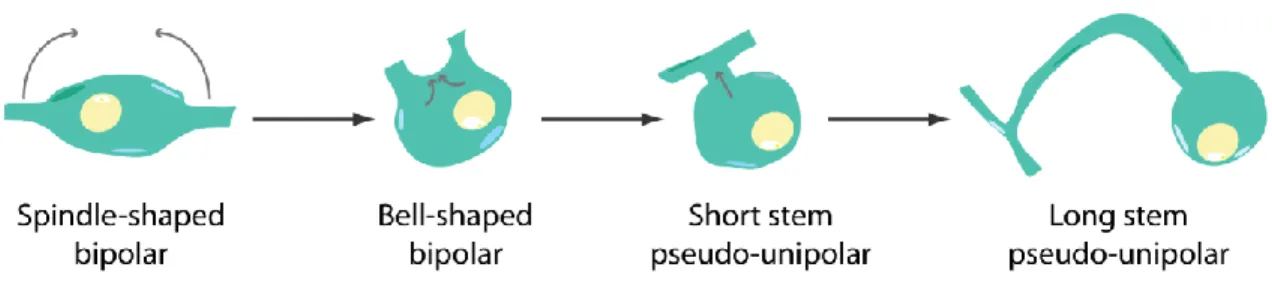
During their early embryonic development, DRG neurons are bipolar and undergo a unique morphological change, termed pseudo-unipolarization, to acquire their mature shape. Pseudo-unipolarization was first mentioned by His (His 1886). The origin of the stem axon has been proposed by two different mechanisms, the fusion of the two axons or the elongation of the cell body towards the two pre-existing axons. This phenomenon was examined in vivo using classical silver impregnation methods (His 1886, Ramón y Cajal 1890) and later confirmed using scanning electron microscopy (Matsuda et al. 1984, Matsuda et al. 1996), transmission electron microscopy (Tennyson 1965), retrograde tracing techniques (Barber et al. 1986), and immunohistochemistry for cytoskeletal markers (Riederer et al. 1992). Ramón y Cajal summarized the sequence of events leading to the formation of the two DRG branches in developing DRG neuroblasts (Rámon y Cajal 1955). In early stages, most DRG neurons are spindle-shaped bipolar. As the cell body bulges in a direction, the two processes approach each other forming an angle of less than 90 degrees (bell-shaped bipolar conformation). The most recent evidence by sequential analysis of DRG neurons morphology during development also support the hypothesis of cell body elongation for pseudo-unipolarization (Fig. 1) (Takahashi et al. 1987, Matsuda et al. 2000). Nevertheless, it would be interesting to take advantage of recent techniques such as live imaging of transduced DRG neurons as suggested by (Delloye-Bourgeois et al. 2014) to confirm such suggestions.
It is possible that pseudo-unipolarization is not a cell-autonomous mechanism as it may be regulated by supporting cells. In vitro, it was shown that the presence of Schwann cells changes the morphology of DRG neurons from bipolar to unipolar (Mudge 1984). Besides, the presence of Satellite cells was also shown to determine whether the neurites would have a dendritic or axonal behavior, as DRG neuron cultured in the absence of these cells present most processes positive for the dendritic marker MAP2 (De Koninck et al. 1993).
The onset of pseudo-unipolarization may vary with species, but the process is apparently only concluded in late embryonic development and early post-natal stages. In
8
rats, at embryonic day (E) 14, only 7% of neurons are pseudo-unipolar, while at E19 this percentage abruptly increases to 94% (Matsuda, Baluk et al. 1996). In mice, at E12, all DRG neurons are bipolar whereas the bell-shaped bipolar and pseudo-unipolar neurons are predominant at E15 (Barber and Vaughn 1986). On the other hand, in the chick embryo, pseudo-unipolar neurons are detected after E6 and increase in number to 53% on E14 and to 82% at 2 days after hatching (Matsuda, Baluk et al. 1996).
In summary, despite that the cellular and molecular mechanisms leading to pseudo-unipolarization may enable us to understand how DRG neuron polarity is established and maintained, these remain mostly unknown and have been largely neglected in the field. It would be interesting to clarify the contribution of both cellular contact and soluble factors of supporting glia during the process of pseudo-unipolarization. This could be achieved by comparing in vitro systems allowing or not (trans-well system) cell-cell contact.
Fig. 1. Morphological changes leading to a pseudo-unipolar morphology. Initially, most DRG
neurons are spindle-shaped bipolar. During its maturation, the two axons approach each other forming an angle of less than 90 degrees (bell-shaped bipolar conformation). Then, the cell body between the two axons elongate and constrict, forming the stem axon. At this stage, the stem axon does not have its final length (short stem pseudo-unipolar). The elongation of the newly formed stem axon completes neuronal morphology maturation (long stem pseudo-unipolar).
9
4 . DRG ne u ro ns u ltra - stru ctu re . Ca n s tru ctu re d e te rm i ne fun c ti on ?
4.1. The DRG neuronal cell body: clusters, cell body projections and nests
In DRGs, clusters of neuron cell bodies are interspersed among nerve fascicles. In cross sections, the neuronal clusters appear to assume different sizes and shapes. Histologically, each cluster of neurons possesses cells of different size and there appears to be no specific pattern in their arrangement (Khan et al. 2011). DRG neurons are typically circular to oval and are of variable size ranging from 20 to 100μm in diameter in rats (Lee et al. 1986). The cell bodies of DRG neurons are completely wrapped by sheaths comprised of several satellite cells. These perineural sheaths that may have one or several layers of SGCs, are generally continuous and have the outer surface covered by basal lamina (Pannese 2010). Importantly, each neuron and its surrounding SGC sheath constitute a morphological unit that is separated from other units by connective tissue. Occasionally, there are two or three neuron cell bodies, in most cases separated from each other by a SGC sheath, sharing a common connective envelope (Pannese 2010).
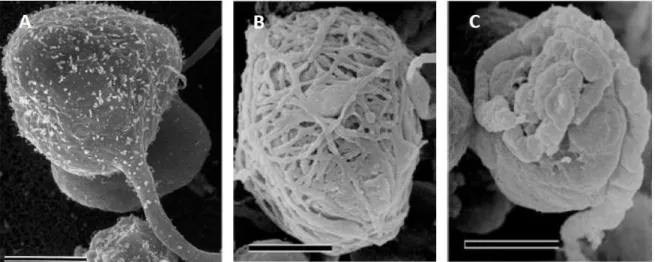
Vertebrate DRG neurons have many slender projections arising from the cell body, named perikaryal projections (Fig. 2A). These projections represent an extension of the cell body membrane and are increased in areas of contact with SGC. They increase the surface area available for exchange of metabolites and for this reason they are believed to be important for neuronal metabolism, since they may increase the rate of metabolite exchange with SGC (Pannese et al. 1998). Whether these projections have other functions besides increasing surface area is not known. Could these structures represent important sites for signal transduction? It would be interesting to determine their content, as it would help understand its functions. An additional interesting feature of DRG neurons is the classically denominated terminal Dogiel’s nest, which was first described in the late nineteenth century (Fig. 2B). Terminal Dogiel’s nests are endings of unmyelinated sympathetic fibers that either present the shape of a nest or a plexus enveloping the SGCs sheath (Garcia-Poblete et al. 2003). These sympathetic fibers penetrate the area between the SGCs sheath and the neuron cell body and form synaptic contacts (Kayahara et al. 1981) or, at least, synaptic varicosities in apposition with the cell body of DRG neurons (Chung et al. 1997). In healthy animals, the number of terminal Dogiel’s nests increases with increasing phylogenetic complexity (Matsuda et al. 2005) and, in rats, their number increases with increasing age (Ramer et al. 1998). These structures could be important in the modulation of the excitability of DRG neurons. Although the cell body of DRG neurons
10
is able to elicit action potentials, its physiological roles are not understood. Sympathetic contacts may contribute to cell body excitability, and their dysregulation may be important in pathological conditions such as neuropathic pain where the sensory pathway is abnormal. In fact, it is widely suggested that sympathetic sprouting in the DRG is an important underlying mechanism for neuropathic pain after peripheral nerve injury (McLachlan et al. 1993) or in the chronically compressed DRG (Chien et al. 2005). Although all these suggestions exist, a direct link between neuropathic pain and cell body excitability has not been established yet. In this respect, it would be interesting to determine the electrophysiological properties of the cell body of DRG neurons under normal and chronic pain situations like chronic constriction nerve.
Fig. 2. Scanning electron micrographs showing the three-dimensional cytoarchitecture of DRG neurons. (A) Perikaryal projections of post-natal rabbit DRG neurons, seen after removal of
the satellite cell sheath. Scale bar, 10µm. Image from (Matsuda et al. 1997). (B, C) Scanning electron micrographs of the exposed surface of the rat DRG, showing an intricate meshwork of sympathetic fibers forming a Dogiel’s nest (B) and a highly convoluted stem axon forming an initial glomerulus of Cajal (C), covering their respective parent neurons and satellite glial cell sheaths. Scale bars, 50µm. Images from (Matsuda, Kobayashi et al. 2005).
4.2. An axon originating two axons: the stem axon
The stem axon is the portion of the axon between the cell body and the bifurcation into central and peripheral processes, and it can range from 100 to 600 µm (Hoheisel et al. 1986). While the proximal region of the stem axon is always unmyelinated and ensheathed by SGCs, its distal part is ensheathed by Schwann cells and can be myelinated (Spencer
11
et al. 1973, Zenker et al. 1976). Studies using scanning electron microscopy showed that, in some higher vertebrates (in rats and rabbits, but not in adult frogs or chicks), the proximal portion of the stem axon may form the initial glomerulus of Cajal, which consists of the stem axon, ensheathed by SGCs (Matsumoto et al. 1985), making a tortuous, coiled path, and eventually spiraling around the SGCs sheath with a diameter typically superior to 1µm (Fig. 2C) (Matsuda et al. 1981, Matsuda, Kobayashi et al. 2005). Of note, the glomerulus of Cajal is not present in all DRG neurons and neurons with a larger diameter are more likely to have this structure (Matsuda and Uehara 1981). Regarding the surface membrane, the proximal non-myelinated stem axon has many perikaryal projections, whereas the membrane surface ensheathed by Schwann cells is smooth, as seen in the axons (Zenker and Högl 1976). The first internodes of the stem axon are, in proportion to the axon diameter, unusually short and thinly myelinated (Spencer, Raine et al. 1973). Besides, the myelin sheath is surrounded by an outer coat of flattened SGCs processes which is separated from the myelin sheath by a layer of connective tissue (Zenker and Högl 1976).
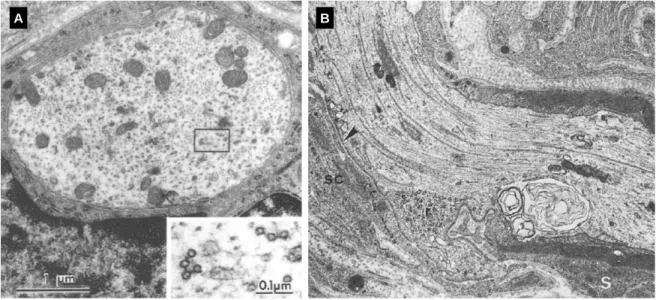
The characterization of the stem axon by electron microscopy has shown that it is not uniform along its length as its proximal part contains strikingly larger numbers of mitochondria (Spencer, Raine et al. 1973, Zenker and Högl 1976), and ribosomes (Zelená 1972, Spencer, Raine et al. 1973, Zenker and Högl 1976), and a higher density of microtubules and endoplasmic reticulum (Zenker and Högl 1976) than that present more distally. In fact, the numbers and densities of these organelles are higher in the non-myelinated region than in the non-myelinated portion of the stem axon (Zenker and Högl 1976). Also, in the non-myelinated part of the stem axon, microtubules are closely packed in fascicles and connected with lateral cross bridges (Fig. 3A) (Bird et al. 1976, Zenker and Högl 1976, Nakazawa et al. 1995). These ultrastructural differences between the non-myelinated and the non-myelinated portions of the stem axon suggest the existence of an intracellular filter for the transport of organelles between these two domains, such as the axon initial segment (AIS) of multipolar neurons (Song et al. 2009). In fact, Zenker and Högl (1976) analyzed DRG neurons of adult rats by electron microscopy and observed a thin layer of dense material undercoating the axolemma beginning in the most distal unmyelinated region and ending abruptly at the first heminode (Fig. 3B) (Zenker and Högl 1976). In a similar way, the AIS of multipolar neurons is characterized by fasciculated microtubules and a thin lamina of electron dense material beneath the axolemma (Chan-Palay 1972). At the bifurcation, neurofilaments and microtubules divide into two streams,
12
one to the peripheral process and the other to the central one. No neurofilaments or microtubules traverse between both processes (Hongchien 1970). This suggests that two different sets of microtubules pass separately down into each of the two axons, which may allow the occurrence of cargo targeting to both peripheral and central axon before the axonal bifurcation. Also, once the cargoes enter one of the axonal branches they may not be redirected to the other axonal branch. In addition, the bifurcation has fasciculated microtubules (Nakazawa and Ishikawa 1995) and a triangular area which is occupied by clusters of mitochondria (Hongchien 1970). The bifurcation of myelinated fibers is constricted and has a node of Ranvier, while unmyelinated fibers show a triangular expansion at this region (Hongchien 1970).
Fig. 3. The ultrastructure of the stem axon. (A) Transversal section of the unmyelinated portion
of the stem axon proximal to the myelinated portion. Fasciculated microtubules are frequent, as shown at a higher magnification in the inset. There is no layer of dense material undercoating the axolemma. Image from (Nakazawa and Ishikawa 1995). (B) Longitudinal section through the terminal part of the unmyelinated portion of the stem axon and through the first heminode. The arrow indicates the axolemma, which in this region is undercoated by dense granular material, according to Zenker and Högl (1976). Neurofilaments, microtubules and mitochondria are axially oriented. S, Schwann cell cytoplasm, sc, satellite cell leaflets, r, ribosome-like particles. X 18 800. Image from (Zenker and Högl 1976).
13
4.3. The axonal processes of DRG neurons: are there structural differences?
Both the peripheral and central axonal processes branch extensively at the terminal fields but rarely in or near the ganglion (Devor et al. 1984). However, in the developing rat DRG, axonal branches may present collaterals with axonal sproutings and some axonal swellings resembling synaptic boutons, both in size and shape (Mirnics et al. 1997). Nevertheless, the molecular characterization of these structures has not been performed. So caution should be made when considering these structures as potential sites of neuronal modulation. It would be important first to confirm if these structures exist in adult animals and to perform their molecular characterization to understand whether they function as synapses. It would be more important to specifically determine between which cells these synapses are established and what their functional consequences might be.
Axonal diameter of DRG branches has been extensively studied by intracellular labeling of DRG neurons (Hoheisel and Mense 1986, Lee, Chung et al. 1986) or electron microscopy analysis of cross-sections of the dorsal root and peripheral nerve (Ochs et al. 1978, Suh et al. 1984, Fadic et al. 1985). In unmyelinated fibers, central processes have a smaller diameter than the peripheral ones (Suh, Chung et al. 1984, Hoheisel and Mense 1986, Lee, Chung et al. 1986). However, in the case of myelinated fibers, there is not a consensus as to whether there is a difference in diameter between central and peripheral processes (Suh, Chung et al. 1984, Lee, Chung et al. 1986). In some reports central and peripheral myelinated branches were shown to be equal in diameter (Ochs, Erdman et al. 1978, Fadic, Vergara et al. 1985) whereas in others the myelinated central process was shown to have a smaller diameter than peripheral ones (Suh, Chung et al. 1984, Lee, Chung et al. 1986). An increased diameter on both myelinated an unmyelinated axons is consistent with the peripheral process conducting action potentials faster than the central axon, for both myelinated and unmyelinated sensory neurons (Waddell et al. 1989).
At the region immediately distal to the bifurcation, the central and peripheral processes share the same ultrastructural features, both possessing the characteristics of an axon (Hongchien 1970). However, some structural differences have been reported between the two processes more distally. In several species, the density of microtubules was reported to be significantly higher in peripheral axons than in central axons of a similar diameter, both in myelinated (Smith 1973, Zenker et al. 1975, Pannese et al. 1984, Fadic, Vergara et al. 1985) and unmyelinated (Pannese, Ledda et al. 1984, Fadic, Vergara et al. 1985) fibers. However in a study using adult monkeys and cats, no significant differences
14
in microtubule density were observed between the peripheral and central myelinated axons (Ochs, Erdman et al. 1978). Recently, Wortman et al. (2014) suggested that closely spaced parallel microtubules may enable a cargo to simultaneously engage motors on more than one microtubule, thus dramatically enhancing motor activity and minimizing the effects of any opposition to axonal transport (Wortman et al. 2014). Thus, differences in the density of microtubules may justify the increased axonal transport observed in the peripheral axon comparing to the central one (Mori et al. 1979, Wujek et al. 1983). On the other hand, in each side of the DRG neuron, the density of microtubules decreases with an increase of axon diameter (Ochs, Erdman et al. 1978, Pannese, Ledda et al. 1984, Fadic, Vergara et al. 1985). Some microtubules are arranged in fascicles at nodes of Ranvier, and the density of fasciculated microtubules is higher in axon portions more proximal to the cell body (Nakazawa and Ishikawa 1995).
The axons of the DRG neuron also possess axially oriented neurofilaments. In contrast to microtubules, the density of neurofilaments does not change as a function of nerve fiber diameter (Smith 1973, Ochs, Erdman et al. 1978). Interestingly, myelinated fibers have approximately the same density of these structures in both axons (Smith 1973, Ochs, Erdman et al. 1978), whereas unmyelinated fibers have a smaller density of neurofilaments in the peripheral process than in the central one (Ochs, Erdman et al. 1978).
So far, no Golgi or rough ER have been observed in axons, including the two branches of DRG neurons. As so, axons have been argued to be devoid of such organelles. Nevertheless, several findings show that axons possess a secretory mechanism for locally synthesized proteins that is still not clear (reviewed in (Jung et al. 2012)). Ultrastructurally, smooth ER-like structures have been observed by electron microscopy analysis in the axons of mixed nerves (Tsukita et al. 1976), and in the central (Smith 1973, Berthold et al. 1993) or peripheral (Smith 1973, Pannese et al. 1991) axons of DRG neurons. In the myelinated fibers of mixed nerves, the smooth ER forms a continuous tridimensional network which was suggested to extend from the cell body to the axon terminals (Tsukita and Ishikawa 1976). Additionally, the ER shows polarity, with most tubules running parallel to the axon (Tsukita and Ishikawa 1976, Berthold, Fabricius et al. 1993). In amphibian myelinated fibers, peripheral processes possess slightly more ER than the myelinated central axons (Smith 1973). Accordingly, during the bell-shaped bipolar stage of rabbit neuroblasts, the proximal region of the two processes differs: one process contains a small amount of ER and therefore resembles an axon, while the other
15
contains a considerable amount of granular ER typical of dendrites (Tennyson 1965). However, in this study the authors were not able to determine which processes originate the central and peripheral axons.
The presence of ribosomes has been observed in the axons of DRG neurons (Zelená 1972, Pannese and Ledda 1991, Koenig et al. 2000). These organelles appear to be organized into plaque-like structures near the axolemma (Zelená 1972, Pannese and Ledda 1991, Koenig, Martin et al. 2000) and only exceptionally in close attachment to the ER (Pannese and Ledda 1991). A systematic analysis of serial sections of myelinated fibers of rabbits showed that ribosomes are only exceptionally located in dorsal root axons, but are abundant in a few peripheral processes (Pannese and Ledda 1991). However, differences in the incidence of ribosomes between the central and peripheral axons of the DRG neuron should be further analyzed. The presence of ribosomes within the axons of DRG neurons is particularly interesting in view of the axoplasmic protein synthesis. It has been proposed that the ability of PNS axons to locally synthesize proteins is much higher than CNS axons (Twiss et al. 2009). Of interest, exciting recent findings suggest that ribosomes are transferred from adjacent Schwann cells in the mouse sciatic nerve after peripheral nerve injury (Court et al. 2008). If this is the case, an asymmetric transference of ribosomes from adjacent glial cells may contribute to the differences in the incidence of ribosomes between the axons of DRG neurons. Such evidence also raises another interesting question: the peripheral and central axons are functionally different. Do glial cells from the two branches also have different functions?
5 . T h e Pro x i ma l Seg m e nt
In vitro, cultured DRG neurons assemble a distinctive region termed the proximal
segment. The proximal segment is enriched in ankyrin G (ankG) (Zhang et al. 1998), βIV-spectrin (Hedstrom et al. 2007, Yang et al. 2007), voltage-gated sodium (Nav) channels (Dzhashiashvili et al. 2007) and neurofascin186 (Zhang and Bennett 1998, Dzhashiashvili, Zhang et al. 2007). In DRG neuron cultures, the proximal segment, as defined by the enrichment in at least one of above components, is located in the initial portion of some neurites even in cells presenting a multipolar morphology (Dzhashiashvili, Zhang et al. 2007) and also apparently in the stem axon of pseudo-unipolar DRG neurons (Hedstrom, Xu et al. 2007, Yang, Ogawa et al. 2007).
16
In DRG neurons, the existence of the proximal segment in vivo, as defined by enrichment in one of its components, was not yet shown. Nevertheless, there is a region of the stem axon that has microtubule fascicles and an electron dense undercoating observed beneath the membrane (Zenker and Högl 1976), which are ultrastructural features similar to those of the AIS (Palay et al. 1968). These ultrastructural features are described ahead.
5.1. Possible functions of the proximal segment
The AIS is a specialized ∼20–40-μm-long structure located in the proximal axon of multipolar neurons (Yang, Ogawa et al. 2007). Interestingly, the proximal segment has a positioning and molecular composition similar to the AIS and nodes of Ranvier (Dzhashiashvili, Zhang et al. 2007) thus suggesting that it may present functions similar to those of this specialized structure. Although the AIS is assembled after axon specification (Galiano et al. 2012), it contributes to the maintenance of neuronal polarity. Indeed, upon AIS dismantlement, the axon loses its identity and acquires many of the molecular and structural features of dendrites, both in vitro (Hedstrom et al. 2008) and in vivo (Sobotzik et al. 2009). The AIS contains a membrane (Kobayashi et al. 1992, Winckler et al. 1999) and cytosolic (Song, Wang et al. 2009) barrier that restricts the diffusion of molecules to somatodendritic or axonal domains. In the case of the proximal segment, if it is located at the stem axon it is not positioned to function as a barrier between the central and peripheral processes, but rather between the cell body and both axons. As such, the proximal segment may not contribute to the maintenance of polarity between the central and peripheral axons. Whether the assembly of the proximal segment precedes or succeeds pseudo-unipolarization is unknown. However, if the proximal segment assembles prior to pseudo-unipolarization in one of the neurites of the DRG neuron in the bipolar stage, it could then contribute to the establishment of the differences between the central and peripheral axons. Moreover, has previously described, peripheral and central microtubules are independent and do not communicate with each other. These independent microtubule networks present an optimal place for the regulation of the components that are targeted for each axonal branch. If this separation is made within the proximal segment, the proximal segment could be responsible for the targeting of cargoes to either the peripheral or central axon, contributing to their different identities.
The AIS is the region of multipolar neurons where action potentials are generated (Kole et al. 2012). In contrast, in DRG neurons, action potentials are generated at the
17
peripheral nerve ending. However, after inflammation (Weng et al. 2012), partial nerve injury (Devor 2009) or direct compression of the DRG (Ma et al. 2007), a portion of the axon and/or cell body of DRG neurons become sufficiently hyperexcitable to generate ectopic action potentials. Ectopic firing alters the sensory information delivered to higher order neurons in the somatic afferent pathway (Ma and LaMotte 2007). In fact, ectopic discharges are considered to be a key driver of neuropathic pain (Djouhri et al. 2006). However, little is known about where or how ectopic activity is generated in the sensory neuron (Ma and LaMotte 2007). Ectopic activity is caused by an abnormal hyperexcitability of the membrane, namely an enhancement of subthreshold oscillations (Liu et al. 2000). This abnormal excitability results from alterations in the function, distribution and density of molecules such as Nav channels, which have been widely implicated in inflammatory and neuropathic pain (reviewed in (Levinson et al. 2012)). If the proximal segment contains a high density of these molecules, it might be one key subcellular region of the DRG neuron where site-specific changes lead to ectopic firing. In the sciatic-nerve axotomy model, ectopic spikes may arise alternatively in the soma, the injured axon end (neuroma), and the T-junction or the stem axon (Amir et al. 2005). In a chronically compressed rat DRG, ectopic firing is generated at the cell body, and in the axon at a site within or close to the DRG, which includes the hypothetic location of the proximal segment (Ma and LaMotte 2007).
Sensory transmission in DRG neurons is commonly conceptualized as an uninterrupted conduction of action potentials along peripheral and central axons toward the CNS. Nevertheless, it has been observed that high-frequency signals fail during their passage through the T-junction, both in vitro (Stoney 1990, Luscher et al. 1994) and in
vivo in adult rat C-fiber neurons (Gemes et al. 2012). The morphology of the T-junction
provides an intrinsically low safety factor for action potential propagation by means of impedance mismatch. However, it has been recently speculated that impedance mismatch alone does not account for adequate low-pass filtering (Sundt et al. 2015). In small-diameter unmyelinated DRG neurons, increased membrane conductance and hyperpolarization of the somatic/perisomatic resting membrane potential have been suggested to contribute to action potential failure at the T-junction (Du et al. 2014, Sundt, Gamper et al. 2015). However, little is known about how changes in these parameters affect peripheral sensory transmission. We hypothesize that these two parameters might be regulated locally at the proximal segment as a way to control low-pass filtering.
18
Therefore, one of the possible functions of the proximal segment may be to control the selective elimination of high-frequency signals therefore “gating” peripheral signaling.
5.2. Mechanism of assembly of the proximal segment
In rats during development (E16), the immunostaining for AnkG revealed that this protein is homogeneously distributed along the length of the axons of DRG neurons (Lambert et al. 1997), and so at this stage the proximal segment has still not assembled as defined by local enrichment in this molecule. Later, AnkG disappears from unmyelinated processes whereas in myelinating axons, AnkG redistributes at clusters which later form the nodes of Ranvier (Lambert, Davis et al. 1997). So far, there is no compelling evidence that in vivo AnkG clusters in the proximal segment. Importantly, the proximal segment and nodes of Ranvier are two types of axonal domains of DRG neurons that assemble by very different mechanisms, at least in vitro (Dzhashiashvili, Zhang et al. 2007). In rats, the formation of nodes of Ranvier depends on interactions with adjacent glia that lead to the formation of clusters containing neurofascin along the length of the axon (Eshed et al. 2005). Neurofascin recruits AnkG which, in turn, is responsible for the subsequent localization and assembly of the nodes of Ranvier (Dzhashiashvili, Zhang et al. 2007). Interestingly, in the absence of AnkG, other proteins rescue nodal assembly (Ho et al. 2014). In contrast, the assembly of the proximal segment is thought to not require the presence of glial cells and so to be intrinsically specified (Zhang and Bennett 1998). In addition, neurofascin is not necessary for clustering of AnkG at the proximal segment of cultured rat DRG neurons (Dzhashiashvili, Zhang et al. 2007). Similarly, the AIS is intrinsically assembled by multipolar neurons (Ogawa et al. 2008). Multiple AnkG-specific domains may contribute to the restriction of AnkG to the proximal segment, suggesting that distinct protein interactions may be involved (Zhang and Bennett 1998). However, details are still missing in the molecular mechanisms that trigger AnkG accumulation at the proximal segment (Dzhashiashvili, Zhang et al. 2007). More importantly, the confirmation that AnkG clusters in the proximal segment in vivo, and the exact developmental period in which it occurs would be of great help to understand its importance in DRG neuron physiology.
19
6 . F u nc tio n a l As ym m e try o f Ce ntra l a n d Pe riph e ra l DRG Ax o ns
The central and peripheral processes of DRG neurons present different functional characteristics. An intriguing question is how two axons linked to the same cell body can display such different properties, and whether possible ultrastructural differences may contribute to the strikingly different functional properties of both branches. Although both axons conduct action potentials, the peripheral process functions as dendrite-like, since the action potential is generated at its peripheral terminal and then propagates towards the bifurcation of the stem process; whereas the central process is axon-like, since it conducts the signal from the bifurcation to the CNS (Du, Hao et al. 2014).
6.1. Nerve conduction velocity
DRG neurons have additional central-peripheral asymmetry regarding electrophysiological properties. It has been shown in cats and rats that signal conduction velocity is higher in the peripheral process than in the central process of the same cell, both in myelinated (Loeb 1976, Lee, Chung et al. 1986, Waddell, S.N et al. 1989) and unmyelinated sensory neurons (Waddell, S.N et al. 1989). An additional and interesting difference is that conduction velocity of both branches decreases after chronic axotomy of the peripheral process, whereas chronic section of the central process increases the conduction velocity of only the peripheral process (Czéh et al. 1977).
6.2. Axonal regeneration, lessons from the peripheral nervous system to improve central regeneration
One of the most strikingly differences between the two axonal branches is their ability to regenerate. While the peripheral axon extensively regenerates when injured, the central axon fails to do so (Huebner et al. 2009). Central and peripheral axons regenerate through different environments: whereas peripheral axons are located entirely in the PNS, the central axons are located in the PNS (in the dorsal root) and enter the CNS in the dorsal root entry zone continuing then in the CNS. As so, environmental factors may also account for the differences in regeneration of both DRG branches. The environment created in the PNS by Schwann cells contributes to its successful regeneration, while in the CNS there is the accumulation of inhibitory molecules that prevent axonal regrowth (Gaudet et al. 2011). In fact, when peripheral nerve grafts are provided to injured central processes of DRG neurons, their regrowth capacity is enhanced, supporting an important
20
role of cell extrinsic factors in the regeneration outcome (Zelená et al. 1988). Nevertheless, central axons within the PNS dorsal root fail to regenerate to the same extent as peripheral axons (Seijffers et al. 2006). Also, the rate of axonal regeneration of peripheral axons is much higher when compared to dorsal root axons. In contrast, the regeneration rate of motor neurons within the ventral root is similar to their regeneration rate within the peripheral nerve (Wujek and Lasek 1983). These observations suggest that the intrinsic response of the DRG to injuries in its peripheral and central branch is different.
The rodent sciatic nerve has been extensively used as a model of peripheral sensory branch injury allowing the identification of numerous injury signals that are activated upon peripheral injury and transported to the cell body (Perlson et al. 2005). The activation of injury signals is dependent on local protein synthesis (Perlson, Hanz et al. 2005) and such signals result in epigenetic alterations that allow extensive transcription changes (Cho et al. 2013). It has also been proposed that a peripheral injury may repress the presence of intrinsic inhibitory mechanisms (Abe et al. 2008). Such alterations increase the intrinsic ability of DRG neurons to regenerate. Contrarily, when a dorsal root or spinal cord injury occurs, DRG neurons are not able to mount a regenerative program, at least not as strong as a peripheral injury (Ylera et al. 2009, Mar et al. 2016). It has been suggested that the absence of response following a central injury may be related to both deficits of injury signals and failure to repress inhibitory signals (Cho et al. 2015, Mar, Simoes et al. 2016). However, the reasons underlying the ineffective response following a central injury remain largely unanswered as most studies on injury signaling do not compare signals differentially activated following peripheral and central injury. Instead, the majority of the studies identify injury signals that are present following peripheral injury and absent in normal nerves (Perlson, Hanz et al. 2005, Shin et al. 2012). Interestingly, the alterations provoked by an injury to the peripheral branch of DRG neurons are also able to increase regeneration of axons in the central branch. This phenomenon is known as conditioning lesion effect (Filbin 1999, Neumann et al. 1999). This increase in the intrinsic regeneration ability of DRG neurons after a peripheral conditioning injury results from a robust transcription alteration that leads to the expression of numerous regeneration enhancers. Initially, cAMP was proposed as being the master regulator of the conditioning effect that could mimic all of its effects (Neumann et al. 2002, Qiu et al. 2002). However, recently it was shown that the transcription alterations triggered by a conditioning injury are much broader than the ones elicited by cAMP (Blesch et al. 2012). So far, no single molecule has been identified as being able to fulfill the conditioning effect. More
21
interesting, the alterations produced by a peripheral conditioning injury occur even when it is performed after a central injury (Ylera, Erturk et al. 2009).
6.3. Axonal transport underlies axonal regeneration
Upon lesion, axonal regrowth is dependent on the de novo assembly of the axonal components. This process is dependent on the delivery of the building blocks to the axon tip. Most of these components are synthesized in the neuronal cell body and then transported through the axon. As such, axonal transport is extremely important for successful axon regeneration (Liu et al. 2011). Classically, radiolabeling studies of newly synthesized proteins were extensively used to study axonal transport. Such studies revealed that the rate of axonal regeneration correlates with the rate of axonal transport (Wujek and Lasek 1983). Interestingly, the rate and the amount of components being transported in peripheral axons of DRG neurons is much higher than in central ones, contributing to its higher regeneration capacity (Mori, Komiya et al. 1979, Wujek and Lasek 1983). Recently, the analysis of mitochondria transport in both the peripheral and central branch of DRG neurons from transgenic mice expressing cyan fluorescent protein in neuronal mitochondria revealed that while axonal transport in both branches was similar in non-injured animals, it was dramatically increased following peripheral injury. Additionally, whereas injury to the central DRG branch did not produce alterations in axonal transport, injury to the peripheral DRG branch increased axonal transport in both branches (Mar et al. 2014). Such observations support the idea that both axonal branches have different identities and that they respond differently to injury. It is likely that changes in axonal transport may be part of the conditioning effect. More interestingly, despite individual axonal identities, it also shows that changes in one of the axons may have repercussion in the other. Moreover, a selective transport in each axonal branch has been shown. This is the case of the transport of transient receptor potential ion channels that are particularly important for terminal sensory nociceptors. The regulation of their expression, transport, localization and activity is of extreme importance, since alterations in any of these steps may lead to altered nociception. Upon inflammation, the transport of TRPV1 receptors is increased to the peripheral branch of DRG neurons, while their transport is not altered in the central branch (Ji et al. 2002)
22
7 . How to s tud y DR G n e u ro ns ? I n v i tro a nd i n vi v o m od e ls .
The structural organization of the DRG makes it extremely difficult to analyze its cells, particularly the neuronal cell body and initial parts of the stem axon. Also, DRG neurons represent a highly heterogenic group of neurons in function, dimension and constituents. Such evidence makes it difficult to understand whether some of the identified mechanisms are common to all DRG neurons or feature in only some of its sub-groups. So, experimental designs and model selections are particularly relevant to the study of this neuron type.
DRG neurons can be cultured from both embryonic and adult animals, however in both cases the morphology acquired in vitro does not resemble the in vivo one, as usually several processes arise from the cell body and they may be highly branched. The processes emerging from the cell body are called neurites. It would be interesting to develop an in vitro model where DRG neurons present a pseudo-unipolar morphology. Embryonic DRG neurons may have higher plasticity than post-natal neurons, to reproduce the establishment of a pseudo-unipolar morphology. A good in vitro model would also be suitable to establish the role of supporting cells in establishing such morphology, as well as the composition of the different axonal segments (proximal segment and distal segments).
In vivo, single DRG neurons with the corresponding proximal axon are hard to
image given their complex structure. The usage of transgenic mice expressing a fluorescent marker in a sub-set of neurons may enable the identification of single axons. In this respect, a number of different transgenic lines expressing fluorescent markers under the neuronal promoter thy1 exist (Feng et al. 2000). To study single neurons in vivo, a line expressing the marker in a small number of neurons would best fit this purpose, as such, lines GFP-M and -O and CFP-S could be excellent models. All these 3 lines have less than 10% of their DRG neurons labeled (Feng, Mellor et al. 2000). The use of these animals together with a technique that enables correlative light and electron microscopy (Misgeld et al. 2007) would enable the identification followed by ultra-structural analysis of the individual axons in different regions: naked proximal axon, myelin coated proximal axon and the T-junction. However, this approach has some drawbacks. It is unknown whether the labeled neurons belong to a unique sub-group of DRG neurons or neurons of different groups are labeled. This would have major implications, since generalizations of DRG neuron structure could be made when they exist only in a specific sub-group.
23
Other transgenic models may be useful to study other features of DRG neurons. Transgenic mice expressing a fluorescent mitochondria marker under a neuronal promoter have been used to assess axonal transport in motor neurons in vivo (Misgeld, Kerschensteiner et al. 2007). Also, tissues from these animals can also be evaluated in explants. This has been performed for the analysis of the effects of axonal regeneration in transport (Mar, Simoes et al. 2014) as well as aging (Milde et al. 2015). These animal models could be further used to assess axonal transport in DRG neurons in other situations like degenerative diseases. Although this model enables single axon imaging both in vivo and ex vivo, the analysis of mixed nerves like the sciatic nerve poses an extra challenge, as both sensory and motor neurons are labeled. Sensory or motor neurons should be labeled prior to the analysis, accordingly to the aim of the study. Alternatively, ventral or dorsal spinal root transection could be performed so that motor or sensory axons are eliminated respectively.
8 . Con cl us i o n
Sensory DRG neurons present a unique morphology with two axons linked to the cell body through a common axon (stem axon). Although the two axons are linked, they present different functional properties: different conduction velocity, axonal transport and regeneration capacity. However, the reasons underlying this asymmetry remain largely unknown. Some ultrastructural differences have been observed between the two axons of DRG neurons, namely regarding axonal diameter, and the densities of microtubules and ribosomes. In addition, the stem axon may possess a specialized region (the proximal segment) that may work as a filter between the cell body and the two axons, and may contribute to the establishment of the central-peripheral asymmetry during development in the bipolar morphological stage. Microtubules arising from the stem axon are directed to either peripheral or central axons. More interesting, microtubules from one axonal branch do not communicate with the other axonal branch, suggesting that cargo selection for each axon can be made within the stem axon. This selection may contribute to the maintenance of axonal asymmetry. However, the mechanisms responsible for this possible differential targeting are unknown. These observations and hypotheses further confirm the importance of the ultrastructure analysis of the axons of DRG neurons, but this subject has been neglected in recent years. Further characterization could bring improvements in our understanding of DRG neuron biology and function.
24 9 . Ack now le d ge m en ts
Work from the authors’ group was supported by Fundação Grunenthal, Bolsa Jovens Investigadores em Dor 2016 (to F.M.M); Prémio Melo e Castro - Santa Casa da Misericórdia de Lisboa; and FEDER through COMPETE, by National funds through FCT – Fundação para a Ciência e a Tecnologia under the Project PTDC/SAU-GMG/111761/2009; Norte-01-0145-FEDER-000008 - Porto Neurosciences and Neurologic Disease Research Initiative at i3S, supported by Norte Portugal Regional Operational Programme (NORTE 2020), under the PORTUGAL 2020 Partnership Agreement, through the European Regional Development Fund (ERDF). F.M.M is a FCT fellow (SFRH/BPD/104503/2014).
25 1 0 . Re fe re n c es
Abe, N. and V. Cavalli (2008) Nerve injury signaling. Curr Opin Neurobiol 18: 276-283. Adaes, S., L. Almeida, C. S. Potes, A. R. Ferreira, J. M. Castro-Lopes, J. Ferreira-Gomes and F. L. Neto (2017) Glial activation in the collagenase model of nociception associated with osteoarthritis. Mol Pain 13: 1744806916688219.
Amir, R., J. D. Kocsis and M. Devor (2005) Multiple Interacting Sites of Ectopic Spike Electrogenesis in Primary Sensory Neurons. The Journal of neuroscience : the official journal of the Society for Neuroscience 25: 2576-2585.
Barber, R. P. and J. E. Vaughn (1986) Differentiation of dorsal root ganglion cells with processes in their synaptic target zone of embryonic mouse spinal cord: a retrograde tracer study. J Neurocytol 15: 207-218.
Berthold, C. H., C. Fabricius, M. Rydmark and B. Andersen (1993) Axoplasmic organelles at nodes of Ranvier. I. Occurrence and distribution in large myelinated spinal root axons of the adult cat. J Neurocytol 22: 925-940.
Bird, M. M. and A. R. Lieberman (1976) Microtubule fascicles in the stem processes of cultured sensory ganglion cells. Cell Tissue Res 169: 41-47.
Blesch, A., P. Lu, S. Tsukada, L. T. Alto, K. Roet, G. Coppola, D. Geschwind and M. H. Tuszynski (2012) Conditioning lesions before or after spinal cord injury recruit broad genetic mechanisms that sustain axonal regeneration: superiority to camp-mediated effects. Exp Neurol 235: 162-173.
Chan-Palay, V. (1972) The tripartite structure of the undercoat in initial segments of Purkinje cell axons. Z Anat Entwicklungsgesch 139: 1-10.
Chien, S. Q., C. Li, H. Li, W. Xie, C. S. Pablo and J.-M. Zhang (2005) Sympathetic Fiber Sprouting in Chronically Compressed Dorsal Root Ganglia Without Peripheral Axotomy. Journal of neuropathic pain & symptom palliation 1: 19-23.
Cho, Y., J. E. Shin, E. E. Ewan, Y. M. Oh, W. Pita-Thomas and V. Cavalli (2015) Activating Injury-Responsive Genes with Hypoxia Enhances Axon Regeneration through Neuronal HIF-1alpha. Neuron 88: 720-734.
Cho, Y., R. Sloutsky, K. M. Naegle and V. Cavalli (2013) Injury-induced HDAC5 nuclear export is essential for axon regeneration. Cell 155: 894-908.
Chung, K., Y. W. Yoon and J. M. Chung (1997) Sprouting sympathetic fibers form synaptic varicosities in the dorsal root ganglion of the rat with neuropathic injury. Brain Research 751: 275-280.
26
Court, F. A., W. T. Hendriks, H. D. MacGillavry, J. Alvarez and J. van Minnen (2008) Schwann cell to axon transfer of ribosomes: toward a novel understanding of the role of glia in the nervous system. J Neurosci 28: 11024-11029.
Czéh, G., N. Kudo and M. Kuno (1977) Membrane properties and conduction velocity in sensory neurones following central or peripheral axotomy. The Journal of Physiology 270: 165-180.
De Koninck, P., S. Carbonetto and E. Cooper (1993) NGF induces neonatal rat sensory neurons to extend dendrites in culture after removal of satellite cells. J Neurosci 13: 577-585.
Delloye-Bourgeois, C., A. Jacquier, J. Falk and V. Castellani (2014) Use of pHluorin to assess the dynamics of axon guidance receptors in cell culture and in the chick embryo. J Vis Exp: e50883.
Devor, M. (2009) Ectopic discharge in Abeta afferents as a source of neuropathic pain. Exp Brain Res 196: 115-128.
Devor, M., P. D. Wall and S. B. McMahon (1984) Dichotomizing somatic nerve fibers exist in rats but they are rare. Neuroscience Letters 49: 187-192.
Djouhri, L., S. Koutsikou, X. Fang, S. McMullan and S. N. Lawson (2006) Spontaneous pain, both neuropathic and inflammatory, is related to frequency of spontaneous firing in intact C-fiber nociceptors. J Neurosci 26: 1281-1292.
Donegan, M., M. Kernisant, C. Cua, L. Jasmin and P. T. Ohara (2013) Satellite glial cell proliferation in the trigeminal ganglia after chronic constriction injury of the infraorbital nerve. Glia 61: 2000-2008.
Du, X., H. Hao, S. Gigout, D. Huang, Y. Yang, L. Li, C. Wang, D. Sundt, D. B. Jaffe, H. Zhang and N. Gamper (2014) Control of somatic membrane potential in nociceptive neurons and its implications for peripheral nociceptive transmission. Pain 155: 2306-2322. Dzhashiashvili, Y., Y. Zhang, J. Galinska, I. Lam, M. Grumet and J. L. Salzer (2007) Nodes of Ranvier and axon initial segments are ankyrin G–dependent domains that assemble by distinct mechanisms. The Journal of Cell Biology 177: 857-870.
Eide, A. L. and J. C. Glover (1997) Developmental dynamics of functionally specific primary sensory afferent projections in the chicken embryo. Anat Embryol (Berl) 195: 237-250.
Eshed, Y., K. Feinberg, S. Poliak, H. Sabanay, O. Sarig-Nadir, I. Spiegel, J. R. Bermingham, Jr. and E. Peles (2005) Gliomedin Mediates Schwann Cell-Axon Interaction and the Molecular Assembly of the Nodes of Ranvier. Neuron 47: 215-229.
27
Fadic, R., J. Vergara and J. Alvarez (1985) Microtubules and caliber of central and peripheral processes of sensory axons. J Comp Neurol 236: 258-264.
Farinas, I., M. Cano-Jaimez, E. Bellmunt and M. Soriano (2002) Regulation of neurogenesis by neurotrophins in developing spinal sensory ganglia. Brain Res Bull 57: 809-816.
Feng, G., R. H. Mellor, M. Bernstein, C. Keller-Peck, Q. T. Nguyen, M. Wallace, J. M. Nerbonne, J. W. Lichtman and J. R. Sanes (2000) Imaging neuronal subsets in transgenic mice expressing multiple spectral variants of GFP. Neuron 28: 41-51.
Filbin, M. T. (1999) The benefits of adding insult to injury. Neuron 23: 2-4.
Galiano, M. R., S. Jha, T. S. Ho, C. Zhang, Y. Ogawa, K. J. Chang, M. C. Stankewich, P. J. Mohler and M. N. Rasband (2012) A distal axonal cytoskeleton forms an intra-axonal boundary that controls axon initial segment assembly. Cell 149: 1125-1139.
Garcia-Poblete, E., H. Fernandez-Garcia, E. Moro-Rodriguez, M. Catala-Rodriguez, M. L. Rico-Morales, S. Garcia-Gomez-de-las-Heras and M. A. Palomar-Gallego (2003) Sympathetic sprouting in dorsal root ganglia (DRG): a recent histological finding? Histol Histopathol 18: 575-586.
Gaudet, A. D., P. G. Popovich and M. S. Ramer (2011) Wallerian degeneration: gaining perspective on inflammatory events after peripheral nerve injury. Journal of Neuroinflammation 8: 110-110.
Gemes, G., A. Koopmeiners, M. Rigaud, P. Lirk, D. Sapunar, M. L. Bangaru, D. Vilceanu, S. R. Garrison, M. Ljubkovic, S. J. Mueller, C. L. Stucky and Q. H. Hogan (2012) Failure of action potential propagation in sensory neurons: mechanisms and loss of afferent filtering in C-type units after painful nerve injury. The Journal of Physiology 591: 1111-1131.
Giuffrida, R. and A. Rustioni (1992) Dorsal root ganglion neurons projecting to the dorsal column nuclei of rats. J Comp Neurol 316: 206-220.
Hedstrom, K. L., Y. Ogawa and M. N. Rasband (2008) AnkyrinG is required for maintenance of the axon initial segment and neuronal polarity. The Journal of Cell Biology 183: 635-640.
Hedstrom, K. L., X. Xu, Y. Ogawa, R. Frischknecht, C. I. Seidenbecher, P. Shrager and M. N. Rasband (2007) Neurofascin assembles a specialized extracellular matrix at the axon initial segment. The Journal of Cell Biology 178: 875-886.
His, W. (1886). Zur Geschichte des menschlichen Rückenmarkes und der Nervenwurzeln. Abhandlungen der mathematisch-physischen classe der königlich sächsischen gesellschaft der wissenschaften. 13: 479-513.
28
Ho, T. S.-Y., D. R. Zollinger, K.-J. Chang, M. Xu, E. C. Cooper, M. C. Stankewich, V. Bennett and M. N. Rasband (2014) A hierarchy of ankyrin-spectrin complexes clusters sodium channels at nodes of Ranvier. Nat Neurosci 17: 1664-1672.
Hoheisel, U. and S. Mense (1986) Non-myelinated afferent fibres do not originate exclusively from the smallest dorsal root ganglion cells in the cat. Neuroscience Letters 72: 153-157.
Hongchien, H. (1970) Axonal bifurcation in the dorsal root ganglion of the cat: a light and electron microscopic study. J Comp Neurol 140: 227-240.
Huebner, E. A. and S. M. Strittmatter (2009) Axon regeneration in the peripheral and central nervous systems. Results Probl Cell Differ 48: 339-351.
Ji, R. R., T. A. Samad, S. X. Jin, R. Schmoll and C. J. Woolf (2002) p38 MAPK activation by NGF in primary sensory neurons after inflammation increases TRPV1 levels and maintains heat hyperalgesia. Neuron 36: 57-68.
Jung, H., B. C. Yoon and C. E. Holt (2012) Axonal mRNA localization and local protein synthesis in nervous system assembly, maintenance and repair. Nat Rev Neurosci 13: 308-324.
Kayahara, T., T. Takimoto and S. Sakashita (1981) Synaptic junctions in the cat spinal ganglion. Brain Research 216: 277-290.
Khan, A. A., M. Naushad and A. Dilkash (2011) Morphological heterogeneity in the cervical dorsal root ganglion neurons of mice. Curr Neurobiol 2: 125-128.
Kobayashi, T., B. Storrie, K. Simons and C. G. Dotti (1992) A functional barrier to movement of lipids in polarized neurons. Nature 359: 647-650.
Koenig, E., R. Martin, M. Titmus and J. R. Sotelo-Silveira (2000) Cryptic peripheral ribosomal domains distributed intermittently along mammalian myelinated axons. J Neurosci 20: 8390-8400.
Kole, Maarten H. P. and Greg J. Stuart (2012) Signal Processing in the Axon Initial Segment. Neuron 73: 235-247.
Lambert, S., J. Q. Davis and V. Bennett (1997) Morphogenesis of the node of Ranvier: co-clusters of ankyrin and ankyrin-binding integral proteins define early developmental intermediates. J Neurosci 17: 7025-7036.
Lawson, S. N. and T. J. Biscoe (1979) Development of mouse dorsal root ganglia: an autoradiographic and quantitative study. J Neurocytol 8: 265-274.
29
Lee, K. H., K. Chung, J. M. Chung and R. E. Coggeshall (1986) Correlation of cell body size, axon size, and signal conduction velocity for individually labelled dorsal root ganglion cells in the cat. J Comp Neurol 243: 335-346.
Levinson, S. R., S. Luo and M. A. Henry (2012) The role of sodium channels in chronic pain. Muscle Nerve 46: 155-165.
Liu, C. N., M. Michaelis, R. Amir and M. Devor (2000) Spinal nerve injury enhances subthreshold membrane potential oscillations in DRG neurons: relation to neuropathic pain. J Neurophysiol 84: 205-215.
Liu, K., A. Tedeschi, K. K. Park and Z. He (2011) Neuronal intrinsic mechanisms of axon regeneration. Annu Rev Neurosci 34: 131-152.
Loeb, G. E. (1976) Decreased conduction velocity in the proximal projections of myelinated dorsal root ganglion cells in the cat. Brain Research 103: 381-385.
Luscher, C., J. Streit, R. Quadroni and H. R. Luscher (1994) Action potential propagation through embryonic dorsal root ganglion cells in culture. I. Influence of the cell morphology on propagation properties. J Neurophysiol 72: 622-633.
Ma, C. and R. H. LaMotte (2007) Multiple Sites for Generation of Ectopic Spontaneous Activity in Neurons of the Chronically Compressed Dorsal Root Ganglion. The Journal of neuroscience: the official journal of the Society for Neuroscience 27: 14059-14068.
Mar, F. M., A. R. Simoes, S. Leite, M. M. Morgado, T. E. Santos, I. S. Rodrigo, C. A. Teixeira, T. Misgeld and M. M. Sousa (2014) CNS axons globally increase axonal transport after peripheral conditioning. J Neurosci 34: 5965-5970.
Mar, F. M., A. R. Simoes, I. S. Rodrigo and M. M. Sousa (2016) Inhibitory Injury Signaling Represses Axon Regeneration After Dorsal Root Injury. Mol Neurobiol 53: 4596-4605. Marmigere, F. and P. Ernfors (2007) Specification and connectivity of neuronal subtypes in the sensory lineage. Nat Rev Neurosci 8: 114-127.
Maro, G. S., M. Vermeren, O. Voiculescu, L. Melton, J. Cohen, P. Charnay and P. Topilko (2004) Neural crest boundary cap cells constitute a source of neuronal and glial cells of the PNS. Nat Neurosci 7: 930-938.
Matsuda, S., P. Baluk, D. Shimizu and T. Fujiwara (1996) Dorsal root ganglion neuron development in chick and rat. Anat Embryol (Berl) 193: 475-480.
Matsuda, S., J. Desaki, J. Aburaya and M. Sakanaka (1997) Perikaryal projections of developing spinal ganglion neurons in the chick demonstrated by scanning electron microscopy. Anat Embryol (Berl) 195: 137-146.
30
Matsuda, S., N. Kobayashi, K. Mominoki, H. Wakisaka, M. Mori and S. Murakami (2000) Morphological transformation of sensory ganglion neurons and satellite cells. Kaibogaku Zasshi 73: 603-613.
Matsuda, S., N. Kobayashi, T. Terashita, T. Shimokawa, K. Shigemoto, K. Mominoki, H. Wakisaka, S. Saito, K. Miyawaki, K. Saito, F. Kushihata, J. Chen, S.-Y. Gao, C.-Y. Li, M. Wang and T. Fujiwara (2005) Phylogenetic investigation of Dogiel's pericellular nests and Cajal's initial glomeruli in the dorsal root ganglion. The Journal of Comparative Neurology 491: 234-245.
Matsuda, S. and Y. Uehara (1981) Cytoarchitecture of the rat dorsal root ganglia as revealed by scanning electron microscopy. J Electron Microsc (Tokyo) 30: 136-140.
Matsuda, S. and Y. Uehara (1984) Prenatal development of the rat dorsal root ganglia. A scanning electron-microscopic study. Cell Tissue Res 235: 13-18.
Matsumoto, E. and J. Rosenbluth (1985) Plasma membrane structure at the axon hillock, initial segment and cell body of frog dorsal root ganglion cells. J Neurocytol 14: 731-747. McLachlan, E. M., W. Janig, M. Devor and M. Michaelis (1993) Peripheral nerve injury triggers noradrenergic sprouting within dorsal root ganglia. Nature 363: 543-546.
Milde, S., R. Adalbert, M. H. Elaman and M. P. Coleman (2015) Axonal transport declines with age in two distinct phases separated by a period of relative stability. Neurobiol Aging 36: 971-981.
Mirnics, K. and H. R. Koerber (1997) Properties of individual embryonic primary afferents and their spinal projections in the rat. J Neurophysiol 78: 1590-1600.
Misgeld, T., M. Kerschensteiner, F. M. Bareyre, R. W. Burgess and J. W. Lichtman (2007) Imaging axonal transport of mitochondria in vivo. Nat Methods 4: 559-561.
Mori, H., Y. Komiya and M. Kurokawa (1979) Slowly migrating axonal polypeptides. Inequalities in their rate and amount of transport between two branches of bifurcating axons. J Cell Biol 82: 174-184.
Mudge, A. W. (1984) Schwann cells induce morphological transformation of sensory neurones in vitro. Nature 309: 367-369.
Nakazawa, E. and H. Ishikawa (1995) Occurrence of fasciculated microtubules at nodes of Ranvier in rat spinal roots. J Neurocytol 24: 399-407.
Neumann, S., F. Bradke, M. Tessier-Lavigne and A. I. Basbaum (2002) Regeneration of sensory axons within the injured spinal cord induced by intraganglionic cAMP elevation. Neuron 34: 885-893.