Star Wars: Exclusive Superstars and Collusive Outcomes
Mariano Selvaggi
yLuis Vasconcelos
zJuly 2006
Abstract
We examine the impact of agreements that prohibit “superstars” from switching their services to rivals on …rms’ability to collude. Exclusivity (or non-compete) clauses are not uncommon in the sports, entertainment and professional services industries, but courts often refrain from enforcing them owing to inequity and/or restraint of trade considerations. We argue this attitude may be misguided. While in the collusive path exclusion may be inconsequential because …rms agree not to hire each other’s star, its enforcement level a¤ects the severity of future punishments. For exclusive talent may not be poached by rivals. The ability to sustain tacit collusion may thus be impaired, which in plausible constellations leads to e¢ ciency improvements and more equitable distribution of rents.
JEL Classi…cation: J44, K21, L42.
Keywords: collusion, contract enforcement, exclusive contracts, non-compete covenants, supergames, superstars.
1
Introduction
Talent is a precious commodity in constant scarce supply. This makes it very expensive. When …rms scramble for premium talent in the market (a “star”), they may hold a tight grip on hiring costs by writing exclusivity clauses that prohibit potential stars from dealing with others in the future. That way, the star’s outside opportunities plummet. Alternatively …rms may sustain tacit understandings whereby they do not try to hire each other’s star, thus eschewing “star wars” that consume the rents created by new talent. While both mechanisms are observed in practice, the economics literature contains no formal analysis of the We would like to thank Ran Abramitzky, Adeline Delavande, David de Meza, Nuno Garoupa, Iliyan Goergiev, José Mata, April Mitchell Franco, Luís Pinto, Guillaume Roger, Johan Stennek, and participants at the 4th Annual International Industrial Organization Conference (Boston) for helpful comments.
yDepartment of Management, Managerial Economics & Strategy Group, London School of Economics. Tel: +44 (0)20 7955
7544, E-mail: [email protected]
possible linkages between them or the basic trade-o¤s involved. In this paper we study a setting in which …rms repeatedly compete for new talent, and argue that di¤erential enforcement of exclusionary rights over stars a¤ects …rms’ ability to sustain collusive outcomes. In particular, we show that tighter enforcement of exclusivity may hinder (tacit) collusion because the exclusive-rightholder expects to capture more of the rents created by future stars, which in turn lessens the severity of punishments upon defectors. Hence star wars, where …rms engage in …erce competition for free talent, are more likely to occur. This simple reasoning leads to staggering conclusions. Not only may courts that are more prone to enforce exclusivity provisions actually boost the rewards earned by stars, but to the extent that a breakdown of collusion in the market for talent induces pro-competitive behavior in other markets, allocative e¢ ciency and aggregate welfare may also swell. The model permits us to o¤er a subtle explanation as to why exclusivity ‡ourishes precisely in environments where it receives strong support from enforcement agencies, and to understand why it is frequently the case that only top talent, or “superstars”, are restricted by exclusive rights.
Exclusivity occurs when two parties enter into a contractual agreement that prohibits one— or sometimes both— of them from trading with others. While exclusive contracts are often written to govern vertical relationships between …rms (e.g. manufacturers and retailers), they are certainly not uncommon in the labour market. One such sort of exclusion occurs when a superbly talented individual, while free to walk away from his or her current job, is contractually forbidden to join other …rms in the same industry— one of the employer’s rivals. A prominent example of exclusive employment contracts, and one which is indeed
very close to the situation delineated in our formal set-up, occurs in sports leagues.1 Frequently American
football teams and baseball clubs cannot hire players who are “owned” exclusively by competitors unless the player’s employer explicitly agrees. In such situations, the exchange of talent in the market typically entails monetary compensations between clubs (i.e. side payments) according to the features of the transfer system. In English football, for instance, clubs and/or managers cannot even discuss transfer conditions with a football player that “belongs”exclusively to another club. In that connection, a recent case is provided by the Arsenal star Ashley Cole, who in 2005 received a …ne of £ 100,000 by the Premier League following an illegal approach by Chelsea. A Premier League commission found Cole in breach of rule K5, which prohibits a player contracted to a club from approaching another with a view to negotiating a transfer. Chelsea, in turn, was …ned £ 300,000 for breaking rule K3, which forbids an approach to a player while he is under contract. Other examples along similar lines abound. The NBA, which organizes the professional basketball championship in the US, also applies exclusionary rules regarding the transfer of players between teams. So too do companies in the movies, TV shows and music industries. Very often, young artists sign contracts
with record companies embodying exclusive-dealing clauses for several years.2
1Other “celebrities” restricted by exclusivity provisions comprise, among others, movies/TV and music stars, top executives,
chatshow and news broadcasters, best-selling authors and, less often, prominent academics/researchers.
Arguments against and in favour of exclusive contracts abound in the economics literature; yet, to the best of our knowledge, there is no analysis that formally examines the impact of exclusivity provisions on …rms’ability to collude in in…nitely repeated environments. Let alone models that attempt to draw a link between them in the context of employment contracts and competition for talent. In addition to the heed paid to exclusive contracts in the antitrust arena (see, e.g., Bernheim and Whinston (1998) and Fumagalli and Motta (2005)), the formal literature on exclusivity has been concerned with free-riding problems arising from investment spillovers. For instance, a manufacturer may grant a retailer an exclusive dealership to encourage (e¢ cient) pre-sale services or advertising that would otherwise bene…t all retailers carrying the brand— Motta (2004) nicely reviews this reasoning. More recent papers have suggested instead that exclusive trade agreements may be socially bene…cial because they a¤ect non-contractible investments that are highly speci…c to the partnership, thereby alleviating hold-up problems— see Segal and Whinston (2000), De Meza and Selvaggi (2004) and Vasconcelos (2006). However none of these papers tackles the main issue that concerns us here, namely, the potential e¢ ciency and distributional implications of di¤erential enforcement
of exclusive contracts when …rms can collude in the process of hiring stars.3
In what follows, we investigate the impact of exclusive contracts on the extent of collusion that …rms that repeatedly compete for a scant resource— talent— can sustain in equilibrium. Particularly we characterise and compare the most pro…table collusive equilibria that can be maintained when the courts are more prone to enforce exclusivity clauses. It is well known that owing to statutory reasons, inequity considerations (…rms are disproportionately favoured) or antitrust issues, the degree to which courts e¤ectively enforce contractual provisions in general, and exclusivity clauses in particular, varies markedly across jurisdictions (e.g., states in the US or countries). For example the so-called covenants not to compete, or non-compete clauses, also restrain employee mobility and are subject to strong di¤erential enforcement across states in
the US (see, e.g., Franco and Mitchell (2005)).4 Indeed, more often than not the draconian restrictions
originally embedded in these agreements are disregarded by courts. In our model this is encapsulated in a probabilistic enforcement of exclusionary rights. The likelihood that exclusivity is enforced may be subject to di¤erent interpretations: perhaps the parties do not know whether the enforcement agency will use a speci…c performance remedy, or there are con‡icting and changing legal attitudes towards exclusionary rights to specify in the contract that a music label has exclusionary rights over a potential “rock star” not only on earth but also in the outer space.
3Segal (2003) does examine the pro…tability of exclusive and collusive arrangements in a completely di¤erent environment
of (cooperative) coalitional bargaining. However the link between the degree of enforcement of exclusionary rights and the sustainability of collusive outcomes, which is at the heart of our paper, is not analyzed.
4These provisions often pursue the extra ob jective of insulating …rms against competition from employees that walk out
carrying with them valuable (e.g. secret, strategically sensitive) information. Employment contracts embedded with a non-competition clause comprise such professions as scientists, top researchers (see, e.g., the legal battle between Microsoft and Google over Kai-Fu Lee) and top executives, among others.
(see, e.g., Lafontaine and Slade (2005)), or courts may feel that stipulated damages depart too much from “reasonable” payments, thus dismissing them as inadequate or punitive and refusing to enforce them— see, e.g., Edlin and Reichelstein (1996) and the literature cited there. Relatedly, if the productive interaction between …rm and star extends over many periods, one could interpret the probability that exclusivity is enforced as the maximum duration of the exclusivity provision that courts are prepared to enforce. We simply note that any of these interpretations is well-suited to our theoretical framework.
The main thrust of the connection between exclusive rights over stars and collusion in the market for talent is the following. Exclusive employment agreements and coordination between …rms that compete for talent are substitute methods of appropriating revenues generated by the stars. In e¤ect both ensure that wage packets remain relatively low. In the presence of collusive behavior in the market for new talent, exclusivity is often immaterial because …rms agree not to hire each other’s stars. During a punishment phase in which there is increased competition for talent, however, exclusivity is valuable because it prevents rivals from poaching stars. On such occasions, exclusivity is much more instrumental in rent seeking. Hence when courts are more likely to upheld exclusivity clauses, the gains from deviating (the pro…t from luring the star away from the rival) are large relative to the punishment for deviating (the loss of future pro…ts owing to …erce competition). Ceteris paribus, collusive outcomes are thus harder to maintain.
The remainder of the paper proceeds as follows. In Section 2, we analyze repeated interaction between …rms when stars are homogeneous. This enables us to study in a simple setting how the level of enforcement of exclusive contracts between …rms and (potential) stars impinges on …rms’ ability to sustain collusive outcomes. The main result is that if courts are more prone to enforce exclusive contracts, it is harder for …rms to cooperate and avoid …erce competition for free talent. Thus stars actually earn higher equilibrium rewards when exclusivity is more likely to be enforced. The underlying intuition has been provided above. We also show that tighter enforcement of exclusive contracts may also be e¢ ciency-enhancing. Based on the concept of multimarket contact pioneered by Bernheim and Whinston (1990), we argue than when …rms arguably interact in many markets simultaneously, breaking down collusion in the market for talent may induce competitive behavior in all markets.
In Section 3, we consider a richer model comprising stars and …rms with di¤erent productivity. This allows us to study how …rms’incentives to write exclusive contracts vary across talent, and to examine wealth redistributions across stars as a result of changes in the likelihood of enforcement. With heterogeneity, …rms’ ability to collude depends on realised talent. Speci…cally, the more talented a free star is, the harder it is to sustain non-competitive behavior because the temptation to cheat goes up. On such occasions, colluding …rms increase the salary packet o¤ered to the star in order to reduce the gains from deviating. Hence uniquely talented stars who are free in the market earn premium wages. Since cooperation never really breaks down, these outcomes are a sort of “cold wars” for talent. Our model also implies that …rms …nd
exclusivity valuable even along the collusive phase, and that its value is sensitive to the star’s talent— in equilibrium, only superstars are bounded by exclusive contracts. E¤ectively, for less outstanding stars the coordination wage is low even when they are free in the market, so there are no gains from writing exclusive contracts with them.
In this context, increasing the probabilistic enforcement of exclusive contracts has two opposite e¤ects on stars’payo¤s. On the one hand, stars lose because they are free less often; on the other hand, when they are free their wages may go up because coordination is harder to sustain— this is a novel e¤ect that this paper emphasizes. The interplay between these two forces ultimately determines whether principals and stars lose or gain from shifts in enforcement level. We show that for stars of exceptional talent the …rst e¤ect tends to dominate, whereas for stars of moderate talent the second e¤ect is the dominant. Thus, when enforcement increases there is redistribution of surplus from very talented stars to less talented ones. One can also show that principals can be worse o¤ following an increase in exclusivity enforcement. Another implication of our analysis is that exclusive agreements are rampant precisely when courts are more likely to enforce them. While this result seems intuitive, the underlying mechanism at work is subtle. Exclusive contracts are more frequently used not because they are necessarily more e¤ective, but because collusive outcomes are harder to sustain and principals fall back on other ways to appropriate the rents created by their stars.
In Section 4, we make some concluding remarks.
2
Basic Model
Consider a market with two identical, in…nitely lived principals, P1and P2. At the beginning of the period,
each principal hires an agent from a large pool of homogenous individuals. Agents are embedded with star
potential, and those hired in a given period are equally likely to become the single star in the market.5 To
capture repeated competition between principals for new talent, we assume agents/stars live for only one period. (The pool of agents is replaced every new period.) Thus, talent is constantly in scarce supply. Both principals and agents are risk neutral and maximize expected wealth.
The supergame we study in this paper consists of a discounted, in…nitely repeated stage game in which each principal “breeds”the star in the market with probability 0.5. (Throughout we use masculine pronouns
for the principals and feminine pronouns for the agents and stars.) Time is discrete (indexed by ) and
denotes the common discount factor between stages, with 0 < < 1. The precise timing of events within
5For simplicity, we assume that each period only one of the agents becomes a star. We do not formally model the mechanism
by which agents develop into real stars. The important feature in our approach is that only those hired by principals may develop their star potential, which emphasizes the role played by employers in the star-breeding process. Think of principals as football clubs or music labels that spot raw talent, whereas agents could be amateur young players or musicians who need to further their natural talent and to be trained/promoted/groomed to become superstars.
each period— or constituent game— is as follows.
1. Contracting phase. At the outset principals meet agents and make take-it-or-leave-it employment
contract o¤ers. (Agents cannot simultaneously work for both principals.) With this assumption
we want to capture the idea that there is, ex ante, a competitive supply of potential stars. Pi’s
o¤er takes the form i = (wi; i) ; i 2 f1; 2g, where wi denotes the agent’s binding salary and
i 2 fnon-exclusive, exclusiveg represents absence or presence of an exclusionary clause that forbids
employment with other principals during the period. If Pi’s o¤er is rejected the matched agent
irretriev-ably returns to the pool of unmatched individuals— she has zero probability of being resampled— whilst the principal draws a new agent, and this process continues until both principals hired their respective
agents.6 We posit that up-front transfers from agents to principals are infeasible because the former
are wealth-constrained and protected by limited liability.7
2. Contract enforcement and competition for talent. Once all parties observed the contracts signed in the market, the state of nature is revealed and the identity of the star becomes public knowledge. If the employment contract of the new star includes an exclusionary clause, she may try to get around the exclusivity provision by legally “repudiating” the contract. In that connection, e 2 [0; 1] stands for the probability that exclusive-dealing arrangements will be enforced by the enforcement agency—
i.e. courts of law.8 We assume e is exogenous and …xed as it depends, by and large, on the legal
environment.
If the star is tied to her principal by an enforceable exclusivity clause, she may stay and earn the
contracted wage or quit and get her outside wage (or reservation utility) w0 0.9 If the new star in
the market is non-exclusive (either because her employment contract does not embody an exclusivity provision or because courts decided not to enforce it), she is “free talent”and may be poached by other principals. At this point, principals may engage in …erce competition for the free star in the market or tacitly agree not to hire each other’s star so as to eschew bidding wars for free talent. It is the ability to collude at this particular stage that lies at the centre of our analysis.
3. Production. At the end of each period production takes place. The star generates (gross) revenues
to her employer whereas an ordinary agent generates w0, where > w0: As stated above, w0 also
6The assumption that principals hold all the bargaining power at the contracting stage simpli…es the analysis considerably
but is not crucial for our results. This is formally shown in the Appendix.
7This implies that two-part tari¤ o¤ers are also ruled out. We think our assumption is natural and realistic in the context
of this paper, since more often than not it is virtually impossible to borrow money in the market against unveri…able talent potential. Yet in Section 2.2 we brie‡y examine the main implications of relaxing this assumption.
8Alternatively but equivalently, think of e as the maximum level of exclusionary rights that courts are able/willing to enforce.
In this interpretation e represents the maximum level of exclusivity allowed in this market.
represents the reservation utility/wage or outside opportunity of an ordinary agent. Thus principals are indi¤erent between remaining inactive in a given period and employing an ordinary agent because in both cases they collect zero.10
Throughout we con…ne ourselves to “collusive” equilibrium outcomes that permit principals to appro-priate the revenues created by stars, assuming that in the subgame following a defection there is in…nite reversion to the (static) Bertrand-Nash equilibrium of the one-shot game. Our focus on (stationary) trig-ger strategies entails no loss of generality because, as it will become clear shortly, this strategy pro…le also
characterizes an optimal punishment (see Abreu, 1988).11
2.1
Exclusivity Enforcement and Collusion
This section discusses the key forces at work in our analysis within a simpli…ed setting of repeated inter-action between …rms in the market for new talent. Concretely, we illustrate how the (probabilistic) level of enforcement of exclusive employment contracts a¤ects the critical discount factor above which …rms can sustain collusive outcomes.
One-Shot Game. We begin by examining the (static) equilibrium of the one-shot game. Since in this
milieu collusion is unfeasible, its associated payo¤s represent what principals expect to collect in each period
of the punishment phase. Without loss of generality, suppose P1’s agent is the new star in the market.
Suppose also that the contract between P1 and his agent is 1= (w1; exclusive), where w0 w1< .12 If
exclusivity is enforced, the principals’payo¤s are given by
E
1 = w1; (2.1)
E
2 = 0. (2.2)
When the exclusivity deal is enforced, the star’s equilibrium reward equals w1. Since the other principal
can be excluded, the contract with the star simply needs to guarantee she can make at least her outside
option from quitting.13 Hence P
1 keeps the star and reaps w1 whereas P2 employs an ordinary agent
1 0We denote by w
0 the revenue generated by an ordinary agent to simplify notation. Throughout most of the paper, we
assume that owing to convention or legal restrictions the agent may not be paid less than w0:So think of w0 as a legally
enforceable minimum wage.
1 1Trigger strategies, or Nash reversions, refer to strategies that punish deviations from the (tacit) collusive outcome by
reverting to the one-shot Nash equilibrium forever. Thus, they are subgame perfect and entail an eternal punishment phase: it lasts for all remaining periods of the game.
1 2It is also without loss of generality to consider a contracted wage w < , since is the maximum payo¤ (gross of wage
payments) that a principal can obtain.
1 3This is a simplifying assumption. In the Appendix A.2 we show that the main conclusion of this section also obtains when
and collects zero. This outcome must be compared with the alternative situation in which the star is “free talent” in the market. On such occasions, we posit that principals scramble for the new talent by making simultaneous wage o¤ers to the star. As is well known, in the unique solution of this Bertrand-type (auction)
game principals bid away all the revenues created by the star.14 As a result, the star’s equilibrium reward
equals and the principals’payo¤s come down to
1= 2= 0. (2.3)
Expressions (2.1) and (2.3) imply that principals will optimally write exclusivity deals during the punish-ment phase. (This holds, of course, so long as the cost of writing exclusive contracts is not “too large”.) Since
the principals’payo¤ are decreasing in wi, the equilibrium of the constituent game has i= (w0; exclusive)
for i 2 f1; 2g. Therefore the principals’ expected payo¤s when, say, P1’s agent becomes the star are as
follows:
N C
1 = e( w0); (2.4)
N C
2 = 0. (2.5)
E¤ectively, when exclusivity is enforced by courts P1and P2collect w0and zero, respectively, whereas
the star gets w0. This case occurs with probability e. In the presence of free talent, however, principals
compete …ercely and the star goes to whoever pays the highest wage. As a result, the star’s equilibrium
reward escalates to and both principals get zero. This case occurs with the complementary probability
1 e: So long as e > 0 and the cost of writing exclusivity deals is relatively low (e.g., negligible transaction
costs), principals always sign exclusive contracts with their agents in the punishment phase and expect to reap positive gains.
In…nitely Repeated Game. We now consider the supergame in which principals tacitly agree not to
compete for the new star in the market. To be more precise, collusive behavior by principals means that Pi
abstains from making a (secret and binding) wage o¤er to a star who was initially hired by P i. In this way
principals avert bidding away the rents created by free talent. Importantly, we posit that no side payments between principals are allowed owing to antitrust legislation. So irrespective of whether the star is exclusive
or not, with coordination is always captured by the principal who initially contracted with the star.
A non-competitive (or cooperative) equilibrium outcome may be characterized as a path of contract o¤ers
and associated payo¤s i( ) ; C
i ( ) 1
=0; i = f1; 2g ; where it is understood that deviations from this
path are punished by retreating to the static solution forever.15 Since this equilibrium entails an implicit
1 4The wage o¤ers made by principals to the star might be secret.
1 5To be fully rigorous, this characterization of a non-competitive equilibrium outcome should also include the principals’wage
o¤ers to a free star in the market. Since these o¤ers are not made along a collusive equilibrium path, we omit this variable to reduce notational burden.
understanding proscribing principals from hiring each other’s stars, the most pro…table outcome exhibits
contracted wages equal to w0.16 The payo¤ stream from the collusive path is thus given by
1 1
2( w0). (2.6)
In e¤ect principals split 50:50 the bene…ts from collusion because both are equally likely to groom agents for star. Notice that exclusivity is in fact immaterial for principals’ payo¤s when collusive outcomes are sustainable. Hence exclusivity and collusion are to some extent substitute methods of appropriating the rents created by new stars. As we shall see, however, the probability of enforcement of exclusive contracts, e; impinges on principals’ability to maintain non-competitive behavior.
To investigate the linkage between exclusivity and collusive outcomes, suppose P i deviates from the
tacit agreement by (secretly) o¤ering w0+ " to Pi’s star when she is free, for an arbitrarily small ": Since the
star accepts Pi’s binding o¤er, the most a principal can gain from cheating on the collusive arrangement is
w0: (2.7)
Principals anticipate that any deviation from the (equilibrium) collusive path at time x will be punished by a reversion to the Bertrand-type (static) solution forever, i.e., from x + 1 on. Therefore if the expected value of such punishments are large enough to outweigh the immediate gains from cheating, the collusive outcome is sustainable. From (2.4) through (2.6), the expected discounted loss of future pro…ts equals
1 1
2(1 e) ( w0) : (2.8)
(2.8) is positive and decreasing in e. While heightened contract enforcement leaves the payo¤ stream from collusive behavior una¤ected, it does increase principals’ expected payo¤s in the punishment path. When courts are more prone to enforce exclusivity provisions the punishment for deviating softens because principals are more likely to be insulated from competition and reap the rents created by their exclusive stars. For e large enough, the reward for cheating on the agreement may therefore outweigh the cost. (Perfect enforceability provides the lowest punishment, i.e. zero punishment, because the star is tied to the principal till the end of the period.) The fact that the expected losses associated with the punishment phase are decreasing in probability with which courts enforce exclusionary rights over stars plays a major role in our analysis.
A collusive outcome is sustainable if and only if Pi’s short-term gains from deviating are compensated
by the subsequent long-term losses, i.e., whenever [use (2.7) and (2.8)]: w0
1 1
2(1 e) ( w0) , (2.9)
1 6In this simple model with homogeneous stars, one can show that if collusion is not sustainable with contracted wages w 0
which is equivalent to
e 3 2 = e : (2.10)
Expression (2.10) can alternatively be written as ; where = 2= (3 e) is the critical discount factor
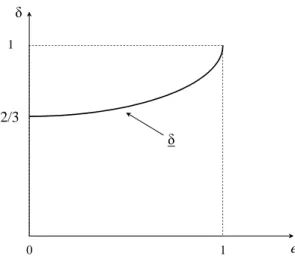
below which principals are unable to sustain tacit collusion in a repeated-interaction environment. This is depicted in Figure 1. Since @ =@e > 0; the sustainability of collusive behavior in the market for new stars
decreases with e. More particularly, for < 2=3 principals cannot sustain collusive subgame-perfect equilibria
irrespective of the value of e: On such occasions the level of enforcement of exclusive contracts plays no role
whatsoever. For 2=3, however, principals can sustain collusion if and only if e is relatively small (i.e.,
e must satisfy 2.10). In consequence, when exclusive employment contracts are more likely to be enforced by courts there exist fewer discount factors for which collusion between principals is sustainable— the set of subgame-perfect equilibria that yield collusion is reduced. Di¤erently put, the ability of principals to sustain collusive outcomes is impaired by heightened enforcement of exclusivity clauses. This idea is summarized in the following proposition.
Proposition 1 If 2 [0;2
3); a collusive outcome cannot be sustained irrespective of the value of e. If
2 [2
3; 1], however, a collusive outcome can be sustained i¤ the probability of enforcement satis…es the
condition e 3 2.
The above result has intriguing distributional implications. To see this, suppose that 2 [2
3; 1): Then,
whenever an increase in e upsets the implicit understanding between principals it also boosts the equilibrium rewards earned by stars. This is because after switching to the non-collusive equilibrium path stars earn competitive salaries whenever they are free, while in the collusive path star always get their reservation
utility w0: We deal with distributional e¤ects more thoroughly in Section 3, where some stars might earn
wages above w0 even along the equilibrium collusive path.
It is easy to see that in the presence of costless contracting, colluding principals lose nothing by always writing exclusive clauses with their agents. However, in the presence of positive but negligible transaction costs colluding principals would never write exclusive contracts. Clearly this bang-bang prediction is not very realistic. We shall come back to this issue in Section 5, where an enriched version of our basic model does permit us to study when and why costly exclusive employment contracts are signed.
2.2
Welfare Implications
Above we argued that the degree of enforcement of exclusive employment contracts (or non-compete clauses) may a¤ect principals’ ability to sustain non-competitive behavior in the “market for new talent”. Yet the
1 e
2/3
0 1
Figure 1: Relationship between e and critical discount factor.
mechanism highlighted there was neutral in terms of aggregate welfare because principals merely collude in order to maintain stars’rewards relatively low. In such a context, increases in e may only induce distributional shifts. This need not always be the case though. In this subsection we extend the basic framework by introducing other markets, and show that our framework entails e¢ ciency implications whenever less collusive behavior in the market for talent leads to pro-competitive conduct in other, not necessarily linked, markets in which principals operate. On such occasions, tighter enforcement of exclusivity deals with potential stars enhances allocative e¢ ciency and bene…ts society as a whole. The analytical vehicle we rely upon for doing this exercise is the concept of multimarket contact pioneered by Bernheim and Whinston (1990).
The main result is simple. When principals cannot maintain collusive outcomes in other markets in which they participate unless they simultaneously sustain non-competitive behavior in the market for new talent, breaking down collusion in the latter market automatically induces competitive behavior in all markets. If the shift of regime in turn raises social welfare in any of those other markets (maybe because joint monopoly pricing can no longer be sustained in a subgame-perfect equilibrium), then stricter enforcement of exclusive employment agreements turns out to be e¢ ciency-enhancing.
To formalize this intuition, suppose principals P1and P2operate (i.e. interact) in two separate markets, A
and B. Following Bernheim and Whinston (1990), we assume the markets are technologically independent.
The interaction between principals occurs at the same set of points in discrete time, f g1=0: Pi’s static
j.17 To keep things simple, assume the punishment phase in market j yields the same discounted payo¤ j to both principals in the next period, and restrict attention to stationary equilibrium paths. As shown in
the previous section, generally A(e) will be increasing in the level of contract enforcement e (see 2.8). So
we just posit that @ A(e)=@e > 0.
When principals treat the two markets in isolation, strategies (s1j; s2j) constitute a perfect equilibrium
outcome path in market j if and only if
ij(^sij(s ij); s ij) + j
1
1 ij(sij; s ij) (2.11)
for i 2 f1; 2g, where ^sij(s ij) is Pi’s static best response to s ij (see Bernheim and Whinston (1990)). This
is the analogue of condition (2.9). Next, suppose that (2.11) holds strictly for j = A but does not hold for j = B, namely iA(^siA(s iA); s iA) + A(e) < 1 1 iA(siA; s iA) and iB(^siB(s iB); s iB) + B > 1 1 iB(siB; s iB) .
These inequalities imply that if principals treat the two markets unconnectedly, collusive strategies (s1j; s2j)
are supportable as a subgame-perfect equilibrium in market A (the market for new talent) but not in market B. As it turns out, principals could do better by “pooling” the incentive constraints in order to sustain collusive outcomes in the two markets. Recognizing their multimarket contact, they could agree that any
deviation in either market will be met with future punishments in both markets.18 In this context, strategies
[(s1A; s2A) ; (s1B; s2B)] are supportable as a perfect equilibrium (collusive) outcome if
X j=A;B ij(^sij(s ij); s ij) + j 1 1 X j=A;B ij(sij; s ij) : (2.12)
As noted by Bernheim and Whinston (1990), this pooling device may be a method of relaxing binding constraints so as to increase principals’expected pro…ts. In the case being considered here, non-competitive behavior in market A is essential to sustain collusive outcomes in market B because only the former constraint was assumed to be slack. Di¤erently put, principals can use their slack enforcement power in the market for new talent to overcome incentive problems in market B: Our point is that higher enforceability of exclusive employment agreements might in fact break down collusion in “both” markets. To see this suppose, for example, there exists e such that
iA(^siA(s iA); s iA) + A(e) =
1
1 iA(siA; s iA)
1 7Following Bernheim and Whinston (1990), strategy s
iB; i 2 f1; 2g ; could be interpreted as the price announced by Piin
market B. If we also assumed that demand in market B is a decreasing continuous function of the …nal price and that aggregate pro…ts are concave in price, welfare implications would easily obtain.
and
iB(^siB(s iB); s iB) + B >
1
1 iB(siB; s iB) .
In these circumstances, (2.12) fails to hold for any e e: Our comparative statics thus indicate that when
e increases, …rms’ ability to punish in market A decreases. The novelty here is that the sustainability of more global collusive arrangements involving other markets may also collapse. Hence, when e rises aggregate welfare goes up whenever the breakdown of collusion in those other markets has positive welfare implications.
2.3
Monetary Transfers at the Contracting Stage
The above analysis rests on the assumption that agents are unable to make up-front payments to principals because they are liquidity constrained. While this is an appropriate assumption if, for example, agents lack initial wealth and cannot borrow against (potential) talent, it evidently poses a rent-extraction problem for principals. This is because in the absence of collusion, non-exclusive stars reap some of the rents created in the market. In e¤ect principals provide agents with a chance to become valuable merchandise but are unable to “charge” for this service at the outset. When monetary transfers from agents to principals at the contracting stage are possible, principals can appropriate more of the expected surplus created in the market through a suitable (signing-up) fee paid up front. That way rent-extraction problems disappear.
Under these conditions, collusion becomes unattainable independently of the probability of enforcement e. Indeed, in all likelihood principals will not be bothered about writing exclusive contracts with their potential stars. This is because a principal can reap in expected terms exactly the same rents with an up-front entry fee as with an exclusive employment contract. As a result, the gains from collusive behavior evaporate and exclusivity does not impinge on the principals’inability to sustain collusion.
This “irrelevance” result is formally summarized in the following proposition.
Proposition 2 If A can pay Pi an up-front monetary transfer at the contracting stage, then the probability
of enforcement e does not a¤ ect sustainability of collusion. Further, in this case collusion does not boost the principals’ equilibrium payo¤ s.
2.4
Asymmetric Star-Breeding Technologies
In this section we brie‡y consider the case in which principals have distinct probabilities of breeding super-stars. Perhaps the available resources to spend searching and forming potential stars vary across principals, with the result that one of them creates celebrities more frequently than the other. Be that as it may, we
posit that Pibreeds the star with probability iwhereas P idoes it with probability 1 i; where i2 [0; 1].
The chief di¤erence between this scenario and the symmetric one considered above is given by the
payo¤ when principals can sustain tacit collusion is
1 i( w0):
After any defection, the discounted payo¤ to Pi is in turn given by
1 ie( w0).
In consequence, the principals’loss as a result of deviation from a collusive behavior amounts to
1 i(1 e) ( w0) . (2.13)
Since the gains from cheating when the star is free talent in the market are again captured by (2.8), principals can sustain collusion as a subgame-perfect equilibrium if and only if
w0
1 (1 e) ( w0) minf i; (1 i)g: (2.14)
This expression con…rms our previous conclusion that as e rises, non-competitive behavior in the market for stars is more di¢ cult to sustain. Further, very asymmetric principals also …nd it relatively more di¢ cult to
sustain collusive equilibria because the term minf i; 1 ig becomes smaller— the enforcement level e for
which collusion is sustainable is lower. Formally;
Proposition 3 When the asymmetry between principals’star-breeding technologies increases, collusive
agree-ments are more di¢ cult to sustain. Speci…cally, the minimum enforcement level below which collusion can
be sustained as a SPE decreases with i 12 .
This conclusion is in line with prior literature on tacit collusion: more asymmetry between …rms makes implicit collusion less sustainable. The underlying rationale for our result is somewhat di¤erent though. E¤ectively, in most of the existing literature the mechanism at work is that a larger …rm has more to gain from a deviation and cannot be punished so severely by the smaller ones. Hence more asymmetry is pro-competitive because the dominant …rm’s incentive to defect on the agreement swells [see, e.g., Compte et al. (2002)]. Here, however, it is the weakest principal who …nds defection relatively more attractive. As this principal faces a dismal prospect of breeding its own stars in the future, the immediate gains from a defection in the current period outweigh the longer-term losses. A related result arises in the Industrial Organization literature. With di¤erent unit costs and no side payments, joint pro…t maximization might entail zero production by the less e¢ cient …rm which is thus better o¤ deviating [see, e.g., Feuerstein (2005)]. Again, more asymmetry restricts the ability of …rms to tacitly collude.
3
Heterogeneous Principals and Stars
In this section we consider a richer setting in which stars embody a quality index. This permits us to take a …rst step towards explaining why principals write costly exclusive employment contracts even when they can sustain collusion in the hiring process.
Concretely, the star’s innate talent or productivity is captured by the random variable ~ 2 [ ; ]; 0 < < ,
with continuous distribution function F (:) (density f (:)) on its support. Each period, denotes the realized
state of nature. For now, we shall assume that is observed by all parties together with the identity of the
new star— one case of asymmetric information is considered in Section 3.2.
i( ); i 2 f1; 2g ; represents the (gross) revenue created by a type star who works for Pi. Hence
principals may value talent di¤erently. We posit that i( ) is increasing and continuous, and that i( ) > w0
for i = f1; 2g. As in previous sections, the principal who hires a standard agent collects zero. Hence “agent”
can formally be treated as an individual for whom = 0; with the associated payo¤ to the principal
i(0) = w0:
We allow for transfers of talent between principals that lead to ex post e¢ ciency. So, if the star is allocated to a low-value principal after the “contract enforcement and competition for talent” stage (either because the principal is the recepient of exclusivity or because he “won”the star at the competition stage), principals may implement side payments so as to exchange the star and achieve a mutually bene…cial outcome. It is
assumed that a …xed, exogenously given share i of the surplus from Pareto-improving transfers goes to
Pi.19
As in previous sections, we start the analysis of sustainable collusive outcomes by examining the static
equilibrium of the one-shot game.20 Suppose …rst that Pi holds exclusive rights over the star in realization
1 9Implicit in our analysis is the supposition that only principals collect shares of the renegotiation surplus. Our results do
not hinge on this stark assumption, though, and the e¤ect on the analysis of relaxing this simplicity of bilateral bargaining is discussed in the Appendix.
2 0As in Section 2, principals use their privileged position at the contracting stage. So they will both make the most pro…table
wage o¤ers and sign non-compete agreements (i.e. exclusive contracts) with their agents. Therefore, equilibrium contracts in the one-shot game (and consequently along the punishment phase) are given by i= (w0; exclusive), i 2 f1; 2g. The exclusive
contracts that we consider can be interpreted as contracts whose fee to break the exclusivity clause is in…nite. So, it is never optimal to a principal to break that clause and hire a star that is exclusive to the other principal. In the spirit of Aghion and Bolton (1987), we could consider contracts that explicitly specify the (…nite) fee associated with a break of the exclusivity clause. In principle, such fee could be used by a contracting principal to extract surplus from a principal with superior valuation for the star. However, in a model like ours in which principals always renegotiate ine¢ cient outcomes, an exclusive contract specifying a …nite penalty fee is never superior (in terms of surplus extraction) to an exclusive contract with an in…nite fee. This is because, a principal with the highest star valuation facing a star tied to the other principal by an exclusive contract specifying a fee that he considers excessively high, can always reject to pay the fee and consequently not hire the star. By doing so, he forces the other principal into renegotiation, in which case he obtains the same as if the star’s exclusive contract had an in…nite fee.
. In this case, principals’payo¤s are given by E i ( ) = i( ) w0+ i[maxf i( ); i( )g i( )] (3.1) and E i( ) = i[maxf i( ); i( )g i( )]; (3.2)
where superscript “E” means enforceable exclusivity. The logic behind (3.1)-(3.2) is as follows. Pi and
P i collect their default-option payo¤s, i( ) w0 and 0 respectively, plus a fraction of any surplus from
renegotiation. For P iis contractually prevented from poaching Pi’s star. Underlying the di¤erence between
(2.1)-(2.2) and (3.1)-(3.2) is the supposition that the principal who holds exclusive rights over new talent may agree to transfer the star to its (superior) competitor whenever this action is e¢ ciency-enhancing.
Suppose now that Pi’s star is free in the market. The maximum wage Pi is willing to pay to the star in
realization , wi( ), leaves the principal indi¤erent between wining and losing the star to his rival. Hence
wi( ) must satisfy the following condition:
i( ) wi( ) + i[maxf i( ); i( )g i( )] = i[maxf i( ); i( )g i( )]. (3.3)
E¤ectively when Pi hires the star he gets i( ) wi( ) plus a fraction of the renegotiation surplus, if any.
When Pi loses the star to his rival, he gets a positive payo¤ only when i( ) > i( ). Expression (3.3)
implies that wi( ) = i( ) + i[ i( ) i( )]. Since i+ i = 1, it follows that wi( ) = w i( ), i.e.,
the maximum rewards that Pi and P i are willing to o¤er to the free star are identical. Therefore, in the
absence of collusion there is a unique equilibrium of the bidding game in which both principals’ o¤er the
maximum wage and their payo¤s are given by the r.h.s. of (3.3). Namely;21
N C
i ( ) = i[maxf i( ); i( )g i( )], for i = 1; 2. (3.4)
We denote by wN C( ) the equilibrium non-collusive wage of a free star of quality , where wN C( ) =
1 2( ) + 2 1( ) is increasing in .22 By looking at (3.4), we can infer that the payo¤ to the
highest-value principal is strictly positive only when he has some bargaining power. So a principal who not only has relatively high bargaining power but is much more productive than his competitor will manage to appropriate most of the surplus created by free stars in the market.
2 1Notice that if
i= 1if i iand i= 0otherwise, we obtain a standard Bertrand-type equilibrium outcome in which
the winning principal pays a salary equal to the value of the other principal.
2 2The star’s highest salary thus occurs when the principals are identical or the most e¢ cient one has no bargaining power.
The star’s lowest salary occurs when the bargaining power of the most e¢ cient principal equals one— her reward is given by the other principal’s valuation. Finally, when i= i= 0:5the star’s reward locates halfway between the values of the two
To sum up, Pi’s expected payo¤ in the (static) equilibrium of the one-shot game is given by
i[maxf i( ); i( )g i( )] + e [ i( ) w0] . (3.5)
Thus the discounted payo¤ stream from the punishment path amounts to
1 E i[maxf i( ); i( )g i( )] +
1
2e[w
N C( ) w 0] .
Principals always capture their respective shares of the surplus from renegotiation. In addition, a principal expects to appropriate the di¤erence between the non-collusive wage and the reservation wage whenever he breeds an exclusive star (which occurs with probability e=2).
Next, let us compute the expected discounted value of principals’pro…ts along a collusive path. To this end, we extend the notion of collusion to encompass situations in which principals tacitly agree on an upper bound to the salaries o¤ered to free stars. More speci…cally, a collusive agreement is de…ned by a schedule
wC( ) that speci…es the maximum wage wC( ) that principals can o¤er to a type free star. Throughout
the following analysis, we refer to this wage as the cooperation wage and to wC( ) as the cooperation wage
schedule. A deviation from an agreement with cooperation wage schedule wC( ) occurs whenever a principal
o¤ers a wage bigger than wC( ) to a type star that is free.23 We thus allow for on-equilibrium realizations
in which wC( ) > w
0. This is a generalization of the type of collusive agreement studied in Section 2 because
it enables principals to sustain (some) wage cooperation when coordination on the lowest possible wage, w0;
is not sustainable.24 Finally, note that in a collusive equilibrium path in which principals tacitly coordinate
on wage schedule wC( ), equilibrium bids for a type free star equal wC( ) w
0— the wage prescribed by
wC( ). (We assume that whenever a star receives identical o¤ers from both principals, she accepts the one
made by her current employer.)
When Pi’s agent becomes a type free star and principals cooperate on the wage schedule wC( ), their
equilibrium payo¤s are given by
C
i ( ) = i( ) wC( ) + i[maxf i( ); i( )g i( )]; (3.6)
C
i( ) = i[maxf i( ); i( )g i( )]: (3.7)
2 3A similar form of collusive agreement is used in Rotemberg and Saloner (1986).
2 4Note that this type of collusion comprises, as special cases, situations in which principals never try to hire each other’s
stars and fully competitive outcomes. The former occur when coordination focuses on the wage schedule wC( ) = w 0 for all
2 [ ; ], whereas the latter occur when wC( ) = wN C( )for all 2 [ ; ].
We did not consider explicitly this more general form of collusion in Section 2. We considered only collusive outcomes with cooperation wage w0. This was without loss of generality because with homogeneous stars, a collusive outcome with
cooperation wage wC w
0is sustainable if and only if it is with cooperation wage w0. Further, by focusing on equilibria with
cooperation wage w0 we focused on the most pro…table equilibria to principals. As we shall see, this is not the case when stars
Hence P igets exactly what it would have obtained had principals abstained from colluding (compare (3.4)
with (3.7)). Pigets, in addition to that, the di¤erence between the star’s competitive wage and the collusion
wage, i.e., Ci ( ) = N Ci ( ) + [wN C( ) wC( )].
When Pi’s star is exclusive, however, the principals’ability to collude is irrelevant and their payo¤s are
given by E
i ( ) [as given by (3.1)-(3.2)], i 2 f1; 2g, so long as Pi’initial contract with the star speci…es wage
w0.
Unlike in Section 2, enforcement of exclusive contracts is important even along the collusive path. For
in any equilibrium outcome with cooperation wage wC( ) > w
0, principals are better o¤ when exclusivity
is enforced because on such occasions the recipient of exclusivity also appropriates wC( ) w
0. Thus, as
long as e > 0, principals are better o¤ signing exclusive employment agreements with their agents (despite non-negligible transaction costs). In the analysis that follows we shall focus on the most pro…table collusive equilibrium to principals. We thus focus on collusive equilibria in which principals sign (on-the-equilibrium
path) the most favorable contract to them, i.e., equilibria in which i = (w0; exclusive), i 2 f1; 2g.
The above analysis implies that the principals’(symmetric) expected discounted payo¤s when they can sustain collusion in a subgame-perfect equilibrium path equal
1 E i[maxf i( ); i( )g i( )] + 1 2[w N C( ) wC( )] +1 2e[w C( ) w 0] . (3.8)
The intuition is as follows. A principal expects to always collect the …rst term in the curly brackets of (3.8) irrespective of whether he initially contracted with the star or not. The second term represents the additional expected payo¤ that accrues to a colluding principal when its agent becomes a star, whereas the third term captures the extra payo¤ to a colluding principal that employs an exclusive star. Notice that in terms of expected aggregate payo¤s to principals, collusion is equivalent to enforceable exclusivity only if
the cooperation wage equals w0.
Consider now the net gains from cheating on the collusive agreement. Particularly, suppose Pi o¤ers
w > wC( ) to P i’s type star when the latter is free in the market. Since Pi makes the best wage o¤er
(that is acceptable to the star) and gets i( ) plus a fraction of any renegotiation surplus, the maximum
“net” gains from cheating on the tacit understanding are
i( ) wC( ) i[ i( ) i( )]. (3.9)
This expression in fact boils down to
wN C( ) wC( ).
As a result, in realization principals can sustain collusion along a perfect equilibrium path with cooperation
wages wC( ) so long as wN C( ) wC( ) 1 1 2(1 e)E w N C( ) wC( ) . (3.10)
Note that the right-hand side of the above inequality encapsulates the expected discounted value of the long-term loss from deviating on the collusive agreement in the current period. A collusive equilibrium path
with cooperation wage schedule wC( ) is therefore sustainable if and only if (3.10) holds for all in [ ; ].
For expositional reasons, we state this result in the following lemma.
Lemma 1 Collusive outcomes (with contracts i = (w0; exclusive); i = 1; 2; and) with cooperation wage
schedule wC( ) can be sustained in a subgame-perfect equilibrium path if and only if
wN C( ) wC( ) 1 1 2(1 e)E w N C( ) wC( ) for all 2 [ ; ]. (3.11)
Proof. See Appendix.
The following proposition generalizes the main conclusion of Section 2 by showing that the ability of principals to sustain collusive outcomes is impaired when law courts are more likely to enforce exclusive employment contracts.
Proposition 4 The set of collusive equilibria (with contracts i = (w0; exclusive); i = 1; 2) is
“non-increasing” in the level of enforcement, e. More speci…cally;
1. If a non-competitive equilibrium with cooperation wage schedule wC( ) is sustainable when e =be, then
it is also sustainable if e be.
2. For every non-competitive equilibrium with cooperation wage schedule wC( ) that is sustainable when
e = 0, there exists a level of enforcement e (w( )) such that collusion with cooperation wage schedule wC( ) is not sustainable for e > e (wC( )).
Proof. Point 1. follows from Lemma 1 and the fact that the r.h.s. of (3.11) is decreasing with e. Point
2. follows from Lemma 1 and the fact that the r.h.s. of (3.11) is decreasing with e and converges to 0 as e approaches 1.
We next investigate how the level of enforcement of exclusivity a¤ects stars’ equilibrium wages and principals’ expected payo¤s. This allows us to revisit distributional issues in a more realistic context. To undertake such a comparative-static analysis, we focus on the most pro…table outcomes that principals can sustain in a collusive equilibrium path. In this respect, we de…ne the “most pro…table collusive equilibrium”
as one in which principals tacitly agree to o¤er free stars the lowest sustainable wage wC( ) w
0 for each
type star.25
2 5This de…nition implies that in the most pro…table equilibrium principals’ expected payo¤s are the highest among the
payo¤s in all possible collusive equilibria, but it is slightly stronger than that. For it also entails the existence of a well-de…ned cooperation wage schedule wC( )in the most pro…table equilibrium.
As a starting point, let us characterize cooperation wages in the most pro…table collusive equilibrium that principals can sustain.
Lemma 2 The cooperation wage schedule wC( ) associated with the most pro…table collusive equilibrium
may be characterized as follows:
wC( ) = 8 < : w0 if wN C( ) K if > ,
for some and K such that wN C( ) K > w
0 for all 2 max f ; g ; .
Moreover, if e < e = 3 2 the most pro…table collusive equilibrium exists and is such that 2 ( ; ]
and K = wN C( ) w
0.
Proof. See Appendix.
The argument behind Lemma 2 is simple. In the most pro…table collusive path, principals pay free stars the lowest wage packet for which the immediate reward for deviating from the agreement is outweighed by the expected discounted value of future punishments. The key feature though is that the gains from cheating covary with the quality of the current star in the market. E¤ectively, in low states of nature the temptation to cheat is relatively small with respect to the expected value of future punishments (which depends on
future realizations of ~). Hence principals can sustain w0 as a cooperative wage. When principals are faced
with a free star of abnormally high quality (a superstar ), however, the gains from deviating rise relative to the present value of future punishments. On such occasions incentive compatibility requires that principals
pay non-competitive wages above w0. That way, the reward for defecting in the current period shrinks.
Another interesting implication of Proposition 2 is that for stars of relatively high ability (i.e. in realizations
where > ), the “marginal reward” to ability under the most pro…table collusion equilibrium is identical
to that under non-collusion. More speci…cally, whenever > the non-cooperative wage function wN C( )
di¤ers from the cooperation wage schedule wC( ) by just a constant.
The result that in some realizations of ~ principals may …nd it pro…table to collude on wages above w0to
diminish the temptation to cheat is reminiscent of Rotermberg and Saloner (1986). In their case, periods of relatively high demand are accompanied by output beyond the joint pro…t-maximizing level so as to reduce the immediate bene…ts reaped by a deviating …rm. This behavior gives rise to the so-called “price wars
during booms”.26 Here, however, superbly talented stars who are free in the market earn premium wages
2 6Snyder (1996) relies on a similar sort of logic to develop a theory explaining discounts for large buyers. In his model, a
buyer’s countervailing power stems from the fact that he may accumulate a large backlog of un…lled orders and purchase all at once. The o¤-equilibrium-path strategic threat of using lumpy orders generates “endogenous” booms in demand that once again constrain collusive sellers.
because principals attempt to sustain collusive outcomes. Since cooperation between principals never really breaks down, these outcomes are a sort of “cold wars” for talent.
We now move on to analyze how e a¤ects stars’ equilibrium wages along the most pro…table collusive equilibrium sustainable by principals. Since Proposition 4 showed that the sustainability of collusion with a
given wC( ) depends on the probability of enforcement, we refer to the cooperative wage schedule and the
cuto¤ associated with the most pro…table equilibrium as functions of e: wC( ; e) and (e), respectively.
The next result then follows.
Proposition 5 Suppose that (e) < (i.e., cooperation on the lowest possible wage w0 for all 2 [ ; ]
is not sustainable in equilibrium). Then, the cooperation wage wC( ; e) associated with the most pro…table
collusive equilibrium is strictly increasing in e; for each 2 [max f ; (e)g ; ]. Further, if (e) then
(e) is strictly decreasing in e.
Proof. See Appendix.
Proposition 5 establishes that stars’wage packets tend to increase (more speci…cally, do not decrease) as exclusivity is more tightly enforced by courts. This comparative-static result may seem self-evident, since tighter enforcement of non-compete covenants ultimately means that principals have to pay more to hire their agents exclusively. However, the underlying mechanism at work in our model is much more subtle. When the level enforcement of exclusive contracts increases, collusion becomes more di¢ cult to sustain because future punishments on deviants are less severe. In order to sustain optimal collusive equilibria, principals must therefore permit high-ability stars to earn higher wages and content themselves with lower pro…ts. That way, neither principal …nds it pro…table to deviate from the agreement.
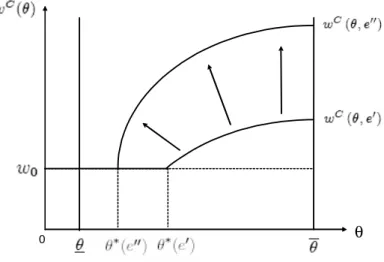
Figure 2 illustrates the central messages of Propositions 5 and Lemma 2, where we depict the cooperative
wage schedule, wC( ); as a function of the quality parameter, (we further assume that
i( ) is strictly
con-cave). We consider there a comparative-static exercise for two …xed values of the probability of enforcement,
e0> 0 and e00> e0: Note that as e rises, the wage schedule shifts upwards and the cut-o¤ value plummets
in order to ful…l condition (3.11). As a result of the increase in e, there are more realizations in which stars
are paid “non-competitive”wage packets above w0— we stress the word non-competitive because these wages
are lower than wN C( ) :
We can now tackle distributional issues. Particularly, we would like to know what happens to the expected discounted payo¤s to stars and principals after a change in the probability of enforcement, e. In that connection, the fact that free stars of relatively high ability earn higher equilibrium wages when e goes up implies that they may actually gain from tighter enforcement of non-compete clauses. The ‡ip side, of course, is that superstars are less likely to become free. This is analyzed more formally in the next proposition.
θ
0Figure 2: Cooperative wage schedule
Proposition 6 Consider a given probability of enforcement of exclusive contracts, e0, and suppose that the
most pro…table collusive equilibrium is such that (e0) 2 ( ; ). If the probability of enforcement rises to
1 > e00> e0, we have that:
(i) either (e00) < and stars with ability 2 [ ; (e0)] are better o¤ , or (e00) and stars with ability
2 [ ; (e00)] earn the same while stars with ability 2 ( (e00); (e0)] are better o¤ ;
(ii) either all stars with ability 2 ( (e0); ] are better o¤ , or there exists { 2 ( (e0); ) such that stars
with ability 2 ( (e0); {) are better o¤ and stars with ability 2 ({; ] are worse o¤.
Further, the principals’expected payo¤ s along the most pro…table collusive equilibrium path may decrease with the level of enforcement of exclusivity provisions.
Proof. See Appendix.
When e rises, there are two opposite forces at work. For one thing, a larger fraction of the expected rents created in the market accrue to the colluding principals because stars are free less often. For another
thing, collusion is harder to sustain and in some realizations the coordinated wage schedule wC( ) increases.
Hence expected rents to the colluding principals falter. The interplay between these two e¤ects ultimately determines whether principals and stars lose or gain from movements in e. To illustrate, consider relatively low realizations of ~. On these occasions principals can a¤ord to pay low wages on the collusive path even
when exclusivity is not enforced. Since the marginal loss from decreasing the likelihood of becoming free stars in the market is low, the second e¤ect dominates and stars are better o¤ when enforcement swells. In relatively high realizations of ~, however, colluding principals need to o¤er premium wages to free stars. Therefore the marginal loss from being free in the market less often is high and may o¤set the marginal gain from increases in the coordinated wage bill. In this case, the …rst e¤ect dominates and superstars are worse o¤ with heightened enforcement.
A consequence of this is that changes in the enforcement parameter need not have the same impact on the well-being of all stars. Particularly, a shift in the legal environment toward stricter exclusivity enforcement may induce a redistribution of expected surplus from top stars to stars of relatively low ability. There also exists a parallel redistribution of wealth between principals and potential stars. An important implication of Proposition 6 is that an increase in the (probabilistic) enforcement level is not necessarily bad for stars and good for principals. Actually exactly the opposite may be true. This conclusion stems from the impact of stricter enforcement on the most pro…table collusive equilibria that principals can sustain.
3.1
Partial Collusion and Star Wars
In this section, we discuss brie‡y how our results extend to a simpler form of collusion in which, given a state of nature, principals either abstain from hiring each other’s star or engage in …erce competition for the new talent. This sort of collusion is appealing because it requires relatively little coordination and/or communication between principals— the prescribed strategies are less delicate. Thus it is easier to implement in practice. The downside, of course, is that principals no longer choose the most pro…table collusive behavior. Hence there is a basic trade-o¤ between simplicity and pro…tability. While arguably less burdensome as far as strategic coordination is concerned, this scheme raises the average cost of hiring new talent because coordinated behavior coexists with blatant star wars in equilibrium.
Full collusion means principals cooperate in all possible realizations, i.e., they tacitly agree not to poach
each other’s star irrespective of the latter’s ability. When collusive behavior for all 2 [ ; ]) is not
sustain-able, however, principals might focus on less ambitious outcomes in which coordination only occurs in some
realizations of ~. For example principals may adopt non-competitive conduct if and only if 2 [ ; ];
where stands for the cooperation set. These outcomes are called perfect equilibria with “partial collusion”.
In the presence of partial collusion employers bid for new talent whenever 2= ; but this competitive
be-havior is not considered a defection on the tacit agreement. All this leads to …erce competition for superstars because in relatively high realizations of ~; pro…table deviations cannot be deterred. Stars’equilibrium wages are therefore either w0or wN C( ).27
2 7Thus bidding wars for superstars may occur both on and o¤-the-equilibrium path. In our model, bidding wars occur
Consider an equilibrium with partial collusion in which principals behave non-competitively only if 2 .
This situation corresponds to the following cooperative wage schedule: wC( ) = w0 if 2 and wC( ) =
wN C( ) if 2= . In consequence, cooperation wages di¤er from competition wages only when the star’s
ability 2 . The equilibrium sustainability condition of Lemma 1 then becomes
wN C( ) w0 1 1 2(1 e)E f w N C( ) w 0 2 g Pr[ 2 ], for all 2 : (3.12)
Direct inspection shows that when courts are more prone to enforce exclusive contracts, condition (3.12) is less likely to hold. Indeed Proposition 4 implies that the set of collusive equilibria (partial or total collusion) cannot increase with the level of enforcement, e. In other words, if an equilibrium with partial collusion and
cooperation set is sustainable when the e =be, then it is also sustainable when e be.
We now focus on the most pro…table collusive equilibrium with partial collusion. Since principals’payo¤s are decreasing in stars’ wage packets, the payo¤s to principals on the equilibrium path increase with the
cooperation set (where set 1 is said to be larger than set 2 if 2 1). Suppose now that a collusive
equilibrium with cooperation set 6= ? exists, and consider an arbitrary 02 . Inequality 3.12 is trivially
satis…ed for = 0. Further, since the l.h.s. of 3.12 is increasing in , it must also hold for every 00< 0.
This observation, together with the fact that in the presence of partial collusion principals’payo¤s increase with the size of the supportive cooperation set, dictates that in the most pro…table equilibrium principals
cooperate whenever sup .28 Consequently, the cooperation set of the most pro…table equilibrium with
partial collusion is of the form [ ; (e)], for some (e) 2 [ ; ]— principals cooperate for stars of relatively
low ability but compete …ercely for top quality talent.
The sustainability condition for the most pro…table equilibrium is then given by
wN C( ) w0 1 1 2(1 e)E f w N C( ) w 0 2 g F ( (e)) (3.13)
for all (e). When the cuto¤ (e) lies inside the set [ ; ], (3.13) has to hold with equality. In such
circumstances, an upward shift in the enforcement level from e to e0 triggers a decrease in the r.h.s. of (3.13)
and therefore (e0) < (e).
The aforementioned implies that heightened enforcement of exclusivity provisions leads to more
realiza-tions with star wars. Competition for the marginal stars— i.e. those within ( (e0); (e)]— increases, and
is di¤erent from the mechanism that generates price wars in Green and Porter (1984). In Green and Porter (1984), price wars occur on-the-equilibrium path because of an informational problem: when …rms observe a low market price, they do not know whether that is due to a negative shock in the demand or to a deviation by one of the other …rms. Thus, to make collusion sustainable, a punishment always follows observation of a low market price (even when that is exclusively due to an exogenous demand ‡uctuation).
2 8The inequality is not strict because the l.h.s. of the inequality in (3.12) is continuous in . Thus, if condition (3.12) is