1 A Work Project presented as part of the requirements for the Award of a Master’s Degree in
Management from the NOVA School of Business and Economics
ORGANIZATIONAL FRAMEWORK FOR MICROFINANCE SUCCESS? STRUCTURAL ELEMENTS OF MICROFINANCE INSTITUTIONS
Michele Beretta #27428
A Project carried out on the Management course, under the supervision of: Professor Miguel Alves Martins
Lisbon, January 3, 2017
Michele Beretta
Phone: +351 932 761 994
2
Abstract
Microfinance (MF) is a relatively young and somewhat ambiguous concept. The phenomenon has, however, proven to contribute to making the lives better for many poor people whist being financially sustainable, thus the interest for the industry has grown substantially. The increased attention has stimulated various types of organizations to enter the market, some achieving astonishing results both in financial and social performance. This study aims to map the organizational framework that associate MF institutions (MFIs), using successful
sustainable organizations with different business models as references. Literature does not provide comprehensive and practical tool to define qualitatively the internal structuring of MF institutions, but allowed the collection of methodologies and successful cases to discover a central thread within their organizational frameworks.
Key Words: MF, MF institutions, Organizational Framework, Structural Elements, Successful cases.
3 Contents
Abstract ... 2
1. Introduction ... 4
2. Literature review ... 6
2.1 MF Institutions Market Idiosyncrasy ... 6
2.3 Organizational architecture ... 8
2.4 Research design for key organizational architecture elements ... 9
2.4.1 Input dimension ... 9
2.4.2 Transformation dimension ... 10
2.4.3 Organization-environment-dimension ... 10
2.6 Literature review conclusion ... 11
3. Methodology ... 11
3.1 Sample selection ... 12
4 Business models (BMs) ... 13
5. MFIs organizational framework ... 15
5.1 Legal structure ... 15
5.2 Governance and MFI leadership ... 16
5.3 Capital structure ... 16
5.4 Organizational culture (OC) ... 17
5.5 Human Resources ... 18
5.6 Organizational system ... 18
5.7 Institutional Support System (ISS) ... 19
5.8 Planning system ... 20
5.9 Control Systems ... 20
5.10 Cost effective system ... 21
5.11 Product Development ... 21 5.12 Competitive drivers (CD) ... 21 5.11.1 Rural presence ... 22 5.11.2 Additional services ... 22 5.11.3 Clientele Selection ... 22 5.11.4 MF product range ... 23
5.11.5 Differentiated microcredit and saving products ... 23
5.11.6 Technological innovation ... 23
6. Conclusions ... 24
6.1 Main outputs ... 24
6.2 Limitations ... 25
6.3 Recommendations for further researches ... 25
4 1. Introduction
Microfinance (MF) is defined as the provision of financial services to low-income people who traditionally have been excluded from financial systems (Hermes et al. 2011; Pe´rilleux et al. 2012) because they were considered un-creditworthy or too expensive to serve (DiLeo & FitzHerbert, 2007), instead, empirical studies (DFID, 2004) confirmed MF to be a catalyst for private sector development. MF is considered as one of the most promising instruments to reduce poverty and promote economic development in many areas of the world. Its potential is based on the idea that poor people have an unexplored amount of entrepreneurial skills that ought to be considered in any sustainable development plan. MF was designed to help the poor to help themselves. MFIs are financial providers that focus, sometimes exclusively, on delivery of financial services targeted at low-income people whose income sources are typically informal, rather than wages from registered employers. Among these financial services, microcredit predominates in most MFIs today, but savings, insurance, payments, and other money transfers are being added to the mix, as well as more varied and flexible forms of credit. MFIs take many forms—for instance, informal village banks, not-for-profit (NGOs) lending agencies, savings and loan cooperatives, for-profit finance companies, licensed specialized banks, specialized departments commercial banks, and government programs and institutions. Commercial MF appeared for the first time more than 40 years old, and it has continuously grown since then, reaching a portfolio of 87 Billion USD, and 111 million customers served by 1045 MFIs (MF Barometer, 2016). This growth has been driven as much by public institutions as by an increasing number of private institutional and retail investors (CGAP, 2011). Indeed, MF investing has become the flagship of the rapidly growing impact investment movement. However, on a global basis MF is likely reaching no more than about 10-15% of potential clients today, and the potential demand for MF services remains largely unfulfilled. Furthermore, demographic, and economic trends, including the high proportion of youth, low-mid education and skills development, rural to urban migration and sluggish absorptive capacity
5 of the formal sector, ensure that the pool of potential clients in all developing countries will continue to grow (Otero and Rhyne 2006).
The worldwide heightened interest in MF driven from good performances of some MFIs, together with the strong emotional impact on public opinion, have attracted a large number of national institutions, banks, NGOs and donors to this emerging market. Despite being active in the same markets, these institutions are motivated by different objectives, spanning from poverty reduction to profit maximization, passing through different definition of financial sustainability, respectively having different goals, internal functioning, and resources available. The differences in business models are yet to be explored, in order to define a central thread within their organizational framework.
The identification of lack in studies concerning MFIs’ organizational frameworks resulted, also, from a preview research project, in which I participated. The research aimed to understand how MFIs in similar environment perform in (1) financial performance; (2) structuring; and (3) positioning, throughout quantitative benchmarks. The study provided a clear overview on MFIs’ outputs, resulting from particular strategies and undefined organizational frameworks. The research has been struggling to get access to useful material from the literature, which has been failing at providing qualitative systemized information on MFIs’ (1) organizational frameworks, (2) generalized industry strategies, and (3) detailed business models. Most of what has been done was developed towards traditional financial institution, corporates, and traditional businesses, and not to the inclusive financial sector (United Nations Publications, 2006). The potential of creating knowledge for market practitioners is fundamental, by creating guidelines that specify which are those elements that lead to the MFIs outcome. In the presence of this need, this thesis aims at understanding (1) which are the most common MFIs’ business models (2) do successful MFIs have common elements that compose their organizational frameworks; and (2) how differently do those MFIs develop those elements. This work project should add value to academia, to the previews research project report and, most important, to
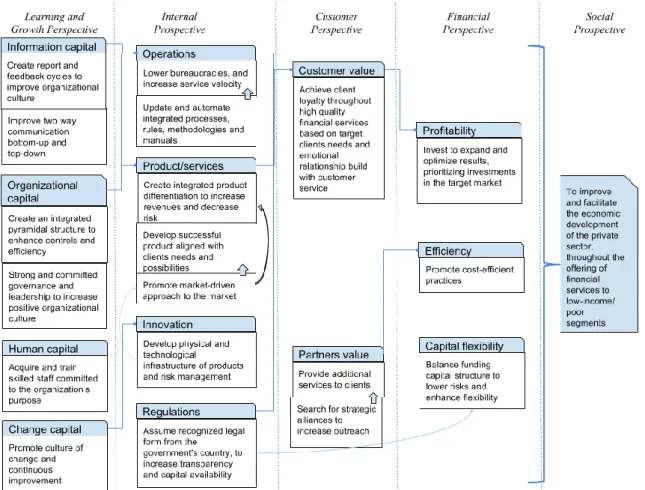
6 MF practitioners that are willing to provide financial products to those that do not have access to them. The study includes a literature review on the topics of market taken into consideration, and the methods used to define the MFIs’ organizational framework. It will follow the methodology utilized to select literature and the sample of successful MFIs used as reference for the study. The conclusion will summarize the results by designing a balance scorecard strategy map to clearly communicate key “landmarks” of a typical MFI that is willing to develop and distribute financial products to economically active poor/low-income clients. Limitations, and recommendations are driven by the end of the paper.
2. Literature review
In an effort to study MF and their organizational framework, the information in this document was derived largely from lessons in the vast business literature. Because of this piecemeal formalization of MF, MFIs are not always structured or organized following guided principles. For MF to fully establish itself as a pioneering industry, it must combine the successful practices and behaviours of the business community with the social mission of the development world. Additionally, studying internal structuring and strategies of MFIs result to be particularly difficult, because (1) MFIs are peculiar organization that combines different institutional logics in unprecedented ways (Scott & Meyer, 1991), (2) there is no single MF business model, but rather a number of models pursued by different types of institutions (Cull et al, 2016), and (3) MFIs cannot rely on any “ready-to-wear” model.
2.1 MF Institutions Market Idiosyncrasy
The MF movement can be described by an accumulation of revolutionary inventions, which combine determinate knowledge, techniques, and concepts. It qualifies as a revolution in that it radically overturned established idea of the “unbackable poor people”. As displayed by Figure 1, the core MF market might be defined as some substantial proportion of the 1.1 billion working age people with incomes between $1 and $2 per day (DiLeo et al, 2007), differently
7 from the commercial bank and NGOs (and MFI subsidized). In this paper only the MFIs’ idiosyncratic market is taken into account.
Figure 1. MFI positioning in the financial market1
MFIs differ from traditional financial institutions mainly in financial products delivery, operational process and costs, marketing implications, and customer relations. Receiving and delivering financial product daily to thousands, even millions, low-educated customer is possible only via the design and implementation of widely studied mechanisms such as group lending, dynamic incentives, regular repayment schedules etc. These tools allow MFIs to tackle issues such as moral hazard, absence of collateral, adverse selection, gender specify and so on (Rosenberg et al, 2013). But the implementation of these mechanisms is complex, often delicate. Therefore, MFIs charge relatively higher interest rates2 than standard financial services to achieve financial sustainability. MFIs are often defined as “high touch business” (Rosenberg et al, 2008) due to its close relation to their customers. These idiosyncrasies increase the study’s relevance of defining how MFIs’ organizational framework and business models are developed. Therefore, using already existent models to define those elements is fundamental.
1 Reproduced from Robinson (2001)
8 2.3 Organizational architecture
Organizations are formal structures which are consciously created by actors to achieve specific objectives, and they are directly responsible to creation of institutions, which lay on plans and standard-setting, and a set of external rules (Craig, 1997; North, 1990).
Consequently, organizations need to be built with plans to define its elements, in the same way an architect designs and constructs buildings. The plan outlines not just where the walls and windows will be, but also how the plumbing and electricity will flow and connect all the rooms. The proposed function of that space determines the shape and the location of the rooms. In the process of building architects must balance competing forces, such as the concern for beauty with the need for energy conservation and the multiplicity of owner-specified requirements with budgetary constraints. With this allegory Tomasko (1993) defines the term of “organizational architecture”, which reflect the need of inclusive view of design elements, and the social and work systems that make up organizations, thus, MFIs. Organizational architecture includes formal structures, such as the design of work practices; the nature of the organization or operating style; and the process for selection, socialization, and development of people; the legal forms assumed in the organization; etc (Nadler et al., 1992). Architecture encourages a holistic approach to design, which focus on creating a durable organization composed of structural elements in harmony among them. In his paper Craig (1997) utilizes the architectural logic applied on growing MFIs, which occurs in the need of scaling to outreach and increase sustainability. Whether an organization is a “new construction” or a “renovation,” it must be brought into being through a complex architectonical process prone to innovation and growth, which represents the competencies and strength of MF. Therefore, the fundamental elements to the success of MF must be reflected in its architecture. Tomasko (1993) and Nedler (1992) define three main element that compose organizational architecture as: (1) human resources, (2) organizational structure, and (3) institutional culture.
9 2.4 Research design for key organizational architecture elements
The architectural framework appears to look at organizations as static figures (buildings), and most managers still see organizations with the classic hierarchical pyramid-shaped structure (Tomasko, 1993), which is a prospective based on a snapshot in time, and it focuses on a stable configuration of jobs and work units as the most critical factors in an organization (Nadler et al, 1992). Nevertheless, it results in limiting the understanding of organizational complexity of its systems and its interaction with the external environment.
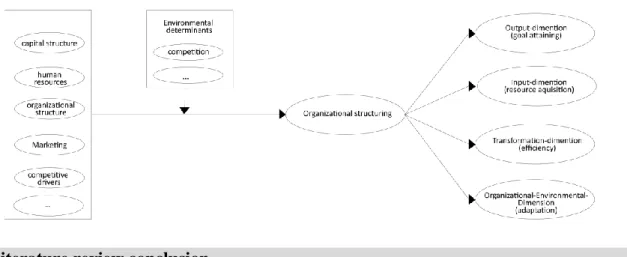
According to the contingency theory “organizations can be better understood if they are considered as dynamic and open social systems” (Nedler et al, 1980). The system approach implies that the organization is seen as a complete entity composed from different elements, which comply and integrate the organizational architecture definition. It follows that, to study organizations as systems not only the structure must observed but also processes, not only social but also technological factors, not only the closed organization but also its interaction with the environment. With the system approach, organizations appear embedded in a system framework, where they acquire inputs, engage in transformation processes, produce outputs, and interacts with the external environment.
Indeed, MFIs are organizations which are embraced within a system that is directed to one final purpose, as the goal-attaining prospective indicates that organizations exist to accomplish predefined goals (Etzioni, 1964).
2.4.1 Input dimension
Firstly, focusing on the input dimension, the resource dependent model (Yuchtman et al, 1967) considers the organizational effectiveness as the ability of an organization to acquire scarce and valued resources critical for its survivor -or entering- in the market. However, the input of resources cannot be considered as sufficient condition for organizational effectiveness, but a necessary component for their final success (Yuchtman et al, 1967). Studies on capital structuring, raising of capital, staff recruitment (human resources), infrastructure development
10 (legal structures), and clientele selection, thus, offer elaborations on the input dimension of MFIs (Pinz at el., 2014).
2.4.2 Transformation dimension
Second, the internal congruence model (Nadler et al, 1980) particularly considers business processes as the transformation of inputs into outputs in the most efficient way. This transformation dimension appears to be is crucial for MFIs which combine highly complex structures with clientele that is usually hard to reach. With this model it is possible to recognize which are the MIFs’ transformation dimension components that enhance efficiency, such as the organizational structuring, operational models, control systems, product development (market approaches), and information management.
2.4.3 Organization-environment-dimension
Finally, because MF is context specific (Yaron, 1994) investigations on MFIs programs replications in different parts of the world may be subsumed under the elements that MFIs use to compete in different markets. In other words, the model is characterized by certain strategies and distinctive attributes that result in being prosperous even if exported to other environments. Therefore, by studying the organizational-environmental dimension and its relation, it can be recognized what are these characteristics that organizations export in order to be successful in other environments, thus, their competitive drives.
In conclusion, considering all four dimensions, organizations can be selected and anatomized because only by assessing the structural elements comprehensively is possible to identify reliable determinates of organizational success with respect to different parts of the business process (Helmig et al. 2013). Figure 3 illustrates a typical research design for success factor studies in strategic management research.
In conclusion, organizational relevant elements that enhance input of resource, efficiency in transformation, and organizational-environmental adaptation are relevant dimension to study MFIs’ composition, and add to the “organizational framework” further elements.
11
Figure 2. System approach Dimensions and Components
2.6 Literature review conclusion
MFIs’ organizational framework is the component that must be built from the base to create a favourable institution that promotes innovation and growth. Therefore, this document aims to define which are the most important elements that MFIs must put in place to create a base for success. Thus, the definition of this framework has been created by combining different methodologies, which enabled the study to have a wider prospective on the analysis.
Consequently, the most important elements of MFIs’ organizational framework were defined throughout research design combining the “organizational architecture” logic and other theoretical conceptualization of organizational system. Therefore, this widened groundwork defines, analyses and designs inter-related components that are essential in MFIs’ organizational composition, which are: (1) legal structure, (2) capital structure, (3) institutional culture (3) human resources, (4) clientele selection, (5) organizational system, (6) institutional support system, (7) control system, (8) market driven mechanisms, and (9) competitive drivers.
3. Methodology
This study relies on the procedure suggested by Denyer and Trangield (2009) on systematic review3, which is a specific methodology that locates existing studies, selects, and evaluates contributions, analysis, and reports in such a way that allows reasonably clear conclusions to
12 be reached about what is and is not known. Fifty-five (55) articles and reports were identified4 belonging to the MFIs’ research of organizational frameworks.
3.1 Sample selection
The reference to existing MFIs is intended to recognize organizational elements within those institutions, and provide best practices examples. However, the sample selection has been one of the major issue in developing of this study. The main reasons are (1) the lack of reports, literature, and observation on start-up MF institutions, and (2) a definitive methodology to select successful MFIs to observe.
The selection was driven by three criteria: (1) success of the MFIs defined as their outreach under a constrain of self-sustainability, (2) availability of exhaustive reports and data of the MFI, and (3) MFIs assuming different business models. Using the MIX5 data base, table 1 was
extracted, which gives the rank (out of 971) of the top 5 MFIs according to the scale of their outreach in terms of depositors and borrowers under self-sustainability constraint (OSS ≥ 100). However, the following data limitations should be kept in mind: MIX do not gather data of the whole market, it comprehends only organizations that agree to deliver their results in given year/semester.
Table 1. Top five outreach MFIs from MIX database6
LOANS (2015 DATA) SAVINGS (2015 DATA)
MFIS GLP NAB ALBB/GNI OSS MFIs Deposits ND ASAD/GNI OSS
GB 1.294.646.242 7.180.000 5,06% 100,6% EBS 2.316.160.712 8.437.020 9,18% >100% VBSP 6.434.685.129 6.863.035 16,33% 105,6% ASA 646.397.521 7.428.597 2,44% 188% ASA 1.533.970.742 6.207.689 6,94% 188,8% VBSP 2.135.921.729 6.016.399 6,18% 105% BRAC 1.436.605.804 4.923.936 8,20% 175,0% BRAC 515.221.021 5.799.933 2,50% 175% BHARAT 1.161.676.257 4.636.669 4,13% 143,4% BCS 2.427.074.173 5.300.169 3,37% 128%
4 See appendix 3.2 for the articles’ full list
5 MF Information Exchange, which gather financial and non-financial data from more than 700 MFIs 6 Table’s Acronyms: R: ranking | GLP: gross loan portfolio | NAB: number of active borrowers | ALBpB: Average loan per Borrower | OSS: operational self-sustainability | ND: number of depositors | ADBpD: Average deposit per depositor
Table’s MFIs: GB: Grameen Bank (Bangladesh) | BRAC (Bangladesh) | ASA: association for social advancement (Bangladesh) | BHARAT (India) | VBSP: Vietnamese bank for social policy (Vietnam)
13 For instance, EBS did not report to MIX its OSS, yet it has a significant profit of 232,8 mil USD$ in 2015, thus, it can be considered with an OSS>100%. This first criteria allocate the quality of successful by utilizing the goal-attaining prospective which indicates that organizations exist to accomplish predefined goals (Etzioni, 1964), so organizational success reflects the degree of target achievement (Price, 1972). The whole sample have a double bottom approach to MF composed by their social performance considered as the breadth of outreach (Schreiner, 2002), where (as showed in table 1) are the best worldwide, and their financial performance, which the reach of self-sustainability is defined as constrain to its success. The second criteria enable the research to gather enough information to study qualitatively the MFI’s organizational framework and strategies. The methodology follows the Denyer and Trangield, above explained, using the Microfinance Gateway and the organizations’ websites as reference and quality screening tools to search publication on the MIFs7. The organizations selected must have at least more than 10 publications or yearly detailed reports on their operations in English language. Banco Caja Social did not present enough information in English language to base the research on, thus, it was excluded from the study.
Lastly, the third criteria propose to develop the research with a wider spectrum of business models, still if using a narrow sample. Literature is scarce in studies on the theme, therefore, using available resources, the next chapter displays the main business models used by MFIs in the industry, tanking the sample organizations as references.
4 Business models (BMs)
The MF idiosyncratic market is made of different type of organizations which operate in the same industry aiming to deliver financial products to poor people, yet they might vary on the ways of doing it, according their purposes and conception. Although business model does not have a clear and unique definition and it is relatively little explored in the MF industry, it may
14 be described as the particular way of doing business as reflected by the business’s core value propositions for customers; its configurated value networks to provide that value; and its enabling capabilities to continually sustain and reinvent itself to satisfy the multiple objectives of its various stakeholders (Voelpel et al, 2004). MFIs rely on a similar business models, creating value to their customer by providing micro financial services for income generation purposes, to enhance their possibilities to exit from the poverty cycle. Some organizations aim to create value exclusively for the poor, yet other MFIs have a much wider spectrum of customer base including non-poor. Table 4 displays one interesting indicator that MIX database uses, expressing average balance as a percentage of GNI per capita allows for a comparison of how deeply MFIs from different countries reach down in their own national income distributions. For instance, is noticeable how VBSP compared with ASA lends a much higher amount per borrower, including also non-very-poor clients.
Taking into consideration microcredit as the main product to approach clients, at all stages of maturity, MFIs deliver credit with two main methodologies: collateral-free loans to small group of clients, where peer-pressure plays the “informal” collateral, or loans guaranteed from customers’ individual liabilities that allows for greater flexibility and simplicity. The first model was pioneered by GB (Bangladesh), which from 1976 is proving that group-landing guarantees high repayment rate from customers and decrease in default risks, leading GB to become the worldwide largest MFI on active borrower base nowadays. On the other hand, ASA (Bangladesh) differs in function, which works through individual liabilities that allows for greater flexibility and simplicity, following its a unique operating model called, “ASA Cost– effective and Sustainable MF Model”, shaping the organization to execute standardize functions in the most cost-effective way achieving the most sustainable MFI with large number of customers. Moreover, the nature of the MFIs influences its business model. For example, commercial banks might develop specialized departments to increase their impact in society, by utilizing internal structuring and traditional banking business models combined with MF
15 principles. ESB (Kenya) relied on market-driven strategies more common in the traditional bank industry, applied to MF, becoming the largest bank in terms of customer base in Africa. NGOs, such as BRAC (Bangladesh), use MF as leverage to increase the outreach of their poverty-relief projects, thus, serving customers with extra-services beside MF (BRAC’s model called credit-plus), and increase their self-sustainability. On the other hand, some governments create programs and institutions that offer a full range of financial products and services (mostly subsidized) to tackle specific societal issue in the low-income/poor population, combining the strong public state support with private separate institutions that deliver MF, as the Vietnamese government created and promoted the VBSP.
These organizations8 present different business models accumulated from the direction of their efforts to poor people, yet they present a common thread in organizational frameworks, which are implemented in various way.
5. MFIs organizational framework
5.1 Legal structure
The global MF trend is toward its commercialization, in countries where the government regulate these type of institutions (Microned, 2009). MF commercialization is defined by three essential elements: profitability, competition and regulation (Christen, 2000). For instance, BHARAT changed its legal form from NGO to registered non-banking finance company (NBFC) in 2005, enabling the access to equity capital, and obtaining a highly successful initial public offering. The strict legal requirements instructed from Central Bank of the country enhance the institution competitiveness, by creating transparency practices, possibilities to access to public funds, and attract equity9. On the other hand, donors’ money directed to NGOs,
such as BRAC or ASA, may subsidize MF operations. However, it leads to dependency from donors’ money, contributing to a much higher focus on the impact to their beneficiaries, in fact
8 See appendix 4.1 for more information about the Sample MFIs 9 See appendix 5.1.1 for implication of MF’s commercialization
16 BRAC serves its clients with wider poverty relief services. The MFIs “transformation” increase competitiveness and self-sufficiency, yet it should not lead to a loss in impact-orientation focus. The loss of impact-orientation would decrease the MFI’s competitiveness, due to its positioning change, and loss of trust from its clients.
5.2 Governance and MFI leadership
Governance is one of the fundamental sources of weakness in MFIs. It impacts the quality of management and staff quality, strategy and decision-making, and prospects for healthy growth. It is often accompanied by a lack of transparency about accounting and business practices which affected public confidence. Many saw the controversies about mission drift and over-indebtedness resulting from a failure at the top of MFIs to provide strong leadership (Mendelson et al, 2012). Corporate governance provides the guidelines for the MFI’s diverse stakeholders to set the strategic vision, monitor performance, and manage risks (MF Gateway). Independence and authority are crucial for performant governance. Independence means that the board is free from conflicts of interest, and authority is the knowledge and commitment of the individuals to oversee and guide the executive, to set policy and ensure that it is followed. Weak governance is one of the most contributory factors of MFIs failure in crisis times, and is ranked top ten risks from the Banana Skins survey10 (Mendelson et al, 2012). Moreover, strong, genuine, and culturally close to the context leadership, both at governance and executive level, is essential for the MFI success.
5.3 Capital structure
MFIs have a complex capital structure11, that has become increasingly prominent issue in the world of finance. MIFs use two main sources to funding: debt (deposits and grants) and equity (commercial). MIX’s database provides the evolution of worldwide MFIs capital structuring
10 MF Banana Skins describes the risks facing the MF industry extracted by an international sample of practitioners, investors, regulators and observers.
17 from 2007 to 201012, which remain stable during time and it shows a remarkable leverage on debt funding of MFIs compared to equity, ranging between 20% and 25% contrasting the overall 75% of debt funding (respectively ≅45% from deposits debt and ≅30% general debt). Empirical studies find evidence that financing structure matters in MFIs performance13, a
proportionally higher deposit-to-loan ratio is associated with improved profitability, if the deposits mobilization program is efficient (Muriu, 2011). For instance, GB with its considerably high debt-to-equity ratio (17.78), funding loans disbursement with deposits (193,50%). On the other hand, excessive leverage on debt capital could determine financial rigidity, particularly risky market downturn. GB faced a drop-in profitability during the Bangladeshi MF market crisis, and at the same time ASA (with debt-to-equity of 0,57) leveraged on equity to fight market adversity with flexibility, continuing to perform firmly. However, a high proportion of fixed interest capital to equity would imply that the MFI is highly leveraged and increase the risk of becoming insolvent.
5.4 Organizational culture (OC)
OC does not have any monetary value, yet it represents one of the most important assets of organizations. OC are unwritten rules that guide the behaviour of the MFIs employees and determine if they are contributing to or detracting from the growth of the business. Firstly, MFIs’ key step to build a durable, growing company is to define and articulate its core ideology/vision14, focusing on core values and purpose (Collins et al, 1994). Young MFIs might have culture based on a family approach which promotes flexibility, creativity, and innovation with a strong leadership from a visionary entrepreneur. However, mature MFIs may require a more structured approach; transforming informalities into rules and visionary entrepreneurs in managers. Nevertheless, whatever the stage of the MFI’s maturity, OC considers various elements as conditions to create a success-friendly environment: commitment, leadership,
12 See appendix 5.3.2 for MFIs’ capital structure evolution (Bogan, 2012) 13 See appendix 5.3.3 for financing structure matters in MFIs performance 14 See Appendix 5.4.1 for steps to build vision, and transform it into action
18 quality, honesty, and innovation. Commitment stems from MFIs staff, when it strongly believes in the MFI culture15, and drives the organization performance, which is enhanced by best
employees’ retention, customer satisfaction, thus, lowering costs of turnovers and increasing profits, so improving the satisfaction of the shareholders16. The key determinant for cost in MF is portfolio poor quality, which pushes loan officer to chase down delinquent clients whilst they become unable to generate new loans. Fraud prevention strategies usually focus on internal control procedures and the use of internal auditors. However, for MFIs the most effective means of deterring fraud may be actively integrating honesty into their institutional culture17.
5.5 Human Resources
The foundation of any MFI lies at the locus of interaction between the institution and its customers, resulting in prioritize human resources as crucial element. Two main approaches to human resources in MFIs organizational framework can be recognized. MFIs’ training practices present two main human resources structuring18. On one hand, practical human resource acquiring aiming to lower costs, characterized by on-job training that creates staff capable of carrying out their task in credit delivery to the poor. For instance, ASA utilize this approach aligned with its cost-efficiency practices. However, there are other organization, such as GB, BRAC, and VBSP, which aim to create of impact not only through the delivery of financial products, but also through the interaction of the MFI (its personnel) and its clients. It requires costly procedures and training programs to form highly motivated staff aiming to deliver an excellent job, to impact positively the institution and its clients.
5.6 Organizational system
A remarkable number of MFIs organizational model rely on multi-layer systems, with self-organized group of poor people at the informal organizational layer bottom. Collateral-free
15 See appendix 5.4.2 for how MFI indoctrinate people into the OC 16 See appendix 5.4.3 for the importance of MFIs’ stakeholders 17 See appendix 5.4.4 for what is fraud in MFIs
19 loans exploit the peer-to-peer pressure within the group as an informal collateral. The methodology is developed on groups or joined groups of 5 to 32 self-selected members. MFIs provide conditions to the groups to enhance efficiency and impact, for instance, groups internal structure (president, accountant, etc..) and self-selection guidelines (work affinity, belonging to same community, etc…). Training is fundamental in developing a feeling of collective ownership and raising financial awareness19. Some MFI gather groups in village organizations to enhance proximity to clients and impact, or work directly with groups in branches. However, organizations such as ASA or EBS which works through liabilities from groups or individual. MFIs need to manage high quantity of information and tasks, thus, they set small retail outlets that do the front-line work, linked by a superstructure that provides higher level of services and oversight to the units, forming a pyramidal organizational structure20. At the bottom of the
formal organizational layers there are the branches. Branches are the “operational” layer, that commonly host up to 8 field officers. Loan officers are responsible for the initial promotion of the financial products, then the facilitation of groups formation, and finally the delivery and collection of financial products. Branches are the fundamental organizational structure of MFI, thus, clear set of practices need to be installed institutionally to ensure their functionality. The institution’s central functioning is directed from the Head Office (HO), which tasks involve managing of programs development, financial systems, human resources, internal auditing, institutional support systems, and control systems. When MFIs grows they tend to construct “buffer” layers (Regional offices, Area offices) between the HO and Branches, to create higher controls and a smoother support system.
5.7 Institutional Support System (ISS)
MFIs produces a tremendous amount of information daily, coming from collection, disbursements, and control of loans and deposits, and all their other MF activities. Discipline
19 See appendix 5.6.1 for the process of group formation
20 and efficient ISS is fundamental to develop methods and measures to safeguard the accuracy and reliability of its accounting data, operational efficiency, and encourage adherence to prescribed managerial policies. The sample MFIs assertively require the tracking of every internal transaction, to enhance transparency and inefficiencies. Additionally, many of them govern complexity with strict guidelines developed at the head-level, which are delivered to trained staff in form of standardized registers, ledgers, forms, and formats.
Branches in most of the cases collect accounting systems in paperwork, which transformed from data to information. “Cushion” layers filter and organize those data coming from the branches to increase the ISS effectiveness. Performant management information systems (MIS) development is crucial for MFIs to collect, transform, and utilize those information to guide management’s decisions and actions21.
5.8 Planning system
The sample MFIs use operational planning system and budgeting to define future projection, based on previews trends, and constrains the overall organization. The process creates clear objective to all functional levels, allowing them to design their work in advance. The MFIs use different approaches to planning, which varies short (daily in case of ASA), mid or long term22.
5.9 Control Systems
The organizational structure functions as a control system, higher layers run controls, inspections, and require direct reporting to the lower ones. Internal control is a process designed to provide reasonable assurance for the achievement of organisational objectives under: efficiency, reliability, and compliance. Internal auditing is backbone to an effective internal control system23. It is an independent verification and assessment function providing a sound control environment for the achievement of institutional final objectives. Audit and internal control should cover: (a) financial transactions, (b) operations, and (c) adherence to mission.
21 See appendix 5.7.1 which provides an overview of the key functionality of a MF IS 22 See appendix 5.8.1 for examples on approaches to future planning
21 Some of the controls used by MFIs include identification of fundamental processes and the risk involved in each step of the process; controls such as segregation of duties, incentives, penalties, written warnings, etc; reports generated through shadowing of field staff and non-participatory observance of processes.
5.10 Cost effective system
MFI have very complex structure that implies institutional dislocation, alignment of different structure, and considerable amount of data to transform into information. Therefore, various MFIs opt to adopt specific strategies and practices to lower costs, that originate from the organizational intricacy. ASA’s cost-effective and sustainable MF model24 is based on simple,
standardized, and specialized set of practices, which aim to deliver quick service, reduce paperwork and bureaucracies, and simplify MF general complexity.
5.11 Product Development
The classic dislocated model imposes standardization to simplify the highly complex procedures and lower operational costs. But, top-down and supply-driven approach to product development can have expensive consequences. Experience has proved that it is prudent and cost effective to invest in market-driven approaches to understand client needs using qualitative techniques that reveal the details of clients’ financial behaviour and preferences.
Innovative MFIs, such as EBS25, build their organizational success through market-driven approach to MF. With systematic processes26 of product development MFIs can save significant costs and/or help to generate client loyalty, and increase of competitiveness.
5.12 Competitive drivers (CD)
Increasing competition in the MF market pushed MFIs to set clear competitive advantages. Competitive drivers enable MFIs to better serve their clients, and differentiate their offer from
24 See appendix 5.10.1 for ASA’s cost-effective model 25 See appendix 5.11.1 for EBS market-driven approach case
22 the competitors’ one. MF is context depended, so MFIs replication model leverage on a few set of competitive drivers, which can be defined and described27 as:
5.11.1 Rural presence
MFIs that establish physical presence close to target rural areas can benefit from close relation with customers, economy of scale, and proximity to clients’ home and businesses.
It allows the organization to be preferred to other MFIs thanks to its proximity. It is widely believed that demand for financial services among poor borrowers is highly inelastic (Harper, 1998), thus, access to financial products is more important for poor people that have scarce availability of transportation.
5.11.2 Additional services
Many MFIs leverage on their proximity to rural villages and poor people to offer extra services directed to uplift their condition. “microfinance-plus”28 can vary from poverty relief services, on health, agricultural development, education, etc… or training/coaching sessions to advise clients on the best way to manage their businesses. This practice increases clients’ chance of success, thus, their repayment, and, contributes to customer satisfaction, acquiring and loyalty. 5.11.3 Clientele Selection
Often MIFs use clientele selection as strategy to position themselves in the market, achieve financial objectives, and enhance their impact. More socially driven MFIs usually choose to target exclusively the poor people, but they need to direct their efforts in designing appropriate products, which otherwise are likely to damage customers’ interests, explaining some of the high drop-out rates seen in the industry. However, an increasing number of MFIs are expanding their product portfolio to target much wider segments.
27 See appendix 5.12.1 for sample strategy canvas representation 28 See appendix 5.12.2.1 for MF plus model
23 5.11.4 MF product range
MF includes different types of products: microcredit, microsavings, micropensions, transfers and microinsurance29. Differentiating MF product increase the MFI attractiveness to customers, enhance other organizational aspects, such as decreasing credit-risks, increasing revenues, and creating integration processes within different products. Mature MFIs usually cover the whole spectrum of MF products, with degrees of standardization within the categories. However, incorporating such different offers increases operational complexity, thus, many MFI outsource those services to partner organizations (such as NGOs). Lastly, their development needs to follow a step-by-step strategy according to the maturity stage of the MFI, in order to have a successful outcome.
5.11.5 Differentiated microcredit and saving products
Product differentiation30 creates unique values for specific customer segment, which could result in competitive advantage of the MFI, and it create a sense of value which improves the firm’s performance. However, the differentiation should be driven by market studies which confirm the need of specific products. In other cases, differentiation could result into operational inefficiency due to institutional complexity rise. Other MFIs prefer to offer standardized product to increase their operational efficiency, whilst maximising the customers. 5.11.6 Technological innovation
Technology is increasingly playing a critical role in the MF industry, thus, MFIs use technology to improve organizational efficiency, access to financial services, and interaction with their customers. The spread of mobile technology31 has paved the way for a new era of financial services in many countries. Agent networks and other technology enabled people to conduct many basic transactions take place without every stepping inside a bank branch.
29 See appendix 5.12.4.1 for examples of microinsurance methodologies 30 See appendix 5.12.5.1 for examples of MF products
24 However, technology acquisition relies on the state of technology development in the context (country) where the MFI is based. For instance, mobile banking cannot be developed if the MFI cannot rely on any national telecommunications company platform. Some, MFIs also innovate the way of delivering MF, for example EBS use vehicles (mobile branches) to reach rural areas.
6. Conclusions
The present study tried to detect the key elements that compose successful MFIs’ organizational framework, comparing their different models. The element found in the literature and in the MFI’s reports were study in a sample of five most successful MFIs in the worldwide context.. The qualitative understanding of those elements allows the final production of a strategy map, which intends to deliver a functional tool to practitioners that intend to start or transform their institutions following the key “landmarks” of successful MFIs.
6.1 Main outputs
25 The main findings of this research underline the identification of a central thread between successful MFIs’ organizational frameworks. Consequently, the findings are described and summarized in the balance score card strategy map for successful MFIs, as shown in figure 3, which is the final output created by the study. The map aims to allow market practitioners, or academics, to clarify the links between different organizational elements, creating a successful organizational framework of MFIs aiming at financial performances with a social prospective. 6.2 Limitations
As limitation for the research the study was not based on statistical or empirical data; thus, it should be seen as qualitative finding from common patterns across best case studies, and not as a result of empirical study. Moreover, the sample result too small to define a generalized common framework for MFIs, yet it represents how the most successful MFIs structure their organizational elements, defining successful MFIs which reached the most outreach under a constrain of self-sustainability using the goal attaining prospective as reference to define success. A more rigorous and deeper study would imply a larger sample with defined variables that would allow correlations between them.
6.3 Recommendations for further researches
Further empirical research would be needed to (1) redesign the study with a larger sample and for each business maturity stage, (2) develop a theory-based conceptualization and operationalization to define MFIs success, (3) define statistical variables for organizational frameworks and establish correlations among variables in order to understand causality or independency between variables, (4) understand how the applicability of the strategy map and usage of the model should differ other business models, and (5) deeper study business models in the MF industry.
26
References
Churchill, C.; Frankiewicz, C.. 2006. Making MF work: Managing for improved
performance. Geneva: International Labour Office.
Collins, James C., Jerry I. Porras. 1994. Built to Last: Successful Habits of Visionary
Companies. New York: Harper Business.
Craig, F. Churchill. 1997. Managing Growth: The Organizational Architecture of
Microfinance Institutions. Microenterprise best practices, U.S. Agency for International
Development.
Cull B., Demirgüç-Kunt Asli, Morduch Jonathan. 2016. The MF business model: Enduring
subsidy and modest profit.
DFID. 2004. The importance of Financial Setor Development for Growth and Poverty
Reduction. Policy division working paper, Department for International Development (DFID).
Denyer, D., & Tranfield, D.. 2009. Producing a systematic review. In D. Buchanan & A. Bryman (Eds.), The SAGE handbook of organizational research methods: 671–689.
DiLeo, Paul. FitzHerbert, David.. 2007. The Investment Opportunity in MF: An overview of
current trends and issues. Grassroots captial management, LLC
Etzioni, A.. 1964. Modern organizations. Englewood Cliffs, NJ: Prentice Hall.
Harper, Malcolm. 1998. “Profit for the Poor - Cases in Micro-Finance”. Intermediate
Technology Publications 11-12
Harper, Stephen. 1995. The McGraw-Hill Guide to Managing Growth in your Emerging
Business. New York: McGraw-Hill.
Helmig, B., Ingerfurth, S., & Pinz, A.. 2013. “Success & failure of nonprofit organizations: Theoretical approaches, empirical evidence, and future research”. Voluntas: International
Journal of Voluntary and Nonprofit Organizations
Mendelson, S.; Lascelles, D.. 2012. “The CSFI survey of MF risk - Staying relevant”. Banana Skins.
MFC. 2007. From mission to action management series for microfinance institutions: strategic
management toolkit handbook. Published by Microfinance Centre (MFC) for central and
eastern Europe and new independent states.
Microfinance Barometer. 2016. “Microfinance Barometer, 7th edition”. Convergences.
MicroNed. 2009. “Trends in MF 2010 – 2015”. MicroNed/Triodos Facet publications.
Mohan, R.& & Ray, P., (2017). Indian Financial Sector: Structure, Trends and Turns. Working Paper No. 17/7
Muriu, Peter W.. 2016. MF Performance: Does Financing Choice Matter?. Department of Finance, Birmingham Business School, University of Birmingham.
Nadler D., David A., Marc S. Gernstein, Robert B. Shaw, and Associates. 1992.
Organizational Architecture: Designs for Changing Organizations. San Francisco: Jossey-Bass
27 Nadler D., Tushman M.. 1980. "A Model for Diagnosing Organizational Behaviour". Organizational Dynamics 9.
North, Douglass C.. 1991. “Institutions”. The Journal of Economic Perspectives, Vol. 5, No. 1: 97-112.
Otero, E., & Rhyne, E.. 2006. Microfinance through the next decade: Visioning the who, what,
where, when and how. Paper commissioned by the Global Microcredit Summit 2006, Boston
MA: ACCION International.
Pinz, A.. Helmig, B.. 2014. Success Factors of Microfinance Institutions: State of the Art and
Research Agenda. International Society for Third-Sector Research and The Johns Hopkins
University
Price, J. L.. 1972. The study of organizational effectiveness. The Sociological Quarterly, 13, 3–15.
Robinson, Marguerite S. 2001. The MF Revolution: sustainable finance for poor. World Bank, 23250, v1.
Rosenberg R., Gaul S., Ford W., and Tomilova O.. 2013. Microcredit Interest Rates and
Their Determinants 2004–2011. Access to Finance Forum. Reports by CGAP and Its Partners.
Rosenberg R., Kneiding C. 2008. Variations in Microcredit Interest Rates. CGAP
publications, July 2008.
Schreiner, M.. 2002. Aspects of outreach: A framework for discussion of the social benefits of
microfinance. Journal of International Development, 14, 591–603.
Scott, W.R., and Meyer, J.W.. 1991. The organization of societal sectors: Propositions and
early evidence. In: Powell, W.W., and DiMaggio, P.J., eds., 2012. The new institutionalism in
organizational analysis. University of Chicago Press, pp. 108-140.
Tomasko, Robert M. (1993). Rethinking the Corporation: The Architecture of Change. New York: American Management Association.
United Nations. 2006. UN Publications: Building Inclusive Financial Sectors for
Development. New York.
Voelpel, S.C.. Leibold, M.. Tekie, E.B.. 2004. “The wheel of business model reinvention: how to reshape your business model to leapfrog competitors”. Journal of Change Management,4 (3): 259–276.
Yaron, Jacob. 1994. "What Makes Rural Finance Institutions Successful?" The World Bank
Research Observer, Vol. 9, No. 9, pp. 49-70.
Yuchtman, Ephraim. Seashore, Stanley E.. 1967. A System Resource Approach to