IMPLEMENTATION:
A DECISION MAKING FRAMEWORK
DEVELOPING A FRAMEWORK TO HELP DECISION MAKERS ININDUSTRIAL CONTEXTS INQUIRING WHETHER OR NOT THE IMPLEMENTATION OF LEAN MANAGEMENT IS THE RIGHT CHOICE
FOR THEIR SITUATION
by Diogo Aurélio
Submitted to the graduate faculty Universidade Nova de Lisboa – Faculdade de Ciências e Tecnologia in partial fulfillment of the requirements for the degree of
Master in Industrial Engineering
Universidade Nova de Lisboa Faculdade de Ciências e Tecnologia
Considero a dissertação de mestrado a actividade académica mais eclética, e, por este mesmo facto, mais enriquecedora que realizei até hoje.
Seja pela sua rigorosa e extenuante exigência científica, pelo abundante enriquecimento a nível de conhecimentos teóricos e, em alguns aspectos, o abrupto choque com a realidade prática a que obriga, seja pura e simplesmente pelo crescimento pessoal que o desafio me proporcionou; penso que poderei afirmar sem qualquer pretensão de provocação que escrever uma dissertação de mestrado não é, como se diz na linguagem comum, pêra doce. Além do natural prazer de a utilizar em semelhante contexto, acredito que a expressão “pêra doce” seja a forma mais precisa, pela sua suficiente ambiguidade, para transmitir a alguém que aguarda semelhante desafio o complexo sentimento. Começando pelo todo e só depois pela parte, dirijo um primeiro agradecimento a todos aqueles que mo ajudaram a compreender verdadeiramente.
Gostaria de dirigir agradecimentos a dois grupos de pessoas que contribuíram significativamente, directa ou indirectamente, para a conclusão deste trabalho. Começo por deixar um agradecimento ao Professor António Grilo, orientador do presente trabalho, e peça fundamental na estruturação e desenlace deste projecto. Em segundo e não menos importante lugar, em termos de contribuição directa com material para o presente trabalho, não poderia deixar de agradecer ao Engenheiro Bernardo Dias, cujo contributo para a escolha do tema de estudo, compreensão do problema, e para a passagem da teoria à prática foi de valor inestimável.
Não poderia naturalmente deixar de agradecer também a todos os verdadeiros e incansáveis amigos que não descansaram enquanto não me fizeram sentir alguma forma de embaraço por não dar por terminada esta minha última tarefa do mestrado. À boa e típica maneira cinematográfica americana de concluir as obras com um final feliz, embora exaustos, podem agora descansar.
Deixo para último lugar as duas pessoas a quem mais devo em tantos aspectos, sendo este apenas mais um. Cada uma à sua maneira será sempre um exemplo inspiracional a seguir em termos de valores e de ambições profissionais e pessoais. De forma a fazer jus à minha desequilibrada dívida, espero que esta seja apenas mais uma de muitas oportunidades que terei para agradecer aos meus pais.
Posso, portanto, concluir que graças a todas estas pessoas esta pêra amarga tornou-se das mais agradáveis que já provei, mesmo incluindo-a num mesmo saco de doces. Deixo aqui o meu profundo e sentido agradecimento a todas elas.
implementation of Lean Management methodologies in their industrial contex. The framework takes both internal and external context of each case into consderation. A logical
order when considering Lean’s implementation is proposed, where strategic considerations should be taken first into consideration, and operational considerations after. Moreover, the
framework proposes the power and leverage perspective on transactional exchange as the central factor to determine the strategic success of any implementation. Finally when it comes to operational considerations, a key thinking factor is taken into consideration, which
is the potential penetration ability of Lean techniques according to the internal and external context. The framework is applied to a portuguese leading company in the molding industry
that has already applied some Lean Management methodologies, which is Logoplaste. Results lead to conclusions that, not only Lean’s suitability varies according to context, but
also that the potential penetration ability of Lean techniques decreases as the compliance level to Lean’s core principles increases, and that companies where Lean techniques with low penetration ability are suitable to be used, have a higher propensity to evolve into higher
Lean maturity stages.
Key-words: Lean Manufacturing, Lean Accounting, power and leverage perspective, Lean
que estejam a equacionar a possibilidade de implementarem as metodologias de gestão Lean. O modelo tem em conta simultâneamente as variáveis que formam o contexto interno e
externo do caso em estudo. É proposta uma sequência lógica para o processo de decisão de implementação de Lean, na qual se determina que se devem analizar primeiramente as
questões estratégicas, e apenas após as mesmas se deve equacionar considerações operacionais. Para análsie da dimensão estratégica, é proposta a utilização da perspectiva
“power and leverage perspective on transactional exchange” como factor central para determinar o sucesso de qualquer implementação. Para análise da dimensão operacional, propõe-se a análise da potencial capacidade de penetração das técnicas Lean de acordo com o
contexto interno e externo do caso em estudo. O modelo é aplicado a uma empresa portuguesa da indústria dos moldes que já tinha aplicado previamente técnicas Lean, a Logoplaste. Os resultados levam o autor a concluir em primeiro lugar que a aplicabilidade
das metodologias Lean variam consoante o contexto em questão, e que a potencial capacidade de penetração das técnicnas decresce à medida que o seu nível de afinidade em relação aos princípios centrais da filosofia Lean aumentam. Por último o autor conclui ainda
que empresas onde se conclua que as técnicas Lean com maior afinidade aos princípios centrais da filosofia Lean se aplicam serão empresas com maior propensão para evoluir para
estágios de maturidade Lean mais evoluidos.
Chapter 1...1 1. INTRODUCTION...2 1.1 Problem Statement...2 1.2 Research Objectives...3 1.3 Research Approach...4 1.4 Limitations...5 1.5 Thesis Contribution...6 Chapter 2...8 2. REVIEW OF LITERATURE...9
2.1 General Industrial Management...9
2.1.1 Industrial Strategy...9
2.1.2 Inventory Management Systems...18
2.1.3 Cost Accounting...21
2.2 Lean Management...26
2.2.1 Lean’s guiding principles...26
2.2.2 Lean Management Methods and Techniques...29
2.2.3 Lean Management Implementation...42
2.3 Conclusions...49
Chapter 3...51
3. Research methodology...52
Chapter 3...56
4. FRAMEWORK CONSTRUCTION...57
4.1 Key Foundation Blocks: variables to consider...57
4.1.4 Lean penetration ability...70
4.2 Framework Formulation...80
4.2.1 Defining the Framework structure...80
4.2.2 Defining the decision making process...83
4.3 Decision Making Framework...93
Chapter 5...101
5. Testing the Framework: Logoplaste Case Study...102
5.1 Logoplaste Characterization...102
5.2 Framework Application...112
5.3 Current Logoplaste’s Lean Status...120
4.4 Discussion of Results...123
Chapter 6...126
6. CONCLUSIONS AND RECOMMENDATIONS...127
6.1 Conclusions...127
6.2 Recommendations...132
Bibliography...134
List of Figures
FIGURE 1REPRINTEDFROM COMPETITIVE STRATEGYBY MICHAEL E. PORTER, P.13 (1997)...12FIGURE 2 APPROPRIATENESSOF LEANTOOLSANDTECHNIQUESACCORDINGTO PRODUCTCHARACTERISTICS. ADAPTEDFROM: ABDULLAH, F. (2003), P. 62...65
FIGURE 3 APPROPRIATENESSOF LEANTOOLSANDTECHNIQUESACCORDINGTO MATERIALFLOWCHARACTERISTICS. ADAPTEDFROM: ABDULLAH, F. (2003), P. 63. ...66
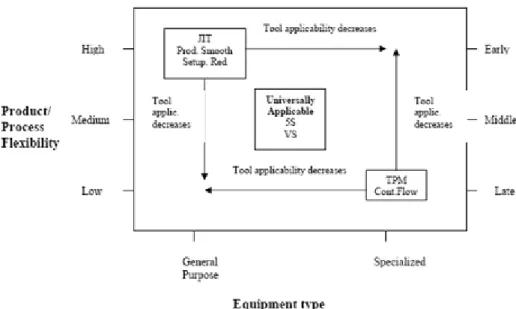
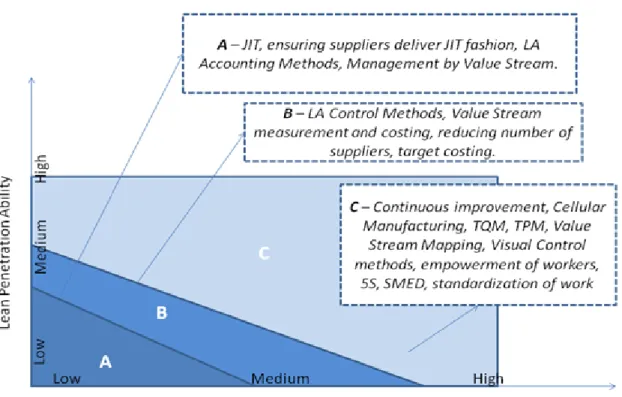
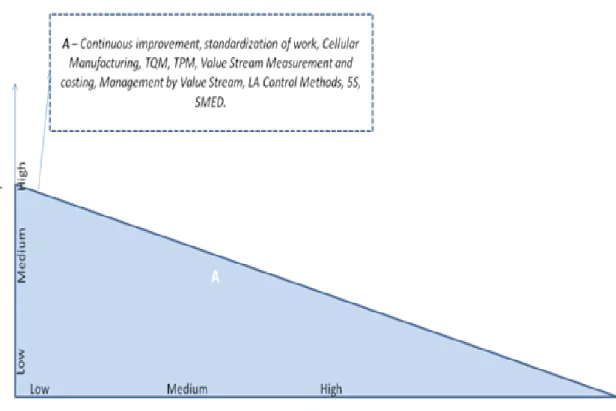
FIGURE 4 INFLUENCEOF VARIABILITYINDEMANDANDSUPPLYON LEAN’S PENETRATIONABILITY...71
FIGURE 5 INFLUENCEOFPRODUCTVOLUMEANDEQUIPMENTTYPEON LEAN’S PENETRATIONABILITY...73
FIGURE 7 INFLUENCEOF NOVELTYOFPROCESSES, LEARNINGRESISTANCEAND
RESISTANCETOCHANGEON LEAN’S PENETRATIONABILITY...75
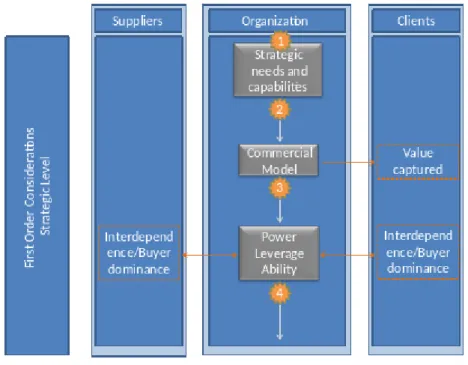
FIGURE 8 STRUCTUREOFTHEFRAMEWORK: STRATEGICLEVELCONSIDERATIONS...82
FIGURE 9 STRUCTUREOFTHEFRAMEWORK: OPERATIONALLEVELCONSIDERATIONS...82
FIGURE 10 STRUCTUREOFTHEFRAMEWORK: STRATEGICLEVELCONSIDERATIONS...95
FIGURE 11 INFLUENCEOF VARIABILITYINDEMANDANDSUPPLYON LEAN’S PENETRATIONABILITY...96
FIGURE 12 INFLUENCEOFPRODUCTVOLUMEANDEQUIPMENTTYPEON LEAN’S PENETRATIONABILITY...97
FIGURE 13 INFLUENCEOFRAWMATERIALVARIETYANDPROCESSFLEXIBILITYON LEAN’S PENETRATIONABILITY...98
FIGURE 14 INFLUENCEOF NOVELTYOFPROCESSES, LEARNINGRESISTANCEAND RESISTANCETOCHANGEON LEAN’S PENETRATIONABILITY...98
FIGURE 15 STRUCTUREOFTHEFRAMEWORK: OPERATIONALLEVELCONSIDERATIONS.99 FIGURE 16 LEAN DECISION MAKING FRAMEWORK SCORECARD...100
FIGURE 17 LOGOPLASTE’S VALUE STREAM MAP...106
FIGURE 18 GENERAL REPRESENTATIONOF INVENTORY SYSTEMIN LOGOPLASTE’S INTERNALSUPPLYCHAIN...107
FIGURE 19 PRE-FORM COST BREAKDOWN (2007)...109
FIGURE 20 PLANTLABORHIERARCHY...111
FIGURE 21 LEANCONTINUOUSIMPROVEMENT: NEWCONTAINER...121
FIGURE 22 TPM INITIATIVES: ACTIVITYBOARD...122
List of Tables
TABLE 1 CHARACTERIZATIONOF WASTEANDITSCONSEQUENCES, (MASKETETAL, 2004)...27TABLE 2 VALUE STREAM MEASUREMENT: SOFP...42
TABLE 3 SCALEOFCOMPARISONFOREACHCRITERION...83
TABLE 4 SCORINGCRITERIAPAIR-WISE...85
TABLE 5 SCORETABLEFORCRITERION 1...87
TABLE 6 SCORETABLEFORCRITERION 2...88
TABLE 7 SCORETABLEFORCRITERION 3...89
TABLE 8 SCORETABLEFORCRITERION 4...90
TABLE 9 SCORETABLEFORCRITERION 5...91
List of equations
EQUATION 1TAKT TIME CALCULATION...34EQUATION 5 OEE: AVAILABILITYCALCULATION...38
EQUATION 6 OEE: PERFORMANCECALCULATION...39
EQUATION 7 OEE: QUALITYCALCULATION...39
EQUATION 8 DECISIONMAKINGFORMULATIONA)...83
EQUATION 9 DECISIONMAKINGFORMULATIONB)...83
EQUATION 10 NORMALIZATIONFORMULA...85
EQUATION 11 CALCULATIONFORMULAFORTHEFINALWEIGHTSOFEACHCRITERION. 86 EQUATION 12 FINAL WEIGHTSCALCULATIONFOREACHCRITERION...86
EQUATION 13 CALCULATIONOFTHEMINIMALSCOREOF LEANIMPLEMENTATION APPROPRIATENESS...92
EQUATION 14 CALCULATIONOFASATISFACTORYSCOREOF LEANIMPLEMENTATION APPROPRIATENESS...93
1. INTRODUCTION
1.1 P
ROBLEMS
TATEMENT
Lean Management principles and techniques have gained over the years popularity among industrial managers and management researchers as the number of implementations extended across various organizations. In some cases, these techniques have led to a real competitive advantage in their competing industries. The aumotive industry is one of the main drivers of Lean implementations. However, it is still not consencious amog researchers a direct relationship between Lean methodologies being the way to success.
Although Lean proponents seem to argue that Lean is a methodology, or some even dare to call it a phylosophy, that will ultimatly strech to further extends than just the industrial reality onto the services industry, reaching unanimous oppinions about it’s success ramains a hard task. V. Crute et al. suggest that plant specific manufacturing strategies with a holistic scope have to be planned, so that more readily results can be achieved [ CITATION Imp03 \l 2070 ]. Bhasin and Burcher conclude in their research that the major difficulties companies are faced with when implementing Lean are lack of direction, lack of planning and a lack of adequate project sequencing, and add that knowledge of tools and techniques is not often a problem[ CITATION Lea \l 2070 ]. On the same page, Cox and Chicksand present concerns the appropriateness of Lean’s potential as a universally extendable approach to production. Distinguishing when are Lean approaches more appropriate to apply, i.e., in which industry context and to which type of companies still remains blurish [ CITATION Cox05 \l 2070 ].
Common ground for discussion seems to be missing. It is still difficult to find the correct basic factors to attend when considering Lean implementation, because it is not by far linear that a certain operational measure will lead to finantial benefits in all circumstances. The first misleading rationalization problem appears when operational and commercial dimentions seem to be confused and lead simultaneously in several debates[ CITATION Cox06 \l 2070 ]. A very strict relationship to JIT Stock policies to Lean management policies seems to swift and restrain discussions to an operational level, which is only one of the dimentions of the problem. And this is one of the main causes that leads to diverging oppinions – the application of Lean techniques can not be summarized to this dimention, and arguing solely based on these methods can be misleading.
On the other hand, analysing external and internal context analysis seems also to be missing in several studies. A lot of researchers focus on the benefits of the application of some Lean techniques without even considering what consequences they will have
when it comes to relating to suppliers or buyers. Nor are the internal limiting factors clear to which situations and to which specific technics they can influentiate the success of Lean’s implementation.
Finally external power relationships can dictate in a majority of cases the versatibility of a company to innovate its own processes. Not taking these relationships into consideration can also retrinct the ability to predict the future success of any Lean implementation.
The author is of the oppinion that the implementation constrains and implications remain still fragmented in dispersed studies, and that collecting these into a single thinking process is of the essence when analysing Lean potential benefits and suitability to industrial contexts or when considering extending it to other industries. Thus, a holistic view that gathers all key aspects is needed in order to successfully help any decision maker inquiring whether or not to implement Lean Management.
1.2 R
ESEARCHO
BJECTIVESIn order to reach the final goal of elaborating a thinking model for decision makers who are inquiring for the possibility of applying Lean management methodologies, this thesis focuses on three key objectives.
The first objective of this research is studying what are the key considerations that need to be taken into consideration regarding Lean management methodologies implementation.
One of the key challenges in this objective resides on the fact that technical considerations regarding industrial management may not in fact be the only factor that needs to be taken into consideration. In other words, Lean industrial management methodologies may technically be the most attractive option to apply in some industrial scenarios, when in reality, it is not the best management solution an administration board may decide for the long term. For this matter, a key realization was taken into consideration right from the beginning, which is the need for a holistic thinking approach. In other words, it is vital clearly distinguish what are the strategic considerations, and what are the technical and more practical implementation considerations, how to incorporate both taking into consideration the relevance that each should have. Thus, an effort was done to distinguish two types of considerations: strategic related and technical implementation related.
Once the first objective is fulfilled, the following task concerns translating these constrains into a reasonable framework that can be used for a majority of cases in an industrial context. Thus, the second objective involves establishing a thinking framework to guide through the decision making process that, ultimately, may help
decision makers to understand if Lean methodologies are or not appropriate for their scenario, and if so, how far Lean methodologies ought to be implemented.
Finally, the last research objective involves testing the validity of the built framework by applying it to a practical scenario where Lean has already been implemented. The practical scenario involves a Portuguese leading company in the molding industry, which is Logoplaste. Logoplaste has implemented in the past some of Lean methodologies and therefore consists of an ideal case study for a framework validation.
1.3 R
ESEARCHA
PPROACHIn order to successfully fulfill the established objectives, four key steps where defined. The first step was to undertake a systematic study of the state of the art of industrial management practices, as well as accounting practices and strategic thought. Concerning industrial management practices, a special attention was devoted to inventory systems, as they represent a key implementation step in any Lean Manufacturing implementation.
As for accounting practices, an effort was done to point out the traditional mindset that has been practiced over the years and is still taught in management universities, in order to better understand the breakthroughs that Lean Accounting practices introduce in traditional accounting.
Furthermore, an insight on how strategic thought is generally oriented was also considered to be relevant for later formulation of the framework.
The last but not least procedure in this first step was to do review of literature also on Lean Manufacturing and Lean Accounting procedures, so that a state of the art of Lean methodologies could be well perceived.
The second step consisted on gathering the key literature material that could serve as support for the construction of the framework. To do so, the author collected the most extensive number of opinions concerning Lean Management benefits, barriers to success and critics, most commonly applied tools and techniques, implementation considerations, strategic considerations, and so forth. The goal was to collect a more precise opinion on what were the main factions and thought currents regarding Lean’s utility as an industrial management methodology.
Having collected what the author considered to be the opinions of the majority of researchers in all factions, the next step consisted on two phases. The first was to order strategic considerations that could be applied to any specific case, and the second consisted on concatenating the key internal and external factors that influenced positively and negatively practical lean implementations. The first phase is critical in
order to assure the essential holistic view of the problem. Once the holistic view was organized, the second phase consisted in constructing the decision making framework. Finally, the last step consisted on testing the built framework in a real industrial scenario where Lean had already been implemented. The goal was not only to validate the thinking framework, but, most importantly, to draw further conclusions on how the framework could evolve in future research.
1.4 L
IMITATIONSThere are some limitations that influence directly the extent of the contribution of the developed work around the present thesis to the research community. It is important that these limitations are taken into consideration before further considerations.
The first natural limitation is that, as a student finishing its master thesis, the author did not have access to the total universe of literature available within the research community. Many papers were not available, as they required a certain amount of monetary value. Since this thesis builds its own opinion and thinking model based on existing literature, constrained access to existing literature about the subject might have limited the drawn conclusions.
Another argument still about existing literature involves around the prior motivation of the present work, which consists itself a challenge that must not be neglected. As previously stated, a considerable set of biased opinions were found during the literature research work, many with explicit commercial interests involved. Though this might be considered to be a natural condition in a majority of research communities given certain areas or topics, one cannot leave this fact out of the equation when doing the present exercise.
On the other hand, the validation of the thinking framework is done with only one practical case study. In order to formulate and validate a rigorous hypothesis, a larger sample would be required.
Another considerable limitation might be the fact that the application of the thinking framework on the decision-making process of Lean Implementation to Logoplaste’s case might be biased, due to the fact that the results are already visible. In other words, the framework intends to establish a prevision of results of future Lean implementation; and, in Logoplaste’s case, these results are already visible.
Last but not least, one might consider a limitation the fact that the author does not have any practical industrial management experience, nor previous research experience.
1.5 T
HESISC
ONTRIBUTIONExtensive literature has approached the implementation process of Lean Manufacturing. Benefits and barriers to success have been also largely covered, and object of intense disputes between researchers. More recently, Lean Accounting is also becoming better known, mainly thanks to BMA, CO, a consulting group that has been making a great effort in the Lean Accounting “evangelization”. To what concerns Lean Accounting, literature is clearly in an infant stage in terms of studying of actual link to better financial performance. Even Lean Manufacturing has not shown yet undisputed results showing this financial performance improvement guarantee to further industries other than the automotive industry. One of the conclusions that the author was able to withdraw from the conducted literature research, especially to what concerns Lean Accounting, is that it seems that a completely impartial view is missing, that is able to balance both potential benefits and potential defects. Furthermore, it seems that the focus of literature has been largely concerned in alluring managers to Lean practices, explaining how these methods would occur and the potential benefits. Even software applications have been developed to help and guide practitioners in the implementation process. However, at the same time, another perspective, one that opposes to much of assumptions made concerning Lean’s benefits. These critics not only dispute the benefits of Lean Business Management practices, but also their suitability to different industries rather than the automotive industry.
An interesting gap seems to remain unfulfilled somewhere in the middle of both views (defenders and opponents of Lean potential to companies), which concerns studying the critical factors of Lean implementation that may be important for decision making situation between which improving investments should a company chose. Therefore, this thesis is focused in studying the critical factors relevant to support making the decision of choosing whether or not to implement Lean practices in a manufacturing context. It is not concerned with the question how to implement it; it rather focuses on the questions that are important to answer the final question – is it worthwhile making
the specific investment in implementing Lean practices or not? For that manner, an
impartial view is required1.
Benefits of Lean implementation are subject to a number of studies. Many of which try to force boundaries of Lean’s suitability and test it in more business market configurations, either than just similar business to automotive branch. These studies are of great importance, as they provide us more information about how valuable a Lean tool can be.
The studies testing Lean’s suitability diverge on the focus, where it can be more devoted to finding operational benefits, or more concerned with the strategic benefits, finding
1 An impartial view may be hard to find when there are interests involved. For this manner, a study conducted in an academic context should have at least a starting advantage in terms of impartialness.
financial performance evidence, etc. They also seem to vary in the results obtained, thus being the cause of divergence in terms of Lean suitability to several business contexts. In addition, some of these studies seem to depend in some matter on prior researcher’s opinion about the potential benefits of Lean’s, which inevitably raise some doubts concerning the results obtained. Moreover, research to Lean practices’ suitability to different industrial contexts seems to lack. Browning and Heath point out Shah and Ward (2003) affirmation about the lack of attention given to the Lean’s suitability in various contexts and the tendencies of the existing literature that points out well my point: “There is not only a lack of empirical attention given to contextual factors’
relationship with lean practices, but there is also a paucity of theory to guide our expectations about the direction of possible effects.’’[ CITATION Bro09 \l 2070 ].
Furthermore they add that: “A major source of knowledge continues to be studies of
successful applications, including the TPS, although much of the available literature tends to be biased towards successes” [ CITATION Bro09 \l 2070 ].
Aggregating these distinct angle views about Lean’s potential benefits appears as a value adding activity. Why is it important to aggregate such information? The decision of implementing Lean’s practices carries a real cost with it, an opportunity cost, and a tremendous effort in changing processes and mindsets. Deciding whether to invest in Lean’s practices should be a well thought decision with as much objective information as possible. It is to this particular benefit that this thesis aims to: providing a decision making thinking model, to facilitate managers without any extent knowledge of Lean practices to evaluate the potential key factors that may be relevant to the decision of implementing or not Lean Business Management practices (both Manufacturing and Accounting) in their manufacturing company.
2. REVIEW OF LITERATURE
2.1 G
ENERALI
NDUSTRIALM
ANAGEMENTIn order to better understand the breakthroughs that Lean Management introduces it is necessary to comprehend how general traditional management policies are practiced. As such, an effort to clarify what the general industrial management practices are was made. These include strategy generation, inventory management systems and costing systems.
2.1.1 Industrial Strategy
The value chain
S. Brown points out Porter’s notion of value chain as an important notion to the manufacturing firm [ CITATION Bro96 \l 2070 ]. To Porter, value is translated into the amount that buyers are willing to pay for what the company has to offer them. Thus, optimally all activities performed within the company would contribute to increasing value to the product or service intended to be sold, and part of the value chain [ CITATION Bro96 \l 2070 ]. Now, it follows that not all activities increase value directly. Thus, a distinction between activities is made, dividing them into two types: primary and support activities. Primary activities include [ CITATION Bro96 \l 2070 ]:
Inbound logistics – logistics concerning all inputs to the product;
Operations – all activities implied in the transformation of the product until final product;
Outbound logistics – all activities until distribution to customers;
Marketing and sales – activities that provide the means to sell the product; Service – Activities that enhance the value of the product (such as training,
repair and maintenance);
On the other hand, support activities include [ CITATION Bro96 \l 2070 ]:
Procurement – activity of purchasing raw material, supplies and other company assets.
Technology development – activities to develop procedures and expertise in technological issues that support other main functions (such as production);
Human resource management – activities to select, evaluate, train, and develop of the company’s human workforce;
Firm infrastructure – all general management activities and support systems.
The link between Strategy and production/operations
The role of strategy in manufacturing companies is becoming increasingly demanding, as the market’s nature tends to progressively become more volatile, erratic, more dynamic, and continuously fragment to smaller market segments [ CITATION Imp03 \l 2070 ]. Decisions concerning operational effectiveness are also of a great importance to the survival and success of the company. Moreover, the role of production gains increased importance, as it demands management responsibility in terms of assets utilization, costs and human resource management [ CITATION Imp03 \l 2070 ]. Machinery purchase is just one of many good examples how production related decisions can affect the future performance of a firm. A decision like this affects directly the production capacity in a variety of questions such as in the variety of products, in the throughput rate, quality and cost of the product, delivery speed, ability of introducing new products to the market, etc. This is an example of a competitive choice, where production capability is directly implied [ CITATION Imp03 \l 2070 ]. Though there are many factors that one could argue that can influence the success of a manufacturing firm, the capability and competence of the productions/operations are certainly key factors. However, though referring that operational effectiveness and strategy are “essential for superior performance”, Porter stresses that many companies are suffering from a mutually destructive competition, because they fail to see the distinction between both [ CITATION Por97 \l 2070 ]. He explains that management tools associated with operational performance have left strategic management out of the management activity per se, by focusing too much on improvement and by neglecting possible competitive positions [ CITATION Imp03 \l 2070 ].
Decision-making responsibility
Strategic decision making is of great importance to the firm’s success. It should therefore not admire that, though an increasing number of companies are including various levels of the hierarchy and cross-functional teams in the process of formulating strategy, ultimately the last long-term concerned decisions still are of the responsibility of senior (and therefore more experienced) managers [ CITATION Bro96 \l 2070 ]. S. Brown stresses the differences between traditional management policies and more actual trends to what concerns the responsibility of the ultimate decision-making actors.
Traditional western management usually expects the responsibility of strategy formulation and decision-making from senior members of the board or chief executives [ CITATION Bro96 \l 2070 ]. Alternatively, he points that this view has been challenged to some degree by the Japanese cross-functional model of strategy, which includes both bottom-up and top-down approaches; and that the levels of management hierarchy have been drastically reduced in many firms [ CITATION Bro96 \l 2070 ].
General critical factors for strategy choice
Strategic management research has devoted a lot attention to studying the critical factors which managers have to take account of. S. Brown summarizes some key points for successful strategy, which include [ CITATION Bro96 \l 2070 ]:
understanding the areas in the market where it can gain competitive advantage and avoiding those that it cannot;
anticipating in order to be prepared for retaliation from competitors after the attack on the chosen market;
focusing its resources and capabilities to succeed;
capability of making the strategy well known and understood within the entire organization, and of involving everyone in the change process;
having a good sense of timing;
capability of establishing effective alliances.
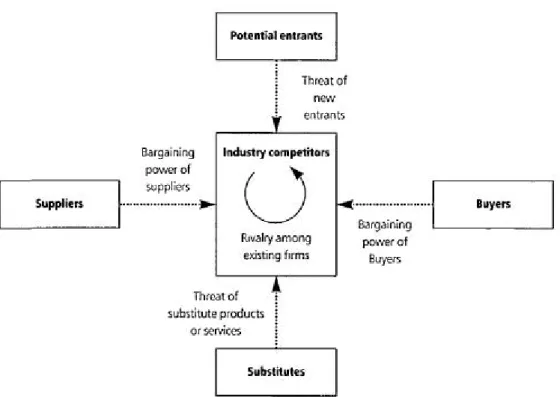
Though its most known contributions date to 1980, Michael E. Porter remains still today as an extremely important reference to strategic management research. He developed a powerful framework to analyze external context that is specifically applicable to strategic planning, in a time where traditional approaches where single focused on the company per se (excluding it from its industry environment), or in a specific aspect of the industry, such as cost/price relationship [ CITATION Por97 \l 2070 ]. He suggest as a first step to strategic planning a structural analyzes of the surrounding industries where the company operates. Furthermore Porter presents a general structure of the industry, which results in the interaction between five basic competitive forces [ CITATION Por97 \l 2070 ]: Potential entrants, Suppliers, Substitutes, Buyers, and
industry competitors. The strength of each force balanced together affects the overall
scenario in aspects such as the effectiveness, the profit share and the attractiveness of the market.
Figure 1Reprinted from Competitive Strategy by Michael E. Porter, p.13 (1997)
Let us start explaining the forces that drive the industry competition by the industry
competitors. The intensity of the rivalry among the existing firms influences the market
share and customer’s demand that each company achieves to attract. Environments where high levels of rivalry exist demand aggressive strategies from companies in order to remain competitive, especially if the industry growth is not sufficient to guarantee a profitable level to assure survival [ CITATION Por97 \l 2070 ]. For example, in situations of demand fluctuations that result in overproduction, aggressive price cutting may be a solution [ CITATION Por97 \l 2070 ]. Moreover companies running high risk ventures tend to be willing to take more risks and sacrifices in return for rapid growth. The level of competitiveness between competitors has also other consequences. For instance, in the presence of lack of product differentiation or low switching costs, lead to increased price sensitivity of the buyer [ CITATION Por97 \l 2070 ]. Or, in the other hand, the presence of high barriers to exit the industry such as financial, strategic or emotional, may induce increasingly more aggressive tactics [ CITATION Por97 \l 2070 ].
The threat of potential entrants is also a concern. The less natural barriers exist for the new competitors to overcome, the more the concerns should existing companies have. The barriers to the entrance of new entrants are for example [ CITATION Por97 \l 2070 ]:
economies of scale (which usually demand a high volumes of production, know-how, and level of customer service);
brand loyalty;
high capital requirements; existence of switching costs; access to distribution channels;
inaccessible advantages that competitors have access (such as facility location, government subsidies, etc.)
governmental restrictions (like environmental related, or quality standards) Another industry competitive driving force is substitute products. These products can be viewed as an appealing alternative to another existing product. Therefore, substitute products are a dangerous menace for companies with similar products, which can compete directly on price and/or performance. The consequence of the entrance of substitute products is usually a reduction on the price that companies can charge for their products, which naturally drives down profitability [ CITATION Por97 \l 2070 ]. As to buyers, Porter steps away from traditional interrelated supply-demand model, by defending that these are two distinct forces. According to him, Buyers’ power is an important force that also determines the intensity of the pressure that companies have in setting the price and quality levels. This means that buyer’s power can also determine the profit that can be extracted from a product or service [ CITATION Por97 \l 2070 ]. For example, in situations where quality and other forms of added value are unimportant, the buyer will look for the cheapest alternative. Or alternatively, situations of backward integration, where the buyer has the capability of doing himself the product will result in loss of profitability for the vendor.
The last existing force is suppliers. Suppliers can also have a significant bargaining power, which gives them the power to limit the profitability of the buyer. This can occur in situations such as in the following cases:
there are several buyers and the supply is limited to a small number of suppliers;
when there are no substitute products; switching costs are high;
the industry is not a significantly relevant buyer and to the supplier group; when the importance of the product to the buyer is high;
forward integration is possible (production of the suppliers of the buyers product)
Generic types of strategy
Planning a strategy is a hard task, that requires the confrontation between ideal actions with the company’s feasibility in terms of the company’s resources and capabilities, and, of course, the industry structure analyzes. Porter distinguishes three generic competitive strategies to outperform competition, as well as their requirements, each of these strategies having its own advantages and drawbacks [ CITATION Whe05 \l 2070 ]. The set of generic competitive strategies is constituted by the following options:
Overall Cost Leadership, Differentiation, and Focus[ CITATION Whe05 \l 2070 ]. Overall Cost Leadership is the most commonly adopted strategy, and involves an
aggressive pursuit of economy and efficiency in the overall operations of the firms in order to achieve providing the product or service at the lowest price [ CITATION Por97 \l 2070 ]. It usually requires in terms of skills and resources: “sustained capital
investment and access to capital, process engineering skills, intense supervision of labor, products designed for ease of manufacture, and low-cost distribution system”
[ CITATION Whe05 \l 2070 ]. As for common organizational requirements, these include: “tight cost control, frequent, detailed control reports, structured organization
and responsibilities, and incentives based on meeting strict quantitative targets”
[ CITATION Whe05 \l 2070 ]. This strategy has the advantages of being protected against cost cutting from less efficient competitors, as profit margin remains bigger at any given price; flexibility to defend against substitution and new entrants; and price flexibility to sustain impact of supplier demands. Besides its natural requirements, other drawbacks exist, such as the possibility of imitation of other players in the industry that may achieve competitive cost minimization through imitation of technology and production process; and the need for initial competitive advantage to be successful, such as high market share, access to cheap materials or through presence in a competitive distribution chain.
The Differentiation strategy is generally targeted at broad mass market and intends to charge a premium[ CITATION Whe05 \l 2070 ]. It may consist in developing a significant aspect of a product or service, such as product’s functions or/and design, distinguishing it from competitor’s products [ CITATION Por97 \l 2070 ]. Following a more radical logic, it can also consist in inventing a new and unique product or service. Along with the differentiation strategy are usually associated changes in design or brand image, technology, features, dealer network, or customer service2. The commonly
required skills and resources for its implementation are: “Strong marketing abilities,
product engineering, creative flair, strong capability in basic research, corporate reputation for quality or technological leadership, long tradition in the industry or unique combination of skills drawn from other business, and strong cooperation from channels”[ CITATION Whe05 \l 2070 ]. The usual organizational requirements for this
strategy are: “Strong coordination among functions in R&D, product development, and
marketing, subjective measurement and incentives instead of quantitative measures, and amenities to attract highly skilled labor, scientists, or creative people”[ CITATION
Whe05 \l 2070 ]. The further drawbacks besides its requirements are the possibility of perceived exclusivity and market share; and the risk of imitation.
Finally, the Focus strategy involves targeting the product or service to a very specific market segment, and providing a low cost situation to the particular niche [ CITATION Whe05 \l 2070 ]. This market segment can consist on a specific buyer group, product line or geographic market [ CITATION Por97 \l 2070 ]. This last strategy requires the combined skills, resources of the two other strategies, but this time directed to a specific strategic target [ CITATION Whe05 \l 2070 ]. The same combined approach between the other two strategies is necessary for the Focus strategy in terms of organizational requirements [ CITATION Whe05 \l 2070 ]. The advantages of such strategy are avoiding the threats of competition, substitution and new entrants; nourishing brand loyalty and rising switching costs; focusing exclusively on profitable market segments; and increasing company’s share by monopolizing its distribution channels [ CITATION Por97 \l 2070 ].
2 A recent and explicit example of such changes in brand image and design is the introduction of fiber optic services by the Portuguese company Portugal Telecom (PT).
There is also a further type of strategy, which normally supports the previously discussed strategies, which is the functional strategy [ CITATION Whe05 \l 2070 ]. A functional strategy addresses a specific company area, and intends to maximize resource efficiency in order to improve performance and provide the company or business unit a competitive advantage [ CITATION Whe05 \l 2070 ]. Such type of strategy is related to issues such as [ CITATION Whe05 \l 2070 ]:
Sourcing of resources and capabilities – choosing where a determinate function should be performed is an important strategic decision. Purchasing a certain function outside the company should be considered whenever the activities of that function are not essential to the company’s distinctive competence [ CITATION Whe05 \l 2070 ]..
Marketing strategy – the company or business unit can use market development strategies, which are intended to capture a larger share in the existing market or in penetrating new markets, using advertizing and promotions to achieve this goal [ CITATION Whe05 \l 2070 ]. Alternatively, a product development strategy can also be used to develop new products for existing or new markets [ CITATION Whe05 \l 2070 ]..
Financial strategy – this type of strategy is intended to maximize the financial value of the firm. It is used to provide the appropriate financial structure and funds to achieve overall objectives, by examining the financial implications of corporate and business-level strategic options, indentifying the best financial plan, searching for lower cost of funds and flexible ways to raise capital to support business strategy [ CITATION Whe05 \l 2070 ].
Research and Development (R&D) strategy – R&D strategies are used in cases of companies that depend on technology for their success [ CITATION Whe05 \l 2070 ]. This strategy is depends a lot on the choice of the generic strategy – if a company decides to choose a product differentiation strategy, or a low-cost [ CITATION Whe05 \l 2070 ]. It has also to do with the choice either to be a technological leader, pioneering the market with a lost-cost or with a unique product or functionalities of a product, or rather to be a technological follower, providing low-cost products by learning from the leader’s experience, or adapting the product to buyer’s needs also from learning with leader’s case [ CITATION Whe05 \l 2070 ].
Human Resources strategy – such strategies are concerned with decisions whether or not should hire low-skilled or high-skilled employees, career planning of internal staff, promotions, motivation and teamwork effectiveness, etc. [ CITATION Whe05 \l 2070 ]. An example of a concretization of a Human Resource strategy for motivation and teamwork effectiveness promotion is team building events.
Operations strategy – a company needs to formulate its operation strategy whenever questions of how and where to do a product or service are placed. This strategy is to some degree dependent on the product life cycle, the type of activities required in its process, the demand’s characteristics of the product,
among other. Moreover, the operations’ strategy addresses other issues, such as vertical integration (the decision to make or buy), partnerships establishment. Formulating a strategy cannot be done without considering the risks involved. There are several corporate, business, and functional strategies that can lead either to bigger profit and growth, or rather to bankruptcy. Predicting this risk is a difficult task that requires experience, intuition, intelligence and knowledge. Choosing the right strategy should, therefore, not leave any previous knowledge aside that can indicate a potential flood in the plan. Case studies of failing strategies contributed to strategy management literature, providing valuable knowledge to determine which type of plans should be avoided. Such type of strategies include:
Imitating the strategy of a leading competitor – companies that obstinate on catching leading companies with the exact same strategy might fail with such strategy, as it ignores the individual strengths and weaknesses, and, most of all, that the leader’s strategy may simply be wrong [ CITATION Whe05 \l 2070 ]. Expecting double success from the same strategy – companies that have
pioneered with an extremely successful product tend to believe that betting on the same strategy will ensure growth and prosperity. The problem are the large sums of investment that may not get the expected reward [ CITATION Whe05 \l 2070 ].
Entering in aggressive battles with another firm – though competition for increased market share might increase sales, it might also carry large sums of costs that may overrule the gains, such as in advertizing, promotion, R&D, and manufacturing costs, etc. Competitions such as price wars may simply only shift the value to buyers, instead of to the sellers [ CITATION Whe05 \l 2070 ]. Variety investments – company might have the temptation to invest time, money
and energy on a variety of projects, which, in time, may exhaust the company. Inflexibility/stubbornness in the strategy – top management may be so fixed in a
particular strategy that they cease to see that it is not, in fact, the right strategy, consequently leading to failure.
Cox and Chicksand refer that before building their operational strategy, companies’ management need to decide what their commercial goals are. Only after this should management decide what the operational strategy should be [ CITATION Cox05 \l 2070 ]. This means that the operational strategy should be thought as a way of achieving the commercial goals. Cox and Chicksand underlie the importance of the relationship between the company and the two Porter’s forces: suppliers and buyers
[ CITATION Cox05 \l 2070 ]. The capability of a company to achieve commercial
returns by operational means is ultimately limited by the power it is capable of leveraging to those forces. Since all companies act both as buyers and suppliers, it is important to analyze the power leverage of the company on both directions: to costumers and to suppliers. Let us start by reviewing the possible interactions between buyer and supplier and then approach the ideal situation for any company.
There are four interactions possible between buyers and suppliers: buyer dominance, interdependence, supplier dominance, and mutual independence [ CITATION Cox05 \l 2070 ]. A situation of the buyer dominance happens typically when there are few buyers and many suppliers, and the buyer has a high share of total market for the supplier. In this situation the supplier will be highly dependent on the buyer for revenue, and his switching costs will be very high [ CITATION Cox05 \l 2070 ]. The buyer, on the other hand, will benefit from very low switching and search costs [ CITATION Cox05 \l 2070 ]. Therefore, the buyer will be in an extremely favorable position, where he will be able to achieve all they want operationally and commercially at the expense of the suppliers.
In the interdependence situation, there are few suppliers and buyers on the market. Here the supplier is very dependent on the buyers for revenue purposes, so his switching costs are very high [ CITATION Cox05 \l 2070 ]. He strives to offer a unique offer. As for the buyer, he has also high switching costs, and high searching costs [ CITATION Cox05 \l 2070 ]. It is normal to occur a buyer and supplier share of value from their relationship in the interdependence situation [ CITATION Cox05 \l 2070 ].
The supplier dominance is characterized by an existence of many buyers and only few suppliers. So, here the supplier has no dependence on the buyer for revenue purposes, since he has many alternatives, and thus, a low switching cost. The buyer, on the other hand, suffers from high switching and search costs [ CITATION Cox05 \l 2070 ]. Consequently, in this situation it is the supplier who is able to achieve all of his operational and commercial goals at the expense of the buyer.
Finally, in the situation where there are many buyers and suppliers, for both parties the switching costs are low, with little dependence on each other [ CITATION Cox05 \l 2070 ]. Buyers may achieve a favorable position at the expense of suppliers in terms of operational and commercial efficiency.
So to conclusion, the most desired position to any company in a supply chain would be to dominate relationships with both its customer and its supplier, so that it can be able to impose price and quality standards upstream and downstream [ CITATION Cox05 \l 2070 ]. This situation is called the Janus-faced Dominance, where a company is able to achieve the maximum share of value for itself, and consequently, the above normal desired results [ CITATION Cox05 \l 2070 ].
Operations strategy
S. Brown (1996) presents the results of survey in the 1990’s, done by De Meyer and Ferdows, where the competitive priorities for a total of 224 companies were asked [ CITATION Bro96 \l 2070 ]. The results showed that a numerously quantity of factors that were linked with production activities/functionalities, including [ CITATION Bro96 \l 2070 ]:
Offer consistently low defect rates – related to process quality; Offer dependable delivery products – delivery reliability;
Provide high-performance products or amenities – product quality; Offer fast deliveries – delivery speed;
Customize products and services to customer needs – flexibility manufacturing system;
Profit in price competitive markets – low-cost production; Introduce new products quickly – rapid product innovation;
Provide effective after-sales service – not a manufacturing related factor; Offer a broad product line – flexibility manufacturing system;
Make a rapid volume changes – flexibility manufacturing system; Make rapid product mix changes – flexibility manufacturing system; Make product easily available – logistics concerned (distribution channels) Make rapid changes in design – flexibility manufacturing system;
These are most of all issues related to manufacturing competences. Manufacturing competences demand interface with other internal areas such as product technology, capacity, facilities and their location, process technology, human resources, operating decisions, and the relationship and integration of suppliers and customers, which, may indicate that manufacturing can become either a process enhancer or a bottleneck. Therefore, it should be no coincidence to include manufacturing competences in the company’s strategic considerations, and these as their essential areas to formulate manufacturing strategy [ CITATION Bro96 \l 2070 ]. The strategy taken should, at least, enhance some of these areas, either aiming to provide products with a low price, or at providing innovating products, or by doing both.
2.1.2 Inventory Management Systems
Operational Research has shown a great interest in the study of inventory management models and systems. The majority of the models use minimization of cost functions as a way of obtaining optimal solutions that increase profitability by using various measures [ CITATION Chu09 \l 2070 ]. Some of the costs included in these models are «the costs of ordering or manufacturing, holding or storage costs, unsatisfied demand or shortage penalty costs, revenues, salvage costs, and discount costs» [ CITATION Lie05 \l 2070 ]. There are three basic categories of inventory control systems:
1. Continuous systems – with fixed order quantity. In these systems there is a predetermined and fixe quantity that is ordered, and so the reorder point is calculated by subtracting the total time until next the stock is empty by the lead time of delivery. This type of system uses models that belong to the category of “pure models”, which often assume the demand rate and the delivery lead time constant.
2. Periodic system – with fixed time period. In these systems there is a predetermined period when the reorder is to occur. Inventory is checked and an order of a certain quantity is placed, so that inventory would reach a certain maximal level at the time of reorder. This means that the quantity to order is equal to the difference between the maximal level of inventory and the actual quantity at reorder time. This type of system uses models that also belong to the category of “pure models”.
3. Hybrid systems – non-rigid systems that alternate or use both principles of Continuous and Periodic systems simultaneously to decide when to reorder and which quantity.
Each of these systems has specific models proposed to address specific situations. Hybrid systems are the most common systems utilized, since they are more versatile and flexible to answer real inventory management situations. The choice of the system often varies according to the characteristics of the item considered.
On the other hand, cases of multiproduct inventory systems are also often in companies. Sometimes companies have to deal with hundreds or thousands of products, which sometimes calls for the need to distinguish the control model applied between the items according to its characteristics [ CITATION Lie05 \l 2070 ]. Moreover, since controlling inventory involves costs, some products may not need the same attention as others [ CITATION Lie05 \l 2070 ]. So, the first question to answer when deciding how to control the stocks of a company is to choose which products need tighter control models and which do not. One option that can be useful to categorize each item according to its relevance is using the “ABC Classification”. An ABC classification is a method that divides all products into three groups: the “A”, the “B” and the “C” [ CITATION Lie05 \l 2070 ]. The A group is consisted by the products that are priority to the company – such as products that provide the biggest revenues, or the biggest costs, or that have the highest rotation, etc3.
This means that these are the ones that suffer the most intense control. Group B products ought to receive median attention, and group C is monitored only informally [ CITATION Lie05 \l 2070 ].
However, Hillier and Lieberman stress that sometimes it may not be the best policy to apply a single-product inventory model, because it may have interactions with other products [ CITATION Lie05 \l 2070 ].
Periodic Review (Q,r)
Continuous and Periodic Review are two similar models, as both are based in the same basic presumption, which is that one should only reorder ore restart production when stock levels are low. This implies a continuous or periodic review of the stock level. So where do the models differ? The Continuous Review model is designed to be applied in
3 Although the materials purchased by a company may not have a regular consumption pattern, the regularly consumed items generally are the ones that account for most of the purchasing and inventory
the presence deterministic demands. Alternatively, the Periodic Review model is thought for situations where demand is stochastic. So, in both models the essential questions are «when to order?» and «how much to order?».
Economic Order Quantity (EOQ)
The EOQ model is a mathematical formulation that attempts to determine the optimal order to purchase, obtaining it in the formula of the sum of all costs involved. So, the underlying idea in the EOQ model is that a rational buyer prefers to buy the exact quantity that minimizes his total costs.
A large extent of literature has leaned on the EOQ model, making it one of the most well known inventory management policies. Much of this literature relaxed some of the basic assumptions of the classical EOQ model in order to better fit it to specific business situations, such as quantity discounts, and shortage costs, etc.
The EOQ model has several basic assumptions. The first is that it assumes that the demand rate is constant and known [ CITATION Chu09 \l 2070 ]. Demand is calculated by adding already processed orders with demand forecasts. There are not many real situations where demand rates are relatively stable, so risks of a stockout situation rise when applying this mathematical formulation (with such assumption) to situations facing large and stochastic demands.
Other basic assumptions including fixed ordering costs per order, and constant per unit holding cost for inventory item are also considered [ CITATION Faz98 \l 2070 ]. It is a common strategy by sellers to reduce the selling price of each unit in order to increase the quantity sold per lot, creating thus a potential benefic economical purchasing alternative to the buyer. Although the classical EOQ model is considered by many a simplistic model, it is also considered a useful tool to estimate the most economic lot sizes [ CITATION Faz98 \l 2070 ].
Material Requirement Planning (MRP) systems
MRP systems are also inventory control systems, and, as opposed to JIT systems, they control stocks through push demand systems (instead of pull demand systems), since backward scheduling is considered a primary tool [ CITATION Bar05 \l 2070 ]. But not all are divergences. MRP’s goal is reducing inventory, in order to achieve savings in «capital, resources, and space» [ CITATION Bar05 \l 2070 ]. This is achieved by determining all items that need to be purchased and completed to support the master production schedule [ CITATION Bar05 \l 2070 ].
MRP systems are considered a complex systems, that requires the use of specialized software in order to be able to manage the great amount of information needed [ CITATION Bar05 \l 2070 ].
2.1.3 Cost Accounting
Cost elements of a product
There are three cost integral components, which are direct materials, direct labor and factory overhead. These elements can provide valuable information for income measurements and product pricing [ CITATION Pol91 \l 2070 ]. The definition of these elements will be given based on Polimeni, Fabozzi and Adelberg, and will be important for further developments.
Materials are the principle substances used in production. They can be transformed into finished goods by the addition of direct labor and factory overhead, and can be classified into two categories – direct and indirect materials [ CITATION Pol91 \l 2070 ]. Direct materials are all materials that can be easily traced to the final product and that represent a major material cost of producing a product [ CITATION Pol91 \l 2070 ]. On the other hand, indirect materials cannot always be traced back into a specific product, and are therefore included as factory overhead [ CITATION Pol91 \l 2070 ]. Thus, a good example of an indirect material can be the ink used for product painting. Labor is considered to be the mental or physical effort applied in the production of a product, and is divided as well in two distinctions – direct and indirect labor [ CITATION Pol91 \l 2070 ]. Direct labor constitutes all labor that can be easily traced to the product and represents a major labor cost to producing a product [ CITATION Pol91 \l 2070 ]. Alternatively, indirect labor cannot always be traced back into a specific product, and is therefore included as factory overhead. Thus, a good example of an indirect material can be the glue [ CITATION Pol91 \l 2070 ]. An example of an indirect labor can be the work spent on machine maintenance.
Finally, factory overhead is a term used to accumulate all indirect labor, indirect materials and other indirect manufacturing costs. Therefore, examples of factory overhead are the rent, energy costs, etc.
Cost accounting systems
As stated before, the primary use of cost accounting is for internal use of managers. In order for cost accounting to support managers in their decision making, planning and controlling, it becomes essential to establish budgets and gather information about actual cost of operations, processes, departments or product. Cost accounting also analyzes variances, profitability and social use of funds [ CITATION Pol91 \l 2070 ].
Nevertheless, cost accumulation and classification activities may be extremely difficult in specific situations and time-consuming as the volume of paperwork processed in a manufacturing firm can be overwhelmingly big, even if they are small or medium sized companies. Polimeni, Fabozzi and Adelberg state that «small and medium-sized manufacturing companies may handle thousands of requisitions, purchase orders, receiving reports, vendors’ invoices, vouchers, checks, stock issues, and similarly business documents each month» [ CITATION Pol91 \l 2070 ]. Moreover, «a large manufacturing company may handle tens of thousands of such documents a month» [ CITATION Pol91 \l 2070 ]. Therefore the design of a cost accumulation system must be adequate for the nature and type of operations performed in a manufacturing company [ CITATION Pol91 \l 2070 ].
There is a first division in the types of cost accumulation systems, which are periodic and perpetual systems [ CITATION Pol91 \l 2070 ].
Periodic cost accumulation systems provide only limited product cost information during a period and requires quarterly or year-end adjustments to arrive at the cost of goods manufactured [ CITATION Pol91 \l 2070 ]. A periodic count of physical inventories must be taken to adjust inventory accounts to arrive at the cost of goods manufactured [ CITATION Pol91 \l 2070 ]. Therefore, a periodic cost accumulation system is not considered to be a complete cost accumulation system since the costs the of raw materials, work-in-process, and finished goods can only be determined after physical inventories are counted [ CITATION Pol91 \l 2070 ]. In other words, in order to obtain a final and confident result it is needed to check periodically all real inventories.
It is to understand that this fact constitutes a limitation. As such, periodic cost accumulation systems are generally used only by small manufacturing companies, where accounting departments are small or information systems are not advanced [ CITATION Pol91 \l 2070 ].
On the other hand, «perpetual cost accumulation system is a vehicle for accumulation product data, through the three inventory accounts, that provide continuous product information about raw materials, work-in-process, finished goods, cost of goods manufactured, and cost of goods sold. Such cost systems are usually very extensive and are used by most medium and large manufacturing companies [ CITATION Pol91 \l 2070 ].
So, the big difference between the two systems is that in perpetual accumulation systems information is continuously available concerning raw materials inventory, work-in-process inventory, finished goods inventory, cost of goods manufactured, and cost of goods sold, as opposed to periodic accumulation systems, where accumulation is done just in the end of the period [ CITATION Pol91 \l 2070 ]. Since perpetual accumulation systems are the best fitted to larger companies, this will be the object of focus in this chapter. Furthermore, today’s information system, such as Enterprise Resource Planning (ERP), allow for common databases and real-time information
sharing from different functional areas or even from different organizations. Therefore perpetual systems will be our sole consideration in this chapter.
There are various managerial accounting approaches, which differ in the attention that is given to the different organizational aspects to be measured. The main approaches are:
Standard Cost Accounting
Activity-based Costing
Resource Consumption Accounting
Lean accounting
Standard Cost Accounting is considered a traditional cost accounting system. These are characterized by being volume-based cost drivers, that were specially adequate during the mass production, when there was limited product variety and direct material and direct labor were the predominant costs concerning manufacturing [ CITATION Lea07 \l 2070 ]. As variety of products increased, the distortion caused by these systems increased as well, as factory overhead costs gained a big portion of total costs and was considered proportional to production volume (which is not necessarily right) [ CITATION Lea07 \l 2070 ].
On the other hand ABC systems calculate the production costs based on the activities, using both volume and non-volume based cost drivers [ CITATION Lea07 \l 2070 ]. All activities concerning production, sale, delivery, and customer support of groups and services are identified and considered product costs [ CITATION Lea07 \l 2070 ]. Throughput accounting considers that no cost should be allocated to products, with the exception of raw materials [ CITATION Lea07 \l 2070 ]. Instead, this systems calculates product costs by summing what they consider truly variable costs of production that usually include only raw materials [ CITATION Lea07 \l 2070 ].
Traditional Cost Accounting Systems
There are two basic types of Perpetual cost accumulation systems that concern the type of manufacturing process, which are job order and process costing [ CITATION Pol91 \l 2070 ].
Job order Cost Accumulation System are suited for companies where «each job is custom made» according to the client’s specifications. An example where job order cost accumulation system can be useful are machine building firms.
Under job order accounting systems, the three basic elements of a product’s cost (direct materials, direct labor, and factory overhead) are accumulated into specific jobs. Each job has its “job sheet”, where a work-in-process inventory account is processed individually. The unit cost is obtained by dividing the total number of units in the job by
the total cost accumulated in that work-in-progress inventory account before transferring these units to finished goods inventory. Selling and administrative expenses are left a part of the cost of producing the job and are shown separately on the job cost sheet and income statement. [ CITATION Pol91 \l 2070 ].
As for Process Cost Accumulation Systems, these are fit to companies that manufacture homogeneous products in large volumes, either with continuous processing ore mass production techniques [ CITATION Pol91 \l 2070 ]. In this system, the three basic elements of product’s cost (direct materials, direct labor, and factory overhead) are accumulated according to departments or cost centers, which are major functional and specialized divisions in a factory [ CITATION Pol91 \l 2070 ]. The same goes for individual work-in-process inventory accounts, also set up for each department and charged with costs incurred in the processing of the units that pass through them [ CITATION Pol91 \l 2070 ]. At each department a unit cost for finished product is calculated and passed to the next department. So the total unit costs is obtained by calculating the sum of the unit costs in each department where the product has passed [ CITATION Pol91 \l 2070 ]. Similarly as job order costing, selling and administrative expenses are shown separated on the income statement. [ CITATION Pol91 \l 2070 ].
Activity-based costing (ABC)
Armstrong affirms that the original concern of ABC methodology was manufacturing competiveness, by reducing distortion of managerial decision making caused by misallocation of indirect costs [ CITATION Arm02 \l 2070 ]. He states that traditional accounting treated indirect costs as a homogenous portion, to be allocated to product lines on a single volume-related base, often direct labor. This procedure would lead to an inaccurate allocation of costs which were driven by variety, activity changes or other forms of complexity, into «high volume, labor intensive products and under-allocated to short-run capital intensive specialist items» [ CITATION Arm02 \l 2070 ]. Furthermore, this inaccurate allocation had as consequence a «systematic distortion of manufacturing strategy, which favored the pursuit of specialists niche markets rather than head-to-head competition in the world’s mass markets» [ CITATION Arm02 \l 2070 ].
In contrast, ABC method calculates the product’s full cost by allocating indirect costs according to activities performed by the staff in the concerning departments [ CITATION Leb99 \l 2070 ]. So, it allows answering the question where were costs incurred in a different manner, by looking for specific activities [ CITATION Leb99 \l 2070 ]. Therefore the big advantage of using ABC is discovering the activities through which factory overhead can be allocated and controlled [ CITATION Arm02 \l 2070 ].