Impact of Content Storage and Retrieval Mechanisms on the
Performance of Vehicular Delay-Tolerant Networks
Bruno M. Silva
1, Vasco N. G. J. Soares
1,2, Mario L. Proença Jr.
3, and Joel J. P. C. Rodrigues
1 1Instituto de Telecomunicações, University of Beira Interior, Covilhã, Portugal2Superior School of Technology, Polytechnic Institute of Castelo Branco, Portugal 3 Computer Science Department, State University of Londrina, Londrina, Brazil
[email protected]; [email protected]; [email protected]; [email protected]
Abstract — Vehicular Delay-Tolerant Networking (VDTN) is
a new disruptive network architecture based on the concept of delay tolerant networks (DTNs). VDTNs handle non-real time applications using vehicles to carry messages on their buffers, relaying them only when a proper contact opportunity occurs. Therefore, the network performance is directly affected by the storage capacity and message retrieving of intermediate nodes. This paper proposes a suitable content storage and retrieval (CSR) mechanism for VDTN networks. This CSR solution adds additional information on control labels of the setup message associated to the corresponding data bundle (aggregated traffic) that defines and applies caching and forwarding restrictions on network traffic (data bundles). Furthermore, this work presents a performance analysis and evaluation of CSR mechanisms over a VDTN application scenario, using a VDTN testbed. This work presents the comparison of the network behavior and performance using two DTN routing protocols, Epidemic and Spray and Wait, with and without CSR mechanisms. The results show that CSR mechanisms improve the performance of VDTN networks significantly.
I.
I
NTRODUCTIONDelay-tolerant networking (DTN) [1] paradigm was proposed to enable communication in challenged environments with sparse intermittent connectivity and where end-to-end communication does not exist. DTN networks include storage-and-forward functions by overlaying the bundle protocol layer over the transport layer. Network nodes (mobile and fixed) relay these bundles between gateways, and intermediate nodes store and carry bundles until a proper contact is available [2, 3].
Vehicular delay-tolerant networks (VDTNs) [4] are a particular application of mobile DTN characterized by opportunistic contacts. VDTN uses vehicles mobility to enable network connectivity in scenarios where end-to-end path does not exist. VDTN network architecture consists on three node types, terminal nodes, relay nodes, and mobile nodes. Terminal nodes are the VDTN access points providing several application services such as exchanging emails, documents, voice mails, movies, music, images, among others. Relay nodes act as store-and-forward agent allowing bypassing mobile nodes to store and relay data. Mobile nodes (e.g., vehicles) are responsible for physically carry and relay
data in the network. VDTN network architecture also proposes the separation between control and data plane, using out-of-band signaling. Control plane includes the exchange of signaling messages that contain all the information regarding node type and communication characteristics. This information includes vehicles speed, energy constraints, storage capacity constraints and delivery options, among others. This approach is based on the signaling approach used on optical burst switching (OBS) networks [5]. For storage and forward services the VDTN architecture, contrary to DTNs, includes a bundle layer placed under the network layer. This sub-layer assumes the aggregation of Internet protocol (IP) datagrams into very large data packets, called bundles. Due to the network intermittent connection problem, nodes can store bundles for unknown periods of time. Therefore, the storage and forward functions included in each bundle are a key issue in node buffer management. It is clear that the creation of suitable content storage and forward mechanisms targets the improvement of VDTN network performance. These content storage and retrieval (CSR) mechanisms manage the node buffers, deciding, for example, which data will be sent, stored or eliminated (dropped). This paper proposes a storage and forwarding solution to improve and maximize VDTN network performance. This CSR solution adds additional information on control labels of the setup message associated to the corresponding data bundle (aggregated traffic) that defines and applies caching and forwarding restrictions on network traffic (data bundles). The
VDTN CSR labels define storage and retrieval contents and
apply them forwarding restrictions. Furthermore, this paper presents the performance evaluation and analysis of the proposed content storage and retrieval (CSR) mechanisms over a VDTN network, through a VDTN testbed [6]. The network scenario considers the use of the well known DTN Epidemic and Spray and Wait routing protocols, applied to VDTNs. For comparison purposes, scenarios with and without CSR mechanisms were considered for node’s bundle delivery probability, bundle average delay, and average contact time.
The remainder of this paper is organized as follows. Section II elaborates on related work about the topic, focusing on DTN storage and forward mechanisms and DTN
routing protocols evaluated in this work. Section III describes the proposed VDTN content storage and retrieval mechanisms. Section IV focuses on the performance evaluation study of the CSR mechanisms through a VDTN testbed. Finally, section V concludes the paper and proposes topics for future research works.
II. R
ELATEDW
ORKContent storage and retrieval mechanisms proposed for VDTN gather several contributions from cache-based networks, mainly from DTNs. Since end-to-end online communication may not exist in a DTN context, adequate storage and forward solutions become even more important. In [7], a system based on the concept of custody transfer is presented. This approach addresses the network congestion problem, managing traffic flow and decreasing storage usage.
Custody transfer uses hop-by-hop reliability to enhance
end-to-end communication. A node acting as custodian accepts custody for messages, stores them and retrieve the messages at appropriate times. At the same time, the node saves the location of all stored messages. Custodians select the messages to store based on their time, size, and priority.
Ott et al. [8, 9] proposes a distributed caching scheme for DTNs. This proposal includes application hints [9] to messages in order to perform content intelligent caching, acting as distributed storage or forward content. This approach presents a distributed caching strategy in DTN nodes. In order to improve this distributed caching scheme, the authors proposed a logic module for storage and retrieval operations in [10]. This module allows caching lookups for stored resources in the queue and caching retrieval for passing requests. Such procedures require additional information about their payloads. For this purpose,
application-hints extension blocks for the bundle protocols
were also introduced. The application-hint contains several cache control fields. Application protocol field explicit the application protocol to perform proper resource matching; resource field identifies the carried resource for matching operations; operation type field indicates if the resource is a request, a response, an unconfirmed event, or an unknown operation type, and whether the bundle contains a resource. These distinctions allow different storage policies, and
lifetime field defines the application layer duration time that a
resource should be contained. In case of bundle fragmentation, the application hint must be copied to all fragments.
Routing strategies and protocols in DTNs have been studied extensively [11]. The proposed CSR approach is evaluated and uses two well-known DTN routing protocols, Epidemic [12] and Spray and Wait [13]. Epidemic is a flooding based routing protocol where network nodes exchange all the data that they do not have. In an infinite
buffer space environment, this protocol performs better than all the other ones. It has the best delivery and latency ratios providing an optimal routing solution. However, in an environment with limited resources, the overall performance severely decreases, due to the flooding that wastes unmeasured network resources. Spray and Wait protocol creates a number of copies N to be exchanged (“sprayed”) per message. A network node forwards de N copies to the first different nodes encountered. Then, it “waits” until one of the network nodes reaches the destination. In a large range of scenarios, Spray and Wait presents better overall network performance than epidemic routing, especially in average message delay and number of transmissions per message delivered [13].
III. C
ONTENTS
TORAGE ANDR
ETRIEVALM
ECHANISMSThis section describes the content storage and retrieval (CSR) proposal for VDTN networks. The next sub-section introduces and describes the CSR control label and Sub-section B presents the main storage and retrieval operations.
A. Content storage and retrieval control labels
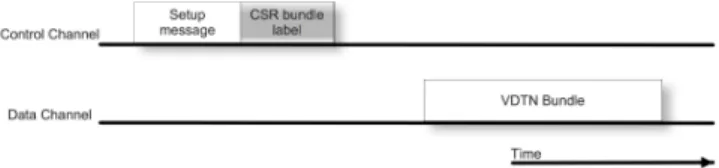
The VDTN CSR proposal assumes the inclusion of CSR control labels attached to every bundle of aggregated network traffic (data bundles). When network nodes interact, they first exchange control information, e.g. a setup message that furnishes information about messages they are carrying and their storage and energy constraints, node coordinates, velocity and destination, among others. The bundle CSR control label is also sent in the control channel and it is attached to the bundle setup message (as shown in Figure 1).
Fig 1. Illustration of a VDTN CSR bundle label concatenated with the bundle setup message.
A VDTN data bundle is a big data packet created with an aggregation of IP datagrams. Network traffic has different sources, sizes, destinations, and priorities. These properties directly affect nodes buffer management, and therefore, the network performance. For each VDTN data bundle, two different CSR control labels were created, as may be seen in Figure 2. The CSR Bundle label is applied to the VDTN bundle and contains the respective CSR bundle fragment
label for all aggregated network contents. The CSR bundle fragment label is applied to a single bundle fragment that
packets with same characteristics). Each label contains specific CSR control fields that define if the content is to be cached or forwarded. Bundle fragment ID identifies the unique bundle fragment label; Content creation data/time includes the data and the time of creation or last modification of the respective content; Operation type specifies the operation for the respective content (i.e., request, response, or
storage); Content type identifies the fragment label content
type (i.e., text, image, video, or audio); Content description describes the fragment label content (i.e., www.content.com,
image.png, sensordata32.txt, file.mp3, etc.).
Figure 2. VDTN content storage and retrieval control labels.
B. Storage and retrieval operations
CSR mechanisms allow that a given node may select bundles to be considered for storing and/or retrieving. After nodes exchange their CSR bundle labels, each one has access to the list of bundle fragments that the other node is carrying. A node only process bundles containing fragments that have ‘Storage’, ‘Response’, and ‘Request’ as content ‘Operation
type’. Storage type contents, are automatically selected for
being stored, comparing only if a bundle with the same content is not already stored in the buffer node. If the bundle has responses or requests, first it compares if a possible corresponding request or response is stored. If yes, the bundle is selected to be stored or retrievable (sent or received). If no, but at least one of the communicating nodes is mobile, the destination node is matched with the mobile node route information, comparing the nodes that it already visited and may visit. In this case, the bundle is selected to be stored or retrievable so that mobile node carries it to the destination. When CSR negotiation ends, all selected bundles are exchanged between nodes in a list of stored and retrieved data, as well as their respective CSR bundle labels.
IV. P
ERFORMANCEE
VALUATION ANDA
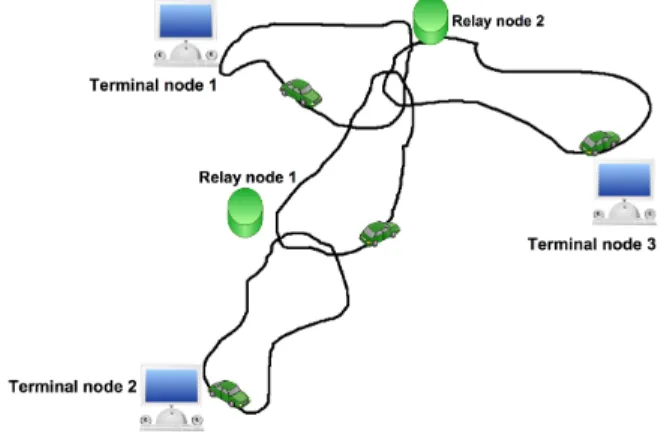
NALYSIS This section focuses on the evaluation and analysis of the above-described CSR protocols and their impact on the performance of a VDTN network, with and without CSRmechanisms. This study was conducted with a VDTN testbed [6]. The network scenario includes three terminal nodes that act as access points to the VDTN network, four mobile nodes responsible for carrying data between terminal nodes and two relay nodes that try to increase the number of contact opportunities between mobile nodes. Each mobile node follows its own route as illustrated in Figure 3. Relay nodes are placed in the paths intersection helping the mobile nodes to bypass data along the network. In the presented application scenario, terminal node 1 furnishes several services to the network, answering the requests issued by terminal nodes 2
and 3. These services include text, image and video files. Terminal node 1 also generates data bundles with
temperature of its computer CPU to be delivered and stored on terminal nodes 2 and 3. It is assumed that during data transfer between nodes, there is no bundle fragmentation. Incomplete or loss transfers are considered as a failed data exchange and re-transmitted in a next contact opportunity.
Figure 3. Illustration of the VDTN testbed with three terminal nodes, two relay nodes, and four mobile nodes.
The performance of the VDTN testbed was evaluated with a bundle generation at every 15, 30 and 60 seconds. Dropping policies assume a first-in, first-out (FIFO) queue where bundles are deleted when their time-to-live (TTL) expires. The bundles TTL changes between 5 and 15 minutes per hour, along tests. Performance metrics considered in this study are the average bundle delivery probability (percentage), and the bundle average delay (in seconds) that consists in the time between bundle creation and delivery (per hour) and the average contact time (seconds) between nodes. In the context of this work, the VDTN testbed has a limited and challenged scenario with low number of network nodes and messages directly. These aspects may affect the network behavior and its performance.
A. Performance Assessment of Epidemic Routing Protocol
The study starts with focus on results obtained for Epidemic routing protocol, with and without CSR
mechanisms. Figure 4 shows the bundle delivery probability as function of number of data bundles generated per minute. As may be seen, CSR mechanisms clearly improve the network performance presenting better results on the three different input traffic loads. With the increase of generated bundles per minute, the bundle delivery probability decreases, as expected. However, with CSR mechanisms, Epidemic protocol increases the bundle delivery probably in 17%, 20% and 22%, respectively, improving the delivery probability on all traffic loads. This network behavior results from the better performance of relay nodes and also from the decreasing number of exchanged bundles per contact.
Figure 4. Average bundle delivery probability (%) as function of number of generated bundles per minute for Epidemic protocol with and without
content storage and retrieval mechanisms.
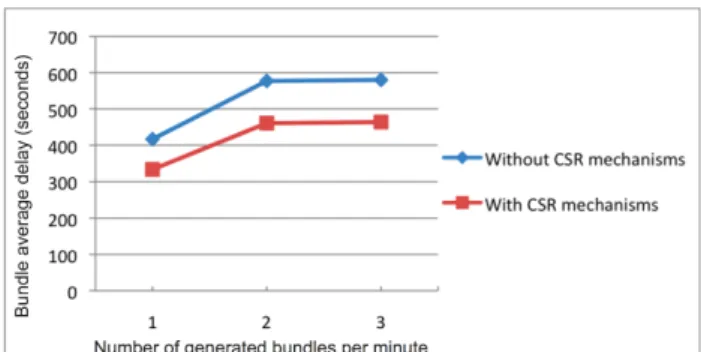
The bundle average delay also improves the network performance significantly with CSR mechanisms. Figure 5 depicts the bundle average delay (in seconds) as function of number of generated bundles per minute with and without content storage and retrieval mechanisms. The bundle average delay benefits from CSR mechanisms, decreasing the delay in 80, 106 and 116 seconds, respectively. These performance improvements also benefits from the relay nodes storage and forwarding procedures. Relay nodes store previous requested bundles that are forwarded every time that the same requests are issued from terminal nodes, that eventually are closer to the relay node than the source node. An example is a bundle stored in relay node 2 containing a content previously requested by terminal node 3. If terminal
node 2 issues a request for the same content, then mobile node 3 encounters it in relay node 2 instead of sending a
request all around the network that “hopefully” reaches
terminal node 1.
Figure 6 presents the average contact time between nodes as function of number of generated bundles per minute. Due to vehicles mobility, contact between nodes must be brief and fast to guarantee that if not all, the biggest amount of data is exchange. CSR mechanisms clearly improve this performance metric through the selection of specific cacheable and forwarding contents eliminating redundant data. These procedures eliminate all the exchanged traffic
waste, saving also contention resources (e.g. buffer space).
Figure 5. Bundle average delay (seconds) as function of number of generated bundles per minute for Epidemic protocol with and without content storage
and retrieval mechanisms.
Figure 6. Average contact time (seconds) as function of number of generated bundles per minute for Epidemic protocol with and without content storage
and retrieval mechanisms.
B. Performance Assessment of Spray and Wait Routing Protocol
Figure 7 shows the average bundle delivery probability as function of number of generated bundles per minute for Spray and Wait protocol. It is expected that network performance with Spray and Wait routing protocol may be better than Epidemic in all performance metrics. However, as may be seen Epidemic presents a better performance. Nevertheless, CSR mechanisms increase significantly the bundle delivery probability for all input loads.
Figure 7. Average bundle delivery probability as function of number of generated bundles per minute for Spray and Wait protocol with and without
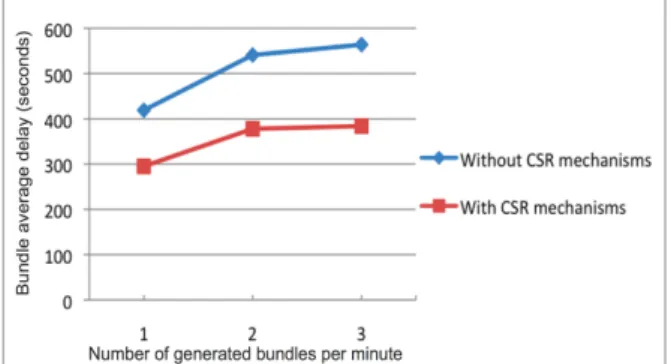
Figure 8, presents the bundle average delay as function of number of generated bundles per minute for Spray and Wait protocol. It is shown that Spray and Wait performs better than Epidemic. With CRS mechanisms, the average delay decreases 38, 83 and 70 seconds for each class of input traffic load, respectively. This reduces the time that a bundle is carried through the network, reducing also the contention and waste of resources (buffer space).
The average contact time as function of number of generated bundles per minute for Spray and Wait protocol is shown in Figure 9. Spray and Wait also presents better results than Epidemic. As may be observed, for Spray and Wait, CSR mechanisms decreases even more the contact time between nodes and the average contact time decreases about 9, 12 and 10 seconds, respectively, for the three input loads.
Figure 8. Bundle average delay (seconds) as function of number of generated bundles per minute for Spray and Wait protocol with and without content
storage and retrieval mechanisms.
Figure 9. Average contact time (seconds) as function of number of generated bundles per minute for Spray and Wait protocol with and without content
storage and retrieval mechanisms.
V. C
ONCLUSIONS ANDF
UTUREW
ORKThis work proposed and studied the impact of content storage and retrieval (CSR) mechanisms on the performance of VDTN networks through a testbed. Different network setups, with and without CSR mechanisms using Epidemic and Spray and Wait routing protocols, and different input traffic loads were performed on the testbed. It was observed that CSR mechanisms improve significantly the overall performance of VDTN networks, as expected. Despite of some results variations due to the testbed challenged scenario, CSR
mechanisms improve the average bundle delivery probability, the average bundle delay, and the average contact time between nodes for both studied protocols.
For future works, more application scenarios (e.g., file transfer protocol or World Wide Web applications for VDTN) may be considered. Furthermore, the performance evaluation and analysis of other routing protocols using CSR mechanisms may be considered.
A
CKNOWLEDGMENTSPart of this work has been supported by the Instituto de
Telecomunicações, Next Generation Networks and
Applications Group (NetGNA), Portugal in the framework of the Project VDTN@Lab, and by the Euro-NF Network of Excellence from the Seventh Framework Programme of EU, in the framework of the Specific Joint Research Project VDTN.
R
EFERENCES[1] K. Fall, "A Delay-Tolerant Network Architecture for Challenged Internets," in Applications, Technologies, Architectures, and Protocols for Computer Communication (SIGCOMM) Karlsruhe, Germany, Aug. 25-29, 2003, pp. 27-34.
[2] K. Fall, S. Farrell, "DTN: an architectural retrospective", IEEE Journal on Selected Areas in Communications, vol.26, no.5, June 2008, pp. 828-836.
[3] K. Scott, S. Burleigh, "Bundle Protocol Specification", IETF RFC 5050, November 2007.
[4] V. N. G. J. Soares, F. Farahmand, and J. J. P. C. Rodrigues, "A Layered Architecture for Vehicular Delay-Tolerant Networks," in IEEE Symposium on Computers and Communications (ISCC 2009), Sousse, Tunisia, 2009, pp. 122-127.
[5] J. J. P. C. Rodrigues, Optical Burst Switching Networks Architectures and Protocols, Fundação Nova Europa (Ed.), University of Beira Interior, Covilhã, Portugal, 2008.
[6] J. A. Dias, J. N. Isento, B. M. Silva, V. N. G. J. Soares, P. Salvador, A. Nogueira, and J. J. P. C. Rodrigues, "Creation of a Vehicular Delay-Tolerant Network Prototype," in Engineering 09: Innovation and Development, Covilhã, Portugal, November 25-27, 2009.
[7] M. Seligman, "Storage usage of custody transfer in delay tolerant networks with intermittent connectivity," in Internacional Conference on Wireless Networks (ICWN), Las Vegas, NE, USA, 2006, pp. 386-392.
[8] J. Ott and M. J. Pitkanen, "DTN-based Content Storage and Retrieval," in 2007 IEEE International Symposium on a World of Wireless, Mobile and Multimedia Networks, Espoo, Filand, June 18-21, 2007, pp. 1-7.
[9] J. Ott and M. J. Pitkanen, "Enabling opportunistic storage for mobile DTNs," Pervasive and Mobile Computing, vol. 4, 2008, pp. 579-594. [10] M. J. Pitkanen and J. Ott, "Redundancy and Distributed Caching in Mobile
DTNs," in 2nd ACM/IEEE international workshop on Mobility in the Evolving Internet Architecture (MobiArch 2007), Kyoto, Japan, August 27, 2007, pp. 1-7.
[11] Z. Zhang, "Routing in intermittently connected mobile ad hoc networks and delay tolerant networks: Overview and challenges," IEEE Communication Surveys Tutorials, vol. 8, 2006, pp. 24-37.
[12]A.Vahdat and D. Becker, "Epidemic Routing for Partially-Connected Ad Hoc Networks," in Duke University Technical Report CS-2000-06, April, 2000.
[13]T. Spyropoulos, K. Psounis, and C. S. Raghavendra, "Spray and Wait: An Efficient Routing Scheme for Intermittently Connected Mobile Networks," in ACM SIGCOMM, Philadelphia, USA, August 26, 2005, pp. 252-259.