Knowledge Sharing and (In)Security: towards a comprehensive view of managerial aspects
Leal, Carmem
1; Meirinhos, Galvão
2; Loureiro, Marlene
2; Silva, Rui
11
Centro de Estudos Transdisciplinares para o Desenvolvimento (CETRAD)
2LabCom.IFP
1, 2
University of Trás-os-Montes e Alto Douro, Vila Real, Portugal
[email protected]
[email protected]
[email protected]
[email protected]
Abstract:
The present study characterizes the global dynamics of academic publications about Knowledge
Sharing and Information Security through a research restricted to articles and conference proceedings present
in Thomson Reuters Web of Science. It is an exploratory and descriptive study for which techniques
recommended by Bibliometrics were used. Thus, during the period established for this study, a total of 78
authors contributed to 28 publications, distributed by 17 titles of journals and 19 conferences proceedings, with
almost 60% of these authors contributing with three or more publications. About 60% of the scientific output
was the responsibility of Malaysia, Sweden, Iran, Greece and England whose research reaches respectively 18%,
11%, 11%, 11%, 11% of total productivity, showing a great geographical dispersion. However, there is some
concentration in terms of scientific journals and research areas, being identified, mostly, the Computer Science,
Information Sciences and Engineering areas. Due to this confluence and constant interaction with other
disciplines, apparently the field of Knowledge Sharing has not yet crystallized as a theoretical territory. The
articles identified related to Knowledge Sharing and Information Security were submitted to a bibliometric
analysis using VOSviewer software. This method was applied in two phases, primarily, a descriptive analysis was
conducted and then a co-citation analysis was performed recurring to VOSviewer software. The results obtained
from co-citation analysis include two clusters, namely: cluster 1 - Information Security and sharing of knowledge under
the user's perspective and cluster 2 - Knowledge Sharing and Information Security under the organisation’s perspective and
translate a gap in terms of research about Knowledge Sharing and Information Security, thus pointing to a path
to be explored. There is also the need to foster new research and strengthen the networks of researchers, in
order to broaden the framework and theoretical crystallization as an autonomous scientific discipline
.
Keywords: Knowledge Sharing; Information security; Bibliometrics; co-citation analysis.
1.
Introduction
The way organisations capturing, developing, distributing and effectively using organizational knowledge is
defined as Knowledge Management (Davenport & Prusak 1998). This specific process lead organisations to
create value as well they make the best use of knowledge.
In this procedure,
is crucial
when firms share their
knowledge (internally or externally) enabling them to serve
their customers more efficiently and effectively gaining a competitive advantage. Knowledge sharing among
employees constitutes one essential stage in the development of an organizational knowledge base. In this sense
Leal et al. (2016) demonstrate the positive and direct knowledge sharing’ influence over organisational
performance and innovation (Marques et al. 2015).
Niwa (1990) was the first author to publish about knowledge-sharing in management, but under an engineering
vision. This Japanese researcher defined what he called a knowledge-sharing paradigm and highlighted the
importance of the knowledge flow, suggesting some strategies of creation of knowledge-based systems. These
systems would consist in a paradigm shift as they were an attempt to establish a knowledge platform to firms
and suppliers sharing their knowledge for “effective problem solving” (Niwa 1990, p.278). Despite being the first
author mentioning knowledge-sharing practices, it was done under an IT user’s perspective leaving the
management issue to a second place.
As similar with Knowledge Management, Information Security has become a globally recognized discipline within
organisations and at the Academy (European Network and Information Security Agency (ENISA) 2009). Affecting
individuals and organisations on a daily basis (Albrechtsen 2007; Winkler 2011) by protecting the confidentiality,
integrity and availability or accessibility of information (Grama 2014).
The first article relating KS to information security was presented on a Medical Conference and published just in
2003. In his paper, Wright have explored the Risk Information Management Resource (RIMR) as a tool to share
knowledge in communities of practice (Wright 2003).
It is evident that knowledge sharing and information security have become well-established concepts in
Academia and within organisations. However, it appears that the intersection of these two practices, has
received inadequate attention.
So this paper intends, under a systematic literature review recurring to bibliometrics techniques, to unveil how
academia has demonstrated its interest in these two subject through publications that are able to articulate
information security questions with knowledge sharing, as so far as dynamically investigates the international
research production in the wider field of knowledge sharing .
The objectives of this study are: (1) to ascertain the quantity and spread of papers published available through
the Thomson Reuters web-based databases; (2) to identify the authorship patterns deal with relevant literature;
(3) to find out the active authors and affiliations involved in the published works; (4) to explore the JCR.s subject
categories of the major journals; and (5) to identify the main co-cited references and ways they are grouped (i.e.
clusters).
The situation of scarcity in the information concerning research in these two adjacent practices proves clearly
the need for a systemic exploration. Thus, the review presented below, which aggregates bibliometric data,
sought to systematise the various publications in this field and identify the main topics studied in recent decades,
as well as how these streams have evolved. The results of this study would (a) present an overview of the
worldwide status of publication productivity of researchers and practitioners; (b) identify the main subjects of
academic activity of these experts and (c) forecast the trends of future lines of investigation.
The remainder of the paper is organized as follows: the theoretical background comprises knowledge sharing
and Information Security questions. In section 3 the research methodology, data collection is discussed. The
results obtained are presented in section four. Contributions to, and implementation of the research are
explained in section five. The conclusion, limitations and future work are all described in section six.
2.
Literature Review
Presently, and probably because the explosion of knowledge and information, greater emphasis is placed on
knowledge work and the identification of information and knowledge in Management and Business (Spender &
Grant 1996).
In this sense, knowledge management, processes that naturally exist in organisation (e.g., knowledge sharing or
knowledge acquisition) are vital to organisations, since knowledge is not uniformly disseminated within them,
consequently, it is necessary to identify, capture, create, and accumulate knowledge to enable both resource
structuring and capacity building, which have been found to significantly increase firm performance (Wang &
Wang 2012).
To achieve such aim, (e.g. increase firm’s performance) knowledge sharing plays an important role in assisting
the organization achieving its best practices, and in minimizing both the learning curve and the effort invested
on the part of employees to master new fields of expertise (Hansen 2002). Managers are now trying to facilitate
the spontaneous emergence of communities of practice in organisations to encourage alignment of changing
practices, thereby assisting the transfer of knowledge throughout the organization.
According to de Vries et al. (2006) knowledge sharing is the process where individuals mutually exchange their
(tacit and explicit) knowledge and jointly create new knowledge, been recognized as a positive force for survival
of an organization (Yang & Chen 2008). Wang et al. (2016) stated that Knowledge-related competence and
organizational performance can be enhanced by effective KS, because KS can make jobs easier and improve
process efficiency by the exchange of relevant information, best practices, insights, experiences, preferences,
lessons learned, as well as common and uncommon sense (Wu & Lin 2013) it is why KS is the best way to
effectively and efficiently create, sustain, and transfer knowledge (Wang et al. 2014).
Wu and Lin (2013) define knowledge sharing as a process which comprises a set of shared understandings
related to providing employees with access to relevant information and using existing knowledge within
organizations. Darr and Kurtzberg (2000) go further and define knowledge sharing as the deliberate action in
which employees diffuse relevant information to others across and outside the organisation.
Undoubtedly, information has a key role in this new knowledge paradigm, and above all, “users should play an
active part in the information security work by preventing unwanted incidents; protecting an organisation’s
material and immaterial assets; and reacting to incidents” (Albrechtsen 2007, p.276).
To Parsons et al. (2014) information security concerns to defending information from unauthorized access,
disclosure, use, modification, disruption, or inspection. In other words, confidentiality, integrity and reliability
of information are important in information security (von Solms & van Niekerk 2013). In this sense, information
security management is an issue for both users and organisations playing a vital role in mitigating the risk of
information security breaches
Albrechtsen (2007) stresses that, generally, within organisations, information security awareness is inadequate,
each individual perform very few information security actions; people are not familiar with possible threats and
are not aware of possible consequences of security breaches; and the worst, some of them may not see the
value of their information security role in the holistic security work of the organisation.
Haldin-Herrgard (2000) signs the importance that information security has to knowledge sharing to
organisations. As the author refers: “a great deal can be done through modern information technology to diffuse
explicit knowledge” (Haldin-Herrgard 2000, p.363). Still, and according to this author
the difficulties with sharing
of knowledge can however also be to advantage for the organisation, due to the barriers created to copying by
outsiders.
Safa and Von Solms (2016) presented an interesting study were they tested a knowledge sharing of information
security model. They highlighted the importance of motivational factors on one's attitude towards information
security knowledge sharing behaviour, in particular, the relevance of extrinsic motivational factors.
3. Methodology
In order to accomplish the aims of this study, some research questions were defined:
i.
What are the total number and geographical spread of publications in knowledge sharing and
information security?
ii.
Who are the active contributors, their status and affiliations?
iii.
What are the core of knowledge sharing and information security journals and their disciplines?
iv.
Starting from the co-citations analysis of this sample is it possible to determine that there are
tendencies for certain types of studies or thematic?
Therefore, to perform this study and answer these questions, a systematic approach was applied to the
literature review, making use of a rigorous protocol and definition of steps in order to carry out the research
and an analysis of the literature based on scientific articles published in the Web of Science. The articles found
related to the topic of knowledge sharing and information security were submitted to a bibliometric analysis.
According to Pritchard (1969, p.349), bibliometrics deals with "the application of mathematics and statistical
methods to books and other media of communication". Similarly, Hawkins (1977) defines bibliometrics as the
application of quantitative analysis in the bibliographical references of the body of literature. In sum,
bibliometrics study patterns of authorship, publication and literature use by applying mathematics and statistical
analyses.
Potter (1988) divided bibliometric studies into two categories. Firstly, descriptive, which attempts to study the
body of a literature by counting its contributing countries, authors, Journals, year of publications, and disciplines.
The second category of bibliometrics, attempts to study the use of a body of literature by using citation analysis.
For example, it can be concluded that in a specific field and period of time the most cited papers, and also the
most co-cited papers tend to neglect a particular methodology or thematic. This method looks at the work others
have done and seeks to build upon those previous works with a needed, new interpretation.
As suggested by Di Stefano et al. (2012, p.1199), although this analysis does have its limitations, “if compared to
alternative techniques, citations are less prone to systematic biases in providing an objective assessment of the
influence of publications or authors.
Bibliometrics has been widely used in the social sciences, in different research areas, namely applied to
knowledge management (Akhavan et al. 2016; Serenko et al. 2011; Serenko & Dumay 2015). Many of these
systematic reviews are based on an explicit quantitative meta-analysis of available data.
This study has, therefore, a quantitative nature and can be characterized as an exploratory-descriptive study
(Abrams 2009). Data were collected in February 2017 through the ISI Web of Science (SCI-EXPANDED) and Social
Sciences Citation Index (SSCI) databases, using a Boolean combination of relevant keywords. Table 1 presents
the research criteria used in this study.
Table 1 Research criteria used
Keywords (TOPIC) Period Database Research Areas Document Types “knowledge sharing" and “Information
security” 1900 a 2017 Web of Science SCI-Expanded Business Economics Information Science Computer Science Articles Proceedings papers
After applying these criteria, a database of 28 records was obtained. The proceedings papers were considered
because the records were retrieved, in their majority (68%), from these type of publications.
In addition to the outputs generated by WoS, we used the VOSviewer software to obtain different clusters
according to study’s objectives. The VOSviewer was particularly useful to find the clusters resulted from the
co-citations analysis.
4.
Results:
4.1.
Brief characterization – a descriptive analysis
A preliminary examination of the works published revealed a significant amount of literature addressing
information security available, but much of it is very technical. Besides, despite an evident concern to security
of information, there is an apparent gap in research regarding the intersection between knowledge sharing and
information security, regardless the relevance already recognized of human resources behavior in these areas.
During the period established for this study, a total of 28 studies (articles and proceedings papers) were found
distributed by 61 journal titles. A total of 63 authors published their works since 2003, 87% of them contributed
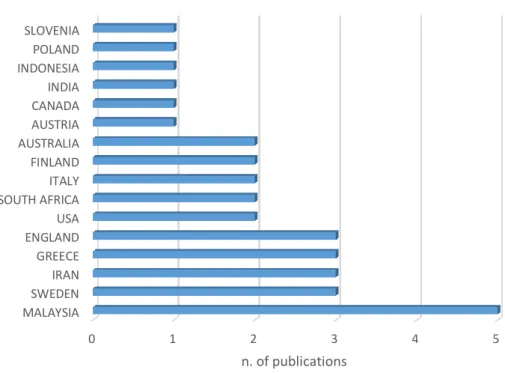
with just one publication. In terms of countries, the list is leading by Malaysia (5 records), England, Greece, Iran
and Sweden (3 records), Australia, Finland, Italy and USA (2 records), verifying a large geographic polarization.
Figure 1 knowledge sharing and Information Security – year-wise distribution of papers on WoS
Figure 1 exemplifies a scarcity of works published on WoS connecting knowledge sharing and Information
Security. The first work published, Risk information management resource (RIMR) modeling an approach to
defending against military medical information assurance brain drain, occurred just in 2003 and belonged to an
American researcher, Woodring Wright, presented at a Medical Conference. The years of 2014 and 2016 were
the years with more publications (6) the rest of the period did not achieve an average of 2 publications/year. In
1 1 4 1 1 1 3 6 3 6 1 2003 2005 2008 2010 2011 2012 2013 2014 2015 2016 2017
2014 we found the first work published in Management Science which related knowledge sharing and
information security, (Ahmed et al. 2014).
Figure 2 shows publications geographical affiliation. Malaysia is the country with the majority of publications,
four countries (Sweden, Iran, Greece and England) have almost 50% of the studies published, followed by USA,
South Africa, Finland, Italy and Australia. The remaining six countries contributed with one paper each during
the period studied. Data shows a geographical high dispersion not highlighting any particular country or
continent.
Table 2 stresses a large prominence that Proceedings from European Conference on Knowledge Management
(ECKM)) have in this sample (21%). Besides, other conferences from Computer Science have also been
highlighted. Almost 60% of the sample was published in Proceedings, mostly from Information and Computer
Science area.
Table 2 – Publications: Source Titles
Source Titles Records
Proceedings of the European Conference on Knowledge Management 21,4%
Computers Security 10,7%
Proceedings of the annual Hawaii International Conference on System Sciences 7,1% International Conference On Research And Innovation In Information Systems 7,1%
Computers in Human Behavior 7,1%
2013 International Conference On Research And Innovation In Information Systems ICRIIS 7,1%
Technological Developments In Education And Automation 3,6%
Science Of Computer Programming 3,6%
Proceedings of the Society Of Photo Optical Instrumentation Engineers SPIE 3,6% Proceedings of the 12th International Symposium On Open Collaboration Opensym 3,6%
Knowledge Based Software Engineering 3,6%
0 1 2 3 4 5 MALAYSIA SWEDEN IRAN GREECE ENGLAND USA SOUTH AFRICA ITALY FINLAND AUSTRALIA AUSTRIA CANADA INDIA INDONESIA POLAND SLOVENIA
n. of publications
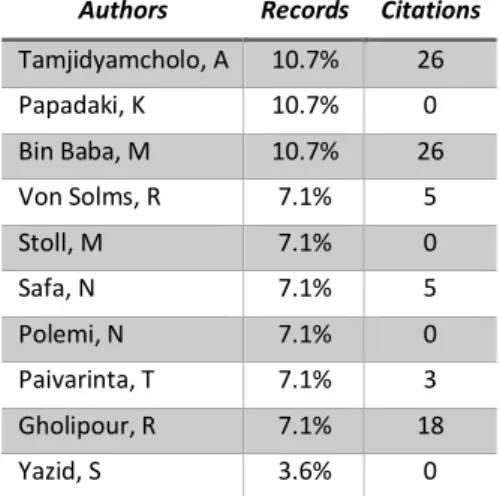
In terms of authorship, Table 3 illustrates the most cited and the ones with highest number of publications. Some
authors, despite having 2 or more publications, do not have any citations, this fact is probably due to the
predominance of papers presented at international conferences.
Table 3 – Top 10 - Authors – Publications
Authors Records Citations Tamjidyamcholo, A 10.7% 26 Papadaki, K 10.7% 0 Bin Baba, M 10.7% 26 Von Solms, R 7.1% 5 Stoll, M 7.1% 0 Safa, N 7.1% 5 Polemi, N 7.1% 0 Paivarinta, T 7.1% 3 Gholipour, R 7.1% 18 Yazid, S 3.6% 0
Given this data, it is possible to summarize some characteristics of this sample. Regardless of a large number of
publications concerning to knowledge sharing and to information security which emphasize their significance,
both academically and professional, it appears that in the intersection of these two themes little publications
have been presented. Furthermore, within this sample, built from Thomson Reuters Web of Science database,
it is possible to find a prevalence of journals and conference proceedings from Compute Science and Information
Systems areas. The Figure 3 illustrates and reinforce this idea showing the keywords more used by the authors
from this database.
Using the Vosviewer software it was possible to define this map (Figure 3) locating the keywords, tracing the
relationships between then and offering a visual illustration of the principal terms applied. Again, within the 28
publications which constituted the sample, terms related to information security were more relevant than the
ones related to knowledge sharing (in number of citations).
4.2.
Co-citation Analysis
According to Di Stefano et al. (2012) a co-citation analysis is a bibliometric method used to examine relationships
between articles or authors contributing to the development of a research field, based on the assumption that
two often co-cited documents are related to each other and address the same broad research questions.
In this paper, the focus will be over the most influential contributions dealing with the knowledge sharing and
information security concepts. Using the Vosviewer software it was possible to define two very distinct and
separated groups of authors (see Figure 4). Given the small sample size the criteria used to run the co-citation
analysis was the author has been cited three times, at least. This criteria gave an output of 59 references divided
into two clusters (one with 30 references and the second with 29). In terms of dimension these two clusters are
practically balanced.
Small (1973) believes that the strength of a co-citation is related to the number of times that two earlier
documents are cited together by a new article. Thus, in Figure 4 it is possible to see the authors most cited on
the papers from WoS’ sample obtained previously.
Additionally, Table 4 points out the two clusters found and list the five most cited references from each of
groups.
Table 4 – Clusters composition - the top 5
Authors Citations Cluster
Chang and Chuang (2011) Chin et al. (2003) Choo (2011)
Fornell and Larcker (1981) Hsu and Lin (2008)
47 36 36 36 36
1 Information Security and sharing of knowledge under the user's perspective
Hsu et al. (2007)
Dhillon and Backhouse (2001) Nonaka (1994)
ISO/IEC (2005)
Brown and Duguid (2001)
110 92 92 84 84
2 knowledge sharing and Information Security under the organisation’s perspective