1
Equilibrium - Flexible Spending Account Platform. A Business Plan for a
Supplier of an Innovative Human Resources Management Platform
Michał Szymkat
Project submitted as partial requirement for the conferral of MScBA - Master of Science in Business Administration
Supervisor:
Nelson Ramalho, Assistant Professor at ISCTE Business School,
2
Navegadores antigos tinham uma frase gloriosa: "Navegar é preciso; viver não é preciso."
Quero para mim o espírito desta frase, transformada A forma para a casar com o que eu sou: Viver não
É necessário; o que é necessário é criar.
Não conto gozar a minha vida; nem em gozá-la penso. Só quero torná-la grande, ainda que para isso
Tenha de ser o meu corpo e a minha alma a lenha desse fogo. Só quero torná-la de toda a humanidade; ainda que para isso
Tenha de a perder como minha.
Cada vez mais assim penso. Cada vez mais ponho Na essência anímica do meu sangue o propósito
Impessoal de engrandecer a pátria e contribuir Para a evolução da humanidade.
3
Acknowledgments
This thesis marks a final of my studying time at ISCTE-IUL in Lisbon. Time that I enjoyed a lot and during which I acquired professional skills necessary for the future development of my career. In this period of study I also met remarkable people who allowed me to improve myself in various dimensions. I would like to thank here all my friends and professors for helping me to reach the point where I am at the moment.
I would like to thank professor Nelson Ramalho for giving me the opportunity to work on creation of a business plan during preparation of my master thesis. This helped me to discover a new dimension of business which demanded of me a creativity what I find both challenging and exciting.
I would also like to thank the people who dedicated their time to answer different questions regarding this thesis and my business idea: Filipe Borges de Medeiros from KPMG Portugal and Monika Staszkiewicz from OK Systems.
Lastly and most importantly, I would like to thank my parents and my sister who always back me in any case of difficulties in my life and unconditionally support me in realizing my passions, interests and choosing my professional path.
4
Index
Abstract ... 7 Executive Summary ... 7 List of Images ... 8 List of Tables ... 9 1 Introduction ... 10 2 Literature Review ... 11 2.1 Entrepreneurship ... 11 2.2 Business Models ... 142.2.1 Definition and types of business models ... 14
2.3 Business Plan ... 17
2.3.1 Definition and Importance ... 17
2.4 Benefits in Human Resources Management theory ... 18
3 The Foundation ... 27
3.1 The Problem – the need ... 27
3.2 The Solution – what is offered... 29
3.2.1 The platform ... 31
3.2.2 The access distribution process ... 32
3.2.3 Final customer usage ... 33
3.2.4 Platform design for the needs of service suppliers... 35
3.2.5 Platform Design for the needs of Equilibrium ... 36
3.3 The Business Model ... 37
3.3.1 Customer segments ... 37
3.3.2 Value proposition ... 37
3.3.3 Channels ... 38
5
3.3.5 Revenues stream ... 39
3.3.6 Key activities and partnerships ... 40
3.3.7 Cost structure ... 40
3.3.8 Key Resources... 41
3.3.9 Company’s Mission, Vision and Core Values ... 42
4 The Context ... 42
4.1 Market Analysis - PESTEL Analysis ... 42
4.1.1 Political and legal factors ... 42
4.1.2 Economic factors ... 44
4.1.3 Social-cultural factors ... 44
4.1.4 Technological factors ... 46
4.1.5 Ecological factors ... 47
4.2 Competition Analysis - Five Forces Model of Michael Porter ... 48
4.2.1 Threat of New Entrants ... 48
4.2.2 Bargaining Power of Buyers ... 48
4.2.3 Bargaining Power of Suppliers ... 48
4.2.4 Threat of Substitute Products or Services ... 48
4.2.5 Rivalry among Existing Competitors ... 49
4.2.6 SWOT Analysis ... 49
5 Marketing Plan ... 50
5.1 Objectives ... 52
5.2 Target Market Definition ... 52
5.3 Services Mix ... 53 5.3.1 Product/Service ... 53 5.3.2 Price ... 54 5.3.3 Placement ... 55 5.3.4 Promotion ... 55 5.3.5 People ... 56
6 5.3.6 Physical Evidence ... 57 5.3.7 Processes ... 59 5.3.8 Productivity ... 60 6 Financial Plan ... 61 6.1 Operating Plan ... 62
6.2 External Services and Supplies ... 63
6.3 Income Statement ... 64
6.4 Balance Sheet ... 66
6.5 Cash statement ... 67
6.6 Financial Indicators ... 67
7 Appendices ... 68
7.1 The Overview of entrepreneurship literature by Gedeon (2010) ... 68
7
Abstract
This Master Thesis project consists of a viable business plan for an innovative solution in the field of human resources management. The rationale of the business plan is founded in the literature review on: entrepreneurship, business modelling and history of global evolution of reward systems. The business plan provides crucial characteristics of Portuguese market which have an impact on the future implementation of the project. The marketing plan and financial estimations are completing the plan as important parts of the business model.
Esta Tese de Mestrado consiste em plano de negócios viável para uma solução inovadora na área da gestão dos recursos humanos. O plano de negócios é antecipado com revisão da literatura sobre: empreendedorismo, criação dos modelos dos negócios e história da evolução dos sistemas de recompensa no mercado global. O plano de negócios caracteriza os importantes factores do mercado Português que condicionam implementação do projecto O plano de marketing e estimativas financeiras são incluídas no plano de negócios como as partes importantes do modelo de negócio.
Executive Summary
The purpose of this project is to design a viable business plan for a startup company created basing on the idea of delivering a value for its customers by offering diversified and flexible benefits solutions at affordable price. The topics covered include the literature review, foundations (business drivers and model), market analysis, marketing plan and financial plan.
The proposed project description is preceded by a literature review sheding a light on the basics of entrepreneurial practice, the importance of business models for defining and creating a specific business plan, as well as on the evolution of recently introduced human resources practices regarding rewards, especially in the fringe benefits area.
The foundation part explains the needs of Portuguese market regarding remuneration policies and introduces an attractive solution of new packages of fringe benefits which could be sold along with meal cards already popular in Portugal. Once the offer is defined, a business model, which allows to generate profits by the company and retain the customers, may be proposed.
8 Proving viability of the idea is supported by three kinds of analysis: PESTEL, Five Forces of Porter and SWOT. These analyses allow to demonstrate some weak points of the idea like uncertain interest from the side of service suppliers and potential clients, or difficult negotiations processes needed to be carried out in order to put the idea to work. Nevertheless there is still a number of strong points which act in favour of the future implementation of the business plan. Acknowledging them translates into more realistic approaches to the business and market.
Marketing activities targeting new customers in order to achieve good sales were proposed in the form of a marketing plan consisting of a mix of most appropriate means and qualities for reaching customers and creating strong brand in the future.
In the financial part of the research the costs and the revenues are estimated to give the potential investors a realistic view on the expenses connected to the projected business as well as expected outcomes.
List of Images
Figure 1 Linking Entrepreneurship to economic growth Wennekers and Thurik (1999) ... 13
Figure 2 Osterwalder’s Business Model Canvas ... 16
Figure 3 Model of total reward by Armstrong (2006) ... 20
Figure 4 Comparative Cumulative Stock Market Returns ... 24
Figure 5 Benefits as an important talent attraction and retention factor in organizations in USA 24 Figure 6 Benefit Systems Management at Warsaw stock market ... 37
Figure 7 Edenred's publicity in Portugal ... 38
Figure 8 A screen from Groupon platform ... 39
Figure 9 Screens from KCRW website and mobile application ... 40
Figure 10 Screen from fiverr website ... 41
Figure 11 A screen from Zenefits website ... 41
Figure 12 Paper tickets released by Edenred ... 47
Figure 13 Benefit TV ... 55
Figure 14 Screens from Rui's Filipe Behance ... 57
9
List of Tables
Table 1 Frequencies of answers on a question: How well rewarded do you feel at the moment? (Martins, 2013) (sic!) ... 29 Table 2 Fringe Benefits regulations in Portugal (Diário Da República) ... 43 Table 3 SWOT Analysis ... 49 Table 4 Target Market- selected sectors in Portugal in 2012 (source: INE Statistics Portugal) .... 53
10
1 Introduction
It is exciting to observe how the entrepreneurial trends change across time. Various ideas leave a mark in the global market and it always starts with an idea within someone’s mind. Especially during the times of economic downturn human creativity and high motivations in gathering necessary living resources become extremely important. The beginning of 21st century brought a creation of large number of interesting startups as a result of economic vitality. The new concept of the “side income” was born with highly controversial companies like Uber, Air BnB and more recent success of Fiverr. All of these companies have one thing in common; they allow their users to get money by sharing their possession with others (Air BnB and, e.g., Spinlister) and their skills (Fiverr, Uber).
Another important fact is the inflow of the new generation of workers to the marketplace. The Millennial generation has different expectations regarding remuneration. It is a generation which is really into technology and technological solutions and many of its members look for a creative way of making money, not necessarily working for huge corporations offering them a career and often quite a monotonous work.
The purpose of this project is to define possibilities for the creation of a new online platform, offering side income to its services suppliers. On the other side attractive rewards for Millennial employees consist of flexible spending accounts which allow them to access various services in their working area. The idea puts the side income in reality of Business to Business market, where instead of individuals the organizations are looking for side income solutions.
The market conditions assumed for this project confine to Portugal. As a country affected by economic crisis and highly developed leisure infrastructure thanks to touristic attractiveness, Portugal seems to be an interesting market for implementing the solution of this type which would allow using recreational facilities in the period when they are not used by tourists. Portugal and especially Lisbon area have a widely developed network of aid for startups which is another reason why the research is focused in this market.
11
2 Literature Review
2.1 Entrepreneurship
A very complete research on definitions of entrepreneurship has been conducted by Gedeon (2010: 19-21) in What is Entrepreneurship? The systematic review the author did covered five schools of thought: the risk theories of profit, dynamic school, trait school, behavioral school, and Austrian school as follows (see appendix.10.1)
One of the first theories coined during that time, was created by Cantillon (1755), where entrepreneur is described as a bearer of risks inflicted by changes in market demand. In his definition Entrepreneurs purchase inputs at a given price to produce and sell later at an uncertain price. The entrepreneur brings prices and production into line with demand. The important part of the definition is the uncertainty. This is the reason why it was classified as one of the risk theories of profit.
Schumpeter (1947) who perceived entrepreneurship as creative and an innovative activity pointed out a possible ways of bringing the innovation like: introduction of a new product, introduction of a new method of production, introduction of a new market, introduction of a new source of supply of raw materials, introduction of a new organization, or of an industry. Schumpeter describes Entrepreneurs as people who out of available resources and solutions are capable of creating something innovative. As the creation process was brought into consideration the new school of defining entrepreneurship is called the dynamic school in Gedeon (2010)
Baumol (1968) extended the Schumpeterian vision of entrepreneurship. He stated: “The entrepreneur (whether or not he in fact also doubles as a manager) has a different function. It is his job to locate new ideas and put them into effect. He must lead, perhaps even inspire… he is the Schumpeterian innovator and more. He is the individual who exercises what in the business literature is called ‘Leadership.’ And it is he who is virtually absent from the received theory of the firm.” As it is visible this definition is focused on the person of the entrepreneur, that is why this theory is one of the firstly classified to the “traits school” in defining entrepreneurship in Gedeon (2010).
The main traits of entrepreneur were defined in McLelland (1961) he defined them as: risk-taking, energetic activity, individual responsibility, money as measure of results, anticipation of future possibilities and organization skills.
12 One of the most popular definitions of entrepreneurship is based on the research of Howard Stevenson (1983) it states: “Entrepreneurship is the process by which individuals pursue opportunities without regard to the resources they currently control.” This is an example of a behavioural definition of entrepreneurship.
There was a group of Austrian scientists who approached the topic of entrepreneurship. Their approach enhanced the dynamics of the entrepreneurial process like Schumpeter. Among them Gedeon recalls Walras, Mises, and Kirzner. The most recent theory associated to Austrian school was coined by Bygrave and Hofner (1991) at Gedeon (2010) “An Entrepreneur is someone who perceives an opportunity and creates an organization to pursue it”. Gedeon states that such definition shares both traits of risk and dynamic approaches. In general these scientists focused more on the dynamics of the entrepreneurship.
Stressing the need for an integrative approach, Gedeon (2010: 30) proposes a new definition of entrepreneurship: “Entrepreneurship is a multi‐dimensional concept that includes owning a small business (Risk Theory), being innovative (Dynamic Theory), acting as a leader (Traits School), or starting up a new company (Behavioural School). It includes spotting opportunities to drive the market toward equilibrium (Austrian dynamic view) or causing disequilibrium through “creative destruction” (Schumpeterian dynamic view). It includes doing this on your own, in a team or inside a company. It involves starting without any resources and creating new values in the realm of business, social values, government or academia.” One can see that even though all approaches are being represented in that definition three out of five parts refer to dynamic approach.
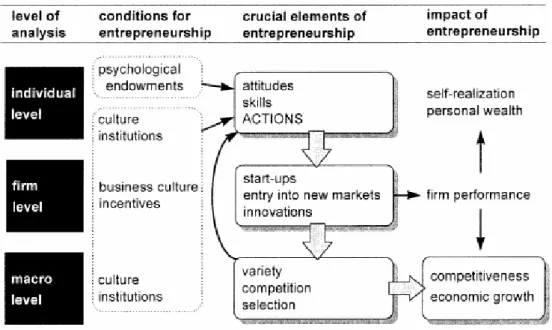
13 There are also studies on the impact of entrepreneurship on economic growth, Wennekers and Thurik (1999) created a very interesting chart concluding one of his articles:
Figure 1 Linking Entrepreneurship to economic growth Wennekers and Thurik (1999)
The figure illustrates a positive impact of the entrepreneurship in 3 different dimensions: individual level, firm level and macro level. In every dimension there is a visible positive impact which can enrich the economy of a society.
Scientific literature noted that very important for the level of entrepreneurship are: external, national or regional environment and internal culture of companies. The research demonstrates possible influence of entrepreneurship on economic growth but the researchers claim that many mechanisms and theories are yet to be proven in the future researches.
Van Praag and Versloot (2008) carried out a meta-study research of 57 studies on the positive impact of entrepreneurs for the performance of macroeconomics. In conclusion they wrote that young firms “engender relatively much [...] productivity growth and produce and commercialize high quality innovations” (p.91).
Galindo and Mendez-Picazo (2013) conclude that innovation is playing central role in the economic growth process and entrepreneur is very important part of the process of obtaining higher profits by companies by implementing new technologies and solutions. The research was conducted by collecting data from ten developed countries: Denmark, Finland, France, Germany, Italy, Japan, Netherlands, Spain, Sweden and the USA. The authors used data on: GDP of each country, number of patents issued, human capital, total entrepreneurship activity, income distribution measured by Gini coefficient, and money supply. The findings
14 show that there is a positive impact of entrepreneurship on economic growth and that the factors, which may increase the level of entrepreneurship in a given country are: education (as it stimulates the innovation), monetary institutions and “social climate” which stands for a fair income distribution in the society.
Despite wide consensus on the positive impacts of entrepreneurship, no entrepreneurial project is successful without careful planning and a great business model.
2.2 Business Models
2.2.1 Definition and types of business models
A business model can be taken as “… a description of how your company intends to create value in the marketplace. It includes that unique combination of products, services, image, and distribution that your company carries forward. It also includes the underlying organization of people, and the operational infrastructure that they use to accomplish their work.” (Kaplan & Warren, 2007: p. 260). Complementarily Roos, Roos Dragonetti and Edvinsson (1997) highlight the central role of intellectual capital stating that a business model shows how an organization creates value by applying knowledge.
The definition of Kaplan & Warren stresses out the importance of added value. It is supposed to be established for the customers and suppliers and it is a base of successful business modelling. From this point of view one of the most important aims of a company is retaining that added value.
A business model of a company can be seen as the blueprint of the company operations. It is: “a conceptual coherent framework that provides a holistic but abstract understanding of the underlying business logic of an organization” (Al-Debei & Avison, 2010).
Another interesting definition was created by Osterwalder (2004: 15) “A business model is a conceptual tool that contains a set of elements and their relationships and allows expressing a company's logic of earning money. It is a description of the value a company offers to one or several segments of customers and the architecture of the firm and its network of partners for creating, marketing and delivering this value and relationship capital, in order to generate profitable and sustainable revenue streams.”
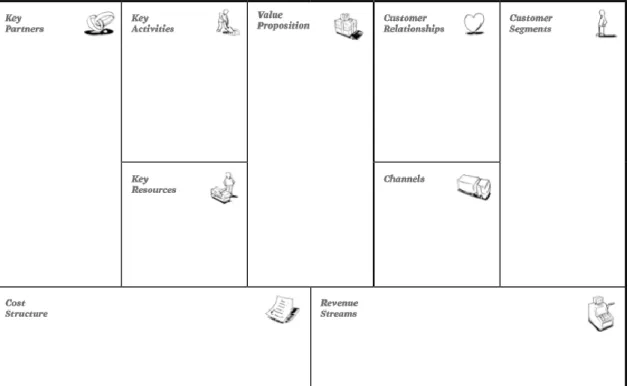
15 Osterwalder (2009) defines nine building blocks which are essential for defining, designing and analysing any business model. All together the blocks construct a widely used by entrepreneurs tool called business model canvas. The canvas contain the following parts:
1. Customer Segments – this is the core part of any business model because without customers the company will not be capable of sustaining the revenue streams needed for its survival. A business model may define one or several customer segments, varying on different factors.
2. Value Propositions – it is the reason why the customer will select a certain company instead of its competitors. It can be defined as aggregated benefits offered to customers by the company.
3. Channels – this is the block that stands in between customers and values. This block can be described with the different roles it plays for the business model. First of all it embraces the communication strategies chosen by the company to raise the awareness of its products and service. Second, it defines the whole purchasing process, including the post-purchase customer support.
4. Customer Relationship – this is a second block that stands between the Value Propositions and the Customer Segments. It defines processes that allow the company to acquire and retain the customer as well as the ways to upsell existing products and services to its loyal customers.
5. Revenue Streams – this block represents the money that company receives for its services. It contains mainly two types of Revenue Streams: the ones resulting from one time customer payments and the ones that result from payments created by ongoing payments for the value delivery and the post-purchase customer support.
6. Key Resources – the key resources block stands for all kind of resources which allow the company to construct the value proposition. The resource can vary for example among: human, financial, intellectual, physical etc.
7. Key Activities – the Key Activities block of the canvas defines all operations which are necessary to let the model work and be profitable. These activities are crucial in building the value proposition of the company
8. Key Partnerships – this block describes the network of partners and suppliers that allow the company work successfully.
16 9. Cost Structure – this block of canvas is about all costs of the operations of the company. The costs as the revenues result from all the activities associated to other blocks of Business Model canvas.
Figure 2 Osterwalder’s Business Model Canvas
Chatterjee (2013) specified different business models categories: Efficiency-Based, Perceived value based, Network Value (Loyalty-Based) and Network Efficiency.
The main idea of businesses operating in Efficiency-Based category is to produce their services and products in a more efficient way than the competition. A typical example of these business models are service companies based on relatively valuable services delivered at low price, thanks to efficiency. For instance companies like McDonalds or Ryanair are famous for their efficient service.
Perceived Value Based companies response to very specific needs of their customers providing them valuable product or service. They tend to use more qualitative preferences of their clients and demonstrate capability of capturing perceived value. Chatterjee uses as examples companies like: P&G, Phillip Morris and Whole Foods Market.
Network Value (Loyalty-Based) model companies provide its customers a certain affinity and generate loyalty among them. As a good example the author presents the American Express company which at some point decided to call its cardholders “members” rather than “clients”.
17 Network Efficiency model core is focused on a hub space which allows facilitating transactions between buyers and sellers. One of the main ideas on which this model is based is increasing the level of transactions and efficiencies among all the companies which are included in the certain deals. The subtle version of Network Efficiency model occurs whenever a local firm operates as a facilitator bridging other companies needs to work more efficiently, like b2b segments of some companies as Paypal, Alibaba or Ebay.
2.3 Business Plan
2.3.1 Definition and Importance
A business plan definition is provided by Kaplan and Warren (2007: 339): “A business plan is a 25-40 page written document that describes where a business is heading, how it hopes to achieve its goals and objectives, who is involved with the venture, why its product or service are needed in the marketplace and what it will take to accomplish the business aims.” The importance of business plan is based on 3 ideas: it allows the entrepreneurs to spot the benefits of their idea, the business plan is a decent base for comparing actual performance with the expected performance, it’s an essence of the idea which is communicated to other interested in the project parts like for example investors who play a crucial role in the project funding process.
2.3.2. Development of Business Plans
Boni (2012) divided the business plan in three parts:
Foundation/ opportunity (Problem + Solution + Business Model)
The Infrastructure/ resources ( Team + Technology + Finances + Current Status)
The Context/Social-economic techno drivers (Market Drivers + Competition)
The main purpose of the foundation part of the business plan is the description of the problem, it defines a gap which calls for the solution, that allegedly brings value to the customers. The business model should explain how to arrange a specific part of the business to capture value in the market, and deliver a good product/service to the customer.
The infrastructure must describe the team of people who will be responsible for making the whole project working successful. The finances issues concern demonstrating financial data
18 that persuade the potential investors to put their money in the project. Boni (2012) mentions: a five-year projection with profit & loss, cash flow, and balance sheet. The current status is another important section of business plan to inform the potential investor what must be achieved to make the project successful. At the last section, the market and the competition needs to be analysed in order to perceive the possible effects on the external environment.
2.4 Benefits in Human Resources Management theory
According to Kłosowska (2011) the first concepts of benefits were coined in the United States of America. The first benefit system is believed to be created in 1636 as military retirement program for the inhabitants of Plymouth colony. Throughout the time the idea has developed and its importance rose. Health insurance became common benefit in XXth century. In the period of II World War benefits became specially important as American government froze the level of wages salaries basing on the values from 15.09.1942. As the employers needed to attract somehow new employees to fulfill the increasing demand, the concept of benefits like health insurances and paid leave emerged. Even when the law changed in favour of adjusting salaries the benefits remained their important role in American remuneration system. In 90’ the Total Reward Concept emerged as a trending concept in Human Resources Management theory.
To comprehend the concept of Total Reward one should understand the importance of the reward systems. According to Von Glinow (1985) the term “reward system” has been used to describe practices of remuneration available to employees, the conditions in which they might be obtained, and the way both the rewards and conditions are selected by the organization. It’s one of the main systems used to manage an organization. To be effective it has to be aligned with company strategic tools and other management tools used within the organization (Hufnagel, 1987; Lawler III and Jenkins Jr, 1992). This statement is confirmed by Camara (2000). He stresses the need of creating a system which is widely understood and accepted by then employees of the company to assure its efficiency. Another study published within the book Novo Humanator (2007) in Portugal, emphasizes the need of testing the remuneration systems by analysing the extent to which indicators of dissatisfaction decreased such as absenteeism, low productivity, and employee turnover.
The Total Reward Concept has been widely described by a renowned association affiliating human resources professionals called WorldatWork, which aims to provide the practitioners with the know-how to successfully implement total rewards assuring connection
19 between employee engagement and business performance (WorldatWork, 2007:10). A working definition in their handbook of compensation, benefits and total rewards states that total rewards are defined “as the monetary and nonmonetary return provided to employees in exchange for their time, talents, efforts and results”
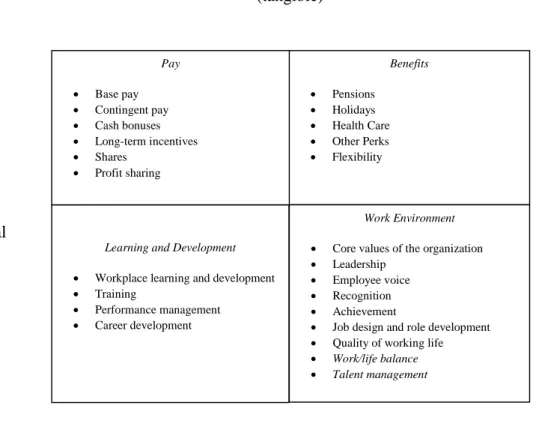
According to Armstrong (2006) Total Reward combines two basic categories of rewards: transactional rewards, which stand for all tangible rewards which arise from transactions between employers and employees including pay and benefits, and relational rewards, enhancing all intangible rewards like learning, development and work experience.
20
Figure 3 Model of total reward by Armstrong (2006)
Two upper quadrants of the model represent transactional rewards as the lower quadrants describe possible relational rewards. Thompson (2002) advises companies to combine both relational and transactional rewards in order to gain power.
At the end of 20th and beginning of 21st century technological revolution brought new
possibilities to HRM and benefits planning, a new solution has been coined, called cafeteria plans. Komodromou (2013) describes it as package of benefits from which an employee chooses from available options the ones that satisfy his needs. Sometimes it has been named by FSA, or flexible spending accounts. Companies which are following this practice make sure that the benefits selected by their employees are those which are the mostly desired by them. Individual preferences of the employees reflected in Human Resources literature effects in the companies offering employees a wide selection of benefits which might be included in their remuneration (Komodromou, 2013).
Work Environment
Core values of the organization
Leadership
Employee voice
Recognition
Achievement
Job design and role development
Quality of working life
Work/life balance
Talent management
Communal
Learning and Development
Workplace learning and development
Training Performance management Career development Relational (intangible) Benefits Pensions Holidays Health Care Other Perks Flexibility Pay Base pay Contingent pay Cash bonuses Long-term incentives Shares Profit sharing Individual Transactional (tangible)
21 Research brought many concepts of how a diversified offer of benefits adds value to a company. Kłosowska (2011) describes plenty of gains for the companies offering benefits to its employees, as follows.
One of the very important effects of including benefits in the reward structure to employers is a creation of more interesting and satisfying job offers in comparison with the main competitors in the sector which may allow the company to attract and acquire more talented and efficient employees. Many companies, like for example KPMG and Hewlett-Packard inform their potential candidates through their websites about the benefits they have in offer. A quote from KPMG Poland website: “(…) At KPMG, we offer a competitive salary (also during internships) – but it is not everything about the salary. Our employees are offered an attractive benefit package: they have access to a private medical center and life insurance coverage and can become holders of American Express credit cards. Those who want to stay physically active, have free access to numerous fitness clubs and swimming pools countrywide thanks to the MultiSport program.(…)”. Many companies decide not to inform, during the recruitment process, about the level of the wages. In this situation working conditions which include fringe benefits packages are very looked for information which make certain companies stand out.
Companies offering benefits as a part of remuneration create an image of being friendly and sensitive to employee’s needs. Organizations nowadays strive to earn the reputation of being a great place to work. There is a concept, which is particularly popular in recent research, called employer branding. The competition for the talent attraction has made employers think about assuring their employees the best possible conditions and working experience. Practices from the marketing field known as branding started to be used by human resources management professionals and the value of branding approach has been applied for better understanding employment life cycle (CIPD 2012).
In a study made by Soininen (2013) titled Employer Brand and Great Place to Work as Perceived by Generation Y Employees, the author claims that to be perceived as an interesting employer brand, capable of attracting and retaining talents, companies have to face the new needs of generation Y employees. This generation is willing to find meanings in work life as well as in spare time. Work has become only one of many aspects of human identity.
To understand the research conclusion one has to comprehend the meaning of Generation Y term. Generation Y, also known as millennials, is born in 1980 - 2000. People belonging to
22 this generation grew up in urbanized and global environment. They think in global way and they have access to wide networks that extend all over the globe. The millennials can be characterized as people who do not like waiting and failing in tasks they have been entrusted to solve. They tend to be self-confident and technology oriented (Soininen 2013). The millennials are expected to change rules and manners in the work environment in a remarkable way. The work in perception of millennials is not related to identity, and big sacrifices for the employer are not seen as necessary anymore. Generation Y seeks the fulfillment outside work due to a belief that identity can be created outside the work through their interests and free time activities. They expect work culture and environment to be attractive enough so that they are motivated to work hard to the organization and make commitments. Millennials expect rather a change from the side of organization than from themselves.
Soininen (2013) conducted an empirical study by creating the sentence competition form for a small sample of employees and shift managers belonging to generation Y working for Ravintolakolmio-ryhmä restaurants. Findings show that functional values, like salary benefits and training are mostly appreciated among the surveyed. Benefits for the employees were indicated in 70 % of surveys when asked about motivation to make a commitment as an employee of Ravintolakolmio-ryhmä. The possibility to training and education gained support in 13% responses. Management group have shown similar perception of commitment reasons of employees. About half (53%) claimed in their response that benefits for personnel were the main reason on commitment. About a quarter (27%) mentioned training and education and the same proportion indicated that a secure and trustful employer can positively affect the level of the work-force commitment. Although the sample size is rather small, within a case study framework, this study is especially relevant for the needs of this project due to the wide range of benefits offered in the company where the research was conducted. “Ravintolakolmio-ryhmä’s benefits for employees are comprehensive in the area of food and beverage service activities. They are divided into four sections: spare time, wellbeing, sports, and education and training. Ravintolakolmio-ryhmä has renewed its benefits for personnel by offering a wide health and accident insurance to all employees. In co-operation with occupational health care a model of early intervention is used. This model controls sick leaves and it aims at maintaining the ability to work. The scope of occupational healthcare in Ravintolakolmio-ryhmä is wider than the statutory requirement. After working one year for the company, a dentist is provided with the cost limit of 350 Euros per year. Health is also considered by supporting exercising on spare time with Smartum’s sports coupons. Ravintolakolmio-ryhmä also provides a
23 possibility to rent an apartment from the company without a rent deposit and prompt terms of notice.” (Soininen, 2013: 39-40).
The previous reports provide evidence that companies nowadays are capable of creating strong employer brand by providing benefits which are tailored to the needs of its employees. Such corollary was already stressed in older studies on the importance of the benefits package in the employee attraction process. Cable and Judge (1994) for example concluded, in a study made on a group of 360 students ranging from 19 to 29 years old, that flexible benefits attract more young job seekers than rigid benefits. This was corroborated by another study (LeBlanc & Mulvey, 1998) made on a population of employees. Both studies are used as a reference in the Total Reward implementation guideline created by a prestigious organization – SHRM Foundation. It points out the following employee preferences as regards rewards (Heneman, 2007: 11):
• flexible benefits instead of a standard benefits package • a small ratio of variable pay to base pay
• individual rewards (such as merit pay) rather than group rewards
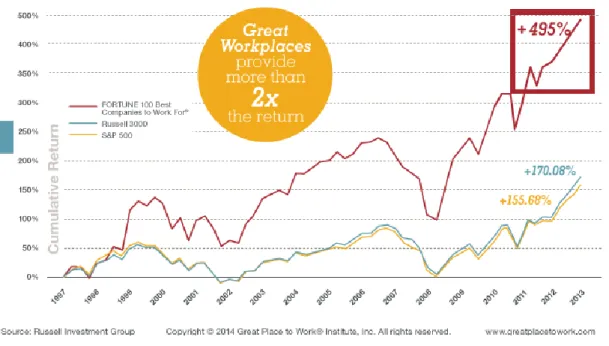
There is a global institute, with strong presence in Portugal, called Great Place to Work which rewards companies with the best working environment. Many Portuguese companies make an effort to obtain better positions in the institute rankings. The institute claims that the companies with better work environment tend to have much better financial returns which found empirical support (Fulmer, Gerhart & Scott, 2003).
They compared the “100 Best Companies to Work for in America” with a group of matched firms. The results of the comparison demonstrate that companies from this list not only can rely on a better workforce attitude but also can prove various performance advantages both in comparison with the broad market and with the matched group (Fulmer, Gerhart & Scott, 2003).
24
Figure 4 Comparative Cumulative Stock Market Returns
The chart illustrates the claim that in general companies which provide their employees better working conditions get higher than average returns over the time.
Another very important outcome for the company offering the benefits is increasing its employees’ loyalty. US studies, such as MetLife (2014) Benefits Breakthrough brings offered support to this claim by showing a conspicuous increase is the proportion of inquired people that agree that their employer choice as well as the decision to remain working there is motivated by the benefits package, as shown in the following picture.
25 Kłosowska (2011) claims that many employees are afraid that by leaving the company they would lose many benefits which would make their life inconvenient. This fact increases retention and loyalty effect.
One of the most important gains of the cafeteria plans (diversified benefits offer) is its potential to increase the motivation of the employees. There is a common belief that the main motivating incentive for the employees is the money paid for the work, but the benefits may pay an important role in motivating employees as they allow employers to overcome the limitations of the paid wage.
Assuming that the money received by the employee can be classified in a wide category of terms in the science of economics, an interesting observation relates to this research. “Diminishing marginal utility is a law of economics, stating that, as a person increases consumption of one product, while keeping consumption of other products constant, there is a decline in the marginal utility that person derives from consuming each additional unit of that product” Kumar (2014: 1). That is why the more reward people obtain the less satisfied they tend to be with it, unless the companies diversify their reward systems with the new types of rewards that would have higher return rate on the employees satisfaction and therefore will make a positive impact on their motivation.
Benefits can bring extra gain to company by allowing it save money, there are certain benefits that can be given to employees and do not cost company a lot. Some of the most popular are flexible work time and possibility of work from home (Kłosowska, 2011). Another saving comes from the fact that some of the benefits are co-financed by employee, and also company can purchase more products and services for its employees at lower prices as it can receive retail prices form the suppliers. Novo Humanator (2007) admit that one of the most important advantages of using benefits within the reward system is the favorable taxation of these kind of rewards.
Over the years MetLife company conducts research on correlation between benefit satisfaction and job satisfaction. In 2014 it reported that: “Employees who are very satisfied with their benefits are more than twice as likely to report being very satisfied with their jobs.” (MetLife, 2014).
A very important perk of using cafeteria plans is their flexibility which allows to satisfy different needs of different employees. Many cafeteria plans can be easily modified in case of needed cost saving of the companies (Kłosowska, 2011)
26 There is a concept, called work-life benefits which is crucial for the further development of this project. These benefits are especially designed to give employees the perception that the organization is concerned about their wellness to the point of offering them services packages that allow them to balance their professional and personal needs. In return the employees tend to put more effort in their professional duties and demonstrate more prosocial behaviours.
In sum, there are two main frameworks defined within this section of research: Business Models and Business Plans. As regards business models, everything starts from spotting new opportunities and driving the market towards equilibrium. An opportunity is, by definition, an unanswered need which, in the present case, concerns the benefits management as a part of reward system. The entrepreneurial activity occurs only when such opportunity is articulated in a business plan with innovative business model design. The constantly developing reward system seem to be an interesting opportunity to build a business model around. One condition of success then is the ability to identify the proper market where those needs operate, which the next section will take care of.
27
3 The Foundation
3.1 The Problem
–the need
The remuneration management is very relevant in the Portuguese market, since companies as everywhere compete for the retention of the best employees and offer better working conditions for newcomers (Abreu, 2013) but the shortage of funds and the relative economic downturn makes it harder to find the necessary financial resources to uphold this HRM policy. However, it is during economic harsh times when HRM is especially critical in turning around the business situation (Carvalho & Cardoso, 2008). So, there is a high probability of a vicious circle where lowering rewards will translate into demotivation and will to exit workforce, which in turn will lower the chances of improving the financial situation of the companies. Adding to this the concomitant prevalence of harsher tax pressure on companies in Portugal (Costa b, 2014), all the conditions are met to precipitate a downward business spiral. Another reason for which the idea is interesting from the employer point of view is due to the fiscal incentives which arise from the fact that fringe benefits are taxed lower than the monetary remuneration. There are possible fiscal incentives which can be exploited for the needs of the company like exemption of TSU and IRS taxes, and advantage of modified IRC tax (Costa b, 2014).
Facing this situation, a company would be more competitive if it is able to offer high standard rewards (where an attractive benefits package is included) but cutting its global cost. A first approach will lead us to think that this cannot be achieved by cutting salaries. It could only be attained by lowering incentives and/or cutting on benefits. However, the cost of saving on incentives is proportional to the financial burden which the employee will feel directly. So, it is not an option. Therefore, it is in the benefits component where the cost cuts can be achieved without harming the HR reward standards and expectations (Kłosowska, 2011). As seen in literature review, flexibility is not the only advantage of the offered solutions, one needs to recall also: talent attraction, image improvement, loyalty, motivation, savings and satisfaction, as the main advantages of flexible solutions.
In Portugal, this is a valid reasoning because, as stated by Clifford Chance (2007) the companies are willing to offer common fringe benefits including subsidized meals for employees, cars for directors, mobile telephones and health insurance.
28 One of the parts of Gedeon’s entrepreneurship definition is “spotting opportunities to drive the market toward equilibrium”, in a recent article from RH Magazine: A Gestão das Pessoas em Revista, Costa (2014) made a review of companies offering flexible benefits on Portuguese market. The article allows to conclude there is an increasing demand for flexible benefits solutions on the Portuguese market. The journalist quotes Olivier Bernon the CEO of Le Chèque Déjeuner Portugal who claims that many Portuguese companies still didn’t realize the existing fiscal benefits, which allowed them to offer their employees more purchasing power and welfare. Another important statement are made by the Head of marketing and communication of Mercer, Tiago Pimentel, a HRM consulting house who notices an increase in interest of its customers in remuneration policies and benefits. According to him the Portuguese market is in a phase of a migration from rigid benefits solutions towards flexible solutions. The article includes also opinions of customers of Le Chèque Déjeuner Portugal. In the name of A7TT, a temporary workforce company, the CFO, Ana Garcês, praises the fiscal benefits and the constant improvements of the solutions offered by Le Chèque Déjeuner, the new products of the company which promises to offer educational courses for employees and their families are awaited with high expectations by A7TT management (Costa b, 2014).
The following conclusions can be made from this article. The Portuguese market is becoming more open for the flexible benefits solutions. There are already proven examples of fiscal and management efficiency of these type of incentives in Portugal. The topic of flexible benefits gains attention in the environment of Portuguese Human Resources experts and professionals.
The solutions offered by Equilibrium should be well diversified, because the workforce employed in the Portuguese market is very diversified and has different needs regarding its remuneration (Martins 2013). A research made by Sara Cunha Martins from University of Minho, which included data obtained from 485 fulfilled questionnaires, regarding remuneration in Portuguese private companies, concludes that there is a need of creating total reward system adequate to the needs of Portuguese society.
29
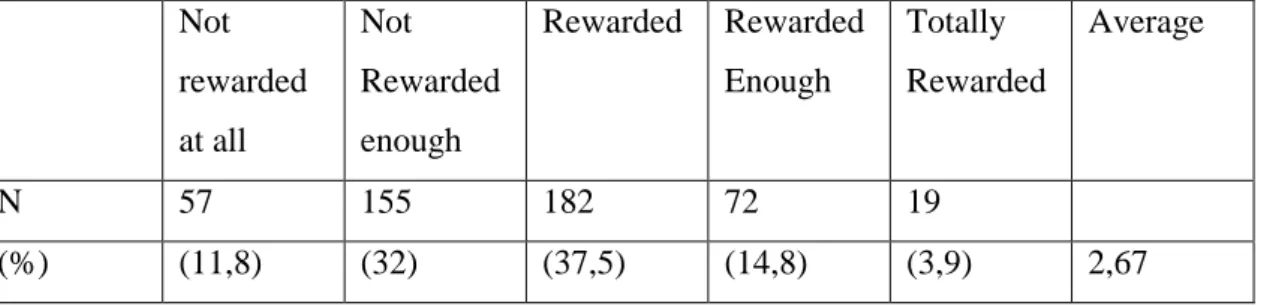
Table 1 Frequencies of answers on a question: How well rewarded do you feel at the moment? (Martins, 2013) (sic!)
Not rewarded at all Not Rewarded enough Rewarded Rewarded Enough Totally Rewarded Average N 57 155 182 72 19 (%) (11,8) (32) (37,5) (14,8) (3,9) 2,67
Looking at the table one can clearly see that there is a numerous group of employees of around 44% of employees in Portuguese private market who do not feel the remuneration they receive is satisfying enough for them.
The reward selected in most of the responses as one of the most important rewards in the employees remuneration is good working environment that is why Equilibrium company should refer to this particular reward a lot in its actions.
3.2 The Solution
–what is offered
The real opportunity lies in building a more efficient way to put together packages of benefits that companies are paying above the minimum possible price. This can be achieved by means of a Business Model based on Network Efficiency (Chatterjee, 2013).
In order to attain this goal a set of attractive and very diversified packages of products will be delivered to the Equilibrium customers.
Products and Services
Alimentary subsidies – subsidies for employees to fulfil their alimentary needs offered using Equilibrium partners meal card. For the success of the project a very important partnership has to be made with a company or a bank offering meal cards (cartões refeição), since this is a part where Equilibrium could offer a real cost cuts for its clients. There are plenty of suppliers of this kind of services which puts Equilibrium in a good negotiating position, Costa (a) (2014) points out:
Euroticket à la card Ticket Restaurant Cartão CA Buffet Cartão Montepio Menu
30 Cartão PayRest
Cartão Pré-Pago Caixa Break Cartão Refeição
Cartão Dá Refeição
Sport and recreation activities: an access to all kind of sport activities like: gyms, fitness classes, yoga classes, bouldering classes, dance classes, swimming pools, martial arts classes, surf schools, golf classes etc.- all in one app
Cultural activities: an access to cinemas, theaters, concert halls, museums etc.- all in one app
31
Health and beauty activities: access to Hotels and Spas in Portugal on weekends and free-days
3.2.1 The platform
A fully working platform must meet the following requirements:
The platform has to be a designed in cloud providing an access from the following web browsers: Google Chrome, Mozilla Firefox, Internet Explorer, and Opera;
The tablet and smartphone application should be developed both for Android and iOS;
The application system has to be compatible with the latest versions of operating systems;
The programming language used should be C++ or Java;
The supplier has to provide a guarantee of maintenance to resolve software functional problems and deliver updates to secure compatibility with future versions of runtime environments;
Performance of the application system must be characterized be running readiness of at 99.95% level or higher;
The supplier has to provide sufficient means to support mechanisms of identity authentication and privacy protection through secure logins/passwords and email or social network account verification;
32
3.2.2 The access distribution process
Task Description
Mail invitation A person responsible for Human Resources in the company receives an e-mail with login name and password that allows
him/her to access special administrator panel. Control panel The platform asks the admin to input e-mails of the
employees to whom he or she would like to grant the access to the Equilibrium platform. In the later stage the admin can
also modify the list of users.
Users input The admin stores the e-mails of the future users so they get invited to use the platform.
33
3.2.3 Final customer usage
Task Description
Log in The user (employee of the organisation) logs into the platform using login name and password provided by the organization and checks the EULA which is displayed automatically in the first log in.
Home Screen News Feed Screen
The platform displays the home screen of the user with the available number of points, news feed with newest information from the service suppliers, and the following categories to select: My Calendar and Categories.
View my Calendar Shows the agenda of booked activities and their current status.
Browse categories The platform displays the following categories: Entertainment, Sport, Health and Beauty, and Around Me category. Once the category is selected the available activities within are displayed.
Activity Choice Users select activity which seems interesting to them. Activity Details Platform provides more information about the activity,
34 Book Activity User initiates the booking process.
Calendar Platform displays calendar of current month which is adjusted to the suppliers’ preferences.
Select Day and Hour User selects day and hour when he or she wants to book the activity.
Yellow booking status is assigned
The platform registers the booking and the approval from the side of supplier is requested.
Approval from the service supplier is received
Service supplier approves the booking. This can be done semi-automatically if service supplier assigns a batch of services in advance. After all of the batch is used the service supplier receives a request for the next batch. Green booking status is
assigned
After the booking is confirmed by the supplier, there is a binding agreement of two sides (demand & supply) which is tacit as it was already agreed upon on the EULA.
Yellow and Green status of booking
In order to give more flexibility to service suppliers there are two booking status levels introduced. The final customer has always the possibility to book the services but once they are booked with yellow status the credits are not taken from their account and they can discard yellow bookings unless the booking becomes approved. After that, credit points are charged from the account. There is a small dose of uncertainty if the service supplier will accept the customer with yellow booking (for instance if the customer makes a reservation for a premier of top selling movie and the cinema operator would not confirm it for the status green there is a possibility that all seats are sold out) in this scenario the service supplier should inform the user on the pending status of his/her booking which may eventually get to green or be cancelled after a timeout period and an alternative offer of a ticket for a different movie may be proposed. From the supplier point of view every green status booking generates a sure income so there is an extra incentive to approve all the booking as fast as possible.
35
3.2.4 Platform design for the needs of service suppliers
Task Description
Login The service supplier system admin logs in with the username and password and checks the EULA which is displayed automatically in the first log in.
Control Panel The system displays control panel which shows pending service requests and gives the possibility to edit the detailed information on the service.
Request Approval The service supplier can approve a request which obligates to accept the service to the customer once he arrives to the appointment. This also obligates Equilibrium to transfer money equivalent to service value.
Request Decline The service supplier has the right to decline the request in the periods in which his or her business faces extreme demand. Different Date Proposition In order to maintain the customer, the platform incentives the
supplier to suggest a different date.
36
3.2.5 Platform Design for the needs of Equilibrium
Task Description
Log in The Equilibrium system admin logs in with the username and password.
Control Panel The system displays the control panel which gives access to the following options: CRM, Supplier Management, Accounting, and News Feed Editing.
CRM CRM shows clusters of the final customers organized by the organizations they belong to. This allows the admin to analyse their movements, and see where the platform is used most actively.
Supplier Management Supplier Management allows the admin to follow up the current demand on suppliers, how many green status occurred, how many yellow turned red, and any issue the supplier wants to communicate.
Accounting Accounting allows the admin to see to which organizations Equilibrium owes money at the end of the month.
News Feed Editing Allows the admin to edit the news feed which is visible at the home screen of the employees.
Data Storage All the changes in the news feed are stored by the application.
37
3.3 The Business Model
The Business model is going to be based on Osterwalder’s business model canvas and exemplified with cases from the global markets.
3.3.1 Customer segments
Equilibrium is supposed to operate in B2B market. The main target of the business consists of companies operating in Portugal.
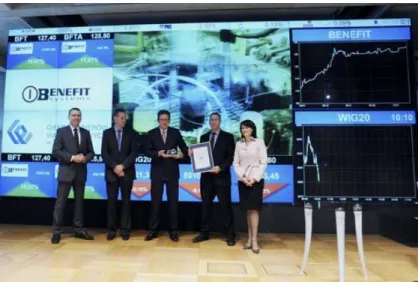
There is an example of a highly successful company started up in Poland called Benefit Systems, which along its history has specialized itself in fringe benefits management in B2B market. Currently it claims to sell it products to over 6500 companies and institutions (Benefit Systems, 2015).
Figure 6 Benefit Systems Management at Warsaw stock market
3.3.2 Value proposition
Value proposition defines what is the company willing to offer to its customers in return for the price they pay. The literature review covered numerous advantages for companies that offer diversified benefits packages. To recall, the companies which decide to give their employees FSAs: provide better employer branding, increase employees productivity and satisfaction, gain flexibility in their remuneration policies, and assure better retention of talents. Another advantages delivered to the clients are simply the access to leisure and entertainment points all across the country and reduction of sick leaves once the employees adapt to a healthy lifestyle.
The partners of Equilibrium will gain a side income from taking part in the program plus an opportunity of cross selling other products from their offer to new customers.
38 A renowned company operating in B2B market offering similar values to its customers, with the leading position in Portuguese market, is called Edenred. In 2014 it claimed to work with 660 000 companies worldwide.
Figure 7 Edenred's publicity in Portugal
3.3.3 Channels
The company at first has to possess at least one sales agent responsible for attracting new customers and partners. So the sales force is an important channel in the start-up phase. Along with the development of the company it is possible that new customers and partners reach the company through the web-sales channel, as observed in case of the Polish company - OK systems. In order to better grasp how channels can be operated I shall briefly present the case of this company. According with information provided by this company’s marketing manager, Monika Staszkiewicz during an interview, the whole starting period lasted 3 years due to long negotiations with technology suppliers. The company is based on innovative system of fingerprint scanners which allows the employees of OK systems customers to access various points of leisure and entertainment. The company received some of its capital from Satus venture capital fund. The company chose fingerprint scanners instead of cards to decrease the cost of multiple usage of one card by various people. Along with the fact of exploiting such an advanced system, the importance of IT department within the company is growing. Plenty of marketing actions have been undertaken, including appearance at the HR conferences all over Poland, content marketing in HR press, social media and Groupon promotion. The company has both offers in B2B and B2C market. At the moment it claims to have much bigger demand from the corporate customers. It has the 2nd biggest share on the market of these kind of
39
3.3.4 Customer relationship
The customer relationship is based on the win-win type of relations. The companies which purchase the packages for their employees gain all the advantages going along with them, the partners gain access to side income and cross selling opportunities, so everyone wins thanks to new transactions. What is very important, the customers have to receive fully automated platform so they do not spend much more time on accounting and administering human resources activities. A good example here is already mentioned, Benefits System, which not only offers FSAs but also takes care of all accounting related to the system, it also provides Human Resources advisory to its customers and Marketing advisory to its partners.
3.3.5 Revenues stream
The revenues are gained through a margin on the purchases made by the companies which will decide to become Equilibrium customers and through selling mobile marketing services to Equilibrium partners.
One of the biggest brands famous from gaining its profits on positioning services within online platform is called Groupon. In 2013 Groupon brought over 2 billion USD of revenues (Groupon, 2015) thus showing the potential of online platforms.
40
3.3.6 Key activities and partnerships
To successfully provide the existence of a hub connecting service demand and supply, one has to constantly reach new partners. This calls for updating and maintaining data base of service suppliers. Another key activity is the creation of efficient and intuitive web platform and mobile applications compatible with it. An extremely important partner in this business is a provider of alimentary card which probably will be one of the banks operating in Portugal.
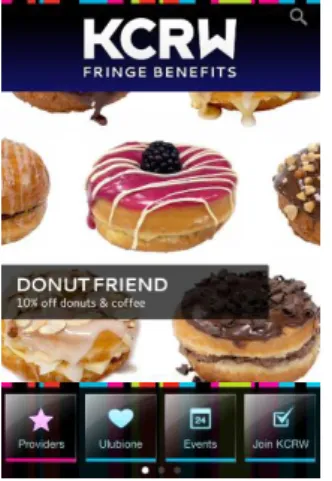
An interesting example of a company successfully creating new partnerships across time is a Californian radio station KCRW, which designed its own fringe benefits program.
3.3.7 Cost structure
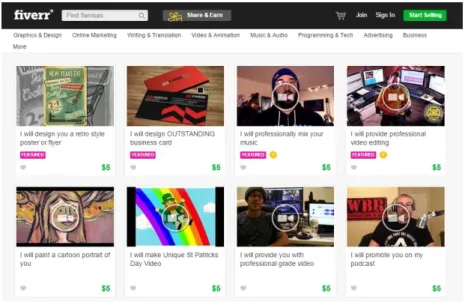
One of the main costs of this business is the design and maintenance of the online platform. The other category of the costs to incur relate to the payroll and administration costs. There are also costs connected to company’s physical evidence, like for example cost of the company’s website design. A very important part of the cost structure of the company is the money paid to the service suppliers in reward for making their services available to package users. A fixed rate of the service will be used like in a famous American platform called Fiverr,
41 but the terms and conditions of the service usage will be flexible and negotiated. External Services and supplies are accounted into cost structure within the financial plan
Figure 10 Screen from fiverr website
3.3.8 Key Resources
The key resources for this model consist of a team of employees dedicated to realization of their objectives. Another very important resource is the allocated budget which allowing to develop and implement the IT solutions as well to cover the costs of trials free to potential customers. One of the companies getting the customers by offering at first a demo version is the famous American platform Zenefits
42
3.3.9 Company’s Mission, Vision and Core Values
Mission
Improve the competitiveness of customers by upgrading their reward systems.
Vision
Obtain a strong position in the Iberian market. Promoting the efficiency of innovative Human Resources Management solutions.
Values
Supportiveness – the concept is based on the idea that companies supporting each other can provide much more value than working alone.
Partnership – every company that is going to be a part of the network is going to work on equal conditions based on partnership relations.
Quality – the company is going to undertake precisely defined quality measurements to provide all its customers with the top quality service.
Honesty – a natural way to create sustainable partnerships within the network.
Respect – a crucial value to keep employees motivated and customers satisfied.
4 The Context
4.1 Market Analysis - PESTEL Analysis
4.1.1 Political and legal factors
A basic thing before starting a business is checking if the activity one is about to start is legally possible and do not put investor at legal hazard. The literature review contains examples of companies already active in Portuguese market offering similar solutions, e.g., Edenred or Le Chèque Déjeuner. This offers reassurance that this type of activity is fully legal in Portugal.
The legal act DL nº26/99, de 28 de janeiro law guarantees fiscal incentives for the companies supporting social benefits which foster education of the employee’s children. The companies are relieved of paying TSU tax and take advantage of a 40% increase in deductions
43 to IRC tax. This may become important when taking under consideration future development of the offer by packages related to children education.
Portuguese law also provides some special regulation regarding different benefits. The table beneath describes this regulation.
There is also a special regulation regarding subsidizing of the employees meals by the company. The law states that once the subsidies are used via bank card there is a maximum amount eligible for exemption from Personal Income Tax (IRS) and Social Security Tax (TSU) which equals to 6,83 euro a day. This law allows the company to reach great savings especially
Benefit
Personal income tax
Social
security Description / limitations
School fees
allowance - family Yes No Effective expense to be made by the employee May not be valued equally by all employees
Transportation
allowance Yes No To be granted to all employees (in order to
compensate expenses - home-work / work-home)
Payment in cash limited to the “passe social”
May not be valued equally by all employees
Contributions to life
insurance Yes No
The withdrawal of the amounts is not limited to the retirement condition
May be subject to contributions in the future May not be valued equally by all employees
Profits sharing Yes No
Payment in cash without any limitations regarding the amounts or the beneficiary
Benefit potentially valued equally by all employees
Social
transportation card
(“Passe social”) no no
Implicates the effective attribution of “passe social” / limited to the respective amount
To be granted to all employees
May not be valued equally by all employees
Contributions for pension funds or life insurance
no no
To be granted to all employees according to an objective and identical criteria for all the employees Limited to retirement / pre-retirement benefits May not be valued equally by all employees
44 those who employ large number of staff (Silva, 2014). Multiplying daily amount by the number of working months (11) and days (22) gives as a result 1.652,86 euro which can be transferred to an employee free of taxes in a given year.
4.1.2 Economic factors
An economic factor which might work in favour of the solutions provided by Equilibrium is the increasing weight of multinational companies in the Portuguese business community and increasingly qualified manpower available on the market. Multinational companies these days care much more about retention of the best employees and providing the best possible conditions for the qualified manpower (Abreu, 2013).
Another economic circumstance which makes the idea interesting for the Portuguese companies is the economic crisis which forces them to use more creative remuneration strategies to avoid additional costs while maintaining or increase the productivity of their workforce (Costa, 2014).
Existing harsh tax pressure from the Portuguese government pushes the companies towards flexible solutions (Costa, 2014) which allow them, at the same time, to take advantage existing fiscal incentives and improve the working conditions of their employees.
From another point of view the companies might not possess the funds needed to purchase a new complicated system because of the economic downturn. This is why the business model has to be wisely designed and communicated as the low cost solution which guarantees a good return on the employees efficiency and their overall satisfaction with their remuneration and working environment.
4.1.3 Social-cultural factors
To implement a sophisticated HRM solution a company has to consider the interests of the employees who are supposed to benefit from this solution.
In overall there is a growing significance on the job market of the generation Y employees described in literature review as people open to innovations and seeking the fulfilment outside work (Soininen, 2013). These are potential clients of some of the products offered by Equilibrium - the packages of Sport and Recreation, Entertainment, and Health and Beauty.