Braz. J. of Develop.,Curitiba, v. 6, n. 10, p. 78404-78409, oct. 2020. ISSN 2525-8761
Production of substrates for determination of xylanase activity
Produção de substratos para determinação da actividade da xilanase
DOI:10.34117/bjdv6n10-318
Recebimento dos originais: 10/09/2020 Aceitação para publicação: 15/10/2020
Renato Henrique Calore
Bioenergy Research Institute (IPBEN), São Paulo State University (UNESP), Rio Claro, SP, 13500-230, Brazil
e-mail: [email protected] Danilo Bueno
Bioenergy Research Institute (IPBEN), São Paulo State University (UNESP), Rio Claro, SP, 13500-230, Brazil
e-mail: [email protected] Michel Brienzo
Bioenergy Research Institute (IPBEN), São Paulo State University (UNESP), Rio Claro, SP, 13500-230, Brazil
e-mail: [email protected] ABSTRACT
The hemicelulose is a molecule heterogeneous and, therefore, its extraction from different biomass is a challenge. In this context this study proposed an hemicelulose extraction from sugarcane biomass using alkaline pretreatment to determination of xylanase activities and evaluation of affinity between substrates and enzymes. The results suggest that the xylan from sugarcane leaves showed greater affinity with the enzymes, but the xylan from bagasse was with more efficient and pure extraction.
Keywords: hemicelullose; biorrefinering; biomass; xylanolitic enzymes. RESUMO
A hemicelulose é uma molécula heterogénea e, portanto, a sua extracção de biomassa diferente é um desafio. Neste contexto, este estudo propôs uma extracção de hemicelulose a partir de biomassa de cana de açúcar utilizando pré-tratamento alcalino para determinação das actividades da xilanase e avaliação da afinidade entre substratos e enzimas. Os resultados sugerem que o xilano das folhas da cana de açúcar mostrou maior afinidade com as enzimas, mas o xilano do bagaço estava com uma extracção mais eficiente e pura.
Palavras-chave: hemicelulose; biorrefinamento; biomassa; enzimas xilanolíticas. 1 INTRODUCTION
There is a need for production of xylan for different applications. Xylan became widely used by industry with the development of bioproducts. There are several studies involving this macromolecule, for example production of furfuraldehyde through hydrolysis and xylose
Braz. J. of Develop.,Curitiba, v. 6, n. 10, p. 78404-78409, oct. 2020. ISSN 2525-8761 dehydration, xylitol production by hydrogenation of xylose, in addition to the production of prebiotics from xylooligosaccharides as well as production of hemicellulose films. The xylan still may have laboratory use, being widely used as substrate for determination of enzymatic activity (Bailey et al., 1992).
However, this substrate is no longer marketed by some companies, creating the demand for the development of a methodology hemicellulose extraction with conditions appropriate for determining xylanase enzymatic activity.
There are some bioenergy and biorefinery studies where hemicelluloses of different biomasses, highlighting materials such as sugarcane straw and bagasse (Alves et al., 2020; Brienzo et al., 2009; Rocha et al., 2017), soft and hard woods (Wang et al., 2015) and grain biomass like soy and corn (Corredor et al., 2008; Bernal et al., 2014). These works take advantage of the portion of hemicellulose based on its solubility or its ability to convert to a molecule of greater value. In many of these conversion occurs the use of enzymes that act in xylan chains, xylanases. To carry out these conversions efficiently is need to know the relationship that the enzyme has with its substrate. Xylan is a versatile raw material, in addition to activities of determination of the enzymatic activity. As macromolecule, hemicellulose can be used as an additive in paper production, in its hydrolyzed form can be used in the form of oligosaccharides in therapeutic activities and under monomer form can be used for production xylitol (Freitas et al., 2019). Due to its versatility it is of interest seek various sources of extraction of hemicellulose.
Although it is possible to extract hemicellulose from several lignocellulosic biomass. The biggest challenge is to find methods and biomasses that provide the extraction of hemicellulose with high purity and high yield (Brienzo et al., 2016). Identifying a suitable substrate further research may emerge in order to optimize and improve methods for extracting products from added value. In this context, the project proposes the evaluation of different lignocellulosic biomasses as a source of hemicellulose extraction and test some characteristics of interest of these obtained substrates.
2 MATERIAL AND METHODS 2.1 HEMICELLULOSE EXTRACTION
Biomass was treated individually with a solution of tetracetic acid ethylenediamine in concentration 0.2% (m/v) for 1 hour at 90 °C. This process removed metals present in the biomass that can react with H2O2. After removal of metals 10 g of biomass was added in a vial containing
200 mL of 6% H2O2 (m/v) solution at a pH of 11.6. That mixture was stirred for 4 hours and finally
Braz. J. of Develop.,Curitiba, v. 6, n. 10, p. 78404-78409, oct. 2020. ISSN 2525-8761 After filtered the mixture had its pH adjusted to 6 using 6 mol/L HCl. After adjustment, this material is heated in oven at 45 °C to concentrate.
2.2 DETERMINATION OF ENZYMATIC ACTIVITY
The xylan extracted from each biomass was evaluated in the xylanase activity according to BAILEY et al. (1992), using commercial enzymes Cellic HTEC and Celluclast. Quantification of reducing sugars released from xylan according to the 3,5-dinitrosalicylic acid method (Miller, 1959).
2.3 AFFINITY BETWEEN ENZYME AND SUBSTRATE
The affinity between enzymes and different xylans was obtained by the method created by Neilands & Sumpf (1955), calculating the values of Km, Michaelis constant, and Vmax, maximum value of initial speed, thus building the graphs of enzymatic kinetics.
2.4 DETERMINATION OF INSOLUBLE LIGNIN
About 300 mg of biomass was be added to 1.5 mL of 72% H2SO4 (m/m) and the reaction will take place at 45 °C for the time of 7 minutes (Brienzo et al., 2009). The reaction is interrupted by the addition of 45 mL of distilled water. This mixture is autoclaved at 121 °C for 30 minutes (Gouveia et al., 2009). The content will be filtered through a number 4 porous plate filter previously tared. The solid residue on the plate is washed with distilled water and dried in an oven 105 °C to constant weight for determination of insoluble lignin.
3 RESULTS AND DISCUSSION
3.1 HEMICELLULOSE EXTRACTION AND CHEMICAL CARACTERIZATION
Hemicellulose extractions was elaborated in triplicates, as well ass chemical characterization to determinate the amount of insoluble lignin, and the results obtained were summarized in the table 1.
Table 1. Hemicellulose extraction and insoluble lignin content Biomass Hemicellulos e recovered (g/100g) Insoluble lignin (%) Sugarcane bagasse 10.53 % 13.7% Sugarcane leaves 9.40 % 18%
Braz. J. of Develop.,Curitiba, v. 6, n. 10, p. 78404-78409, oct. 2020. ISSN 2525-8761 Using the aforementioned extraction method, the amount of average extracted hemicellulose is about 10% of the biomass, that is, for each quantity of biomass treated, 10% of that mass will be converted into hemicellulose.
The amounts of cellulose, lignin and hemicellulose in sugar cane vary depending on the plant age, degree of fertilization, variety species and plant tissue analyzed. Exist certain dispersion of results, where there are studies presenting hemicellulose data composing only 8% of the mass (GOUVEA, 2009), while that other studies this amount can reach 33% (PURCHASE, 1995). Therefore, to validate the effectiveness of the method in extracting hemicellulose from biomass chemical analysis tests can be done to quantify the hemicellulose that makes up the biomass used.
The amount of insoluble lignin extracted from the hemicellulose was expressive. In the case of bagasse, 13.7% of the total mass extracted is insoluble lignin residual, in the case of the leaves this amount was 18%. Lignin is a molecule that is difficult to break down.
As lignin biomass, along with hemicellulose, make up a matrix that protects cellulose from action chemical, physical and biological. Residual lignin present in the extracted hemicellulose may have an similar to what it does as biomass, preventing the full action of xylanolitic enzymes hemicellulose, resulting in media with lower affinity and lower reaction speeds
3.2 DETERMINATION OF ENZYMATIC ACTIVITY
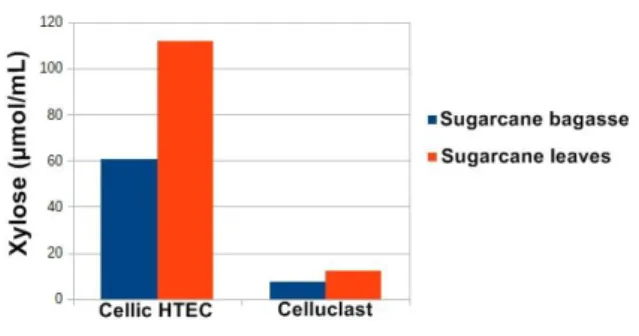
Similar to extraction, the determination of enzymatic action was also carried out in triplicate form. Below, figure 1 represents the converted values of xylose obtained at from the enzymatic hydrolysis reaction.
Figure 1. Enzymatic Hydrolysis
It can be noted the discrepant relationship between results obtained from the different enzymes cockatiels. The Cellic HTEC enzyme releases a greater amount of xylose reacting the same amount
Braz. J. of Develop.,Curitiba, v. 6, n. 10, p. 78404-78409, oct. 2020. ISSN 2525-8761 of material than Celluclast. This difference can be linked to the type and purpose of the different cocktails enzymatic. The HTEC was more effective to hydrolyze the hemicellulose.
3.3 AFFINITY BETWEEN ENZYME AND SUBSTRATE
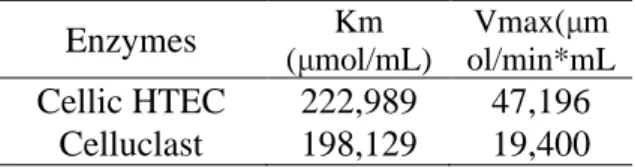
The results of affinity test between Cellic HTEC and Celluclast enzymes with sugarcane bagasse and leaves substrates were summarized in the tables 2 and 3. The results showed that in both uses of cocktails, the sugarcane leaves is superior to sugarcane bagasse. This is evident since the Km values for the cane leaves are about 4 times smaller. This identifies that hemicellulose of sugarcane leaves has greater affinity to enzymes than sugarcane bagasse.
As for maximum speed, the Cellic HTEC enzyme presents similar speeds, being the substrate with sugarcane leaves hemicellulose faster. When we use the Celluclast enzyme at the maximum speed of substrate with bagasse hemicellulose becomes about 3 times faster than the substrate with leaves.
Table 2. Estimated Km and Vmax results for sugarcane bagasse.
Enzymes Km (μmol/mL) Vmax(μm ol/min*mL Cellic HTEC 222,989 47,196 Celluclast 198,129 19,400
Table 3. Estimated Km and Vmax results for sugarcane leaves.
Enzymes Km (μmol/mL) Vmax(μm ol/min*mL Cellic HTEC 46,048 55,404 Celluclast 38,927 6,9341 4 CONCLUSION
According to the data presented, it is possible to conclude that each biomass has its advantage. The sugarcane bagasse showed a better extraction, and the quantities extracted and their degree of purity were slightly larger than the leaf. As for the affinity and speed, the hemicellulose of the sugar cane leaves showed an affinity much higher than that of the sugar cane bagasse, however the speed may vary quite according to the enzyme cocktail used. Therefore, it is possible to conclude that both biomasses have potential for extraction and use. The feature that will adjusting one biomass as superior to the other will be the purpose of its use.
Braz. J. of Develop.,Curitiba, v. 6, n. 10, p. 78404-78409, oct. 2020. ISSN 2525-8761 ACKNOWLEDGMENTS
This study was grant by processes number 2018/07648-0, 2019/12997-6 and 2017/22401-8, São Paulo Research Foundation (FAPESP).
REFERENCES
BAILEY, M.J.; BIELY, P.; POUTANEN, K. Interlaboratory testing of methods for assay of xylanase activity. Journal of Biotechnology, v. 23, p. 257-270, 1992.
BERNAL, H.G.; BERNAZZANI, L.; GALLETTI, A.M.R. Furfural from corn stover hemicelluloses. A mineral acid-free approach. Green Chemistry, v. 1, p. 1-7, 2014.
BRIENZO, M.; SIQUEIRA, A.F.; MILAGRES, A.M.F. Search for optimum conditions of sugarcane bagasse hemicellulose extraction. Biochemical Engineering Journal, v. 46, p. 199-204, 2009.
BRIENZO, M.; CARVALHO, W.; MILAGRES, A.M.F. Xylooligosaccharides Production from Alkali-Pretreated Sugarcane Bagasse Using Xylanases from Thermoascus aurantiacus. Applied Biochemistry and Biotechnology, v. 162, p. 1195-1205, 2010.
Brienzo, M.; CARVALHO, A. F. A. ; FIGUEIREDO, F. C. ; OLIVA NETO, P. . Sugarcane bagasse hemicellulose properties, extraction technologies and xylooligosaccharides production. Food Waste: Practices, Management and Challenges. 1ed.New York: Nova Science Publishers, 2016, v. , p. 155-188.
CORREDOR, D.Y.; SUN, X.S.; SALAZAR, J.M.; HOHN, K.L.; WANG, D. Enzymatic Hydrolysis of Soybean Hulls Using Dilute Acid and Modified Steam-Explosion Pretreatments. Journal of Biobased Materials and Bioenergy, v. 2, p. 43-50, 2008.
FREITAS. C.; CARMONA, E.; BRIENZO, M. Xylooligosaccharides production process from lignocellulosic biomass and bioactive effects. Bioactive Carbohydrates and Dietary Fibre, v. 18, p. 1-8, 2019.
GOUVEIA, Ester Ribeiro et al. Validação de metodologia para a caracterização química de bagaço de cana-de-açúcar. Química Nova, v. 32, n. 6, p. 1500-1503, 2009.
MILLER, G. L. Use of dinitrosalicylic acid reagent for determination of reducing sugar. Analytical Chemistry, v. 31, p. 426-428, 1959.
NEILANDS, J.B.; STUMPF, P.K. Outlines of enzyme chemistry. Nova Iorque: Wiley and Sons, Inc., 1955.
PURCHASE, B. S. et al. Products from sugarcane. International sugar journal, v. 97, n. 1154, p. 70-81, 1995.
ROCHA, M.S.R.S.; PRATTO, B.; JÚNIOR, R.S.; ALMEIDA, R.M.R..G.; CRUZ, A.J.G. A kinetic model for hydrothermal pretreatment of sugarcane straw. Bioresource Technology, v. 228, p. 176-185, 2017.
WANG, S.; RU, B.; LIN, H.; SUN, W. Pyrolysis behaviors of four O-acetyl-preserved hemicelluloses isolated from hardwoods and softwoods. Fuel, v. 150, p. 243-251, 2015.