Received 28/5/2012 Accepted 13/2/2013 (005688)
1 Universidade Federal de Viçosa – UFV, BR 354, Km 310, CP 22, Campus Rio Paranaíba, CEP 38810-000, Rio Paranaíba, MG, Brasil, e-mail: [email protected] 2 Fundação Ezequiel Dias – FUNED, CEP 30510-010, Belo Horizonte, MG, Brasil
3 Embrapa Gado de leite, CEP 36038-330, Juiz de Fora, MG, Brasil *Corresponding author
Enterotoxigenic potential of
Staphylococcus aureus
isolated from
Artisan Minas cheese from the Serra da Canastra - MG, Brazil
Milene Therezinha das DORES1*, Ricardo Souza DIAS2, Edna Froeder ARCURI3, Juliana Escarião da NOBREGA1, Célia Lucia de Luces Fortes FERREIRA1
1 Introduction
The Artisan Minas cheese from the Serra da Canastra is one of the oldest and most traditional cheeses produced in Brazil. It is an income-generating activity for a large number of small-scale farmers. Its centenary production consists of inoculating endogenous starter cultures, which are collected from previous batches, into freshly collected raw milk in order to influence the fermentation process. The main genera of the endogenous starter are Lactobacillus, Lactococcus and Streptococcus with counts of approximately 8 log cfu.mL–1 (BORELLI et al., 2006;
NOBREGA; FERREIRA; DORES, 2008).
Food contamination by S. aureus and the possibility of staphylococcal toxin production represent a potential risk to public health. Staphylococcal enterotoxins belong to a family of twenty thermostable, pepsin-resistant, single chain exoproteins which range in molecular weight from 25,000 to 29,600 Da (SEO; BOHACH, 2010). Most staphylococcal strains are able to produce one or more enterotoxins, which are the cause of the gastrointestinal symptoms including vomiting and diarrhea (MARTIN; MYERS; LANDOLO, 2001; HENNEKINNE; DE BUYSER; DRAGACCI, 2011). Among the foods involved in staphylococcal intoxication outbreaks, raw milk and cheeses are the most common from the dairy category, and S. aureus is the most commonly found etiologic agent in epidemiological investigations (DE BUYSER et al., 2001; IKEDA et al., 2005).
Microbiological determinations in Artisan cheeses have frequently indicated the presence of S. aureus at levels above those permitted by law (PINTO; MARTINS; FERREIRA, 2004; BRANT; FONSECA; SILVA, 2007; BORELLI et al., 2006; MARTINS, 2006; DORES, 2007). On the other hand, there are few reports or notifications of staphylococcal food poisoning associated with the consumption of these products since reports of staphylococcal food poisoning are not considered compulsory in Brazil. Therefore the actual level of contamination with Staphylococcus in artisan cheeses is unknown (STAMFORD et al., 2006).
Dores (2007) analyzed the minimum ripening period necessary to ensure safety in Artisan Minas cheese from the Serra da Canastra and found that the counts of S. aureus
were above those permitted by the Brazilian legislation (2.0 log cfu.g–1) during longer periods of time thus defining the
minimum ripening period necessary to guarantee food safety (State Law N. 14,185, January 2002 (amended by decree N. 44,864, August 2008). The author verified the presence of this microorganism after 64-days of ripening at 10 °C and estimated that at least 84 days of ripening at this same temperature would be necessary to reduce the counts to acceptable levels. Similar results were found by Martins (2006) when monitoring the ripening of Artisan Serro cheeses.
Abstract
This study aimed to evaluate the presence of enterotoxigenic S. aureus in the endogenous starter and in Artisan Minas cheeses from the Serra da Canastra. Sixteen samples of endogenous starters and cheese were collected during the rainy and dry seasons. The isolation and enumeration of S. aureus were performed using the PetrifilmTM-Rapid S. aureus Plate Count method. The presence
of enterotoxin in the cheese samples was analyzed by the Optimal Sensitivity Plate (OSP) method and the ELFA-VIDAS®-Staph enterotoxin-II assay. S. aureus strains were tested for their ability to produce enterotoxins using the Optimal Sensitivity Plate (OSP) method and the polymerase chain reaction (PCR) assay for the classical enterotoxin genes. The Optimal Sensitivity Plate (OSP) method data showed that staphylococcal enterotoxin A (SEA) was detected in 75% of the cheese samples, but no toxin was detected with the ELFA-VIDAS method. It was found that 12.5% of the isolated strains produced staphylococcal enterotoxin A (SEA) and staphylococcal enterotoxin C (SEC). When using the the polymerase chain reaction (PCR) assay, only one isolate was found to harbor an enterotoxin gene, contrary our expectations. However, discrepancies between the immunological and molecular assays are not uncommon. Despite the fact that most isolates did not produce classical enterotoxins, high S. aureus
counts in the cheese samples causes concern since there is a risk of the presence of non-classical enterotoxins.
Keywords: Staphylococcal enterotoxins; Artisan cheese; Staphylococcus aureus.
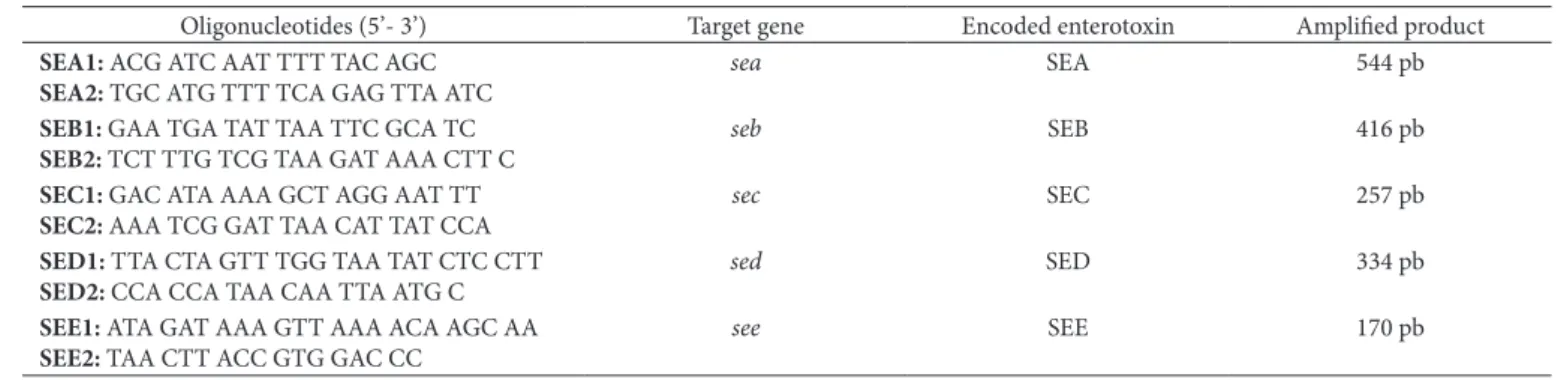
of enterotoxin-encoding genes was performed using a PCR protocol for the sea, seb, sec, sed, and, see genes. Cellular DNA was extracted as described by Hesselbarth and Schwarz (1995). The oligonucleotides were described by Rosec and Gigaud (2002) and are listed in Table 1. The reactions were performed under previously described conditions (ROSEC; GIGAUD, 2002) with some changes as proposed by Arcuri et al. (2004).
For each PCR reaction, a positive and a negative control were used. The strains of S. aureus from the American Type Culture Collection (ATCC) S. aureus ATCC 13565 (sea),
S. aureus ATCC 14458 (seb), S. aureus ATCC 19095 (sec),
S. aureus ATCC 23235 (sed), and S. aureus ATCC 27664 (see) were used as positive control.
3 Results
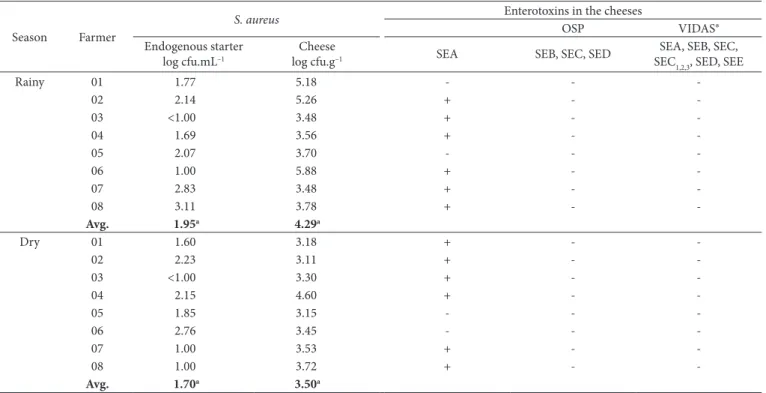
The S. aureus counts in the samples of Artisan Minas cheese from the Serra da Canastra – MG - Brazil ranged from 3.48 to 5.88 log cfu.g–1 during the rainy season and from 3.11 to
4.60 log cfu.g–1 during the dry season (Table 2). The statistical
analysis showed no significant difference between the data from the two seasons (P < 0.05). Counts from all samples were higher than 2.0 log cfu.g–1, which is the maximum limit allowed
by the Brazilian legislation. Approximately one third of the Canastra cheese samples were within the ranges indicated in the literature (>5 log cfu.g–1) as those likely to produce enterotoxins
(IKEDA et al., 2005; JØRGENSEN et al., 2005; ZWEIFEL et al., 2006).
The S. aureus counts in the endogenous starter samples were considerably lower than those in the cheese samples. The values ranged from <1 to 3.11 log cfu.mL–1 during the rainy season and
from <1 to 2.76 log cfu.mL–1 during the dry season (Table 2).
These results also showed no statistical difference (P < 0.05). In the detection of staphylococcal enterotoxins in the cheese samples, only the SEA was found when the OSP method was used. Of all cheese samples analyzed (8 from each season), 75% had SEA type with no apparent influence of the season on enterotoxin production (Table 2). However, via the ELFA-VIDAS® Staph enterotoxin II method, no enterotoxins were detected in any of the analyzed cheese samples.
S. aureus strains were induced in vitro to produce enterotoxins and tested by OSP in order to detect SEA, SEB, SEC, and SED. Of the 44 strains of S. aureus, 12.5% were able to The presence of S. aureus is common in Artisan Minas
cheese, and the lack of reports of outbreak of staphylococcal food poisoning associated with its consumption prompted us to investigate the enterotoxigenic potential of S. aureus strains to contaminate the endogenous starter and Artisan cheeses from the Serra da Canastra – MG.
2 Materials and methods
Samples of Artisan Minas cheese and of endogenous starter were collected from eight different farms during two periods of the year: the rainy season, between December and January, and the dry season, between September and August. A total of 16 samples of cheese and 16 samples of endogenous starter were collected. The samples were stored and transported under refrigeration (~10 °C) until analysis. Microbiological analyses and enterotoxin determination were performed within a 48 hour period after sampling.
The isolation and enumeration of S. aureus were performed using the PetrifilmTM-Rapid S. aureus Plate Count method
(3M Center, St. Paul, USA) according to the manufacturer’s recommendations. The data of counts of S. aureus in the cheese and endogenous starter samples were submitted to analysis of variance (ANOVA) F test at a 5% probability.
One hundred representative isolates were selected, which were subjected to biochemical analyses with the API®
Staph (BioMérieux SA, Marcy-l’Etoile, France) system for identification of staphylococci and micrococci. S. aureus strains that showed different reaction profiles were selected, totaling 44 isolates.
The presence of staphylococcal enterotoxin in the cheese samples was analyzed by the OSP method for the Staphylococcal enterotoxins SEA, SEB, SEC, and SED (ROBBINS; GOULD; BERGDOLL, 1974) and by the Enzyme Linked Fluorescent Assay (ELFA - VIDAS® Staph enterotoxin II, BioMérieux SA, Marcy-l’Etoile, France) for the enterotoxins SEA, SEB, SEC, SEC1, SEC2, SEC3, SED, and SEE. Both assays were performed at the Laboratory of Staphylococcal Enterotoxins, FUNED (Belo Horizonte, MG, Brazil).
The 44 S. aureus isolated strains were induced in vitro
in order to produce enterotoxins. The analysis of in vitro
enterotoxin production was carried out by the OSP method for the detection of SEA, SEB, SEC, and SED. The detection
Table 1. Oligonucleotides used in the PCR techniques for detection of enterotoxin-encoding genes in Staphylococcus sp.
Oligonucleotides (5’- 3’) Target gene Encoded enterotoxin Amplified product
SEA1: ACG ATC AAT TTT TAC AGC
SEA2: TGC ATG TTT TCA GAG TTA ATC
sea SEA 544 pb
SEB1: GAA TGA TAT TAA TTC GCA TC
SEB2: TCT TTG TCG TAA GAT AAA CTT C
seb SEB 416 pb
SEC1: GAC ATA AAA GCT AGG AAT TT
SEC2: AAA TCG GAT TAA CAT TAT CCA
sec SEC 257 pb
SED1: TTA CTA GTT TGG TAA TAT CTC CTT
SED2: CCA CCA TAA CAA TTA ATG C
sed SED 334 pb
SEE1: ATA GAT AAA GTT AAA ACA AGC AA
SEE2: TAA CTT ACC GTG GAC CC
see SEE 170 pb
presence of SEA in 75% of the cheese samples and in 4.54% of the isolated strains when the OSP method was used. Unexpectedly, this enterotoxin was not detected by the ELFA-VIDAS method even though it is considered a more sensitive assay (1 ng/mL) (HENNEKINNE; DE BUYSER; DRAGACCI, 2011) then the OSP method (100 ng/mL) (DIAS et al., 2008).
produce toxins, and SEA was the most prevalent gene among a larger number of isolates, followed by the SEC (data not shown).
The PCR analysis showed the presence of the seb gene in one isolate only (Figure 1). All other genes (sea, sec, sed, and see) where not detected in any isolate in this assay (data not shown).
4 Discussion
The average values of S. aureus counts found in Minas Artisan cheese samples, 4.29 log cfu.g–1 during the rainy season
and 3.50 log cfu.g–1 during the dry season, were higher than those
allowed by current Brazilian legislation (2.0 log cfu.g–1). These
counts may favor staphylococcal enterotoxin production under appropriate environmental conditions, especially considering that there are reports in which lower counts are involved in the production of staphylococcal enterotoxin in foods (OTERO et al., 1988; MEYRAND et al., 1998; BALABAN; RASOOLY, 2000). High counts of S. aureus have been frequently reported in Artisan cheeses, and they are usually associated with poor sanitary conditions during production, storage, and transportation (PINTO; MARTINS; FERREIRA, 2004; MARTINS, 2006; BORELLI et al., 2006; BRANT; FONSECA; SILVA, 2007). The low counts of S. aureus in the endogenous starter samples may be related to the dominant microbiota present, especially lactic acid bacteria, which may inhibit the growth of pathogenic microorganisms (NOBREGA; FERREIRA; DORES, 2008; BORELLI et al., 2006).
Staphylococcal enterotoxin A (SEA) is among the most frequently identified enterotoxins in food poisoning outbreaks (CARMO et al., 2004). The results obtained indicated the
Table 2. Results of the S. aureus counts and enterotoxin detection in endogenous starter and Artisan Minas cheese samples from the Serra da Canastra collected during rainy and dry seasons.
Season Farmer
S. aureus Enterotoxins in the cheeses
OSP VIDAS®
Endogenous starter log cfu.mL–1
Cheese
log cfu.g–1 SEA SEB, SEC, SED
SEA, SEB, SEC, SEC1,2,3, SED, SEE
Rainy 01 1.77 5.18 - -
-02 2.14 5.26 + -
-03 <1.00 3.48 + -
-04 1.69 3.56 + -
-05 2.07 3.70 - -
-06 1.00 5.88 + -
-07 2.83 3.48 + -
-08 3.11 3.78 + -
-Avg. 1.95a 4.29a
Dry 01 1.60 3.18 + -
-02 2.23 3.11 + -
-03 <1.00 3.30 + -
-04 2.15 4.60 + -
-05 1.85 3.15 - -
-06 2.76 3.45 - -
-07 1.00 3.53 + -
-08 1.00 3.72 + -
-Avg. 1.70a 3.50a
+: detected; - : non-detected. Values showing a common superscript in the same column do not differ significantly by F test (P < 0.05).
Figure 1. Agarose gel electrophoresis of PCR products amplified with
the SEB1/SEB2 primers for the specific seb gene from the staphylococcal
enterotoxin SEB. Column 39: positive isolate for the gene seb. Column
c+: positive control gene seb (S. aureus ATCC 14458).Column c-:
additional differences in the genes that would be present in the isolates. McLauchlin et al. (2000) considered that the degree of homology between the enterotoxins, especially the less studied non-classical ones, could generate cross-immune reactions and generate false-positive results.
Despite the fact that most isolates did not produce classical enterotoxins, high counts of S. aureus in the analyzed cheese samples are still of great concern since there is a risk of the presence of non-tested enterotoxins. These results emphasize the need for better hygienic practices throughout the production, processing, and marketingof dairy products. Further studies are necessary in order to develop analytical methods that do not interfere with the results and include classical enterotoxins and the new enterotoxins described.
Acknowledgements
This study was funded by the Fundação de Amparo à Pesquisa do Estado de Minas Gerais (FAPEMIG – processo no.
CVZ396/06).
References
AITICHOU, M. et al. Detection the Staphylococcus aureus enterotoxin
A and B genes with PCR-EIA and a hand-held electrochemical
sensor. Molecular and Cellular Probes, v. 18, p. 373-377, 2004.
http://dx.doi.org/10.1016/j.mcp.2004.06.002
ARCURI, E. F. et al. Avaliação do potencial enterotoxigênico de
Staphylococcus aureus isolados de leite cru refrigerado pela detecção
dos genes sea, seb, sec, e sed através da PCR. In: CONGRESSO
BRASILEIRO DE QUALIDADE DO LEITE, 2004, Passo Fundo.
Anais... Passo Fundo, 2004.
BALABAN, N.; RASOOLY, A. Staphylococcal enterotoxins.
International Journal of Food Microbiology, v. 61, n. 1, p. 1-10, 2000. http://dx.doi.org/10.1016/S0168-1605(00)00377-9
BORELLI, B. M. et al. Enteroxigenic Staphylococcus spp. and other
microbial contaminants during production of Canastra cheese,
Brazil. Brazilian Journal of Microbiology, v. 37, p. 545-550, 2006.
http://dx.doi.org/10.1590/S1517-83822006000400026
BRANT, L. M. F.; FONSECA, L. M.; SILVA, M. C. C. Avaliação da qualidade microbiológica do queijo-de-minas artesanal do Serro-MG. Arquivo Brasileiro de Medicina Veterinária e Zootecnia, v. 59, n. 6, p. 1570-1574, 2007. http://dx.doi.org/10.1590/S0102-09352007000600033
CARMO, L. S. et al. A case study of a massive Staphylococcal food
poisoning incidente. Foodborne Pathogens and Disease, v. 1, n. 4,
p. 241-246, 2004. http://dx.doi.org/10.1089/fpd.2004.1.241 CUNHA NETO, A.; SILVA, C. G. M.; STAMFORD, T. L. M.
Staphylococcus enterotoxigênicos em alimentos in natura e
processados no estado de Pernanbuco, Brasil. Ciência e Tecnologia
de Alimentos, v. 22, n. 3, p. 263-271, 2002. http://dx.doi. org/10.1590/S0101-20612002000300012
DE BUYSER, M. L. D. et al. Implication of milk and milk products in food-borne diseases in France and in different industrialized
countries. International Journal of Food Microbiology, v. 67, n. 1,
p. 1-17, 2001. http://dx.doi.org/10.1016/S0168-1605(01)00443-3 DIAS, R. S. et al. Detecção de enterotoxinas estafilocócicas e de
linhagens enterotoxigênicas em alimentos envolvidos em surtos
de toxinfecção alimentar. Revista da Fundação Ezequiel Dias,
v. 3, n. 2, p. 37-44, 2008.
The Sea and sec genes could not be detected by the PCR analysis, even for the SEA and SEC-positive strains. Interestingly, controversial results were also found by Dias et al. (2008) when comparing the OSP and ELFA-VIDAS methods. They observed that among 91 food samples, 31.4% were positive for enterotoxin (OSP), but all of them were negative when tested by the ELFA-VIDAS method.
According to Gilligan et al. (2000), techniques that use commercial diagnostic kits based on enzymatic immunoassay, as well as OSP and radioimmunoassays are widely used for the staphylococcal enterotoxin detection. However, sensitivity and specificity may vary depending on the purity of the reagents and the level of toxin expression. Aitichou et al. (2004) argue that the sensitivity limit combined with the possibility of cross-reactivity and interferences inherent to the analyzed matrix, such as alkaline phosphatase, (DIAS et al., 2008; HENNEKINNE; DE BUYSER; DRAGACCI, 2011) are the major disadvantages of immunoassays, emphasizing the need to develop new methods for toxin diagnosis.
The results of low rate of enterotoxin production by S. aureus isolated strains from Artisan Minas cheese. was similar to that of other studies on Artisan cheeses. For instance, among 12 pools of strains of Staphylococcus sp. isolated from Artisan curd cheese in the state of Ceará (Brazil), Lima et al. (2005) found only a small pool (8.33%) of strains capable of producing staphylococcal enterotoxins. Similar results were found by Vernozy-Rozand et al. (1996), who showed that among 187 strains of Staphylococcus sp. isolated from milk, whey, and goat cheese only 5.9% were able to produce the SEE. On the other hand, there are contradicting reports such as those published by Cunha Neto, Silva and Stamford (2002), who isolated enterotoxigenic Staphylococcus in cheese curds and found that 100% of the strains were positive for staphylococcal enterotoxin, and by Holeckova et. al. (2002), who found that among 51 strains isolated from sheep’s milk cheese produced in Slovakia, 39.2% were able to produce enterotoxins.
With regards to the PCR assay, of the five genes searched, only seb was detected in one strain only, and again it was verified a lack of correlation with the OSP method, indicating that seb
was not expressed or it was expressed below the detection limit of the OSP method. The frequency of enterotoxin genes in S. aureus isolated from foods is highly variable. There are reports with results ranging from 3.6 (ARCURI et al., 2004) to 100% (NAJERA-SANCHES et al., 2003). Vernozy-Rozand et al. (1996) observed low percentage (5.9%) of enterotoxigenic
Staphylococcus among 187 strains isolated from milk, whey, and goat cheese. Among the five genes evaluated, the presence of the see gene was detected and the production of SEE was found for 11 isolates only.
MEYRAND, A. et al. Growth and enterotoxin production of
Staphylococcus aureus during the manufacture and ripening of
Camembert-type cheeses from raw goats’ milk. Journal of Applied
Microbiology, v. 85, p. 537-544, 1998. http://dx.doi.org/10.1046/ j.1365-2672.1998.853531.x
NAJERA-SANCHES, G. et al. Development of two multiplex plymerase Caín reactions for the detection of enterotoxigenic
strains of Staphyloccus aureus isolated from foods. Journal of Food
Protection, v. 66, n. 6, p. 1055-1062, 2003.
NOBREGA, J. E.; FERREIRA, C. L. L. F.; DORES, M. T. Diferenças sazonais no fermento endógeno utilizado na produção do queijo minas artesanal produzido na Serra da Canastra, Minas Gerais.
Revista do Instituto de Laticínios Cândido Tostes, v. 63, p. 26-30, 2008.
OTERO, A. et al. Effect of a commercial starter culture on growth of Staphylococcus aureus and thermonuclease and enterotoxins
(C1 and C2) production in broth cultures. Institute Journal
Food Microbiology, v. 6, p. 107-114, 1988. http://dx.doi. org/10.1016/0168-1605(88)90047-5
PINTO, M. S.; MARTINS, J. M.; FERREIRA, C. L. L. F. Queijo Minas
artesanal da Região do Serro: Avaliação de Staphylococcus aureus
e suas enterotoxinas. Revista do Instituto de Laticínios Cândido
Tostes, v. 59, n. 339, p. 336-338, 2004.
ROBBINS, R.; GOULD, S.; BERGDOLL, M. S. Detecting the
enterotogenicity of Staphylococcus aureus strains. Applied
Microbiology, v. 28, p. 946-950,1974.
ROSEC, J. P.; GIGAUD, O. Staphylococcal enterotoxin genes of classical
and new types detected by PCR in France. International Journal of
Food Microbiology, v. 77, p. 61-70, 2002. http://dx.doi.org/10.1016/ S0168-1605(02)00044-2
SEO, K. S.; BOHACH, G. A. Staphylococcal Food Poisoning. In:
JUNEJA, V. K.; SOFOS, J. N. (Eds.). Pathogens and Toxins in
Foods. Washington: ASM Press, 2010. p. 119-130.
STAMFORD, T. L. M. et al. Enterotoxigenicidade de Staphylococcus
spp. Isolados de leite in natura. Ciência e Tecnologia de Alimentos,
v. 30, n. 1, p. 41-45, 2006. http://dx.doi.org/10.1590/S0101-20612006000100007
VERNOZY-ROZAND, C. et al. Identification Micrococcaceae isolated
from goat’s milk and cheese in the Poitou-Charentes region.
International Journal of Food Microbiology, v. 30, n. 3, p. 373-378, 1996. http://dx.doi.org/10.1016/0168-1605(96)00953-1
ZWEIFEL, C. et al. Determination of various microbiological parameters in raw milk and raw milk cheese produced by biofarms.
Archiv für Lebensmittelhygiene, v. 57, p. 13-16, 2006.
DORES, M. T. Queijo Minas Artesanal da canastra maturado a
temperatura ambiente e sob refrigeração. 2007. 130 f. Dissertação (Mestrado em Ciência de Alimentos)-Universidade Federal de Viçosa, Viçosa, 2007.
GILLIGAN, K. et al. Identification of Staphylococcus aureus enterotoxins
A and B genes by PCR-ELISA. Molecular and Cellular Probes,
v. 14, p. 71-78, 2000. http://dx.doi.org/10.1006/mcpr.2000.0286 HENNEKINNE, J.-A.; DE BUYSER, M.-L.; DRAGACCI, S.
Staphylococcus aureus and its food poisoning toxins: characterization
and outbreak investigation. FEMS Microbiology Reviews,
v. 36, n. 4, p. 815-836, 2011. http://dx.doi.org/10.1111/j.1574-6976.2011.00311.x
HESSELBARTH, J.; SCHWARZ, S. Comparative ribotyping of
Staphylococcus intermedius from dog, pigeons, horses and mink.
Veterinay Microbiology, v. 45, p. 11-17, 1995. http://dx.doi. org/10.1016/0378-1135(94)00125-G
IKEDA, T. et al. Mass outbreak of food poisoning disease caused by
small amounts of Staphylococcal enterotoxins A and H. Applied
and Environmental Microbiology, v. 71, n. 5, p. 2793- 2795, 2005. http://dx.doi.org/10.1128/AEM.71.5.2793-2795.2005
JØRGENSEN, H. J. et al. An outbreak of staphylococcal food poisoning caused by enterotoxin H in mashed potato made with raw milk.
FEMS Microbiology Letters, v. 252, p. 267-272, 2005. http://dx.doi. org/10.1016/j.femsle.2005.09.005
KÉROUANTON, A. et al. Characterization of Staphylococcus aureus
strains associated with food poisoning outbreaks in France.
International Journal of Food Microbiology, v. 115, p. 369-375, 2007. http://dx.doi.org/10.1016/j.ijfoodmicro.2006.10.050
LIMA, A. F. et al. Incidência de Staphylococcus sp. e Staphylococcus
coagulase positiva. Revista do Instituto de Laticínios Cândido
Tostes, v. 60, n. 345, p. 195-198, 2005.
MARTIN, S. E.; MYERS, E. R.; LANDOLO, J. J. Staphylococcus aureus.
In: HUI, Y. H.; PIERSON, M. D.; GORHAM, J. R. (Eds.). Foodborn
disease handbook: bacterial pathogens. New York: Marcel Dekker, 2001. p. 345-381.
MARTINS, J. M. Características físico-químicas e microbiológicas
durante a maturação do queijo Minas Artesanal da região do Serro. 2006. 158 f. Tese (Doutorado em Ciência de Alimentos)-Universidade Federal de Viçosa, Viçosa, 2006.
McLAUCHLIN, J. et al. The detection of enterotoxins and toxic shock
syndrome toxin genes in Staphylococcus aureus by polymerase