AR
TICLE
Work and health dialogues: analysis of interactive activity
in Rio de Janeiro, Brazil, firefighters’ blogs
Abstract Advances in the techniques of automa-tic document analysis allow the understanding of objectives and subjective aspects in texts ex-tracted from social media. This paper proposes a study on the work-health relationship of military firefighters of the Prehospital Care in the city of Rio de Janeiro, through publications in the blogs SOS Bombeiros and SOS Bombeiros RJ. Thanks to the methodological approach, through network analysis, a strong correlation between the words used by the stakeholders was uncovered, revealing precarious working conditions and the need for increased attention to workers’ health.
Key words Firefighters, Blogs, Emergency mobile
units, Worker’s health Marisa Augusta de Oliveira 1
Edeleon Marcelo Nunes de Brito 2 Simone Santos Oliveira 1
1 Programa de Saúde
Pública, Escola Nacional de Saúde Pública Sérgio Arouca, Fiocruz. R. Leopoldo Bulhões 1480, Manguinhos. 21041-210 Rio de Janeiro RJ Brasil. marisa.saude@ yahoo.com.br
2 Universidade do Estado
O
liv
eir
Introduction
Military firefighters are perceived socially as a brave and fearless super-heroes, always ready to help and save lives. However, the reality of the activity of these workers includes the demands of any other worker, aggravated by the strict mil-itary hierarchy, exposure to risk situations and intense work rhythm1.
They live in constant physical and psychic overload, routinely deal with tragic situations, predisposing themselves to high levels of tension, threats, and anxiety, often in unprecedented and unexpected situations, with exposure to all types of risk, also risking their lives2. However, one tends to think of these professionals only as caregivers and hardly as individuals also requiring care and who may have their health compromised3.
The relationship between the health-dis-ease process and work of this category still has little prominence in the national scientific liter-ature1,4-6. This situation is more pressing when we find a lack of studies that consider firefighters working in prehospital care (APH)5.
Prehospital service is a peculiarity in urgent and emergency care since it means a type of care that transcends the conventional physical envi-ronment of health facilities3. The professionals of these services work daily in adverse, unknown and unpredictable environments, with neither routine activities nor control of the time spent in each occurrence, thus hindering their time man-agement.
Also, a particular feature is found in the mu-nicipality of Rio de Janeiro, where the Emergency Mobile Service (SAMU) has been administrative-ly integrated into the Fire Department since 2007 and has assumed operations and implementa-tion since 2008. This is a funcimplementa-tional differentiat-ed situation, because workers are military, unlike what happens in the other SAMUs of the coun-try, whose service is manned by civilian workers7. Since joining the Fire Department, SAMU has increased the rates of service to the popula-tion8. The capital of Rio de Janeiro accounts for about 70% of APH9. According to data from the Statistics Section of CBMERJ, the Fire Depart-ment attended approximately 337,060 distress calls in 2015, of which 173,532 (51.5%) were per-formed by the units of the capital. Of these, 7,930 (4.6%) were for fires, 30,696 (17.7%) rescues and 134,906 (77.7%) for pre-hospital care1.
According to the 2016 CBMERJ Yearbook10, 348,568 military fire services were carried out in the state, of which 148,661 (42.64%) were
car-ried out by the APH. When compared only be-tween the rescue modalities (n = 266,516), this percentage rises to 55.8%, translating into 412 daily attendances. Around 320 attendances/day are estimated in the city of Rio de Janeiro. Over the years, a large number of attendances, coupled with poor working conditions, have generated high rates of dissatisfaction, suffering, and illness of the category.
It can be said that poor conditions have be-come the foundation of contemporary work or-ganization, exerting a disruptive influence on hu-man and social relationships in and out of work. These ruptures stem from the competitiveness engendered, the imposed polyvalence, excellence, intimidation, moral harassment and other forms of violence, culminating in suffering and illness in individuals, reaching the extreme situation of suicide, often in the workplace itself11-13.
One of the manifestations of military fire-fighters’ dissatisfaction is evident in existing blogs. Currently, two blogs represent CBMERJ’s military firefighters and serve as sources of dis-semination, organization, and debates about the needs of the category. These spaces emerged from the demands of the military firefighters of the state of Rio de Janeiro initiated in April 2011, in the fight for decent working conditions and better salaries, at the time, the lowest in the coun-try. Aware of possible reprisals and punishments, comments are predominantly anonymous.
These spaces allow users more freedom of expression and participation and are recognized as a new model of representative democracy and political participation, given that the internet has been the leader of political manifestations in the world14 since the end of the twentieth century.
Furthermore, blogs represent a reconfigura-tion of tradireconfigura-tional media by creating new oppor-tunities for social interaction. The blogosphere (a collective term that includes all weblogs or blogs) consists of independent “bloggers” who have created their networks and promote debates, dis-cussions, collective actions outside the corporate media or sizeable traditional portals14.
Montardo and Passerino15 affirm that posts are at the core of the blog, in which bloggers set their reflections and visitors post comments and opinions about the subject posted. According to the authors, a communication mediated by com-puter postings is an essential and reliable obser-vation mechanism.
e C
ole
tiv
a,
23(10):3297-3307,
2018
APH, with particular attention to the meaning of work, from the interactive activity of blogs SOS Bombeiros and SOS Bombeiros RJ.
Material and methods
An exploratory and analytical-descriptive study was conducted with a quantitative-qualitative approach in two virtual communities of the sub-category of blogs: SOS Bombeiros, through the electronic address (http://www.sosbombeiros. com/), and SOS Bombeiros RJ, through the link (http://www.sosbombeirosrj.com/), without any priority order. The SOS Bombeiros blog was es-tablished in 2011. It has recorded 8,641,077 hits since its inception and has a representation of 6,044 thousand followers in its extension to Face-book. The blog SOS Bombeiros RJwas established in 2012. It has recorded 6,435,548 hits and has 14,371,000 followers on its official Facebook page (access on January 21, 2018).
Data collection
Data were collected using the Import.io software (https://www.import.io/) that runs on websites, performs the automatic extraction of a large volume of data and converts them into structured, analyzable data. Blogs’ posts were searched by keywords, and the by date filter of published material from 2011 to October 2017 was applied.
Considering that these blogs address various topics of interest to the entire firefighters’ cat-egory and some are more specific to particular segments of the fire brigade (lifeguards, first re-sponders, combatants, and so forth), four key-words were established for search, in order to recover only the material that addressed matters relating to the APH service: [“APH”, “ ambulân-cia”, “GSE” and “SAMU”].
Selection criteria
After the initial collection, screening was car-ried out to select only the subjects that dealt with subjects related to the mobile APH service of the municipality of Rio de Janeiro from the key-words described in Data Collection. Those that emerged in the search terms but were not related to the search object were excluded.
Following the selection of the subjects, data were tabulated in a spreadsheet and identified through the fields position, date, paper title, link
to the paper, number of comments in the post and if exclusive of the mobile APH of Rio de Ja-neiro. Thus, it was possible to identify the most influential subjects among bloggers, observing the inclusion and exclusion criteria.
Establishing the corpus
With the most influential blogs at hand, the next step was to assemble a corpus with the com-ments inserted in the four posts with the highest number of comments. The selection of the sam-ple was by the criterion of saturation of recur-rence of words and volume of data.
A corpus is nothing more than a collection of texts that shows a set of natural languages, and establishing this set is a time-consuming task since in most cases manual processes based on the knowledge of a specialist are required16.
For this study, four corpora were assembled in plain text files, using a text editor. After building the corpus, a pre-processing was required before running the experiments in the data analysis tool. This step primarily aims to clean data, eliminate redundancies and unnecessary information17. The main techniques applied in this stage, con-sidering textual databases, derive from computer science, through text mining, which will not be considered in this study because they are not part of the scope, except for stop words.
Stopwords are common words that frequent-ly appear in texts but are semanticalfrequent-ly irrelevant, that is, they have no value for analysis. These words are represented by articles, prepositions, pronouns, conjunctions, and punctuations. Also excluded were month names, dates, numbers, and words “blog”, “reply”, and “comments”. It should be noted that the choice of stop words will result from what we intend to analyze and that some words considered stop words may be significant, depending on the context.
Data analysis
O
liv
eir
Results and discussion
The implementation of the search string in blogs returned a total of 280 posts distributed be-tween 2011 and October 2017. The filter applied through the inclusion and exclusion criteria oc-curred in the following sequence: a) reading the title of the material; b) excluding duplicated ma-terial in the same blog; c) excluding duplicated material between the two blogs; d) reading the full text and e) excluding subjects that did not meet the selection criteria, reducing the initial corpus of the research to 75 subjects. Table 1 summarizes the number of items obtained with search sessions.
During the process of selecting the materials, aiming to select only those that approached the mobile APH service, we found that they mostly addressed APH service-related issues, with some exceptions. However, they did not consider ex-clusive guidelines of Rio de Janeiro, since it is a State institution. Among the matters excluded were those that addressed matters such as APH from other municipalities of the state, matters of general interest to firefighters, matters specific to other firefighters’ segments, policy, and state management.
The subjects related to the object were orga-nized in four categories, based on the title, theme, and subject of comments: Work organization (40), Working conditions (31), Information and Dissemination (3) and Recognition (1).
Work organization – the main guidelines of debates about this realm of work were: GSE/ SAMU linkage, hierarchy, subordination, harass-ment and penalties; Working conditions - urban violence, physical, environmental and psychic risks, remuneration, leave, accumulated func-tions, food and hygiene condifunc-tions, precarious ambulances, lack of vacancies and beds in hos-pitals; Information and Dissemination - a paper
comparing SAMU/RJ with SAMU/SP, another disseminating a reality show that would accom-pany the routine of SAMU Rio professionals and a call for a meeting with SAMU Rio profession-als; Recognition - refers to a matter called “GSE of firefighters: decisive service to save lives” in which the corporation shows the rate of attendances and says that capital of Rio de Janeiro accounts for almost 70% of the state’s APH and describes the relevance of the service for the outcome of accidents, trauma, and clinical events9.
The acknowledgment in this post is related to the statistics of the attendances, without men-tioning the professionals, but it is understood as being appropriate to them since there is no work without workers. At various times, firefighters are grateful for the recognition of the population and media support. Paradoxically, they challenge the lack of recognition of the corporation, either by acknowledgment, praise or promotion.
The interactive activity in blogs was analyzed using the Voyant Tools to meet the research ob-jectives, taking as reference the four subjects with the highest number of comments on the topic addressed in this study (Table 2).
The story with the highest number of com-ments “The face of inhumanity within the CB-MERJ” is the case of a nurse officer working in a SAMU ambulance who, after several occurrenc-es, claimed to no longer have the physical and mental conditions to continue in service. Even under higher orders, the professional maintained her refusal justified by her health status. Through such stance, when returning to the barracks, she was jailed due to insubordination. The subject had great repercussion among firefighters, but among the various manifestations of support, some concerns that put in question the profes-sional’s conduct were raised.
Rodrigues and Bellini13 described that a worker who is ill due to work situations suffers
Tabela 1. Sumarização de seleção das matérias.
Palavras-chave SOS Bombeiros SOS Bombeiros RJ Total Consolidado dos blogs
Ambulância 55 51 106 Somatório inicial 223
APH 3 3 6 Repetidas 25
GSE 25 43 68 Número real 198
SAMU 43 57 100 Exclusão pós-análise 123
Repetidas 23 34 57
Objeto de estudo 75
Total 103 120 223
e C
ole
tiv
a,
23(10):3297-3307,
2018
both from physical or mental impairment and prejudice of commanders and even colleagues, due to lack of knowledge or access to worker’s social rights and health.
Firefighters participating in the study by Monteiro et al.18 reported that society and the community itself believe that firefighters cannot show fragility and must bear everything, mainly because they are military and because there is no opportunity for listening. Oftentimes, they do not complain for fear of criticism and comments from colleagues.
There was also great mobilization of the nursing category and health professionals in gen-eral, including other social media such as Face-book, whose story had 4,036 reactions through standardized figures to express users’ emotions, known as emoticons; 548 comments and 1,251 shares (access on November 18, 2017). This was not different in the firefighters’ blogs.
Inhuman! We have reached our physical and mental health limits. [Anonymous, January 9, 2017, 09:21 min]
This is cowardice!! An unfortunate situation. When we enter the corporation, we arrive full of spirit and will, but the working conditions drive us sick. [Anonymous, January 9, 2017, 00h43min]
The theme of the second story is the arrest of a male health military. According to the report, at the end of the shift, a corporal deployed as a nursing assistant was informed that he should work a “double-shift” because his ambulance re-placement did not show up. The worker justified that he was exhausted following several atten-dances and did not have the physical and emo-tional strengths to complete another 24 hour-shift, in addition to personal issues. However, despite explanations, the military was arrested due to insubordination.
Is arresting an exhausted family man after completing his workday complying with the regu-lation? [Anonymous, February 6, 2014, 1:50 pm] The third story questions the extraordinary, compulsory work schedules in the GSE, in addi-tion to the outrage due to successive salary and 13th salary arrears, claiming not to have the finan-cial resources to travel from the residence to the barracks and vice versa.
The dream of any Top GSE military is to leave the GSE.
The GSE military is not entitled to leave, is not entitled to health,
is not entitled to family, is not entitled to leisure, is not entitled to have rights, is not entitled to life,
We are worthless spare parts to those who com-mand us.
[Anonymous, December 23, 2016, 10:12 a.m.] The last story addresses the report of a distress call sent by a health firefighter. In this report, the worker describes the working conditions experi-enced by ambulance professionals, claiming to be subjected to poor working conditions, without rest and conditions to fulfill his basic needs (food and hygiene), without recognition for work, ac-cumulated leaves to be taken and work overload after linking the SAMU to the GSE, as reported below:
I am here to ask for help from the SOS because I cannot stand the lack of consideration with the military who are already tired of giving away years of their life to APH rescue calls in CBMERJ ambu-lances and also accumulating SAMU’s work. [Ex-cerpt from the Firefighter’s report on working conditions, January 7, 2014]
The four databases were loaded simulta-neously, forming a single file. Thus, the
cor-Table 2. Ranking of the top-four subjects with the highest number of comments.
Rank Data Subject title Number of
comments 1 Sunday, January 8, 2017 The face of inhumanity within the CBMERJ 248
2 Monday, February 3, 2014 12th GBM- The image of oppression and dictatorship! 209
3 Friday, December 23, 2016 In the GSE, “RQUERO” is worth more than general command mark
124
4 Tuesday, January 7, 2014 Ambulance firefigthters and rescuers ask for help 113
O
liv
eir
pus consisting of the four documents contains 31,941 words and 5,894 unique word forms, that is, words that were not repeated in the text. The most frequent Portuguese keywords in the cor-pus are samu (124); serviço (101); gse (99); mil-itar (93) and cbmerj (75). Although the words “bombeiro” and “bombeiros” are also recurrent in the comments (112 occurrences added), they were not considered synonymous due to the semantic value. “Bombeiro” mostly refers to the firefighter subject (worker). “Bombeiros” appears as both a subject and a combination of “ cor-po de bombeiros” (fire department), “quartel de bombeiros” (fire station), and so forth, since the tool understands each word as unique. The same goes for the words “militar” and “militares”.
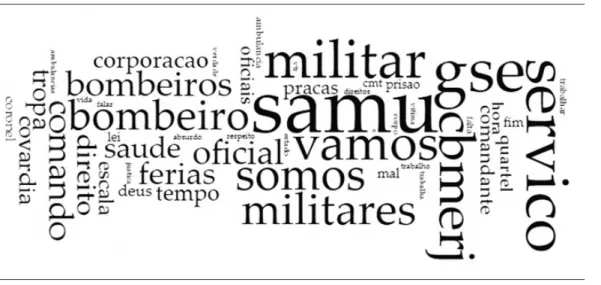
The word cloud configuration (Figure 1) allowed us to identify the most frequent terms, which are more centralized and in a larger font.
The classification of the most frequent words shown in the cloud configuration allows us to visualize the fundamental concepts within the context of the APH Rio service. Possibly, a sim-ilar analysis in a fire department blog of another state, the term SAMU would not be the most in-cident.
The respective acronym is the central element in the discussion of the firefighters linked to the GSE (third most spoken term), in which the SAMU is administratively inserted. These
work-ers claim that increased service (second position) and work overload was noted by linking SAMU to the CBMERJ (fifth position).
According to reports in blogs, narrowing of schedules, increased number of attendances (many of them without urgent criteria such as: toothache, diarrhea, menstrual cramps, etc.), extraordinary schedules, increased exposure to physical, environmental and psychosocial ftors, among them, the increased number of ac-cidents and urban violence in communities with high levels of violence, because they suffer threats from traffickers due to their military status.
However, despite the increased demand and workload of APH Rio firefighters, there was no wage increase, much less more workers, since the last contest that included every health catego-ry was in 2008, and there is no forecast for new competition.
According to Law Nº 6.170 of March 5, 201219, CBMERJ’s workforce was fixed at 23,475 mili-tary firefighters, that is, it should consist of this amount for a population estimated at 16,273,984 inhabitants that year.
In 2016, the population estimate of IBGE20 was 16,635,996 inhabitants. Establishing a cor-relative analysis, the actual estimate should be 25,194 firefighters. However, according to data from the 2016 CBMERJ Yearbook10, the number was 14,797 active military personnel, resulting in
Figure 1.Word cloud.
e C
ole
tiv
a,
23(10):3297-3307,
2018
a proportion of 1,124 inhabitants per firefight-ers and a shortage of approximately 10,397 fire-fighters. Considering the estimate of 1,200 health professionals in the GSE9, the deficit of this cadre would be around 843 workers, or almost double (70%) of workers.
The ratio between the number of attendances and the number of active firefighters shows that around 8% of military personnel are allocated in the APH and account for 42% of all state pro-duction. In the capital, they are 6%, and they perform almost 30% of all the attendances, and work overload of firefighters working in the mo-bile APH of the state and municipality of Rio de Janeiro is evident.
Decentralization, automatically uncoupling the SAMU from the GSE/CBMERJ would not only reduce the demand and work overload in the group of firefighters, but also physical and psychosocial harm, such as depression, burnout, gastrointestinal and cardiovascular disorders, RSI/WMSD, accidents, and so forth.
Unlinking would also promote an higher supply of jobs, favoring many currently unem-ployed workers, as well as affecting the econo-my of the municipality and state, with no excess burden on public coffers, since the compensation of firefighters is already the responsibility of the state manager, and there is a monthly financial incentive (50% of the budget) transferred by the Ministry of Health for the cost and maintenance of the program, and according to the guidelines of the national policy22,23, there must be a coun-terpart of the state and municipality on a regular and agreed basis of the other 50%.
In fact, there is a sum of errors on all sides! The SAMU / CBMERJ military compete on an ABSURD work schedule, given the service de-mand. There are NO WORKING CONDITIONS, as many vehicles do not even have AIR CONDI-TIONING! Apart from the DISRESPECT concern-ing mealtimes and physiological needs, as well as the limit of the body itself [Anonymous, January 8, 2014, 13:43]
Several real-world structures can be rep-resented through graphs, facilitating relevant information about their elements and their in-teractions. In a network, a graph is formed by nodes or vertices connected by lines, called edges or links and that establishes the relation between them24.
In network analysis, centrality is the measure of the importance of a vertex in a graph, and the different metrics allow to estimate the influence of a stakeholder or element within a network.
Several studies have used networks for text anal-ysis, in which words are the nodes and the edges the links between them25.
The representation of text in a network facili-tates categorization of textual data, identification of the most influential terms, detection of closely related concepts in a word community, retrieval of hidden agendas within a text, and perception of feelings, allowing the construction of mean-ings25.
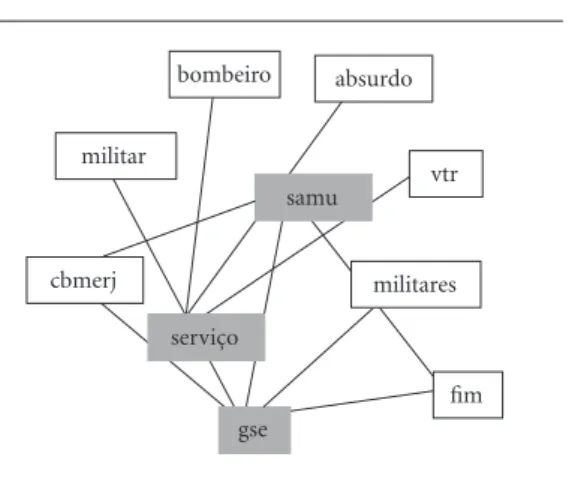
The graphic configuration of Links (Fig-ure 2) is determined by the degree of proximity between words and expresses in a didactic and succinct manner the main topic of debate in the context studied. The words “SAMU”, “SERVICE” and “GSE” (highlighted) have the highest degree of centrality in the text corpus (keywords) and work as mediators in the construction of mean-ings. Adjacent words are the most frequent words in the context of keywords.
Corroborating previous data, we can see the centrality of the word SAMU, however, different from the cloud, we can see beyond frequency the interaction between words. The highlighted words are the most influential in the text, con-sequently, in the statements. The word serviço is directly related to the words: absurdo, militar, bombeiro, SAMU, andvtr (vehicle); GSE is imme-diately related to militar, CBMERJ, fim, militar and SAMU; and the word SAMU, to GSE, serviço, CBMERJ and fim.
bombeiro absurdo
vtr militar
serviço cbmerj
samu
fim gse
militares
Figure 2. Graph of Links.
O
liv
eir
The analysis of the network in dialogue with the materials and comments confirms the study by Salvador et al.5, whose firefighters from the city of Rio de Janeiro declared that the primary work stressor is the integration of SAMU to the Military Fire Brigade, claiming work overload and attendance of non-urgent and non-emer-gency demands, hampering service to the real needs of the population.
CAMPAIGN “DOWN WITH SAMU”, FOR A MINIMUM OF DIGNITY TO THE HEALTH OF THE CBMERJ WORKER! WE NEED TO HELP EACH OTHER; TOGETHER WE ARE STRONG! [MSILVA, JANUARY 8, 2014, 10:26 p.m., empha-sis added]
I can’t stand this work routine anymore. I’ve been on sick leave several times because of health problems. [...] several friends are on sick leave due to health problems. This is absurd; it has to stop. We cannot take it anymore, down with SAMU! [...] [JSF, December 23, 2016, 11:03]
An interesting function provided in the tool is the measure of Correlations, which calculation is based on the correlation function created by Pearson26 and facilitated a deeper understanding of the corpus. This study does not pretend to be exhaustive regarding Pearson’s correlation.
Briefly, the correlations function allows to evaluate when two variables have some relation-ship between them, that is, whether high (or low) values of one of the variables imply high (or low) values of the other variable. For example, one can verify whether there is an association between the birth rate and unemployment in a city, among the financial resources invested in condom use advertising.
In the correlation analysis, we attempt to de-termine the degree of relationship between two variables, that is, to measure the variability be-tween them. A coefficient close to 1 indicates a positive correlation (they rise and fall together). Scores close to -1 mean a negative correlation, that is, frequencies of a term vary inversely (one rises while the other falls). Coefficient close to zero (positive or negative) indicates weak or neg-ligible correlation20.
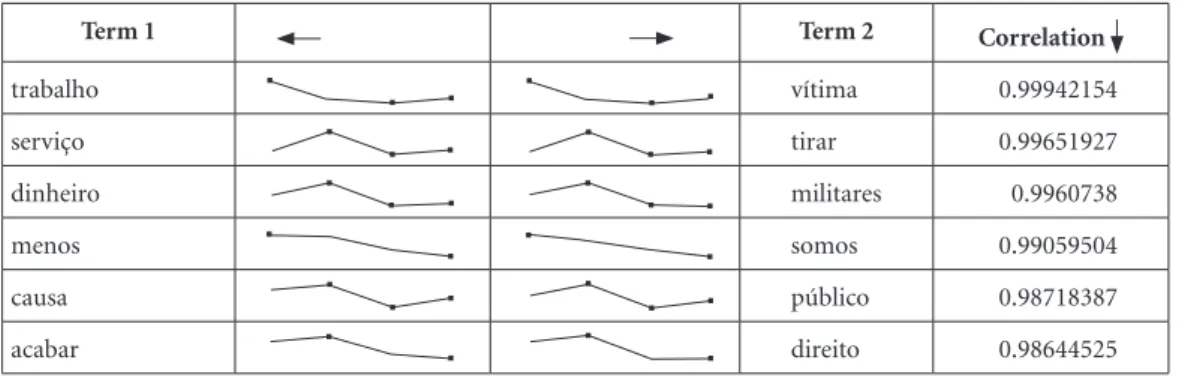
In Figure 3, we can see a strong correlation between some words, among which the tool clas-sified in descending order of correlation.
By verifying the words with the highest cor-relation index, it can be inferred that, in most of the comments, in which the word “trabalho” was used, the word “vítima” was also used, whether in the same comment or the next. It was necessary to go directly to the comments and verify at what
point they were used to check the information and validate the tool-generated result.
Words “trabalho” and “vítima” appeared con-comitantly in two contexts: 1) after a comment about the work and the victims (profile of atten-dance and impact on victims) and 2) sometimes referring to firefighters as victims of their work. [...] you don’t solve anything, and you even shift from victim to culprit (Anonymous, April 8, 2015, 7:03 pm).
Words “serviço” and “tirar” compete in two moments: 1) When they are referring to the ac-tivity of“replacing someone” and 2) in question-ings about work (“serviço”) and impossibilities of taking leave, rest, schedule, etc., the military is coerced to perform an extra service to take leave (Anonymous, December 23, 2016, 09:52).
Words “dinheiro” and “militares” also appear in two circumstances: 1) when they question why the resource transferred by the Ministry of Health to SAMU is not used to remunerate them through extra work; and 2) they mention the lack of money to commute to work and other needs, as a result of various pay and/or bonus payment in arrears. They bleed preparedness by saying that they do not have money to go to the barracks to work their shift. Imagine the situation in PROG, which doesn’t pay (Anonymous, 23 of December of 2016, 10h39min).
Words “acabar” and “direito” alternate dia-lectically in discourses. Users question when this management model ends (SAMU x GSE), a bond that, as they say, brings consequences to work and health (physical and mental overload, urban violence, no leaves, extraordinary schedules, de-layed attendance, scrapping of ambulances, and so forth). At the same time, they question their rights (wages, rest, food, basic hygienic needs, and so forth). In short, they claim the worker’s right to health and better working conditions. [...] They don’t respect the right to leave and oth-ers. When will this end?(Mr_bm, January 9, 2017, 1:28 pm).
The correlation chart made a significant con-tribution to work by showing that it is possible to seek knowledge in blogs, and through the asso-ciation between words, to be able to understand some aspects of reality. However, in this research, in two moments, it was not possible to establish an adequate correlation between the associations shown in the chart:
e C
ole
tiv
a,
23(10):3297-3307,
2018
Term 1 Term 2 Correlation
trabalho vítima 0.99942154
serviço tirar 0.99651927
dinheiro militares 0.9960738
menos somos 0.99059504
causa público 0.98718387
acabar direito 0.98644525
Figure 3. Correlations chart.
Source: Own elaboration in Voyant tools21.
mean collective identity or plurality. However, making an empirical inference, these suggest a disregard for various interests of the community or the reaffirmation of the community’s strength in the face of deprivation or subtraction.
Words “causa” and “público” – It was also not possible to draw up a coherent correlation. The word “causa” usually appears as a consequence of something, for example, work demotivation arising from work organization, while the word “público” is a component of the term Ministério Público, and is repeatedly mentioned as the legal means of filing a complaint and appeal to the firefighters’ rights.
According to Paranyushkin25, the organiza-tion of related terms is based on affinity, causal relationships, chronological sequence, and se-mantic analysis. However, the computational in-terpretation does not apprehend subjective and cultural questions in the graphic structuring of the texts, since it is the result of a negotiation with the text itself. There is also an orthograph-ic limitation since a compound word is not ap-prehended as a unique term, but as two distinct words.
Final considerations
The study showed that although firefighters are socially recognized as heroes and one of the pro-fessions most praised by the population, this rec-ognition does not seem to reflect on the working and life conditions of the mobile APH military firefighters of Rio de Janeiro.
The analyses of the subjects and discussions revealed uncomfortable situations in the work environment, among them military rigidity, moral harassment, physical and mental
over-load, violence, among others. While many refer loving their profession, these situations have had repercussions on dissatisfaction, suffering, and sickness of these workers as a consequence of or-ganizational and working conditions, enhanced by the linkage of SAMU to the GSE/CBMERJ.
Blogs act as a new political stakeholder in social relationships and have shown their poten-tial for building knowledge and understanding of meanings, with elements that can be trans-formed into realities. The representativeness and relevance of blogs analyzed for the firefighting community under the motto “Together we are strong” (despite several censorship attempts) have contributed to the organization, informa-tion, debate, and struggle of these workers for better living, health and work conditions.
The transition of communication and infor-mation to the computerized environment, while quite advanced, often surprises us. The social relationships created in the virtual, networked environment often show us an innovative per-spective that requires in-depth analysis. Like other networks, blogs are environments of in-tense social participation and an efficient way to communicate ideas, articulate actions, mobilize people, and so forth.
O
liv
eir
There is evidence of the need for institutional recognition of the category and public competi-tion, based on the overload and shortage of pro-fessionals since the last public competition that included the entire health category dates back to 2008. It is imperative to elaborate a continuous psychological monitoring service for the APH Rio firefighters and increased attention to the health of these workers.
Of course, this study has limitations. Voyant Tools produces a series of information about the corpus and has a limited collection of metrics, bracketing possibilities of analysis. Moreover, de-spite the merit of being an exploratory study, the nature of the computerized model restricted fur-ther analysis of singularities of firefighters’ work, which essence is the relationship with the other, suggesting new investigations in dialogue with other study methods.
Collaborations
e C ole tiv a, 23(10):3297-3307, 2018 References
1. Pires LAA. A relação saúde-trabalho dos bombeiros
mi-litares do município do Rio de Janeiro [dissertação]. Rio
de Janeiro: Fiocruz; 2016.
2. Sousa, TF, Ferreira WM, Santos SFS, Fonseca AS. Capa-cidade para o trabalho e aptidão física em bombeiros militares. Rev Saúde e Pesquisa 2012; 5(2):310-318. 3. Júnior WLV. Estresse ocupacional do bombeiro militar:
uma realidade no atendimento pré-hospitalar
[mono-grafia]. Goiânia: Universidade Estadual de Goiás; 2012. [acessado 2017 Nov 11]. Disponível em: http://www. bombeiros.go.gov.br/wp-content/uploads/2013/02/Es-tress-Ocupacional.pdf.
4. Souza KMO, Velloso MP, Oliveira SS. A Profissão de Bombeiro Militar e a Análise da Atividade para Com-preensão da Relação Trabalho-Saúde: revisão da litera-tura. In: Anais do VIII Seminário de Saúde do Trabalha-dor; Franca, SP: UNESP; 2012.
5. Salvador RSP, Silva BASA, Lisboa MTL. Estresse da Equipe de Enfermagem do Corpo de Bombeiros no Atendimento Pré-Hospitalar Móvel. Esc. Anna Nery
(impr.) 2013; 17(2):361-368.
6. Vicente NG, Ferreira LA, Rezende MP, Cardoso RJ, Zuffi FB. Percepção do estresse Ocupacional por Bom-beiros Militares de uma Cidade do Interior de Minas Gerais. Rev. pesqui. cuid. fundam. [Online]2013 jul-set [acessado 2017 Ago 12];5(3):75-84. Disponível em: http://www.redalyc.org/pdf/5057/505750941007.pdf. 7. O’Dwyer G, Machado CV, Alves RP, Salvador FG.
Atenção pré-hospitalar móvel às urgências: análise de implantação no estado do Rio de Janeiro. Cienc Saude
Colet 2016; 21(7):2189-2200.
8. Corpo de Bombeiros Militar do Estado do Rio de Janeiro (CBMERJ); 2007. [acessado 2017 Mar 17]. Disponível em: http://www2.cbmerj.rj.gov.br/index.php?option=- com_content&view=article&id=1352:samu-e-bom- beiros=-realizam600--atendimentos-por-dia&catid-33:noticias-da-subsedec&Itemid=43.
9. SOS Bombeiros. GSE dos Bombeiros: serviço decisivo
para salvar vidas. [internet]. 2014 maio 3. [acessado
2017 Nov 10]. Disponível em: http://www.sosbombei-ros.com/2014/05/gse-dos-bombeiros-servico-decisivo -para.html.
10. Corpo de Bombeiros Militar do Estado do Rio de Ja-neiro (CBMERJ). Anuário do Corpo de Bombeiros
Mi-litar do Estado do Rio de Janeiro 2016. [acessado 2017
Dez 12]. Disponível em: http://cbmerj.rj.gov.br/anua-rio2016v2/.
11. Dejours C. Subjetividade, trabalho e ação. Rev Produ-ção 2004; 14(3):27-34.
12. Franco T, Druck G, Seligmann-Silva E. As novas rela-ções de trabalho, o desgaste mental do trabalhador e os transtornos mentais no trabalho precarizado. Rev. bras.
Saúde ocup 2010; 35(122):229-248.
13. Rodrigues PFV, Bellini MIB. A Organização do Traba-lho e as Repercussões na Saúde do Trabalhador e da sua Família. Textos & Contextos 2010; 9(2):345-357. 14. Penteado CLC, Santos MBP, Araújo RPA. Metodologia
de pesquisa de blogs de política: análise das eleições presidenciais de 2006 e do movimento “cansei”. Rev.
Sociol. Polít 2009; 17(34):159-181.
15. Montardo SP, Passerino LM. Estudo dos blogs a partir da netnografia: possibilidades limitações. Rev. Renote 2006; 4(2):1-10.
16. Brito EMN. Mineração de Textos: Detecção automática
de sentimentos em comentários nas mídias sociais
[dis-sertação]. Belo Horizonte: Fundação Mineira de Edu-cação e Cultura; 2017.
17. Gonçalves T, Silva C, Quaresma P, Vieira R. Analysing part-of-speech for portuguese text classification. In: Gelbukh A, editors. Computational Linguistics and
Intelligent Text Processing. CICLing 2006: Lecture
Notes in Computer Science. Berlin: Springer,
Heidel-berg; 2006. vol. 3878. p. 551-562.
18. Monteiro JK, Maus D, Machado FR, Pesenti C, Bottega D, Carnie LB. Bombeiros: um olhar sobre a qualidade de vida no trabalho. Psicol. cienc. prof. 2007; 27(3):554-565.
19. Rio de Janeiro. Lei nº 6.170 de 05 de março de 2012. Altera o art. 1º e itens I e II do anexo único da Lei nº 5.175, de 28 de dezembro de 2007, e dá outras provi-dências.Diário oficial do estado do Rio de Janeiro 2012; 06 março.
20. Instituto Brasileiro de Geografia e Estatística (IBGE). Estimativas da população residente no Brasil e unidades da federação com data de referência em 1º de julho de 2016. [acessado 2017 Dez 12]. Disponível em: ftp:// ftp.ibge.gov.br/Estimativas_de_Populacao/Estimati-vas_2016/estimativa_dou_2016_20160913.pdf. 21. Voyant Tools; 2017. [acessado 2017 Nov 20].
Disponí-vel em: https://voyant-tools.org/.
22. Brasil. Ministério da Saúde (MS). Portaria nº 1.010 de 2012. Redefine as diretrizes para a implantação do Ser-viço de Atendimento Móvel de Urgência (SAMU 192) e sua Central de Regulação das Urgências, componen-te da Rede de Acomponen-tenção às Urgências. Diário Oficial da
União 2012; 22 maio.
23. Brasil. Ministério da Saúde (MS). Portaria de Consoli-dação nº 6 de 2017. ConsoliConsoli-dação das normas sobre o financiamento e a transferência dos recursos federais para as ações e os serviços de saúde do Sistema Único de Saúde. Diário Oficial da União 2017; 03 out. 24. Borba EM. Medidas de centralidade em Grafos e
Aplica-ções em redes de dados [dissertação]. Porto Alegre:
Uni-versidade Federal do Rio Grande do Sul; 2013. 25. Paranyushkin D. Identifying the Pathways for Meaning
Circulation using Text Netword Analysis. Nodus Labs 2011; p. 1-26. [acessado 2017 Dez 12]. Disponível em: https://noduslabs.com/research/pathways-meaning-circulation-text-network-analysis/.
26. Pearson K. On the theory of contingency and its relation
to association and normal correlation. London: Delay &
Co; 1904.
Article submitted 27/01/2018 Approved 06/03/2018
Final version submitted 14/06/2018
This is an Open Access article distributed under the terms of the Creative Commons Attribution License BY