Original Article
MULTICOMPONENT TRAINING TO IMPROVE THE FUNCTIONAL FITNESS AND GLYCEMIC CONTROL OF SENIORS WITH TYPE 2 DIABETES
TREINAMENTO MULTICOMPONENTE MELHORA A APTIDÃO FUNCIONAL E CONTROLE GLICÊMICO DE IDOSOS COM DIABETES TIPO 2
Alessandro Domingues Heubel1, Camila Gimenes1, Terezinha Sasaki Marques1, Eduardo Aguilar Arca1, Bruno Martinelli1and Silvia Regina Barrile1
1
Universidade Sagrado Coração, Bauru-SP, Brazil.
ABSTRACT
Type 2 diabetes mellitus (T2DM) is a prevalent disease in older adults and associated with functional impairment and abnormalities of the glycemic metabolism. Multicomponent training, which consists of strength, balance, coordination, gait, agility and proprioception exercises, is recommended to improve the physical function of the elderly, but its effects in the treatment of T2DM are not clear. The main goal was to investigate the effect of a multicomponent training protocol on functional and glycemic parameters in seniors with T2DM. Thirteen older adults (68±6 years) with T2DM were included. Before and after the intervention period, the following tests were performed: chair stand, arm curl, sit and reach, six-minute walk test (6MWT), fasting blood glucose and glycated hemoglobin (HbA1C). The training program was conducted for 16 weeks, three times a week, on nonconsecutive days. Each session consisted of 10 minutes of warm-up, 50 minutes of multicomponent exercises (coordination, muscle strength, flexibility, balance and agility) and 10 minutes of stretching and relaxation. Statistical analysis was performed using paired t-test and the Wilcoxon test (p<0.05). Training induced an improvement in the arm curl (p = 0.001), sit and reach (p = 0.004), 6MWT (p = 0.009) and HbA1C (p = 0.01) tests. In conclusion, the multicomponent training protocol improved functional fitness and glycemic control in seniors with T2DM. However, fasting blood glucose levels and muscle strength of the lower limbs remained unchanged
Keywords: Type 2 diabetes mellitus. Seniors. Physical exercise. Physical fitness. Blood glucose.
Introduction
The number of seniors with type 2 diabetes mellitus (T2DM) has increased worldwide due to population ageing and longer life expectancy1. In Brazil, it is estimated that more than 20% of individuals over 65 years old have been diagnosed with diabetes, and this prevalence is expected to increase in the next decades2.
T2DM is one of the main causes of adverse effects on the health of the elderly. In addition to micro and macrovascular complications, seniors with diabetes are more
RESUMO
A diabetes mellitus tipo 2 (DM2) é uma doença prevalente em idosos e está associada à incapacidade funcional e anormalidades do metabolismo glicêmico. O treinamento multicomponente, composto por exercícios de força, equilíbrio, coordenação, marcha, agilidade e propriocepção, é recomendado para melhorar a função física de idosos, porém seus efeitos no tratamento da DM2 não estão claros. Objetivou-se investigar o efeito de um protocolo de treinamento multicomponente na aptidão funcional e parâmetros glicêmicos de idosos com DM2. Foram incluídos 13 idosos com DM2 e idade de 68 ± 6 anos. Antes e após o período de intervenção foram realizados os seguintes testes: chair stand, arm curl, sentar e alcançar, teste de caminhada de seis minutos (TC6M), glicemia de jejum e hemoglobina glicada (HbA1C). O programa de treinamento foi realizado por 16 semanas, três vezes/semana, em dias não consecutivos. Cada sessão consistiu de 10 minutos de aquecimento, 50 minutos de exercícios multicomponentes (coordenação, força muscular, flexibilidade, equilíbrio e agilidade) e 10 minutos de alongamento e relaxamento. Para a análise estatística foi utilizado o teste t pareado e teste de Wilcoxon (p<0,05). O treinamento induziu melhora nos testes arm curl (p = 0,001), sentar e alcançar (p = 0,004), TC6M (p = 0,009) e HbA1C (p = 0,01). Conclui-se que o protocolo de treinamento multicomponente promoveu melhora da aptidão funcional e do controle glicêmico em idosos com DM2. Entretanto, a glicemia de jejum e a força muscular de membros inferiores permaneceram inalteradas.
susceptible to functional disability and fragility3. Physiological adaptations due to aging, such as increased adiposity and decreased muscle mass, may be more evident in elderly individuals with T2DM, meaning a greater loss of muscle strength and reduced physical function4.
Insulin resistance and chronic hyperglycemia, the main metabolic changes of T2DM, are associated with reduced muscle mass in the elderly, leading to functional limitations and decreased mobility in this population5. As a result, it is estimated that 70% of older people with diabetes have difficulty performing daily tasks such as going up and down stairs, cleaning the house, showering, eating and participating in leisure activities6.
Regular exercise is an important strategy to minimize the deficits caused by T2DM in the elderly. In addition to improving physical fitness, exercise has been recommended to aid glycemic control, with increased insulin sensitivity and improved glucose tolerance7,8. Although there is consensus about the benefits of exercise in the elderly population and in the treatment of T2DM, most studies refer only to aerobic and endurance training or the combination of both.
Multicomponent training (MT) has been proposed as an alternative to traditional training programs9. Characterized by endurance, strength, coordination, agility, balance, and flexibility exercises, MT is recommended by the American College of Sports Medicine (ACSM) to improve and maintain the physical function of the elderly10.
Some studies have shown that, in addition to improving physical fitness, MT is capable of increasing muscle mass and power in this population11,12. Besides, other studies report its benefits in metabolic and biochemical parameters, with increased insulin sensitivity, improved lipid profile and antioxidant capacity13-15.
Thus, considering that MT is prescribed for the elderly and that it can be a viable strategy in the management of T2DM, the present study aimed to investigate the effect of a multicomponent training program on the functional fitness and glycemic control of seniors with T2DM.
Methods
This is a before/after-type quasi-experimental clinical study in which the sample was selected by convenience.
Sample
The sample was composed of 13 volunteers recruited from Bauru’s Diabetes Association and the Physiotherapy Clinic of Sagrado Coração University (USC), Bauru/SP. The sample’s size was calculated based on a previous study9, considering the distance covered in the walking test as a variable outcome, calculated for a statistical power of 80% and an alpha error of 5%. For participation in the study, all volunteers signed the Free and Informed Consent Form, and all stages were approved by the Research Ethics Committee of the USC (No 817.372).
The study’s inclusion criteria were: 1) medical diagnosis of T2DM; 2) age> 60 years; 3) both sexes; 4) not having practiced systematic exercise for at least three months; 5) medical evaluation to attest the absence of complications that contraindicated exercising.
Assessments
Before and after the intervention period, in addition to functional and glycemic tests, the patients were subjected to clinical and anthropometric assessments.
accordance with the VI Brazilian Guidelines for Hypertension16, using a stethoscope and a sphygmomanometer (Accumed®, Brazil).
In the anthropometric assessment, body mass and height were measured on a digital anthropometric scale (Filizola®, Brazil). BMI was calculated using the formula BMI = body mass/height2. Abdominal circumference was verified with the aid of an anthropometric tape measure (Cescorf®, Brazil) at the umbilical scar level17.
For functional fitness assessment, the following components were considered: flexibility, muscle strength and cardiorespiratory capacity.
Flexibility of the hamstrings and lumbar muscles was assessed through the sit-and-reach test18. The test was executed in the seated position, extended knees, lower limbs slightly separated, and soles resting on a stool specifically designed for this purpose. In this position, the patient performed trunk flexion, with arms extended forward, in order to reach as far as possible. As a final result, the greatest measure among the three attempts made was considered.
Upper and lower limb muscle strength, respectively, were assessed by the arm curl and chair stand tests19. The arm curl test was performed in the seated position and consisted of elbow flexions as many times as possible for 30 seconds, wielding a dumbbell of 2.27 kg (women) or 3.63 kg (men). The chair stand test consisted of sitting on and rising from a chair as many times as possible in 30 seconds. At the end of each test, the total number of repetitions was registered.
Cardiorespiratory capacity was assessed by the 6-minute walking test (6MWT)20. To perform the test, the patients were instructed to walk as far as possible along a 30-meter corridor delimited by cones. At the end of the test, the total distance covered was registered.
Glycemic assessment was conducted after an 8-hour fast at the Laboratory of Clinical Analyses – Véritas Foundation. Glucose analysis used the enzymatic colorimetric method21 Architect Ci8200SR (Abbott Park, Illinois, USA), in serum or plasma. Glycated hemoglobin A1C (HbA1C) was obtained by the immunoturbidimetry method22 (Siemens ADVIA 2400 Chemistry System).
Multicomponent Program
The multicomponent training program was developed based on ACSM recommendations10 and other studies that used the same type of training for the elderly9,11-14. Thus, the program was carried out three times a week, on non-consecutive days, lasting 16 weeks. Each training session consisted of three stages:
1) Warm-up: 10 minutes of preparatory exercises, which included joint rotations (neck, shoulders, hips, knees and ankles), plantar flexion in orthostatism, stationary march and light walking.
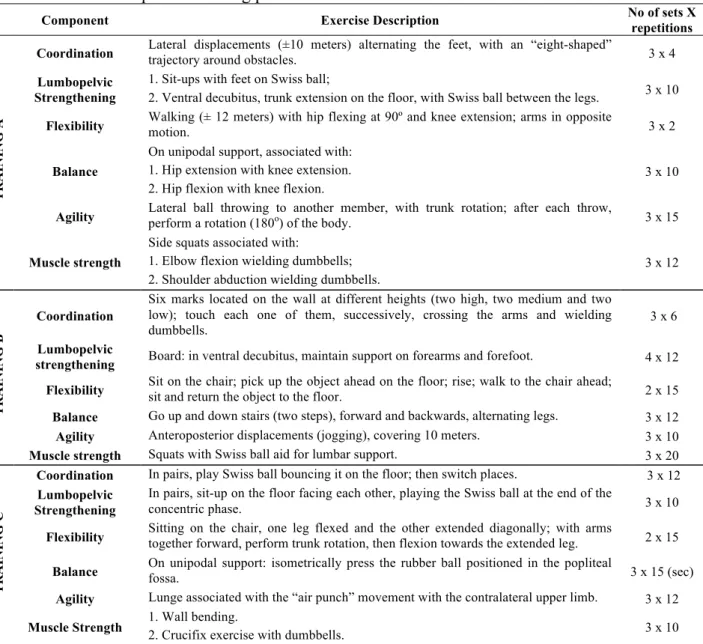
2) Multicomponent training (Table 1): six to nine exercises in circuit form. Each training session was structured in three different sequences (Training A, B and C), which were executed each day of the week and repeated each week. The training lasted 50 minutes, being divided into five components: coordination, strengthening of the lumbopelvic complex, flexibility, balance, agility and muscle strength. Initially, the rest time between sets and repetitions was 50 to 70 seconds.
3) Stretching: 10 minutes stretching the main anterior and posterior muscle chains of the trunk, upper and lower limbs.
Table 1. Multicomponent training protocol
Component Exercise Description No of sets X
repetitions TR A IN IN G A
Coordination Lateral displacements (±10 meters) alternating the feet, with an “eight-shaped”
trajectory around obstacles. 3 x 4
Lumbopelvic Strengthening
1. Sit-ups with feet on Swiss ball;
2. Ventral decubitus, trunk extension on the floor, with Swiss ball between the legs. 3 x 10
Flexibility Walking (± 12 meters) with hip flexing at 90º and knee extension; arms in opposite motion. 3 x 2
Balance
On unipodal support, associated with: 1. Hip extension with knee extension. 2. Hip flexion with knee flexion.
3 x 10
Agility Lateral ball throwing to another member, with trunk rotation; after each throw, perform a rotation (180o
) of the body. 3 x 15
Muscle strength
Side squats associated with:
1. Elbow flexion wielding dumbbells; 2. Shoulder abduction wielding dumbbells.
3 x 12
TR A IN IN G B Coordination
Six marks located on the wall at different heights (two high, two medium and two low); touch each one of them, successively, crossing the arms and wielding dumbbells.
3 x 6
Lumbopelvic
strengthening Board: in ventral decubitus, maintain support on forearms and forefoot. 4 x 12
Flexibility Sit on the chair; pick up the object ahead on the floor; rise; walk to the chair ahead; sit and return the object to the floor. 2 x 15
Balance Go up and down stairs (two steps), forward and backwards, alternating legs. 3 x 12 Agility Anteroposterior displacements (jogging), covering 10 meters. 3 x 10 Muscle strength Squats with Swiss ball aid for lumbar support. 3 x 20
TR A IN IN G C
Coordination In pairs, play Swiss ball bouncing it on the floor; then switch places. 3 x 12 Lumbopelvic
Strengthening
In pairs, sit-up on the floor facing each other, playing the Swiss ball at the end of the
concentric phase. 3 x 10
Flexibility Sitting on the chair, one leg flexed and the other extended diagonally; with arms together forward, perform trunk rotation, then flexion towards the extended leg. 2 x 15
Balance On unipodal support: isometrically press the rubber ball positioned in the popliteal fossa. 3 x 15 (sec)
Agility Lunge associated with the “air punch” movement with the contralateral upper limb. 3 x 12
Muscle Strength 1. Wall bending.
2. Crucifix exercise with dumbbells. 3 x 10 Source: The authors
Table 2. Training load progression
Variables Weeks
1st-4th 5th-8th 9th-12th 13th-16th
Vo
lu
m
e Training time - ↑ (+ 10 min.) - ↑↑ (+ 10 min.)
No of sets and repetitions - ↑(+1 set and +5
repetitions) -
↑↑ (+1 sets and +5 repetitions)
In
ten
si
ty Rest time - - ↓ (40-60 s) -
Load - - ↑ -
Legend: ↑: increase; ↓: decrease Source: The authors
Statistical Analysis
variables were expressed as mean (± standard deviation) and median (25-75% interquartile range), respectively. Comparison between moments was performed by the paired t-test and Wilcoxon (p <0.05).
Results
Table 3 displays the characteristics of the sample at the initial moment, with the seniors’ demographic, anthropometric and general clinical data. As for life habits, it is emphasized that the participants were not receiving nutritional counseling at the beginning of the experiment, nor did they have their eating habits and medicines changed until the end of the training.
Table 3. Initial Characteristics and Medicines Used Characteristics
Sex (men/women) 7/6
Age (years) 67.7 ± 6.4
Time of Diagnosis (years) 17.7 ± 8.6
BMI (kg/m2) 31.0 ± 5.9
AC (cm) 106.7 ± 12.0
SBP (mmHg) 125.1 ± 7.3
DBP (mmHg) 72.2 ± 6.1
Medicines
Sulfonylurea 3
Biguanide 11
Gliptins 4
Insulin 4
Legend: Data expressed as mean ± standard deviation or absolute number of patients; BMI: body mass index; AC: abdominal circumference; SBP: systolic blood pressure; DBP: diastolic blood pressure.
Source: The authors
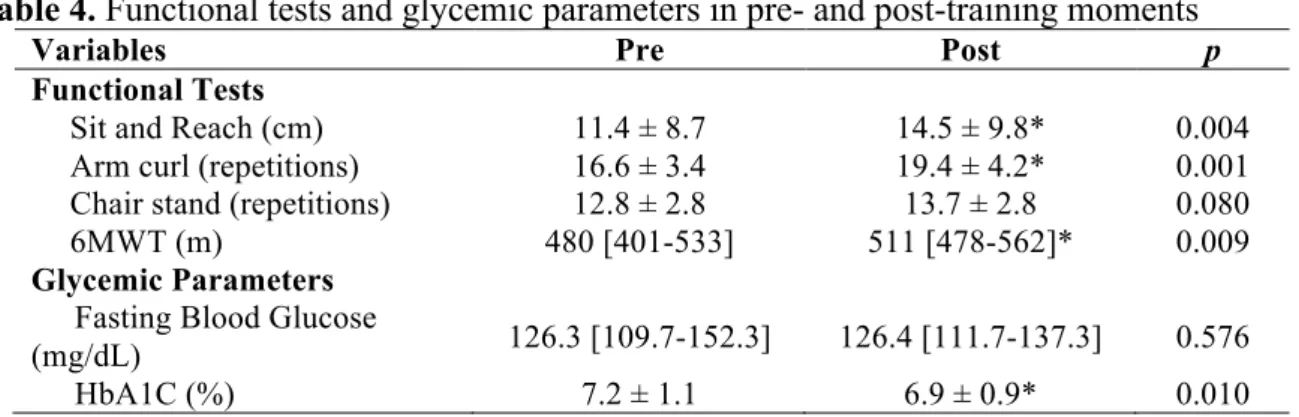
Table 4 shows results of functional and glycemic assessments before and after training. In the functional assessments, with the exception of the chair stand, a significant improvement was observed in all tests performed. The results of glycemic assessments showed a significant decrease in HbA1C, without changes in fasting blood glucose.
Table 4. Functional tests and glycemic parameters in pre- and post-training moments
Variables Pre Post p
Functional Tests
Sit and Reach (cm) 11.4 ± 8.7 14.5 ± 9.8* 0.004
Arm curl (repetitions) 16.6 ± 3.4 19.4 ± 4.2* 0.001
Chair stand (repetitions) 12.8 ± 2.8 13.7 ± 2.8 0.080
6MWT (m) 480 [401-533] 511 [478-562]* 0.009
Glycemic Parameters Fasting Blood Glucose
(mg/dL) 126.3 [109.7-152.3] 126.4 [111.7-137.3] 0.576
HbA1C (%) 7.2 ± 1.1 6.9 ± 0.9* 0.010
Discussion
The results obtained in the present study showed that 16 weeks of MT contributed to improving flexibility, upper limb muscle strength and cardiorespiratory capacity in elderly patients with T2DM. No changes in the chair stand test were verified, suggesting maintenance of muscle strength in the lower limbs. In the glycemic assessment, although there was no change in fasting blood glucose, decreased HbA1C was observed.
The findings reinforce the ACSM’s recommendation10 of prescribing MT for the elderly to maintain or improve physical function. However, although several studies have shown the benefits of MT11-14, there is a lack of standardization with regard to exercise types, volume, intensity and load progression.
The protocol proposed in this study, in addition to strength and flexibility exercises, also emphasized physical abilities such as agility, balance and coordination, which are often neglected in adult training programs, but are considered fundamental in exercise programs for seniors. Vaughan et al.12 found improvements in the physical function of elderly women after 16 weeks of multimodal training involving strength, endurance, balance, agility, coordination and flexibility exercises.
Concerning the sit-and-reach test, improvement in flexibility was observed after the MT protocol. Similarly, a study carried out by Carvalho et al.11 verified improvements in flexibility in the sit-and-reach test after eight weeks of MT involving aerobic, endurance, agility, balance and flexibility exercises. In individuals with T2DM, flexibility gain should be considered a relevant data, since the disease may lead to decreased range of motion due to collagen glycosylation in the joints23.
The 6MWT evidenced an increase in the total distance covered, suggesting an improvement in functional capacity and cardiorespiratory capacity after the proposed MT protocol. Corroborating our results, Carvalho et al.14 verified a significant increase in covered distance in the 6MWT among elderly women after 8 months of MT program involving aerobic, strengthening, balance and flexibility exercises. In contrast, Marques et al.24 studied the effects of MT and found no improvement in the 6MWT after 8 months, with aerobic, endurance, strength, agility, balance and flexibility exercises. Possibly, these divergences occurred due to a difference in training volume, since both were performed three times and twice a week, respectively.
In the arm curl test there was increase in the functional strength of the upper limbs, which was also observed in other studies with seniors11,25. On the other hand, in the chair stand test, there was no significant improvement. Such phenomenon may be related to the fact that elderly people with T2DM present a greater decline in muscle mass and strength of the lower limbs4, which may result from the development of some degree of neuropathy26,27. Perhaps, with greater load and amount of exercises for the lower limbs, or longer training time, increased strength could have been observed.
As for glycemic results, there was significant decrease in HbA1C, with no changes in fasting blood glucose. Fasting blood glucose represents the current and instantaneous balance of blood glucose at the exact moment it was checked, while HbA1C assesses long-term glycemic control, reflecting previous blood glucose in the last four months (50% relative to the month preceding the test, 25% to the previous month, and the other 25% to the third or fourth months)28.
several factors, including level of stress30, which was not measured in the present study. For this reason, the HbA1C test, which represents the glycemic mean of the last three or four months, has been used as a gold standard to monitor glycemic control in individuals with diabetes28.
Decreased HbA1C may be associated with chronic effects of exercise. Such effects are obtained by improving skeletal muscle responsiveness to insulin, with increased expression and/or activity of proteins involved in glucose metabolism and insulin signaling31,32.
In the present study, despite improvements in glycemic control, there should be caution when recommending this type of training for this purpose and as an alternative to aerobic and endurance training. A meta-analysis performed by Umpierre33, for instance, observed that aerobic and endurance training, respectively, can lead to reductions of up to 0.73% and 0.57% in HbA1C. Considering this reference, the proposed MT protocol seems to have had less effect on HbA1C, considering that the reduction was 0.33%.
As one strength of this study, we highlight the beneficial effects of MT in various physical capacities, such as muscle strength, flexibility and cardiorespiratory capacity, which are essential for the elderly population, with direct influence on the performance of daily activities and quality of life. Furthermore, considering that the population studied was seniors with T2DM, who are more susceptible to physical disabilities4-6, the positive results of this study support the importance of MT in the management and prevention of functional deficits in this population. Nevertheless, like any physical exercise program applied to the elderly, the implementation of MT should be accompanied by strategies aimed at deconstructing the many barriers that contribute to the participants’ non-compliance34.
Finally, although important findings have been observed in our study, some limitations should be mentioned. The first one concerns the absence of a control group, which makes it impossible to compare groups and prevents a direct inference of MT’s effect. Secondarily, we considered as limitation the difficulty in comparison with other studies involving MT, which used different variations as to exercise types and training volume and intensity. Lastly, another limitation observed concerns the determination of the initial intensity of the exercises, since the literature does not have specific methods to quantify and prescribe loads for neuromotor training (agility, coordination and balance)10. Thus, the adjustment of initial loads in these exercises was done based on the perception of each individual, which may have underestimated the ideal training intensity.
Conclusion
The MT protocol provides improved functional fitness and glycemic control in elderly patients with T2DM. However, it is not efficient for lower limb strength gains in this population. Nevertheless, we suggest the proposed protocol as an alternative to conventional training, aiming solely at improving physical function in seniors with the disease. Although MT has contributed to improved glycemic control, other clinical trials should be performed, especially to confirm the magnitude of the effect on HbA1C.
References
1. Kim KS, Kim SK, Sung KM, Cho YW, Park SW. Management of type 2 diabetes mellitus in older adults. Diabetes Metab J. 2012; 36 (5): 336-44. DOI: 10.4093/dmj.2012.36.5.336
2. de Almeida-Pititto B, Dias ML, de Moraes AC, Ferreira SR, Franco DR, Eliaschewitz FG. Type 2 diabetes in Brazil: epidemiology and management. Diabetes Metab Syndr Obes. 2015; 8: 17-28. DOI:
3. Sinclair A, Morley JE, Rodriguez-Mañas L, Paolisso G, Bayer T, Zeyfang A, et al. Diabetes mellitus in older people: position statement on behalf of the International Association of Gerontology and Geriatrics (IAGG), the European Diabetes Working Party for Older People (EDWPOP), and the International Task Force of Experts in Diabetes. JAMDA. 2012; 13 (6): 497-502. DOI: 10.1016/j.jamda.2012.04.012
4. Leenders M, Verdijk LB, van der Hoeven L, Adam JJ, van Kranenburg J, Nilwik R, et al. Patients with type 2 diabetes show a greater decline in muscle mass, muscle strength, and functional capacity with aging. J Am Med Dir Assoc. 2013; 14 (8): 585-92. DOI: 10.1016/j.jamda.2013.02.006
5. Kalyani RR, Corriere M, Ferrucci L. Age-related and disease-related muscle loss: the effect of diabetes, obesity, and other diseases. Lancet Diabetes Endocrinol. 2014; 2 (10): 819-29. DOI: 10.1016/S2213-8587(14)70034-8
6. Kalyani RR, Saudek CD, Brancati FL, Selvin E. Association of diabetes, comorbidities, and A1C with functional disability in older adults: results from the National Health and Nutrition Examination Survey (NHANES), 1999-2006. Diabetes Care. 2010; 33 (5): 1055-60. DOI: 10.2337/dc09-1597
7. Colberg SR, Sigal RJ, Fernhall B, Regensteiner JG, Blissmer BJ, Rubin RR, et al. Exercise and type 2 diabetes: the American College of Sports Medicine and the American Diabetes Association: joint position statement executive summary. Diabetes Care. 2010; 33 (12): 2692-6. DOI: 10.2337/dc10-1548
8. Barrile SR, Coneglian CB, Gimenes C, Conti MHS, Arca EA, Rosa-Junior G, et al. Efeito agudo do exercício aeróbio na glicemia em diabéticos 2 sob medicação. Rev Bras Med Esporte. 2015; 21 (5): 360-3. DOI: http://dx.doi.org/10.1590/1517-869220152105117818
9. Barrile SR, Valderramas CGM, Nunes AJ, Heubel AD, Arca EA, Iwamoto HCT, et al. Effects of
multicomponent training on pulmonary function, functional capacity and quality of life in older adults with type 2 diabetes. Sport Sci Health. 2017; 13 (1): 39-46. DOI: 10.1007/s11332-016-0316-7
10. Garber CE, Blissmer B, Deschenes MR, Franklin BA, Lamonte MJ, Lee IM, et al. American College of Sports Medicine position stand. Quantity and quality of exercise for developing and maintaining cardiorespiratory, musculoskeletal, and neuromotor fitness in apparently healthy adults: guidance for prescribing exercise. Med Sci Sports Exerc. 2011; 43 (7): 1334-59. DOI: 10.1249/MSS.0b013e318213fefb 11. Carvalho MJ, Marques E, Mota J. Training and detraining effects on functional fitness after a
multicomponent training in older women. Gerontology. 2009; 55 (1): 41-8. DOI: 10.1159/000140681 12. Vaughan S, Wallis M, Polit D, Steele M, Shum D, Morris N. The effects of multimodal exercise on cognitive
and physical functioning and brain-derived neurotrophic factor in older women: a randomized controlled trial. Age Ageing. 2014; 43 (5): 623-9. DOI: 10.1093/ageing/afu010
13. Ratel S, Gryson C, Rance M, Penando S, Bonhomme C, Le Ruyet P, et al. Detraining-induced alterations in metabolic and fitness markers after a multicomponent exercise-training program in older men. Appl Physiol Nutr Metab. 2012; 37 (1): 72-9. DOI: 10.1139/h11-130
14. Carvalho J, Marques E, Ascensão A, Magalhães J, Marques F, Mota J. Multicomponent exercise program improves blood lipid profile and antioxidant capacity in older women. Arch Gerontol Geriatr. 2010; 51 (1): 1-5. DOI: 10.1016/j.archger.2009.05.020
15. Marques E, Carvalho J, Soares JMC, Marques F, Mota J. Effects of resistance and multicomponent exercise on lipid profiles of older women. Maturitas. 2009; 69 (1): 84-8. DOI: 10.1016/j.maturitas.2009.03.003 16. Sociedade Brasileira de Cardiologia, Sociedade Brasileira de Hipertensão, Sociedade Brasileira de
Nefrologia. VI Diretrizes Brasileiras de Hipertensão. Arq Bras Cardiol 2010; 95 (1): 1-51.
17. Nagatsuyu DT, Moriguti EKU, Pfrimer K, Formighieri PF, Lima NKC, Ferriolli E, et al. O impacto da obesidade abdominal sobre os níveis plasmáticos de lipídes nos idosos. Medicina. 2009; 42 (2): 141-7. DOI: http://dx.doi.org/10.11606/issn.2176-7262.v42i2p157-163
18. Canadian Standardized Test of Fitness (CSTF). Fitness and Amateur Sport. 3rd ed. Ottawa: Minister of State; 1986.
19. Jones CJ, Rikli REM. Measuring functional fitness of older adults. The Journal of Active Aging. 2002; 1 (1): 24-30.
20. ATS Committee on Proficiency Standards for Clinical Pulmonary Function Laboratories. ATS statement: guidelines for the six-minute walk test. Am J Respir Crit Care Med. 2002; 166 (1): 111-7. DOI:
10.1164/rccm.166/1/111
21. Sacks DB, Arnold M, Bakris GL, Bruns DE, Horvath AR, Kirkman MS, et al. Guidelines and
recommendations for laboratory analysis in the diagnosis and management of diabetes mellitus. Diabetes Care. 2011 ; 34 (6): 61-99. DOI: 10.2337/dc11-9998
22. Metus P, Ruzzante N, Bonvicini P, Meneghetti, Zaninotto M, Plebani M. Immunoturbidimetric assay of glycated hemoglobin. J Clin Lab Anal. 1999; 13 (1): 5-8. DOI:
23. Ulhoa LS, Lima RCO, Cunha VNC, Gomes EB, Campbell CSG, Pedrosa HC. Mobilidade articular de idosos diabéticos e não diabéticos e influência da fisioterapia. Fisioter Mov. 2011; 24 (1): 99-106. DOI:
http://dx.doi.org/10.1590/S0103-51502011000100011
24. Marques EA, Mota J, Machado L, Sousa F, Coelho M, Moreira P, et al. Multicomponent training program with weight-bearing exercises elicits favorable bone density, muscle strength, and balance adaptations in older women. Calcif Tissue Int. 2011; 88 (2): 117-29. DOI: 10.1007/s00223-010-9437-1
25. Kang S, Hwang S, Klein AB, Kim SH. Multicomponent exercise for physical fitness of community-dwelling elderly women. J phys Ther Sci. 2015; 27 (3): 911-5. DOI: 10.1589/jpts.27.911
26. Hilton TN, Ttuttle LJ, Bohnert KL, Mueller MJ, Sinacore DR. Excessive adipose tissue infiltration in skeletal muscle in individuals with obesity, diabetes mellitus, and peripheral neuropathy: association with performance and function. Phys Ther. 2008; 88 (11): 1336-44. DOI: 10.2522/ptj.20080079
27. Barrile SR, Ribeiro AA, Costa APR, Viana AA, Conti MHS, Martinelli B. Comprometimento sensório-motor dos membros inferiores em diabéticos do tipo 2. Fisioter Mov. 2013; 26 (3): 537-548. DOI: 10.1590/S0103-51502013000300007
28. Sociedade Brasileira de Diabetes. Diretrizes da Sociedade Brasileira de Diabetes. São Paulo: AC Farmacêutica; 2016.
29. Rohlfing CL, Wiedmeyer HM, Little RR, England JD, Tennill A, Goldstein DE. Defining the relationship between plasma glucose and HbA(1c): analysis of glucose profiles and HbA(1c) in the Diabetes Control and Complications Trial. Diabetes Care. 2002; 25 (2): 275-8. DOI: http://dx.doi.org/10.2337/diacare.25.2.275 30. Sacks DB. A1C versus glucose testing: a comparison. Diabetes Care. 2011; 34 (2): 518-23. DOI:
10.2337/dc10-1546
31. Wang Y, Simar D, Fiatarone-Singh MA. Adaptations to exercise training within skeletal muscle in adults with type 2 diabetes or impaired glucose tolerance: a systematic review. Diabetes Metab Res Rev. 2009; 25 (1): 13-40. DOI: 10.1002/dmrr.928
32. Moro ARP, Iop RR, Silva FC, Gutierres-Filho PJB. Efeito do treinamento combinado e aeróbio no controle glicêmico no diabetes tipo 2. Fisioter Mov. 2012; 25 (2): 399-409. DOI:
10.1590/S0103-51502012000200018
33. Umpierre D, Ribeiro PA, Shaan BD, Ribeiro JP. Volume of supervised exercise training impacts glycaemic control in patients with type 2 diabetes: a systematic review with meta-regression analysis. Diabetologia. 2013; 56 (2): 242-51. DOI: 10.1007/s00125-012-2774-z
34. Aily JB, Carnaz L, Farche ACS, Takahashi ACM. Perception of barriers to physical exercise in women population over 60. Motriz: Rev Educ Fis. 2017; 23 (2): 1-6.
http://dx.doi.org/10.1590/s1980-6574201700020012
Received on Apr, 08, 2016. Reviewed on Sep, 21,2017. Accepted on Oct, 01, 2017.