CONSTRAINTS TOWARDS ORGANIC CONVERSION IN
AGROFORESTRY SYSTEMS: THE CASE OF DEHESA
LIVESTOCK FARMS IN EXTREMADURA (SW SPAIN)
Horrillo A1, Elghannam A1, Gaspar P1*, Escribano M1 1
(1) Research Institute of Agricultural Resources (INURA), University of Extremadura. Avda. Adolfo Suarez, s/n 06007, Badajoz, Spain
*Corresponding author: [email protected]
Abstract
The dehesa is a unique ecosystem within the European territory; it provides an important set of environmental, cultural, aesthetic, and economic values. This paper presents the preliminary results of a research project carried out in the Spanish region of Extremadura, region highly covered by dehesa agroforestry system. The first objective of the project is to analyse the situation of livestock production systems that are located in such agroforestry with the aim to identify what are the main limitations that livestock farmers find for their conversion to organic economic viability and organic model can be a suitable strategy. A participatory research has been conducted: four focus group sessions were carried out with a total of 33 participants. Preliminary results have shown that limitations can be classified in 8 categories: raw material availability, training, production techniques, processing, product certification, marketing, consumption and regulations.
Keywords: organic, extensive livestock, participatory research, conversion
Introduction
The dehesa is a unique ecosystem within the European territory; it provides an important set of environmental, cultural, aesthetic, and economic values. Unfortunately, these systems are in decline as a result of multiple factors among them the lack of profitability is highlighted (Gaspar et al. 2007).
Currently, all stakeholders involved in such ecosystems consider that the implementation of economic viability in order to obtain products efficiently - . These systems are characterized by a wide range of products among them the extensive livestock systems, such as cattle, sheep and pigs, in addition to goats, poultry and horses, are found to be the most important.
In Europe, dehesa is the most widespread agroforestry system, counting around 5.5 million hectares in Spain and 1.2 million of hectares in Portugal (den Herder et al. 2017). In Spain, Extremadura is the region with the largest areas of dehesas. The most recent estimates of forestry reported 2.2 million hectares of dehesas in Extremadura which is considered the basis of socio-economic and cultural activities in this region (CAYMA 2003)
This paper presents the preliminary results of a research project carried out in the region of Extremadura. The objective of the project is to foster the conversion of livestock farms located in dehesa ecosystems in a model of sustainable organic livestock production in the region. The extensive livestock production systems located on dehesas are very close to the organic production models. Although its conversion is possible from a technical point of view, its practical applicability is rather limited (Horrillo et al. 2016). Marketing of products certified as organic is a tool that could add value to all livestock productions of these systems and consequently increase its profitability.
As a first stage of the project, a diagnosis of the situation of livestock production systems that are located in dehesas is to be carried out with the aim to identify what are the main limitations that dehesa farmers would find for their conversion to organic models, then to search for participatory solutions that are applicable at the regional level. Livestock farms are located in the same environmental, social and administrative context. Therefore, the problems and solutions are shared, and in many cases the policy makers at the regional level are those who will have to adopt policies and take decisions.
Materials and methods
The project begins with a participatory process through qualitative research using focus group techniques, in which different dynamics are working. Figure 1 shows the process followed in this first phase of diagnosis. The four focus group sessions were carried out with a total of 33 participants who were selected among stakeholders involved in the management of livestock systems that is located in dehesas of Extremadura. Each focus group session was developed with six to ten participants of both genders (72.8% men and 27.2% women) with ages ranging between 30 and 69 years, among them there were farmers of different species (sheep, cattle, pigs goats and poultry) both organic and conventional, representatives of management, technicians and operations consultants, researchers and representatives of agricultural associations. The sessions were developed during the month of February 2018, in four municipalities of Extremadura, in order to facilitate the participation of stakeholders from the whole region. The participants were located in large rooms comfortably seated around a table in order to enable interaction and eye contact. All the sessions were conducted by a trained moderator and recorded on video and audio for further analysis. The total work time of each session was around 120 minutes and the all the sessions were developed following a common protocol.
Figure 1: Methodological process.
Results
The first findings have identified a set of problems that are restricting livestock systems and prevent a conversion to an organic model of sustainable production. These problems have been grouped into eight categories which are described below.
1. Raw material availability: for participants one of the main problems found was related to high prices of organic raw materials that directly affect the economic viability of the rofile mentioned that the regulations of the communal pastures use of organic farms that share territory with conventional farms does not allow farmers to use those pastures that are necessary for self-sufficiency.
2. Training: participants agreed upon the lack of knowledge of organic production techniques among farmers in the sector which is attributed to the lack of training, and also to the lack of initiatives such as, technical training aids for farmers and both public and private technical expertise.
3. Production techniques: participants concluded that due to the production techniques that legislation requires them to comply, such as the reduction in the stocking of their ally compensated by the agri-environmental aids currently valid in the region.
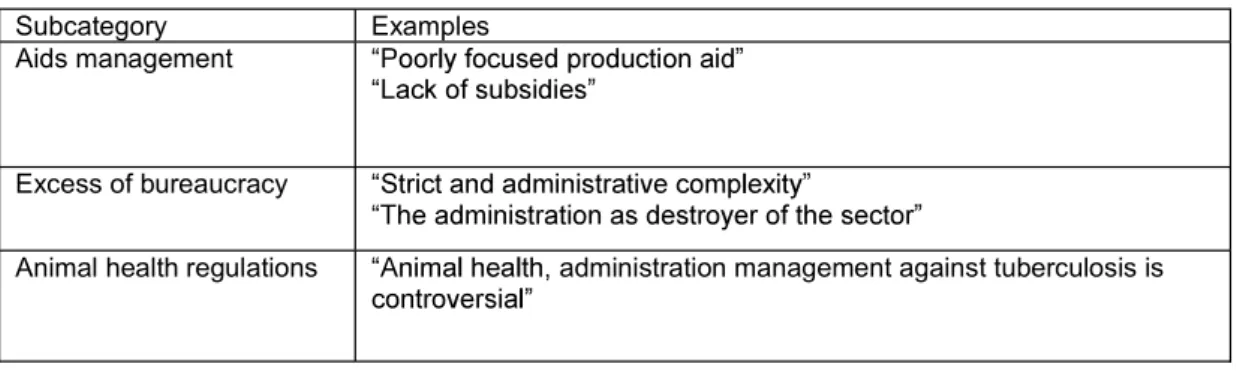
4. Regulation: In this section participants listed many problems which could be grouped into three subcategories, although all of them are directly linked to the regulations, they also have different interpretations.
Problems related to the regulation of the sector and examples of how participants expressed the problem appear in Table 1.
Table 1: Problems identified related to regulations: subcategories and examples given by participants.
Subcategory Examples
Aids management
Excess of bureaucracy
Animal health regulations administration management against tuberculosis is
5. Processing: the participants have highlighted the absence of development in the processing industry in the region. Also the continuous decrease of slaughterhouses especially those who comply with the regulation for organic animals. In this sense, participants talked about the lack of initiative for the organic livestock sector, comparing this with other more developed in the Autonomous Community of Extremadura as it is the case of the fruit sector. For this reason participants argued that although quite much organic products are produced, they end up marketed as conventional.
6. Technical certification: participants with livestock profile commented on the lack of properly trained technical inspectors in organic farms, since sometimes it is observed that there are still many gaps in the interpretation or application of the organic standard at the time of certification.
7. Marketing: Participants do not find specified marketing chains in Extremadura where they can sell their organic products of animal origin, they also describe the sector as not properly united and they believe that a wider grouping is needed to get a more homogeneous product and ensure a continuous supply.
8. Consumption: According to the participants the consumer does not have sufficient information about the systems and techniques of organic livestock production due to the lack of public disclosure, so they confuse animal production systems without differentiating the sustainability thereof.
In the light of these preliminary results we can say that the problems identified are very diverse and that the search for solutions has to be adapted to respond to each one of them. The responsibility that is attributed to the administration in the application of rules and the lack of support for the sector is going to be one of the future research lines in order to establish collaboration between policy makers and farmers to make progress in the conversion of
Acknowledgments
The authors would like to acknowledge the support and funding provided by the Junta de Extremadura and FEDER Funds within the V Plan Regional de I+D+i (2014-2017) through the Research Project GanEcoEx (Project reference IB16057) which made this research possible.
References
den Herder M, Moreno G, Mosquera-Losada RM et al (2017) Current extent and stratification of agroforestry in the European Union. Agric Ecosyst Environ 241: 121 132.
Implications for their sustainability. Agrofort Syst 71: 151-162.
Horrillo A, Escribano M, Mesias FJ, Elghannam A, Gaspar P (2016) Is there a future for organic production in high ecological value ecosystems? Agric Syst 143: 114-125.