Maze test: an instrument to evaluate age-related cognitive and
motor changes in humans
Damião Ernane de Souza*, Débora Carvalho de Oliveira**, Tania Fernandes Campos***
Abstract
Changes in cognitive and motor ability per-formance due to advancing age can com-promise daily activities. It is important to determine if the maze test can be sensitive to the cognitive or motor alterations of nor-mal ageing. This, the aim of the study was to verify age-related differences in executive function, learning and short-time memory by means of the maze test. Participated 80 healthy individuals, 40 young people (22 ± 2 years) and 40 elderly individuals (67 ± 5 years), underwent a health and cognitive evaluation (Mini Mental State Examina-tion). Participants were timed solving thirty mazes, and another 15 minutes later. The data were analyzed by ANOVA and mul-tiple linear regression. The elderly subjects took longer to solve the mazes, suggesting difficulties in executive function; learning took place in the first trials and a short-time memory deficit occurred. A correlation was observed between the cognitive and
maze test (r = -0.320; p = 0.003). Age was the only predictive factor of performance. It is suggested that the maze test may con-tribute to the monitoring of premature cog-nitive and motor alterations in the elderly.
Keywords: Executive function. Learning.
Memory. Cognition. Elderly.
Introduction
The effects of aging on cognitive and motor functions have been approached in different studies. It is recognized that aging is accompanied by changes in velocity or in the manner of processing information in the brain(SALTHOUSE, 2000). Studies on cognitive function have shown, through an assortment of
atten-* Doctor in Public Health / Epidemiology for Public Health Institute, Federal University of Bahia - ISC/UFBA, Planning Analyst, Infrastructure and Management in Geographic Information and Statistics Brazilian Institute of Geography and Statistics - IBGE, Natal/ RN, Brazil.
** Master of Physiotherapy, Professor of Neurological Physiotherapy in the Faculty of Health Sciences of Trairi, Department of Physiotherapy, Santa Cruz/ RN, Brazil
*** Doctor in Psychobiology, Professor of Neurological Physiotherapy at the Federal University of Rio Grande do Norte, Department of Physiotherapy, Center for Health Sciences, Laboratory of Chronobiology, Laboratory of Movement and Health, Natal/ RN, Brazil. Corresponding Author: Universidade Federal do Rio Grande do Norte, Departamento de Fisioterapia, Avenida Senador Salgado Filho, 3000, CEP: 59066-800, Natal/RN, Brazil. E-mail: [email protected]
tion, executive function and memory tasks(MILHAN et al., 2001; WECKER et al., 2000; DENNIS; DASELAAR; CABE-ZA, 2007) that the elderly display deficits in reaction time and response accuracy. Changes in cognitive ability performance due to advancing age can compromise daily activities and consequently, qual-ity of life(LOW; MOLZAHN, 2007) and even life expectancy. One study found that nondemented elderly showing rapid decline in the measures of visuospatial functions, language, and basic and instrumental activities of daily living were around twice as likely to die than nondemented elderly presenting with no or slower decline(SCHUPF et al., 2005).
With respect to motor skill perfor-mance, literature data indicate age-de-pendent differences in motor learning. In an earlier study, motor acquisition in a group of young individuals was signi-ficantly faster than in the older group (PERROT; BERTSCH, 2007). An inte-resting aspect is that motor execution for older adults was dependent on cognitive control, suggesting that cognitive capaci-ty is a determinant of motor slowness in the elderly. Nevertheless, recent results have shown that ageing is accompanied by the functional dysregulation of motor cortex excitability during sensorimotor processing. This deficit becomes progres-sively evident with increasingly complex motor tasks(YORDANOVA et al., 2004). Another study found motor acquisition deficit in older adults; however, they exhibit normal transfer of learning, indicating that motor acquisition and transfer are distinct processes, affected differently by age(SEIDLER, 2007). All
the results found to date show that the causes of reduced motor learning are multifactorial. It is therefore, important to explain age-related mechanisms and processes of decline.
Few studies have focused on the de-velopment of instruments that analyze motor behavior and its relation with cognitive functions. It is difficult to ela-borate an experimental test, which must be based on the need to identify and combine the elements of motor behavior and cognition present in a same task. It is essential to promote the use of stan-dardized and simplified assessments that contribute to effect monitoring of early cognitive-motor alterations in the elderly, in such a way that interventions can be planned to minimize the reper-cussions in the activities of daily living in these individuals. The tests must be able to identify changes due to age in the various processes involved in reco-very, organization, execution and motor learning. The investigations must con-sider the mental operations that occur between stimulus and response, thereby evaluating the cognitive activities that precede motor action.
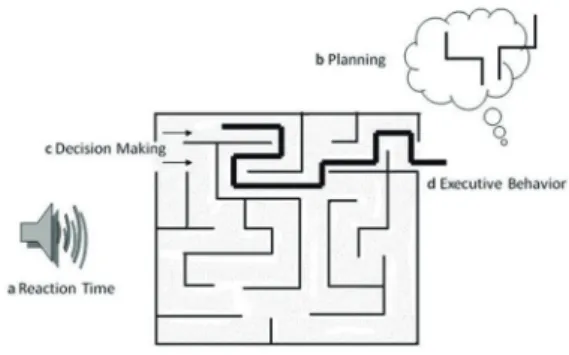
Maze tests have been used in rese-arch and clinical practice to enable the evaluation of different cognitive and mo-tor processes(OTT et al., 2003; SOUZA; FRANÇA; CAMPOS, 2006; KIRSCH et al., 2006). The task of solving a maze involves attention and perception during the analysis of the visuospatial stimu-lus, executive function at the moment of planning, organization and motor action, as well as when deciding on the correct solution path, especially when
encountering a fork in the path. The response is planned based on decisions made, trial and error, and performance improves through various trials until it is stabilized and the learning process is understood; the information is then stored in memory (KIRSCH et al., 2006). Studies using functional magnetic re-sonance imaging (fMRI) have shown evidence of an activation pattern of numerous cerebral structures linked to different cognitive and motor processes. The decision to take alternative paths inside the maze (executive function) in-volved the activation of the pre-frontal cortex. During the processing of visual information related to the analysis of the spatial characteristics of the stimu-lus, the occipital and parietal regions were activated. Furthermore, activation occurred in regions associated with planning and motor execution, such as the basal ganglia, supplementary motor areas and premotor and primary motor areas(KIRSCH et al., 2006).
In a previous study, young healthy male undergraduates were tested using a maze developed and supplied by the Mathematics Department of the Federal University of Rio Grande do Sul through the site www2.mat.ufrgs.br/edumatec/ softwares/soft_recreativos.php#winarc. This study confirmed that the maze test can contribute with the evaluation of the acquisition process of a motor ability since it has a specific goal and allows for the manipulation of different levels of complexity, stimulating the use of cog-nitive strategy to solve the test(KIRSCH et al., 2006). The need arose for a study to verify if the maze test could determine
age-related differences in executive func-tion, learning and short-time memory and if these could be associated with a cognitive screening test in order to con-sider their possible use in the diagnostic evaluation of cognitive or motor altera-tions of normal or pathological ageing.
Methods
Subjects
The study comprised 80 healthy individuals allocated to two groups: 40 healthy young undergraduates and 40 elderly individuals enrolled at the Elderly Care Center (CREAI), with 20 men and 20 women in each group. The age range of the young subjects was be-tween 18 and 25 years and of the elderly between 60 and 77 years. The inclusion criteria for the students and healthy elderly were the following: individuals with no evident signs or diagnosis of any general health disorder, who were functionally independent and capable of understanding and performing the study tests. The exclusion criteria: left side laterality, presence of chronic di-seases, musculoskeletal alterations in the upper right limb, serious functional incapacity, use of medications acting on the nervous system that could interfere in task performance and illiterate in-dividuals. Simple random probability sampling was used.
Procedures
The study was approved by insti-tutional Research Ethics Committee. Participants were informed of the proce-dures of the investigation and signed the terms of agreement. In order to evaluate the general health of the subjects and include those without pathologies the CIRS (Cumulative Illness Rating Scale) scale was applied. This scale provides information on six organic systems: cardiovascular/respiratory, gastrointes-tinal, genitourinary, musculoskeletal and tegumentary, neuropsychological and general/endocrine system, on a severity scale of 0 to 4 points, followed by an evaluation of manual dominance (PARMELEE et al., 1995). The Beck Depression Inventory was used to exclu-de cases of exclu-depression(BECK; STEER; GARBIN, 1988).
The Mini Mental State Examina-tion (MMSE)(FOLSTEIN; FOLSTEIN; MCHUGH, 1975) was used in cognitive evaluation, and to perform the maze test 30 identical mazes were printed on a sheet of paper measuring 7 x 7 centi-meters were initially used. These were solved one at a time at the sound of a bell and the total execution time was recor-ded. After an interval of 15 minutes, an additional maze was solved, for a total of 31 mazes. Each maze had only one entrance to the left and an exit to the right, enabling six different solution pa-ths, only one of which was the shortest. A high number of trials were projected in order to ensure conditions for observing behavior stabilization.
We considered that the planning and processing of information to find the
shortest path to solving the maze (execu-tive function) could be evaluated by the time of execution. The learning process would be determined by the evaluation of stabilized performance (execution time) throughout the trials, and short-time memory by performance maintenance after a time interval (Figure 1).
Figure 1. Model of the maze, with an entrance on the left and exit on the right
Statistical analysis
The data related to execution time on the maze test showed normal distribu-tion of test the Kolmogorov-Smirnov. To evaluate age-related differences (young and elderly subjects) in execution time and trials on the maze tests we used ANOVA two-way repeated measures (group x trials). To analyze differences between the young and elderly subjects in amount of schooling and cognitive performance we used the student’s t-test. The correlation between performance on the maze test and cognitive performance was analyzed by Pearson’s correlation test and a multiple linear regression analysis (stepwise forward) was perfor-med to determine the influence of age adjusted for sex, schooling and cognitive
performance on execution time on the maze test. Data analysis was performed using SPSS 14.0 software (Statistical Package for the Social Science) at a sig-nificance level of 5%.
Results
The mean age of the young individu-als was 22 years (± 2) and of the elderly subjects 67 years (± 5). Mean schooling for the young subjects was 13 years (± 1) and 8 years (± 3) for the elderly indivi-duals, confirming a significant difference between the groups (p < 0.0001). The scores of the Mini Mental State Exami-nation varied from 20 to 30, with young participants obtaining a mean score of
28.7 (± 1.4) and the elderly of 26.4 (± 2.7), also with a significant difference between the two groups (p < 0.001).
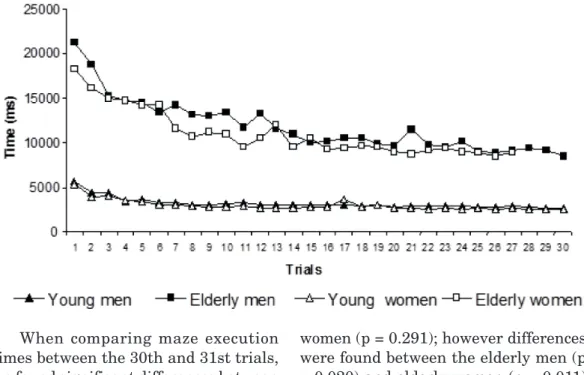
After statistical analysis, a signifi-cant difference was found in execution time of the maze test between the young and the elderly, for both sexes: (mean ± standard deviation), (men: youths = 5566 ± 3249 ms; elderly= 17267 ± 8831 ms; p< 0.0001 and women: youths = 5398 ± 2524 ms; elderly: 13918 ± 6488 ms; p < 0.0001), with the same effect observed in all trials (p < 0.0001) (Figure 2). The difference corresponded to approximate-ly 52% for the men and 44% for women. For the young and elderly subjects of both sexes, no significant differences were found between the trials (p < 0.05). Figure 2. Mean execution times of the maze test for elderly men and women and young people
in the 30 trials performed
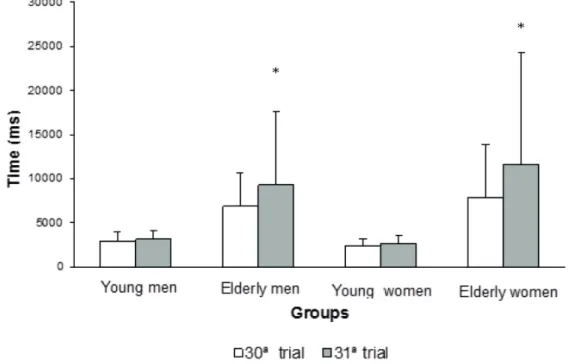
When comparing maze execution times between the 30th and 31st trials, we found significant differences between the young men (p = 0.566) and the young
women (p = 0.291); however differences were found between the elderly men (p = 0.020) and elderly women (p = 0.011) (Figure 3).
Figure 3. Comparison of the means and standard deviations in execution time on the 30th and 31st trials for the groups of young people and elderly individuals, both men and women
Note: * Significant difference between the groups with p < 0.05. A negative correlation (r = – 0.324; p = 0.003) was found between perfor-mance on the maze test and scores on the cognitive test (MMSE), confirming that the better the performance on the cognitive test, the shorter the execution
time on the maze test. According to mul-tiple linear regression analysis of the va-riables age, sex, schooling and cognitive performance, age was the only predictive factor of performance on the maze test, with R² adjusted to 0.39 (Table 1). Table 1. Multiple linear regression model (stepwise forward), considering the sex, age, schooling
levels and cognitive performance as independent variables and performance on the maze test as the dependent variable
Variable β ± ET p
Sex 0.093 ± 0.089 0.297
Age 0.633 ± 0.123 0.0001
Schooling 0.006 ± 0.130 0.966
Discussion
Analysis of performance on the maze test showed age-related differen-ces, with the elderly displaying longer execution times than those of the young. This result indicates that the elderly participants had difficulty in choosing a more efficient cognitive strategy for finding a solution, consequently using the longer maze paths, a decision that may be related to difficulties in executi-ve function caused by age(PIETRZAK; COHENB; SNYDER, 2007). This slo-wer speed, that is, longer test solution time, observed in the elderly, may be due to a greater need for cognitive de-mand owing to greater visual stimulus analysis and the higher requirements of the executive processes, probably to compensate the function deficits in the pre-frontal cortex observed in studies of the elderly(BRICKMAN et al., 2007).
Furthermore, it is likely that the performance observed among elderly subjects may also be related to deficits in parallel processing, suggesting an alteration in the ability to coordinate processes of different cognitive do-mains. According to Verwey (1996) age--related processing deficits are located in the cognitive processor and may be a result of the reduced memory capacity, slow cognitive processing, interference or simultaneity of problems for proces-sing activities. Each of these types of potential problems has been observed in the cognitive function of the elderly. Sal-thouse (1996), for example, argued that the reduced processing speed associa-ted with ageing leads to compromised
cognitive function through the “limited time” mechanism, in which processing cannot be completed in adequate time and the “simultaneity” mechanism, in which advanced processing may not be available when needed for subsequent processing or execution.
Another explanation for the outcome is the possibility that the elderly have difficulty in optimizing the organization of movement sequences. Shea, Park and Braden(2006) that the elderly are unable to organize their responses into subsequences as effectively as young people do, contributing to a slower total performance in the production of sequential movements. In contrast, young people typically organize elements by understanding a sequence within a series of contiguous subsequences. This strategy reduces processing and memory demands and allows for the processing of information sequences and of articu-latory commands responsible for produ-cing the sequence elements.
Analysis of performance over the course of the trials showed no significant difference between the performance in one trial and in the following one, for either group. This finding indicates that the older group encountered no difficulty in the information acquisition stage, corroborating the study carried out by Shea, Park and Braden(2006). In an ear-lier study, using a similar maze to that used here, a characteristic performance curve was found, with higher scores at the start and lower at the end of the test for young individuals. However, visual clues that indicated the proper maze path had been used. Moreover,
it was previously determined that only one path would be considered correct, a stipulation that may have influenced the variation in performance between trials (SOUZA; FRANÇA; CAMPOS, 2006). In a study conducted by Voelcker-Rehage and Willimczik(2006),theyfound plas-ticity of motor performance in elderly individuals who showed improved task performance after receiving instructions and after 6 training sessions. These subjects displayed high reserve capacity, which shows potential for learning new motor skills.
It was important to evaluate per-formance on the maze test after a time interval, as this examined the diffi-culty of the elderly in maintaining the same performance in the final attempt, which suggests a decrease in short-time memory. A similar result was found in a study that evaluated a functional motor task where performance was analyzed at the end of the training session and 48h later. The older adults had lower scores than those of the younger individuals in the first analysis and a significantly greater decline in task performance after 48h, suggesting that the older adults did not manage to preserve a functional motor skill as well as the young adults did(TUNNEY et al., 2004). According to the literature the findings cited may be related to problems of inhibitory control of a competing motor memoryor to some aspects of action representation such as the intention to move or mo-tor predictions(BROSSEAU; POTVIN; ROULEAU, 2007), which also become progressively fragile with age(SKOURA et al., 2005).
However, in a comparative study between young adults and elderly indi-viduals, it was proven that the elderly have great difficulty in maintaining and manipulating mental images and diffi-culty in spontaneously using appropriate strategic mnemonics(PALLADINO; DE BENI, 2003). It is fundamentally impor-tant to emphasize that in determining the limit between normal and pathologi-cal ageing, the characteristics of memory deficits are often considered. Recent findings suggest that the differential effect of age on perceptual-motor perfor-mance is mediated by working memory (KENNEDY; PARTRIDGE; RAZ, 2008). Working memory is a pre-frontal cortex function frequently found to be compro-mised in studies of patients that have specific lesions in this area. A recent study showed that working memory con-tributes to the recovery of the sequential order of movements(PFORDRESHER; PALMER; JUNGERS, 2007).
An interesting result in this study was the correlation between performan-ce on the maze and cognitive (MMSE) tests, indicating the importance of the test as an auxiliary tool for detecting alterations due to age, since the MMSE is considered the gold standard instru-ment among screening tests. Schooling may have influenced performance on the maze test and on MMSE, since the young individuals had more schooling than the elderly subjects, although the literature shows that the differences are significant, especially between illi-terate and liilli-terate persons, where more years of schooling result in better per-formance(LOURENÇO; VERAS, 2006).
Since some of the elderly in the sample presented with cognitive deficit, we can also hypothesize that this, and not age, is the main cause for the compromised performance on the maze test. However, the results of this study become more reliable after regression analysis, where performance on the maze test was adjus-ted for age, sex, schooling and cognitive performance. It became evident that in the sample studied, age was the only pre-dictive factor of performance on the maze test. The global coefficient obtained (R2)
indicated that 39% of the variance in test execution time can be explained by age. It is important to point out that the maze test has the advantage over MMSE of being able to monitor both cognitive and motor deficits. The number of paths and the size and complexity of the task can be changed in the maze used in this study. Moreover, during the application of the test, clues can be included, feedback can be used and more thorough analysis of the variables related to execution time and number of errors can be made. This helps in assessing the cognitive and mo-tor processes involved in the test.
Conclusion
According to the results, the maze test was sensitive in detecting that the elderly have more difficulty in executive function, motor control and mnemonic processes. Young individuals, however, showed no alterations in learning the test. Accordingly, the maze test may con-tribute to the monitoring of premature cognitive and motor alterations in the elderly. New studies are being carried
out to determine the diagnostic power of this test, especially with respect to chro-nic degenerative pathologies that lead to dementia and incapacity in the elderly.
Teste de Labirinto: um instrumento para
avaliar mudanças cognitiva e motora
relacionadas à idade em humanos
Resumo
Mudanças no desempenho das habilidades cognitiva e motora devido à idade avan-çada podem comprometer as atividades diárias. É importante determinar se o teste de labirinto pode ser sensível às alterações cognitivas ou motoras no envelhecimento normal. Dessa forma, o objetivo do estudo foi verificar as diferenças relacionadas à idade na função executiva, aprendizagem e memória de curto prazo, por meio do teste de labirinto. Participaram 80 indivíduos saudáveis, 40 jovens (22 ± 2 anos) e 40 ido-sos (67 ± 5 anos), que foram submetidos a uma avaliação de saúde e cognitiva (Mini Exame do Estado Mental). Os participantes foram cronometrados para resolver 30 la-birintos, e, 15 minutos mais tarde, resolvê--los novamente. Os dados foram analisados por ANOVA e regressão linear múltipla. Os idosos levaram mais tempo para resolver os labirintos, sugerindo dificuldades na função executiva; houve melhoria no desempenho nos primeiros testes, mas ocorreu um deficit na memória de curto prazo. Houve correla-ção entre os testes cognitivo e o de labirinto (r = -0,32, p = 0,003). A idade foi o único fator preditivo do desempenho. Sugere-se que o teste de labirinto pode contribuir para o acompanhamento de alterações cogniti-vas e motoras iniciais em idosos.
Palavras-chave: Função executiva.
Apren-dizagem. Memória. Cognição. Idoso.
Acknowledgements: This research was
References
BECK, A. T.; STEER, R. A.; GARBIN, M. G. Psychometric properties of the Beck Depression Inventory: twenty-five years of evaluation. Clinical Psychology Review, New York, v. 8, n. 1, p. 77-100, 1988.
BRICKMAN, A. M. et al. Structural MRI covariance patterns associated with normal aging and neuropsychological functioning.
Neurobiology of Aging, New York, v. 28,
n. 2, p. 284-295, Feb. 2007.
BROSSEAU, J.; POTVIN, M. J.; ROULEAU, I. Aging affects motor skill learning when the task requires inhibitory control.
Deve-lopmental Neuropsychology, England, v. 32,
n. 1, p. 597-613, 2007.
DENNIS, N. A.; DASELAAR, S.; CABEZA, R. Effects of aging on transient and sustai-ned successful memory encoding activity.
Neurobiology of Aging, New York, v. 28,
n. 11, p. 1749-1758, Nov. 2007.
FOLSTEIN, M. F.; FOLSTEIN, S. E.; MCHU-GH, P. R. Mini-mental state: a practical method for grading the cognitive states of pa-tients for clinician. Journal of Psychiatric
Re-search, England, v. 12, n. 3, p. 189-198, 1975.
KENNEDY, K. M.; PARTRIDGE, T.; RAZ, N. Age-related differences in acquisition of perceptual-motor skills: working memory as a mediator. Aging, Neuropsychology, and
Cognition, London, v. 15, n. 2, p. 165-183,
Mar. 2008.
KIRSCH, P. et al. Brain activation during mental maze solving. Neuropsychobiology, Basel, v. 54, n. 1, p. 51-58, 2006.
LOURENÇO, R. A.; VERAS, R. P. Mini--Mental State Examination: psychometric characteristics in elderly outpatients.
Jour-nal of Public Health, São Paulo, v. 40, n. 4,
p. 712-719, Aug. 2006.
LOW, G.; MOLZAHN, A. E. Predictors of quality of life in old age: A cross-validation study. Research in Nursing & Health, New York, v. 30, n. 2, p. 141-150, Apr. 2007.
MILHAM, M. P. et al. Attentional control in the aging brain: insights from an fMRI study of the Stroop task. Brain and Cognition, New York, v. 49, n. 3, p. 277-296, Aug. 2001. OTT, B. R. et al. Maze test performance and reported driving ability in early dementia.
Journal of Geriatric Psychiatry and Neuro-logy, Thousand Oaks, v. 16, n. 3, p. 151-155,
Sep. 2003.
PALLADINO, P.; DE BENI, R. When mental images are very detailed: image generation and memory permorfance as a function of age. Acta Psychologica, Amsterdam, v. 113, n. 3, p. 297-314, Jul. 2003.
PARMELEE, P. A. et al. Validation of the Cumulative Illness Rating Scale in a geria-tric residential population. Journal of the
American Geriatrics Society, Malden, v. 43,
n. 2, p. 130-137, Feb. 1995.
PERROT, A.; BERTSCH, J. Role of age in relation between two kinds of abilities and performance in acquisition of new motor skill. Perceptual and Motor Skills, Missoula, v. 104, n. 1, p. 91-101, Feb. 2007.
PFORDRESHER, P. Q.; PALMER, C.; JUN-GERS, M. K. Speed, accuracy, and serial or-der in sequence production. Cognitive
Scien-ce, Hoboken, v. 31, n. 1, p. 63-98, Feb. 2007.
PIETRZAK, R. H.; COHENB, H.; SNYDER, P. J. Spatial learning efficiency and error monitoring in normal aging: An investigation using a novel hidden maze learning test.
Ar-chives of Clinical Neuropsychology, Oxford,
v. 22, n. 2, p. 235-245, Feb. 2007.
SALTHOUSE T. A. Aging and measures of processing speed. Biological Psychology, Amsterdam, v. 54, n. 1-3, p. 35-54, Oct. 2000. SALTHOUSE T. A. The processing-speed theory of adult age differences in cognition.
Psychological Review, Washington, v. 130,
n. 3, p. 403-428, Jul. 1996.
SCHUPF, N. et al. Decline in cognitive and functional skills increases mortality risk in nondemented elderly. Neurology, Hagerstown, v. 65, n. 8, p. 1218-1226, Oct. 2005.
SEIDLER, R. D. Aging affects motor lear-ning but not savings at transfer of learlear-ning.
Learning & Memory, Cold Spring Harbor,
v. 14, n. 1-2, p. 17-21, Jan. 2007.
SHEA, C. H.; PARK, J.; BRADEN, H. W. Age--related effects in sequential motor learning.
Physical Therapy, Alexandria, v. 86, n. 4,
p. 478-488, Apr. 2006.
SKOURA, X. et al. Mentally represented motor actions in normal aging. I. Age effects on the temporal features of overt and covert execution of actions. Behavioural Brain
Re-search, Amsterdam, v. 165, n. 2, p. 229-239,
Dez. 2005.
SOUZA, D. E.; FRANÇA, F. R.; CAMPOS, T. F. Maze test: instrument for analyzing the acquisition of motor skills. Brazilan Journal
of Physical Therapy, São Carlos, v. 10, n. 3,
p. 354-359, Sep. 2006.
TUNNEY, N. et al. Aging and motor lear-ning of a functional motor task. Physical &
Occupational Therapy in Geriatrics, London,
v. 21, n. 3, p. 1-16, 2004.
VERWEY, W. B. Buffer loading and chunking in sequential keypressing. Journal of
Ex-perimental Psychology: Human Perception
and Performance, Washington, v. 22, n. 3, p. 544-562, Jun. 1996.
VOELCKER-REHAGE C.; WILLIMCZIK, K. Motor plasticity in a juggling task in older adults - a developmental study. Age Ageing, Oxford, v. 35, n. 4, p. 422-427, Jul. 2006. WECKER, N. S. et al. Age effects on exe-cutive ability. Neuropsychology, Washington, v. 14, n. 3, p. 409-414, Jul. 2000.
YORDANOVA, J. et al. Sensorimotor slowing with ageing is mediated by a functional dysregulation of motor-generationprocesses: evidence from high-resolution event-related potentials. Brain, Oxford, v. 127, n. 2, p. 351-362, Feb. 2004.